
International Workshop on FORESIGHT Bucharest Romania January 26
International Workshop on FORESIGHT Bucharest, Romania – January 26, 2004 The STEEPV method A framework for structured brainstorming Rafael Popper Research Associate Rafael. Popper@man. ac. uk First International Capacity Building Workshop in Romania - January 26, 2004, Bucharest 1
Outline • • • What is Foresight Commonly used foresight methods Foresight methods (locating STEEPV) Basic structure of STEEPV The process Usefulness & drawbacks When to use STEEPV Combining online & real STEEPV & prioritisation STEEPV & SWOT Questions (5 minutes) Exercise & discussions (30 minutes) First International Capacity Building Workshop in Romania - January 26, 2004, Bucharest 2
Foresight involves… • Thinking about: – emerging opportunities & challenges – trends and breaks in trends • Using systematic methods for – developing insights & visions – bringing together key agents of change (actors) • Improving decision making power / action – developing anticipatory strategic intelligence • Preparing better policy recommendations First International Capacity Building Workshop in Romania - January 26, 2004, Bucharest 3
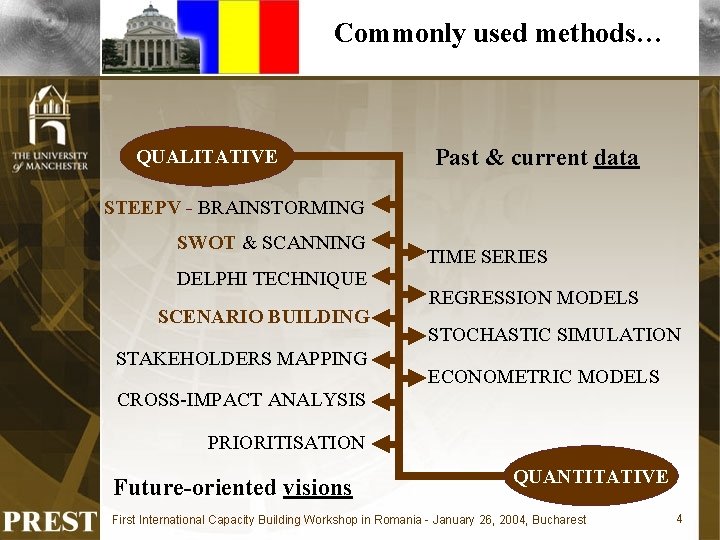
Commonly used methods… QUALITATIVE Past & current data STEEPV - BRAINSTORMING SWOT & SCANNING DELPHI TECHNIQUE SCENARIO BUILDING STAKEHOLDERS MAPPING TIME SERIES REGRESSION MODELS STOCHASTIC SIMULATION ECONOMETRIC MODELS CROSS-IMPACT ANALYSIS PRIORITISATION Future-oriented visions QUANTITATIVE First International Capacity Building Workshop in Romania - January 26, 2004, Bucharest 4
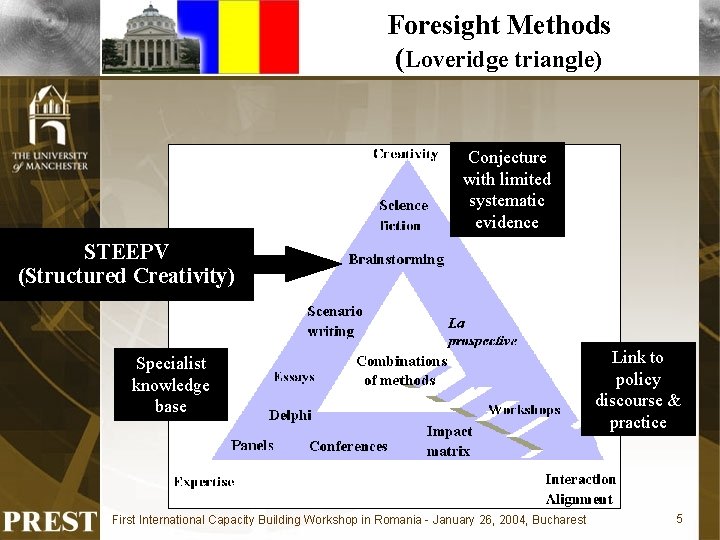
Foresight Methods (Loveridge triangle) Conjecture with limited systematic evidence STEEPV (Structured Creativity) Specialist knowledge base First International Capacity Building Workshop in Romania - January 26, 2004, Bucharest Link to policy discourse & practice 5
Basics of structured brainstorming STEEPV • Group method (recently including online groups/networks) • Attractive & emerging framework for brainstorming sessions • Involve structured-freethinking (to articulate ideas using the STEEPV framework) • All ideas should be captured • Individual ideas should not be discussed • After collection of all ideas the group should discuss on: – clustering ideas; – prioritising ideas, and – identifying ‘wild ideas’ (usually the most difficult task). First International Capacity Building Workshop in Romania - January 26, 2004, Bucharest 6
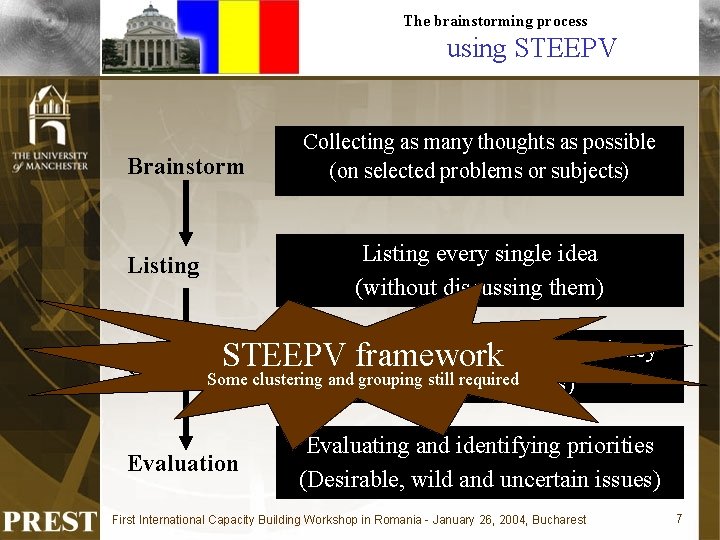
The brainstorming process using STEEPV Brainstorm Collecting as many thoughts as possible (on selected problems or subjects) Listing every single idea (without discussing them) Listing Clustering and Reducing redundancy STEEPV framework Clustering Some clustering and grouping still required (Grouping of ideas) Evaluation Evaluating and identifying priorities (Desirable, wild and uncertain issues) First International Capacity Building Workshop in Romania - January 26, 2004, Bucharest 7
Usefulness of STEEPV method • New / better solutions (freethinking) • New / better problem definition • Help reducing conflict (new / better visions help participants understanding different perspectives on problems) • All ideas have equal status (before prioritisation) • Participants feel owners/part of the process First International Capacity Building Workshop in Romania - January 26, 2004, Bucharest 8
Drawbacks • Unworkable ideas • Results depend on the skill of facilitator to keep discussion alive • Strong antagonist / inflexible positions may not allow consideration of some ideas • Strong or important personalities can control or drive discussion on their on interest First International Capacity Building Workshop in Romania - January 26, 2004, Bucharest 9
When can STEEPV be used? • At anytime while dealing with: – Problem solving (usually new problems) – Decision making (identifying needs) – Planning (considering a multi-dimensional relations) – Crisis management (linkages with other dimensions) – Highly uncertain situations (exploring impacts) – Scenario activities (evaluating SWOTs on STEEPVs) • It helps ‘breaking the ice’ and moving towards a more dynamic working group First International Capacity Building Workshop in Romania - January 26, 2004, Bucharest 10
Reasons for combining F 2 F & Online STEEPV Ø To avoid Follow the leader/wave effect Ø To avoid Ostrich effect Ø To improve/increase knowledge/data collection Ø To provide immediate & dynamic knowledge/data: ØCollection ØProcessing ØAvailability ØEvaluation ØClustering & Prioritisation When time, costs & logistics make frequent meetings unfeasible. Ø First International Capacity Building Workshop in Romania - January 26, 2004, Bucharest 11
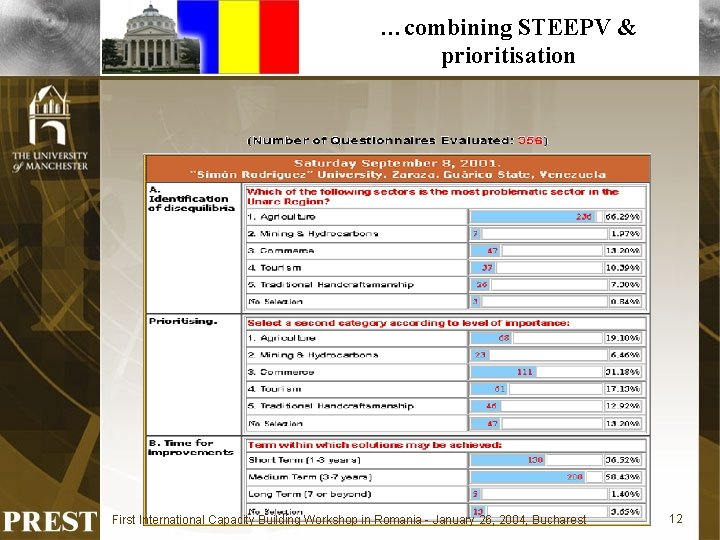
…combining STEEPV & prioritisation First International Capacity Building Workshop in Romania - January 26, 2004, Bucharest 12
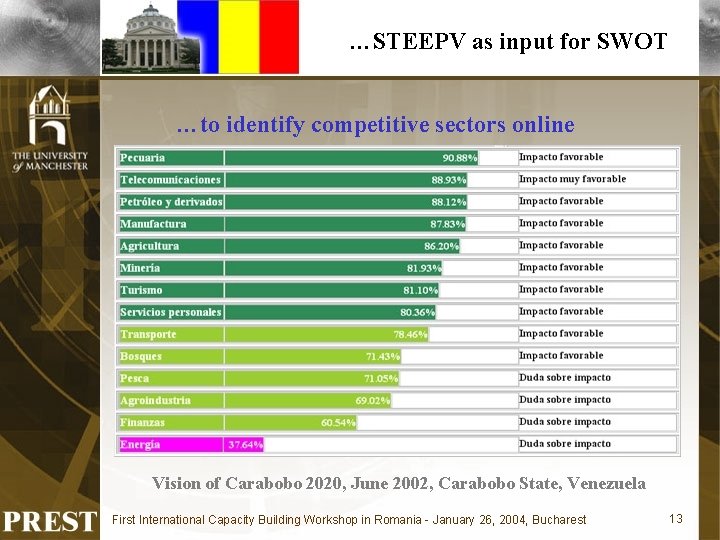
…STEEPV as input for SWOT …to identify competitive sectors online Vision of Carabobo 2020, June 2002, Carabobo State, Venezuela First International Capacity Building Workshop in Romania - January 26, 2004, Bucharest 13
Thank you! Rafael Popper PREST, University of Manchester, UK Rafael. Popper@man. ac. uk http: //les 1. man. ac. uk/PREST First International Capacity Building Workshop in Romania - January 26, 2004, Bucharest 14
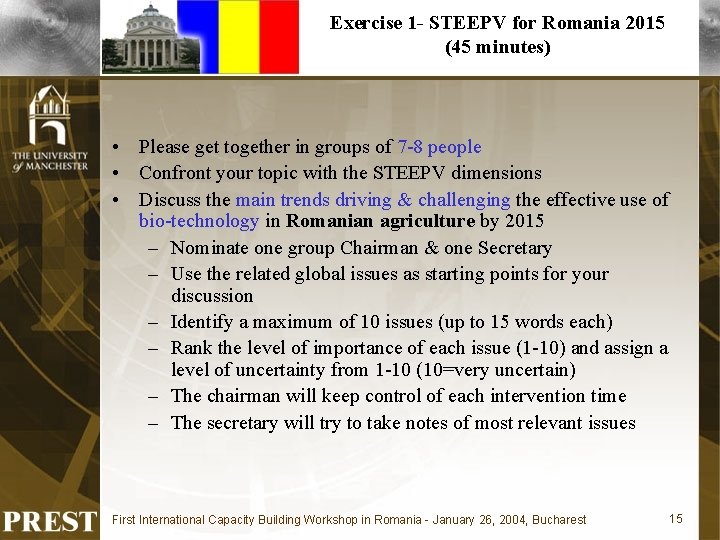
Exercise 1 - STEEPV for Romania 2015 (45 minutes) • Please get together in groups of 7 -8 people • Confront your topic with the STEEPV dimensions • Discuss the main trends driving & challenging the effective use of bio-technology in Romanian agriculture by 2015 – Nominate one group Chairman & one Secretary – Use the related global issues as starting points for your discussion – Identify a maximum of 10 issues (up to 15 words each) – Rank the level of importance of each issue (1 -10) and assign a level of uncertainty from 1 -10 (10=very uncertain) – The chairman will keep control of each intervention time – The secretary will try to take notes of most relevant issues First International Capacity Building Workshop in Romania - January 26, 2004, Bucharest 15
- Slides: 15