
International Update on Satellite Laser Ranging SLR http

- Slides: 23
International Update on Satellite Laser Ranging (SLR) http: //ilrs. gsfc. nasa. gov/index. html Michael Pearlman Director Central Bureau International Laser Ranging Service Harvard-Smithsonian Center for Astrophysics Cambridge MA USA mpearlman@cfa. harvard. edu PNT Advisory Board| Alexandria, Virginia | November 5 – 6 , 2009 | 0
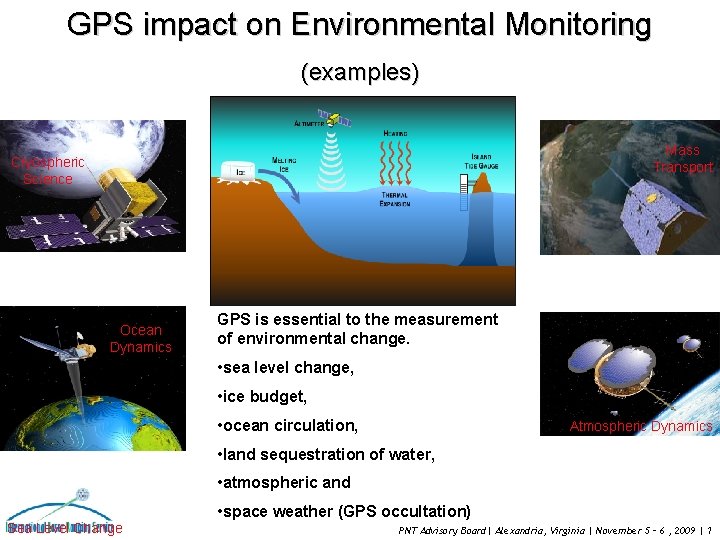
GPS impact on Environmental Monitoring (examples) Mass Transport Cryospheric Science Ocean Dynamics GPS is essential to the measurement of environmental change. • sea level change, • ice budget, • ocean circulation, Atmospheric Dynamics • land sequestration of water, • atmospheric and Sea Level Change • space weather (GPS occultation) PNT Advisory Board| Alexandria, Virginia | November 5 – 6 , 2009 | 1
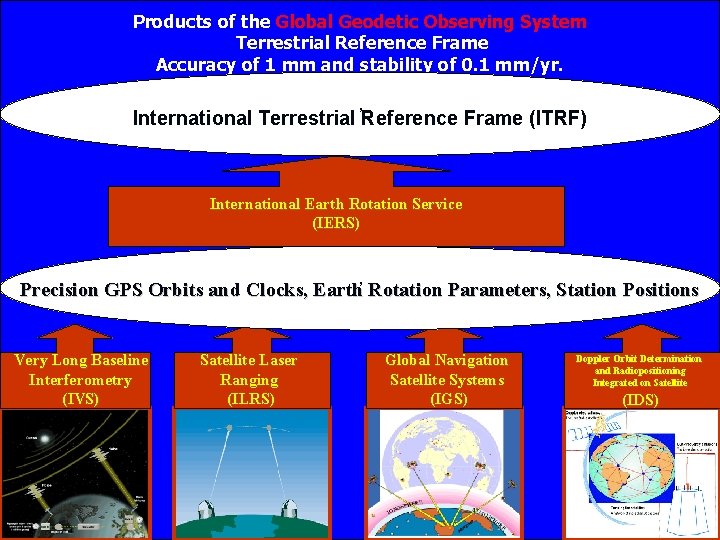
Products of the Global Geodetic Observing System Terrestrial Reference Frame Accuracy of 1 mm and stability of 0. 1 mm/yr. , International Terrestrial Reference Frame (ITRF) International Earth Rotation Service (IERS) , Precision GPS Orbits and Clocks, Earth Rotation Parameters, Station Positions Very Long Baseline Interferometry (IVS) Satellite Laser Ranging (ILRS) Global Navigation Satellite Systems (IGS) Doppler Orbit Determination and Radiopositioning Integrated on Satellite (IDS) PNT Advisory Board| Alexandria, Virginia | November 5 – 6 , 2009 | 2
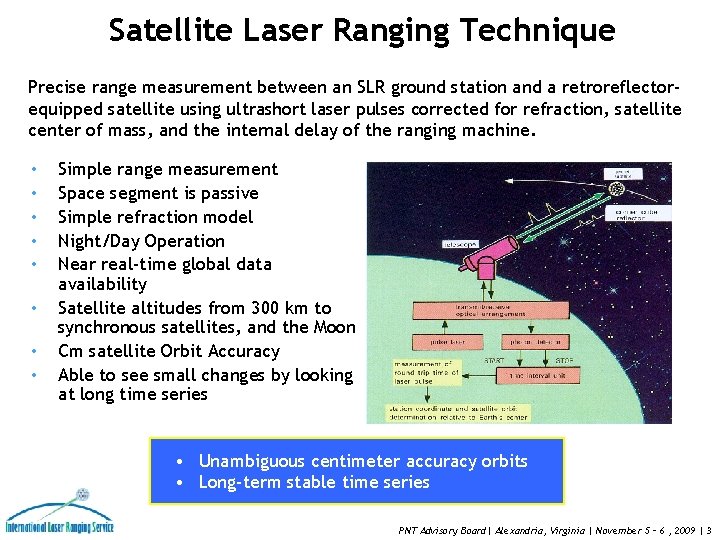
Satellite Laser Ranging Technique Precise range measurement between an SLR ground station and a retroreflectorequipped satellite using ultrashort laser pulses corrected for refraction, satellite center of mass, and the internal delay of the ranging machine. • • Simple range measurement Space segment is passive Simple refraction model Night/Day Operation Near real-time global data availability Satellite altitudes from 300 km to synchronous satellites, and the Moon Cm satellite Orbit Accuracy Able to see small changes by looking at long time series • Unambiguous centimeter accuracy orbits • Long-term stable time series PNT Advisory Board| Alexandria, Virginia | November 5 – 6 , 2009 | 3
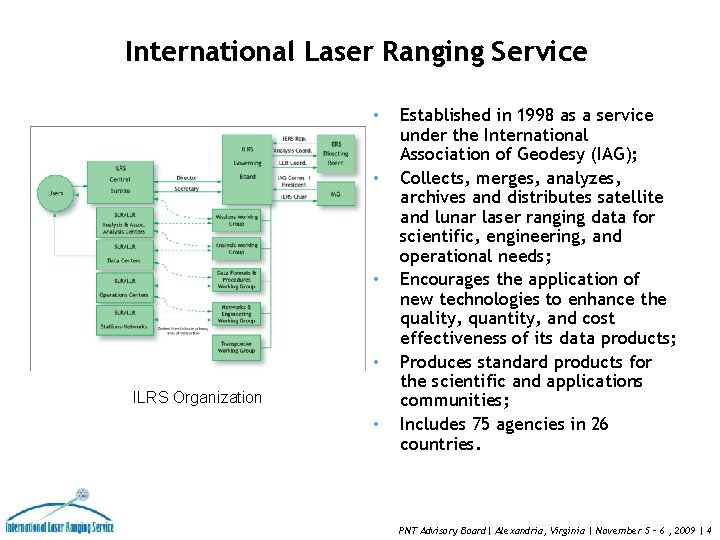
International Laser Ranging Service • • ILRS Organization • Established in 1998 as a service under the International Association of Geodesy (IAG); Collects, merges, analyzes, archives and distributes satellite and lunar laser ranging data for scientific, engineering, and operational needs; Encourages the application of new technologies to enhance the quality, quantity, and cost effectiveness of its data products; Produces standard products for the scientific and applications communities; Includes 75 agencies in 26 countries. PNT Advisory Board| Alexandria, Virginia | November 5 – 6 , 2009 | 4
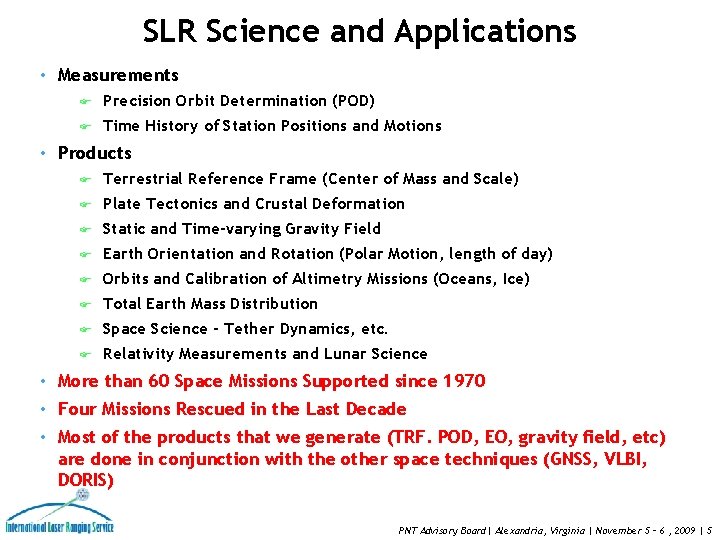
SLR Science and Applications • Measurements F Precision Orbit Determination (POD) F Time History of Station Positions and Motions • Products F Terrestrial Reference Frame (Center of Mass and Scale) F Plate Tectonics and Crustal Deformation F Static and Time-varying Gravity Field F Earth Orientation and Rotation (Polar Motion, length of day) F Orbits and Calibration of Altimetry Missions (Oceans, Ice) F Total Earth Mass Distribution F Space Science - Tether Dynamics, etc. F Relativity Measurements and Lunar Science • More than 60 Space Missions Supported since 1970 • Four Missions Rescued in the Last Decade • Most of the products that we generate (TRF. POD, EO, gravity field, etc) are done in conjunction with the other space techniques (GNSS, VLBI, DORIS) PNT Advisory Board| Alexandria, Virginia | November 5 – 6 , 2009 | 5
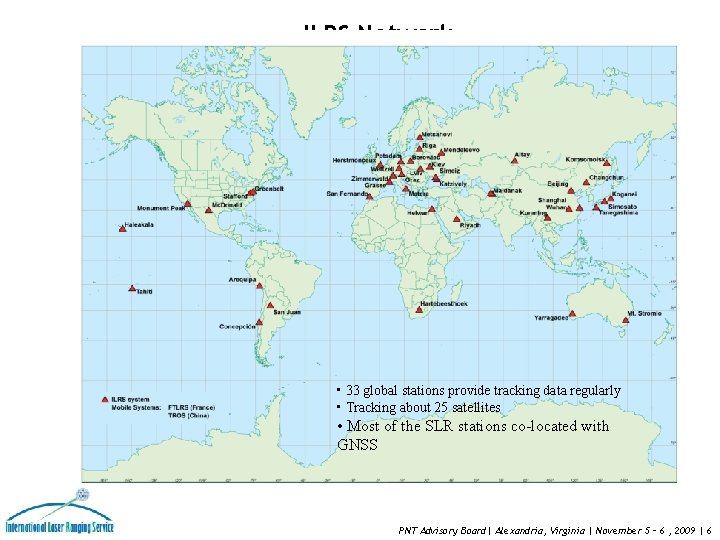
ILRS Network • 33 global stations provide tracking data regularly • Tracking about 25 satellites • Most of the SLR stations co-located with GNSS PNT Advisory Board| Alexandria, Virginia | November 5 – 6 , 2009 | 6
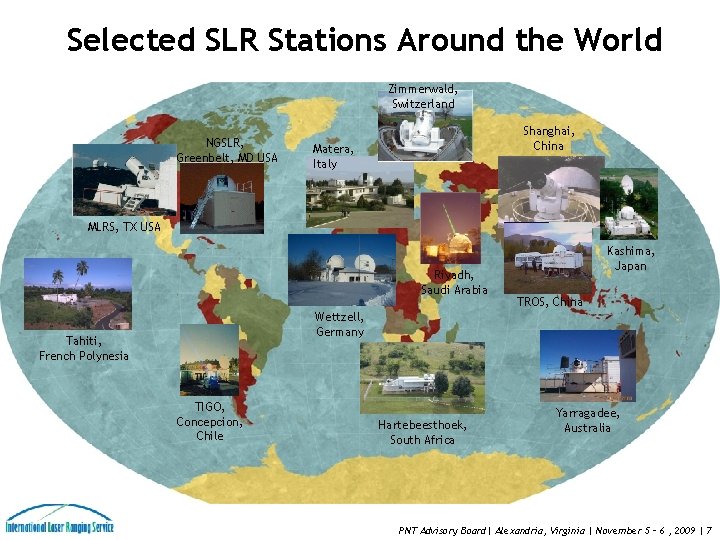
Selected SLR Stations Around the World Zimmerwald, Switzerland NGSLR, Greenbelt, MD USA Shanghai, China Matera, Italy MLRS, TX USA Riyadh, Saudi Arabia Kashima, Japan TROS, China Wettzell, Germany Tahiti, French Polynesia TIGO, Concepcion, Chile Hartebeesthoek, South Africa Yarragadee, Australia PNT Advisory Board| Alexandria, Virginia | November 5 – 6 , 2009 | 7
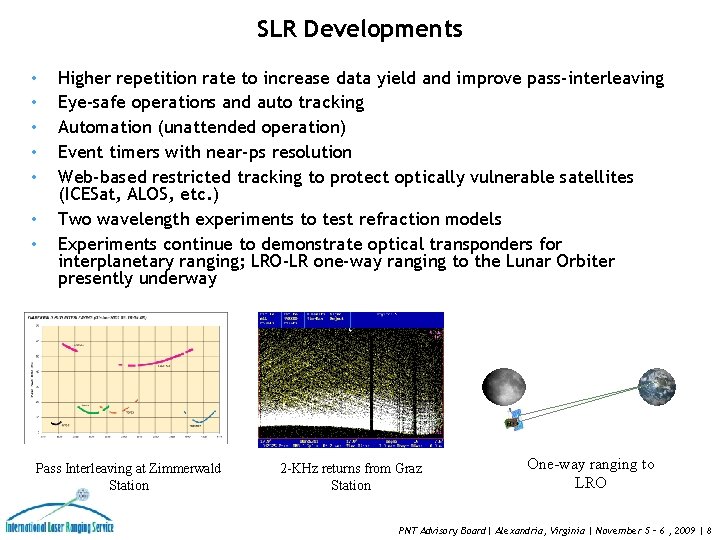
SLR Developments • • Higher repetition rate to increase data yield and improve pass-interleaving Eye-safe operations and auto tracking Automation (unattended operation) Event timers with near-ps resolution Web-based restricted tracking to protect optically vulnerable satellites (ICESat, ALOS, etc. ) Two wavelength experiments to test refraction models Experiments continue to demonstrate optical transponders for interplanetary ranging; LRO-LR one-way ranging to the Lunar Orbiter presently underway Pass Interleaving at Zimmerwald Station 2 -KHz returns from Graz Station One-way ranging to LRO PNT Advisory Board| Alexandria, Virginia | November 5 – 6 , 2009 | 8
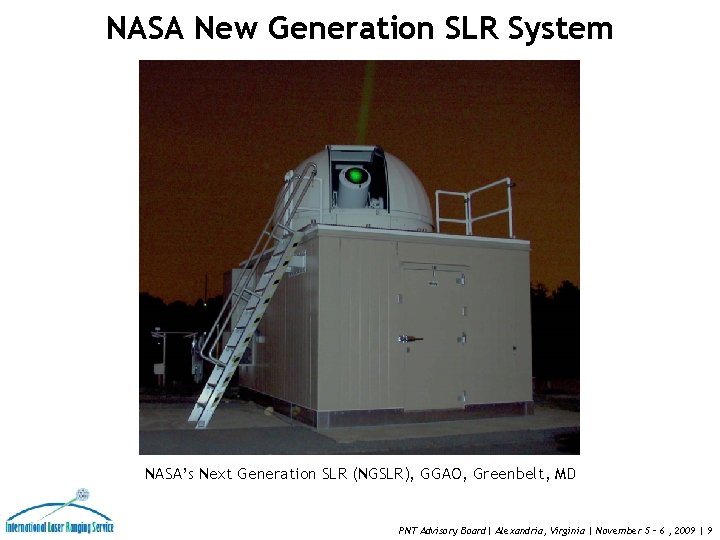
NASA New Generation SLR System NASA’s Next Generation SLR (NGSLR), GGAO, Greenbelt, MD PNT Advisory Board| Alexandria, Virginia | November 5 – 6 , 2009 | 9
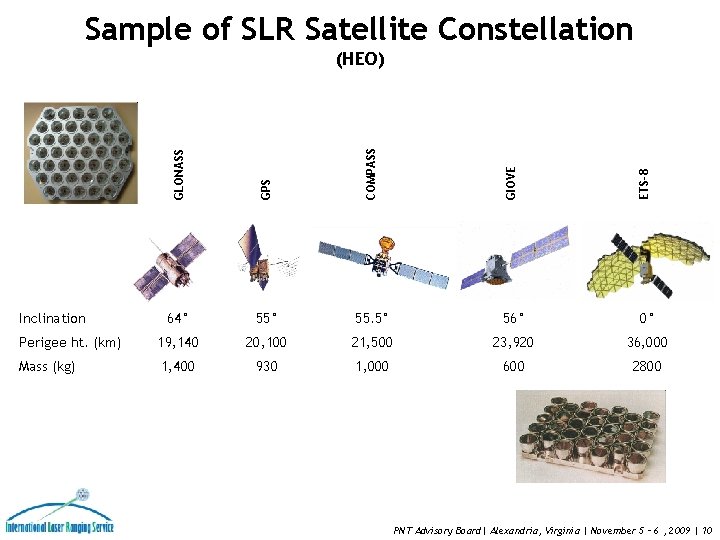
Sample of SLR Satellite Constellation GPS COMPASS GIOVE 64° 55. 5° 56° 0° Perigee ht. (km) 19, 140 20, 100 21, 500 23, 920 36, 000 Mass (kg) 1, 400 930 1, 000 600 2800 Inclination ETS-8 GLONASS (HEO) PNT Advisory Board| Alexandria, Virginia | November 5 – 6 , 2009 | 10
ILRS Retroreflector Standards for GNSS Satellites to increase tracking efficiency • Retroreflector payloads for GNSS satellites in the neighborhood 20, 000 km altitude should have a minimum “effective cross-section” of 100 million sq. meters (5 times that of GPS-35 and -36) • Retroreflector payloads for GNSS satellites in higher or lower orbits should have a minimum “effective cross-section” scaled to compensate for the R**4 increase or decrease in signal strength • The parameters necessary for the precise definition of the vectors between the effective reflection plane, the radiometric antenna phase center and the center of mass of the spacecraft should be specified and maintained with an accuracy better than 0. 1 ppb (few mm). PNT Advisory Board| Alexandria, Virginia | November 5 – 6 , 2009 | 11
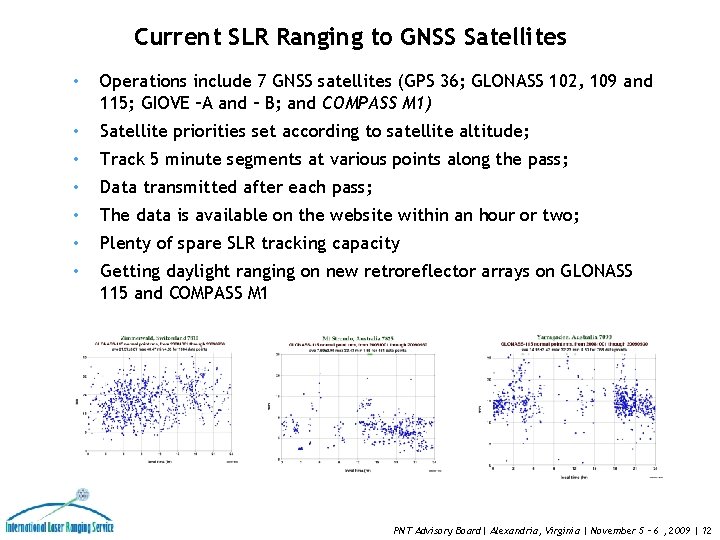
Current SLR Ranging to GNSS Satellites • Operations include 7 GNSS satellites (GPS 36; GLONASS 102, 109 and 115; GIOVE –A and – B; and COMPASS M 1) • Satellite priorities set according to satellite altitude; • Track 5 minute segments at various points along the pass; • Data transmitted after each pass; • The data is available on the website within an hour or two; • Plenty of spare SLR tracking capacity • Getting daylight ranging on new retroreflector arrays on GLONASS 115 and COMPASS M 1 PNT Advisory Board| Alexandria, Virginia | November 5 – 6 , 2009 | 12
ILRS Restricted Tracking ILRS authorization to track ILRS-approved satellites is constituted and governed by an approved Mission Support Request Form; All SLR stations within the International Laser Ranging Service agree to adhere to any applicable ILRS Restricted Tracking Procedures including: • station by station authorization; • time and viewing angle constraints; • energy/power constraints; • go/no-go switch. PNT Advisory Board| Alexandria, Virginia | November 5 – 6 , 2009 | 13
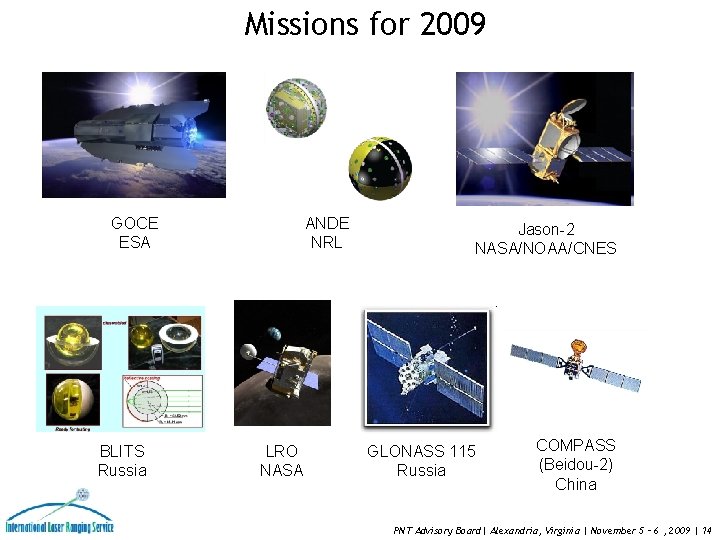
Missions for 2009 GOCE ESA BLITS Russia ANDE NRL LRO NASA Jason-2 NASA/NOAA/CNES GLONASS 115 Russia COMPASS (Beidou-2) China PNT Advisory Board| Alexandria, Virginia | November 5 – 6 , 2009 | 14
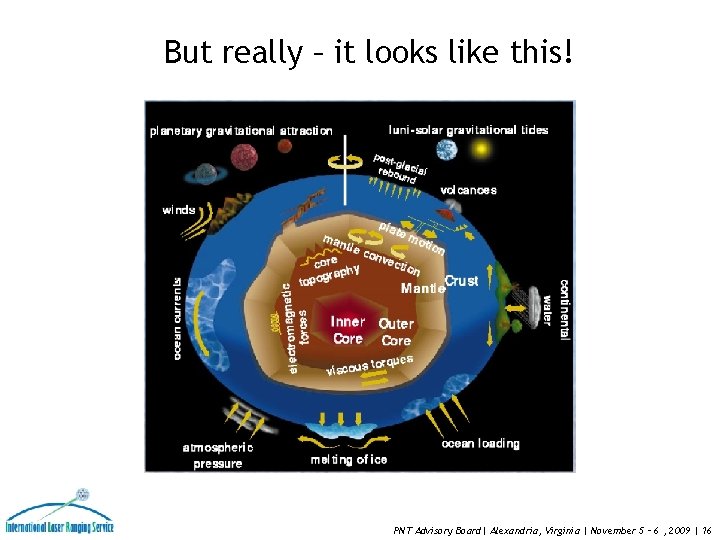
Some people think the Earth looks like this: : PNT Advisory Board| Alexandria, Virginia | November 5 – 6 , 2009 | 15
But really – it looks like this! : PNT Advisory Board| Alexandria, Virginia | November 5 – 6 , 2009 | 16
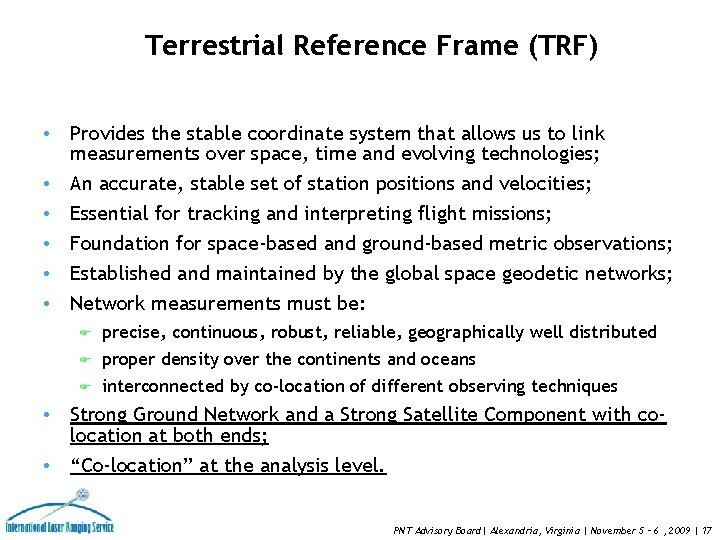
Terrestrial Reference Frame (TRF) • Provides the stable coordinate system that allows us to link measurements over space, time and evolving technologies; • An accurate, stable set of station positions and velocities; • Essential for tracking and interpreting flight missions; • Foundation for space-based and ground-based metric observations; • Established and maintained by the global space geodetic networks; • Network measurements must be: F precise, continuous, robust, reliable, geographically well distributed proper density over the continents and oceans F interconnected by co-location of different observing techniques F • Strong Ground Network and a Strong Satellite Component with colocation at both ends; • “Co-location” at the analysis level. PNT Advisory Board| Alexandria, Virginia | November 5 – 6 , 2009 | 17
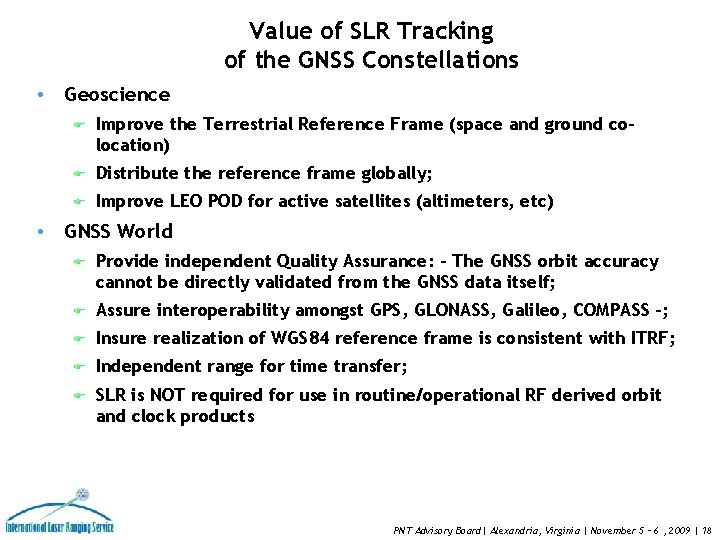
Value of SLR Tracking of the GNSS Constellations • Geoscience F Improve the Terrestrial Reference Frame (space and ground colocation) F Distribute the reference frame globally; F Improve LEO POD for active satellites (altimeters, etc) • GNSS World F Provide independent Quality Assurance: - The GNSS orbit accuracy cannot be directly validated from the GNSS data itself; F Assure interoperability amongst GPS, GLONASS, Galileo, COMPASS -; F Insure realization of WGS 84 reference frame is consistent with ITRF; F Independent range for time transfer; F SLR is NOT required for use in routine/operational RF derived orbit and clock products PNT Advisory Board| Alexandria, Virginia | November 5 – 6 , 2009 | 18
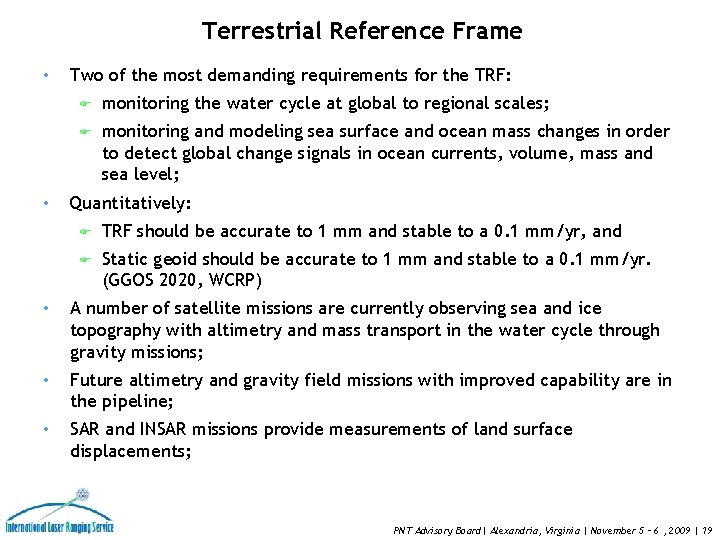
Terrestrial Reference Frame • • Two of the most demanding requirements for the TRF: F monitoring the water cycle at global to regional scales; F monitoring and modeling sea surface and ocean mass changes in order to detect global change signals in ocean currents, volume, mass and sea level; Quantitatively: F TRF should be accurate to 1 mm and stable to a 0. 1 mm/yr, and F Static geoid should be accurate to 1 mm and stable to a 0. 1 mm/yr. (GGOS 2020, WCRP) • A number of satellite missions are currently observing sea and ice topography with altimetry and mass transport in the water cycle through gravity missions; • Future altimetry and gravity field missions with improved capability are in the pipeline; • SAR and INSAR missions provide measurements of land surface displacements; PNT Advisory Board| Alexandria, Virginia | November 5 – 6 , 2009 | 19
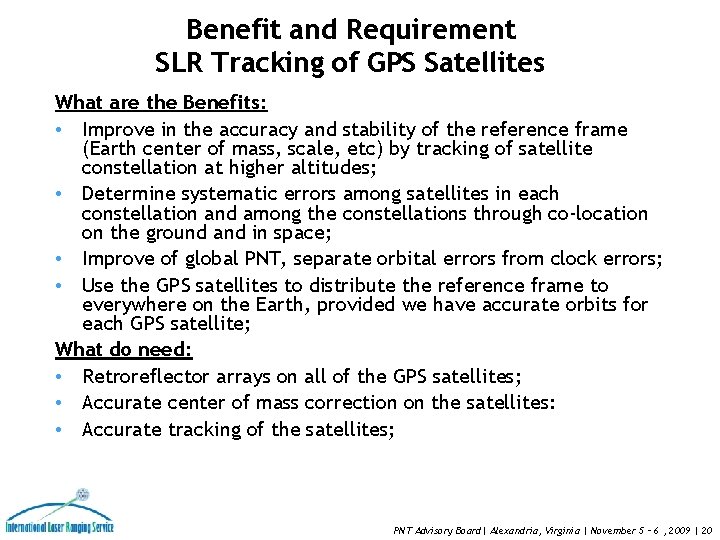
Benefit and Requirement SLR Tracking of GPS Satellites What are the Benefits: • Improve in the accuracy and stability of the reference frame (Earth center of mass, scale, etc) by tracking of satellite constellation at higher altitudes; • Determine systematic errors among satellites in each constellation and among the constellations through co-location on the ground and in space; • Improve of global PNT, separate orbital errors from clock errors; • Use the GPS satellites to distribute the reference frame to everywhere on the Earth, provided we have accurate orbits for each GPS satellite; What do need: • Retroreflector arrays on all of the GPS satellites; • Accurate center of mass correction on the satellites: • Accurate tracking of the satellites; PNT Advisory Board| Alexandria, Virginia | November 5 – 6 , 2009 | 20
Concepts for an Operational GNSS Plan • • • Support GPS, Galileo, GLONASS, and COMPASS; Greater emphasis on more robust tracking and daylight ranging; Increased tracking capacity with high repetition rate systems; Newer retroreflector design; Data available on the website shortly after each pass; Possible tracking strategy F F Tracking of a subset of each constellation with a rotation through the entire constellation; simulations underway to help develop optimum strategies; For example: • one satellite per orbital plane per system at a time; • 60 -day tracking cycles set to cover all satellites within a 12 month period; • • • Flexible tracking strategies; organized in cooperation with the agencies involved and the requirements for the ITRF; The network can be segmented to track different satellites; ILRS analysts will do the data analysis and make the results available; PNT Advisory Board| Alexandria, Virginia | November 5 – 6 , 2009 | 21
We invite you to visit our website @ http: //ilrs. gsfc. nasa. gov/index. html PNT Advisory Board| Alexandria, Virginia | November 5 – 6 , 2009 | 25