
International Trade Working Capital Management International Trade v
- Slides: 40
International Trade & Working Capital Management
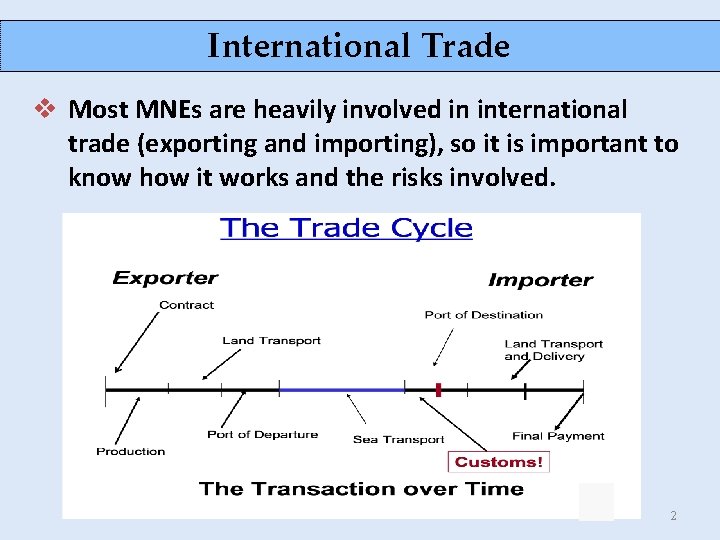
International Trade v Most MNEs are heavily involved in international trade (exporting and importing), so it is important to know how it works and the risks involved. 2
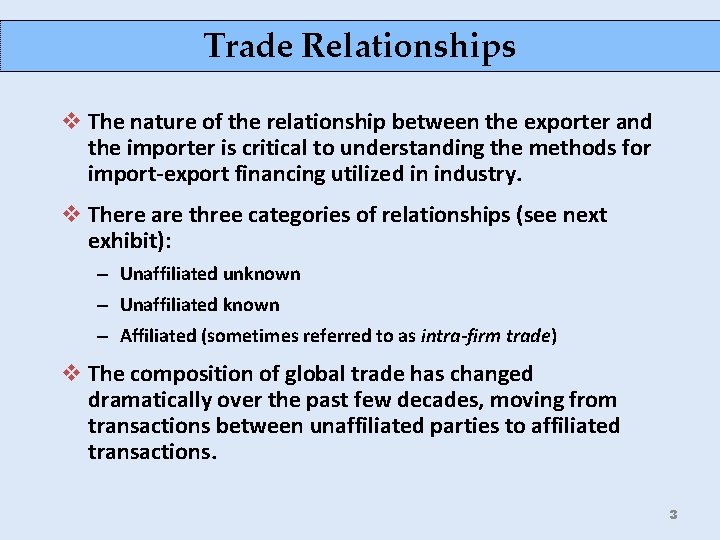
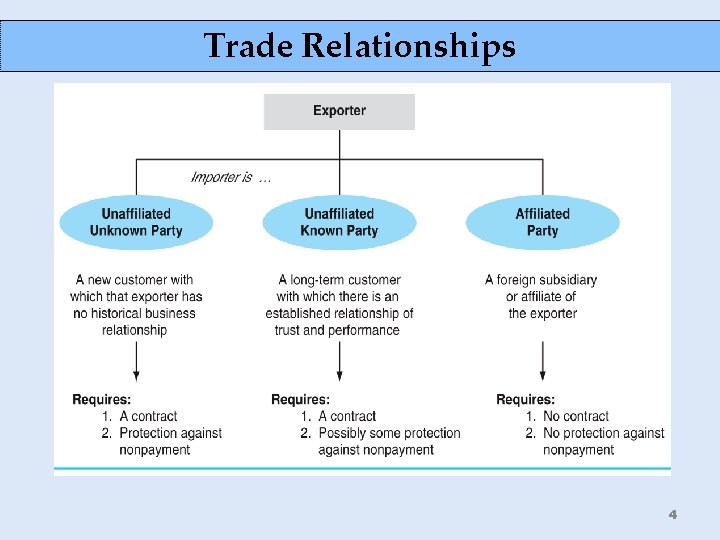
Trade Relationships v The nature of the relationship between the exporter and the importer is critical to understanding the methods for import-export financing utilized in industry. v There are three categories of relationships (see next exhibit): – Unaffiliated unknown – Unaffiliated known – Affiliated (sometimes referred to as intra-firm trade) v The composition of global trade has changed dramatically over the past few decades, moving from transactions between unaffiliated parties to affiliated transactions. 3
Trade Relationships 4
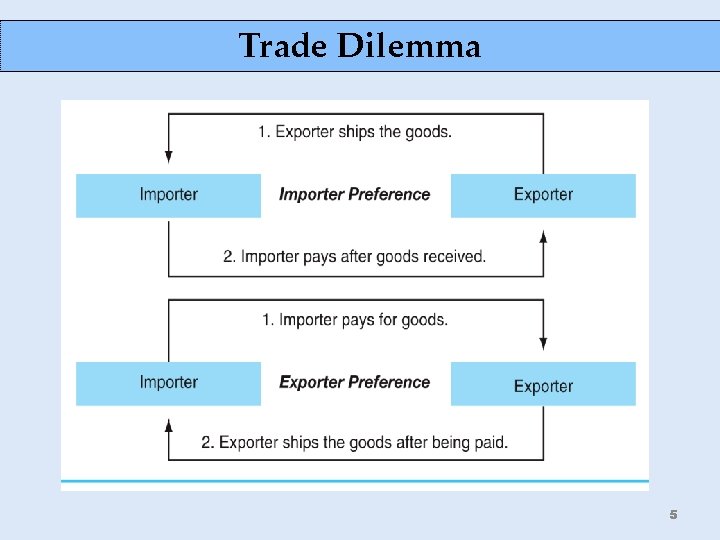
Trade Dilemma 5
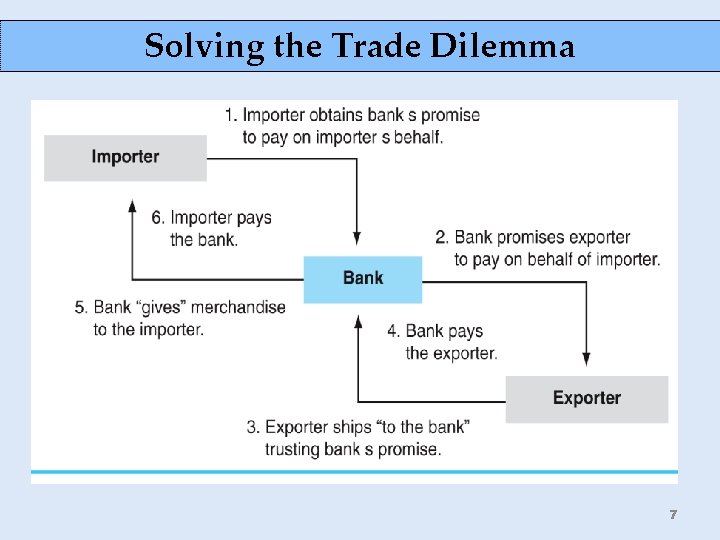
Trade Dilemma v The fundamental dilemma of being unwilling to trust a stranger in a foreign land is solved by using a highly respected bank as an intermediary. v The following exhibit is a simplified view involving a letter of credit (a bank’s promise to pay) on behalf of the importer. v Two other significant documents are a bill of lading and a sight draft. 6
Solving the Trade Dilemma 7
Solving the Trade Dilemma v. This system has been developed and modified over centuries to protect both the importer and exporter from: – The risk of noncompletion – Foreign exchange risk – And, to provide a means of financing 8
Letter of Credit v A letter of credit (L/C) is a bank’s conditional promise to pay issued by a bank at the request of an importer, in which the bank promises to pay an exporter upon presentation of documents specified in the L/C. v An L/C reduces the risk of non-completion because the bank agrees to pay against documents rather than actual merchandise. 9
Letter of Credit v Letters of credit are also classified as: – Irrevocable versus revocable – Confirmed versus unconfirmed v The primary advantage of an L/C is that it reduces risk – the exporter can sell against a bank’s promise to pay rather than against the promise of a commercial firm. v The major advantage of an L/C to an importer is that the importer need not pay out funds until the documents have arrived at the bank that issued the L/C and after all conditions stated in the credit have been fulfilled. 10
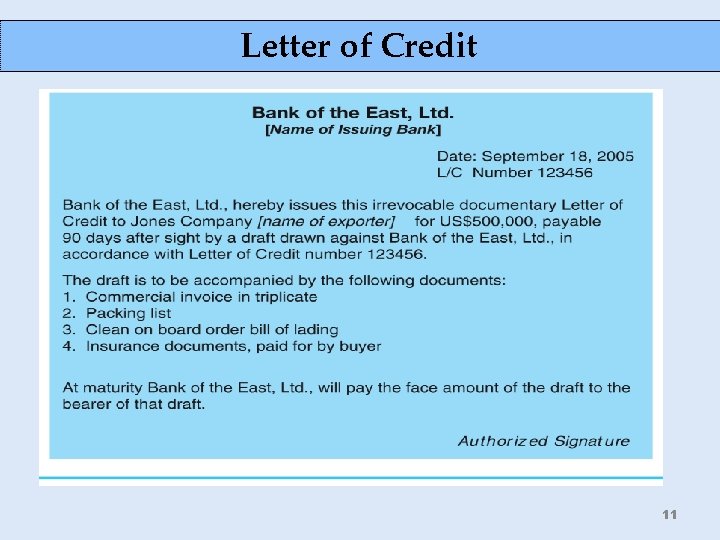
Letter of Credit 11
Draft v A draft, sometimes called a bill of exchange (B/E), is the instrument normally used in international commerce to effect payment. v A draft is simply an order written by an exporter (seller) instructing and importer (buyer) or its agent to pay a specified amount of money at a specified time. v The person or business initiating the draft is known as the maker, drawer or originator. v Normally this is the exporter who sells and ships the merchandise. v The party to whom the draft is addressed is the drawee. 12
Draft v If properly drawn, drafts can become negotiable instruments. v As such, they provide a convenient instrument for financing the international movement of merchandise (freely bought and sold). v To become a negotiable instrument, a draft must conform to the following four requirements: – It must be in writing and signed by the maker or drawer. – It must contain an unconditional promise or order to pay a definite sum of money. – It must be payable on demand or at a fixed or determinable future date. – It must be payable to order or to bearer. v There are time drafts and sight drafts. 13
Bill of Lading v The third key document for financing international trade is the bill of lading or B/L. v The bill of lading is issued to the exporter by a common carrier transporting the merchandise. v It serves three purposes: a receipt, a contract and a document of title. v Bills of lading are either straight or to order. 14
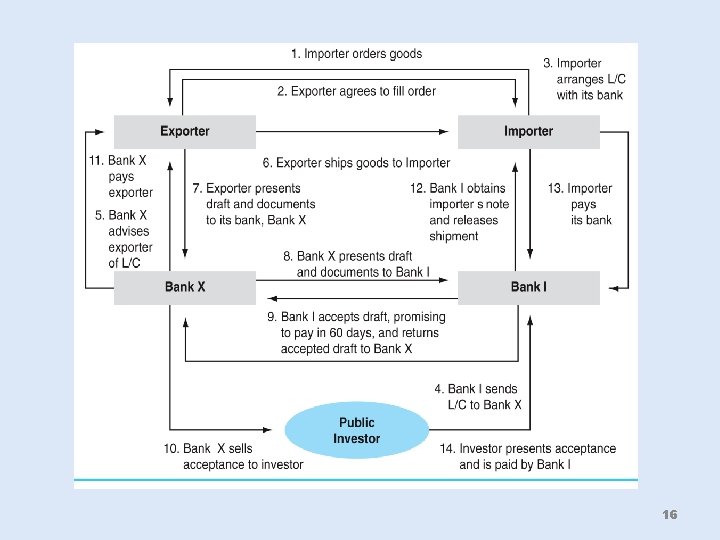
Typical Trade Transaction v A trade transaction could conceivably be handled in many ways. v The transaction that would best illustrate the interactions of the various documents would be an export financed under a documentary commercial letter of credit, requiring an order bill of lading, with the exporter collecting via a time draft accepted by the importer’s bank. v The following exhibit illustrates such a transaction. 15
16
Trade Financing Alternatives v In order to finance international trade receivables, firms use the same financing instruments as they use for domestic trade receivables, plus a few specialized instruments that are only available for financing international trade. v There are short-term financing instruments and longer-term instruments in addition to the use of various types of barter to substitute for these instruments. 17
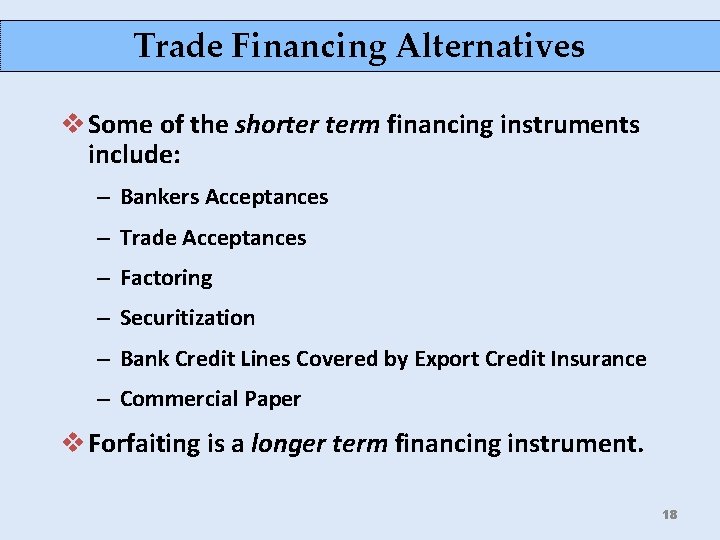
Trade Financing Alternatives v Some of the shorter term financing instruments include: – Bankers Acceptances – Trade Acceptances – Factoring – Securitization – Bank Credit Lines Covered by Export Credit Insurance – Commercial Paper v Forfaiting is a longer term financing instrument. 18
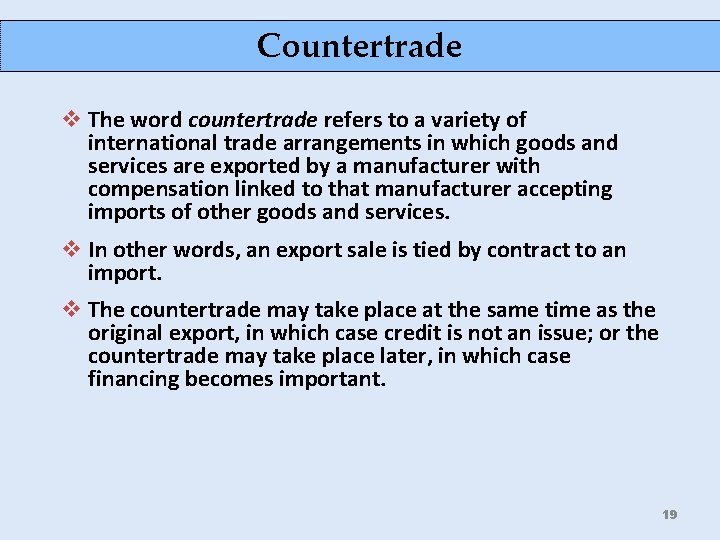
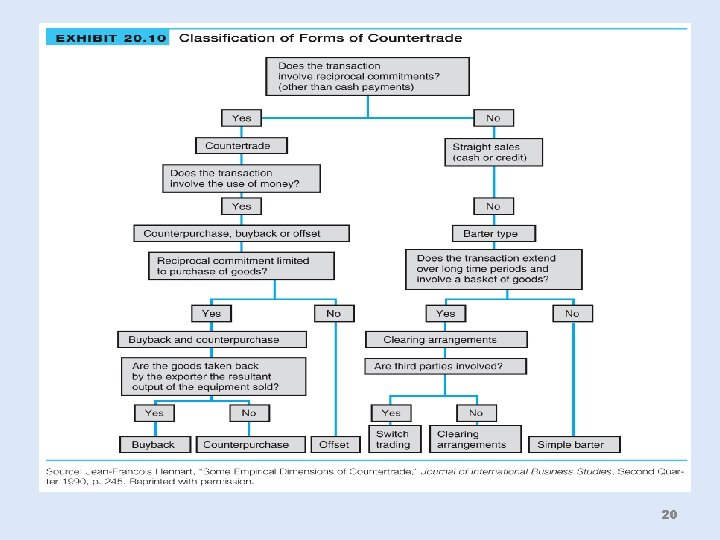
Countertrade v The word countertrade refers to a variety of international trade arrangements in which goods and services are exported by a manufacturer with compensation linked to that manufacturer accepting imports of other goods and services. v In other words, an export sale is tied by contract to an import. v The countertrade may take place at the same time as the original export, in which case credit is not an issue; or the countertrade may take place later, in which case financing becomes important. 19
20
Government Trade Promotion v Governments of most export-oriented industrialized countries have special financial institutions that provide some form of subsidized credit to their own national exporters. v These export finance institutions offer terms that are better than those generally available from the competitive private sector. v Thus domestic taxpayers are subsidizing lower financial costs foreign buyers in order to create employment and maintain a technological edge. v The most important institutions usually offer export credit insurance and a government-supported bank for export financing. 21
Working Capital Management v Working capital management in a multinational enterprise requires managing current assets (cash balances, accounts receivable and inventory) and current liabilities (accounts payable and short-term debt) when faced with political, foreign exchange, tax and liquidity constraints. v The overall goal is to reduce funds tied up in working capital while simultaneously providing sufficient funding and liquidity for the conduct of global business. v Working capital management should enhance return on assets and return on equity and should also improve efficiency ratios and other performance measures. 22
International Cash Management v International cash management is the set of activities determining the levels of cash balances held throughout the MNE (cash management) and the facilitation of its movement cross-border (settlements and processing). v These activities are typically handled by the international treasury of the MNE. v Cash balances, including marketable securities, are held partly to enable normal day-to-day cash disbursements and partly to protect against unanticipated variations from budgeted cash flows. These two motives are called the transaction motive and the precautionary motive. 23
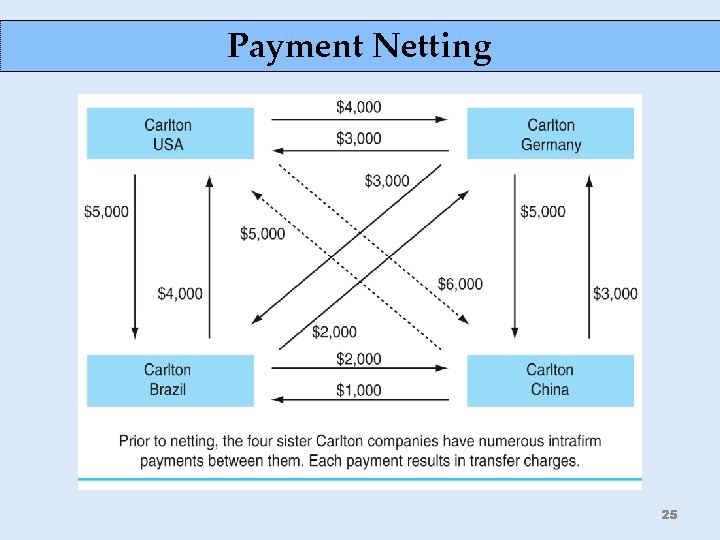
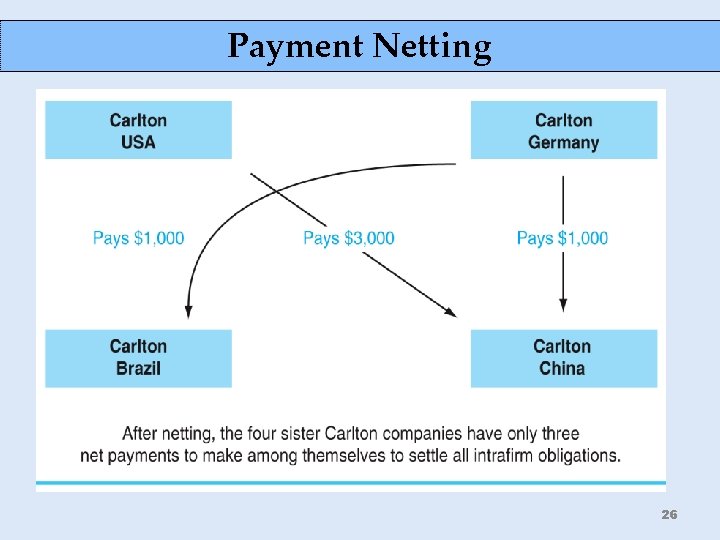
International Cash Management v Efficient cash management aims to reduce cash tied up unnecessarily in the system, without diminishing profit or increasing risk, so as to increase the rate of return on invested assets. v Over time a number of techniques and services have evolved that simplify and reduce the costs of making cross-border payments. v Four such techniques include: – – Wire transfers Cash pooling Payment netting Electronic fund transfers 24
Payment Netting 25
Payment Netting 26
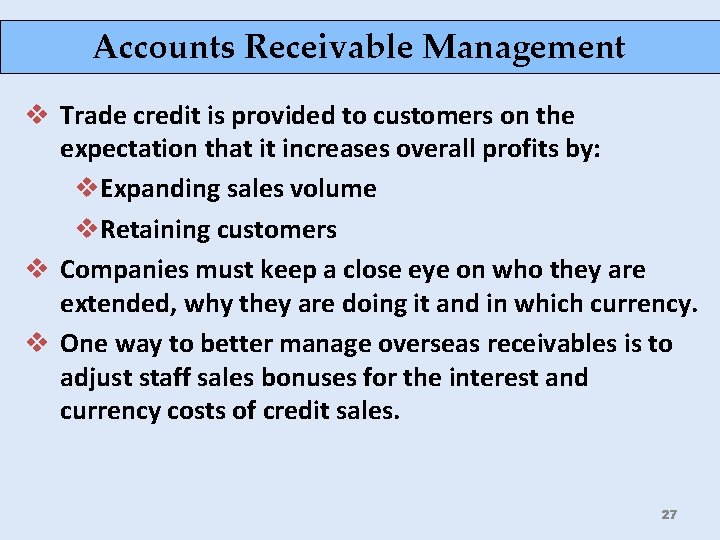
Accounts Receivable Management v Trade credit is provided to customers on the expectation that it increases overall profits by: v. Expanding sales volume v. Retaining customers v Companies must keep a close eye on who they are extended, why they are doing it and in which currency. v One way to better manage overseas receivables is to adjust staff sales bonuses for the interest and currency costs of credit sales. 27
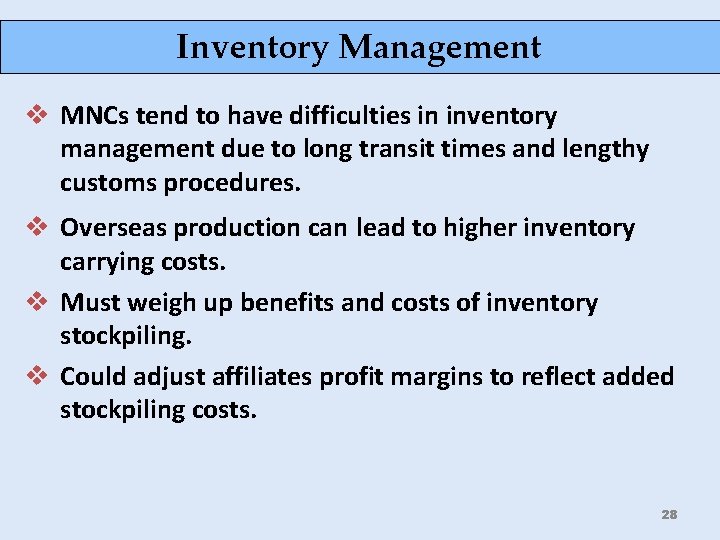
Inventory Management v MNCs tend to have difficulties in inventory management due to long transit times and lengthy customs procedures. v Overseas production can lead to higher inventory carrying costs. v Must weigh up benefits and costs of inventory stockpiling. v Could adjust affiliates profit margins to reflect added stockpiling costs. 28
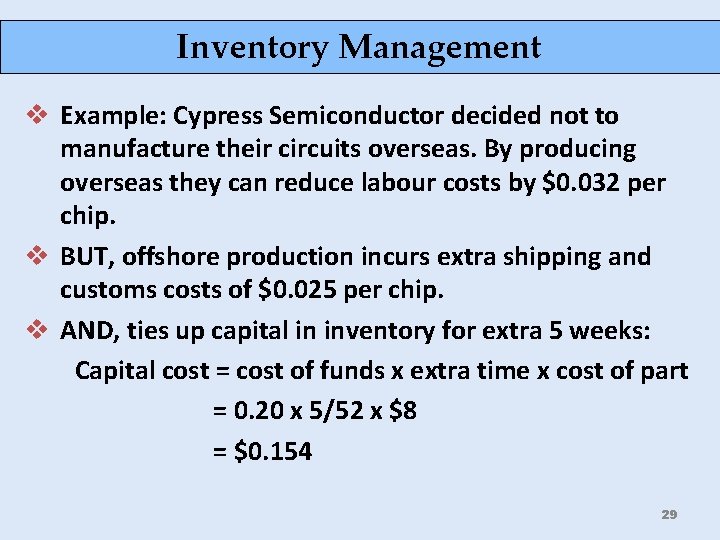
Inventory Management v Example: Cypress Semiconductor decided not to manufacture their circuits overseas. By producing overseas they can reduce labour costs by $0. 032 per chip. v BUT, offshore production incurs extra shipping and customs costs of $0. 025 per chip. v AND, ties up capital in inventory for extra 5 weeks: Capital cost = cost of funds x extra time x cost of part = 0. 20 x 5/52 x $8 = $0. 154 29
Short-Term Financing v Take advantage of discount on Accounts Payable? § 2/10 net 60 – effective cost? v Three principal short-term financing options: § Internal financing – borrowing from parent company or other affiliates. § Local currency loans – overdrafts, line of credit, discounting (commercial paper) and term loans. § Euro market loans/issues – Euronotes and Euro-CP. 30
Managing the MNE Financial System v A firm operating globally faces a variety of political, tax, foreign exchange and liquidity considerations that limit its ability to move funds easily and without cost from one country or currency to another. v Political constraints can block the transfer of funds either overtly or covertly. v Tax constraints arise because of the complex and possibly contradictory tax structures of various national governments through whose jurisdictions funds might pass. v Foreign exchange transaction costs are incurred when one currency is exchanged for another. v Liquidity needs are often driven by individual locations (difficult to conduct worldwide cash handling). 31
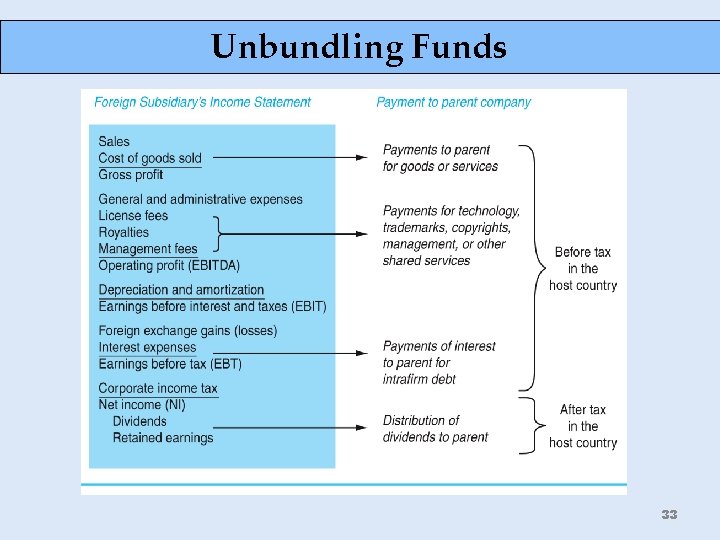
Unbundling Funds v Multinational firms often unbundle their transfer of funds into separate flows for specific purposes. v Host countries are then more likely to perceive that a portion of what might otherwise be called remittance of profits constitutes and essential purchase of specific benefits that command worldwide values and benefit the host country. v Unbundling allows a multinational firm to recover funds from subsidiaries without piquing host country sensitivities over large dividend drains. 32
Unbundling Funds 33
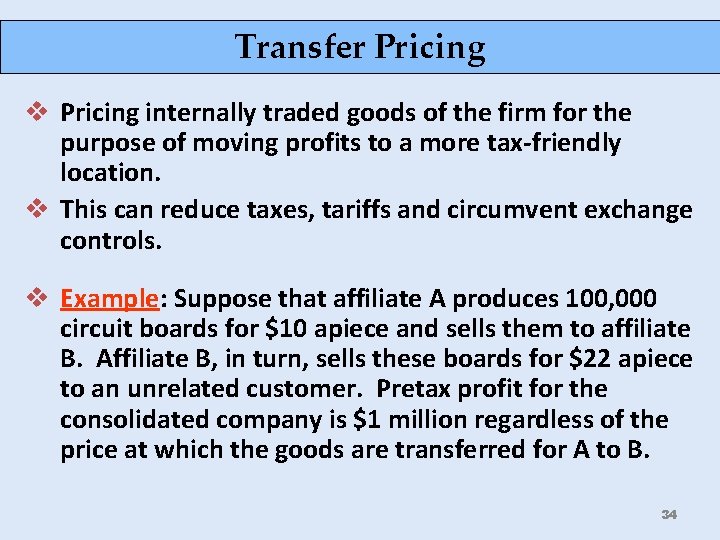
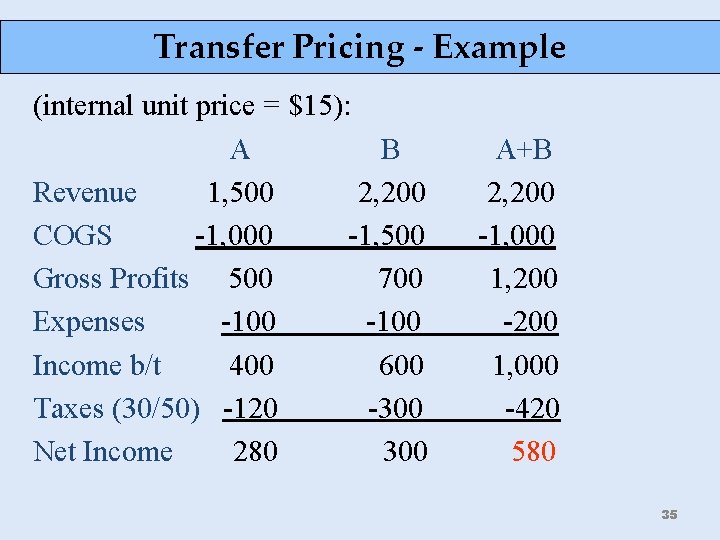
Transfer Pricing v Pricing internally traded goods of the firm for the purpose of moving profits to a more tax-friendly location. v This can reduce taxes, tariffs and circumvent exchange controls. v Example: Suppose that affiliate A produces 100, 000 circuit boards for $10 apiece and sells them to affiliate B. Affiliate B, in turn, sells these boards for $22 apiece to an unrelated customer. Pretax profit for the consolidated company is $1 million regardless of the price at which the goods are transferred for A to B. 34
Transfer Pricing - Example (internal unit price = $15): A B Revenue 1, 500 2, 200 COGS -1, 000 -1, 500 Gross Profits 500 700 Expenses -100 Income b/t 400 600 Taxes (30/50) -120 -300 Net Income 280 300 A+B 2, 200 -1, 000 1, 200 -200 1, 000 -420 580 35
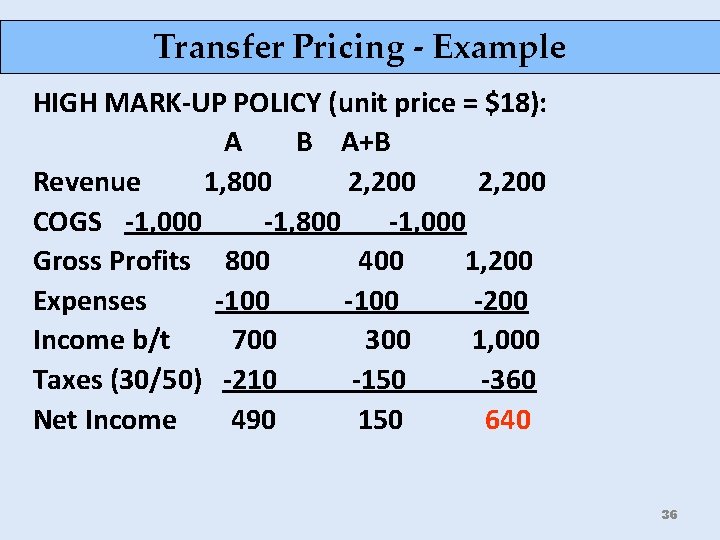
Transfer Pricing - Example HIGH MARK-UP POLICY (unit price = $18): A B A+B Revenue 1, 800 2, 200 COGS -1, 000 -1, 800 -1, 000 Gross Profits 800 400 1, 200 Expenses -100 -200 Income b/t 700 300 1, 000 Taxes (30/50) -210 -150 -360 Net Income 490 150 640 36
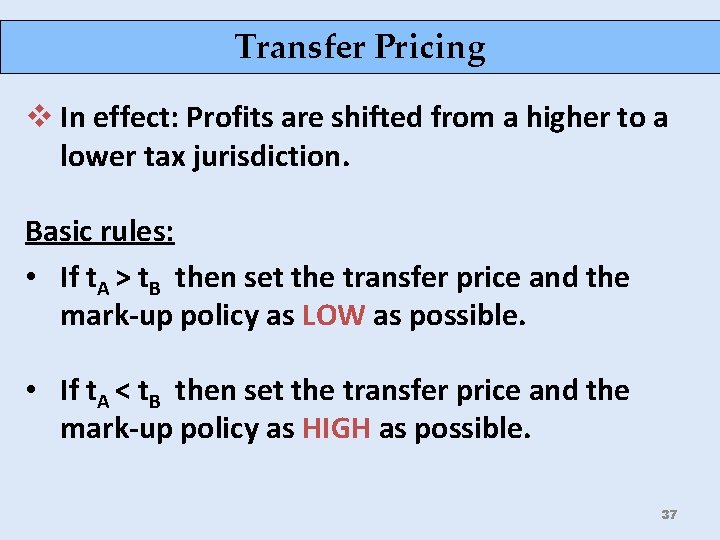
Transfer Pricing v In effect: Profits are shifted from a higher to a lower tax jurisdiction. Basic rules: • If t. A > t. B then set the transfer price and the mark-up policy as LOW as possible. • If t. A < t. B then set the transfer price and the mark-up policy as HIGH as possible. 37
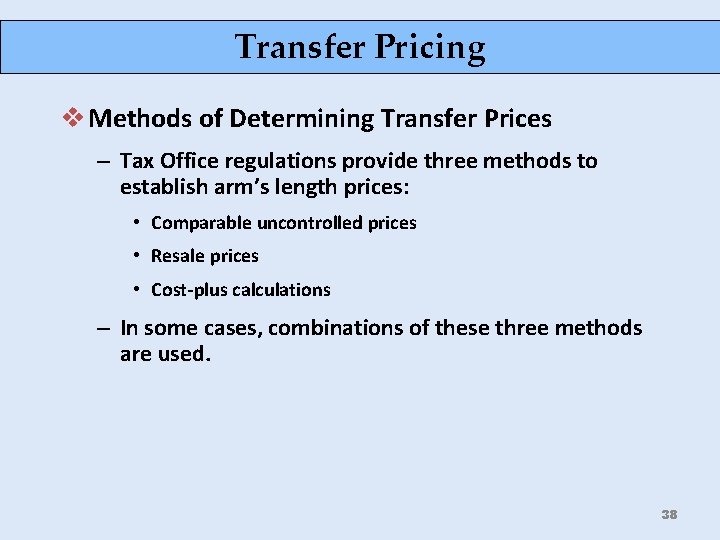
Transfer Pricing v Methods of Determining Transfer Prices – Tax Office regulations provide three methods to establish arm’s length prices: • Comparable uncontrolled prices • Resale prices • Cost-plus calculations – In some cases, combinations of these three methods are used. 38
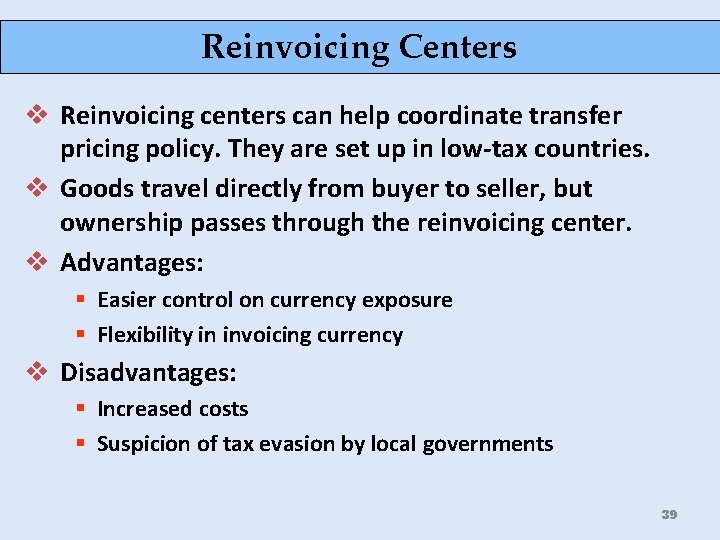
Reinvoicing Centers v Reinvoicing centers can help coordinate transfer pricing policy. They are set up in low-tax countries. v Goods travel directly from buyer to seller, but ownership passes through the reinvoicing center. v Advantages: § Easier control on currency exposure § Flexibility in invoicing currency v Disadvantages: § Increased costs § Suspicion of tax evasion by local governments 39
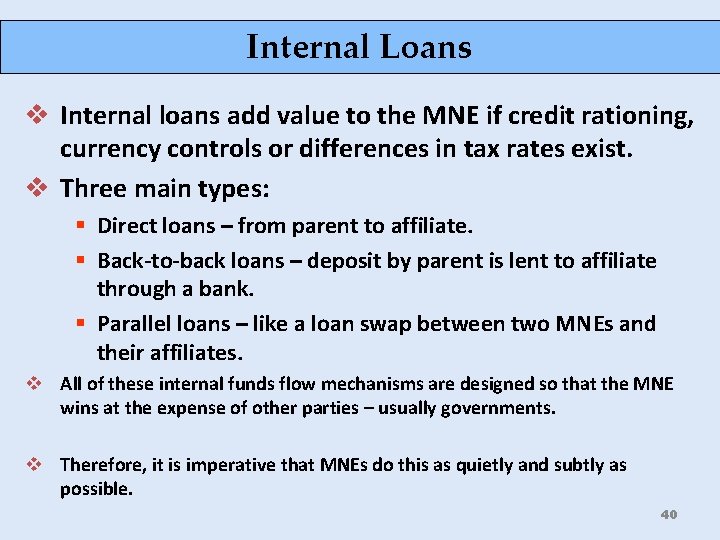
Internal Loans v Internal loans add value to the MNE if credit rationing, currency controls or differences in tax rates exist. v Three main types: § Direct loans – from parent to affiliate. § Back-to-back loans – deposit by parent is lent to affiliate through a bank. § Parallel loans – like a loan swap between two MNEs and their affiliates. v All of these internal funds flow mechanisms are designed so that the MNE wins at the expense of other parties – usually governments. v Therefore, it is imperative that MNEs do this as quietly and subtly as possible. 40