
International Trade Theory International Trade Theory What is
- Slides: 18
International Trade Theory
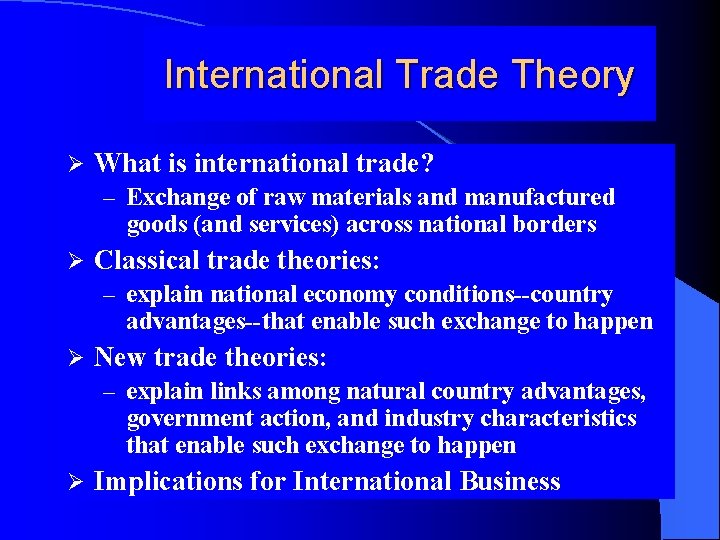
International Trade Theory Ø What is international trade? – Exchange of raw materials and manufactured goods (and services) across national borders Ø Classical trade theories: – explain national economy conditions--country advantages--that enable such exchange to happen Ø New trade theories: – explain links among natural country advantages, government action, and industry characteristics that enable such exchange to happen Ø Implications for International Business
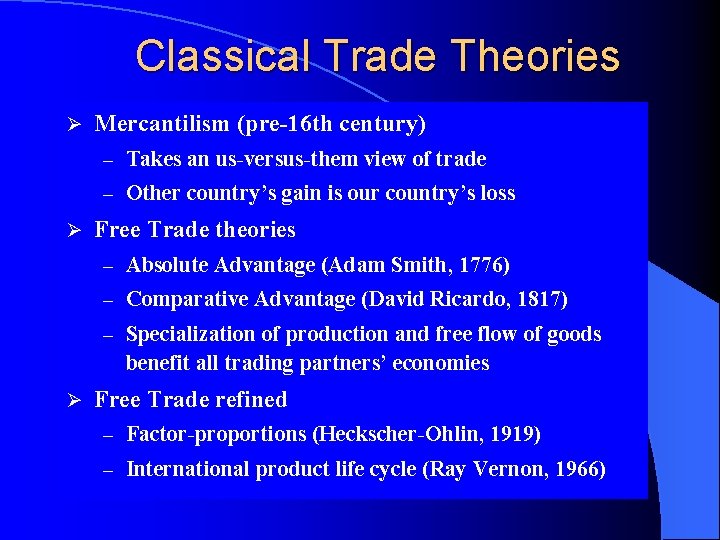
Classical Trade Theories Ø Mercantilism (pre-16 th century) – Takes an us-versus-them view of trade – Other country’s gain is our country’s loss Ø Free Trade theories – Absolute Advantage (Adam Smith, 1776) – Comparative Advantage (David Ricardo, 1817) – Specialization of production and free flow of goods benefit all trading partners’ economies Ø Free Trade refined – Factor-proportions (Heckscher-Ohlin, 1919) – International product life cycle (Ray Vernon, 1966)
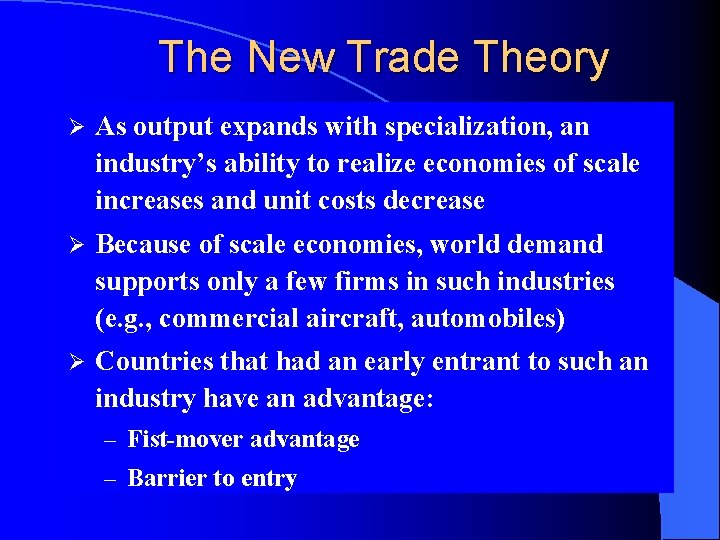
The New Trade Theory Ø As output expands with specialization, an industry’s ability to realize economies of scale increases and unit costs decrease Ø Because of scale economies, world demand supports only a few firms in such industries (e. g. , commercial aircraft, automobiles) Ø Countries that had an early entrant to such an industry have an advantage: – Fist-mover advantage – Barrier to entry
New Trade Theory Ø Global Strategic Rivalry – Firms gain competitive advantage trough: intellectual property, R&D, economies of scale and scope, experience Ø National Competitive Advantage (Porter, 1990)
Mercantilism/Neomercantilism Ø Prevailed in 1500 - 1800 – Export more to “strangers” than we import to amass treasure, expand kingdom – Zero-sum vs positive-sum game view of trade Ø Government intervenes to achieve a surplus in exports – King, exporters, domestic producers: happy – Subjects: unhappy because domestic goods stay expensive and of limited variety Ø Today neo-mercantilists = protectionists: some segments of society shielded short term
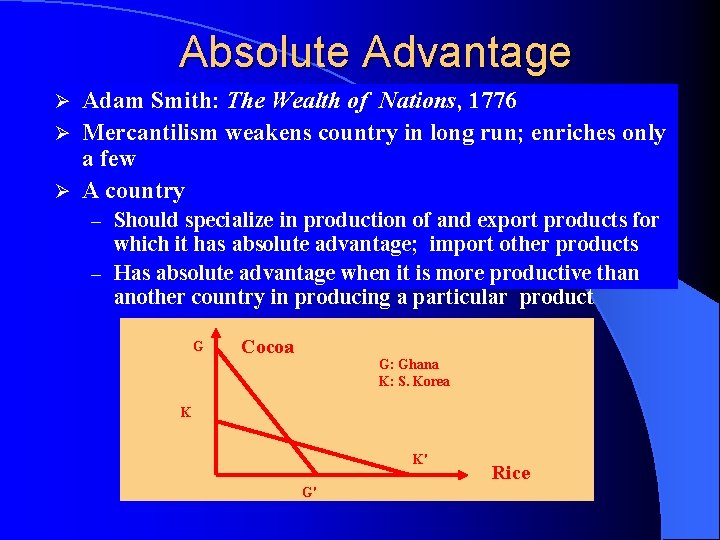
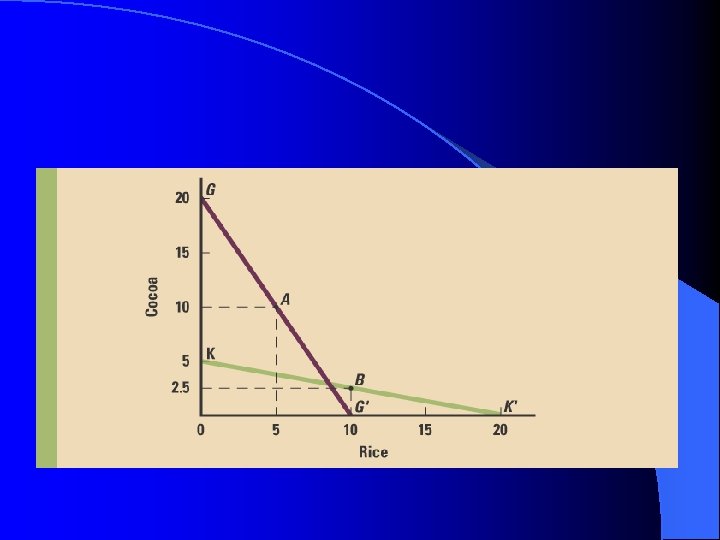
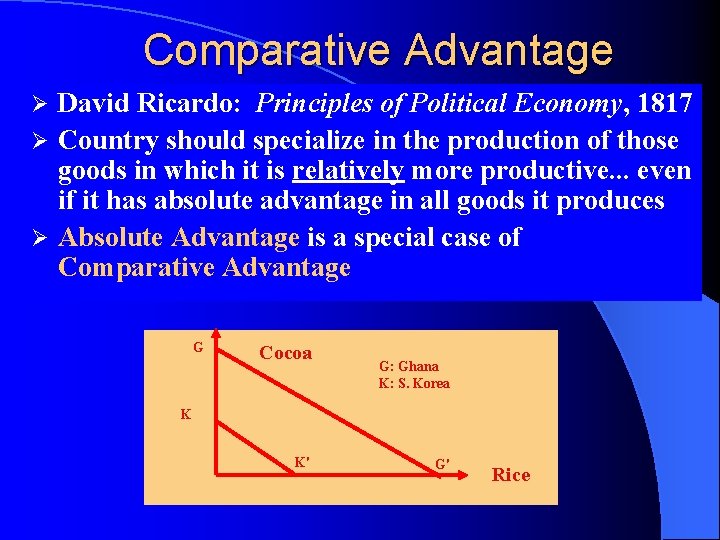
Absolute Advantage Adam Smith: The Wealth of Nations, 1776 Ø Mercantilism weakens country in long run; enriches only a few Ø A country Ø – Should specialize in production of and export products for which it has absolute advantage; import other products – Has absolute advantage when it is more productive than another country in producing a particular product G Cocoa G: Ghana K: S. Korea K K' G' Rice
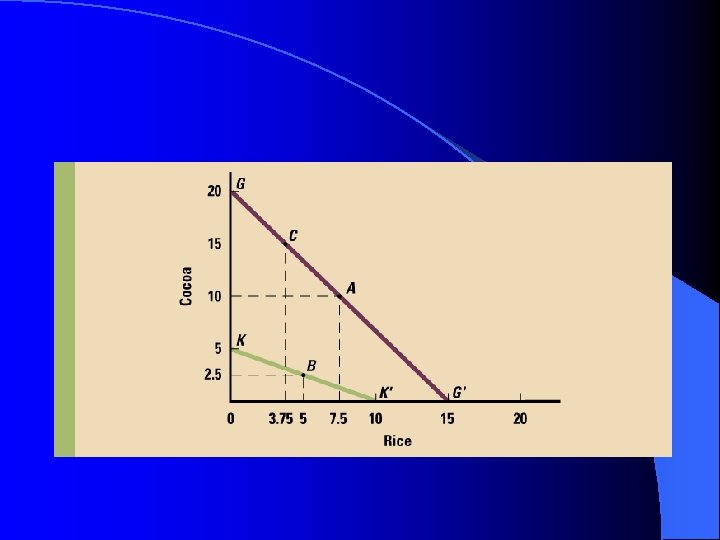
Comparative Advantage David Ricardo: Principles of Political Economy, 1817 Ø Country should specialize in the production of those goods in which it is relatively more productive. . . even if it has absolute advantage in all goods it produces Ø Absolute Advantage is a special case of Comparative Advantage Ø G Cocoa G: Ghana K: S. Korea K K' G' Rice
Heckscher (1919)-Ohlin (1933) ØDifferences in factor endowments not on differences in productivity determine patterns of trade ØAbsolute amounts of factor endowments matter ØLeontief paradox: – US has relatively more abundant capital yet imports goods more capital intensive than those it exports – Explanation(? ): l US has special advantage on producing new products made with innovative technologies l These may be less capital intensive till they reach massproduction state
Theory of Relative Factor Endowments (Heckscher-Ohlin) Ø Factor endowments vary among countries Ø Products differ according to the types of factors that they need as inputs Ø A country has a comparative advantage in producing products that intensively use factors of production (resources) it has in abundance Ø Factors of production: labor, capital, land, human resources, technology
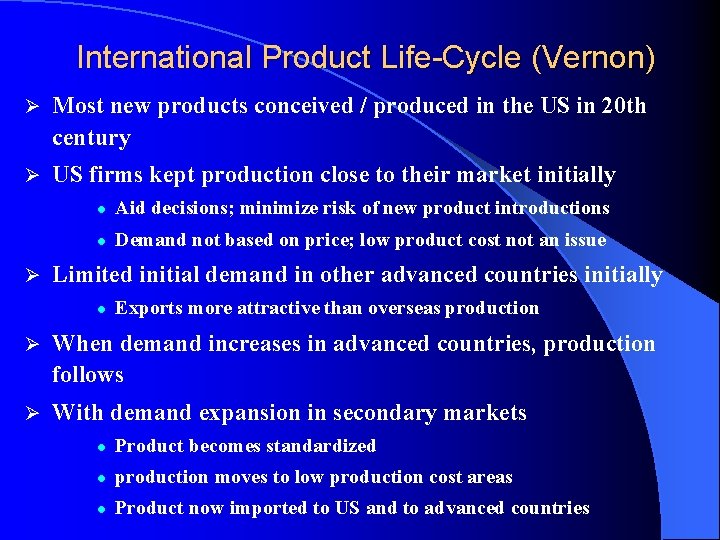
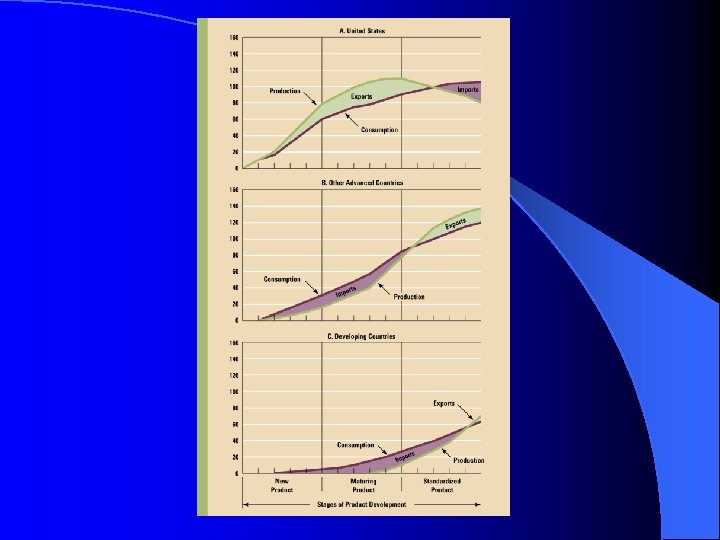
International Product Life-Cycle (Vernon) Ø Most new products conceived / produced in the US in 20 th century Ø US firms kept production close to their market initially Ø l Aid decisions; minimize risk of new product introductions l Demand not based on price; low product cost not an issue Limited initial demand in other advanced countries initially l Exports more attractive than overseas production Ø When demand increases in advanced countries, production follows Ø With demand expansion in secondary markets l Product becomes standardized l production moves to low production cost areas l Product now imported to US and to advanced countries
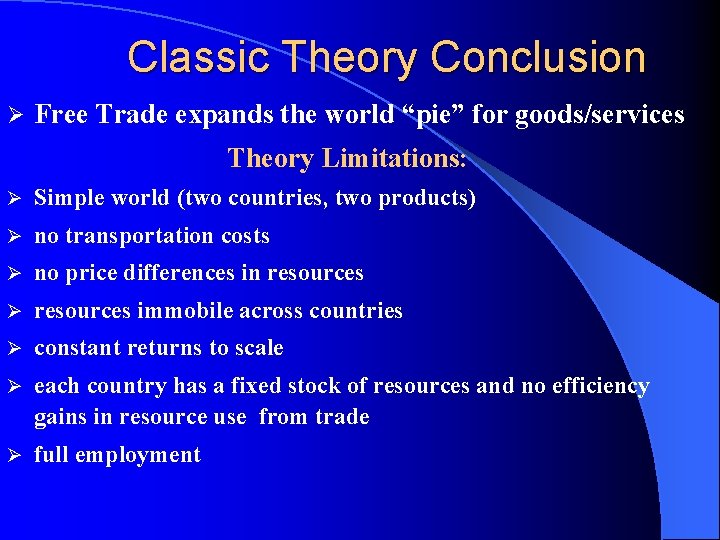
Classic Theory Conclusion Ø Free Trade expands the world “pie” for goods/services Theory Limitations: Ø Simple world (two countries, two products) Ø no transportation costs Ø no price differences in resources Ø resources immobile across countries Ø constant returns to scale Ø each country has a fixed stock of resources and no efficiency gains in resource use from trade Ø full employment
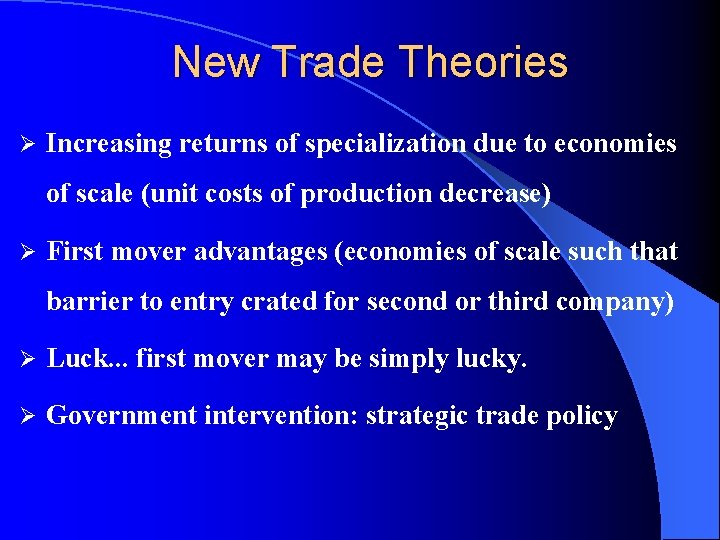
New Trade Theories Ø Increasing returns of specialization due to economies of scale (unit costs of production decrease) Ø First mover advantages (economies of scale such that barrier to entry crated for second or third company) Ø Luck. . . first mover may be simply lucky. Ø Government intervention: strategic trade policy
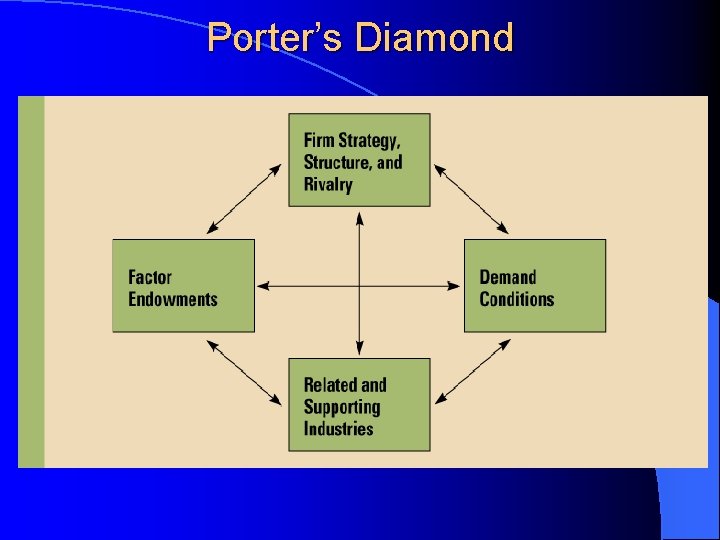
National Competitive Advantage (Porter, 1990) Ø Factor endowments l Ø Demand conditions l Ø large, sophisticated domestic consumer base: offers an innovation friendly environment and a testing ground Related and supporting industries l Ø land, labor, capital, workforce, infrastructure (some factors can be created. . . ) local suppliers cluster around producers and add to innovation Firm strategy, structure, rivalry l competition good, national governments can create conditions which facilitate and nurture such conditions
Porter’s Diamond