
International Trade Theory Adam Smiths Theory of Absolute
International Trade Theory • Adam Smith`s Theory of Absolute Advantage • David Ricardo`s Theory of Comparative Advantage • Heckscher-Ohlin`s Theory of Factor Endowment • Raymond Vernon`s Product Life Cycle Theory • New Trade Theory based on economies of scale • Theory of national competitive advantage: Porter`s diamond
International Trade Theory Trade theory focuses on three basic questions: • a) What products to import and export? b) How much to trade? , and c) With whom to trade? • Some theories explain trade patterns that exist in the absence of governmental interference, and some theories explain what governmental actions should strive for in trade • Climate and natural resource endowments explain why Brazil exports coffee, Saudi Arabia exports oil But • Why Japan exports electronics and machine tools? • Switzerland exports chemicals, watches?
International Trade Theory • Interplay between proportions in which the factors of production (land, lab our, capital, technology) are available in different countries • Product Life Cycle Theory • New products are produced in and exported from the country in which they are produced • Once product is internationally accepted, production in other countries as a result it is exported back to original country • Some countries specialize in the production and export of particular products not because of differences in factors of endowments, but in certain industries the world market can support only limited number of firms • Certain countries achieve competitive advantage in certain sectors (Michael Porter)
International Trade Theory: Mercantilism • Gold & silver were major component of national wealth • Earn gold and silver by exporting goods • Amass gold and silver to maintain national prestige and to maintain trade surplus • Government intervention to achieve trade surplus • Flaw with this theory is that it views trade as zero sum game
Theory of Absolute Advantage • Adam Smith in 1776 in his book “The Wealth of Nations” argued that • Countries differ in their ability to produce goods efficiently • Country has an absolute advantage in production of a product when it is more efficient than any other country producing it • Countries should specialize in the production of goods for which they have absolute advantage then trade for goods produced by other countries
Theory of Absolute Advantage • Countries should never produce goods at home that it can buy at a lower cost from other countries • Specializing in production of goods in which each has absolute advantage both countries benefit engaging in trade
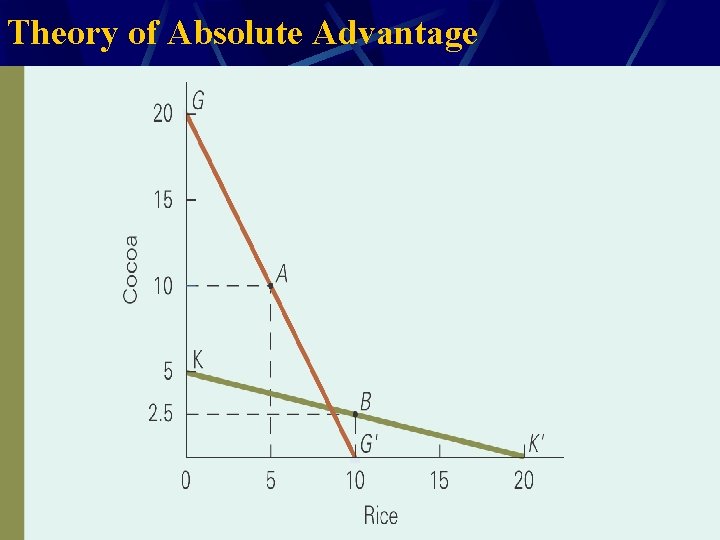
Theory of Absolute Advantage
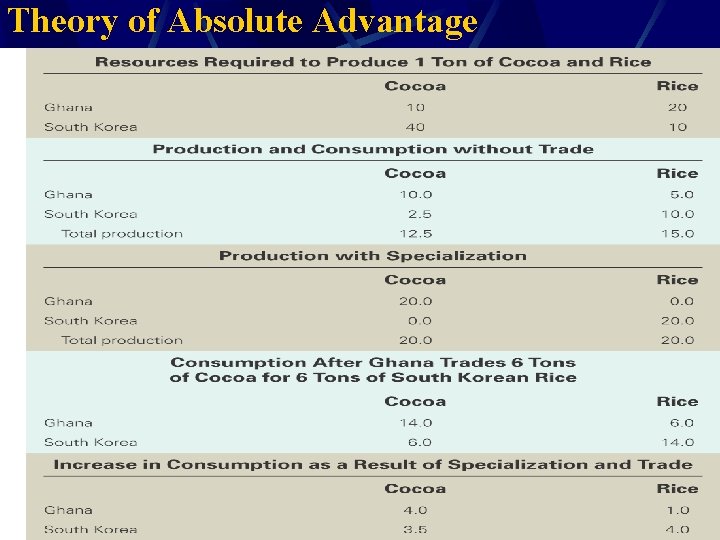
Theory of Absolute Advantage
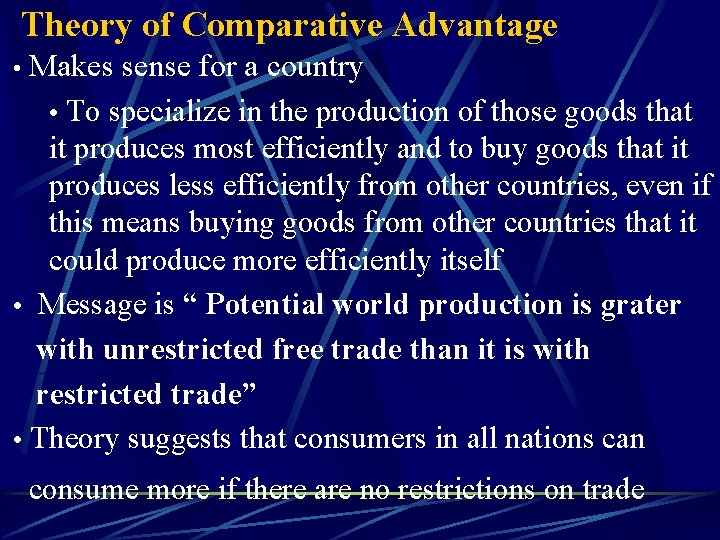
Theory of Comparative Advantage • Makes sense for a country • To specialize in the production of those goods that it produces most efficiently and to buy goods that it produces less efficiently from other countries, even if this means buying goods from other countries that it could produce more efficiently itself • Message is “ Potential world production is grater with unrestricted free trade than it is with restricted trade” • Theory suggests that consumers in all nations can consume more if there are no restrictions on trade
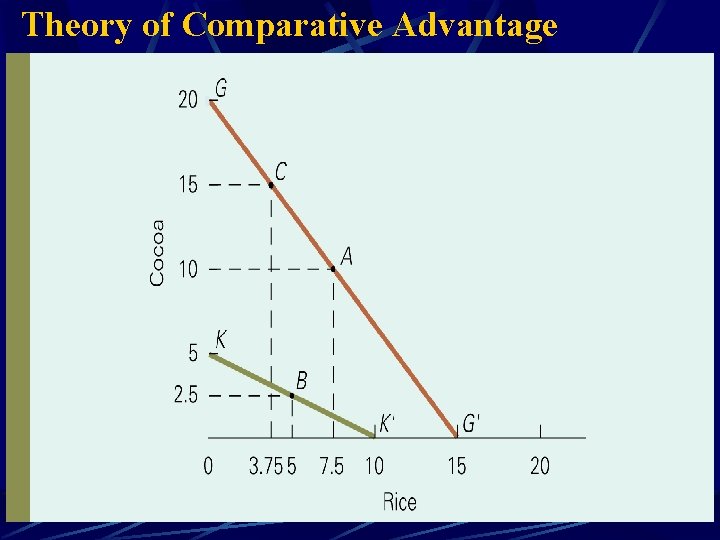
Theory of Comparative Advantage
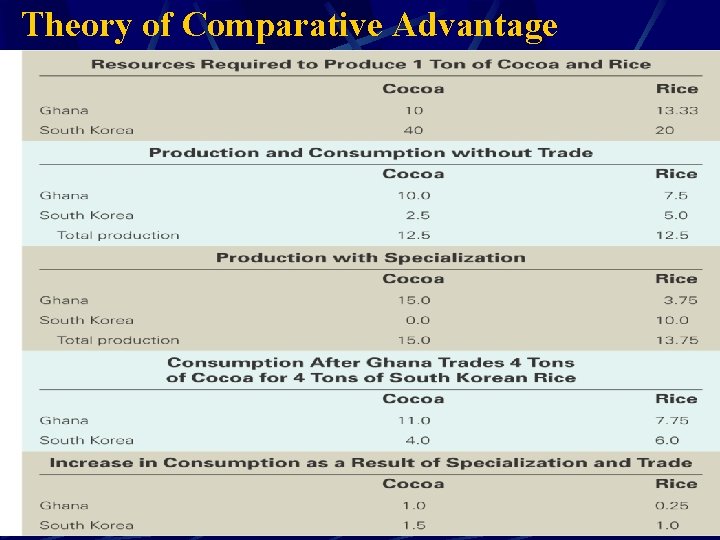
Theory of Comparative Advantage
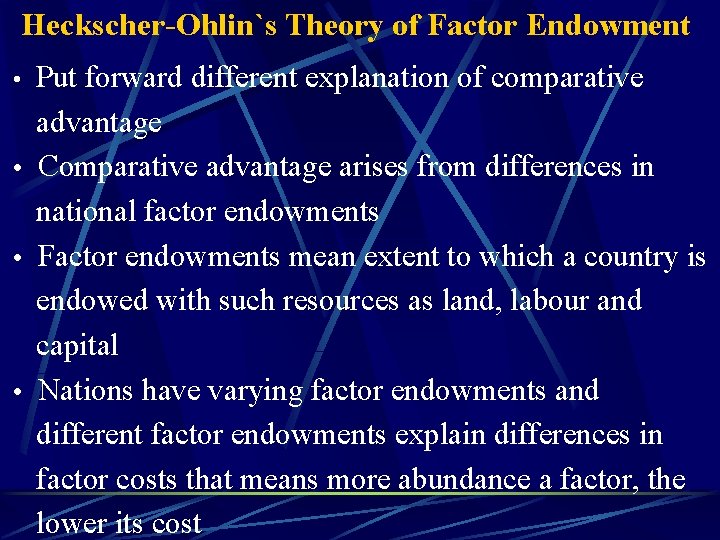
Heckscher-Ohlin`s Theory of Factor Endowment Put forward different explanation of comparative advantage • Comparative advantage arises from differences in national factor endowments • Factor endowments mean extent to which a country is endowed with such resources as land, labour and capital • Nations have varying factor endowments and different factor endowments explain differences in factor costs that means more abundance a factor, the lower its cost •
Heckscher-Ohlin`s Theory of Factor Endowment • Predicts that countries will exports those goods that • • make intensive use of factors that are locally abundant while importing goods that make intensive use of factors that are locally scarce Free trade is beneficial Differences in factor endowments, rather than differences in productivity determine pattern of international trade USA exports agriculture products China exports labour intensive goods
Product Life Cycle Theory (Raymond Vernon) PLC theory explains the location of production will shift internationally depending upon the stage of life cycle of the product There are four basic stages of PLC • Introduction • Growth • Maturity • Decline
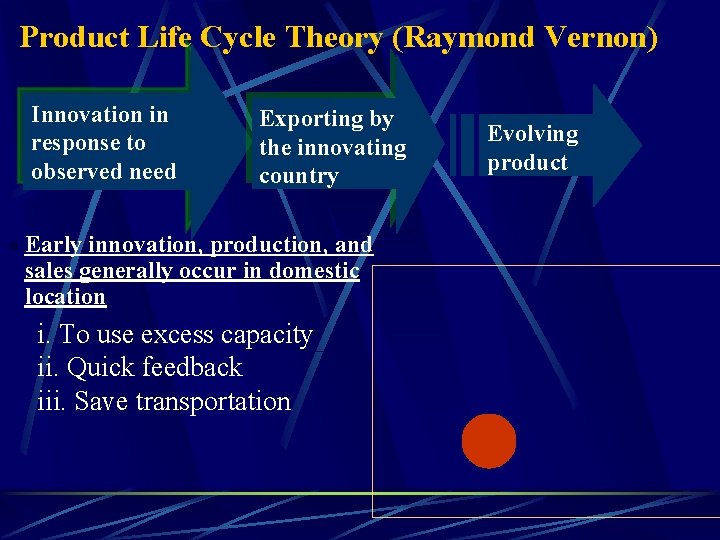
Product Life Cycle Theory (Raymond Vernon) Innovation in response to observed need Exporting by the innovating country Early innovation, production, and sales generally occur in domestic location i. To use excess capacity ii. Quick feedback iii. Save transportation Evolving product
Product Life Cycle Stages: Introduction contd. . Location and importance of innovation l l l Early manufacturing and sales occur in industrial countries as 95% of world technology sources from industrial countries Industrial countries have advantage of highly skilled human resources, high economy which enable them to invest in R&D Innovation is the main source of companies’ competitive strength Continuous innovation is required to shield oneself from imitations Innovations/ improvements maybe in the output or the process (product or manufacturing/ marketing process) LDCs (least developed countries) cannot afford R&D and hence may lack competitiveness
Product Life Cycle Stages: Introduction contd. . Exports and labor l Even during this stage, some exports may take place in similar market segments l The high-scale production process takes sometime to streamline l Production will not be standardized at this stage, hence it is more labor-intensive to allow rapid changes as dictated by market feedback
Product Life Cycle Stages: Growth - Increase in exports by the innovating country - To address increase in foreign demand (of similar nature) - More competition - Competition enforces more variations so need for labor intensive production may still arise - Increased capital intensity Rapid growth in sales encourages standardization and development of process technology - Some foreign Companies expand to foreign production; establish and specialize in foreign market -
Product Life Cycle Stages: Maturity stage is characterized by l Decline in exports by the innovating country l Decrease in demand in some countries and increase in some, but overall demand falls l More product standardization l More capital intensity l Increased price competition l Production startups in LDCs l Encouraged use of unskilled labor in LDCs
Product Life Cycle Stages: Decline stage is characterized by l Concentration of production in LDCs l Innovating country becoming net importer
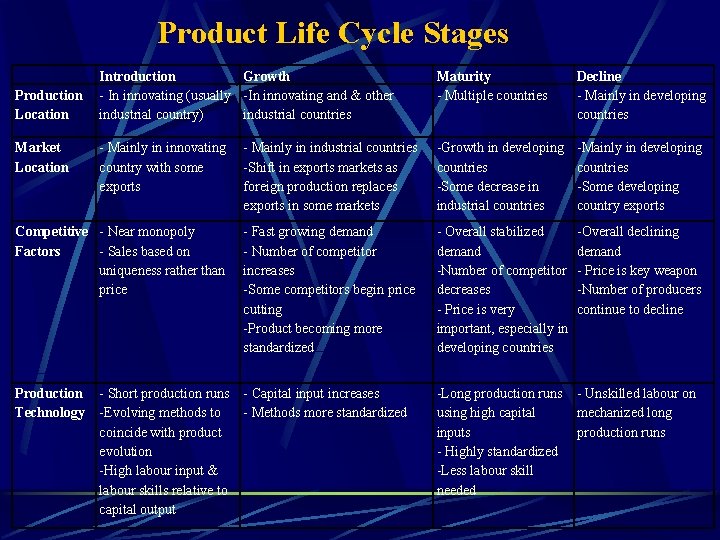
Product Life Cycle Stages Introduction Growth - In innovating (usually -In innovating and & other industrial country) industrial countries Maturity - Multiple countries Decline - Mainly in developing countries - Mainly in innovating country with some exports - Mainly in industrial countries -Shift in exports markets as foreign production replaces exports in some markets -Growth in developing countries -Some decrease in industrial countries -Mainly in developing countries -Some developing country exports Competitive - Near monopoly Factors - Sales based on uniqueness rather than price - Fast growing demand - Number of competitor increases -Some competitors begin price cutting -Product becoming more standardized - Overall stabilized demand -Number of competitor decreases - Price is very important, especially in developing countries -Overall declining demand - Price is key weapon -Number of producers continue to decline -Long production runs using high capital inputs - Highly standardized -Less labour skill needed - Unskilled labour on mechanized long production runs Production Location Market Location Production Technology - Short production runs - Capital input increases -Evolving methods to - Methods more standardized coincide with product evolution -High labour input & labour skills relative to capital output
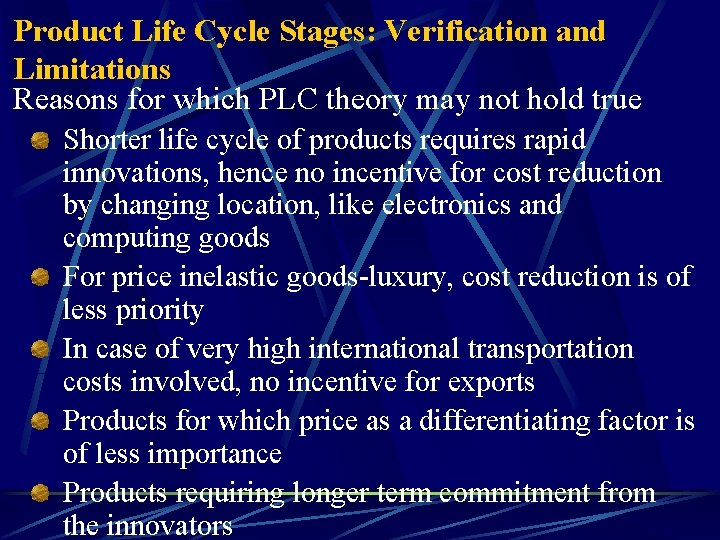
Product Life Cycle Stages: Verification and Limitations Reasons for which PLC theory may not hold true Shorter life cycle of products requires rapid innovations, hence no incentive for cost reduction by changing location, like electronics and computing goods For price inelastic goods-luxury, cost reduction is of less priority In case of very high international transportation costs involved, no incentive for exports Products for which price as a differentiating factor is of less importance Products requiring longer term commitment from the innovators
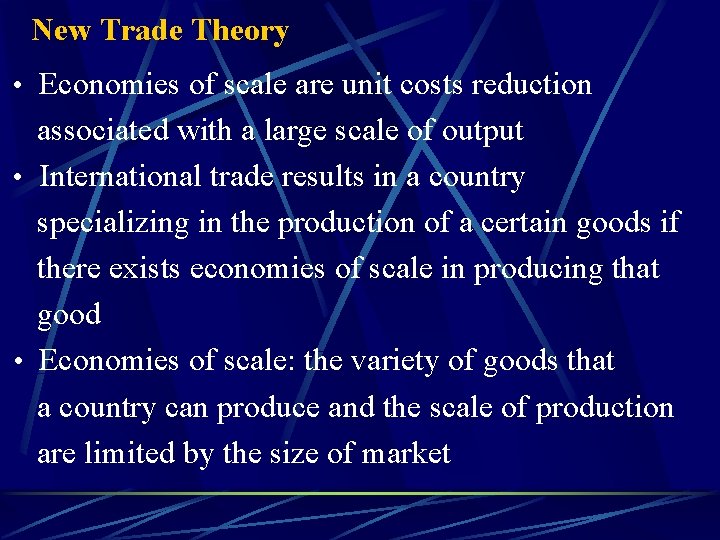
New Trade Theory • Economies of scale are unit costs reduction associated with a large scale of output • International trade results in a country specializing in the production of a certain goods if there exists economies of scale in producing that good • Economies of scale: the variety of goods that a country can produce and the scale of production are limited by the size of market
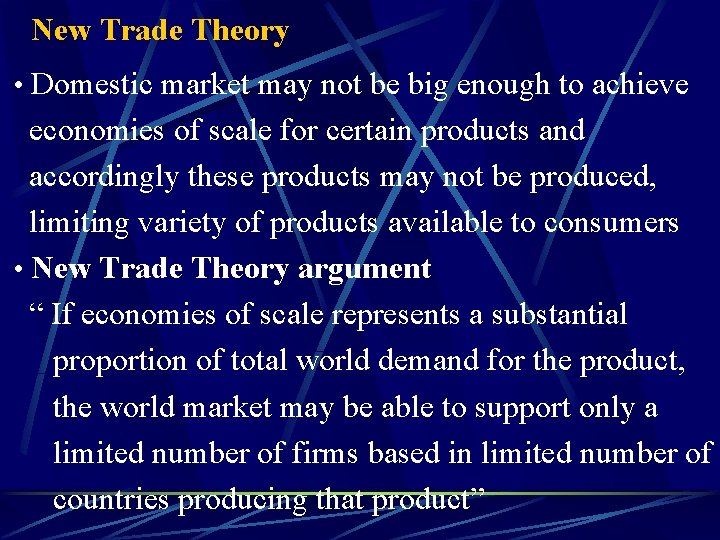
New Trade Theory • Domestic market may not be big enough to achieve economies of scale for certain products and accordingly these products may not be produced, limiting variety of products available to consumers • New Trade Theory argument “ If economies of scale represents a substantial proportion of total world demand for the product, the world market may be able to support only a limited number of firms based in limited number of countries producing that product”
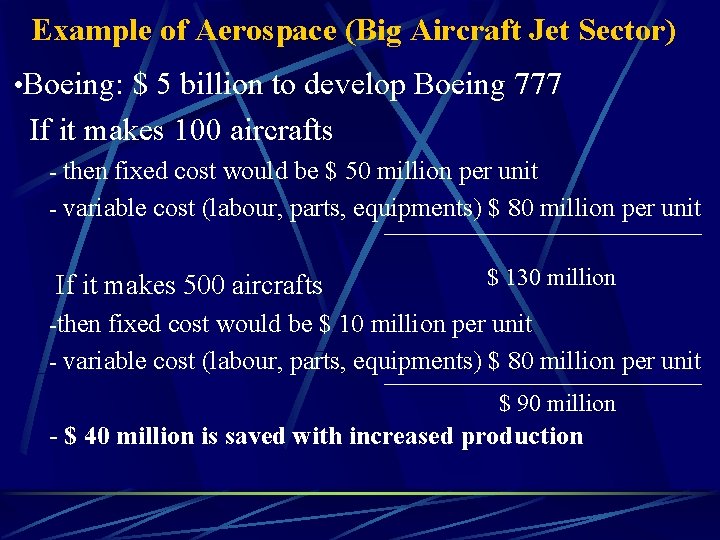
Example of Aerospace (Big Aircraft Jet Sector) • Boeing: $ 5 billion to develop Boeing 777 If it makes 100 aircrafts - then fixed cost would be $ 50 million per unit - variable cost (labour, parts, equipments) $ 80 million per unit If it makes 500 aircrafts $ 130 million -then fixed cost would be $ 10 million per unit - variable cost (labour, parts, equipments) $ 80 million per unit $ 90 million - $ 40 million is saved with increased production
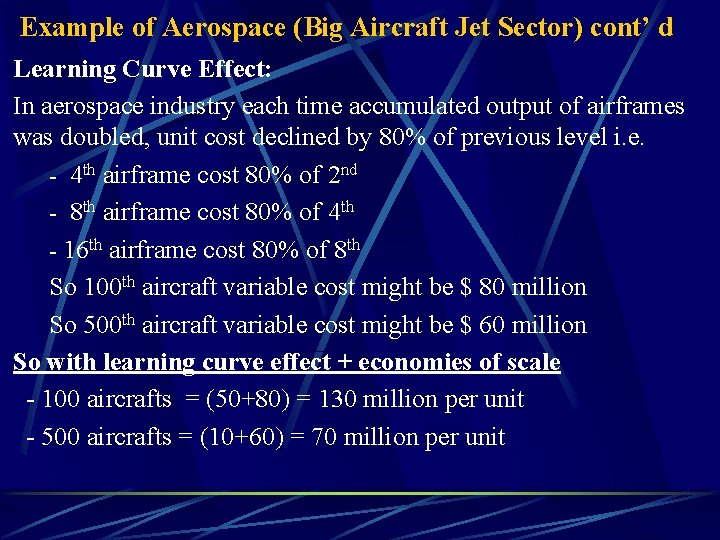
Example of Aerospace (Big Aircraft Jet Sector) cont’ d Learning Curve Effect: In aerospace industry each time accumulated output of airframes was doubled, unit cost declined by 80% of previous level i. e. - 4 th airframe cost 80% of 2 nd - 8 th airframe cost 80% of 4 th - 16 th airframe cost 80% of 8 th So 100 th aircraft variable cost might be $ 80 million So 500 th aircraft variable cost might be $ 60 million So with learning curve effect + economies of scale - 100 aircrafts = (50+80) = 130 million per unit - 500 aircrafts = (10+60) = 70 million per unit
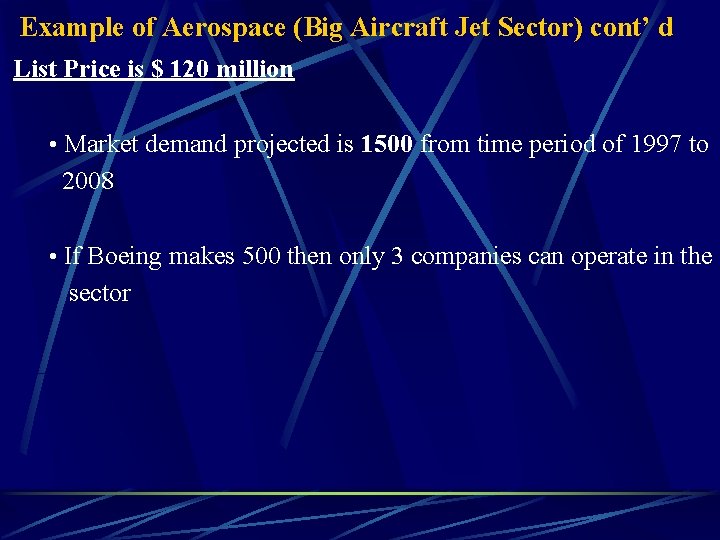
Example of Aerospace (Big Aircraft Jet Sector) cont’ d List Price is $ 120 million • Market demand projected is 1500 from time period of 1997 to 2008 • If Boeing makes 500 then only 3 companies can operate in the sector
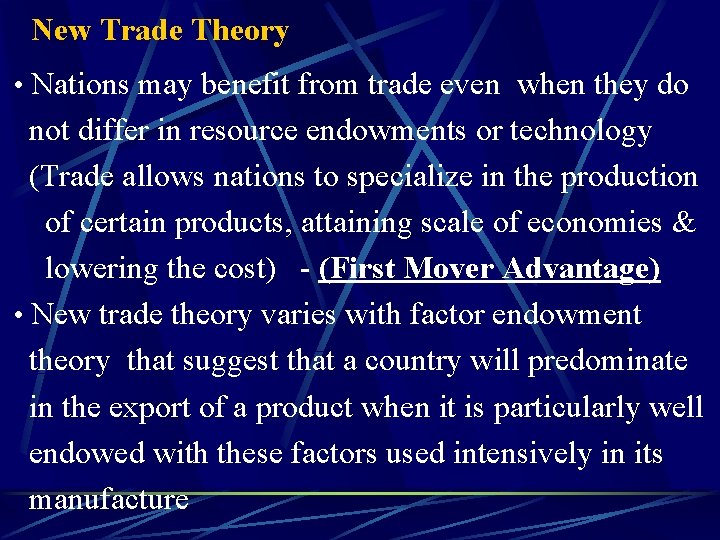
New Trade Theory • Nations may benefit from trade even when they do not differ in resource endowments or technology (Trade allows nations to specialize in the production of certain products, attaining scale of economies & lowering the cost) - (First Mover Advantage) • New trade theory varies with factor endowment theory that suggest that a country will predominate in the export of a product when it is particularly well endowed with these factors used intensively in its manufacture
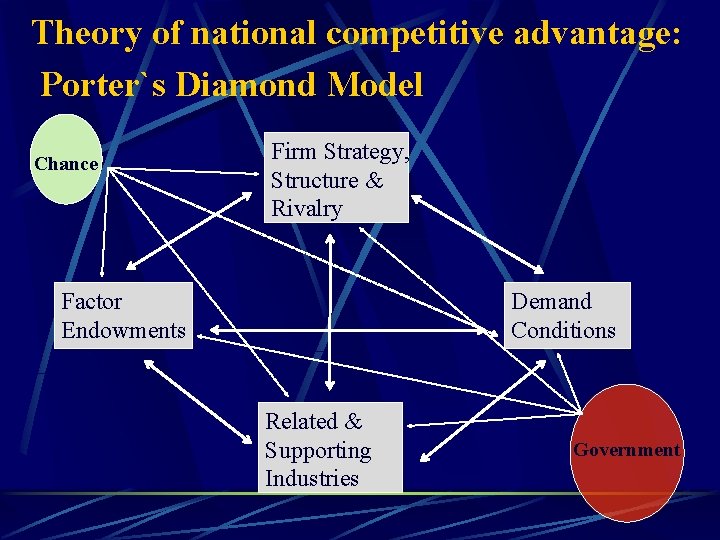
Theory of national competitive advantage: Porter`s Diamond Model Chance Firm Strategy, Structure & Rivalry Factor Endowments Demand Conditions Related & Supporting Industries Government
Porter`s Diamond Model: Factor Endowments • Nations factors of production such as skilled labour or the infrastructure necessary to compete in given industry • Similarity with Ohlin`s theory • Analyse the factors of production • Basic factor: natural resources, climate, location, demographics • Advanced factors (products of investment by individuals, companies& government) : communication, infrastructure & skilled labour, research facilities, technological know- how
Porter`s Diamond Model: Demand Conditions • Nature of home demand for the industry`s product or service • Role of home demand plays in upgrading competitive advantage • Characteristics of home demand are particularly important in shaping the attributes of domestically made products and in creating pressures for innovation and quality • Firms gain competitive advantage if their domestic consumers are sophisticated and demanding
Porter`s Diamond Model: Related & Supporting Industries • Presence and absence of supplier industries and related industries that are internationally competitive • Presence of suppliers or related industries that are internationally competitive • Strength in fabricated steel products (balls, bearings) has imparted strengths in Swedish`s specialty in steel industry • Technological advancement in semi conductor of U. S. in mid 1980 s have good impact in U. S. success in PCs
Porter`s Diamond Model: Firm Strategy, Structure & Rivalry • Conditions governing how companies are created, organised and managed and the nature of domestic rivalry • Different nations characterised by different management ideologies, which either help then or do not help them to build national competitive advantage • Strong association between vigorous domestic rivalry and the creation and persistence of competitive advantage in an industry
Porter`s Diamond Model: Firm Strategy, Structure & Rivalry • Vigorous domestic rivalry induces firms to look for ways to improve efficiency which makes then better international competitors • Domestic rivalry creates pressures to innovate, improve in quality, reduce costs, invest in upgrading advanced factors Besides these other two factors are: • Chance Events: Such as major innovations can reshape industry structure & provide opportunity for one nation`s firm to supplant another • Government: government by its choice of policies, can detract from or improve national advantage
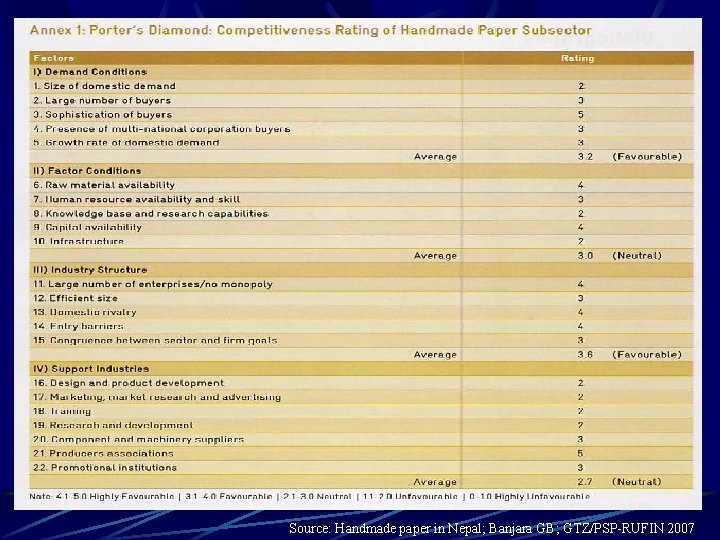
Source: Handmade paper in Nepal; Banjara GB; GTZ/PSP-RUFIN 2007
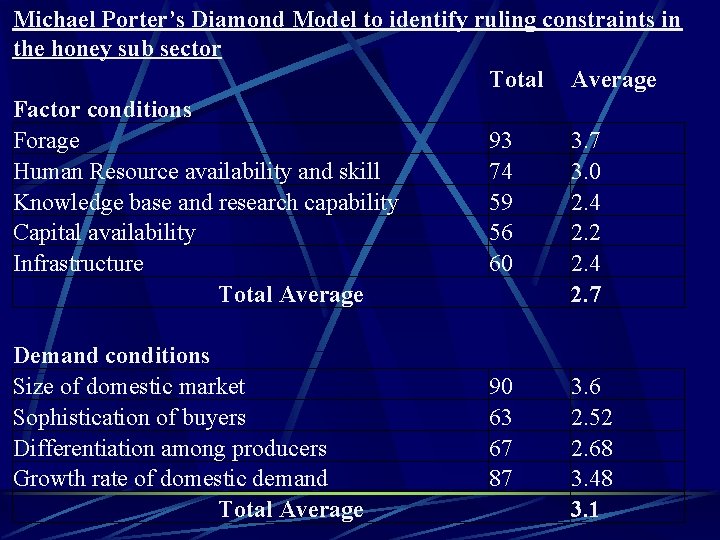
Michael Porter’s Diamond Model to identify ruling constraints in the honey sub sector Total Average Factor conditions Forage 93 3. 7 Human Resource availability and skill 74 3. 0 Knowledge base and research capability 59 2. 4 Capital availability 56 2. 2 Infrastructure 60 2. 4 Total Average 2. 7 Demand conditions Size of domestic market Sophistication of buyers Differentiation among producers Growth rate of domestic demand Total Average 90 63 67 87 3. 6 2. 52 2. 68 3. 48 3. 1
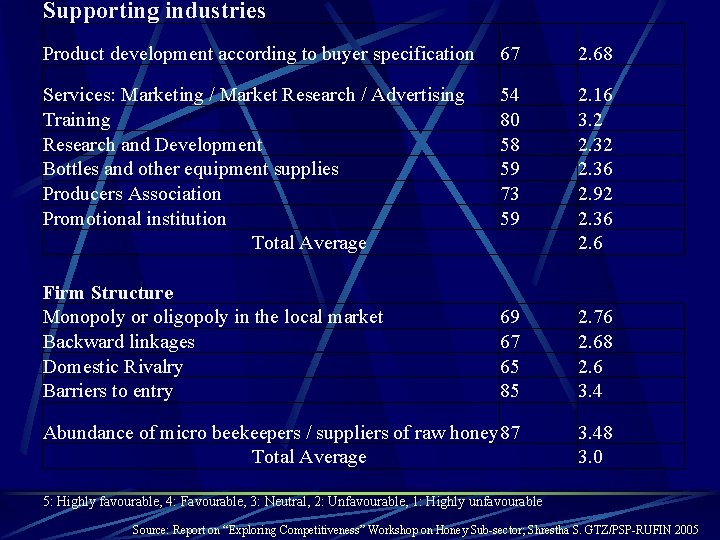
Supporting industries Product development according to buyer specification 67 2. 68 Services: Marketing / Market Research / Advertising Training Research and Development Bottles and other equipment supplies Producers Association Promotional institution Total Average 54 80 58 59 73 59 2. 16 3. 2 2. 36 2. 92 2. 36 2. 6 69 67 65 85 2. 76 2. 68 2. 6 3. 4 Abundance of micro beekeepers / suppliers of raw honey 87 Total Average 3. 48 3. 0 Firm Structure Monopoly or oligopoly in the local market Backward linkages Domestic Rivalry Barriers to entry 5: Highly favourable, 4: Favourable, 3: Neutral, 2: Unfavourable, 1: Highly unfavourable Source: Report on “Exploring Competitiveness” Workshop on Honey Sub-sector; Shrestha S. GTZ/PSP-RUFIN 2005
Implications for IB Location From profit perspective, it makes sense for a firm to disperse its productive activities to those countries where according to theory of international trade, can be performed efficiently • Result is global web of productive activities, with different activities being performed in different locations around the globe • First Mover Advantage • Firms establish first mover advantage with regard to the production of particular new product may subsequently dominate global trade in that product
Implications for IB First Mover Advantage • True in industries where the global market can profitably support only limited number of forms e. g. aerospace & also early commitments also seem to be important in less concentrated industries such as cellular phones Government Policy • Business can exert strong influence on government trade policy, lobbying to promote free trade or trade restrictions • In 1991 IBM & Apple protested strongly against intention of U. S. government to place tariff on Japanese imports of LCD screens • Restrictions on import of steel are result of direct pressure by U. S. firms on government
- Slides: 39