
International Trade in Agriculture Commodities n The principle
- Slides: 14
International Trade in Agriculture Commodities n The principle of comparative advantage - compare the opportunity costs of producing a commodity between the countries - we consider the cost of producing additional units of any one product in terms of reduction necessary in the output of other good - to produce additional units of crop x, the country has to rearrange its resources in such a way that it might have to relinquish the opportunity to produce some unit of crop y.
International Trade in Agriculture Commodities - import goods for which the international price is less than the domestic opportunity cost of producing an additional unit at home - export products for which the international price is higher than the domestic opportunity cost of producing an additional unit
International Trade in Agriculture Commodities n n International trade rests on possible difference among countries in the rates at which production of one item can be replaced by another through internal reallocation of resources Principle of comparative advantage is symmetrical.
International Trade of Ag. Commodities - Indian context n n Till 1990, international trade in agriculture commodities was perceived as residual phenomenon - Based on difference between domestic production and effective demand It was controlled by Govt. - quantitative restrictions: quotas, minimum export price - canalization: trade only through State Trading Corporations (STCs)
International Trade of Ag. Commodities - Indian context n Rationale for protected trade - to maintain the domestic prices of agriculture commodities at a level that are commensurate with average income - stability in domestic prices - balance of payment constraint
New Agriculture Trade Policy n n n All Agriculture imports other than cereals, oilseeds and edible oil have been decanalised All agricultural exports, except onion have been decanalised Pulses, paddy and coconut: licensing Sugar, cotton: quantitative ceilings Groundnuts, tobacco: minimum export price
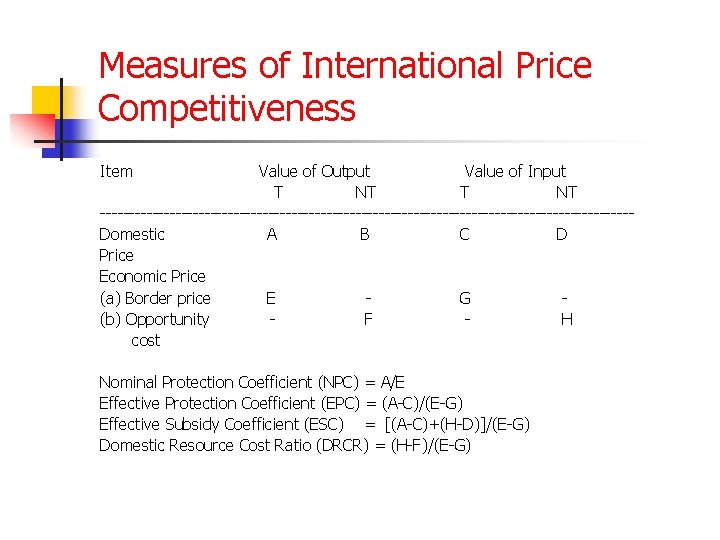
Measures of International Price Competitiveness Item Value of Output Value of Input T NT ----------------------------------------------Domestic A B C D Price Economic Price (a) Border price E G (b) Opportunity F H cost Nominal Protection Coefficient (NPC) = A/E Effective Protection Coefficient (EPC) = (A-C)/(E-G) Effective Subsidy Coefficient (ESC) = [(A-C)+(H-D)]/(E-G) Domestic Resource Cost Ratio (DRCR) = (H-F)/(E-G)
Border price n Exportable item: - the domestic good competes in a foreign port - relevant border price is f. o. b price (say at New York), net of the transportation cost (domestic and international), port clearance charges, marketing costs.
Border price n Importable items: - the competition is supposed to be taking place in a domestic port - relevant border price to be compared to farm gate price would be c. i. f price at our port plus port charges, domestic transport cost and other handling & marketing cost.
Nominal Protection Coefficient (NPC) n n A value of NPC greater than unity means government is protecting the commodity - (under free trade, the price would be lower) A positive value of (1 -NPC) would measure the degree of competitiveness of the commodity
Effective Protection Coefficient (EPC) n n n Calculation of EPC requires knowledge of input structure for the commodity In calculating the denomination of EPC, the border price of tradable inputs must always be calculated under the importable hypothesis. If value of EPC>NPC ? - the domestic processors cum traders are being accorded protection to tradable inputs through govt. policy as they are realizing higher profits as compared to free trade.
Effective Subsidy Coefficient (ESC) n n n Subsidies on non-tradable inputs (electricity, irrigation, credit) exist. It takes care of distortions in the markets of both tradable and nontradable inputs It is the most complex measure of competitive analysis
Domestic Resource Cost Ratio (DRCR) n n It computes the value of domestic primary and non-tradable resources in order to earn or save a unit of foreign exchange through production and exchange of the commodity A value of DRCR less than unity implies that the industry is using less of domestic nontradable resources as compared to value addition through use of tradable resources. - Hence the industry is said to be internationally competitive from the social welfare point of view.
Issues n n n Competitiveness (cost and quality) Robustness (sensitivity analysis) - international price (highly fluctuating) - international transport cost - domestic cost of cultivation Mechanisms to increase exportable surplus Impact on domestic economy – safety nets Benefit distribution