
International Trade Chapter 4 Nature of International trade


- Slides: 34
International Trade Chapter 4
Nature of International trade n n n International Trade – is the exchange of goods and services among nations. Imports – are goods and services purchased from other countries. Exports – are goods and services sold to other countries.
Section 4. 1 International Trade Nature of International Trade The principle of economic interdependence is fundamental to marketing in a global environment.
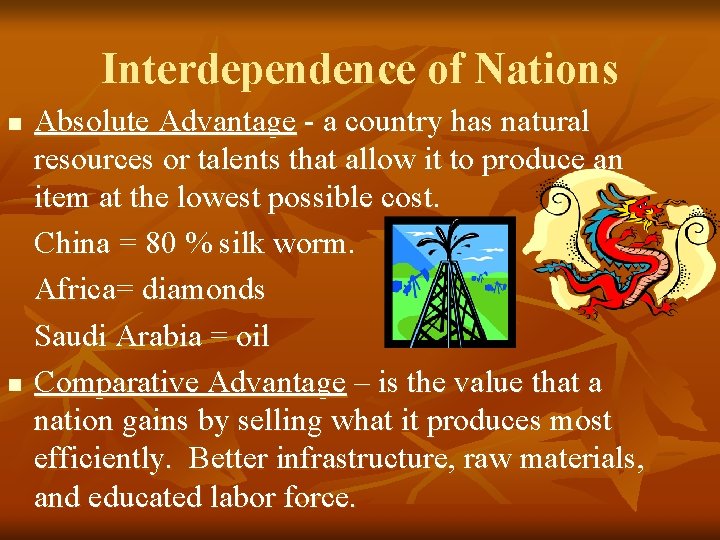
Interdependence of Nations n n Absolute Advantage - a country has natural resources or talents that allow it to produce an item at the lowest possible cost. China = 80 % silk worm. Africa= diamonds Saudi Arabia = oil Comparative Advantage – is the value that a nation gains by selling what it produces most efficiently. Better infrastructure, raw materials, and educated labor force.
Benefits of International Trade n n Consumers, workers, producers, and nations benefit from international trade in different ways. COMPETITION = lower prices, better products, variety of products. 1/3 of USA profits comes from international trade and foreign investments. Workers benefit from higher employment rates
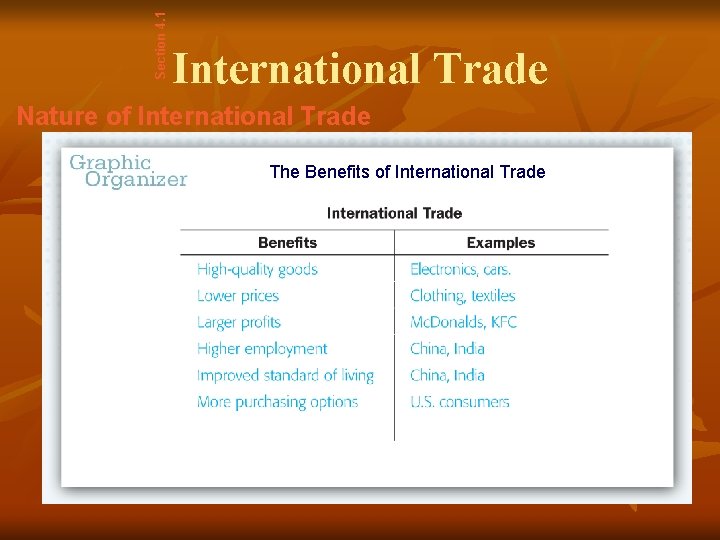
Section 4. 1 International Trade Nature of International Trade The Benefits of International Trade
Government Involvement in International Trade n n Balance of Trade – the difference between exports and imports. Trade Surplus = nation exports more than imports. Trade Deficit = nation imports more than exports. Negative Consequences of Trade Deficit = reduces a nations revenue. More money leaves the country.
Government Involvement in International Trade Barriers Free Trade = commercial exchange between nations that is conducted on free market principles, without restrictive regulations. However, to limit trade, countries impose barriers n
Trade Barriers 1) Tariffs n n Tariffs – (sometimes called a duty) is a tax on imports. Revenue producing tariffs first used around 1913 before income taxes. . Discourage trade or make prices/competition fairer = protective tariff.
Trade Barriers 2) Quotas n n Quotas – limits either the quantity or the monetary value of a product that may be imported. Sometimes a country may try to improve relations with another country by placing a quota on itself.
Trade Barriers 3) Embargos n n Embargos – a total ban on specific goods coming into and leaving a country. Can impose an embargo for health reasons. Grapes in 1989 due to poisoned fruit found during inspection. Mad Cow disease Political = CUBA
Trade Barriers Political & Economic Consequences n Protectionism – economic policies to protect domestic industries. Protectionism is the opposite of free trade. n Imposing tariffs and quotas is one method of practicing protectionism. n n Subsides – subsidizing domestic companies allowing them to be more competitive
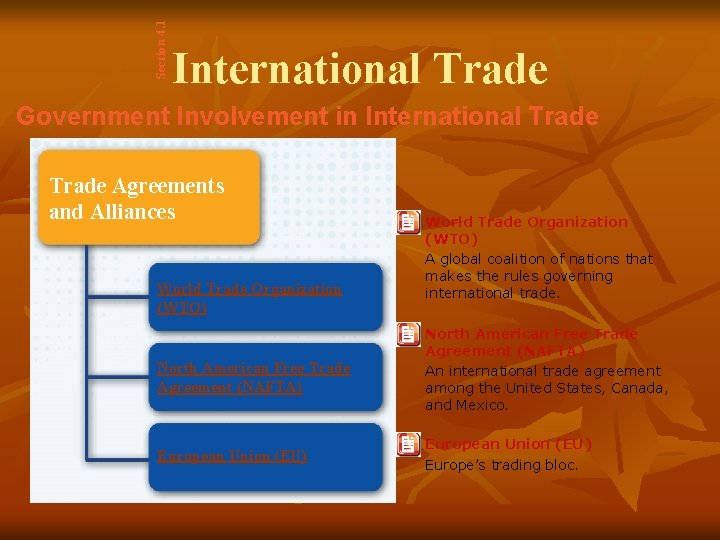
Section 4. 1 International Trade Government Involvement in International Trade Agreements and Alliances World Trade Organization (WTO) North American Free Trade Agreement (NAFTA) European Union (EU) World Trade Organization (WTO) A global coalition of nations that makes the rules governing international trade. North American Free Trade Agreement (NAFTA) An international trade agreement among the United States, Canada, and Mexico. European Union (EU) Europe’s trading bloc.
Trade Agreement and Alliances n 1. n n Governments make agreements with each other. WORLD TRADE ORGANIZATION (WTO) 148 members as of Oct 2004. Reduce tariffs and have a common set of trade rules. Creates a borderless economy. Set of rules that are universally accepted Critics of WTO raise concerns about democracy labor rights and the environment.
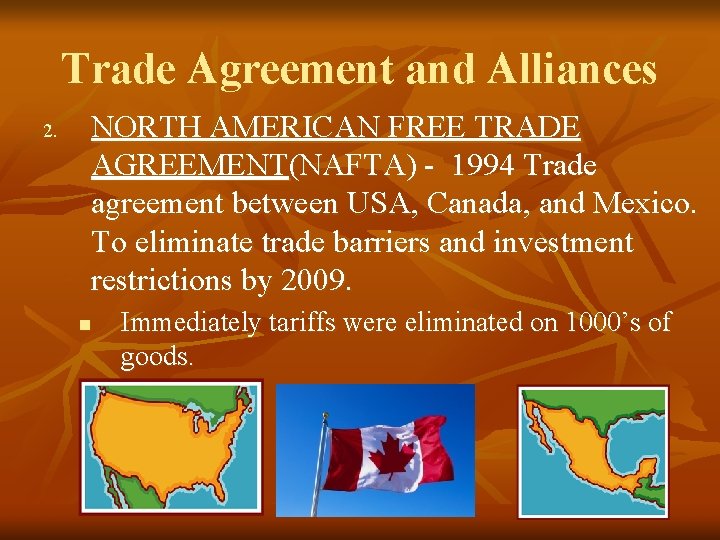
Trade Agreement and Alliances 2. NORTH AMERICAN FREE TRADE AGREEMENT(NAFTA) - 1994 Trade agreement between USA, Canada, and Mexico. To eliminate trade barriers and investment restrictions by 2009. n Immediately tariffs were eliminated on 1000’s of goods.
Trade Agreement and Alliances 3. n n EUROPEAN UNION (EU) – 1992 Europe’s trading bloc. 1992 Maastrricht Treaty created the EU to establish free trade among the member nations. Establish and conform to the political, economical, and legal standards. In 2004 ten new members joined including Poland, Hungary, the Czech Republic, and the Slovak Republic.
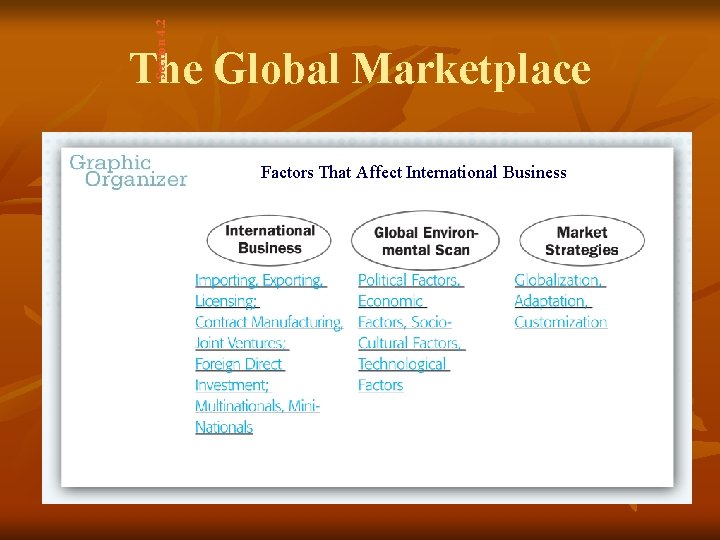
Section 4. 2 The Global Marketplace Factors That Affect International Business
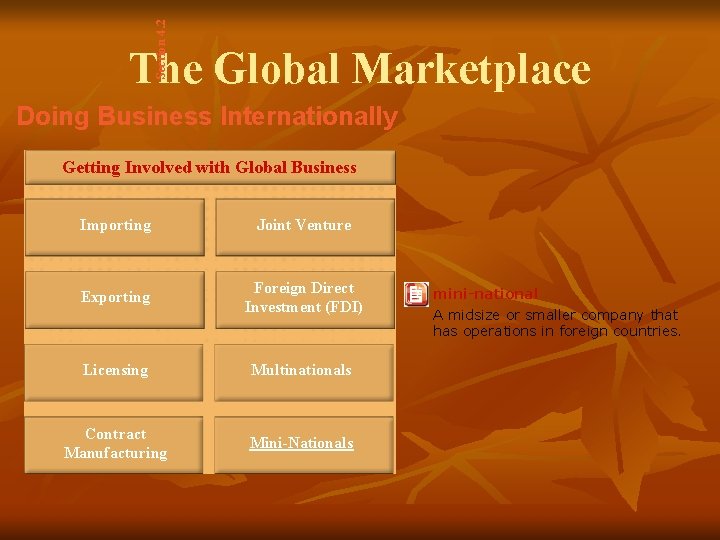
Section 4. 2 The Global Marketplace Doing Business Internationally Getting Involved with Global Business Importing Joint Venture Exporting Foreign Direct Investment (FDI) Licensing Multinationals Contract Manufacturing Mini-Nationals mini-national A midsize or smaller company that has operations in foreign countries.
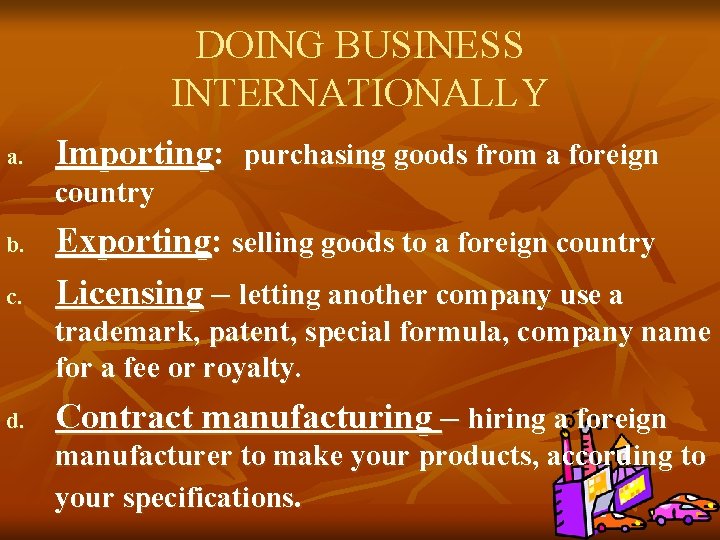
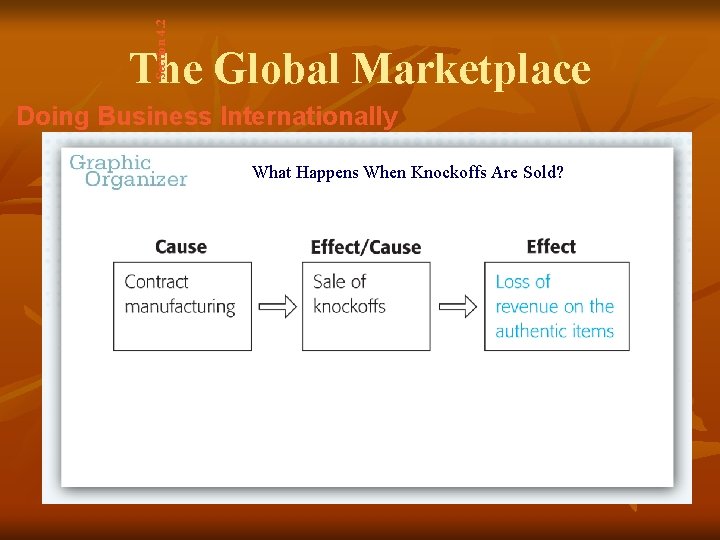
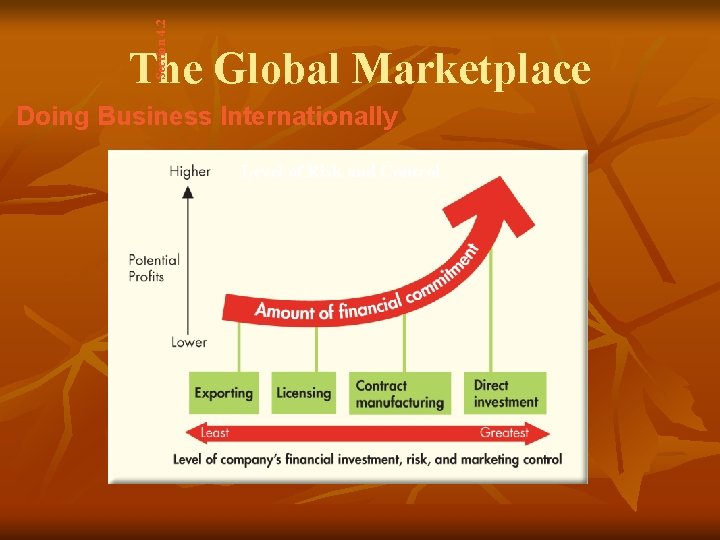
DOING BUSINESS INTERNATIONALLY a. Importing: purchasing goods from a foreign country b. c. Exporting: selling goods to a foreign country Licensing – letting another company use a trademark, patent, special formula, company name for a fee or royalty. d. Contract manufacturing – hiring a foreign manufacturer to make your products, according to your specifications.
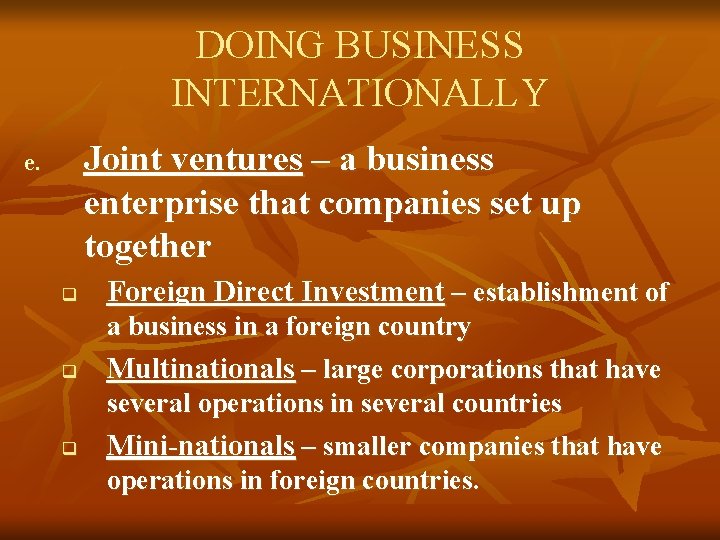
DOING BUSINESS INTERNATIONALLY Joint ventures – a business enterprise that companies set up together e. q q q Foreign Direct Investment – establishment of a business in a foreign country Multinationals – large corporations that have several operations in several countries Mini-nationals – smaller companies that have operations in foreign countries.
Section 4. 2 The Global Marketplace Doing Business Internationally What Happens When Knockoffs Are Sold?
Section 4. 2 The Global Marketplace Doing Business Internationally Level of Risk and Control
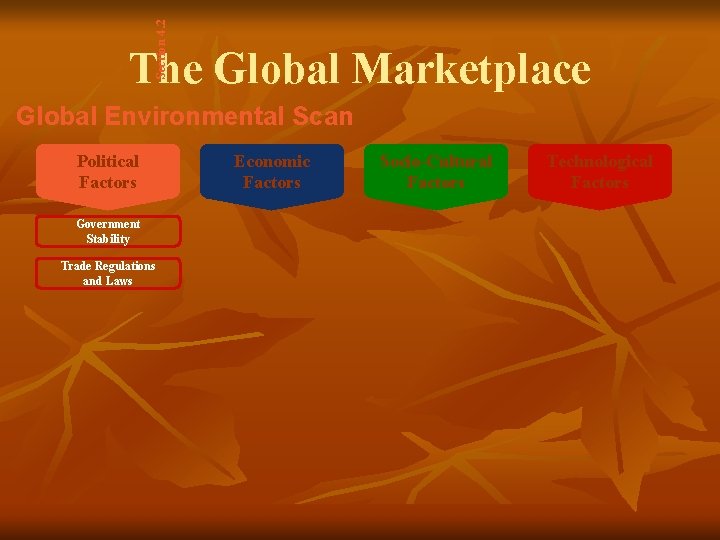
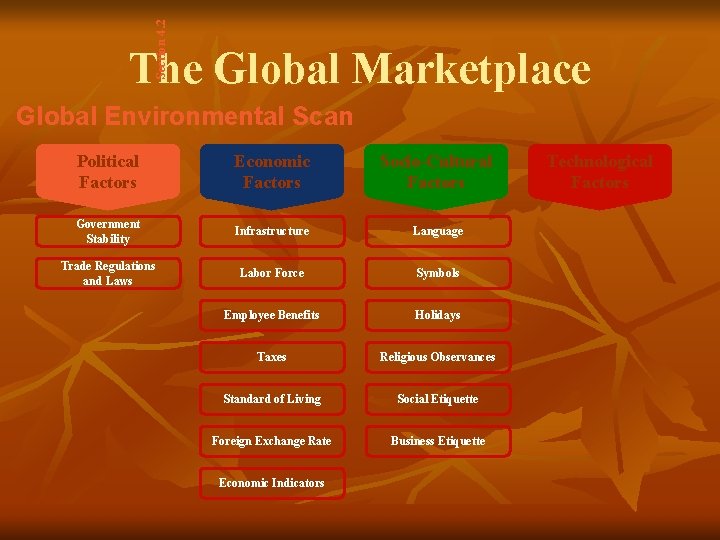
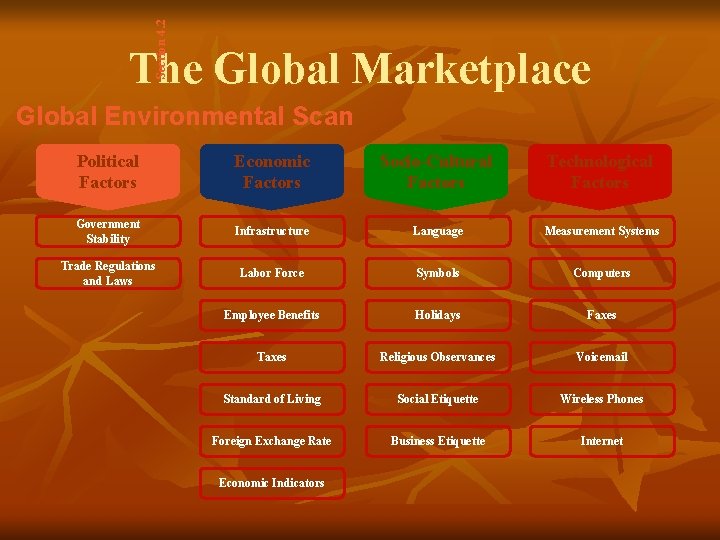
Section 4. 2 The Global Marketplace Global Environmental Scan Political Factors Government Stability Trade Regulations and Laws Economic Factors Socio-Cultural Factors Technological Factors
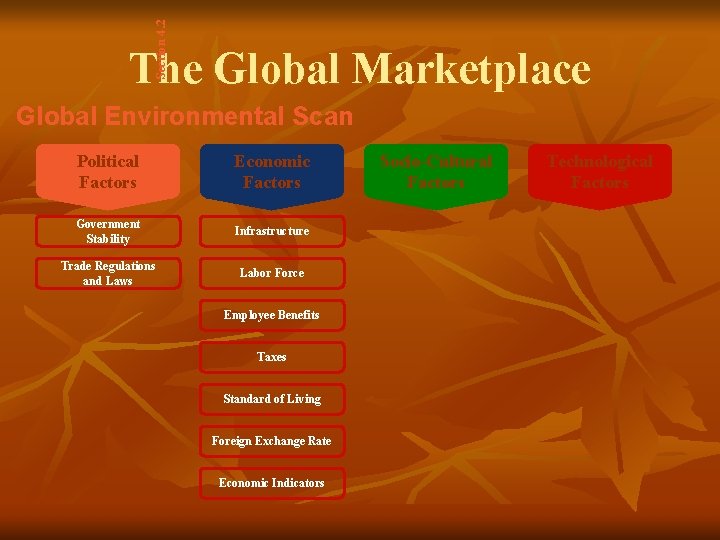
Section 4. 2 The Global Marketplace Global Environmental Scan Political Factors Economic Factors Government Stability Infrastructure Trade Regulations and Laws Labor Force Employee Benefits Taxes Standard of Living Foreign Exchange Rate Economic Indicators Socio-Cultural Factors Technological Factors
Section 4. 2 The Global Marketplace Global Environmental Scan Political Factors Economic Factors Socio-Cultural Factors Government Stability Infrastructure Language Trade Regulations and Laws Labor Force Symbols Employee Benefits Holidays Taxes Religious Observances Standard of Living Social Etiquette Foreign Exchange Rate Business Etiquette Economic Indicators Technological Factors
Section 4. 2 The Global Marketplace Global Environmental Scan Political Factors Economic Factors Socio-Cultural Factors Technological Factors Government Stability Infrastructure Language Measurement Systems Trade Regulations and Laws Labor Force Symbols Computers Employee Benefits Holidays Faxes Taxes Religious Observances Voicemail Standard of Living Social Etiquette Wireless Phones Foreign Exchange Rate Business Etiquette Internet Economic Indicators
GLOBAL MARKETING STRATEGIES Globalization – selling the same product and using the same promotion methods in all countries. (Product is sold as is)
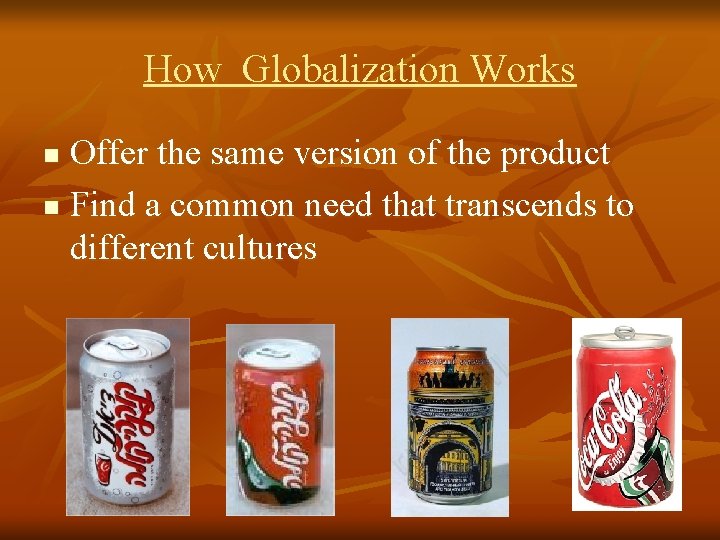
How Globalization Works Offer the same version of the product n Find a common need that transcends to different cultures n
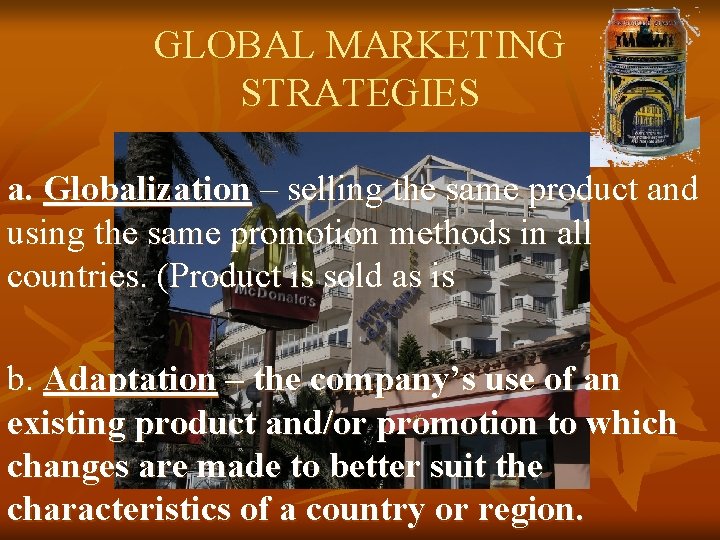
GLOBAL MARKETING STRATEGIES a. Globalization – selling the same product and using the same promotion methods in all countries. (Product is sold as is b. Adaptation – the company’s use of an existing product and/or promotion to which changes are made to better suit the characteristics of a country or region.
GLOBAL MARKETING STRATEGIES c. Customization – Creating of an entirely new product for a specific foreign market. e. g. Coca-Cola developed the Smart brand specifically for the Chinese market.
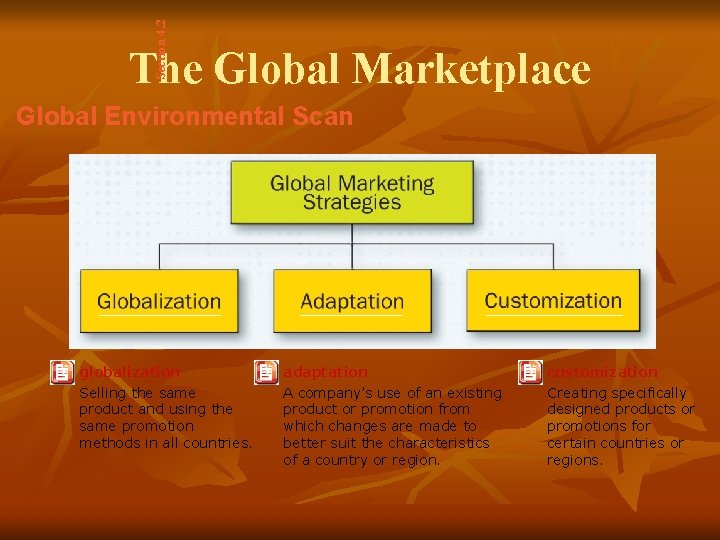
Section 4. 2 The Global Marketplace Global Environmental Scan globalization Selling the same product and using the same promotion methods in all countries. adaptation A company’s use of an existing product or promotion from which changes are made to better suit the characteristics of a country or region. customization Creating specifically designed products or promotions for certain countries or regions.
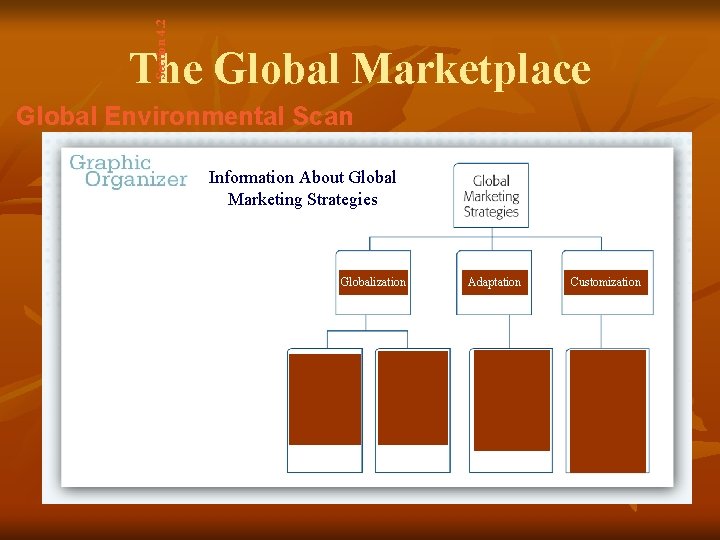
Section 4. 2 The Global Marketplace Global Environmental Scan Information About Global Marketing Strategies Globalization Adaptation Customization
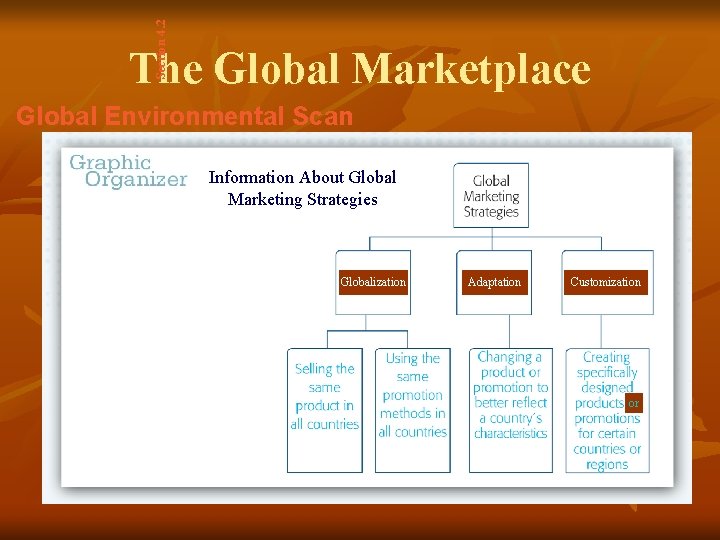
Section 4. 2 The Global Marketplace Global Environmental Scan Information About Global Marketing Strategies Globalization Adaptation Customization or