
International Symposium on Multiparticle Dynamics 22 Years Many



- Slides: 29
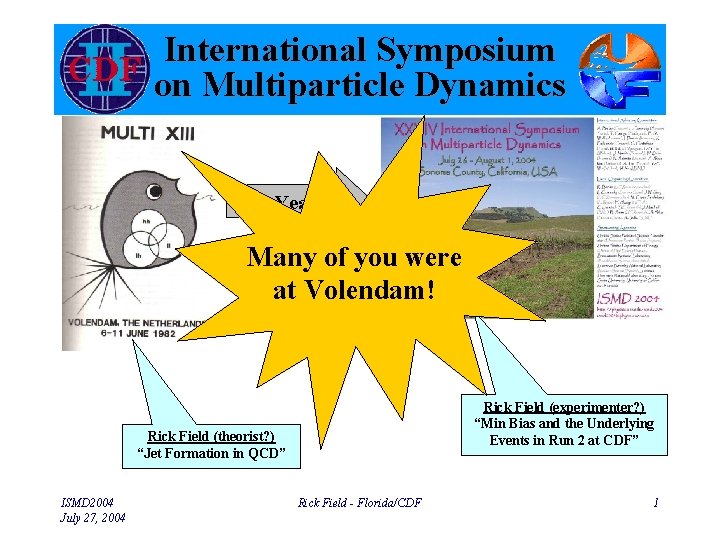
International Symposium on Multiparticle Dynamics 22 Years! Many of you were at Volendam! Rick Field (experimenter? ) “Min Bias and the Underlying Events in Run 2 at CDF” Rick Field (theorist? ) “Jet Formation in QCD” ISMD 2004 July 27, 2004 Rick Field - Florida/CDF 1
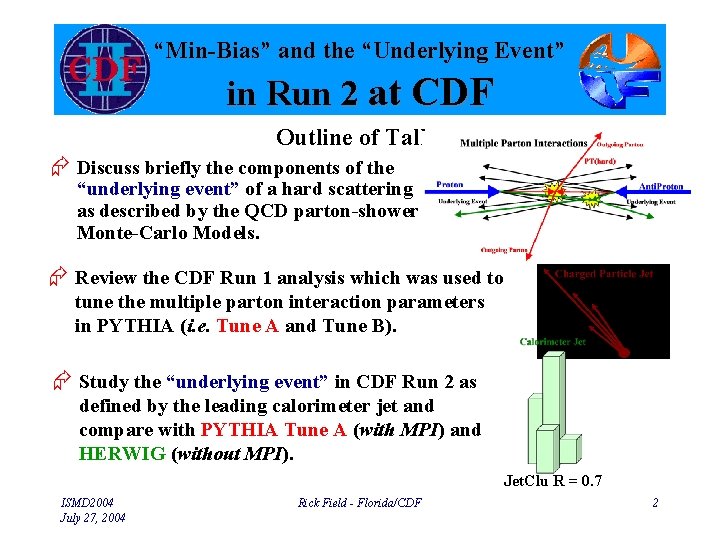
“Min-Bias” and the “Underlying Event” in Run 2 at CDF Outline of Talk Æ Discuss briefly the components of the “underlying event” of a hard scattering as described by the QCD parton-shower Monte-Carlo Models. Æ Review the CDF Run 1 analysis which was used to tune the multiple parton interaction parameters in PYTHIA (i. e. Tune A and Tune B). Æ Study the “underlying event” in CDF Run 2 as defined by the leading calorimeter jet and compare with PYTHIA Tune A (with MPI) and HERWIG (without MPI). Jet. Clu R = 0. 7 ISMD 2004 July 27, 2004 Rick Field - Florida/CDF 2
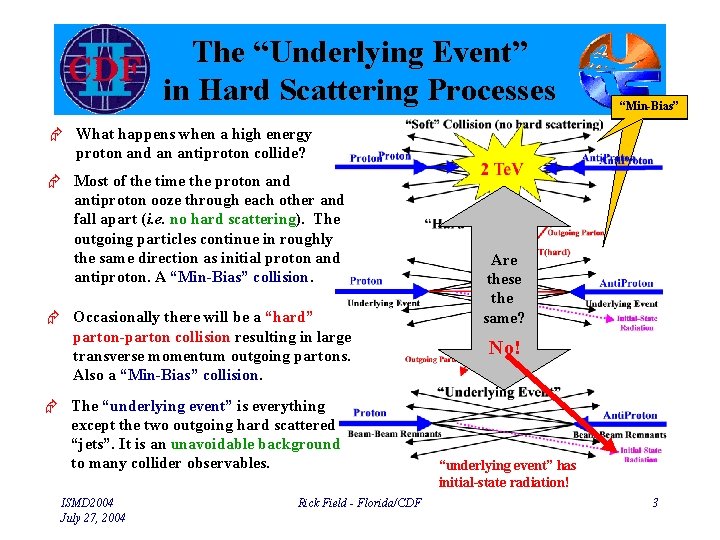
The “Underlying Event” in Hard Scattering Processes “Min-Bias” Æ What happens when a high energy proton and an antiproton collide? Æ Most of the time the proton and antiproton ooze through each other and fall apart (i. e. no hard scattering). The outgoing particles continue in roughly the same direction as initial proton and antiproton. A “Min-Bias” collision. Æ Occasionally there will be a “hard” parton-parton collision resulting in large transverse momentum outgoing partons. Also a “Min-Bias” collision. Æ The “underlying event” is everything except the two outgoing hard scattered “jets”. It is an unavoidable background to many collider observables. ISMD 2004 July 27, 2004 Rick Field - Florida/CDF Are these the same? No! “underlying event” has initial-state radiation! 3
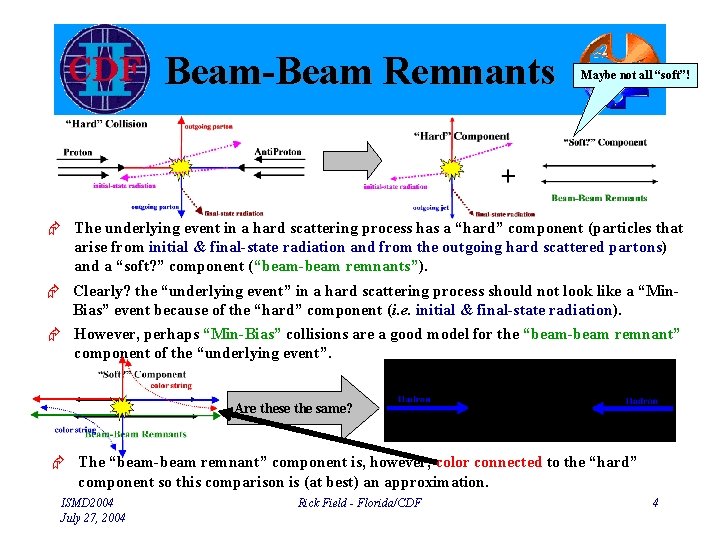
Beam-Beam Remnants Maybe not all “soft”! Æ The underlying event in a hard scattering process has a “hard” component (particles that arise from initial & final-state radiation and from the outgoing hard scattered partons) and a “soft? ” component (“beam-beam remnants”). Æ Clearly? the “underlying event” in a hard scattering process should not look like a “Min. Bias” event because of the “hard” component (i. e. initial & final-state radiation). Æ However, perhaps “Min-Bias” collisions are a good model for the “beam-beam remnant” component of the “underlying event”. Are these the same? Æ The “beam-beam remnant” component is, however, color connected to the “hard” component so this comparison is (at best) an approximation. ISMD 2004 July 27, 2004 Rick Field - Florida/CDF 4
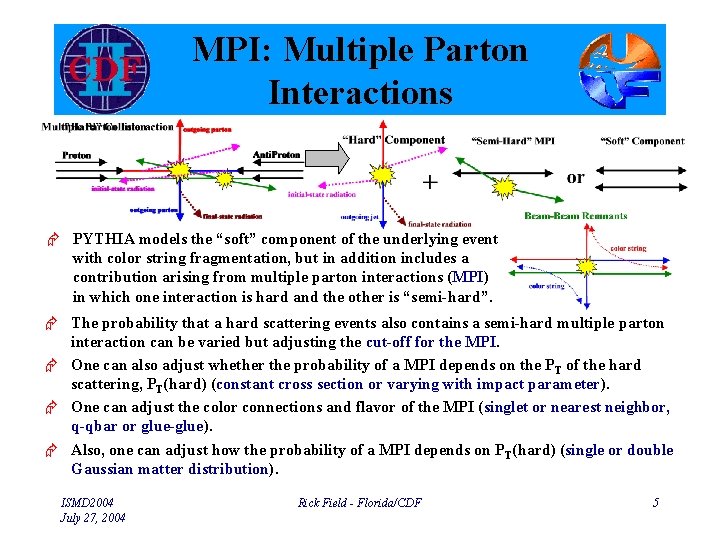
MPI: Multiple Parton Interactions Æ PYTHIA models the “soft” component of the underlying event with color string fragmentation, but in addition includes a contribution arising from multiple parton interactions (MPI) in which one interaction is hard and the other is “semi-hard”. Æ The probability that a hard scattering events also contains a semi-hard multiple parton interaction can be varied but adjusting the cut-off for the MPI. Æ One can also adjust whether the probability of a MPI depends on the PT of the hard scattering, PT(hard) (constant cross section or varying with impact parameter). Æ One can adjust the color connections and flavor of the MPI (singlet or nearest neighbor, q-qbar or glue-glue). Æ Also, one can adjust how the probability of a MPI depends on PT(hard) (single or double Gaussian matter distribution). ISMD 2004 July 27, 2004 Rick Field - Florida/CDF 5
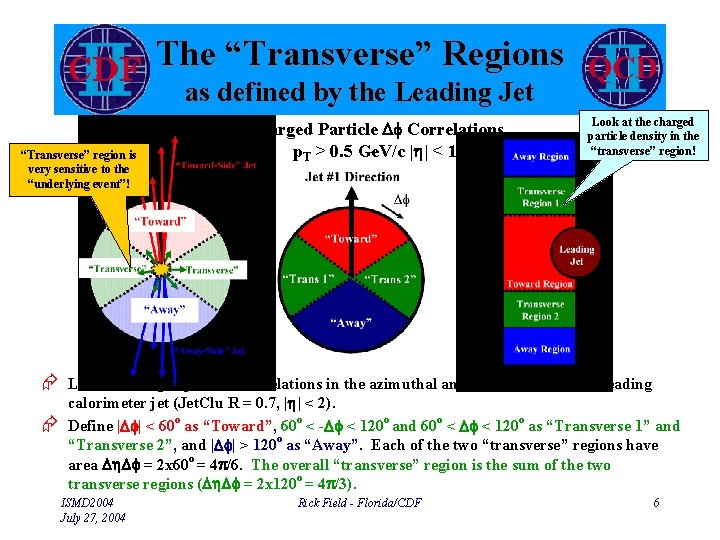
The “Transverse” Regions as defined by the Leading Jet “Transverse” region is very sensitive to the “underlying event”! Charged Particle Df Correlations p. T > 0. 5 Ge. V/c |h| < 1 Look at the charged particle density in the “transverse” region! Æ Look at charged particle correlations in the azimuthal angle Df relative to the leading Æ calorimeter jet (Jet. Clu R = 0. 7, |h| < 2). Define |Df| < 60 o as “Toward”, 60 o < -Df < 120 o and 60 o < Df < 120 o as “Transverse 1” and “Transverse 2”, and |Df| > 120 o as “Away”. Each of the two “transverse” regions have area Dh. Df = 2 x 60 o = 4 p/6. The overall “transverse” region is the sum of the two transverse regions (Dh. Df = 2 x 120 o = 4 p/3). ISMD 2004 July 27, 2004 Rick Field - Florida/CDF 6
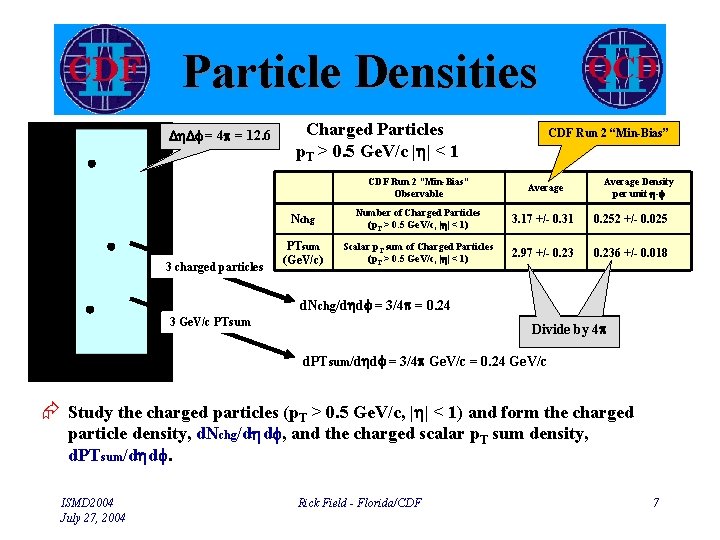
Particle Densities Dh. Df = 4 p = 12. 6 31 charged particles particle Charged Particles p. T > 0. 5 Ge. V/c |h| < 1 CDF Run 2 “Min-Bias” Observable Average Density per unit h-f Nchg Number of Charged Particles (p. T > 0. 5 Ge. V/c, |h| < 1) 3. 17 +/- 0. 31 0. 252 +/- 0. 025 PTsum (Ge. V/c) Scalar p. T sum of Charged Particles (p. T > 0. 5 Ge. V/c, |h| < 1) 2. 97 +/- 0. 236 +/- 0. 018 chg/dhdf = 1/4 p 3/4 p = 0. 08 0. 24 d. Nchg 13 Ge. V/c PTsum Divide by 4 p d. PTsum/dhdf = 1/4 p 3/4 p Ge. V/c = 0. 08 0. 24 Ge. V/c Æ Study the charged particles (p. T > 0. 5 Ge. V/c, |h| < 1) and form the charged particle density, d. Nchg/dhdf, and the charged scalar p. T sum density, d. PTsum/dhdf. ISMD 2004 July 27, 2004 Rick Field - Florida/CDF 7
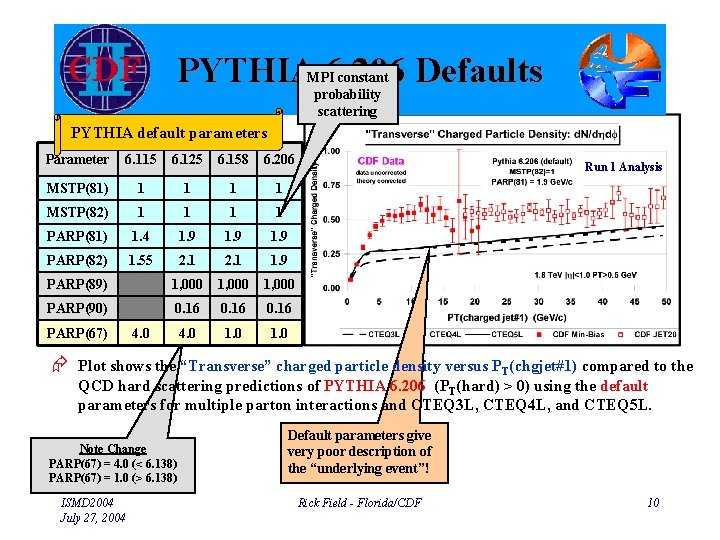
PYTHIA 6. 206 Defaults MPI constant probability scattering PYTHIA default parameters Parameter 6. 115 6. 125 6. 158 6. 206 MSTP(81) 1 1 MSTP(82) 1 1 PARP(81) 1. 4 1. 9 PARP(82) 1. 55 2. 1 1. 9 PARP(89) 1, 000 PARP(90) 0. 16 4. 0 1. 0 PARP(67) 4. 0 Run 1 Analysis Æ Plot shows the “Transverse” charged particle density versus PT(chgjet#1) compared to the QCD hard scattering predictions of PYTHIA 6. 206 (PT(hard) > 0) using the default parameters for multiple parton interactions and CTEQ 3 L, CTEQ 4 L, and CTEQ 5 L. Note Change PARP(67) = 4. 0 (< 6. 138) PARP(67) = 1. 0 (> 6. 138) ISMD 2004 July 27, 2004 Default parameters give very poor description of the “underlying event”! Rick Field - Florida/CDF 10
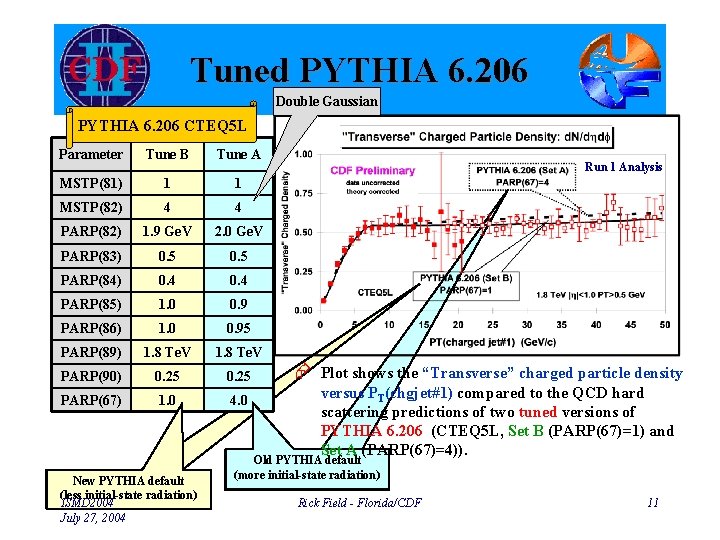
Tuned PYTHIA 6. 206 Double Gaussian PYTHIA 6. 206 CTEQ 5 L Parameter Tune B Tune A MSTP(81) 1 1 MSTP(82) 4 4 PARP(82) 1. 9 Ge. V 2. 0 Ge. V PARP(83) 0. 5 PARP(84) 0. 4 PARP(85) 1. 0 0. 9 PARP(86) 1. 0 0. 95 PARP(89) 1. 8 Te. V PARP(90) 0. 25 PARP(67) 1. 0 4. 0 New PYTHIA default (less initial-state radiation) ISMD 2004 July 27, 2004 Run 1 Analysis Æ Plot shows the “Transverse” charged particle density versus PT(chgjet#1) compared to the QCD hard scattering predictions of two tuned versions of PYTHIA 6. 206 (CTEQ 5 L, Set B (PARP(67)=1) and Set A (PARP(67)=4)). Old PYTHIA default (more initial-state radiation) Rick Field - Florida/CDF 11
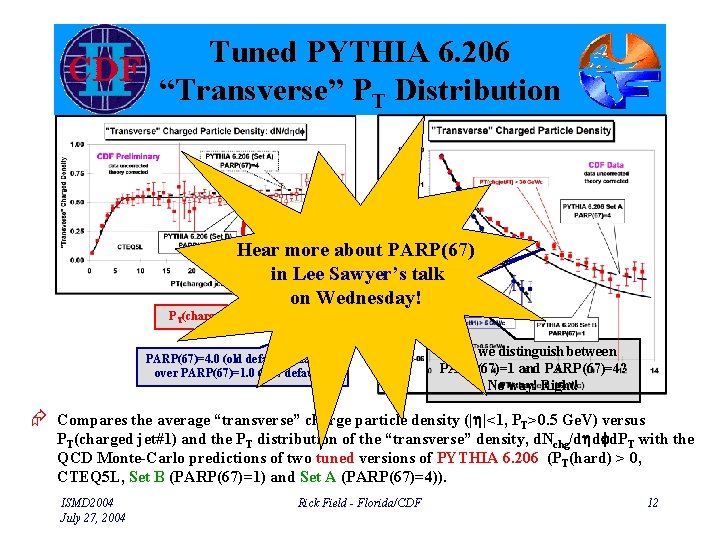
Tuned PYTHIA 6. 206 “Transverse” PT Distribution Hear more about PARP(67) in Lee Sawyer’s talk on Wednesday! PT(charged jet#1) > 30 Ge. V/c PARP(67)=4. 0 (old default) is favored over PARP(67)=1. 0 (new default)! Can we distinguish between PARP(67)=1 and PARP(67)=4? No way! Right! Æ Compares the average “transverse” charge particle density (|h|<1, PT>0. 5 Ge. V) versus PT(charged jet#1) and the PT distribution of the “transverse” density, d. Nchg/dhdfd. PT with the QCD Monte-Carlo predictions of two tuned versions of PYTHIA 6. 206 (PT(hard) > 0, CTEQ 5 L, Set B (PARP(67)=1) and Set A (PARP(67)=4)). ISMD 2004 July 27, 2004 Rick Field - Florida/CDF 12
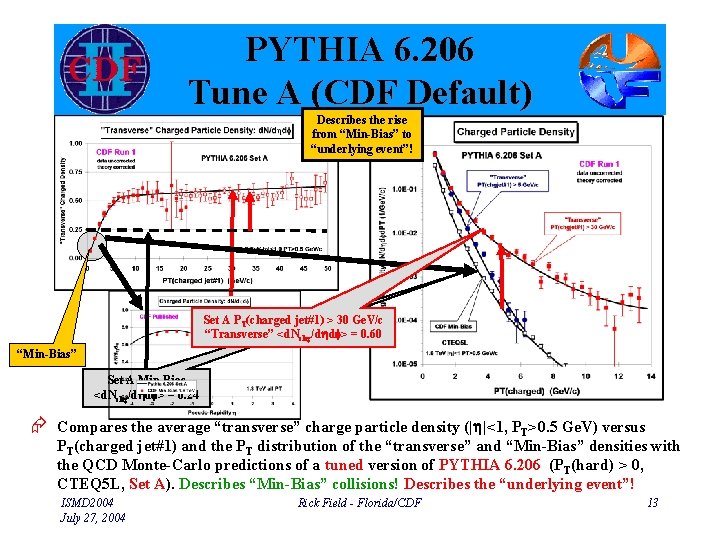
PYTHIA 6. 206 Tune A (CDF Default) Describes the rise from “Min-Bias” to “underlying event”! Set A PT(charged jet#1) > 30 Ge. V/c “Transverse” <d. Nchg/dhdf> = 0. 60 “Min-Bias” Set A Min-Bias <d. Nchg/dhdf> = 0. 24 Æ Compares the average “transverse” charge particle density (|h|<1, PT>0. 5 Ge. V) versus PT(charged jet#1) and the PT distribution of the “transverse” and “Min-Bias” densities with the QCD Monte-Carlo predictions of a tuned version of PYTHIA 6. 206 (PT(hard) > 0, CTEQ 5 L, Set A). Describes “Min-Bias” collisions! Describes the “underlying event”! ISMD 2004 July 27, 2004 Rick Field - Florida/CDF 13
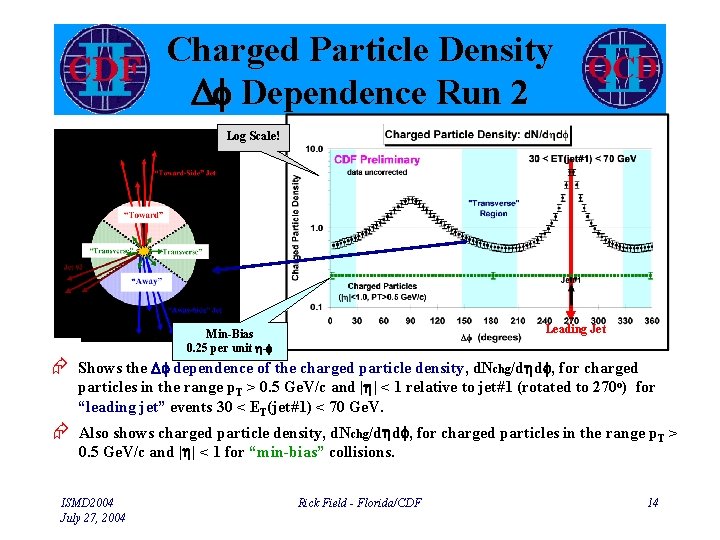
Charged Particle Density Df Dependence Run 2 Log Scale! Leading Jet Min-Bias 0. 25 per unit h-f Æ Shows the Df dependence of the charged particle density, d. Nchg/dhdf, for charged particles in the range p. T > 0. 5 Ge. V/c and |h| < 1 relative to jet#1 (rotated to 270 o) for “leading jet” events 30 < ET(jet#1) < 70 Ge. V. Æ Also shows charged particle density, d. Nchg/dhdf, for charged particles in the range p. T > 0. 5 Ge. V/c and |h| < 1 for “min-bias” collisions. ISMD 2004 July 27, 2004 Rick Field - Florida/CDF 14
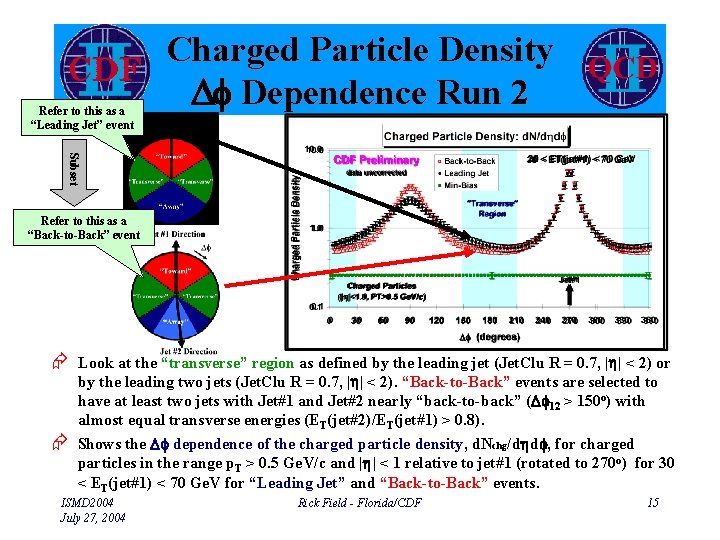
Refer to this as a “Leading Jet” event Charged Particle Density Df Dependence Run 2 Subset Refer to this as a “Back-to-Back” event Æ Look at the “transverse” region as defined by the leading jet (Jet. Clu R = 0. 7, |h| < 2) or Æ by the leading two jets (Jet. Clu R = 0. 7, |h| < 2). “Back-to-Back” events are selected to have at least two jets with Jet#1 and Jet#2 nearly “back-to-back” (Df 12 > 150 o) with almost equal transverse energies (ET(jet#2)/ET(jet#1) > 0. 8). Shows the Df dependence of the charged particle density, d. Nchg/dhdf, for charged particles in the range p. T > 0. 5 Ge. V/c and |h| < 1 relative to jet#1 (rotated to 270 o) for 30 < ET(jet#1) < 70 Ge. V for “Leading Jet” and “Back-to-Back” events. ISMD 2004 July 27, 2004 Rick Field - Florida/CDF 15
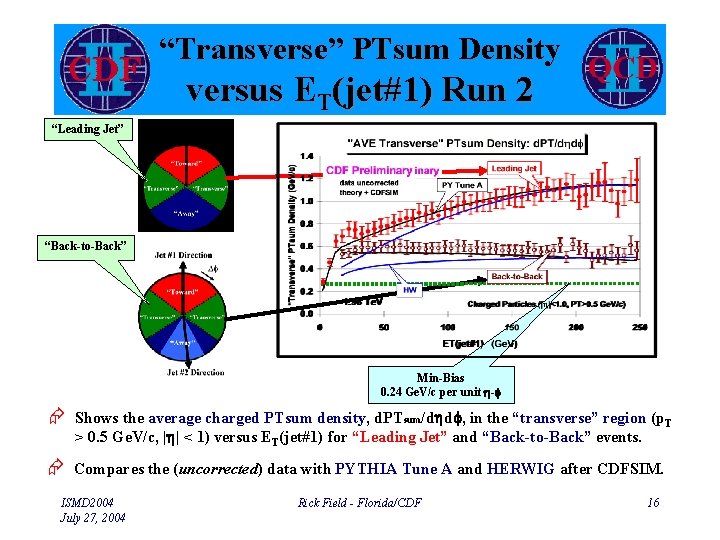
“Transverse” PTsum Density versus ET(jet#1) Run 2 “Leading Jet” “Back-to-Back” Min-Bias 0. 24 Ge. V/c per unit h-f Æ Shows the average charged PTsum density, d. PTsum/dhdf, in the “transverse” region (p. T > 0. 5 Ge. V/c, |h| < 1) versus ET(jet#1) for “Leading Jet” and “Back-to-Back” events. Æ Compares the (uncorrected) data with PYTHIA Tune A and HERWIG after CDFSIM. ISMD 2004 July 27, 2004 Rick Field - Florida/CDF 16
“Trans. MIN” PTsum Density versus ET(jet#1) “Leading Jet” “Back-to-Back” “trans. MIN” is very sensitive to the “beam-beam remnant” component of the “underlying event”! Æ Use the leading jet to define the MAX and MIN “transverse” regions on an event-byevent basis with MAX (MIN) having the largest (smallest) charged particle density. Æ Shows the “trans. MIN” charge particle density, d. Nchg/dhdf, for p. T > 0. 5 Ge. V/c, |h| < 1 versus ET(jet#1) for “Leading Jet” and “Back-to-Back” events. ISMD 2004 July 27, 2004 Rick Field - Florida/CDF 17
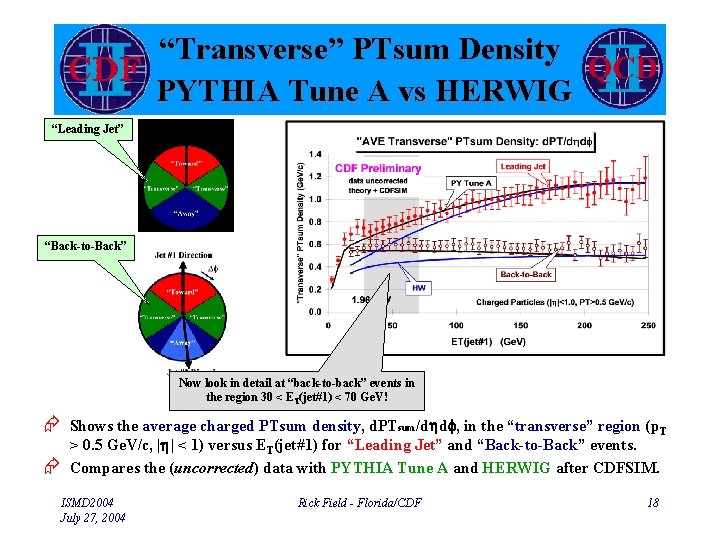
“Transverse” PTsum Density PYTHIA Tune A vs HERWIG “Leading Jet” “Back-to-Back” Now look in detail at “back-to-back” events in the region 30 < ET(jet#1) < 70 Ge. V! Æ Shows the average charged PTsum density, d. PTsum/dhdf, in the “transverse” region (p. T Æ > 0. 5 Ge. V/c, |h| < 1) versus ET(jet#1) for “Leading Jet” and “Back-to-Back” events. Compares the (uncorrected) data with PYTHIA Tune A and HERWIG after CDFSIM. ISMD 2004 July 27, 2004 Rick Field - Florida/CDF 18
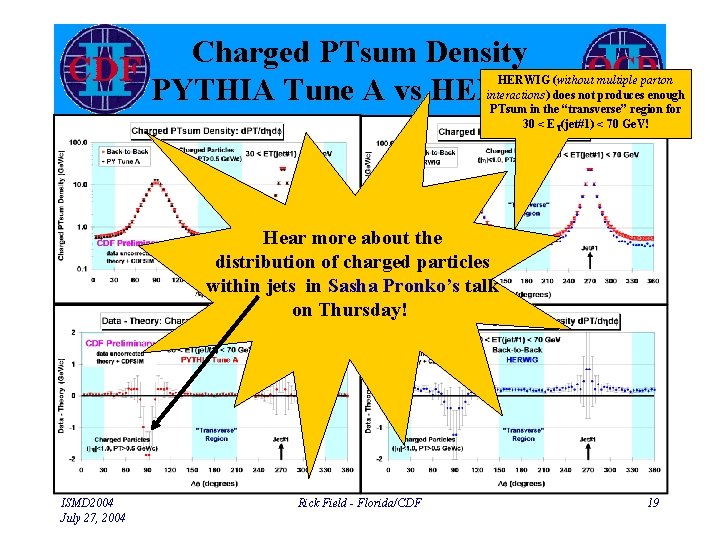
Charged PTsum Density PYTHIA Tune A vs HERWIG (without multiple parton interactions) does not produces enough PTsum in the “transverse” region for 30 < ET(jet#1) < 70 Ge. V! Hear more about the distribution of charged particles within jets in Sasha Pronko’s talk on Thursday! ISMD 2004 July 27, 2004 Rick Field - Florida/CDF 19
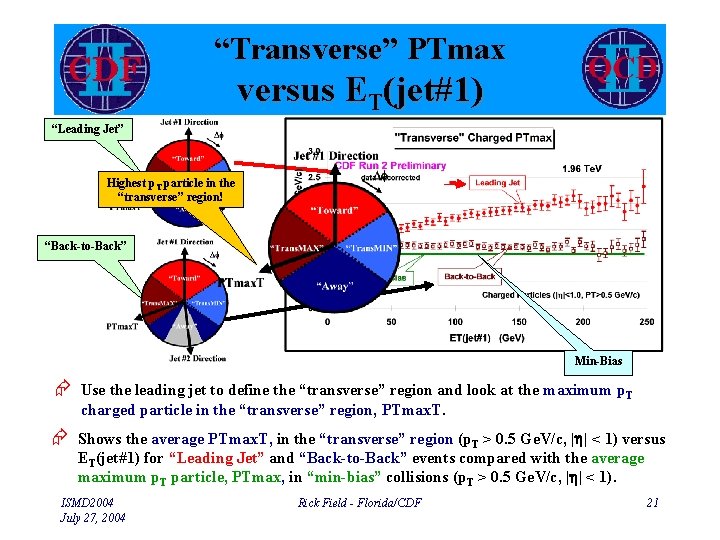
“Transverse” PTmax versus ET(jet#1) “Leading Jet” Highest p. T particle in the “transverse” region! “Back-to-Back” Min-Bias Æ Use the leading jet to define the “transverse” region and look at the maximum p. T charged particle in the “transverse” region, PTmax. T. Æ Shows the average PTmax. T, in the “transverse” region (p. T > 0. 5 Ge. V/c, |h| < 1) versus ET(jet#1) for “Leading Jet” and “Back-to-Back” events compared with the average maximum p. T particle, PTmax, in “min-bias” collisions (p. T > 0. 5 Ge. V/c, |h| < 1). ISMD 2004 July 27, 2004 Rick Field - Florida/CDF 21
Min-Bias “Associated” Highest p. T charged particle! Charged Particle Density “Associated” densities do not include PTmax! Æ Use the maximum p. T charged particle in the event, PTmax, to define a direction and Æ look at the “associated” density, d. Nchg/dhdf. Shows the data on the Df dependence of the “associated” charged particle density, d. Nchg/dhdf, for charged particles (p. T > 0. 5 Ge. V/c, |h| < 1, not including PTmax) relative to PTmax (rotated to 180 o) for “min-bias” events. Also shown is the average charged particle density, d. Nchg/dhdf, for “min-bias” events. ISMD 2004 July 27, 2004 Rick Field - Florida/CDF 22
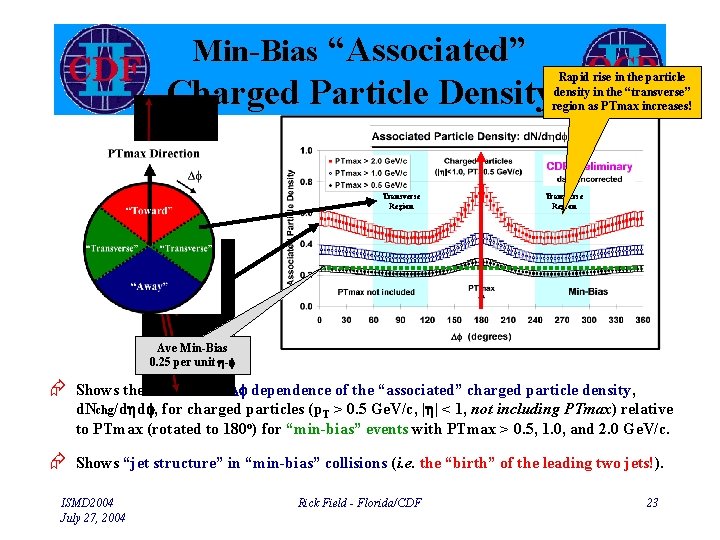
Min-Bias “Associated” Rapid rise in the particle density in the “transverse” region as PTmax increases! Charged Particle Density Transverse Region Ave Min-Bias 0. 25 per unit h-f Æ Shows the data on the Df dependence of the “associated” charged particle density, d. Nchg/dhdf, for charged particles (p. T > 0. 5 Ge. V/c, |h| < 1, not including PTmax) relative to PTmax (rotated to 180 o) for “min-bias” events with PTmax > 0. 5, 1. 0, and 2. 0 Ge. V/c. Æ Shows “jet structure” in “min-bias” collisions (i. e. the “birth” of the leading two jets!). ISMD 2004 July 27, 2004 Rick Field - Florida/CDF 23
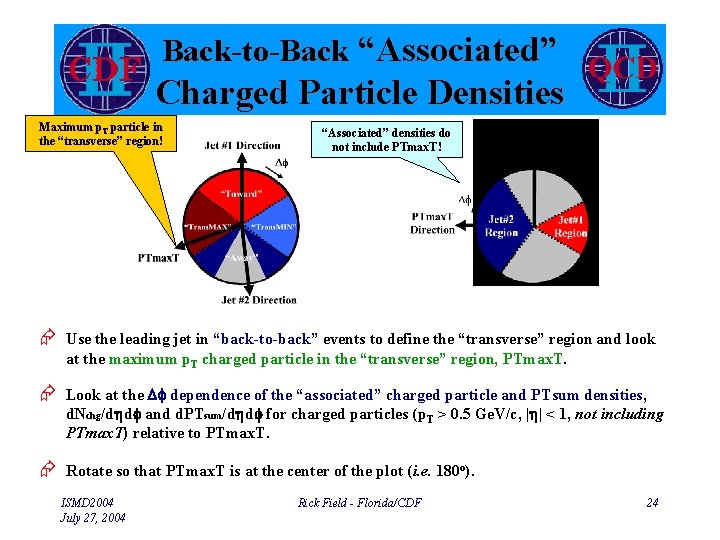
Back-to-Back “Associated” Charged Particle Densities Maximum p. T particle in the “transverse” region! “Associated” densities do not include PTmax. T! Æ Use the leading jet in “back-to-back” events to define the “transverse” region and look at the maximum p. T charged particle in the “transverse” region, PTmax. T. Æ Look at the Df dependence of the “associated” charged particle and PTsum densities, d. Nchg/dhdf and d. PTsum/dhdf for charged particles (p. T > 0. 5 Ge. V/c, |h| < 1, not including PTmax. T) relative to PTmax. T. Æ Rotate so that PTmax. T is at the center of the plot (i. e. 180 o). ISMD 2004 July 27, 2004 Rick Field - Florida/CDF 24
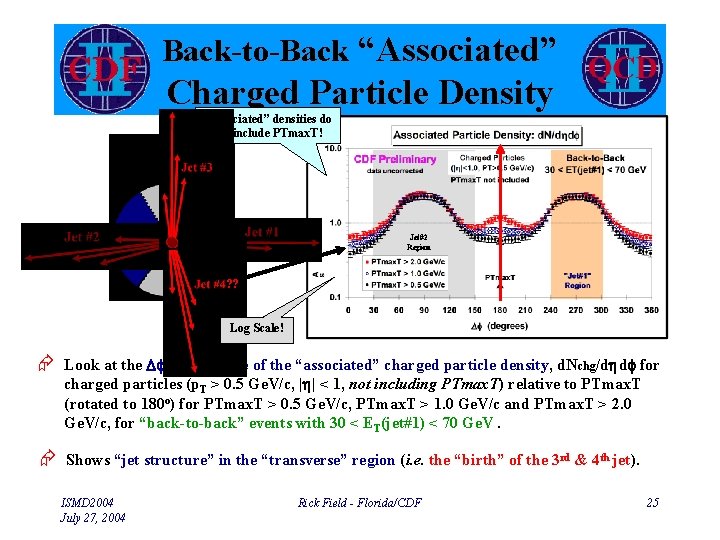
Back-to-Back “Associated” Charged Particle Density “Associated” densities do not include PTmax. T! Jet#2 Region ? ? Log Scale! Æ Look at the Df dependence of the “associated” charged particle density, d. Nchg/dhdf for charged particles (p. T > 0. 5 Ge. V/c, |h| < 1, not including PTmax. T) relative to PTmax. T (rotated to 180 o) for PTmax. T > 0. 5 Ge. V/c, PTmax. T > 1. 0 Ge. V/c and PTmax. T > 2. 0 Ge. V/c, for “back-to-back” events with 30 < ET(jet#1) < 70 Ge. V. Æ Shows “jet structure” in the “transverse” region (i. e. the “birth” of the 3 rd & 4 th jet). ISMD 2004 July 27, 2004 Rick Field - Florida/CDF 25
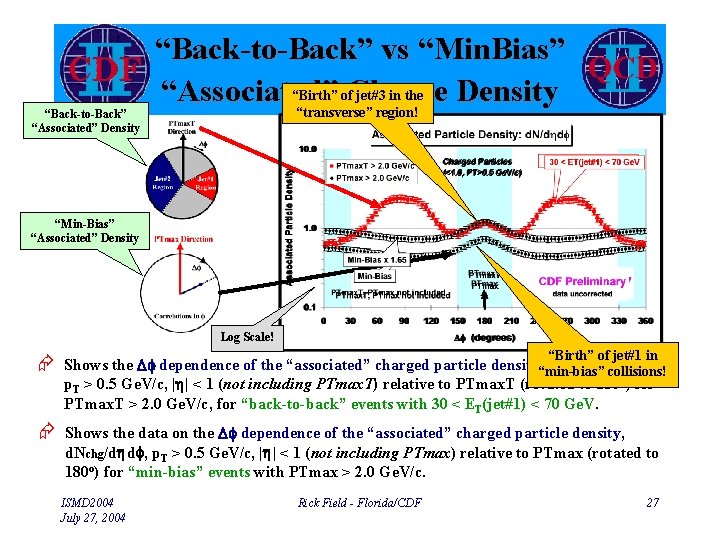
“Back-to-Back” “Associated” Density “Back-to-Back” vs “Min. Bias” “Birth” of. Charge jet#3 in the “Associated” Density “transverse” region! “Min-Bias” “Associated” Density Log Scale! “Birth” of jet#1 in Æ Shows the Df dependence of the “associated” charged particle density, “min-bias” d. Nchg/dhdf for collisions! p. T > 0. 5 Ge. V/c, |h| < 1 (not including PTmax. T) relative to PTmax. T (rotated to 180 o) for PTmax. T > 2. 0 Ge. V/c, for “back-to-back” events with 30 < ET(jet#1) < 70 Ge. V. Æ Shows the data on the Df dependence of the “associated” charged particle density, d. Nchg/dhdf, p. T > 0. 5 Ge. V/c, |h| < 1 (not including PTmax) relative to PTmax (rotated to 180 o) for “min-bias” events with PTmax > 2. 0 Ge. V/c. ISMD 2004 July 27, 2004 Rick Field - Florida/CDF 27
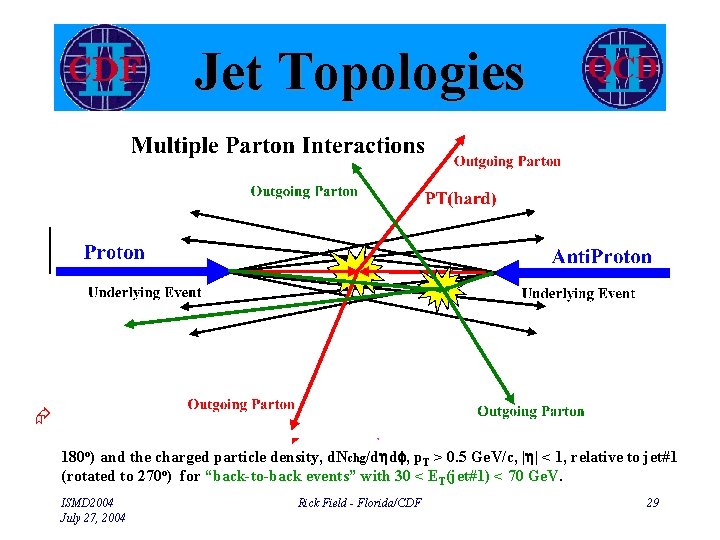
Jet Topologies QCDThree Four Jet QCD Jet Topology 0. 5 1. 0 1. 5 2. 0 Polar Plot Æ Shows the Df dependence of the “associated” charged particle density, d. Nchg/dhdf, p. T > 0. 5 Ge. V/c, |h| < 1, PTmax. T > 2. 0 Ge. V/c (not including PTmax. T) relative to PTmax. T (rotated to 180 o) and the charged particle density, d. Nchg/dhdf, p. T > 0. 5 Ge. V/c, |h| < 1, relative to jet#1 (rotated to 270 o) for “back-to-back events” with 30 < ET(jet#1) < 70 Ge. V. ISMD 2004 July 27, 2004 Rick Field - Florida/CDF 29
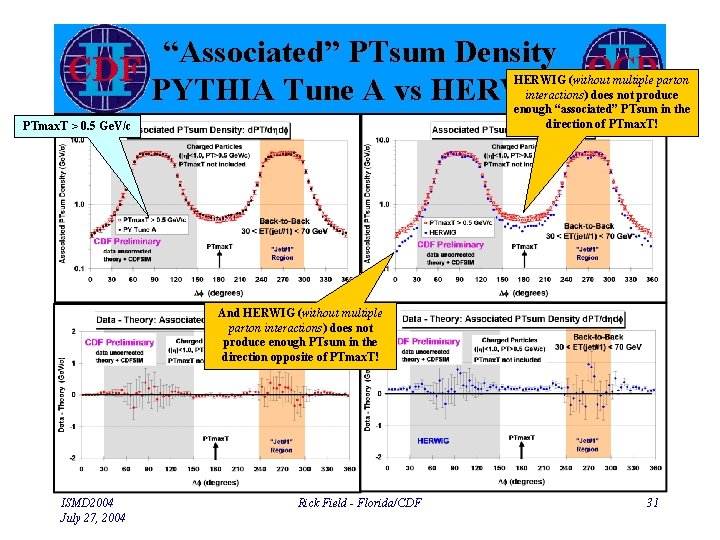
“Associated” PTsum Density PYTHIA Tune A vs HERWIG (without multiple parton interactions) does not produce enough “associated” PTsum in the direction of PTmax. T! PTmax. T > 0. 5 Ge. V/c And HERWIG (without multiple parton interactions) does not produce enough PTsum in the direction opposite of PTmax. T! ISMD 2004 July 27, 2004 Rick Field - Florida/CDF 31
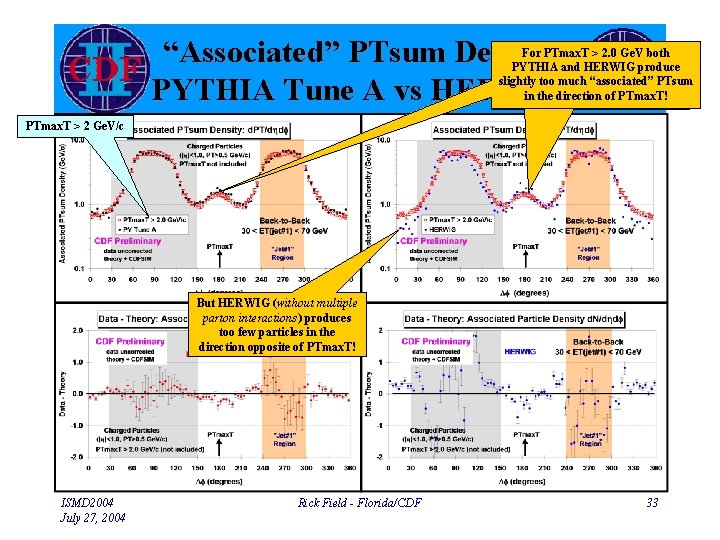
“Associated” PTsum Density PYTHIA Tune A vs HERWIG For PTmax. T > 2. 0 Ge. V both PYTHIA and HERWIG produce slightly too much “associated” PTsum in the direction of PTmax. T! PTmax. T > 2 Ge. V/c But HERWIG (without multiple parton interactions) produces too few particles in the direction opposite of PTmax. T! ISMD 2004 July 27, 2004 Rick Field - Florida/CDF 33
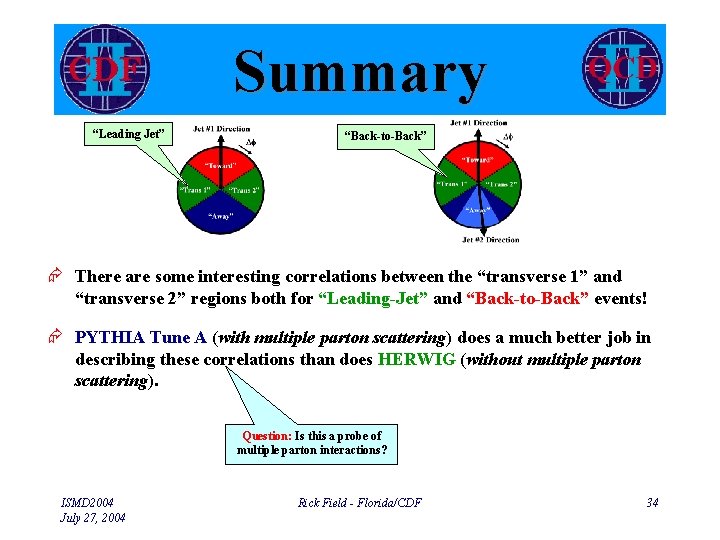
Summary “Leading Jet” “Back-to-Back” Æ There are some interesting correlations between the “transverse 1” and “transverse 2” regions both for “Leading-Jet” and “Back-to-Back” events! Æ PYTHIA Tune A (with multiple parton scattering) does a much better job in describing these correlations than does HERWIG (without multiple parton scattering). Question: Is this a probe of multiple parton interactions? ISMD 2004 July 27, 2004 Rick Field - Florida/CDF 34
Summary “Leading Jet” “Back-to-Back” Æ “Back-to-Back” events have less “hard scattering” (initial and final state radiation) component in the “transverse” region which allows for a closer look at the “beam-beam remnant” and multiple parton scattering component of the “underlying” event. Æ PYTHIA Tune A (with multiple parton scattering) does a much better job in describing the “back-to-back” events than does HERWIG (without multiple parton scattering). ISMD 2004 July 27, 2004 Rick Field - Florida/CDF 35
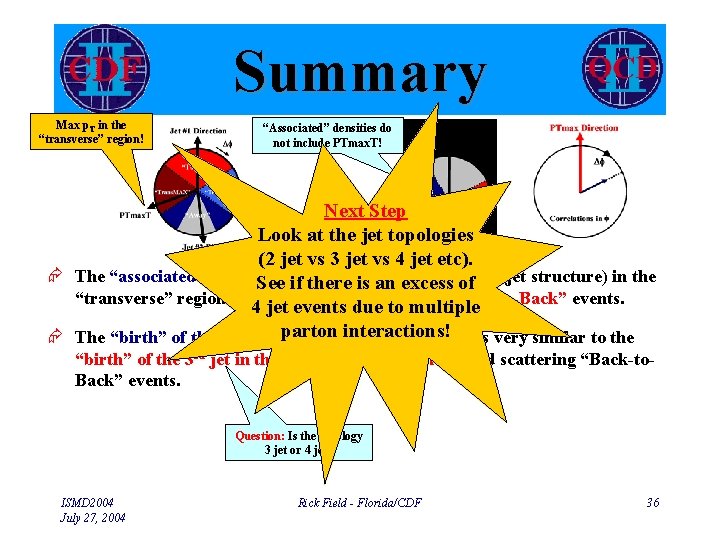
Summary Max p. T in the “transverse” region! “Associated” densities do not include PTmax. T! Next Step Look at the jet topologies (2 jet vs 3 jet vs 4 jet etc). Æ The “associated” densities strong correlations Seeshow if there is an excess of(i. e. jet structure) in the “transverse” region both for “Leading Jet” and “Back-to-Back” events. 4 jet events due to multiple interactions! Æ The “birth” of the 1 st jet inparton “min-bias” collisions looks very similar to the “birth” of the 3 rd jet in the “transverse” region of hard scattering “Back-to. Back” events. Question: Is the topology 3 jet or 4 jet? ISMD 2004 July 27, 2004 Rick Field - Florida/CDF 36