
International Strategy Formulation Theme of this chapter International
- Slides: 17
International Strategy Formulation Theme of this chapter: International Environment is characterized by turbulence Therefore there are no recipes We’ve looked at all the major forms of engaging in international business Q: When do I use which one? A: It all depends. .
I Environmental Turbulence 1. Russia/ Eastern Europe- breakup of the Soviet Union Centralized planning collapsed from its own internal contradictions Some people in the USSR were aware of that as early as 1970, probably earlier Only a relatively decentralize market economy can cope with the complexity and multiplicity of decision making The political consequences were quite severe - independence of former constituent republics - liberation of former Warsaw Pact states from Russian hegemony - unification of Germany - breakup of Czechoslovakia - breakup of Yugoslavia
2. EEC - Growth of political centralization - Growth by expansion to the East Q: Can they afford it? High cost of farm subsidies for agricultural east. Q: Can they manage it? They were not able to manage 15 its still to be seen what they will do with current 25 - Pressures for fragmentation on western and northern boundaries - Danes don’t like the Euro - Norway never joined - Sweden isn’t so sure it was a good thing - Opposition in the UK Q: Commitment to harmonization – e. g. so-called Stability Pact to limit fiscal deficits and inflation seems to be breaking up in the face of national priorities, esp. France and Germany If and when Turkey joins, the EEC enters Asia and the EEC enters the Islamic world.
3. China - has evidently learned the lesson of the Russian collapse - trying to introduce a market economy while maintaining strong central control - Have achieved enormous economic growth - Have become a new economic powerhouse, and therefore a new political force in the Far East and the World. 4. S. E. Asia - Extraordinary growth of the Asian Tigers - collapse of dictatorships and cronyism, especially military backed, e. g. Indonesia, Cambodia, Philippines - but still Pakistan, Burma, Viet Nam - many deep rooted ethnic and religious conflicts 5. Japan - almost a decade of recession, basically brought on by excessive speculation and bad lending in real estate - cronyism and the seeming inability to let go of the old way of doing things has dragged the recession on for far longer than what was necessary. 6. India - market reforms initiated under Narasima Rao (Congress Party) are continuing under the nationalist BJP government
7. Central and South America - collapse of traditional rule in most countries - military dictatorships - perpetual rule of an oligarchy e. g. Mexico and Brazil Emerging middle class seeking an enlarged political voice. A common characteristic of the old oligarchies (whether military or civilian) was their narrow nationalism. Their disappearance means a much more fluid environment for building and/or restructuring economic relationships - among classes (which are closely correlated with race) - among regions within the same country - among countries
8. Africa - still the basket case North: dictatorship or personal rule from Morocco to Egypt - ethnic warfare mixed in with intra-Islamic ideological conflict (Sudan, Algeria) Sub-Saharan Africa - only one or or two true democracies It’s been more than a generation since de-colonization - what’s the problem? - venality and corruption (power, diamonds, oil, copper, etc. ) - failed ideologies (esp. Tanzania and Mozambique - tribal conflicts (sometimes intermixed with religion)
Terrorism since 9/11/01 – Is it a New Issue? Yes and No: -Israel : Irgun and Hagganah - RSA, Rhodesia/Zimbabwe: assassinations, rebellions, -USSR: Stalinist purges, Assassination of Trotsky in Mexico -Northern Ireland – IRA and UDF -USA: FBI at Waco -Kenya: Mau -i. e. Terrorism and guerilla tactics are common to virtually all liberation movements. There is also state terrorism: -Haiti -Chile Pot --Argentina -China: the Red Guards -Cambodia: Killing Fields under Pol #Terror can in fact be a successful organizing principle for states and societies #
Three issues for the MNE: 1. Which regions or countries to penetrate? 2. Which industries or markets to enter? 3. How to co-ordinate activities across such a vast expanse? The book says that Business Unit Managers have become the primary driving forces in shaping international strategies. I beg to differ. They play a powerful role, no doubt, (and there are reasons for this which we will examine later) But they can only be the primary force if top management have abdicated or otherwise failed in their responsibility to manage the corporation as a whole.
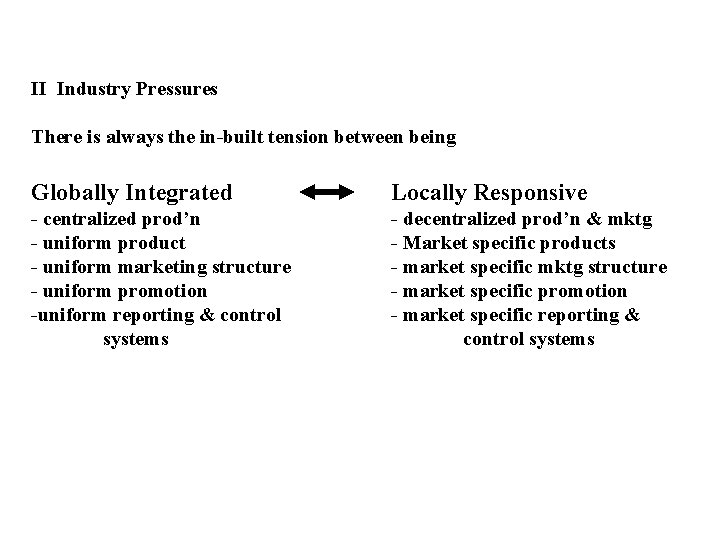
II Industry Pressures There is always the in-built tension between being Globally Integrated Locally Responsive - centralized prod’n - uniform product - uniform marketing structure - uniform promotion -uniform reporting & control systems - decentralized prod’n & mktg - Market specific products - market specific mktg structure - market specific promotion - market specific reporting & control systems
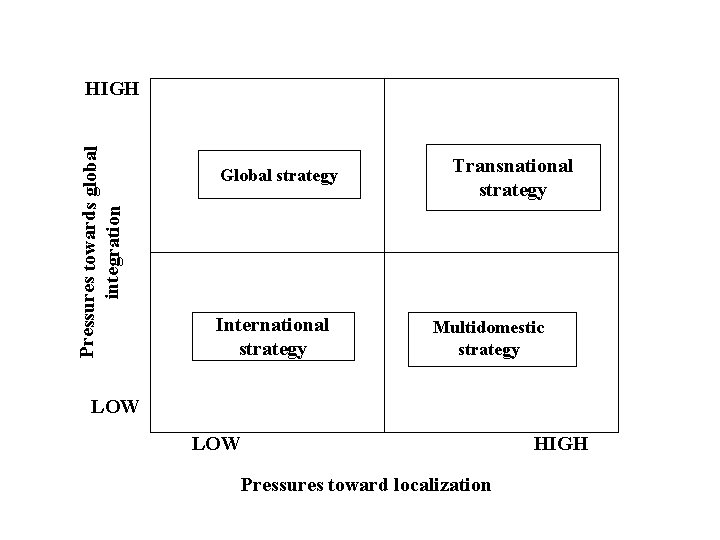
Pressures towards global integration HIGH Global strategy International strategy Transnational strategy Multidomestic strategy LOW HIGH Pressures toward localization
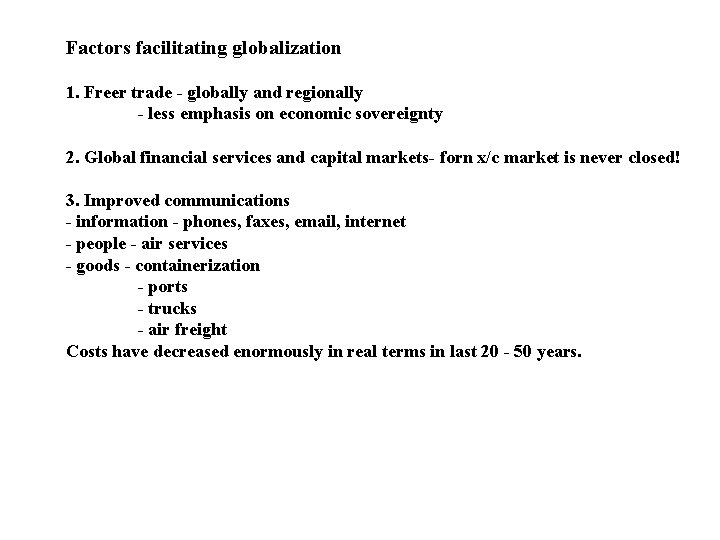
Factors facilitating globalization 1. Freer trade - globally and regionally - less emphasis on economic sovereignty 2. Global financial services and capital markets- forn x/c market is never closed! 3. Improved communications - information - phones, faxes, email, internet - people - air services - goods - containerization - ports - trucks - air freight Costs have decreased enormously in real terms in last 20 - 50 years.
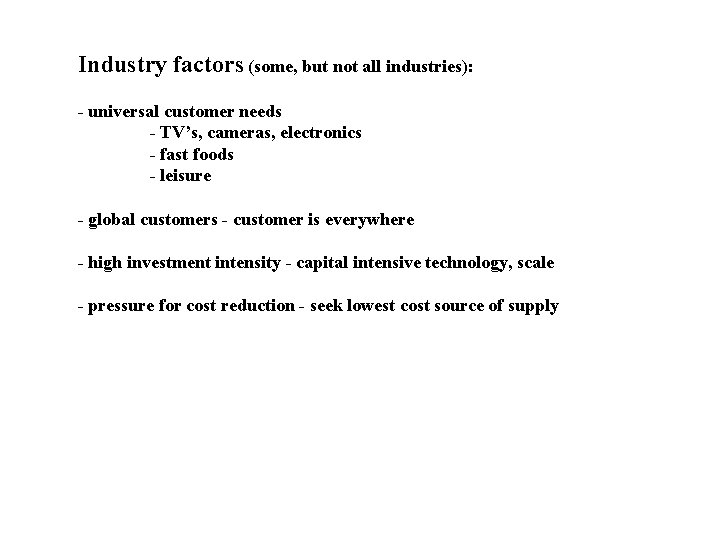
Industry factors (some, but not all industries): - universal customer needs - TV’s, cameras, electronics - fast foods - leisure - global customers - customer is everywhere - high investment intensity - capital intensive technology, scale - pressure for cost reduction - seek lowest cost source of supply
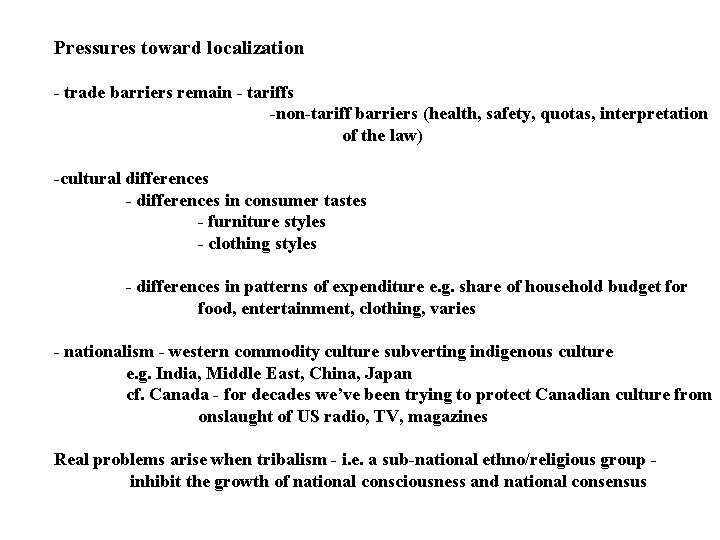
Pressures toward localization - trade barriers remain - tariffs -non-tariff barriers (health, safety, quotas, interpretation of the law) -cultural differences - differences in consumer tastes - furniture styles - clothing styles - differences in patterns of expenditure e. g. share of household budget for food, entertainment, clothing, varies - nationalism - western commodity culture subverting indigenous culture e. g. India, Middle East, China, Japan cf. Canada - for decades we’ve been trying to protect Canadian culture from onslaught of US radio, TV, magazines Real problems arise when tribalism - i. e. a sub-national ethno/religious group inhibit the growth of national consciousness and national consensus
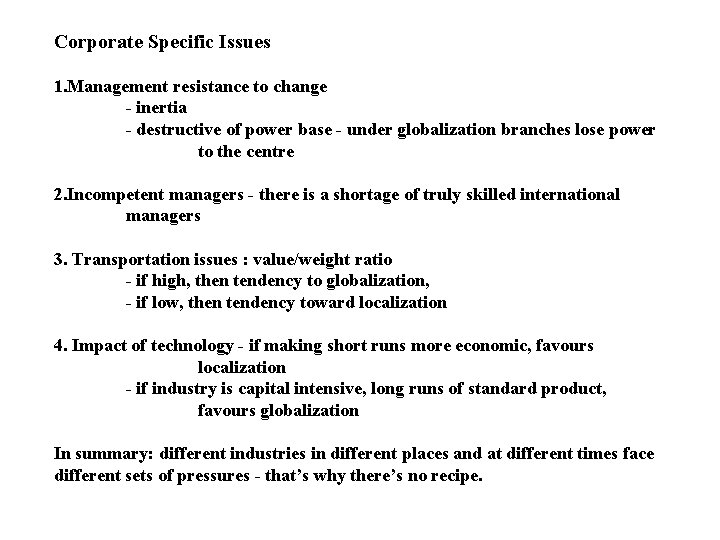
Corporate Specific Issues 1. Management resistance to change - inertia - destructive of power base - under globalization branches lose power to the centre 2. Incompetent managers - there is a shortage of truly skilled international managers 3. Transportation issues : value/weight ratio - if high, then tendency to globalization, - if low, then tendency toward localization 4. Impact of technology - if making short runs more economic, favours localization - if industry is capital intensive, long runs of standard product, favours globalization In summary: different industries in different places and at different times face different sets of pressures - that’s why there’s no recipe.
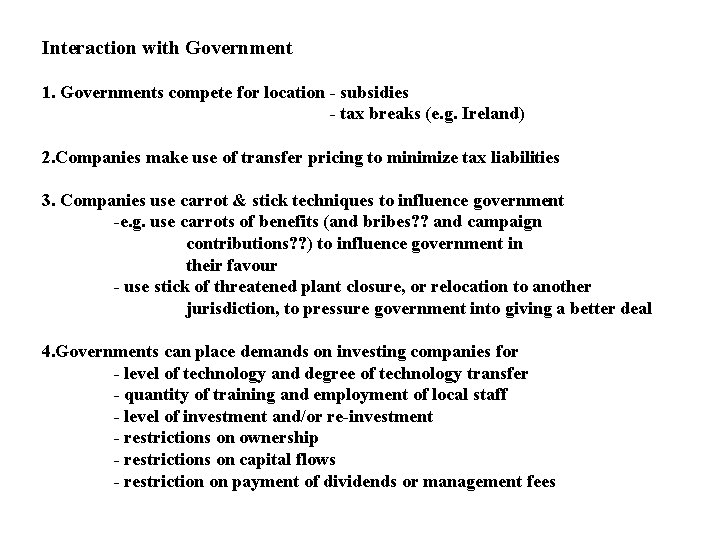
Interaction with Government 1. Governments compete for location - subsidies - tax breaks (e. g. Ireland) 2. Companies make use of transfer pricing to minimize tax liabilities 3. Companies use carrot & stick techniques to influence government -e. g. use carrots of benefits (and bribes? ? and campaign contributions? ? ) to influence government in their favour - use stick of threatened plant closure, or relocation to another jurisdiction, to pressure government into giving a better deal 4. Governments can place demands on investing companies for - level of technology and degree of technology transfer - quantity of training and employment of local staff - level of investment and/or re-investment - restrictions on ownership - restrictions on capital flows - restriction on payment of dividends or management fees
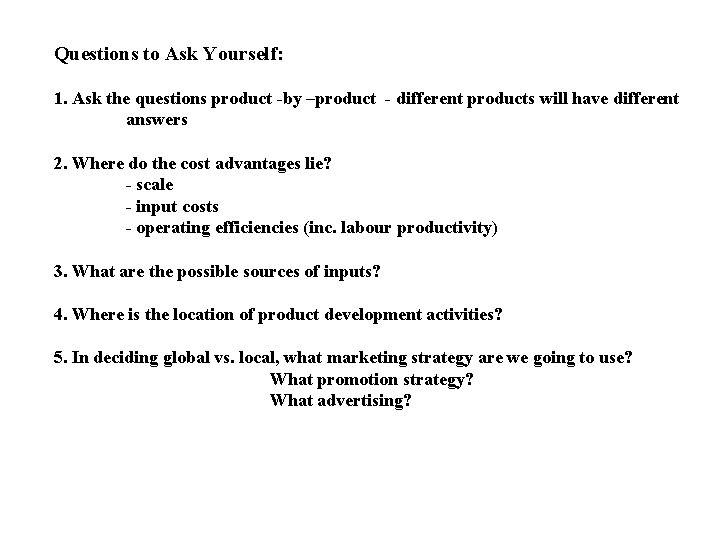
Questions to Ask Yourself: 1. Ask the questions product -by –product - different products will have different answers 2. Where do the cost advantages lie? - scale - input costs - operating efficiencies (inc. labour productivity) 3. What are the possible sources of inputs? 4. Where is the location of product development activities? 5. In deciding global vs. local, what marketing strategy are we going to use? What promotion strategy? What advertising?
Things we can do: 1. Have a specific plan to develop international management expertise e. g. rotate managers But note this will create problems: - salary scales - benefits, family issues of health, education, vacation - problems of managing a multinational work force (cultural diversity) - differences between expat and local salaries and conditions 2. Make the performance measurement and reward system match your strategy 000 Global - emphasis is on cost control, productivity - little control over profitability as such Localized -emphasis on product mix, production, marketing, profitability Remember that it is more varied and complex than a national, one-country, company!