
International Strategy Elizaveta Ogloblina Terese Persson Karoliina Rnjak
International Strategy Elizaveta Ogloblina Terese Persson Karoliina Rnjak Adrian Späthling
Introduction • national boundaries are no longer constraints for companies • many theories • focus on four different approaches to the host countries
The Triad (Kenichi Ohmae 1985) • Regional Trading blocks - Europe (Germany) - North America (USA) - Asia (Japan) • Global strategy has a regional, often triadbased feature
Reasons to go abroad • • • saturated domestic market cheaper production research and development capacity reduction of seasonal effects diversification different competition abroad
Different Strategies • International Strategy – transfer of products and skills • Multidomestic Strategy – maximum local responsiveness • Global strategy – low cost strategy • Transnational strategy – cost pressures and responsibility pressures
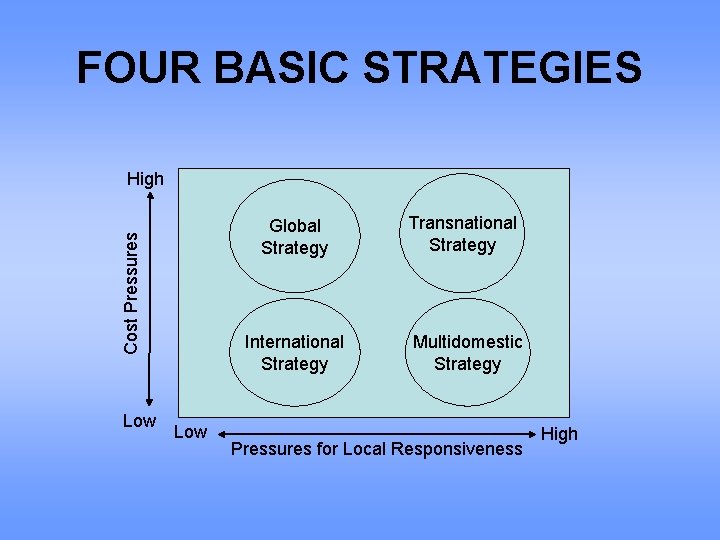
FOUR BASIC STRATEGIES High Cost Pressures Global Strategy Low International Strategy Low Transnational Strategy Multidomestic Strategy Pressures for Local Responsiveness High
International Strategy • value creation by transfer of skills and products to foreign markets • lack of local competitors with skills and products • developed at home and introduced into foreign markets • centralized management • manufacturing abroad duplication
Multidomestic Strategy • response to different national needs – cultural – preferences – legal / political – infrastructural • broad guidelines from headquarter • most of the management is done locally duplication • bottom-up strategies
Global Strategy (1) • Transferring distinctive competencies • Realizing location economies -optimal location for each activity ->value creation is maximized or costs of value creation are minimized • Moving down the experience curve -The longer a product is produced the more experience is gained and costs go down ->With consentrated production, duplication of the learning process is avoided
Global Strategy (2) • cost reduction by standardization • coordinated and economic use of resources • top-down strategy • convergence in buyer preferences in worldwide markets • willingness to sacrifice preferences for cheaper products
Transnational Strategy • local responsiveness and cost reduction • focus on core competences with adjustments • two-way communication • same product with different features
Comparison Global (Triade) • best cost advantages • standardized product • economies of scale • several laws to follow Multi • best market response • adapted product • duplication • just one law to follow

Case Study Procter&Gamble • • • established 1837 household cleaning and hygiene products turnover 02/03: – Austria € 176 Million – Global € 35 Billion • employees 02/03: – Austria 76 – Global 98 000
Case: Vizir Launch • first heavy-duty liquid detergent • should be seen by consumers as a main washing product with superior cleaning performances at lower temperatures • easier and cheaper to produce than powder • easy to copy by competitors
Problems • to be launched in Germany or Europe – marketing strategy – one or different formulas • danger of creating a product that is – too expensive but perfect for everyone – cheap but nobody likes it u not competitive in any market
Possible Solutions • launch in Europe right away, since it is easy to copy • combine countries into geographic regions – limited diversity formula and marketing • long-term: alliances with – washing machines manufacturers – clothing industry

THANK YOU FOR YOUR PATIENCE!
- Slides: 17