
International Strategy Creating Value in Global Markets chapter

International Strategy: Creating Value in Global Markets chapter 7. Copyright © 2014 Mc. Graw-Hill Education. All rights reserved. No reproduction or distribution without the prior written consent of Mc. Graw-Hill Education
International Strategy 7 -2 ¥ Globalization has to do with the rise of market capitalization around the world: © International Trade exchanges have increased in goods & services Exchange of money, information, & ideas © Laws, rules, norms, values, and ideas are growing more similar across countries ¥ Challenges include balancing between emerging markets & developed markets © How to meet the needs of customers at very different income levels
7 -3 Factors Affecting a Nation’s Competitiveness ¥ Michael Porter’s diamond of national advantage explains why some nations and their industries outperform others: © Factor endowments © Demand conditions © Related and supporting industries © Firm strategy, structure, & rivalry
International Expansion: Motivations 7 -4 ¥A company decides to become a multinational firm in order to: © Increase Attain © Take In market size economies of scale advantage of arbitrage opportunities every stage of the value chain © Enhance a product’s growth potential Reinvigorating the product life cycle
International Expansion: Motivations 7 -5 ¥A company decides to become a multinational firm in order to: © Optimize the location of value chain activity To enhance performance To reduce cost To reduce risk © Explore reverse innovation Design & manufacture products locally Export no-frills products to developed markets
International Expansion: Risks 7 -6 ¥ Multinational firms also encounter risks: © Political risk due to social unrest, military turmoil, demonstrations, terrorism, absence of the rule of law can lead to Destruction Disruption of property of operations Non-payment Arbitrary © Economic for goods and services government decisions risk due to piracy and counterfeiting
International Expansion: Risks 7 -7 ¥ Multinational firms also encounter risks: © Currency risk due to fluctuations in the local currency’s exchange rate Affects cost of production or net profit © Management risk due to culture, customs, language, income level, customer preferences, distribution systems Could lead to the need for local adaptation of apparently standard products
International Expansion: Managing Risks 7 -8 ¥ Managing © Market political risk through diversification © Developing stakeholder coalitions © Wooing key influencers © Putting key stakeholders on their boards ¥ Managing economic risk through global dispersion of value chains © Outsourcing © Offshoring
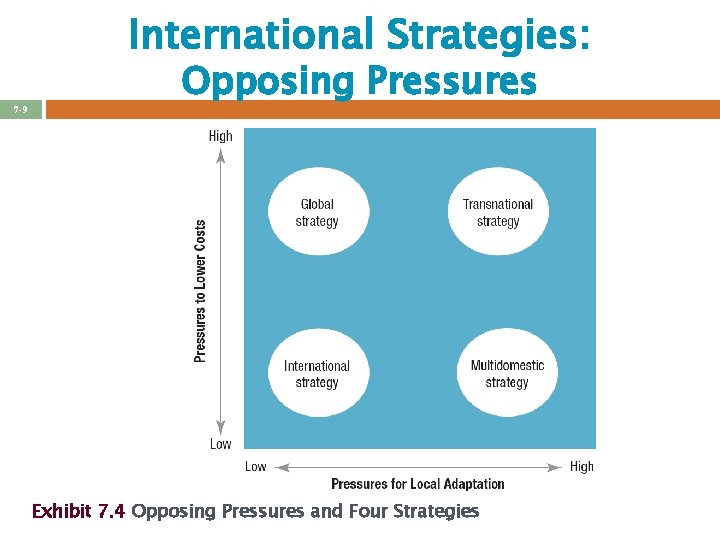
International Strategies: 7 -9 Opposing Pressures Exhibit 7. 4 Opposing Pressures and Four Strategies
International Strategy 7 -10 ¥ An international strategy requires diffusion & adaptation of the parent company’s knowledge & expertise to foreign markets. ¥ The primary goal is worldwide exploitation of the parent firm’s knowledge & capabilities. © All sources of core competencies are centralized. © Pressure for both local adaptation & low costs are rather low
Global Strategy 7 -11 ¥A global strategy implies a firm is interested in lowering costs: © Competitive strategy is centralized & controlled by the corporate office © Products are standardized, operations centralized, producing economies of scale © Worldwide volume supports R&D © There’s a standard level of quality worldwide © Pressure for reducing cost is high; pressure for adaptation to local markets is weak
Multidomestic Strategy 7 -12 ¥A multidomestic strategy puts emphasis on differentiating products & services to adapt to local markets © Decisions are decentralized © Products & services are tailored to local use Consider language, culture, income levels, customer preferences, distribution systems © Markets can expand rapidly © Prices are differentiated by market © Pressure for local adaptation is high; pressure for lowering costs is low
Transnational Strategy 7 -13 ¥A transnational strategy seeks global competitiveness via trade-offs: © Efficiency versus local adaptation versus organizational learning © Assets & capabilities are disbursed according to the most beneficial location for a specific activity; some value chain activities are centralized, some are decentralized. Economies © Pressures of scale, increased knowledge flows for both local adaptation and lowering costs are high
International Strategies: Global or Regional? 7 -14 ¥ It may be unwise for companies to rush into full-scale globalization ¥ Regionalization may be more reasonable © Distance still matters © Commonalities of language, culture, economics, legal & political systems, and infrastructure all make a difference © Trading blocs and free trade zones ease trade restrictions, taxes, & tariffs
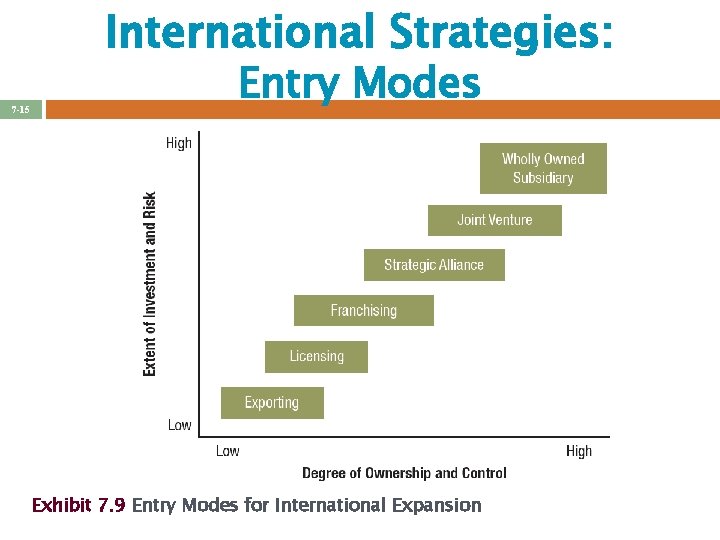
International Strategies: 7 -15 Entry Modes Exhibit 7. 9 Entry Modes for International Expansion
- Slides: 15