
International Space Station SARJ Race Ring Damage Simulation
- Slides: 46
International Space Station SARJ Race Ring Damage Simulation and Durability Test For Life Extension Iqbal Shareef, Ph. D. , CMfg. E, P. E. Bradley University, Peoria, Illinois (309) 677 -2981 Shareef@bradley. edu Presented at NASA Academy of Aerospace Quality Workshop Cape Canaveral, Florida March 22, 2012 www. bradley. edu www. nasa. gov 1
Outline • Overview of the International Space Station SARJ (Solar Alpha Rotary Joint) • SARJ mechanism, tribology and contact mechanics • SARJ degradation and remedy • Lab experiments to simulate and study the ongoing tribology condition of the SARJ – Goals of the experiments – Description of the test rig and test parameters – Typical test results and insights gained from experiments • Summary www. bradley. edu www. nasa. gov 2
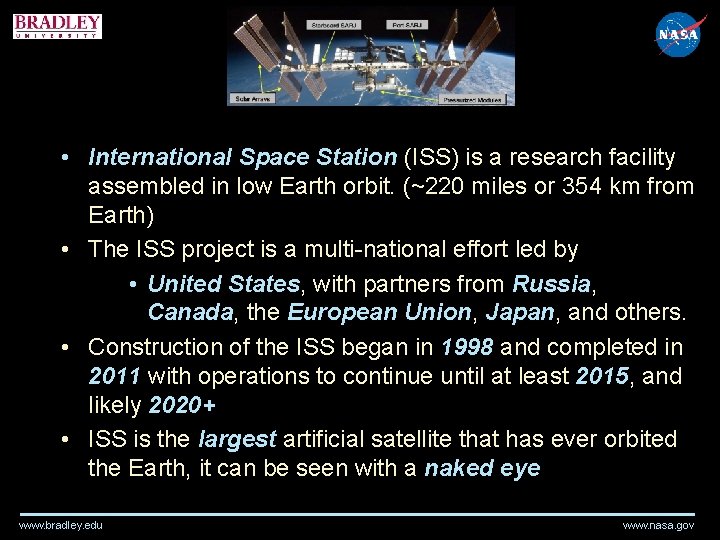
• International Space Station (ISS) is a research facility assembled in low Earth orbit. (~220 miles or 354 km from Earth) • The ISS project is a multi-national effort led by • United States, with partners from Russia, Canada, the European Union, Japan, and others. • Construction of the ISS began in 1998 and completed in 2011 with operations to continue until at least 2015, and likely 2020+ • ISS is the largest artificial satellite that has ever orbited the Earth, it can be seen with a naked eye www. bradley. edu www. nasa. gov
www. bradley. edu www. nasa. gov 4
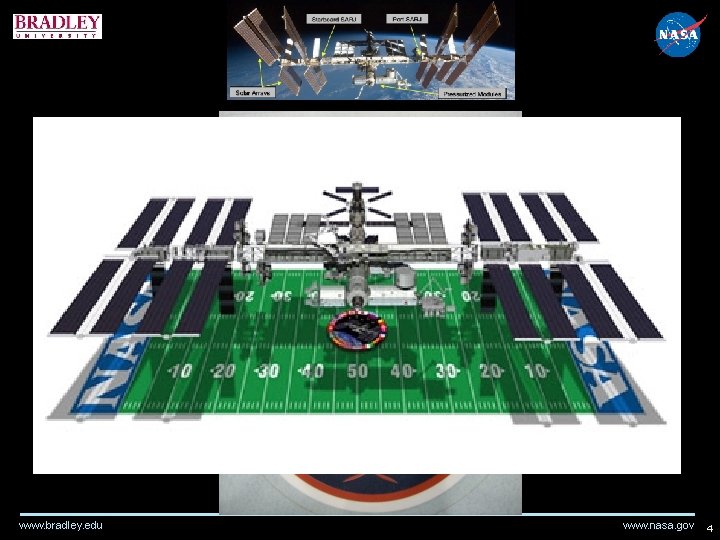
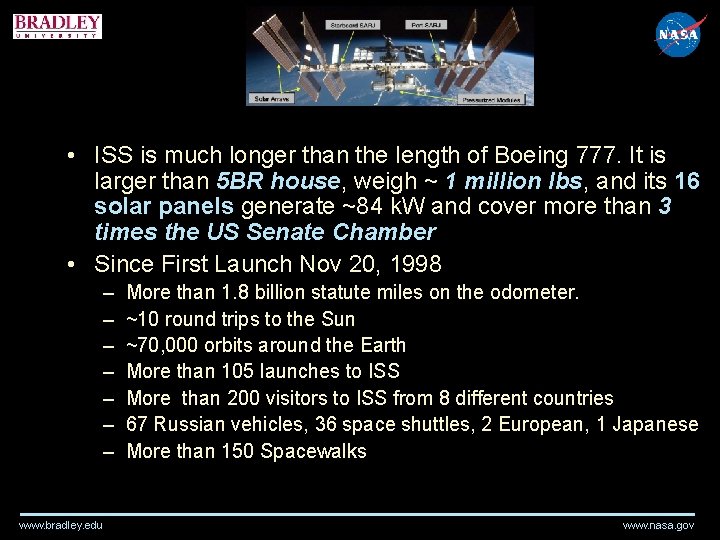
• ISS is much longer than the length of Boeing 777. It is larger than 5 BR house, weigh ~ 1 million lbs, and its 16 solar panels generate ~84 k. W and cover more than 3 times the US Senate Chamber • Since First Launch Nov 20, 1998 – – – – www. bradley. edu More than 1. 8 billion statute miles on the odometer. ~10 round trips to the Sun ~70, 000 orbits around the Earth More than 105 launches to ISS More than 200 visitors to ISS from 8 different countries 67 Russian vehicles, 36 space shuttles, 2 European, 1 Japanese More than 150 Spacewalks www. nasa. gov
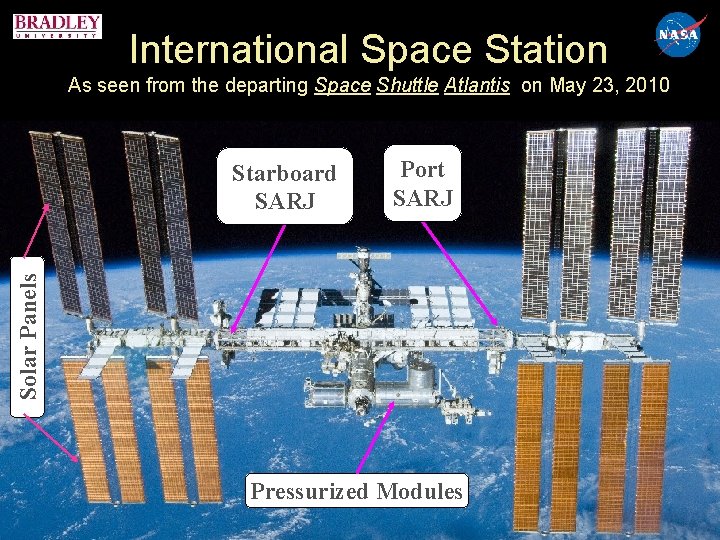
International Space Station As seen from the departing Space Shuttle Atlantis on May 23, 2010 Port SARJ Solar Panels Starboard SARJ Pressurized Modules www. bradley. edu www. nasa. gov
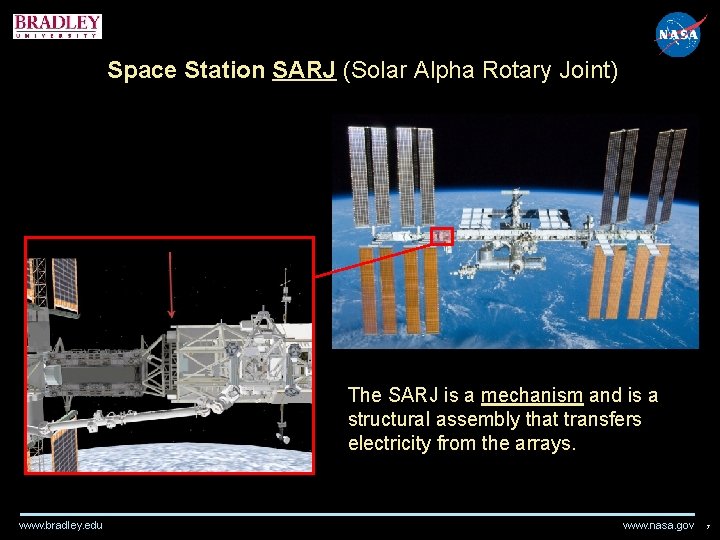
Space Station SARJ (Solar Alpha Rotary Joint) The SARJ is a mechanism and is a structural assembly that transfers electricity from the arrays. www. bradley. edu www. nasa. gov 7
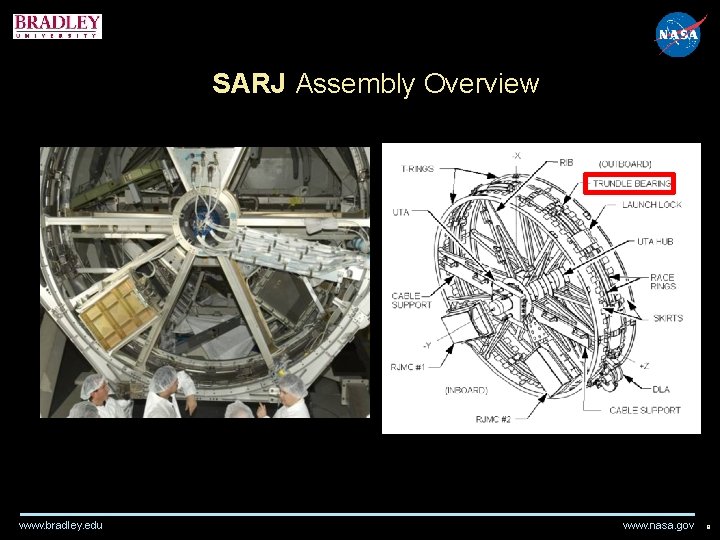
SARJ Assembly Overview www. bradley. edu www. nasa. gov 8
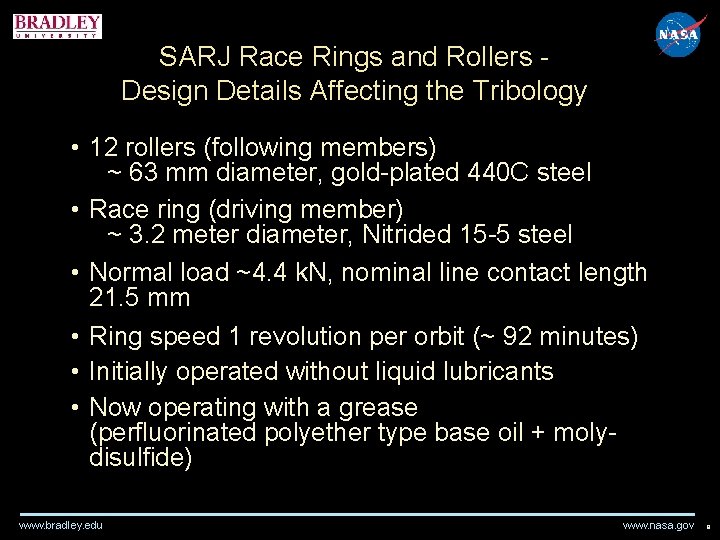
SARJ Race Rings and Rollers Design Details Affecting the Tribology • 12 rollers (following members) ~ 63 mm diameter, gold-plated 440 C steel • Race ring (driving member) ~ 3. 2 meter diameter, Nitrided 15 -5 steel • Normal load ~4. 4 k. N, nominal line contact length 21. 5 mm • Ring speed 1 revolution per orbit (~ 92 minutes) • Initially operated without liquid lubricants • Now operating with a grease (perfluorinated polyether type base oil + molydisulfide) www. bradley. edu www. nasa. gov 9
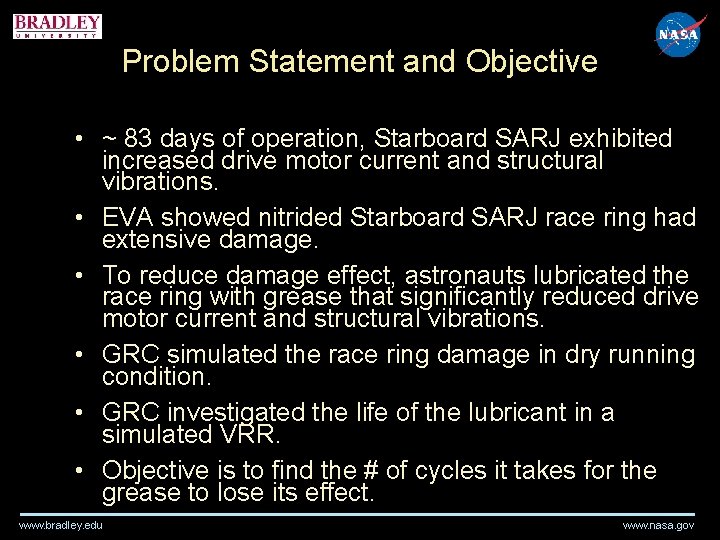
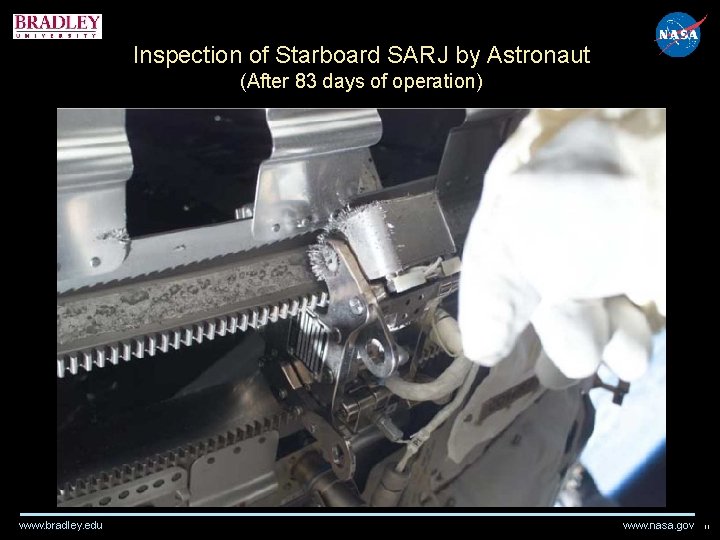
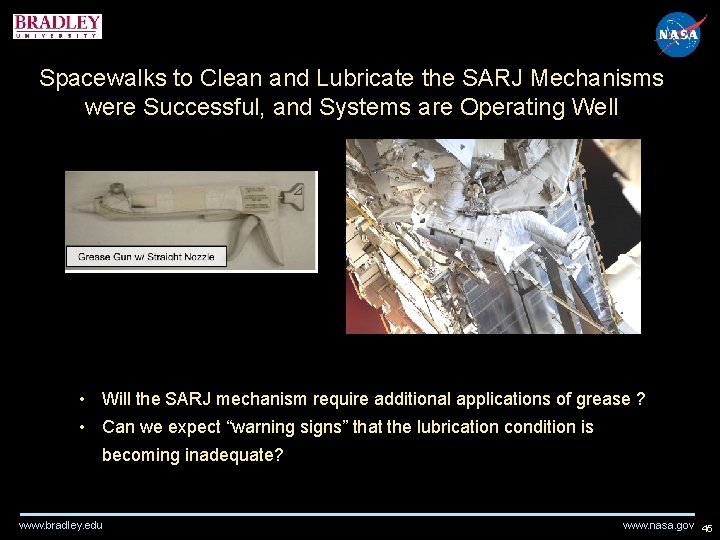
Problem Statement and Objective • ~ 83 days of operation, Starboard SARJ exhibited increased drive motor current and structural vibrations. • EVA showed nitrided Starboard SARJ race ring had extensive damage. • To reduce damage effect, astronauts lubricated the race ring with grease that significantly reduced drive motor current and structural vibrations. • GRC simulated the race ring damage in dry running condition. • GRC investigated the life of the lubricant in a simulated VRR. • Objective is to find the # of cycles it takes for the grease to lose its effect. www. bradley. edu www. nasa. gov
Inspection of Starboard SARJ by Astronaut (After 83 days of operation) www. bradley. edu www. nasa. gov 11
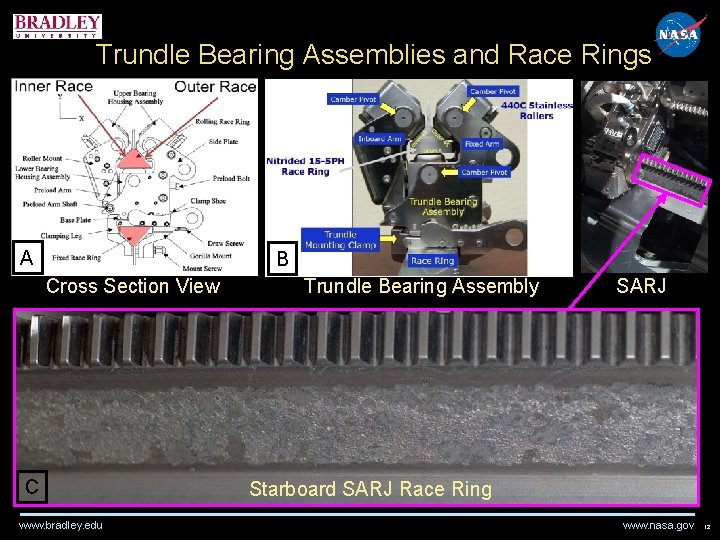
Trundle Bearing Assemblies and Race Rings A B Cross Section View C www. bradley. edu Trundle Bearing Assembly SARJ Starboard SARJ Race Ring www. nasa. gov 12
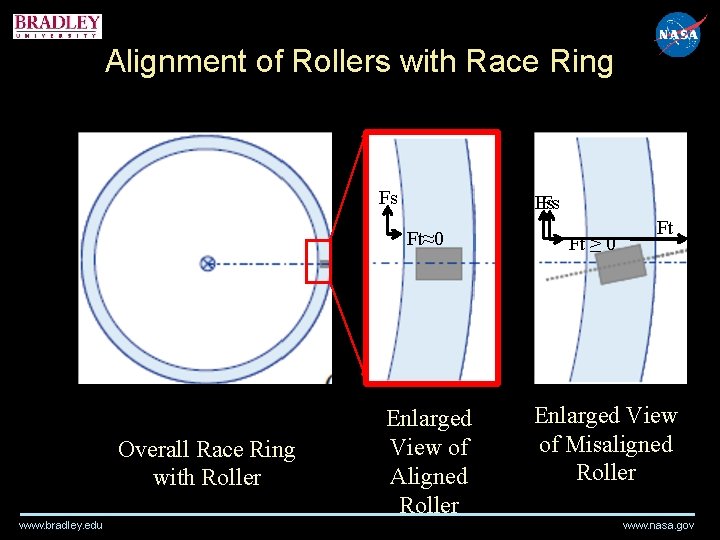
Alignment of Rollers with Race Ring Fs Fs Fs Ft≈0 Overall Race Ring with Roller www. bradley. edu Enlarged View of Aligned Roller Ft ≥ 0 Ft Enlarged View of Misaligned Roller www. nasa. gov
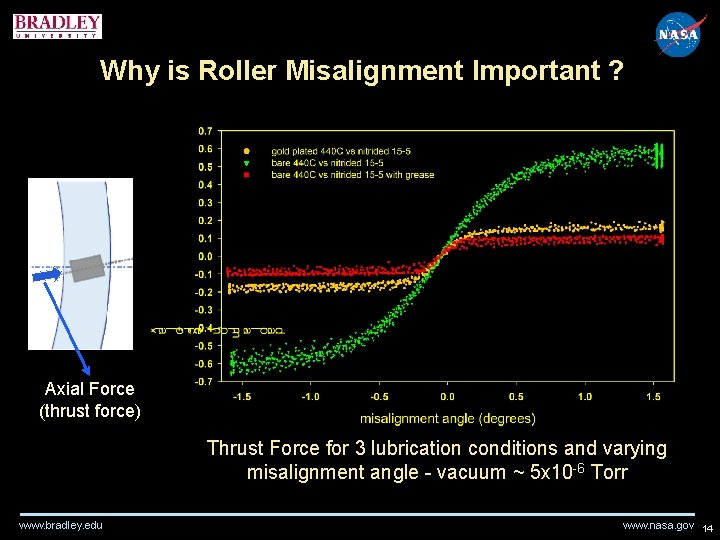
Why is Roller Misalignment Important ? Axial Force (thrust force) Thrust Force for 3 lubrication conditions and varying misalignment angle - vacuum ~ 5 x 10 -6 Torr www. bradley. edu www. nasa. gov 14
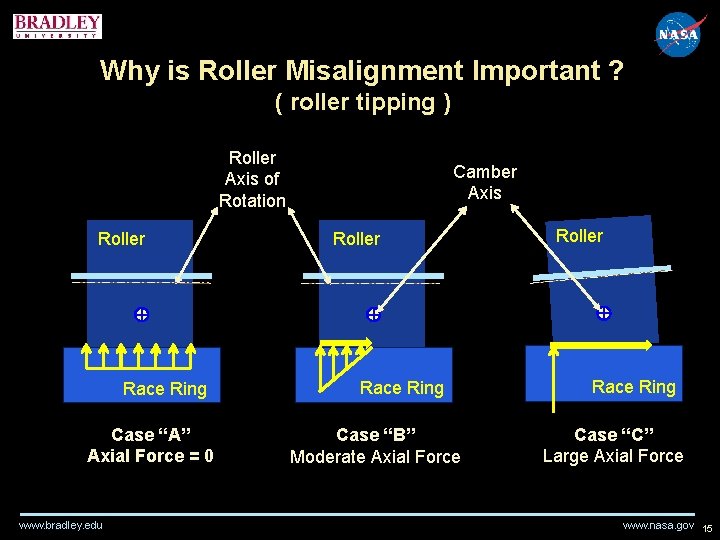
Why is Roller Misalignment Important ? ( roller tipping ) Roller Axis of Rotation Roller Race Ring Case “A” Axial Force = 0 www. bradley. edu Camber Axis Roller Race Ring Case “B” Moderate Axial Force Roller Race Ring Case “C” Large Axial Force www. nasa. gov 15
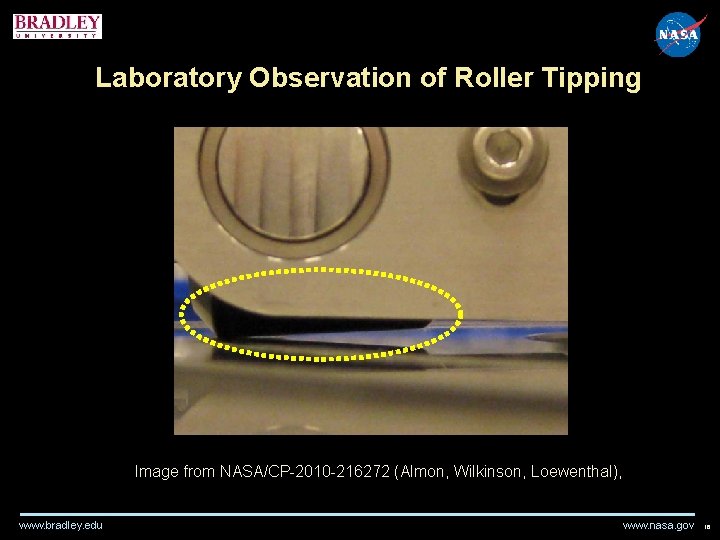
Laboratory Observation of Roller Tipping Image from NASA/CP-2010 -216272 (Almon, Wilkinson, Loewenthal), www. bradley. edu www. nasa. gov 16
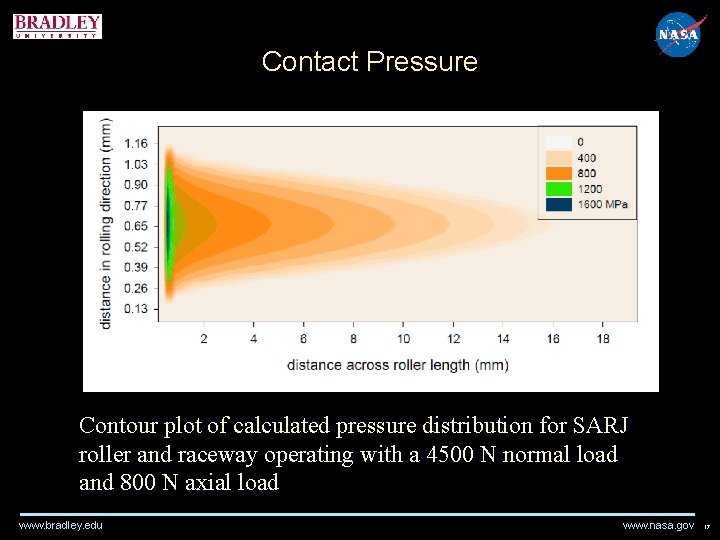
Contact Pressure Contour plot of calculated pressure distribution for SARJ roller and raceway operating with a 4500 N normal load and 800 N axial load www. bradley. edu www. nasa. gov 17
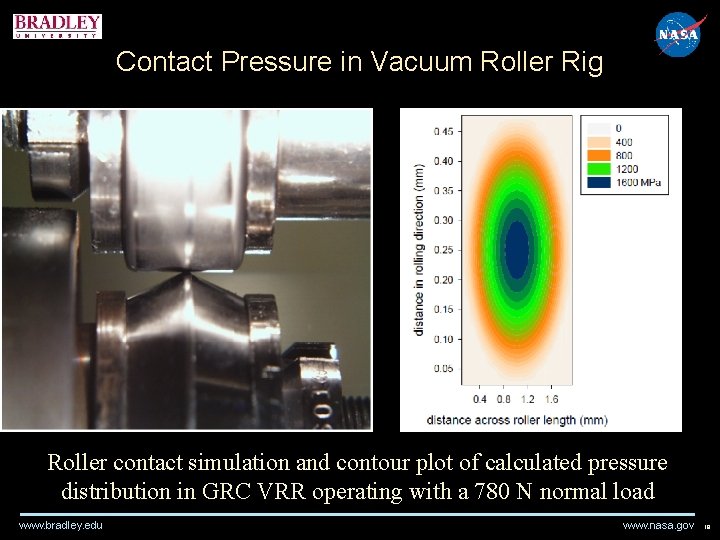
Contact Pressure in Vacuum Roller Rig Roller contact simulation and contour plot of calculated pressure distribution in GRC VRR operating with a 780 N normal load www. bradley. edu www. nasa. gov 18
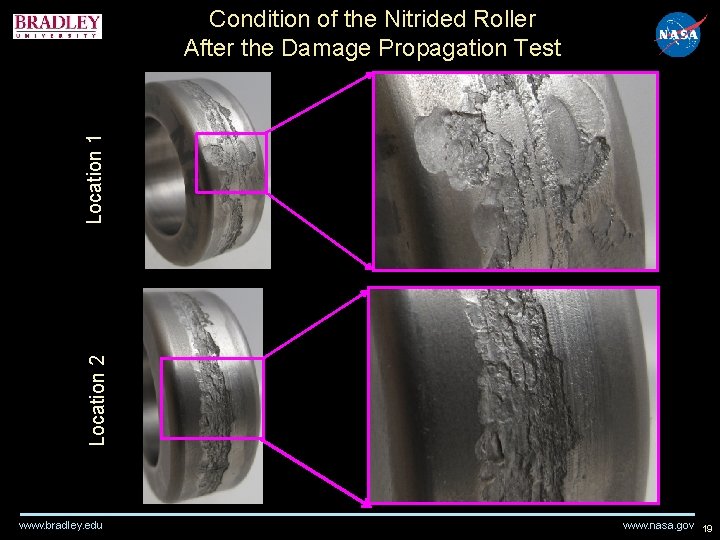
Location 2 Location 1 Condition of the Nitrided Roller After the Damage Propagation Test www. bradley. edu www. nasa. gov 19
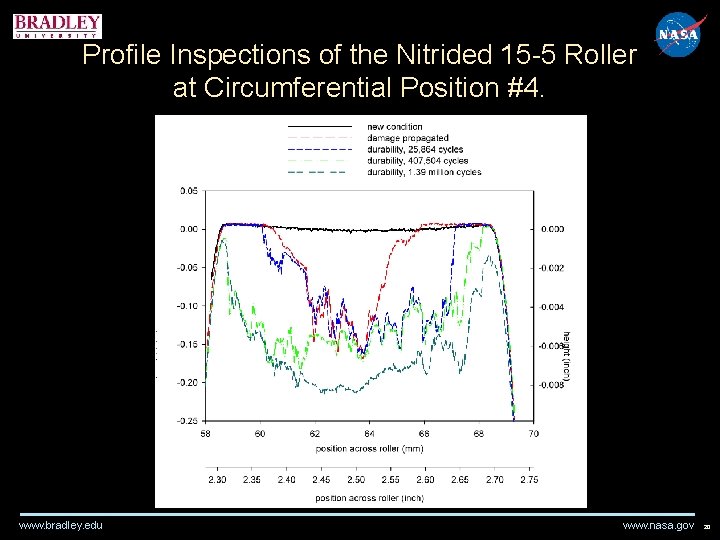
Profile Inspections of the Nitrided 15 -5 Roller at Circumferential Position #4. www. bradley. edu www. nasa. gov 20
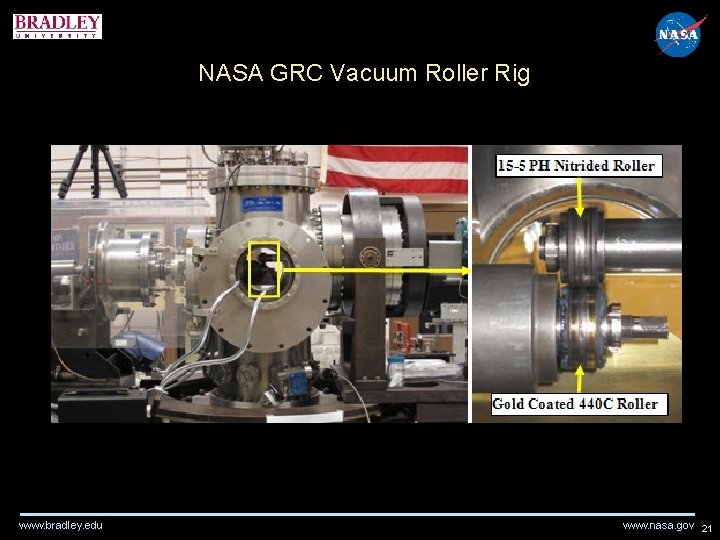
NASA GRC Vacuum Roller Rig www. bradley. edu www. nasa. gov 21
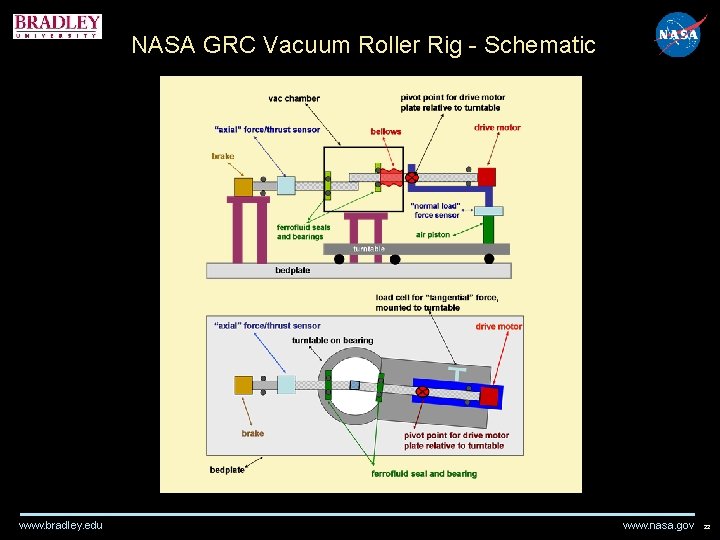
NASA GRC Vacuum Roller Rig - Schematic www. bradley. edu www. nasa. gov 22
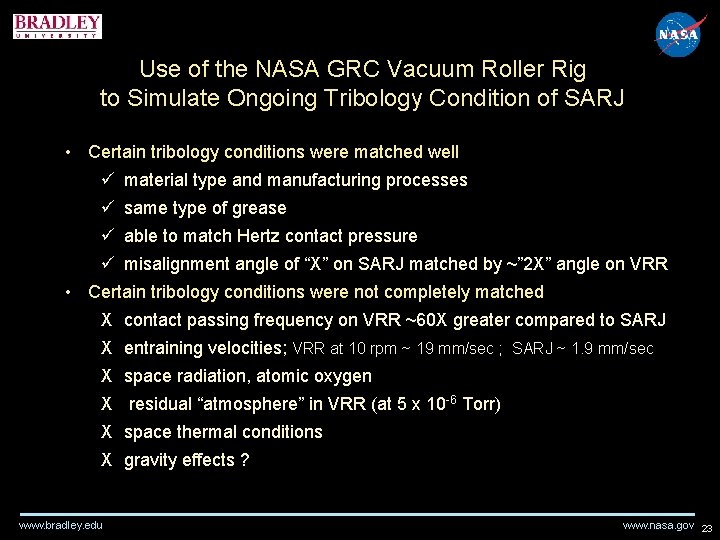
Use of the NASA GRC Vacuum Roller Rig to Simulate Ongoing Tribology Condition of SARJ • Certain tribology conditions were matched well ü material type and manufacturing processes ü same type of grease ü able to match Hertz contact pressure ü misalignment angle of “X” on SARJ matched by ~” 2 X” angle on VRR • Certain tribology conditions were not completely matched X contact passing frequency on VRR ~60 X greater compared to SARJ X entraining velocities; VRR at 10 rpm ~ 19 mm/sec ; SARJ ~ 1. 9 mm/sec X space radiation, atomic oxygen X residual “atmosphere” in VRR (at 5 x 10 -6 Torr) X space thermal conditions X gravity effects ? www. bradley. edu www. nasa. gov 23
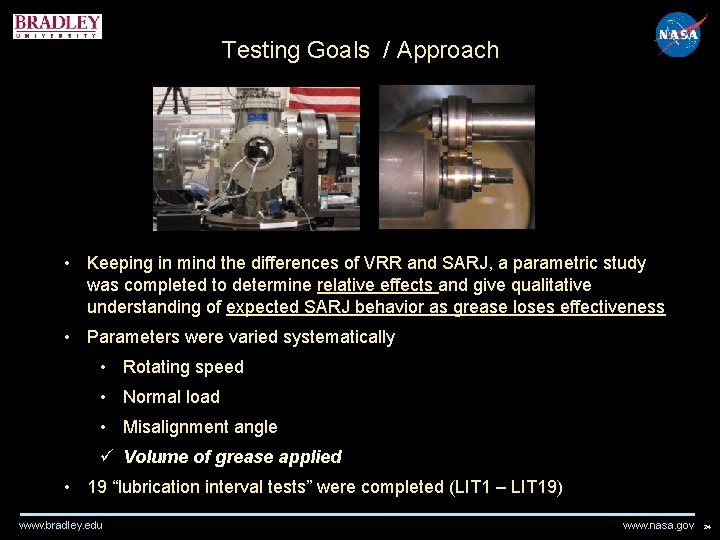
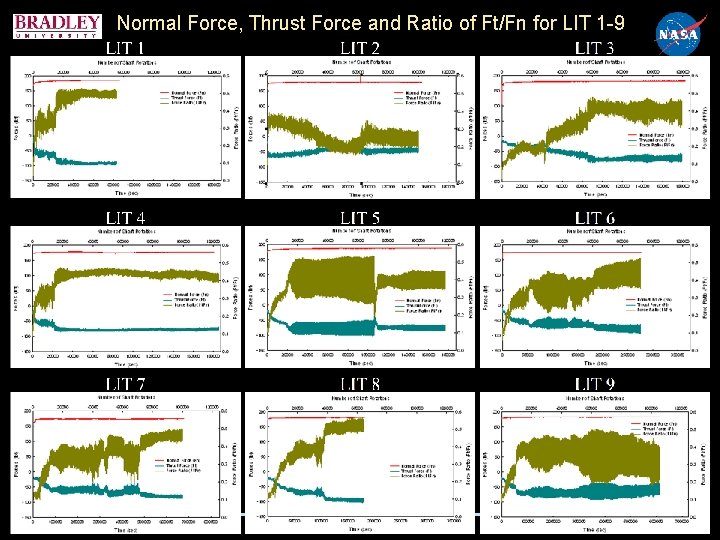
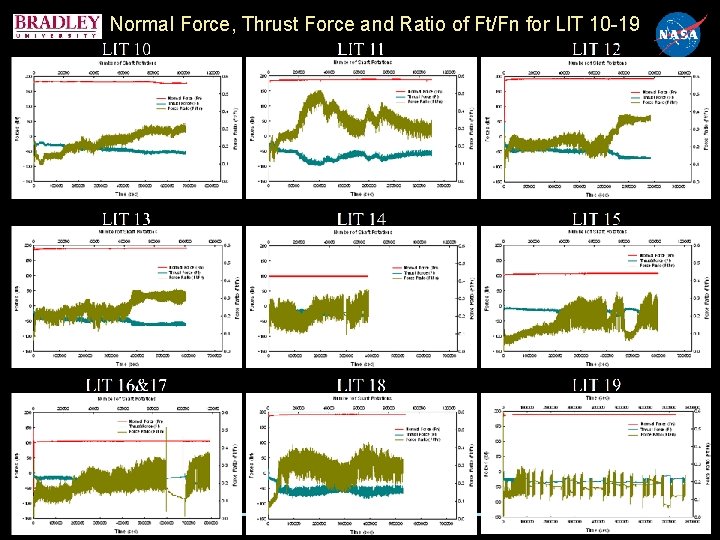
Testing Goals / Approach • Keeping in mind the differences of VRR and SARJ, a parametric study was completed to determine relative effects and give qualitative understanding of expected SARJ behavior as grease loses effectiveness • Parameters were varied systematically • Rotating speed • Normal load • Misalignment angle ü Volume of grease applied • 19 “lubrication interval tests” were completed (LIT 1 – LIT 19) www. bradley. edu www. nasa. gov 24
Normal Force, Thrust Force and Ratio of Ft/Fn for LIT 1 -9 www. bradley. edu www. nasa. gov
Normal Force, Thrust Force and Ratio of Ft/Fn for LIT 10 -19 www. bradley. edu www. nasa. gov
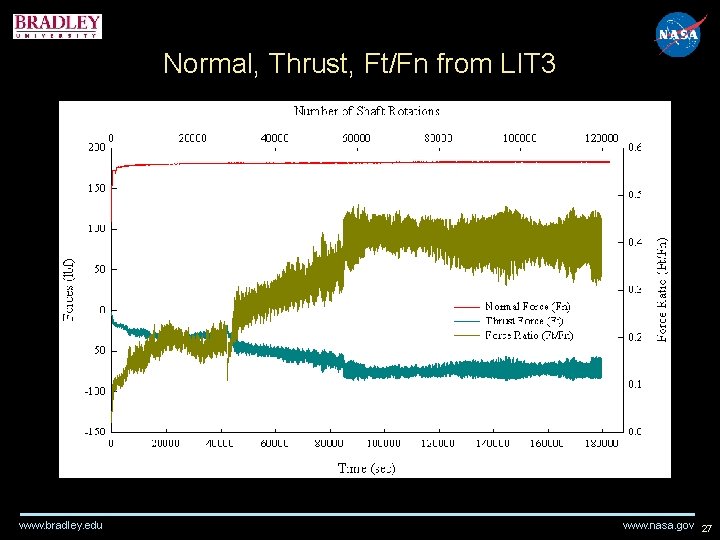
Normal, Thrust, Ft/Fn from LIT 3 www. bradley. edu www. nasa. gov 27
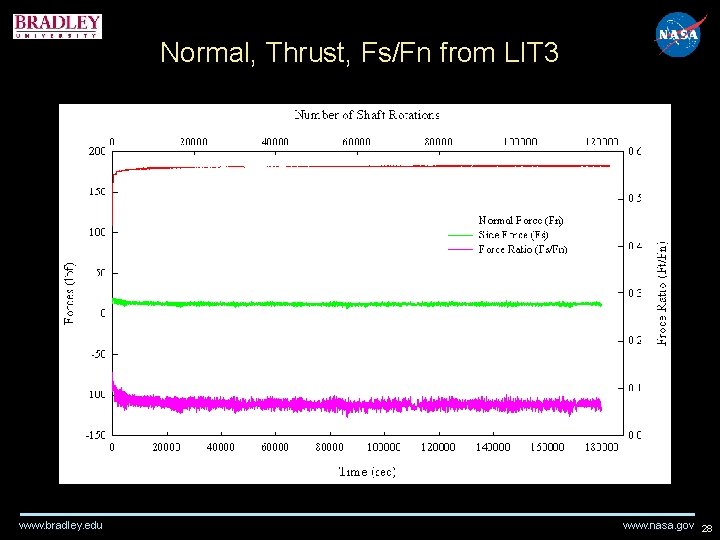
Normal, Thrust, Fs/Fn from LIT 3 www. bradley. edu www. nasa. gov 28
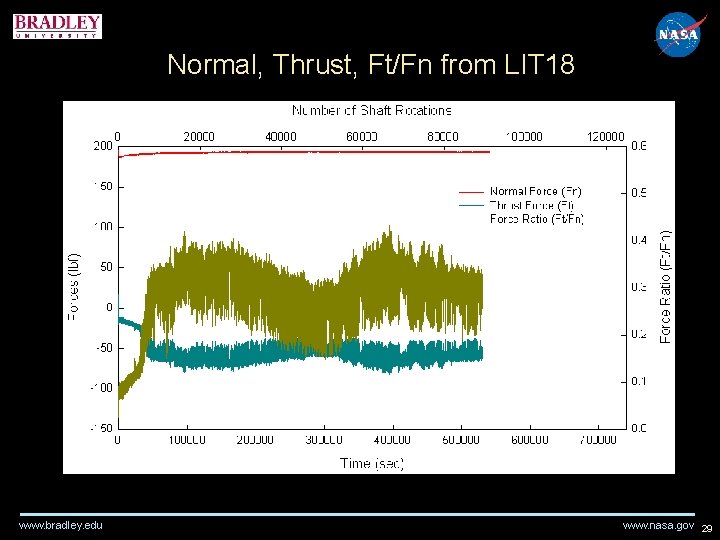
Normal, Thrust, Ft/Fn from LIT 18 www. bradley. edu www. nasa. gov 29
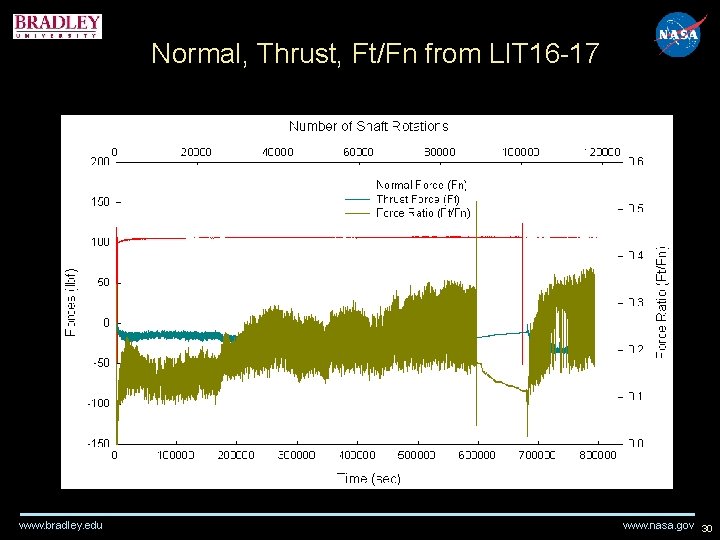
Normal, Thrust, Ft/Fn from LIT 16 -17 www. bradley. edu www. nasa. gov 30
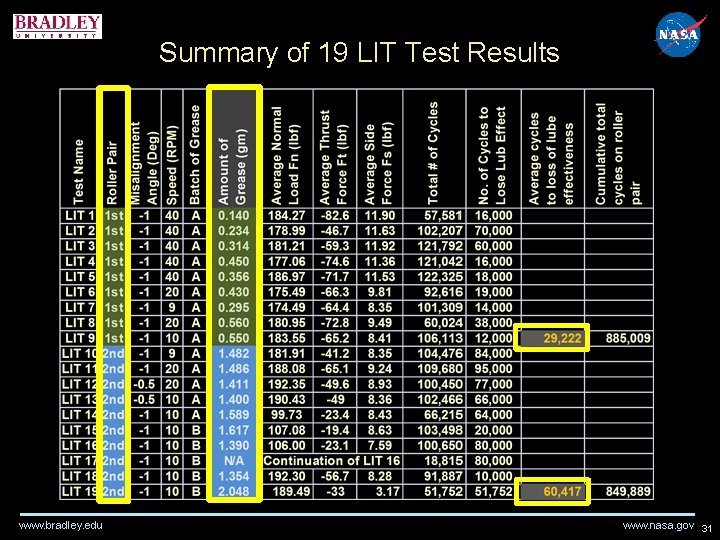
Summary of 19 LIT Test Results www. bradley. edu www. nasa. gov 31
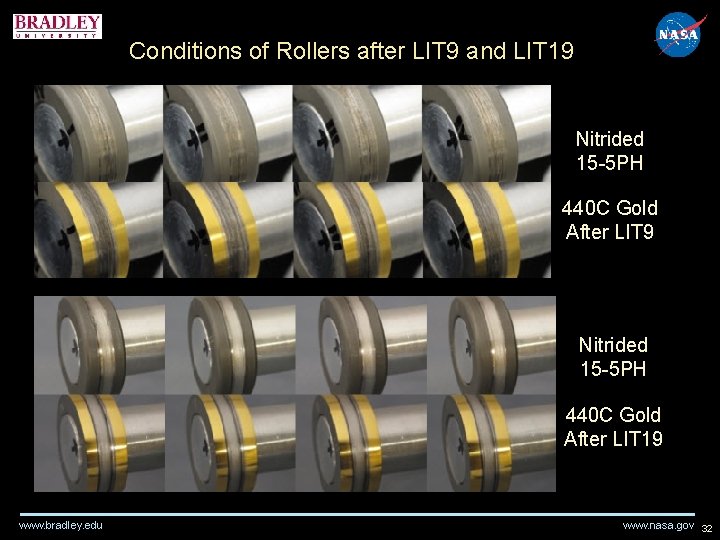
Conditions of Rollers after LIT 9 and LIT 19 Nitrided 15 -5 PH 440 C Gold After LIT 19 www. bradley. edu www. nasa. gov 32
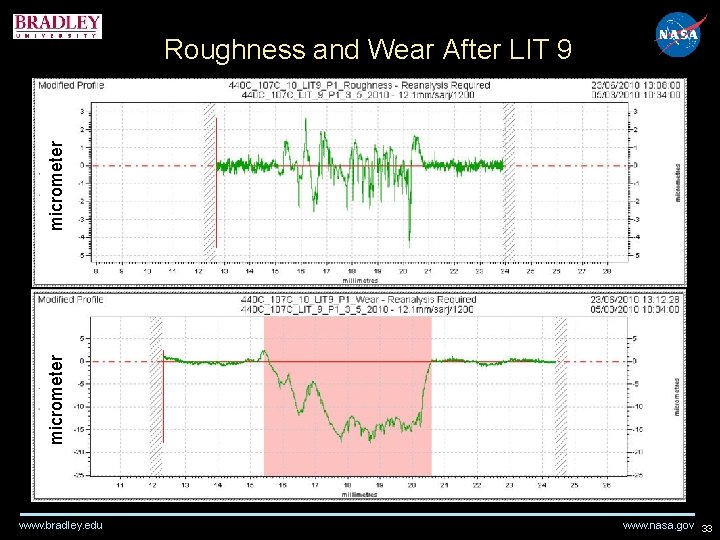
micrometer Roughness and Wear After LIT 9 www. bradley. edu www. nasa. gov 33
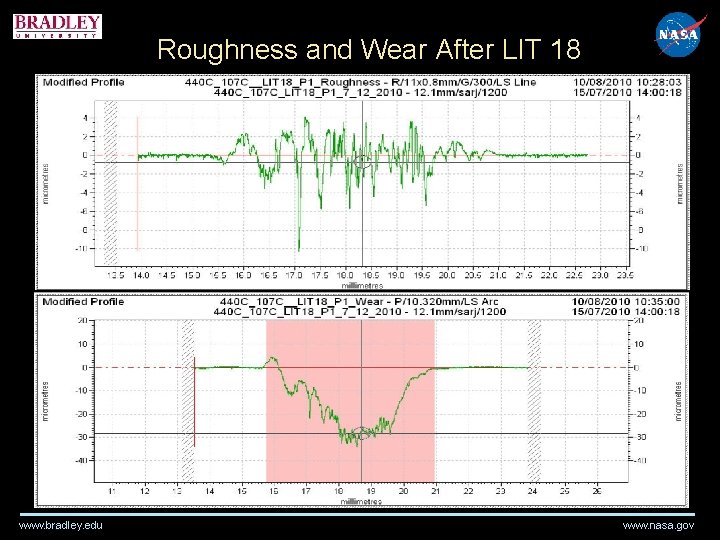
Roughness and Wear After LIT 18 www. bradley. edu www. nasa. gov
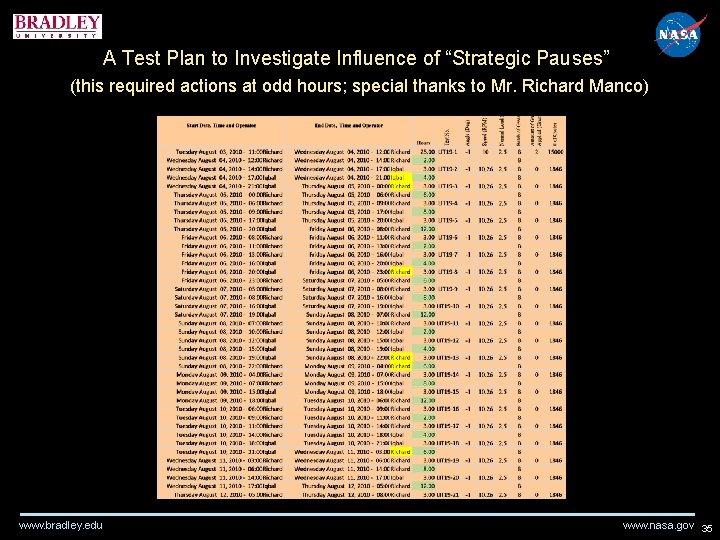
A Test Plan to Investigate Influence of “Strategic Pauses” (this required actions at odd hours; special thanks to Mr. Richard Manco) www. bradley. edu www. nasa. gov 35
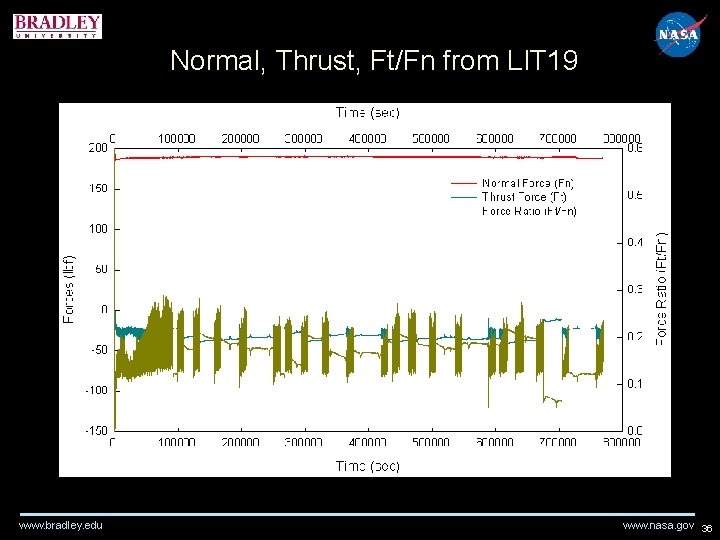
Normal, Thrust, Ft/Fn from LIT 19 www. bradley. edu www. nasa. gov 36
Results of the LIT Tests • During LIT 1 -9 the average number cycles for lubricant to become ineffective was 29, 200 cycles using first pair of rollers. • During LIT 10 -18 experiments the average number cycles for lubricant to become ineffective was 60, 400 cycles. www. bradley. edu www. nasa. gov
Results of the LIT Tests • During the LIT 1 -9 experiments there were more than 885, 000 rotations using the first pair of rollers. • During LIT 10 -19 there were more than 850, 000 rotations without significant damage to render the rollers functionless. Note: SARJ makes nearly 96, 000 rotations per year. www. bradley. edu www. nasa. gov
Summary • SARJ was vulnerable to inadequate lubrication • Large friction can produce SARJ roller tipping • Relative effects of operating parameters were studied by test • Loss of lubrication effectiveness was determined from the rise of the axial force to a critical value • The most influential parameter was the mass of grease applied • “Strategic pauses” were effective to extend lube effectiveness in the VRR and be an effective strategy for SARJ www. bradley. edu www. nasa. gov 39
Acknowledgements l Dr. Alice Smith l l Dr. Timothy L. Krantz l l Chief of S&T Division at NASA GRC, Dr. Richard Johnson l www. bradley. edu Asst. Chief, S&T Division at NASA GRC Dr. Jim Zakrajsek l l Scientist S&T Division at NASA GRC Dr. Phil Abel l l Professor and Chair of IE at Auburn Dean College of E&T at Bradley University www. nasa. gov 40
www. bradley. edu www. nasa. gov 41
Back up Slides www. bradley. edu www. nasa. gov 42
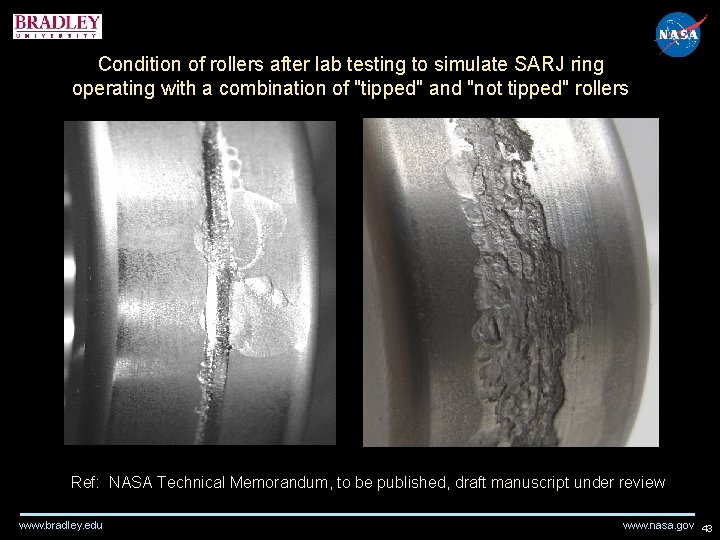
Condition of rollers after lab testing to simulate SARJ ring operating with a combination of "tipped" and "not tipped" rollers Ref: NASA Technical Memorandum, to be published, draft manuscript under review www. bradley. edu www. nasa. gov 43
References • “Investigation Of The Vacuum Tribological Property Of Damaged Surfaces In Presence Of Grease, ” 2011 STLE Annual Meeting & Exhibition, Control ID: 980140, Category: Grease, Atlanta GA, May 15 -19, 2011. by Timothy Krantz and Iqbal Shareef. • NASA CP-2010 -216272 (Conference Proceedings, includes three reports related to SARJ) • “Roller Testing to Mimic Damage of the ISS SARJ Ring and Durability Test to Simulate Fifteen Years of SARJ Operation Using the Damaged Surface”; NASA TM (under technical review) by Krantz; Elchert; Della. Corte, Dube and Stanford • “The ISS SARJ Bearing Failure and Recovery: Technical and Project Management Lessons Learned”; NASA TP (under technical review) by Della. Corte, Krantz, and Dube www. bradley. edu www. nasa. gov 44
Spacewalks to Clean and Lubricate the SARJ Mechanisms were Successful, and Systems are Operating Well • Will the SARJ mechanism require additional applications of grease ? • Can we expect “warning signs” that the lubrication condition is becoming inadequate? www. bradley. edu www. nasa. gov 45
Dr. Iqbal Shareef and Michael Freeman www. bradley. edu www. nasa. gov 46