
INTERNATIONAL SEMINAR ON EARLY CHILDHOOD CARE EDUCATION AND

- Slides: 26
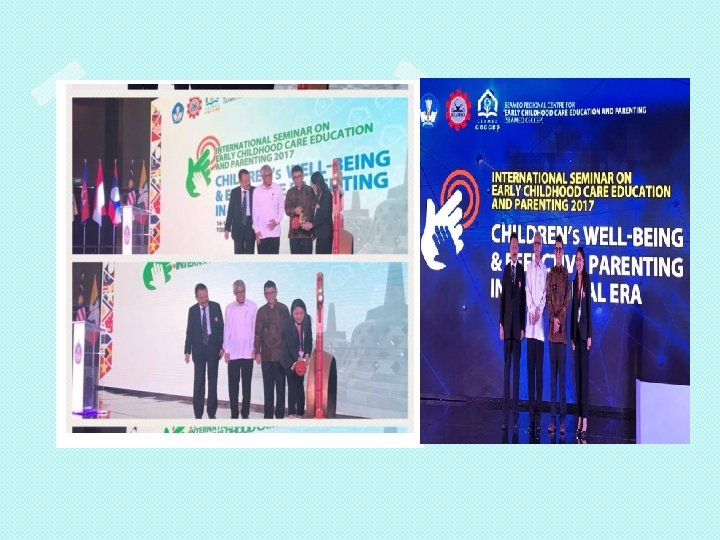
INTERNATIONAL SEMINAR ON EARLY CHILDHOOD CARE EDUCATION AND PARENTING 2017 THEME: CHILDREN’S WELL-BEING & EFFECTIVE PARENTING IN THE DIGITAL ERA : SYNTHESIS by SEAMEO Secretariat
What is this ISECCEP 2017 for? �To bring together diverse stakeholders of ECCEP representing the governments of SEAMEO Member Countries as well as public and private education institutions. �Provide a platform for the participants to share new learning paradigms and practices, exchange their perspectives on current issues and concerns surrounding ECCEP practice in Southeast Asia; and �Build regional consensus on how ECCEP can effectively contribute towards the improvement of human development at the region.
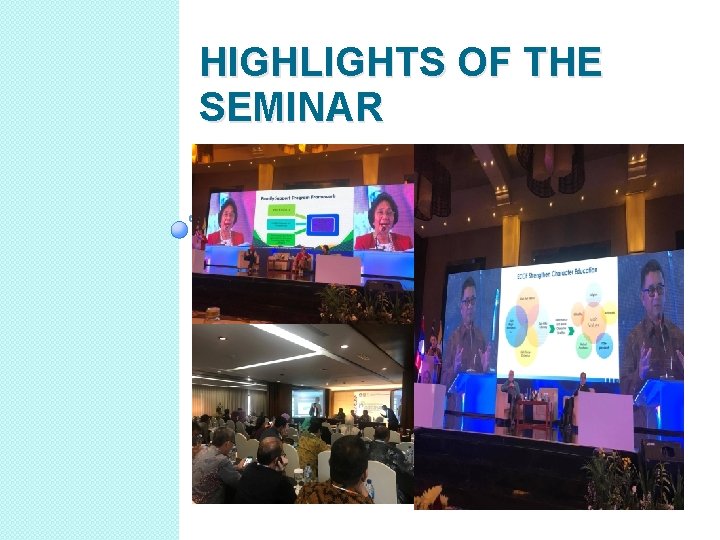
HIGHLIGHTS OF THE SEMINAR
Opening Remarks �Welcome Remarks by (Mr. ) Ir. Gatot Saptadi, the Local Government Secretary of the Special Region of Yogyakarta ◦ Education is an important asset of national development ◦ Research shows that approximately 50% of people’s intelligence is developed before they reach 4 years old, and 80% of human brain development occurs before people reach 8 years old. ◦ The first 4 years is the most critical period for all people, as any development occurring in this interval greatly affects adulthood. ◦ When this “golden period: is missed, unlocking the full potentials of human being will be an illusion.
Opening Remarks � Dr Gatot H Priowirjanto, SEAMEO Director � The first three years of life is a critical and important phase of development. � More than 200 million children under the age of five in the developing world are at risk of not reaching their full development potentials because they suffer from the negative consequences of poverty, nutritional deficiencies and inadequate learning opportunities. � Approximately around 89 million live in Southeast Asia. � Rapid scientific and technological innovations in the 21 st era aggravate the issues above. � SEAMEO CECCEP will serve the needs of the region in ECCE and Parenting
Opening Remarks � Opening Remarks by H. E. (Mr. ) Harris Iskandar, Ph. D. , Director General of Early Childhood Education and Community Education, Ministry of Education and Culture (Mo. EC), Republic of Indonesia � Education plays a fundamental role in addressing the 21 st century issues and challenges, such as poverty, conflict, terrorism, inequality, migration, citizenship and digital divides. � Responding to these multilateral challenges, the Government of Indonesia initiate the establishment a new SEAMEO Regional Centre in the field of early childhood care & education and parenting, abbreviated as SEAMEO CECCEP. � SEAMEO CECCEP will be the laboratory of ideas to exchange enlightening information and practices in the fields of ECCE and parenting in Southeast Asia.
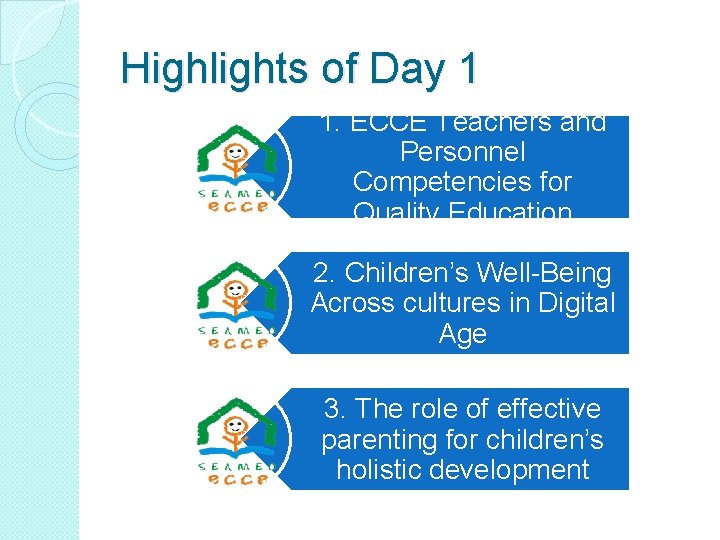
Highlights of Day 1 1. ECCE Teachers and Personnel Competencies for Quality Education 2. Children’s Well-Being Across cultures in Digital Age 3. The role of effective parenting for children’s holistic development
Day 1 Lessons Learned � Mr. ) Dr. M. Solehudin, M. A. , M. Pd. , Indonesia University of Education � The quality of Early Childhood Care and Education (ECCE) teachers is best described and summarised by the concept of “professionalism” as it describes the utilisation of specialised knowledge to accomplish specific outcomes. � In Indonesia, there are four professional competencies that each ECCE teacher with a bachelor degree or diploma IV in early childhood education or psychology has to master. (i) Personality Competency: the capability of performing his/her attitudes and behaviors appropriately in line with children characteristics and to be a model for them; (ii) Professional Competency: the capability of understanding children growth and development and to provide educational interventions and stimulations appropriately; (iii) Pedagogic Competency: the capability of managing and delivering caregiving and education process; and, (iv) Social Competency �
Day 1 Lessons Learned � (Ms. ) Professor Carmen Dalli, Institute for Early Childhood Studies, Victoria University of Wellington � � The New Zealand (NZ) early childhood sector is very diverse – with over 20 different types of services that vary by philosophical orientation, whether they are centre- or home-based; hours of opening; etc. For administrative and funding purposes; centres are classified as either teacher-led or parent-led. � ECCE services accept children from Birth to 6 years old when School becomes compulsory. However, most children start school on the day they turn 5. NZ has had an integrated care and education system since 1986 when policy and administrative responsibility for childcare services was transferred from the Department of Social Welfare to the Department of Education. � NZ is among the first countries to develop an integrated professional ECCE workforce to work across what other countries still refer to as “childcare” and “preschool”.
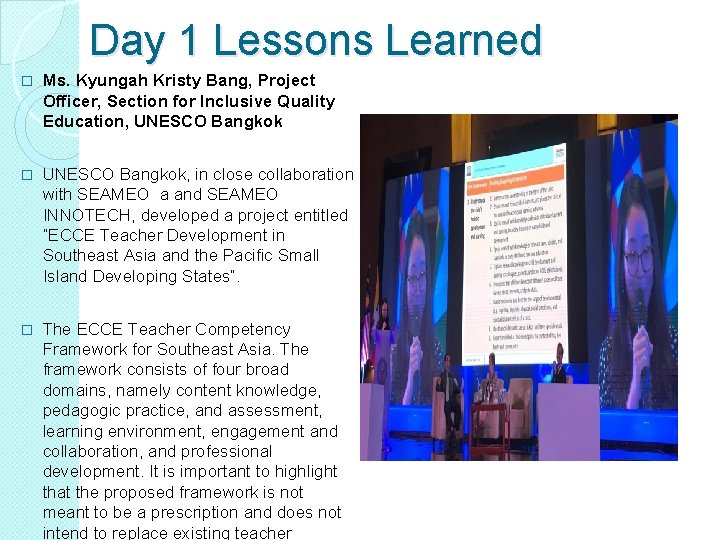
Day 1 Lessons Learned � Ms. Kyungah Kristy Bang, Project Officer, Section for Inclusive Quality Education, UNESCO Bangkok � UNESCO Bangkok, in close collaboration with SEAMEO a and SEAMEO INNOTECH, developed a project entitled “ECCE Teacher Development in Southeast Asia and the Pacific Small Island Developing States”. � The ECCE Teacher Competency Framework for Southeast Asia. The framework consists of four broad domains, namely content knowledge, pedagogic practice, and assessment, learning environment, engagement and collaboration, and professional development. It is important to highlight that the proposed framework is not meant to be a prescription and does not intend to replace existing teacher
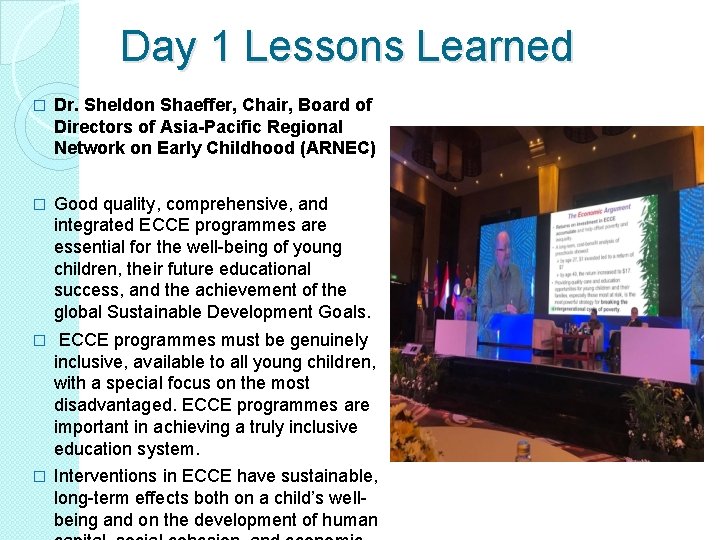
Day 1 Lessons Learned � Dr. Sheldon Shaeffer, Chair, Board of Directors of Asia-Pacific Regional Network on Early Childhood (ARNEC) � Good quality, comprehensive, and integrated ECCE programmes are essential for the well-being of young children, their future educational success, and the achievement of the global Sustainable Development Goals. � ECCE programmes must be genuinely inclusive, available to all young children, with a special focus on the most disadvantaged. ECCE programmes are important in achieving a truly inclusive education system. � Interventions in ECCE have sustainable, long-term effects both on a child’s wellbeing and on the development of human
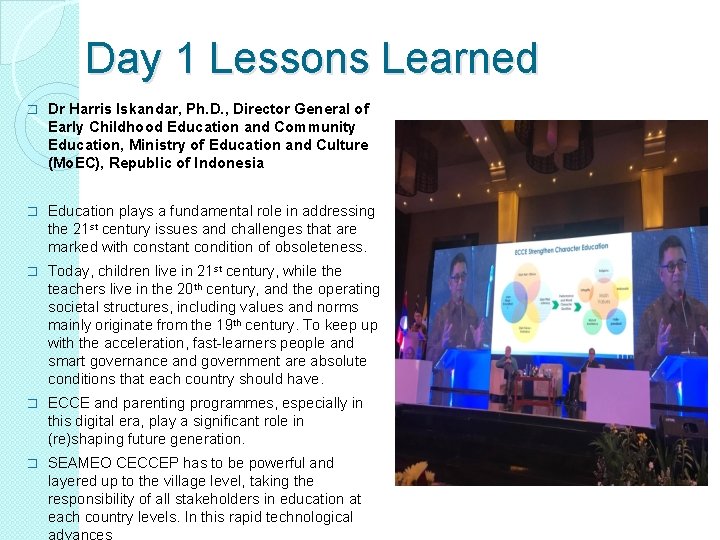
Day 1 Lessons Learned � Dr Harris Iskandar, Ph. D. , Director General of Early Childhood Education and Community Education, Ministry of Education and Culture (Mo. EC), Republic of Indonesia � Education plays a fundamental role in addressing the 21 st century issues and challenges that are marked with constant condition of obsoleteness. � Today, children live in 21 st century, while the teachers live in the 20 th century, and the operating societal structures, including values and norms mainly originate from the 19 th century. To keep up with the acceleration, fast-learners people and smart governance and government are absolute conditions that each country should have. � ECCE and parenting programmes, especially in this digital era, play a significant role in (re)shaping future generation. � SEAMEO CECCEP has to be powerful and layered up to the village level, taking the responsibility of all stakeholders in education at each country levels. In this rapid technological
Day 1 Gala Dinner with cultural performances
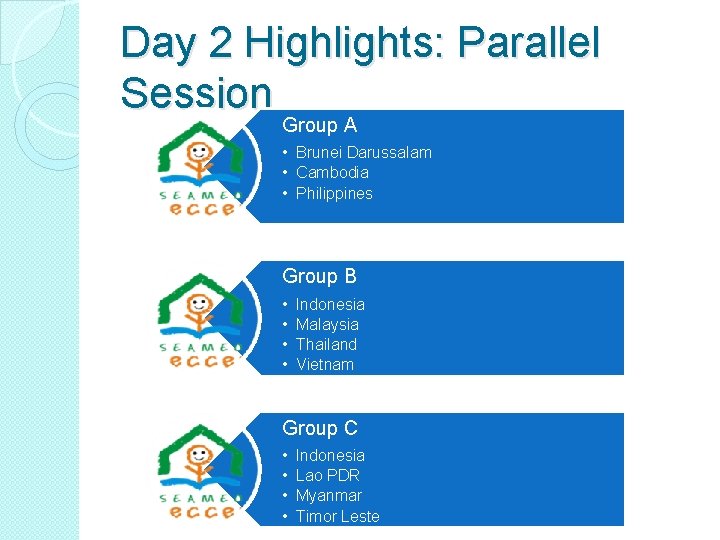
Day 2 Highlights: Parallel Session Group A • Brunei Darussalam • Cambodia • Philippines Group B • • Indonesia Malaysia Thailand Vietnam Group C • • Indonesia Lao PDR Myanmar Timor Leste
Lessons Learned from Day 2 �SEAMEO member countries have supportive policies on ECCE and parenting ◦ There are Children and Young Persons Act 2010, Child Care Centre Order 2006, the Education Order 2003, Compulsory Education Order 2007, the National Health Care plan, and Inclusive special education policy. (Brunei Darussalam) ◦ Cambodia has parenting programmes is when the government introduced Parenting Education Programme.
Lessons Learned from Day 2 �SEAMEO member countries have supportive policies on ECCE and parenting ◦ ECCE in the Philippines is mainly regulated by the Early Childhood Care and Development (EECD) Council Governing Board. The Early Years Act clearly guarantees that the rights of all Filipino children aged 0 -4 years are protected and promoted, and their potentials are developed to the fullest regardless of their conditions, socio-economic status, gender, religion and cultural diversity
Lessons Learned from Day 2 �SEAMEO member countries have supportive policies on ECCE and parenting ◦ ECCE in Singapore was established in 2013 as a regulatory and development authority for early childhood (EC) sector. The ECCE practices in Singapore are divided into two services: Child Care Centres for children aged 2 months until 7 years, and Kindergarten for children aged below 3 years to 7 years. The services are provided mainly by four agencies, Anchor Operators (AOPs), Voluntary Welfare Organisations (VWOs) with a social mission, Private Commercial Operators (PTE) catering middle to higher income families, and Ministry Of Education Kindergartens (MKs) that start operating in January 2014.
Lessons Learned from Day 2 � Ms. Ella Yulaelawati, Ph. D. , the Ministry of Education and Culture (Mo. EC), Republic of Indonesia � Education does not start in school: from an early age, children have learned so many things – including media. When children have access to (quality) educational services at an early age, many obstacles can be prevented when they start school. � Early Childhood Care and Education (ECCE) is all about promoting children’s well- being and equality. It is important to note that children’s well-being encompasses many aspects, namely: growth, learning, development, safety, health and the fulfilment of other basic needs. All these are key to building a holistic children’s well-being.
Lessons Learned from Day 2 �SEAMEO member countries have supportive policies on ECCE and parenting ◦ The education sector in Malaysia provides support for lifelong learning starting from early childhood care and education (ECCE) to tertiary education. ◦ The provision of ECCE in Malaysia has existed before 1960 s, but is officially stated in the national education system since 1993.
Lessons Learned from Day 2 �SEAMEO member countries have supportive policies on ECCE and parenting ◦ The Thai government is taking serious steps to move the country towards “Thailand 4. 0”, which is a new economic model, aimed at pulling ◦ Thailand out of the middle-income trap and developing it as a high-income country. In moving the country towards this destination, Thai government lays emphasis on the promotion of good parenting practices.
Lessons Learned from Day 2 � SEAMEO member countries have supportive policies on ECCE and parenting � “Children from 3 -5 years will have access to early education in a pre-school that is close to the place where they live. Here they will develop skills and knowledge in preparation for Basic Education. Families, communities and local governments will be involved in the decision-making process and, through collaborative efforts, schools will be established that meet all the requirements of quality Pre-School Education. ” � -Timor-Leste National Education Strategic Plan 2011 -2030
Lessons Learned from Day 2 SEAMEO member countries have supportive policies on ECCE and parenting, Myanmar has done some education polices 1. “National Education Law (NEL) (2014. Amendment 2015) 2. National Education Policy Commission (NEPC) 3. National Curriculum Committee(NCC) 4. National Accreditation of Quality Assurance Committee(NAQAC) 5. National Education Strategic Plan(NESP) (2016 -2021)
Lessons Learned from Day 2 �SEAMEO member countries have supportive policies on ECCE and parenting Myanmar has done some education polices ◦ Lao PDR has implemented ECCE and parenting programmes ◦ There were policies developed to support ECCE and improve quality basic education. ◦ UNICEF, UNESCO and other international org supports ECCE in Lao PDR
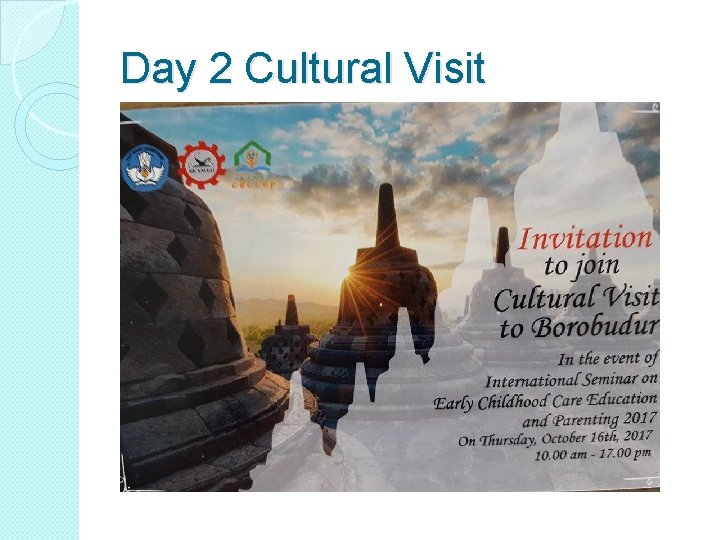
Day 2 Cultural Visit
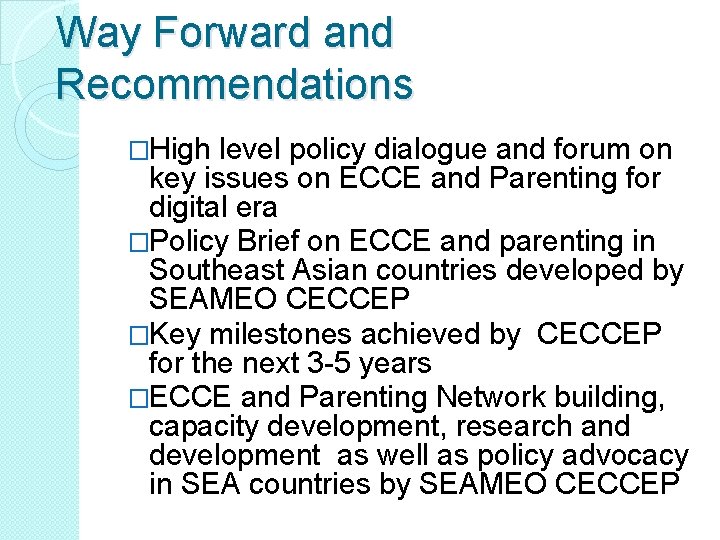
Way Forward and Recommendations �High level policy dialogue and forum on key issues on ECCE and Parenting for digital era �Policy Brief on ECCE and parenting in Southeast Asian countries developed by SEAMEO CECCEP �Key milestones achieved by CECCEP for the next 3 -5 years �ECCE and Parenting Network building, capacity development, research and development as well as policy advocacy in SEA countries by SEAMEO CECCEP