
International Scientific Spring 2016 ISS2016 Islamabad Pakistan March
International Scientific Spring – 2016 ISS-2016 Islamabad, Pakistan March 7 - 11, 2016 Spectral broadening and temporal compression of ultrafast laser pulses in neon-filled hollow core capillary fiber Walid Tawfik 1 Department of Physics and Astronomy College of Science, King Saud University, Riyadh, Saudi Arabia. 2 Department of Environmental Applications NILES National Institute of Laser, Cairo University Cairo, Egypt. 1 wmohamed@ksu. edu. sa 9/18/2020
King Saud University 2 9/18/2020
Outlines �Why we need ultrafast white light (tunable) high-power laser pulse? �Experimental setup layout. �Output characteristics. �Using SPIDER for measurement of few-cycle pulses �Controlling the Tunable broad-bandwidth ultrafast laser pulses. �Creating Transform-Limited �Conclusion and future work. 3 9/18/2020
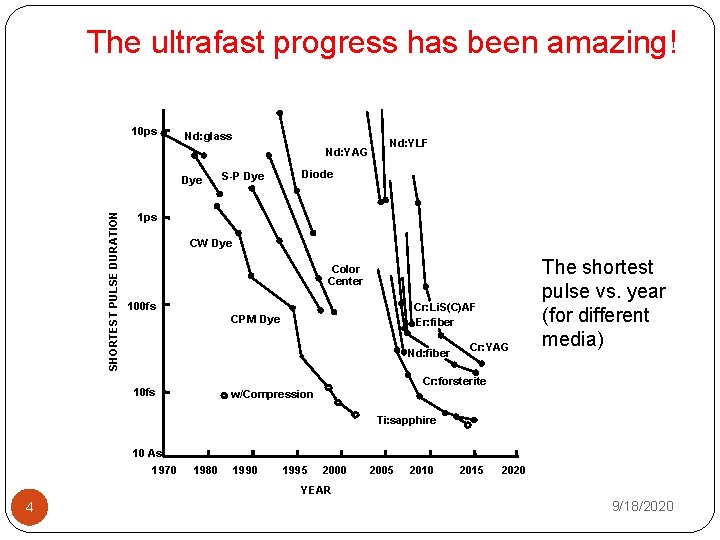
The ultrafast progress has been amazing! 10 ps Nd: glass Nd: YAG SHORTEST PULSE DURATION Dye S-P Dye Nd: YLF Diode 1 ps CW Dye Color Center 100 fs Cr: Li. S(C)AF Er: fiber CP M Dye Nd: fiber Cr: YAG The shortest pulse vs. year (for different media) Cr: forsterite 10 fs w/Compression Ti: sapphire 10 As 1970 1980 1995 2000 2005 2010 2015 2020 YEAR 4 9/18/2020
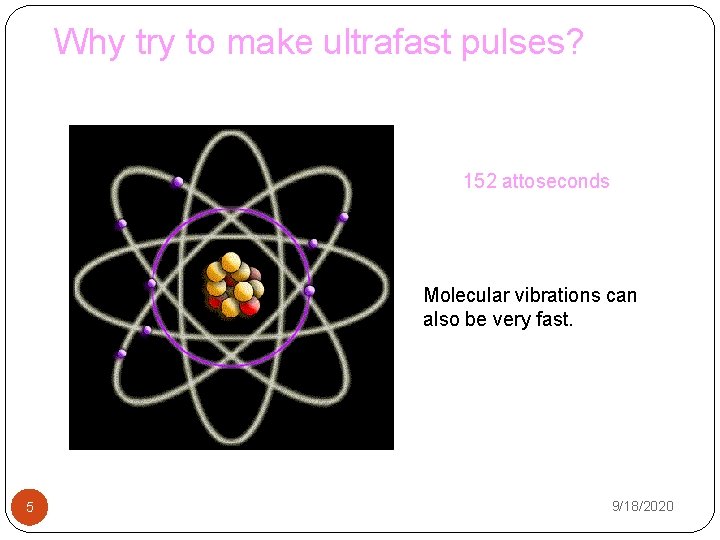
Why try to make ultrafast pulses? Bohr-orbit time in hydrog 152 attoseconds Molecular vibrations can also be very fast. H 2 vibrational oscillation period: ~ 7 fs 5 9/18/2020
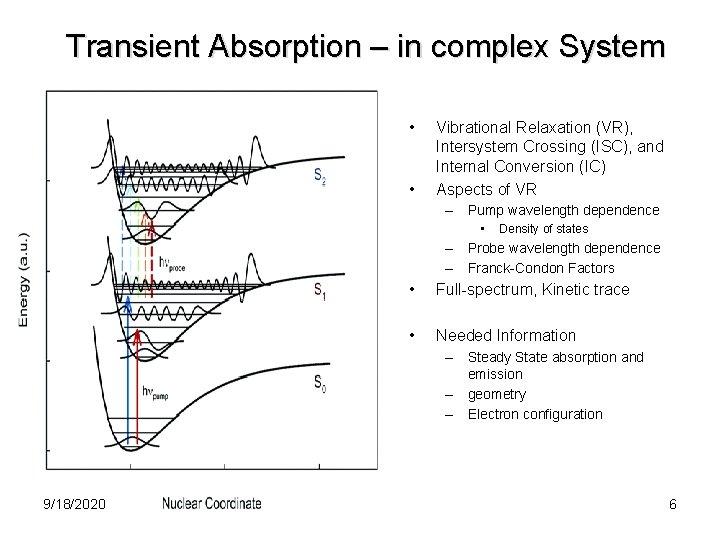
Transient Absorption – in complex System • • Vibrational Relaxation (VR), Intersystem Crossing (ISC), and Internal Conversion (IC) Aspects of VR – Pump wavelength dependence • Density of states – Probe wavelength dependence – Franck-Condon Factors • Full-spectrum, Kinetic trace • Needed Information – Steady State absorption and emission – geometry – Electron configuration 9/18/2020 6
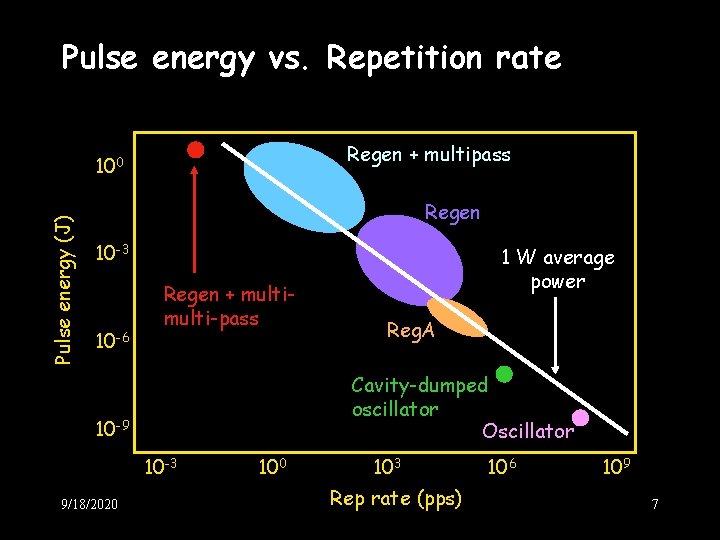
Pulse energy vs. Repetition rate Regen + multipass Pulse energy (J) 100 Regen 10 -3 10 -6 Regen + multi-pass Reg. A Cavity-dumped oscillator Oscillator 10 -9 10 -3 9/18/2020 1 W average power 100 103 Rep rate (pps) 106 109 7
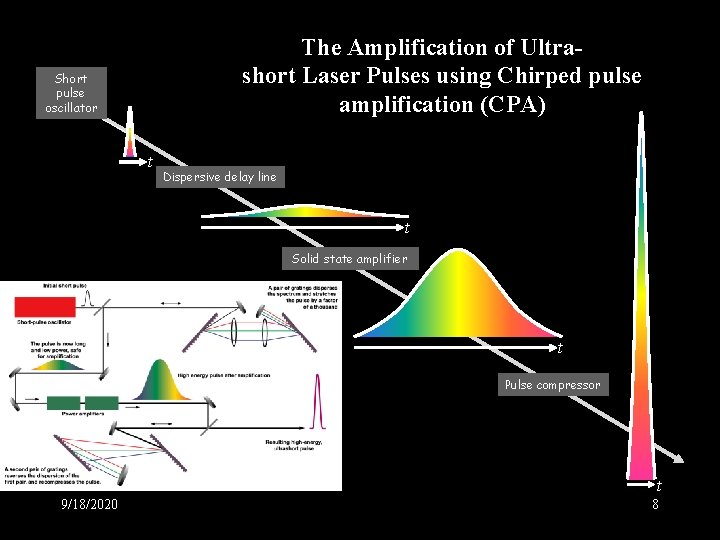
The Amplification of Ultrashort Laser Pulses using Chirped pulse amplification (CPA) Short pulse oscillator t Dispersive delay line t Solid state amplifier t Pulse compressor t 9/18/2020 8
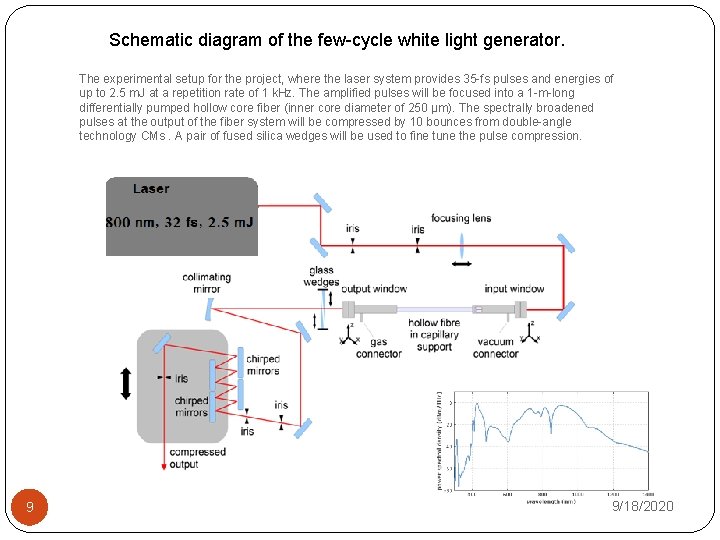
Schematic diagram of the few-cycle white light generator. The experimental setup for the project, where the laser system provides 35 -fs pulses and energies of up to 2. 5 m. J at a repetition rate of 1 k. Hz. The amplified pulses will be focused into a 1 -m-long differentially pumped hollow core fiber (inner core diameter of 250 μm). The spectrally broadened pulses at the output of the fiber system will be compressed by 10 bounces from double-angle technology CMs. A pair of fused silica wedges will be used to fine tune the pulse compression. 9 9/18/2020
Optical layout of the few-cycle white light generator. 10 9/18/2020
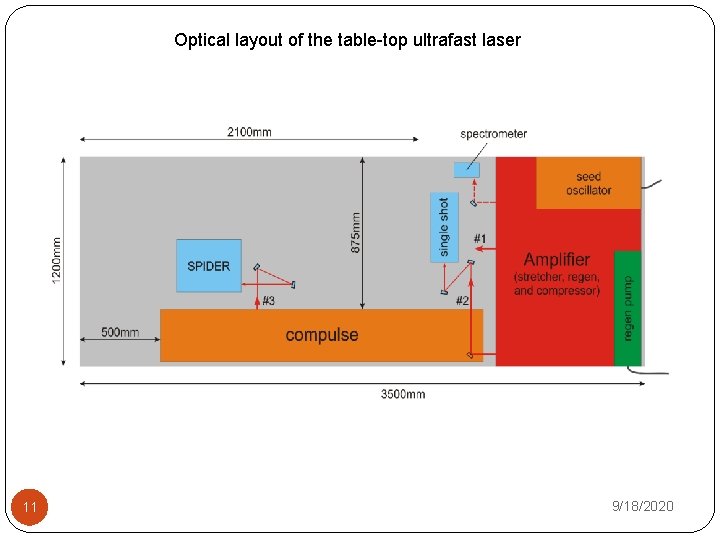
Optical layout of the table-top ultrafast laser 11 9/18/2020
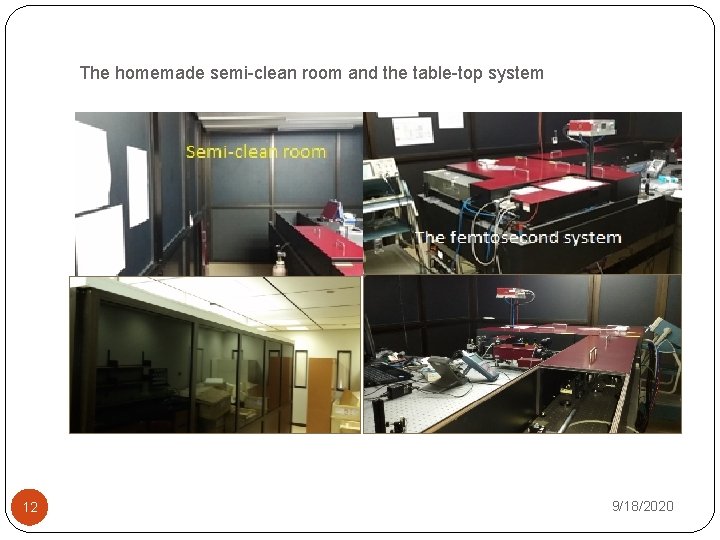
The homemade semi-clean room and the table-top system 12 9/18/2020
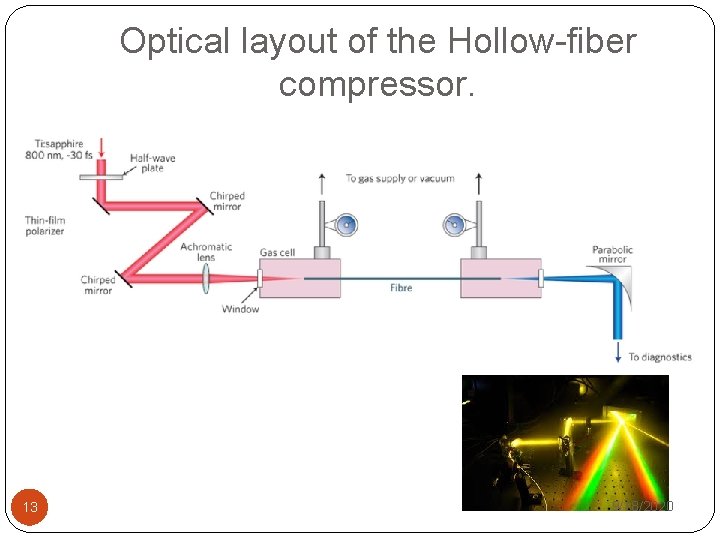
Optical layout of the Hollow-fiber compressor. 13 9/18/2020
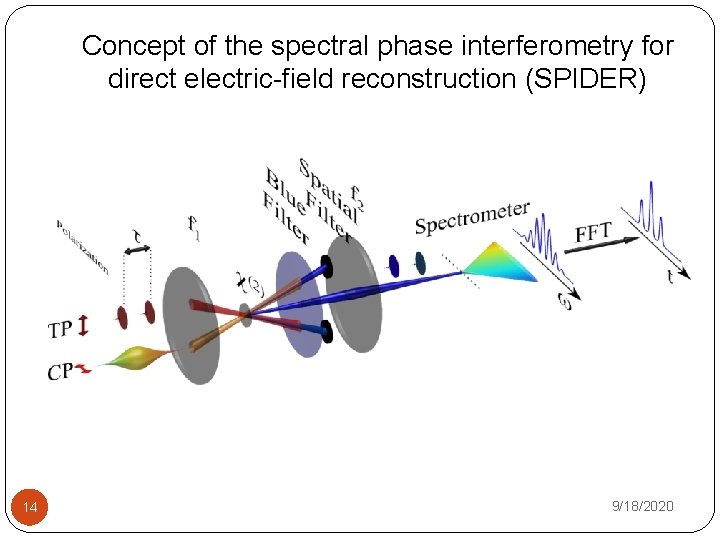
Concept of the spectral phase interferometry for direct electric-field reconstruction (SPIDER) 14 9/18/2020
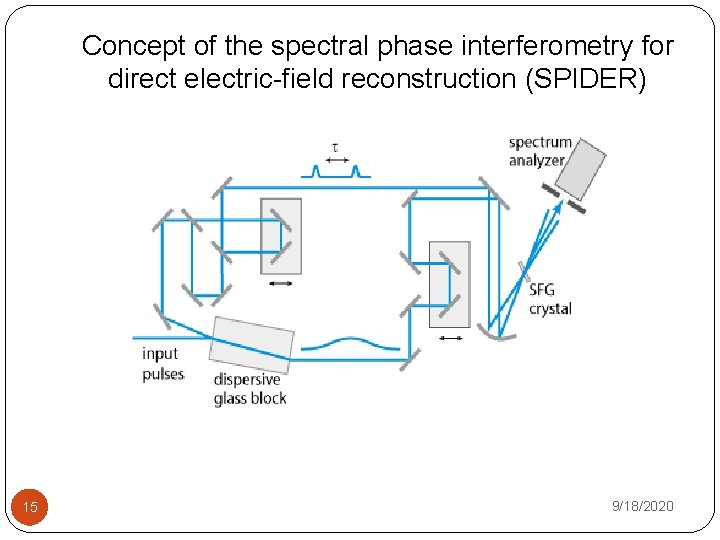
Concept of the spectral phase interferometry for direct electric-field reconstruction (SPIDER) 15 9/18/2020
Optical layout of the spectral phase interferometry for direct electric-field reconstruction (SPIDER) Beam input 16 9/18/2020
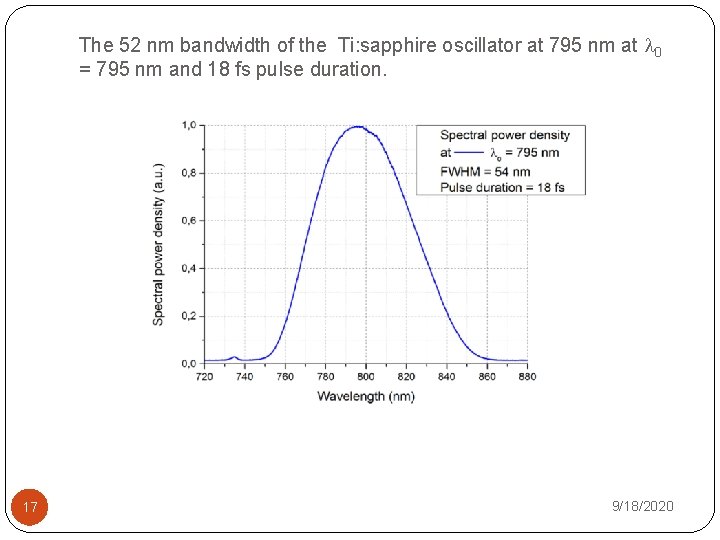
The 52 nm bandwidth of the Ti: sapphire oscillator at 795 nm at l 0 = 795 nm and 18 fs pulse duration. 17 9/18/2020
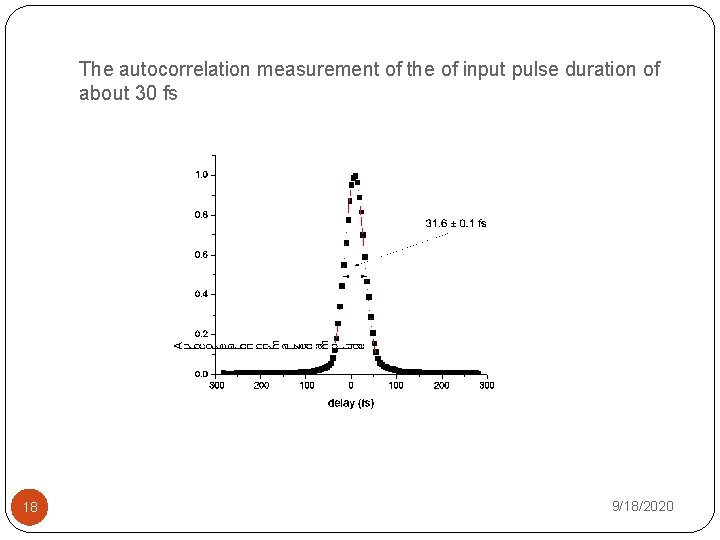
The autocorrelation measurement of the of input pulse duration of about 30 fs 18 9/18/2020
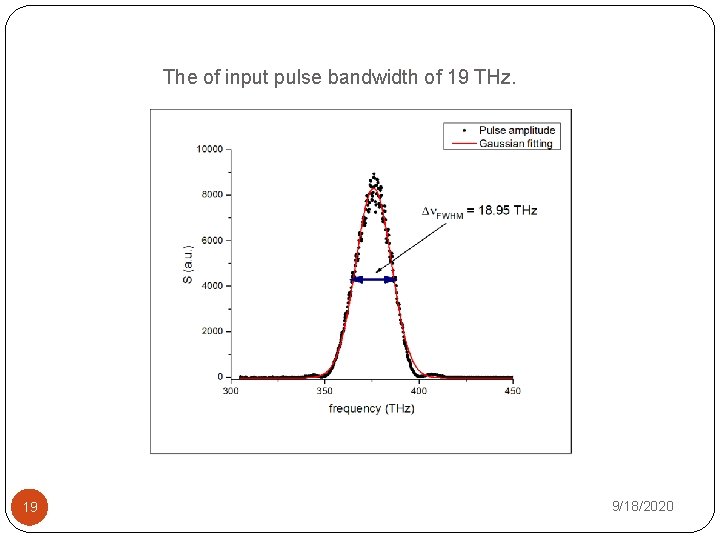
The of input pulse bandwidth of 19 THz. 19 9/18/2020
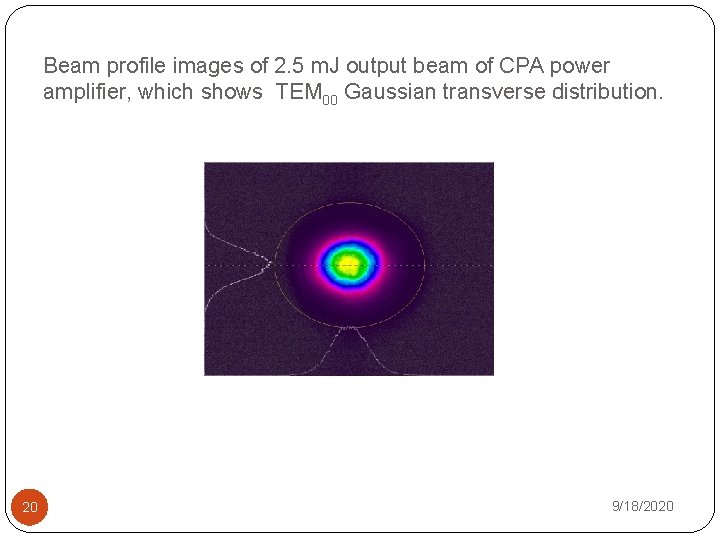
Beam profile images of 2. 5 m. J output beam of CPA power amplifier, which shows TEM 00 Gaussian transverse distribution. 20 9/18/2020
Temporal profile of the compressed output pulse (black curve) and temporal phase (blue curve) of the compressed output pulses of 8. 9 fs measured using SPIDER. 21 9/18/2020
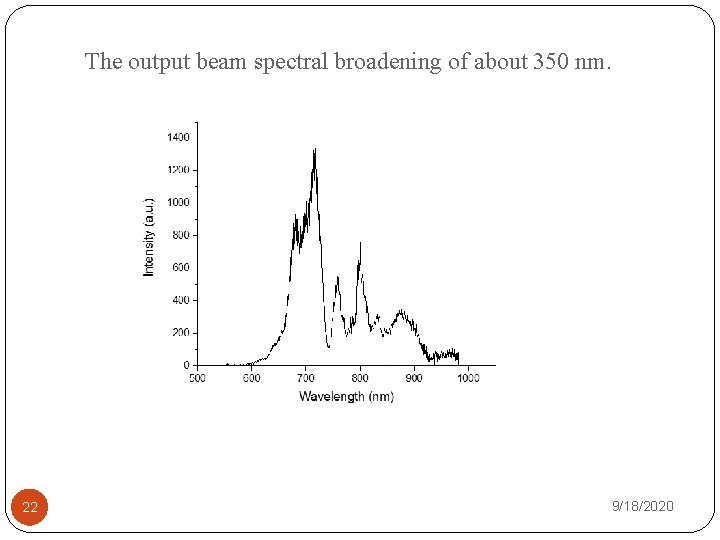
The output beam spectral broadening of about 350 nm. 22 9/18/2020
Accurate measurement of few-cycle laser pulses using spider 23 9/18/2020
The temporal profile change of the transform limited of the output pulses (green curve) for ICP values of 32, 44, and 54 fs, respectively at neon gas pressure of 2 atm. The compressed output pulse (black curve) and temporal phase (blue curve) of the compressed output pulses measured using SPIDER. 24 9/18/2020
The temporal profile change of the transform limited of the output pulses (green curve) for ICP values of 32, 50, and 54 fs, respectively at neon gas pressure of 2. 25 atm. The compressed output pulse (black curve) and temporal phase (blue curve) of the compressed output pulses measured using SPIDER. 25 9/18/2020
The temporal profile change of the transform limited of the output pulses (green curve) for ICP values of 34, 54, and 56 fs, respectively at neon gas pressure of 2. 5 atm. The compressed output pulse (black curve) and temporal phase (blue curve) of the compressed output pulses measured using SPIDER. 26 9/18/2020
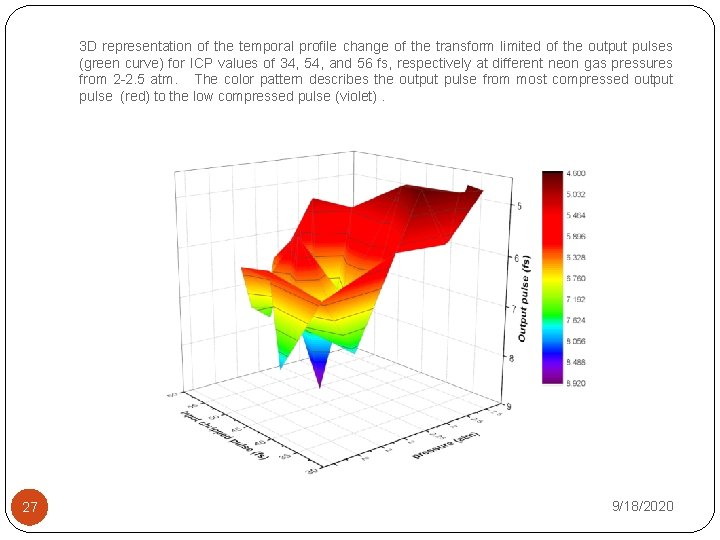
3 D representation of the temporal profile change of the transform limited of the output pulses (green curve) for ICP values of 34, 54, and 56 fs, respectively at different neon gas pressures from 2 -2. 5 atm. The color pattern describes the output pulse from most compressed output pulse (red) to the low compressed pulse (violet). 27 9/18/2020
Controlled the bandwidth of the ultrafast laser pulses to create Transform-Limited 100 GW Optical Pulses 28 9/18/2020
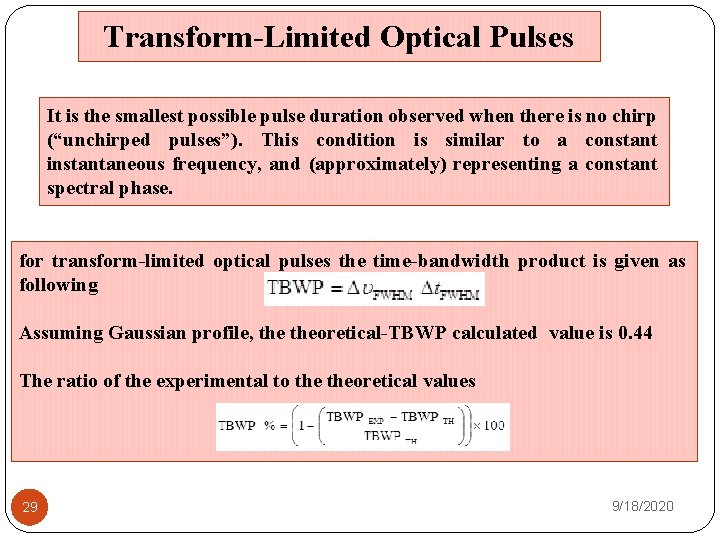
Transform-Limited Optical Pulses It is the smallest possible pulse duration observed when there is no chirp (“unchirped pulses”). This condition is similar to a constant instantaneous frequency, and (approximately) representing a constant spectral phase. for transform-limited optical pulses the time-bandwidth product is given as following Assuming Gaussian profile, theoretical-TBWP calculated value is 0. 44 The ratio of the experimental to theoretical values 29 9/18/2020
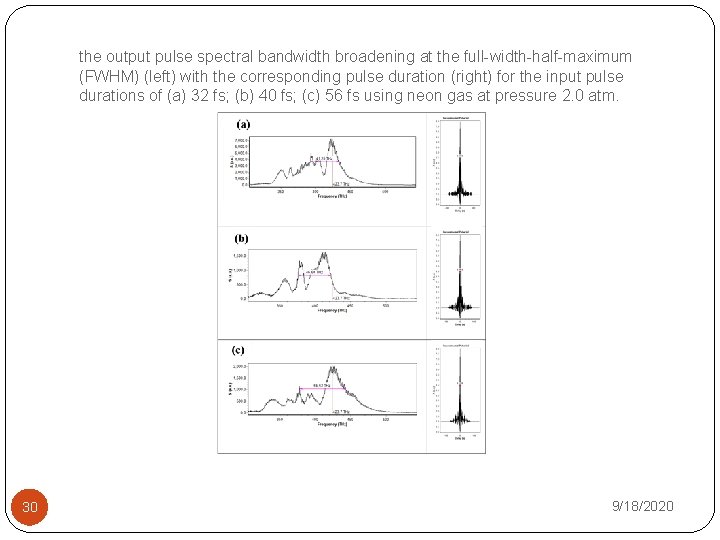
the output pulse spectral bandwidth broadening at the full-width-half-maximum (FWHM) (left) with the corresponding pulse duration (right) for the input pulse durations of (a) 32 fs; (b) 40 fs; (c) 56 fs using neon gas at pressure 2. 0 atm. 30 9/18/2020
the output pulse spectral bandwidth broadening at the full-width-half-maximum (FWHM) (left) with the corresponding pulse duration (right) for the input pulse durations of (a) 32 fs; (b) 40 fs; (c) 56 fs using neon gas at pressure 2. 25 atm. 31 9/18/2020
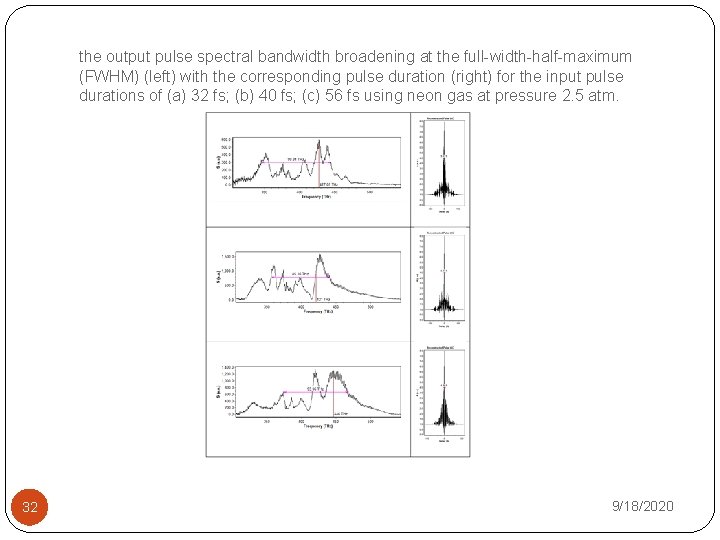
the output pulse spectral bandwidth broadening at the full-width-half-maximum (FWHM) (left) with the corresponding pulse duration (right) for the input pulse durations of (a) 32 fs; (b) 40 fs; (c) 56 fs using neon gas at pressure 2. 5 atm. 32 9/18/2020
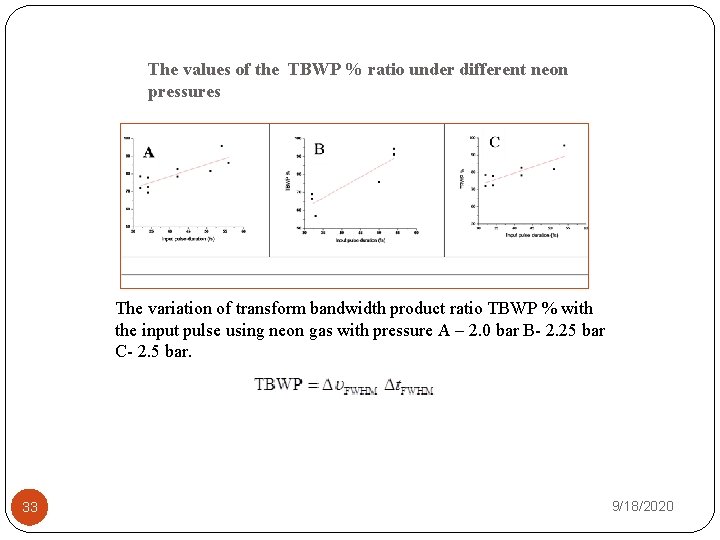
The values of the TBWP % ratio under different neon pressures The variation of transform bandwidth product ratio TBWP % with the input pulse using neon gas with pressure A – 2. 0 bar B- 2. 25 bar C- 2. 5 bar. 33 9/18/2020
Creation of Transform-Limited 100 GW Optical Pulses The transform limited pulse of 6. 01 fs observed under optimized conditions. Then the peak power of the observed optical pulse is considered to be ~ 100 GW for pulse energy of 600 J and 6. 01 fs pulse duration. 34 9/18/2020
Conclusions � we have demonstrated fs system which has the ability to generate pulses of 0. 6 m. J with variable pulse duration from 6 fs to almost 13 fs. � The applied method generates ultrafast pulses of with bandwidth of about 94 THz using injected pulses of about 19 THz. So, the throughput optical enhancement reaches about five-octave-wide extending from 360 - 455 THz. � The observed results are important to control the progression of strong-electric-field interactions on the ultrafast time scale, and can be used to create more shorter pulses in the attosecond regime with shorter wavelength in the UV- x-ray regime in the forthcoming future. 35 9/18/2020
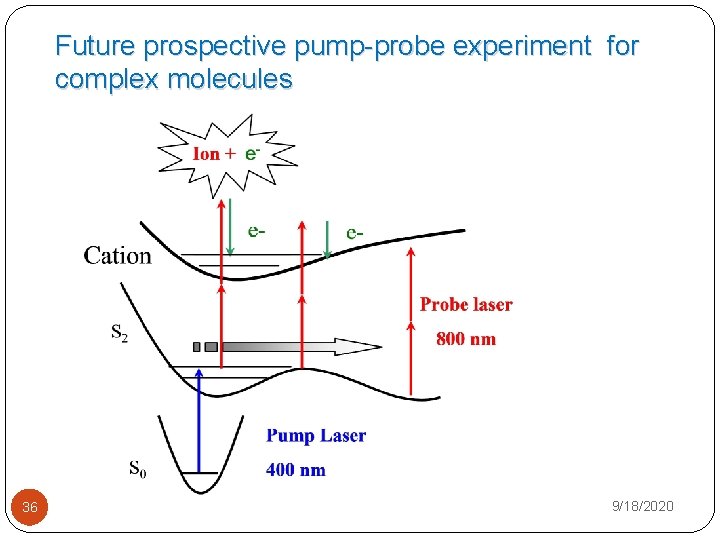
Future prospective pump-probe experiment for complex molecules 36 9/18/2020
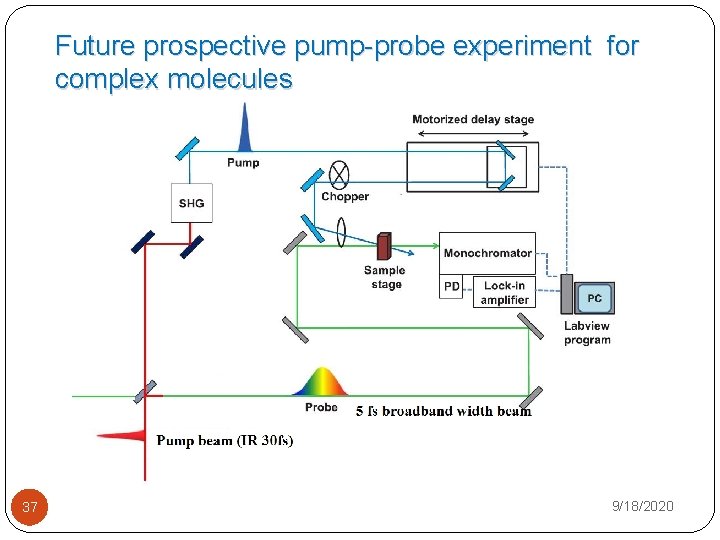
Future prospective pump-probe experiment for complex molecules 37 9/18/2020
Tayyab Imran J P Singh 38 Visiting Professor from Mississippi State University 9/18/2020

39 9/18/2020
- Slides: 39