
International School on Introduction in the Rietveld structure



- Slides: 50
International School on Introduction in the Rietveld structure refinement Sofia, Bulgaria, 28 September - 3 October 2015 Ognyan Petrov Institute of Mineralogy and Crystallography, Bulgarian Academy of Sciences, Sofia, Bulgaria
Why do we need to develop powder XRD quantification methods? Quantitative analysis of diffraction data usually refers to the determination of amounts of different phases in multi-phase samples 1. An accurate knowledge of the contents of the mineral phases in geological materials is essential in a wide range of applications, and particularly in experimental studies investigating reaction kinetics or the mechanical properties of polymineral materials – petrological classification, useful mineral in deposits, wastes from mining, etc. . 2. In research laboratories conducting any kind of synthesis it is important to perform quantitative control of the crystalline phases – to reach a desired phase or to prepare a composite material with fixed proportions, etc.
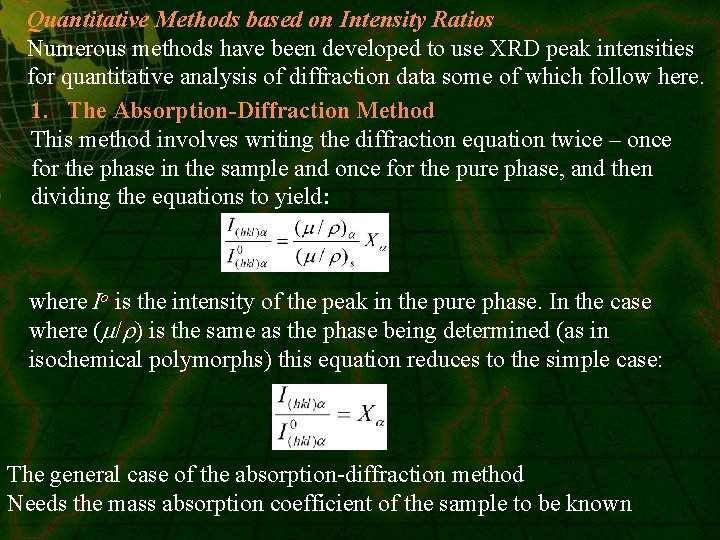
Quantitative Methods based on Intensity Ratios Numerous methods have been developed to use XRD peak intensities for quantitative analysis of diffraction data some of which follow here. 1. The Absorption-Diffraction Method This method involves writing the diffraction equation twice – once for the phase in the sample and once for the pure phase, and then dividing the equations to yield: where Io is the intensity of the peak in the pure phase. In the case where (m/r) is the same as the phase being determined (as in isochemical polymorphs) this equation reduces to the simple case: The general case of the absorption-diffraction method Needs the mass absorption coefficient of the sample to be known
Quantitative Methods based on Intensity Ratios 2. Method of Standard Additions This method requires a variety of diffraction patterns run on prepared samples in which varied amounts of a well-known standard, β, are added to the unknown mixture containing phase α, then each mixture is analyzed. Because of tedious sample preparation and data errors encountered at low concentrations of both phases, this method is rarely applied in X-ray diffraction.
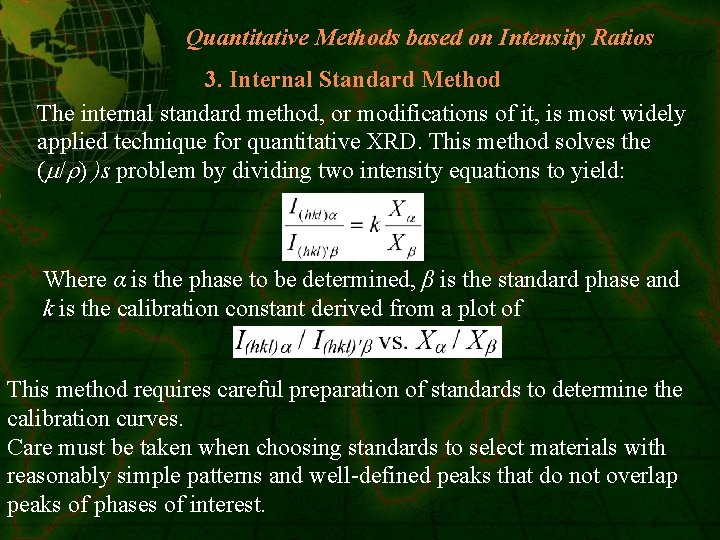
Quantitative Methods based on Intensity Ratios 3. Internal Standard Method The internal standard method, or modifications of it, is most widely applied technique for quantitative XRD. This method solves the (m/r) )s problem by dividing two intensity equations to yield: Where α is the phase to be determined, β is the standard phase and k is the calibration constant derived from a plot of This method requires careful preparation of standards to determine the calibration curves. Care must be taken when choosing standards to select materials with reasonably simple patterns and well-defined peaks that do not overlap peaks of phases of interest.
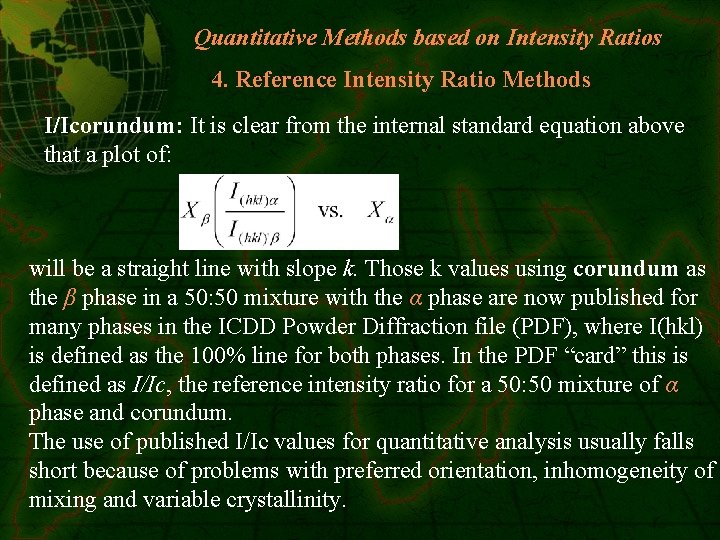
Quantitative Methods based on Intensity Ratios 4. Reference Intensity Ratio Methods I/Icorundum: It is clear from the internal standard equation above that a plot of: will be a straight line with slope k. Those k values using corundum as the β phase in a 50: 50 mixture with the α phase are now published for many phases in the ICDD Powder Diffraction file (PDF), where I(hkl) is defined as the 100% line for both phases. In the PDF “card” this is defined as I/Ic, the reference intensity ratio for a 50: 50 mixture of α phase and corundum. The use of published I/Ic values for quantitative analysis usually falls short because of problems with preferred orientation, inhomogeneity of mixing and variable crystallinity.
Quantitative Methods based on Intensity Ratios 5. Normalized RIR Method (Chung Method) This Method (Chung (1974) postullates that if all phases in a mixture are known and if RIRs are known for all of those phases, then the sum of all of the fractions of all the phases must equal to 1. This allows the writing of a system of n equations to solve for the n weight fractions using specific summation equation Chung referred to this method as the normalized RIR method that allows “quantitative” calculations without the presence of an internal standard. It should be noted that the presence of unidentified or amorphous phases invalidates the use of this method. Also, almost in all rocks, there are phases in the sample that are undetectable and thus the method will not work properly.
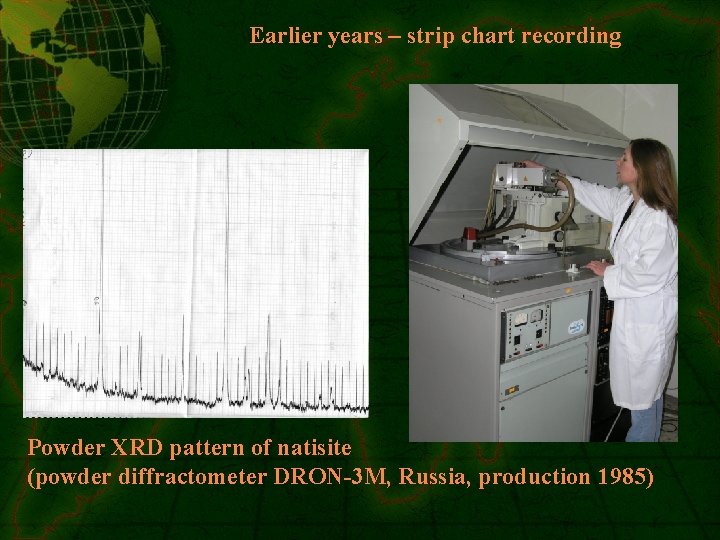
Earlier years – strip chart recording Powder XRD pattern of natisite (powder diffractometer DRON-3 M, Russia, production 1985)
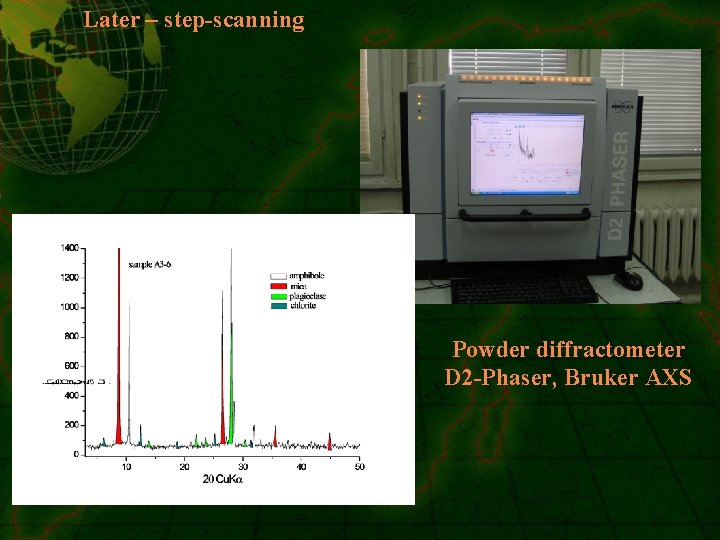
Later – step-scanning Powder diffractometer D 2 -Phaser, Bruker AXS
Full-Pattern Analysis – the Rietveld Method Prerequisites 1. Advances in computer technology 2. This computing power (and the computer programmers) has enabled diffractionists to work with the whole XRD pattern instead of relative intensities of a few identified peaks 3. Whole-pattern analyses is based on diffraction pattern being the sum of all effects, both instrumental and phase-related 4. The basic approach is obtain best data, identify all the phases present and input basic structural data for all phases, then let the computer model your data until raching the best fit to the experimental pattern.
Full-Pattern Analysis – the Rietveld Method The Rietveld method was originally created for refining crystal structures using neutron powder diffraction data. The method requires knowledge of the approximate crystal structure of all phases of interest in the pattern. It is important to understand that this method, because of the whole-pattern fitting approach, is capable of much greater accuracy and precision in quantitative analysis than any peak-intensity based method.
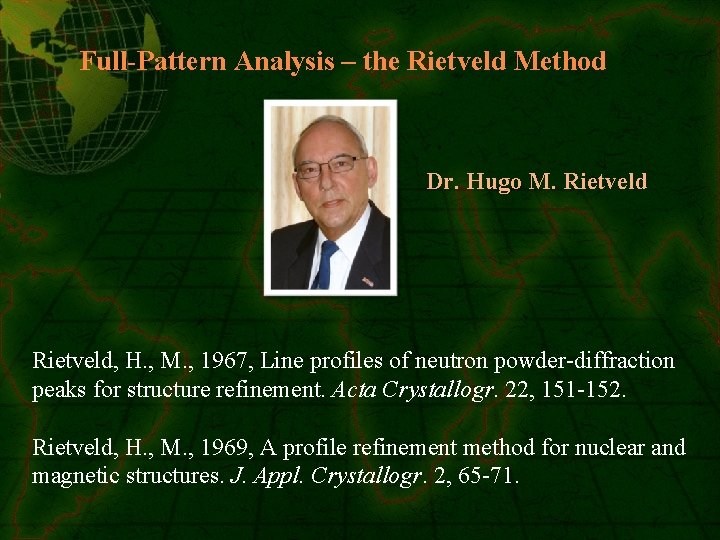
Full-Pattern Analysis – the Rietveld Method Dr. Hugo M. Rietveld, H. , M. , 1967, Line profiles of neutron powder-diffraction peaks for structure refinement. Acta Crystallogr. 22, 151 -152. Rietveld, H. , M. , 1969, A profile refinement method for nuclear and magnetic structures. J. Appl. Crystallogr. 2, 65 -71.
Full-Pattern Analysis – the Rietveld Method In Rietveld analysis, since the refinement “fits” itself to the data by modifying structure and instrument parameters iteratively, the Rietveld method has advantages over peak intensity-based methods: 1. Differences between the experimental pattern and the phase in the unknown are minimized. Compositionally variable phases are varied and fit by the software. 2. Pure-phase standards are not required for the analysis. 3. Overlapped lines and patterns may be used successfully. 4. Lattice parameters for each phase are automatically produced, allowing for the evaluation of solid solution effects in the phase. 5. The use of the whole pattern rather than a few select lines produces accuracy and precision much better than traditional methods. 6. Preferred orientation effects are averaged over all of the crystallographic directions, and may be modeled during the refinement.
The Variables of a Rietveld Refinement Software: - Peak shape function describes the shape of the diffraction peaks (Lorentz effects, absorption, detector geometry, step size, etc. ) -Peak width function starts with optimal FWHM values -Preferred orientation function defines an intensity correction factor - The structure factor, F, is calculated from the crystal structure data (site occupancy, cell dimensions, temperature and magnetic factors). Crystal structure data is usually obtained from the ICSD database. - The scale factor relates the intensity of the experimental data with that of the model data.
The spectrum (at a 2θ point i) is determined by: Where: Sj – is the scale factor for each phase and the marked part relates to quantification Lk - Lorentz-Polarization factor, related to experiment Fk, j – Structure factor, related to atomic positions S (2θi − 2θk, j ) - profile shape function Pk, j - preferred orientation function Aj - The absorption factor Bkgi – background, usually described by polynomial
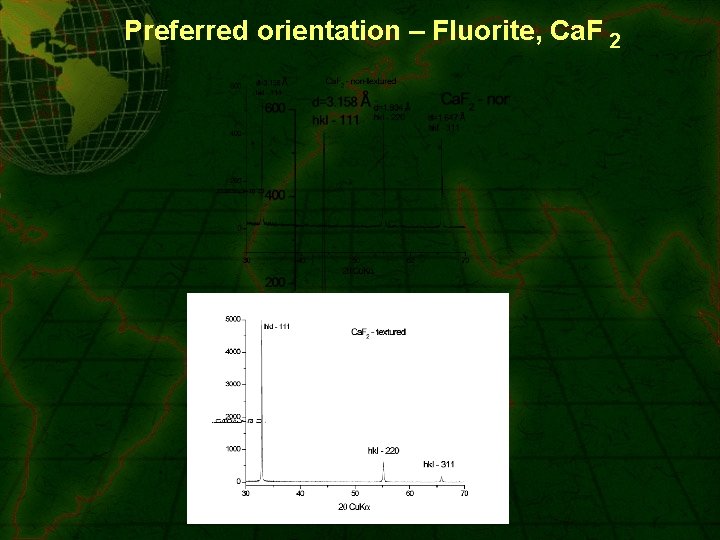
Preferred orientation – Fluorite, Ca. F 2
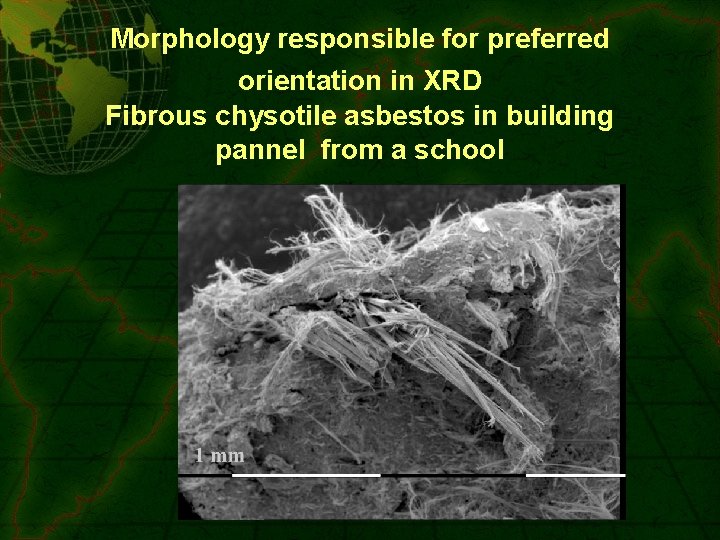
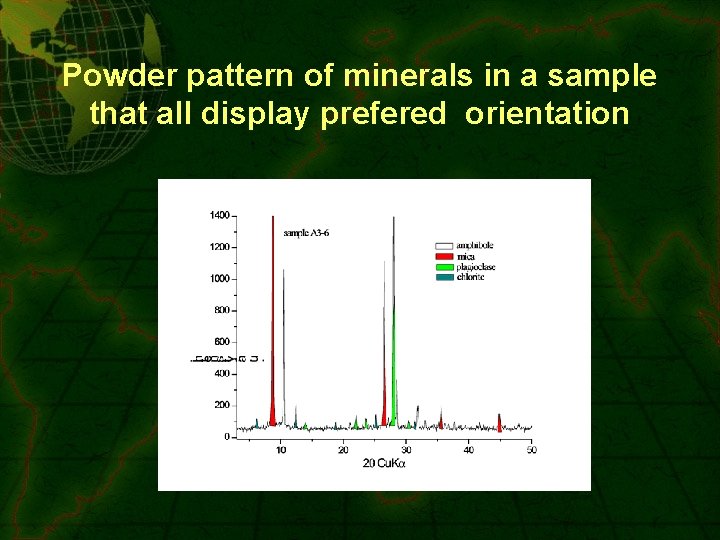
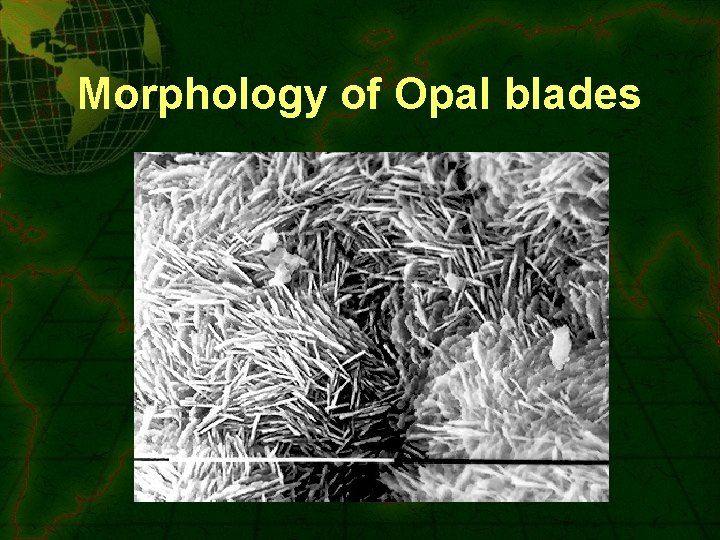
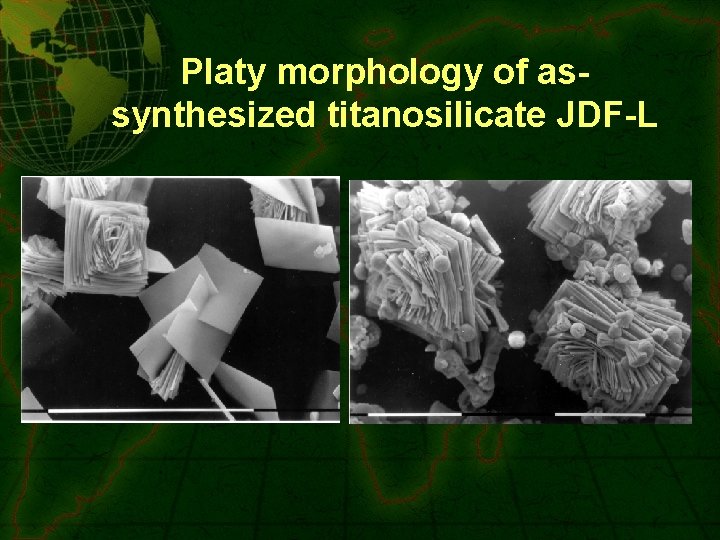
Morphology responsible for preferred orientation in XRD Fibrous chysotile asbestos in building pannel from a school
Powder pattern of minerals in a sample that all display prefered orientation
Morphology of Opal blades
Platy morphology of assynthesized titanosilicate JDF-L
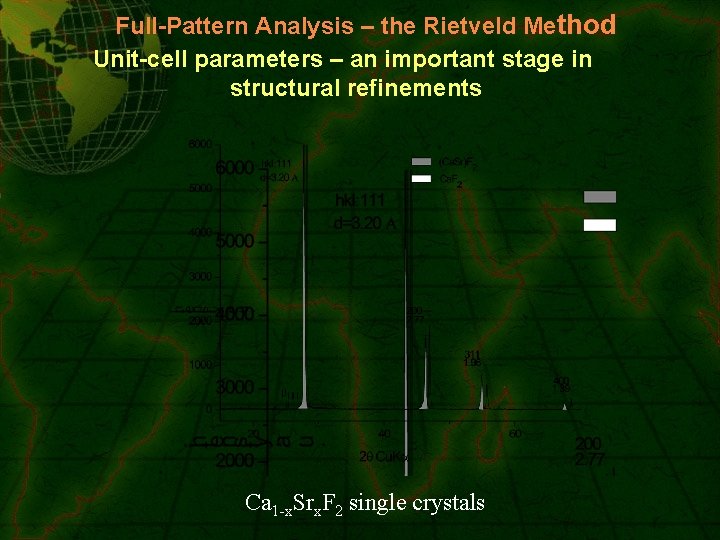
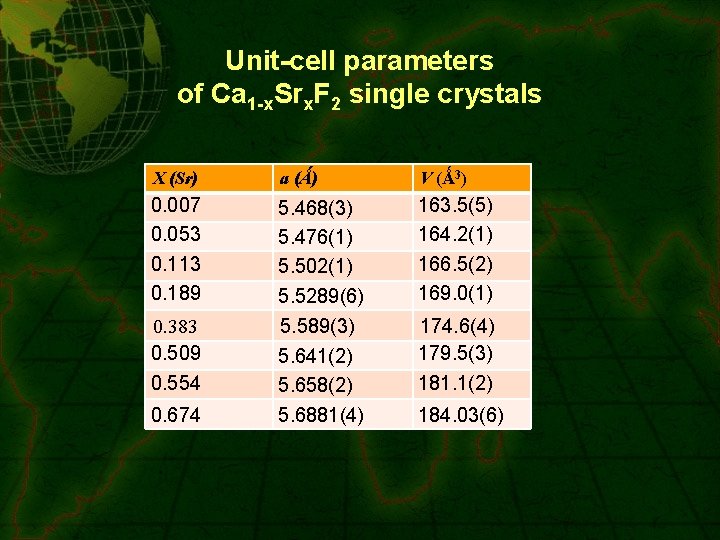
Full-Pattern Analysis – the Rietveld Method Unit-cell parameters – an important stage in structural refinements Ca 1 -x. Srx. F 2 single crystals
Unit-cell parameters of Ca 1 -x. Srx. F 2 single crystals X (Sr) a (Ǻ) V (Ǻ 3) 0. 007 0. 053 0. 113 0. 189 5. 468(3) 5. 476(1) 5. 502(1) 5. 5289(6) 163. 5(5) 164. 2(1) 166. 5(2) 169. 0(1) 0. 383 0. 509 0. 554 5. 589(3) 174. 6(4) 179. 5(3) 181. 1(2) 0. 674 5. 641(2) 5. 658(2) 5. 6881(4) 184. 03(6)
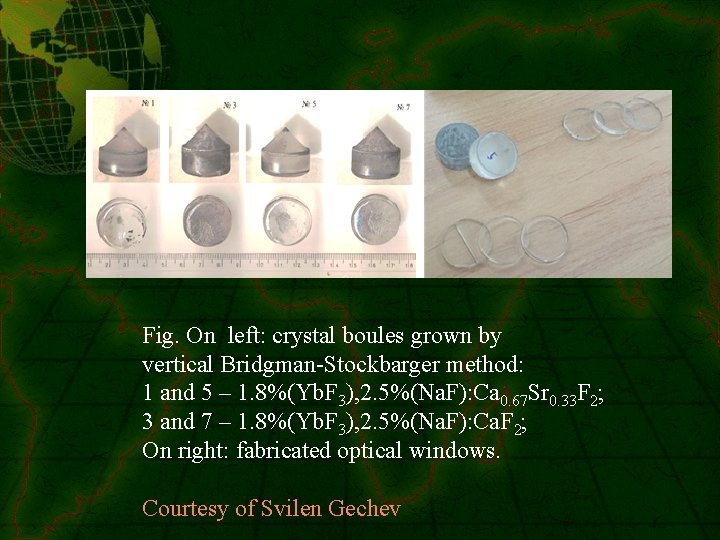
Fig. On left: crystal boules grown by vertical Bridgman-Stockbarger method: 1 and 5 ‒ 1. 8%(Yb. F 3), 2. 5%(Na. F): Ca 0. 67 Sr 0. 33 F 2; 3 and 7 ‒ 1. 8%(Yb. F 3), 2. 5%(Na. F): Ca. F 2; On right: fabricated optical windows. Courtesy of Svilen Gechev
The structure factor, F, is an important item in the intensity, I, of a diffraction line: I(hkl)=KLp / Fhkl / 2. (μ*)-1. cx
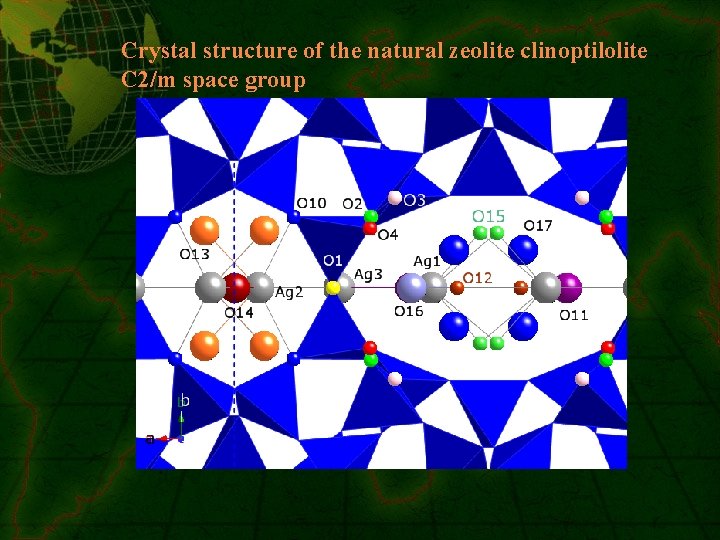
Crystal structure of the natural zeolite clinoptilolite C 2/m space group
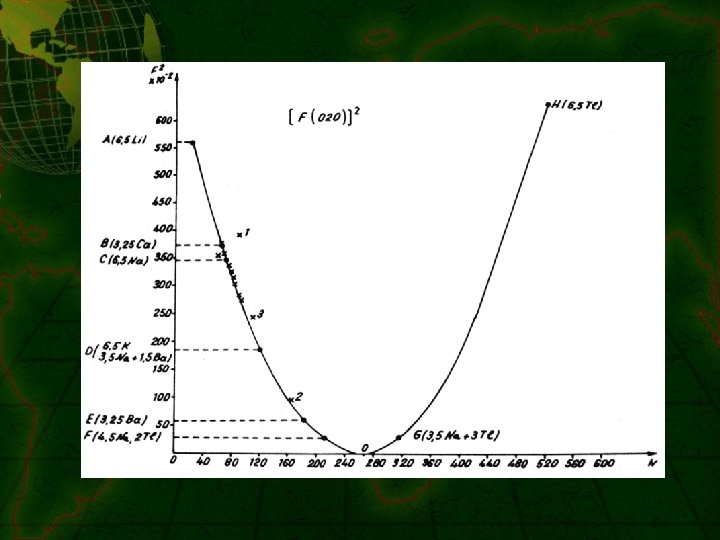
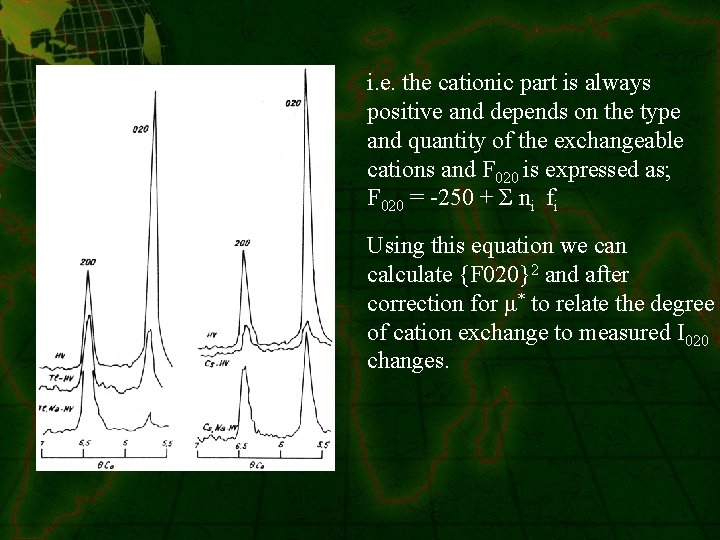
i. e. the cationic part is always positive and depends on the type and quantity of the exchangeable cations and F 020 is expressed as; F 020 = -250 + Ʃ ni fi Using this equation we can calculate {F 020}2 and after correction for μ* to relate the degree of cation exchange to measured I 020 changes.
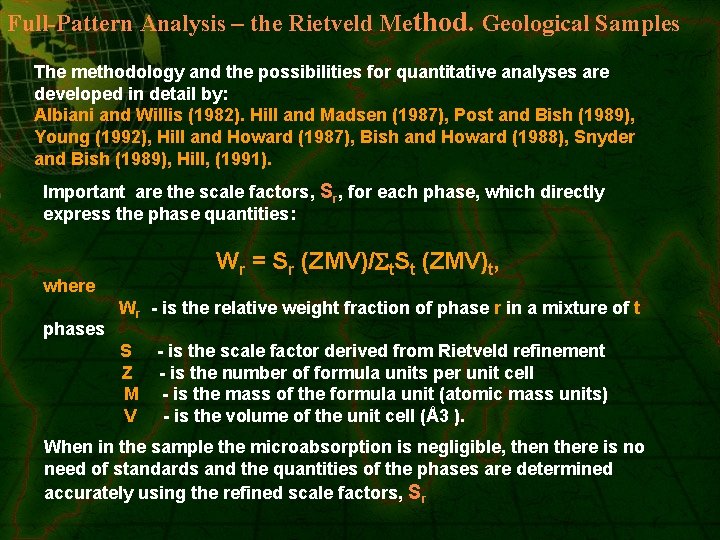
Full-Pattern Analysis – the Rietveld Method. Geological Samples The methodology and the possibilities for quantitative analyses are developed in detail by: Albiani and Willis (1982). Hill and Madsen (1987), Post and Bish (1989), Young (1992), Hill and Howard (1987), Bish and Howard (1988), Snyder and Bish (1989), Hill, (1991). Important are the scale factors, Sr, for each phase, which directly express the phase quantities: where phases Wr = Sr (ZMV)/St. St (ZMV)t, Wr - is the relative weight fraction of phase r in a mixture of t S - is the scale factor derived from Rietveld refinement Z - is the number of formula units per unit cell M - is the mass of the formula unit (atomic mass units) V - is the volume of the unit cell (Å3 ). When in the sample the microabsorption is negligible, then there is no need of standards and the quantities of the phases are determined accurately using the refined scale factors, Sr
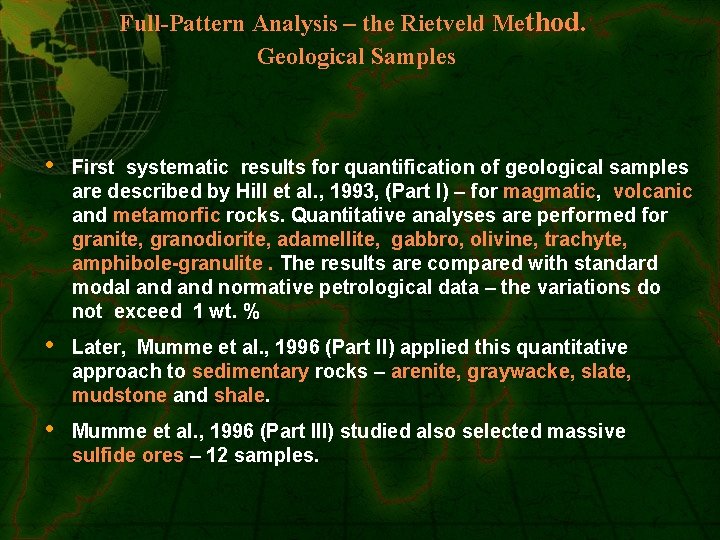
Full-Pattern Analysis – the Rietveld Method. Geological Samples • First systematic results for quantification of geological samples are described by Hill et al. , 1993, (Part I) – for magmatic, volcanic and metamorfic rocks. Quantitative analyses are performed for granite, granodiorite, adamellite, gabbro, olivine, trachyte, amphibole-granulite. The results are compared with standard modal and normative petrological data – the variations do not exceed 1 wt. % • Later, Mumme et al. , 1996 (Part II) applied this quantitative approach to sedimentary rocks – arenite, graywacke, slate, mudstone and shale. • Mumme et al. , 1996 (Part III) studied also selected massive sulfide ores – 12 samples.
Examples of our XRD Rietveld based quantitative determinations Geological Samples The above described quantitative methodology was applied to study: - Phosphorite rock - Dolomite rock - Moganite-containing geode - Skarn mineralization in Eastern Bulgaria -
Materials • The studied phosphorite is a representative sample of phosphorite concretions from Kaspichan deposit. • The dolomite sample (dolostone) is from a carbonate-sulfate formation (Middle Devonian) – a deep drill hole R-119 Kardam town (NE Bulgaria). • The moganite containing sample is isolated from a geode (Lozevo village, Shumen town). (Yanakieva, 2005, Yanakieva et al, 2006. ) Methods • The powder XRD experiments were performed on diffractometer DRON 3 M (Fefiltered Co. Kα radiation) in step-scanning regime and with D 2 Phaser, Bruker (Nifiltered Cu. Kα radiation) • The numeric experimental data were processed with the program Full. Prof (Rodriguez-Carvajal et al. , 1998), using the Rietveld algorithm allowing both structural and quantitative analyses. • The needed structural information for each mineral was taken from– ICSD (Inorganic Crystal Structure Database).
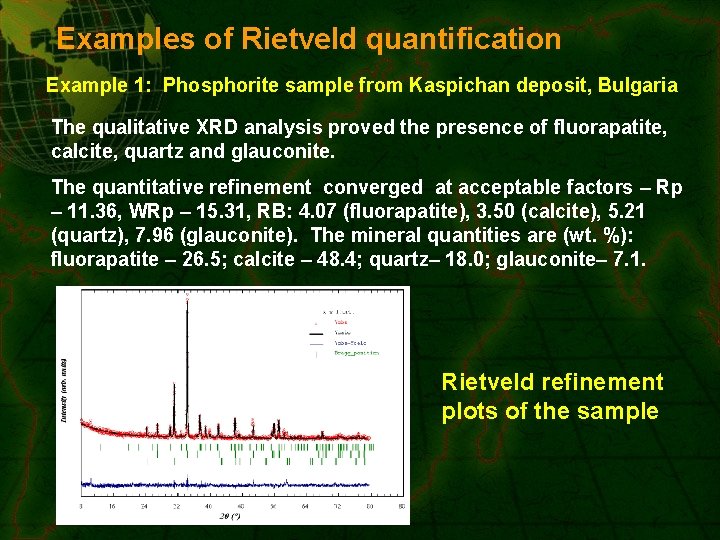
Examples of Rietveld quantification Example 1: Phosphorite sample from Kaspichan deposit, Bulgaria The qualitative XRD analysis proved the presence of fluorapatite, calcite, quartz and glauconite. The quantitative refinement converged at acceptable factors – Rp – 11. 36, WRp – 15. 31, RB: 4. 07 (fluorapatite), 3. 50 (calcite), 5. 21 (quartz), 7. 96 (glauconite). The mineral quantities are (wt. %): fluorapatite – 26. 5; calcite – 48. 4; quartz– 18. 0; glauconite– 7. 1. Rietveld refinement plots of the sample
Fluorapatite is the principle mineral of interest and has content of 26 wt %, which is comparable with similar deposits around the world. However, this content is lower than the found one for Gintsi deposit (W Bulgaria), where the authors (Stoilov et al. , 2007) found 37 wt. %, which correlate very well with the chemical analysis – 35 wt. %.
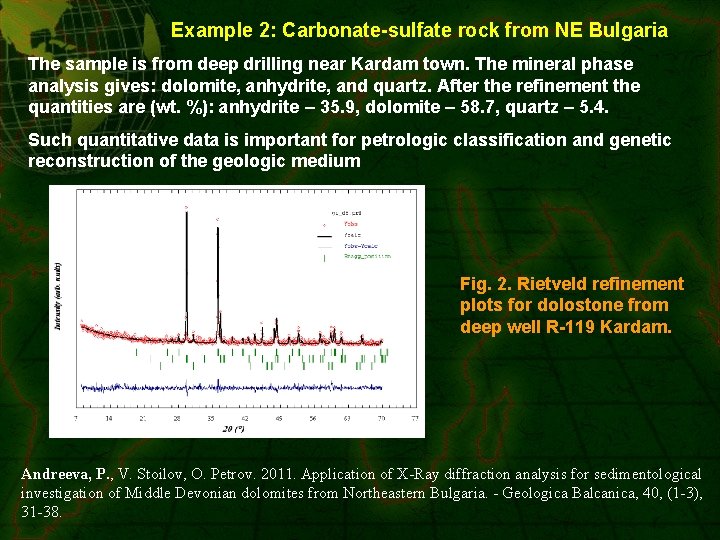
Example 2: Carbonate-sulfate rock from NE Bulgaria The sample is from deep drilling near Kardam town. The mineral phase analysis gives: dolomite, anhydrite, and quartz. After the refinement the quantities are (wt. %): anhydrite – 35. 9, dolomite – 58. 7, quartz – 5. 4. Such quantitative data is important for petrologic classification and genetic reconstruction of the geologic medium Fig. 2. Rietveld refinement plots for dolostone from deep well R-119 Kardam. Andreeva, P. , V. Stoilov, O. Petrov. 2011. Application of X-Ray diffraction analysis for sedimentological investigation of Middle Devonian dolomites from Northeastern Bulgaria. - Geologica Balcanica, 40, (1 -3), 31 -38.
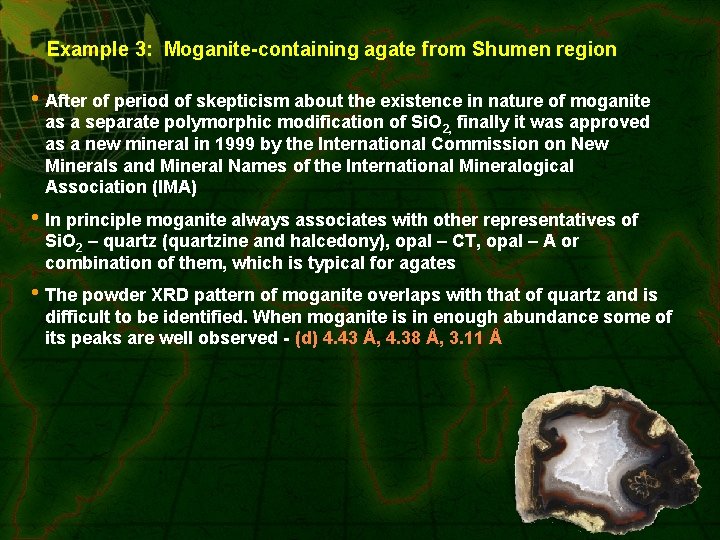
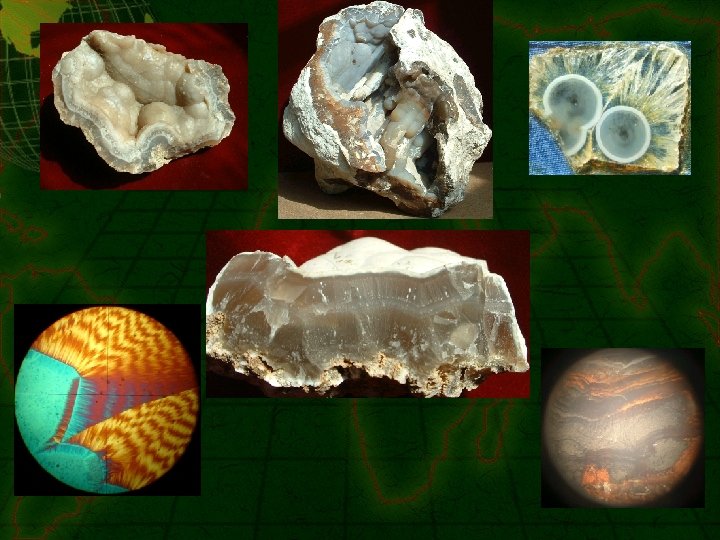
Example 3: Moganite-containing agate from Shumen region • After of period of skepticism about the existence in nature of moganite as a separate polymorphic modification of Si. O 2, finally it was approved as a new mineral in 1999 by the International Commission on New Minerals and Mineral Names of the International Mineralogical Association (IMA) • In principle moganite always associates with other representatives of Si. O 2 – quartz (quartzine and halcedony), opal – СТ, opal – А or combination of them, which is typical for agates • The powder XRD pattern of moganite overlaps with that of quartz and is difficult to be identified. When moganite is in enough abundance some of its peaks are well observed - (d) 4. 43 Å, 4. 38 Å, 3. 11 Å
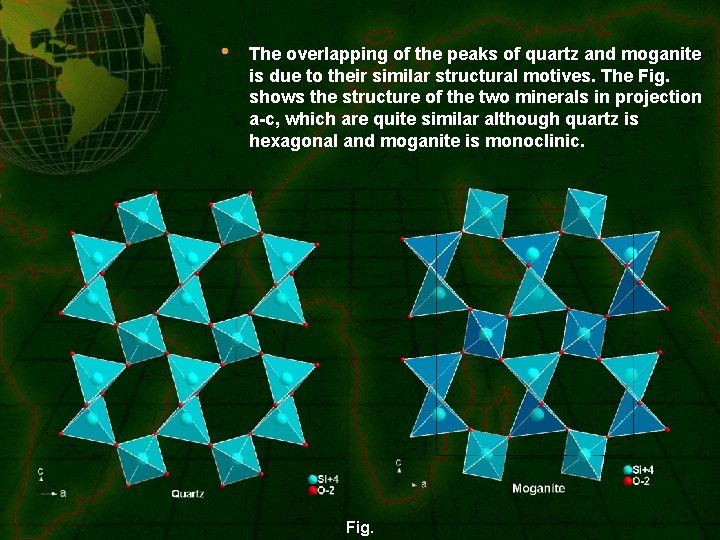
• The overlapping of the peaks of quartz and moganite is due to their similar structural motives. The Fig. shows the structure of the two minerals in projection а-с, which are quite similar although quartz is hexagonal and moganite is monoclinic. Fig.
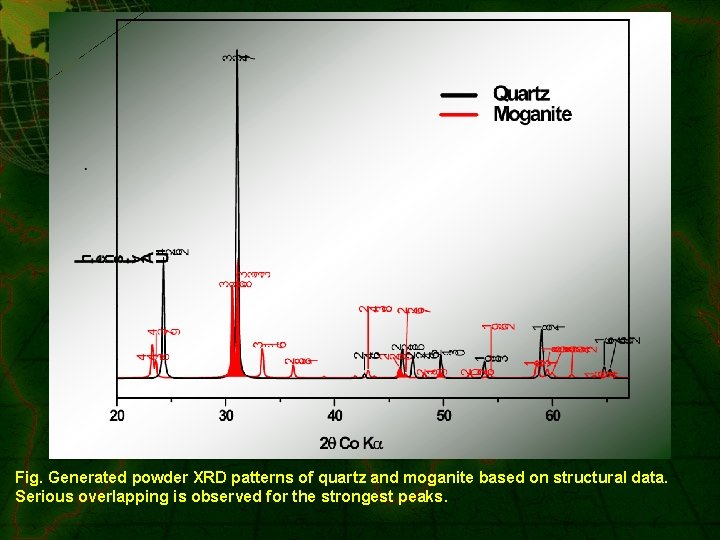
Fig. Generated powder XRD patterns of quartz and moganite based on structural data. Serious overlapping is observed for the strongest peaks.
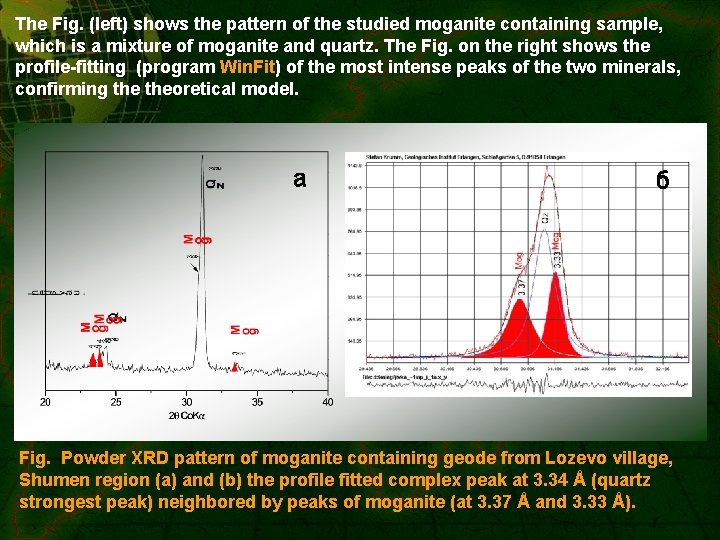
The Fig. (left) shows the pattern of the studied moganite containing sample, which is a mixture of moganite and quartz. The Fig. on the right shows the profile-fitting (program Win. Fit) of the most intense peaks of the two minerals, confirming theoretical model. а б Fig. Powder XRD pattern of moganite containing geode from Lozevo village, Shumen region (a) and (b) the profile fitted complex peak at 3. 34 Å (quartz strongest peak) neighbored by peaks of moganite (at 3. 37 Å and 3. 33 Å).
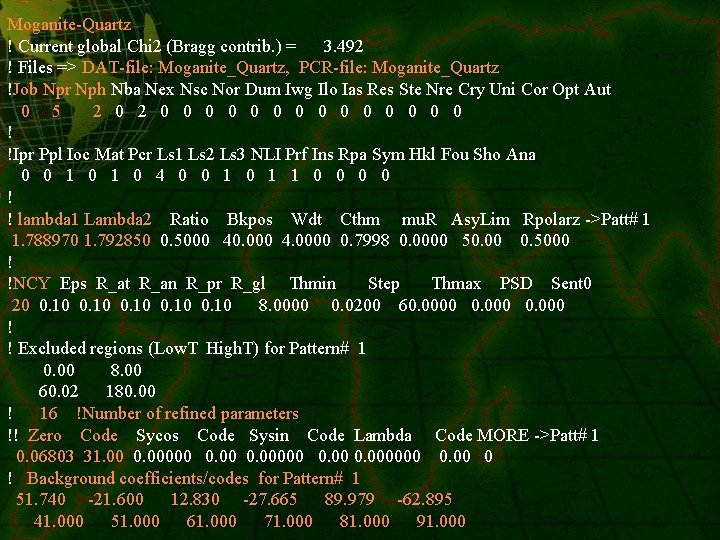
Moganite-Quartz ! Current global Chi 2 (Bragg contrib. ) = 3. 492 ! Files => DAT-file: Moganite_Quartz, PCR-file: Moganite_Quartz !Job Npr Nph Nba Nex Nsc Nor Dum Iwg Ilo Ias Res Ste Nre Cry Uni Cor Opt Aut 0 5 2 0 0 0 0 ! !Ipr Ppl Ioc Mat Pcr Ls 1 Ls 2 Ls 3 NLI Prf Ins Rpa Sym Hkl Fou Sho Ana 0 0 1 0 4 0 0 1 1 0 0 ! ! lambda 1 Lambda 2 Ratio Bkpos Wdt Cthm mu. R Asy. Lim Rpolarz ->Patt# 1 1. 788970 1. 792850 0. 5000 40. 000 4. 0000 0. 7998 0. 0000 50. 00 0. 5000 ! !NCY Eps R_at R_an R_pr R_gl Thmin Step Thmax PSD Sent 0 20 0. 10 8. 0000 0. 0200 60. 0000 0. 000 ! ! Excluded regions (Low. T High. T) for Pattern# 1 0. 00 8. 00 60. 02 180. 00 ! 16 !Number of refined parameters !! Zero Code Sycos Code Sysin Code Lambda Code MORE ->Patt# 1 0. 06803 31. 00 0. 00000 0. 000000 0 ! Background coefficients/codes for Pattern# 1 51. 740 -21. 600 12. 830 -27. 665 89. 979 -62. 895 41. 000 51. 000 61. 000 71. 000 81. 000 91. 000
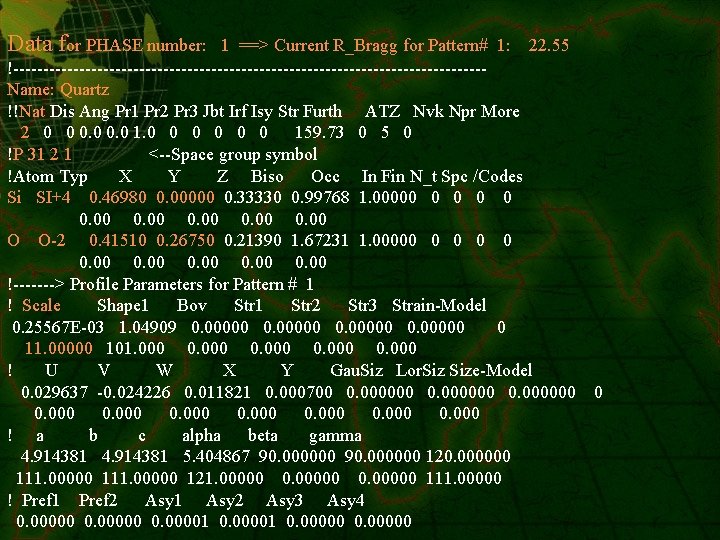
Data for PHASE number: 1 ==> Current R_Bragg for Pattern# 1: 22. 55 !---------------------------------------Name: Quartz !!Nat Dis Ang Pr 1 Pr 2 Pr 3 Jbt Irf Isy Str Furth ATZ Nvk Npr More 2 0 0 0. 0 1. 0 0 0 159. 73 0 5 0 !P 31 2 1 <--Space group symbol !Atom Typ X Y Z Biso Occ In Fin N_t Spc /Codes Si SI+4 0. 46980 0. 00000 0. 33330 0. 99768 1. 00000 0 0 0. 00 O O-2 0. 41510 0. 26750 0. 21390 1. 67231 1. 00000 0 0 0. 00 !-------> Profile Parameters for Pattern # 1 ! Scale Shape 1 Bov Str 1 Str 2 Str 3 Strain-Model 0. 25567 E-03 1. 04909 0. 00000 0 11. 00000 101. 000 0. 000 ! U V W X Y Gau. Siz Lor. Size-Model 0. 029637 -0. 024226 0. 011821 0. 000700 0. 000000 0 0. 000 0. 000 ! a b c alpha beta gamma 4. 914381 5. 404867 90. 000000 120. 000000 111. 00000 121. 00000 0. 00000 111. 00000 ! Pref 1 Pref 2 Asy 1 Asy 2 Asy 3 Asy 4 0. 00000 0. 00001 0. 00000
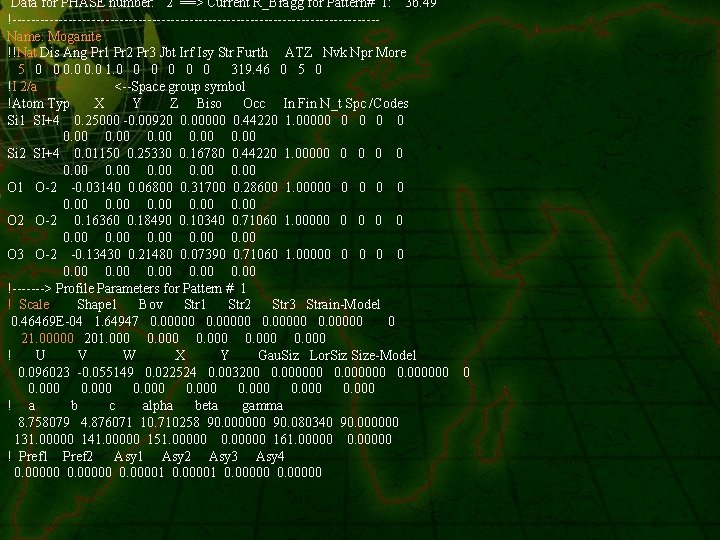
Data for PHASE number: 2 ==> Current R_Bragg for Pattern# 1: 36. 49 !---------------------------------------Name: Moganite !!Nat Dis Ang Pr 1 Pr 2 Pr 3 Jbt Irf Isy Str Furth ATZ Nvk Npr More 5 0 0 0. 0 1. 0 0 0 319. 46 0 5 0 !I 2/a <--Space group symbol !Atom Typ X Y Z Biso Occ In Fin N_t Spc /Codes Si 1 SI+4 0. 25000 -0. 00920 0. 00000 0. 44220 1. 00000 0 0 0. 00 Si 2 SI+4 0. 01150 0. 25330 0. 16780 0. 44220 1. 00000 0 0 0. 00 O 1 O-2 -0. 03140 0. 06800 0. 31700 0. 28600 1. 00000 0 0 0. 00 O 2 O-2 0. 16360 0. 18490 0. 10340 0. 71060 1. 00000 0 0 0. 00 O 3 O-2 -0. 13430 0. 21480 0. 07390 0. 71060 1. 00000 0 0 0. 00 !-------> Profile Parameters for Pattern # 1 ! Scale Shape 1 Bov Str 1 Str 2 Str 3 Strain-Model 0. 46469 E-04 1. 64947 0. 00000 0 21. 00000 201. 000 0. 000 ! U V W X Y Gau. Siz Lor. Size-Model 0. 096023 -0. 055149 0. 022524 0. 003200 0. 000000 0 0. 000 0. 000 ! a b c alpha beta gamma 8. 758079 4. 876071 10. 710258 90. 000000 90. 080340 90. 000000 131. 00000 141. 00000 151. 00000 0. 00000 161. 00000 0. 00000 ! Pref 1 Pref 2 Asy 1 Asy 2 Asy 3 Asy 4 0. 00000 0. 00001 0. 00000
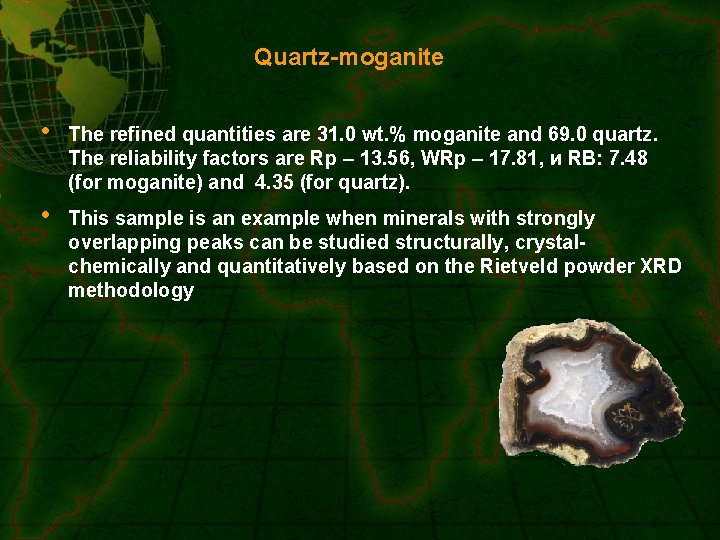
Quartz-moganite • The refined quantities are 31. 0 wt. % moganite and 69. 0 quartz. The reliability factors are Rp – 13. 56, WRp – 17. 81, и RB: 7. 48 (for moganite) and 4. 35 (for quartz). • This sample is an example when minerals with strongly overlapping peaks can be studied structurally, crystalchemically and quantitatively based on the Rietveld powder XRD methodology
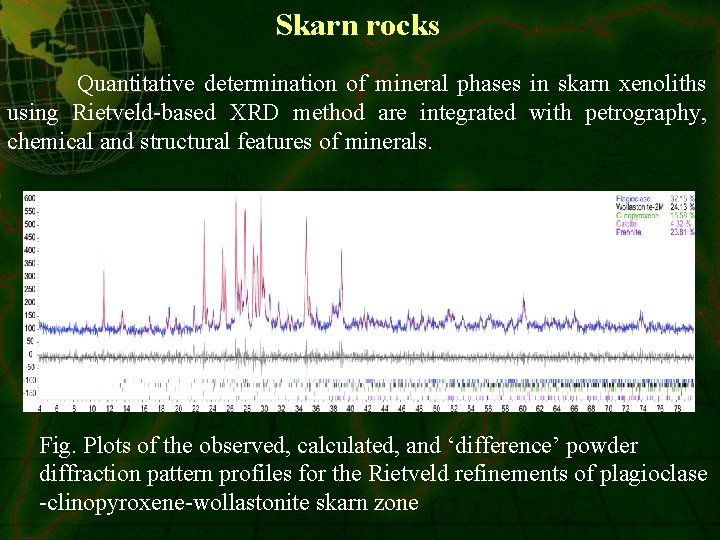
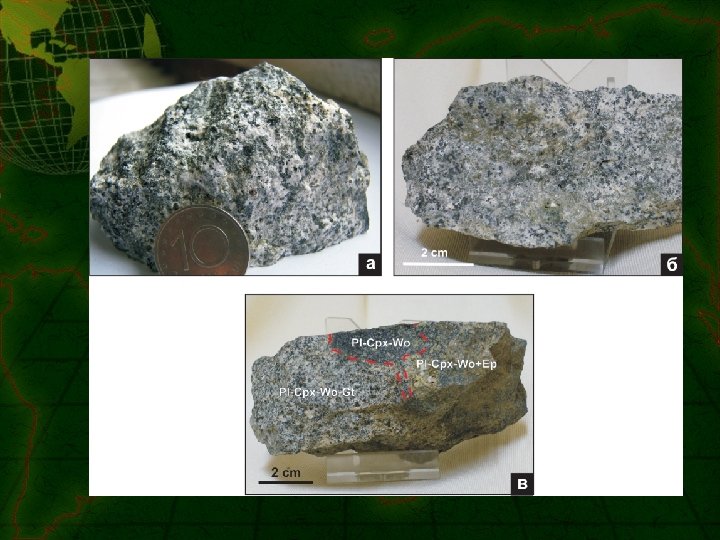
Skarn rocks Quantitative determination of mineral phases in skarn xenoliths using Rietveld-based XRD method are integrated with petrography, chemical and structural features of minerals. Fig. Plots of the observed, calculated, and ‘difference’ powder diffraction pattern profiles for the Rietveld refinements of plagioclase -clinopyroxene-wollastonite skarn zone
A technique for rapid, inexpensive and accurate quantitative determination of mineral phases in heterogeneous samples of skarn rocks is applied. The phase quantification procedure involved the identification of major and minor phases and a subsequent quantitative phase analysis of all data sets by the full profile Rietveld method implemented in the Topas v 4. 2 program. The found mineral assemblages accompanied other methods to prove two main stages – magmatic and postmagmatic one of skarn formation. Yana Tzvetanova, 2015, Crystal-chemical and structural characteristics of minerals from skarns in Zvezdel pluton. Ph. D Dissertation, pp. 183
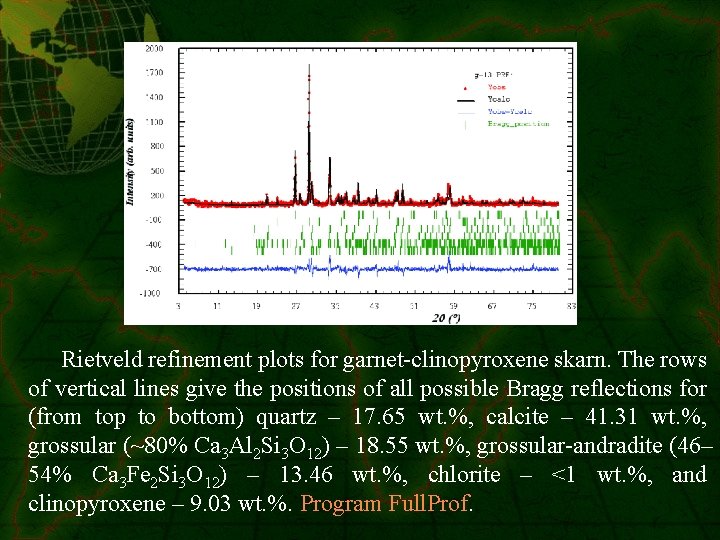
Rietveld refinement plots for garnet-clinopyroxene skarn. The rows of vertical lines give the positions of all possible Bragg reflections for (from top to bottom) quartz – 17. 65 wt. %, calcite – 41. 31 wt. %, grossular (~80% Ca 3 Al 2 Si 3 O 12) – 18. 55 wt. %, grossular-andradite (46– 54% Ca 3 Fe 2 Si 3 O 12) – 13. 46 wt. %, chlorite – <1 wt. %, and clinopyroxene – 9. 03 wt. %. Program Full. Prof.
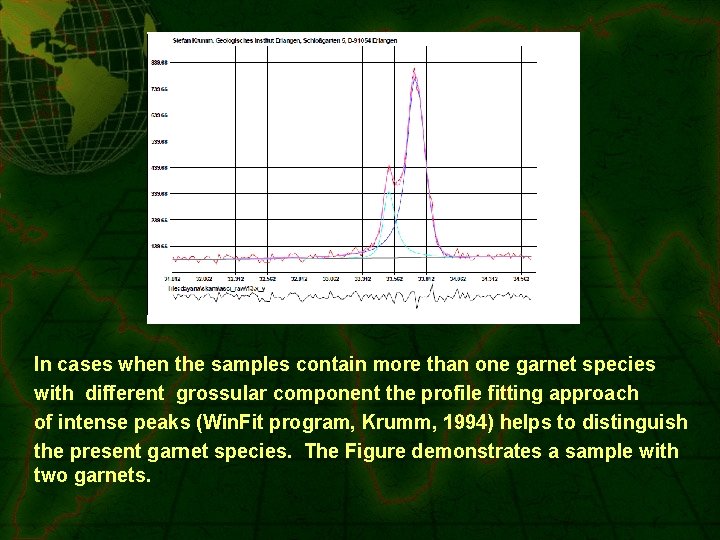
In cases when the samples contain more than one garnet species with different grossular component the profile fitting approach of intense peaks (Win. Fit program, Krumm, 1994) helps to distinguish the present garnet species. The Figure demonstrates a sample with two garnets.
Conclusion • Summarizing the applications of the Rietveld based powder XRD quantification we may state that this is a serious instrument for optimized and speedy quantitative determinations of minerals in various geological environments. • This approach is important and express in petrological analyses and classification of rocks and minerals resources and industrial deposits. • In material science the tasks are analogycal - such quantification is quite needed for evaluation of synthetic products especially during controlled syntheses , ceramic preparations, composites.
Acknowledgements Thanks are due to the Organizing Committee of the International School on Introduction in the Rietveld structure refinement for giving me the opportunity to comment the advantages of the Rietveld methodology Thank you for your attention!