
International Relations The Roles of Actors and Factors
- Slides: 10
International Relations The Roles of Actors and Factors on the International Level
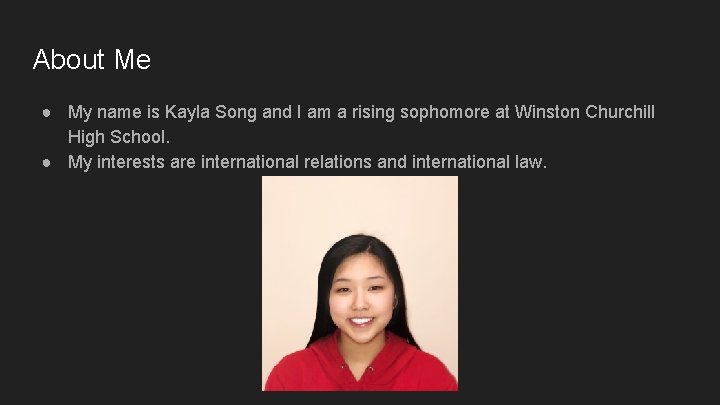
About Me ● My name is Kayla Song and I am a rising sophomore at Winston Churchill High School. ● My interests are international relations and international law.
Definition of International Relations ● International Relations is the study and practice of relationships between nation-states and many "actors" on the global level. ● An actor is any state, organization, or group that has an influence in relationships on the global scale. ● It combines the blend of economics, history and political science into practice on a global level. ● It can include anything from political economy, global governance, global health, foreign policy, security, media, terrorism, social movements and more.
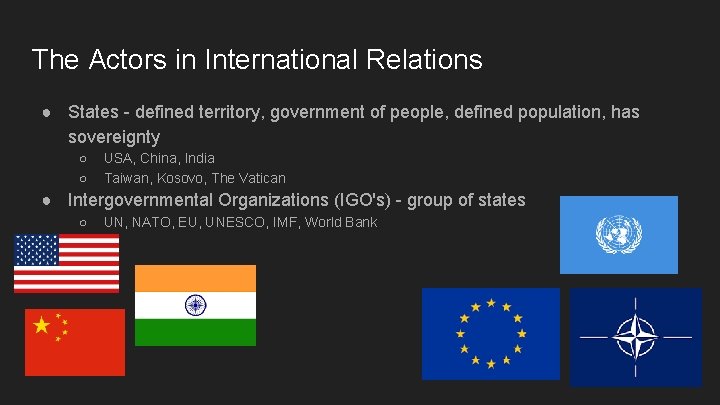
The Actors in International Relations ● States - defined territory, government of people, defined population, has sovereignty ○ ○ USA, China, India Taiwan, Kosovo, The Vatican ● Intergovernmental Organizations (IGO's) - group of states ○ UN, NATO, EU, UNESCO, IMF, World Bank
The Actors In International Relations ● Nongovernmental Organizations (NGO's) - individuals or groups from states globally ○ Amnesty International (prisoners), Greenpeace (environmental), WWF (nature), Religions ● Private Sector Actors - individual or collective participants in economic and social life which are not controlled by the state and usually act for profit ○ banks, social media, Facebook, Apple, Amazon, Netflix, Google
The Actors in International Relations ● Trans-state Political Organizations ○ ○ Groups like al-Qaeda, ETA, Hezbollah, ISIS, etc. are NOT states and NOT NGO's or IGO's BUT still have political goals and membership Classified as "trans-state" because the organizations go BEYOND more than one state ● "Peoples" ○ ○ Groups that bond over race, ethnicity, religion, culture, language, etc but are not NATIONS Kurds, Basques, Iroquois, Inuits ● Individuals ○ ○ ○ World Political Power Leaders- Trump, Kim Jong Un, Putin Pop Culture- Celebrities like Oprah, Kpop stars Nobel Prize Winners- Malala
The Goals of Different Actors in International Relations and How Power is Used ● Philosophical/Ideological Goals, Security Goals, Economic and Resource Goals, Humanitarian Goals ● An actor realizes its goals through… ○ Power- the ability to exert influence ■ Power can come from money, information, military power, territory, allies, supporters ● Hard Power: Coerced power enforced through possibly economic or military coercion ○ Sanctions, Threat of Nuclear War, Trade Wars ● Soft Power: Persuasive power gained through "subtler" means and methods ○ Aid, Internet, Music, Pop Culture
International Law ● International Law is a set of rules that are BINDING on international actors. ● Ways that International Law can be made is through… ○ ○ Treaty- legally binding agreements between two or more states Custom- a repeated action over the passing of time that becomes law. It is perceived as legally obligatory and is practiced by many states. (Diplomatic Immunity) ● International Law is enforced through. . . ○ ○ ○ UN Security Council International Criminal Court Reciprocal Enforcement- sanctions or restrictions enforced in response to a broken law
The Role of Think Tanks in International Relations ● Think tanks consist of advocates and analysts that have the role of bringing KNOWLEDGE to POWER; they mobilize expertise and put forward evidence for innovative changes globally. ● Congressional Research Service is an unbiased think tank with the role of providing information to the US Congress for national and international decisions. ● Advocacy think tanks use their role to bring about a specific political agenda and global goals to the government towards relations internationally. They come up with solutions for the world's problems.
Bibliography ● Arend, Anthony. “An Overview of the International System. ” International ● ● Relations. Summer Hoya, 22 July 2019, Washington, DC, Georgetown University. Edelstein, David. “Instruments of Foreign Policy: An Overview. ” International Relations. Summer Hoya, 22 July 2019, Washington, DC, Georgetown University. Arend, Anthony. “International Law. ” International Relations. Summer Hoya, 23 July 2019, Washington, DC, Georgetown University. Brozus, Lars, and Hanns W. Maull. “Think Tanks and Foreign Policy - Oxford Research Encyclopedia of Politics. ” Oxford Research Encyclopedias, 17 July 2019 “What Is IR? ” Department of International Relations, internationalrelations. sfsu. edu/what-ir.