
International recruitment of health personnel a WHO code

- Slides: 17
International recruitment of health personnel: a WHO code of practice World Health Editors Network Making Global Health News Geneva 17 -18 -May 2009 Jean-Marc Braichet, Coordinator Health Workforce Migration and Retention Team Department of Human Resources for Health World Health Organization, Geneva 1|
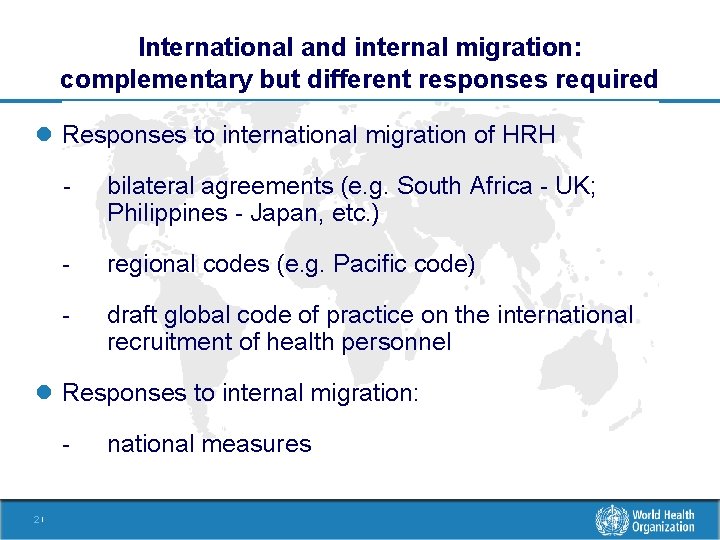
International and internal migration: complementary but different responses required l Responses to international migration of HRH - bilateral agreements (e. g. South Africa - UK; Philippines - Japan, etc. ) - regional codes (e. g. Pacific code) - draft global code of practice on the international recruitment of health personnel l Responses to internal migration: 2| national measures
WHO is developing to major and complementary projects l Developing a draft global code on the international recruitment of health personnel l Implementing a programme which aims to improve the retention of health workers in rural and remote areas 3|
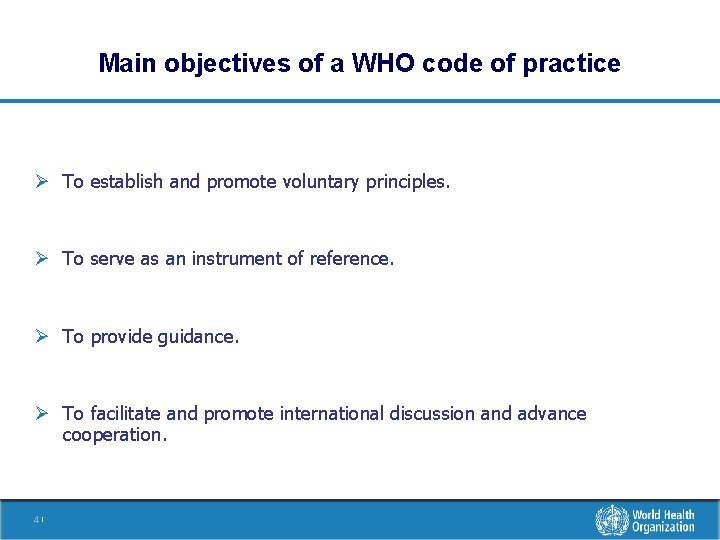
Main objectives of a WHO code of practice Ø To establish and promote voluntary principles. Ø To serve as an instrument of reference. Ø To provide guidance. Ø To facilitate and promote international discussion and advance cooperation. 4|
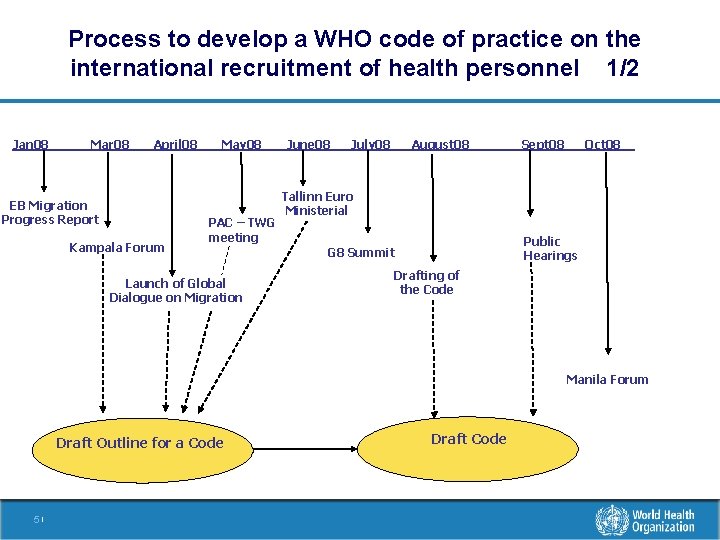
Process to develop a WHO code of practice on the international recruitment of health personnel 1/2 Jan 08 Mar 08 April 08 EB Migration Progress Report Kampala Forum May 08 PAC – TWG meeting Launch of Global Dialogue on Migration June 08 July 08 August 08 Sept 08 Oct 08 Tallinn Euro Ministerial Public Hearings G 8 Summit Drafting of the Code Manila Forum Draft Outline for a Code 5| Draft Code
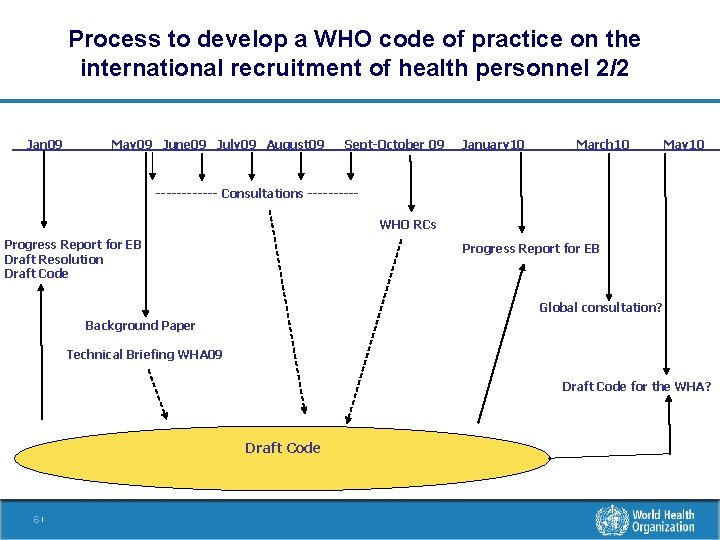
Process to develop a WHO code of practice on the international recruitment of health personnel 2/2 Jan 09 May 09 June 09 July 09 August 09 Sept-October 09 January 10 March 10 May 10 ------ Consultations -----WHO RCs Progress Report for EB Draft Resolution Draft Code Progress Report for EB Global consultation? Background Paper Technical Briefing WHA 09 Draft Code for the WHA? Draft Code 6|
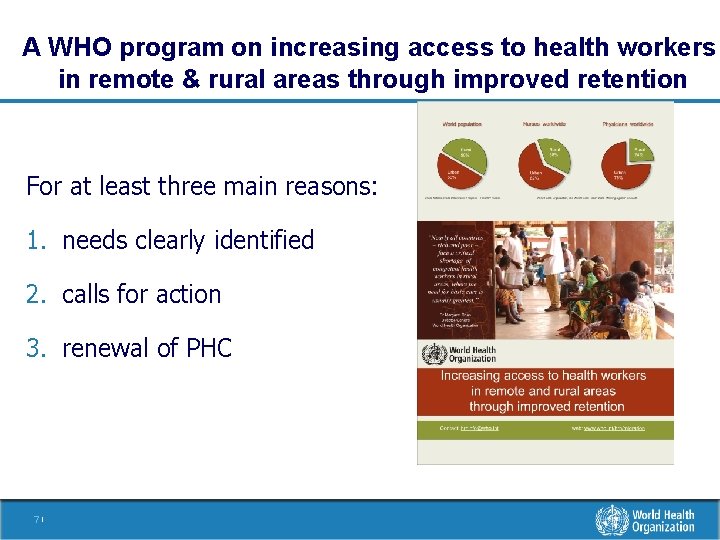
A WHO program on increasing access to health workers in remote & rural areas through improved retention For at least three main reasons: 1. needs clearly identified 2. calls for action 3. renewal of PHC 7|
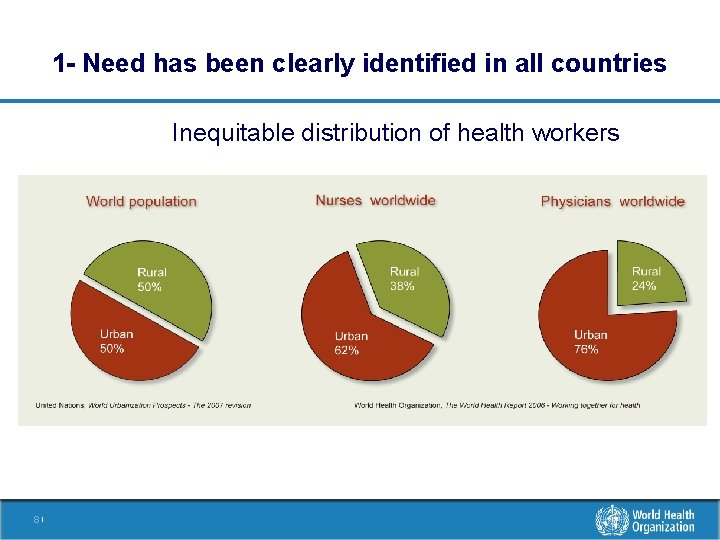
1 - Need has been clearly identified in all countries Inequitable distribution of health workers 8|
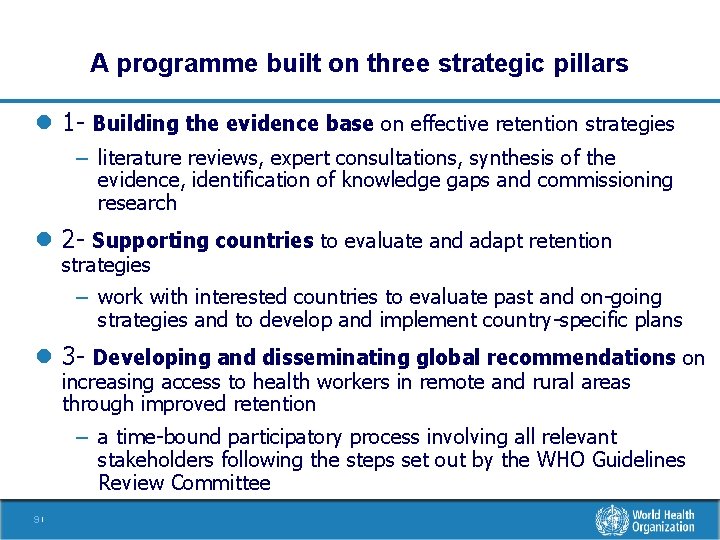
A programme built on three strategic pillars l 1 - Building the evidence base on effective retention strategies – literature reviews, expert consultations, synthesis of the evidence, identification of knowledge gaps and commissioning research l 2 - Supporting countries to evaluate and adapt retention strategies – work with interested countries to evaluate past and on-going strategies and to develop and implement country-specific plans l 3 - Developing and disseminating global recommendations on increasing access to health workers in remote and rural areas through improved retention – a time-bound participatory process involving all relevant stakeholders following the steps set out by the WHO Guidelines Review Committee 9|
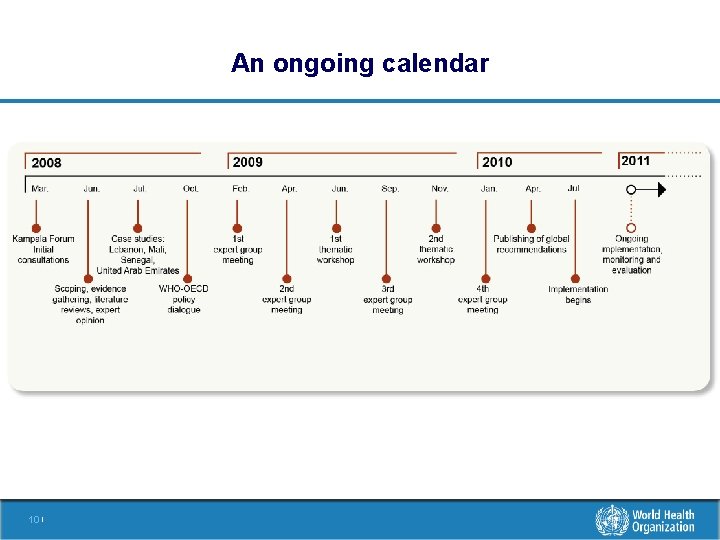
An ongoing calendar 10 |
Thank you for your attention ! 11 |
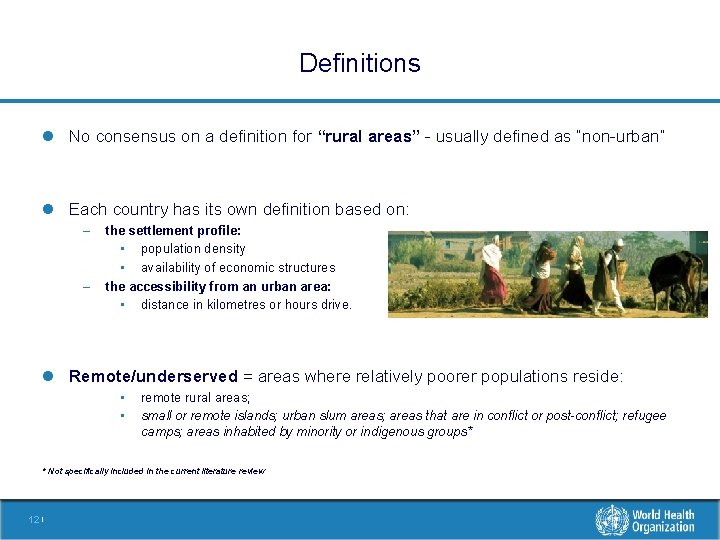
Definitions l No consensus on a definition for “rural areas” - usually defined as “non-urban” l Each country has its own definition based on: – – the settlement profile: • population density • availability of economic structures the accessibility from an urban area: • distance in kilometres or hours drive. l Remote/underserved = areas where relatively poorer populations reside: • • remote rural areas; small or remote islands; urban slum areas; areas that are in conflict or post-conflict; refugee camps; areas inhabited by minority or indigenous groups* * Not specifically included in the current literature review 12 |
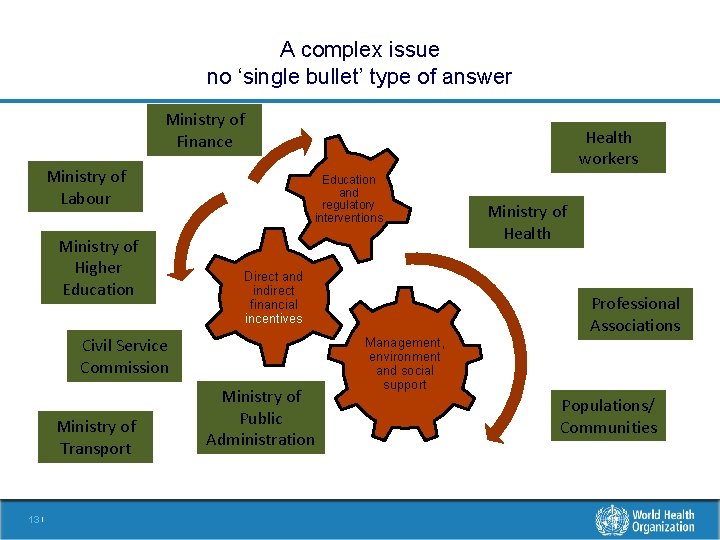
A complex issue no ‘single bullet’ type of answer Ministry of Finance Health workers Ministry of Labour Ministry of Higher Education and regulatory interventions Direct and indirect financial incentives Civil Service Commission Ministry of Transport 13 | Ministry of Public Administration Management, environment and social support Ministry of Health Professional Associations Populations/ Communities
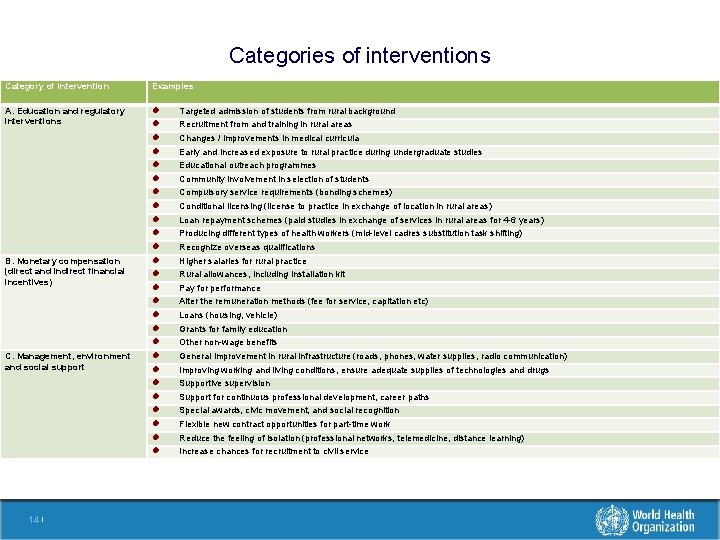
Categories of interventions Category of intervention Examples A. Education and regulatory interventions l l l l l l l B. Monetary compensation (direct and indirect financial incentives) C. Management, environment and social support 14 | Targeted admission of students from rural background Recruitment from and training in rural areas Changes / improvements in medical curricula Early and increased exposure to rural practice during undergraduate studies Educational outreach programmes Community involvement in selection of students Compulsory service requirements (bonding schemes) Conditional licensing (license to practice in exchange of location in rural areas) Loan repayment schemes (paid studies in exchange of services in rural areas for 4 -6 years) Producing different types of health workers (mid-level cadres substitution task shifting) Recognize overseas qualifications Higher salaries for rural practice Rural allowances, including installation kit Pay for performance Alter the remuneration methods (fee for service, capitation etc) Loans (housing, vehicle) Grants for family education Other non-wage benefits General improvement in rural infrastructure (roads, phones, water supplies, radio communication) Improving working and living conditions, ensure adequate supplies of technologies and drugs Supportive supervision Support for continuous professional development, career paths Special awards, civic movement, and social recognition Flexible new contract opportunities for part-time work Reduce the feeling of isolation (professional networks, telemedicine, distance learning) Increase chances for recruitment to civil service
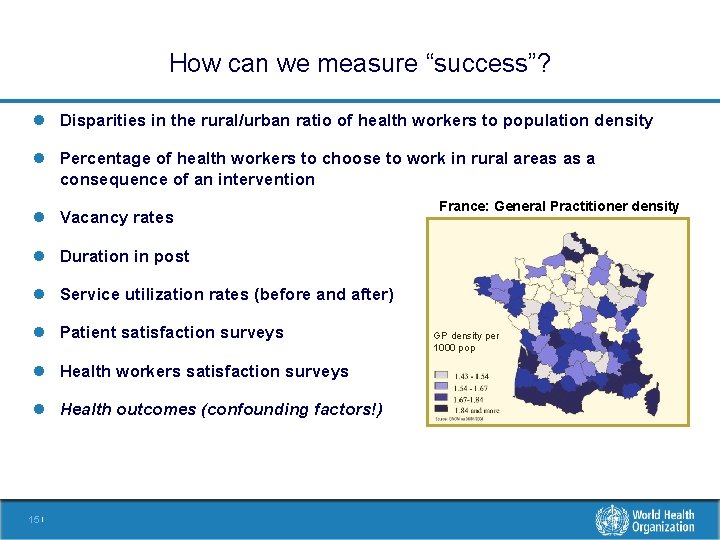
How can we measure “success”? l Disparities in the rural/urban ratio of health workers to population density l Percentage of health workers to choose to work in rural areas as a consequence of an intervention l Vacancy rates France: General Practitioner density l Duration in post l Service utilization rates (before and after) l Patient satisfaction surveys l Health workers satisfaction surveys l Health outcomes (confounding factors!) 15 | GP density per 1000 pop
Guiding principles of a WHO code of practice 1/2 Ø The code is voluntary. Ø The individual right "to leave any country, including [one's] own". Ø Right of everyone to the enjoyment of the highest attainable standard of health. Ø International recruitment can make a legitimate contribution to the development and strengthening of a national health workforce. Ø The development of voluntary international standards and the coordination of national policies on international health worker recruitment. 16 |
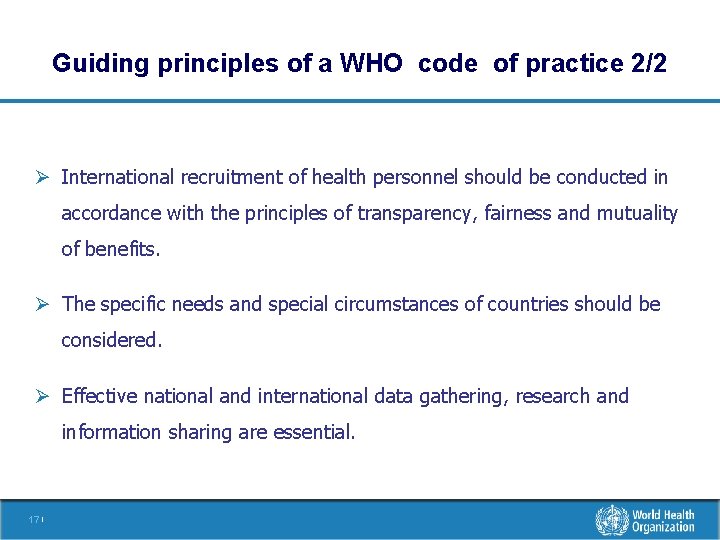
Guiding principles of a WHO code of practice 2/2 Ø International recruitment of health personnel should be conducted in accordance with the principles of transparency, fairness and mutuality of benefits. Ø The specific needs and special circumstances of countries should be considered. Ø Effective national and international data gathering, research and information sharing are essential. 17 |