
International public procurement project IPPI Data and quantification
International public procurement project (IPPI): Data and quantification* Zornitsa Kutlina-Dimitrova, Ph. D Chief Economist and Trade Analysis Unit European Commission Vienna, 12 December 2019 *The opinions expressed in this presentation are the author's own and do not necessarily reflect the views and opinions of the European Commission.
Contents v Why dealing with (international) public procurement? v Data measurement concepts: macro versus micro v Modalities of international government procurement v The dimensions of the IPPI data and barriers collection exercise v Conclusions 2
Why international public procurement? v Size of the markets: public procurement accounts for 5 -25% of GDP on a world basis and for 13% in the EU excluding procurement of utilities. v Large potential impact: limited commitments at the bilateral and/or plurilateral level. v Protectionism in international public procurement is on the rise. 3
Measurement concepts of public procurement v System of national accounts: a macro-level approach ü Intermediate consumption, GFCF and STK ü Activity based approach not explicitly separating SOEs v Contract award data: a micro level approach ü Transaction level data ü The value awarded approximates the true size of the market 4

Macro- versus micro-level data: a comparison v Total market versus above-threshold reporting v Payment versus commitment appropriations v Total versus tendered procurement v International dimension v E-Procurement systems essential for micro- level data 5
Modalities of international procurement v Direct cross-border international procurement: Foreign companies may win public procurement tenders directly from abroad. v Commercial presence procurement: Domestic subsidiaries of foreign companies may be awarded locally public contracts. v "Value-added" indirect international procurement: Foreign companies participate indirectly along the value-chain as subcontractors in a tender which can be won by a foreign or a domestic company. 6
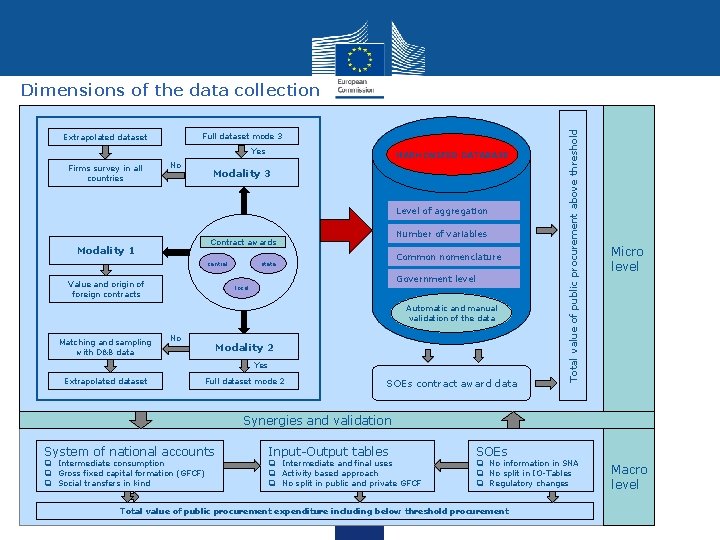
Full dataset mode 3 Extrapolated dataset Yes Firms survey in all countries No HARMONIZED DATABASE Modality 3 Level of aggregation Number of variables Contract awards Modality 1 central Common nomenclature state Government level Value and origin of foreign contracts local Automatic and manual validation of the data Matching and sampling with D&B data No Modality 2 Yes Extrapolated dataset Full dataset mode 2 SOEs contract award data Total value of public procurement above threshold Dimensions of the data collection Micro level Synergies and validation System of national accounts q Intermediate consumption q Gross fixed capital formation (GFCF) q Social transfers in kind Input-Output tables q Intermediate and final uses q Activity based approach q No split in public and private GFCF SOEs q No information in SNA q No split in IO-Tables q Regulatory changes Total value of public procurement expenditure including below threshold procurement Macro level
Taxonomy of public procurement barriers The project made use of the OECD taxonomy of public procurement barriers to make sure it provides for a systematic collection and encoding of government procurement barriers and covers: Ø Explicit barriers like Buy-local provisions; Ø Implicit barriers such as conduct of procurement and qualification criteria; Ø Distinction between below- and above-threshold barriers; Ø Barriers to foreign direct investment.
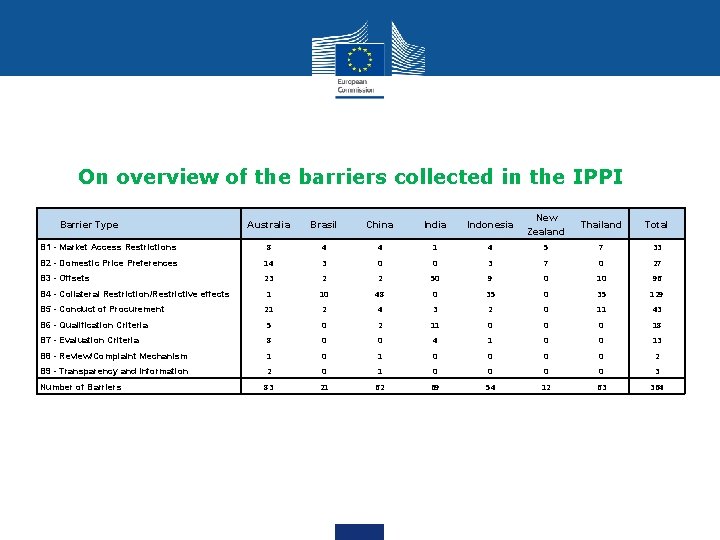
On overview of the barriers collected in the IPPI Australia Brasil China India Indonesia New Zealand Thailand Total B 1 - Market Access Restrictions 8 4 4 1 4 5 7 33 B 2 - Domestic Price Preferences 14 3 0 0 3 7 0 27 B 3 - Offsets 23 2 2 50 9 0 10 96 B 4 - Collateral Restriction/Restrictive effects 1 10 48 0 35 129 B 5 - Conduct of Procurement 21 2 4 3 2 0 11 43 B 6 - Qualification Criteria 5 0 2 11 0 0 0 18 B 7 - Evaluation Criteria 8 0 0 4 1 0 0 13 B 8 - Review/Complaint Mechanism 1 0 0 0 0 2 B 9 - Transparency and Information 2 0 1 0 0 3 Number of Barriers 83 21 62 69 54 12 63 364 Barrier Type
Towards a global public procurement database v First attempt to create a database combining both public procurement flows data covering all modalities and corresponding procurement barriers. v This involved an incredible effort in terms of resources and expertise as there is lack of data on both sides. Still the main challenge remains to match the flows with the barriers. v Finally, the ultimate goal is to be able to assess the impact of those barriers in economic terms 10
IPPI main deliverables v Methodology for data collection v Harmonized government procurement flows and barriers datasets containing nearly 40 million contracts and 400 barriers. Ø Trade data doesn't offer that level of detail! v Detailed country reports covering legal and economic analysis of Australia, New Zealand, Brazil, Indonesia, Thailand, the US, Canada, China and India v Economic assessment of the barriers 11
IPPI what next? v Using the data for negotiation purposes v Monitoring and implementation of FTAs v Analytical work in the area of procurement v Showcasing the importance of this work to the international organisations community v Using the data for communication purposes 12
Thank you for your attention! 13
References Kutlina-Dimitrova, Z. (2018), Government Procurement: Data, trends and protectionist tendencies, DG TRADE Chief Economist Note 2018(3), European Commission. Kutlina-Dimitrova, Z. (2017), Local preferences: avenues for increasing efficiency in international procurement markets, in: Piga, G. and Tatrai, T. (eds), Law and Economics of Public Procurement Reforms, Oxford: Routledge. Kutlina-Dimitrova, Z. (2017), Can we put a price on extending the scope of the GPA? First quantitative assessment, DG TRADE Chief Economist Notes 2017 -1, Directorate General for Trade, European Commission. Kutlina-Dimitrova, Z. and Lakatos, C. (2016), Determinants of direct cross-border public procurement in EU Member States, Review of World Economics 152(3), pp 501 -528. Cernat, L. and Kutlina-Dimitrova, Z. (2016), TTIP and Public Procurement: Going beyond the tip of the iceberg, CEPS Policy Brief No. 339, March 2016. Cernat, L. and Kutlina-Dimitrova, Z. (2015), International public procurement: From scant facts to hard data, in: Georgopoulos, A. et al (eds. ), The internationalization of the government procurement regulation, Oxford University Press. 14
- Slides: 14