
International Policies and Tools for Protecting Against Radiological
- Slides: 11
International Policies and Tools for Protecting Against Radiological Sabotage Rosalyn Leitch, Dennis Stanford, Robert Brigantic Pacific Northwest National Laboratory PNNL-SA-112586 1
Overview The Threat of Nuclear Terrorism and the International Response International Policies and Guidance Physical Protection of Nuclear Facilities against Sabotage Tools for Analyzing Radiological Release and Consequences of Sabotage PNNL-SA-112586 2
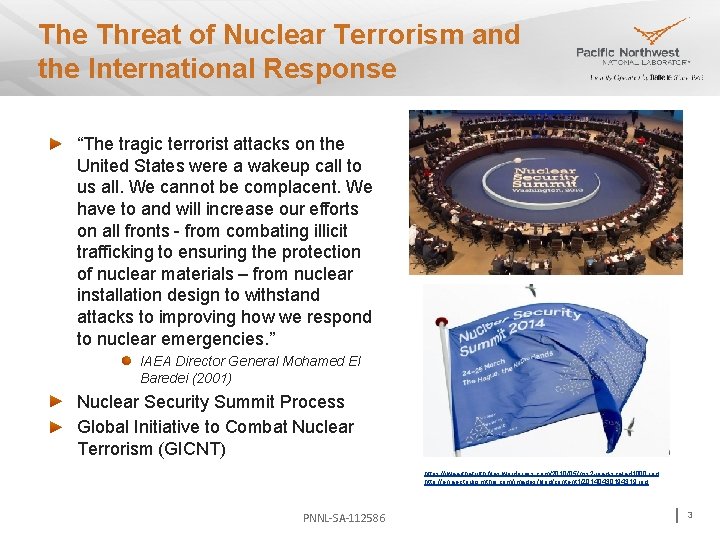
The Threat of Nuclear Terrorism and the International Response “The tragic terrorist attacks on the United States were a wakeup call to us all. We cannot be complacent. We have to and will increase our efforts on all fronts - from combating illicit trafficking to ensuring the protection of nuclear materials – from nuclear installation design to withstand attacks to improving how we respond to nuclear emergencies. ” IAEA Director General Mohamed El Baredei (2001) Nuclear Security Summit Process Global Initiative to Combat Nuclear Terrorism (GICNT) https: //iwearthetruth. files. wordpress. com/2010/05/nss 2 -jpeg-scaled 1000. jpg http: //en. aectourismthai. com/images/blog/content 1/20140430194319. jpg PNNL-SA-112586 3
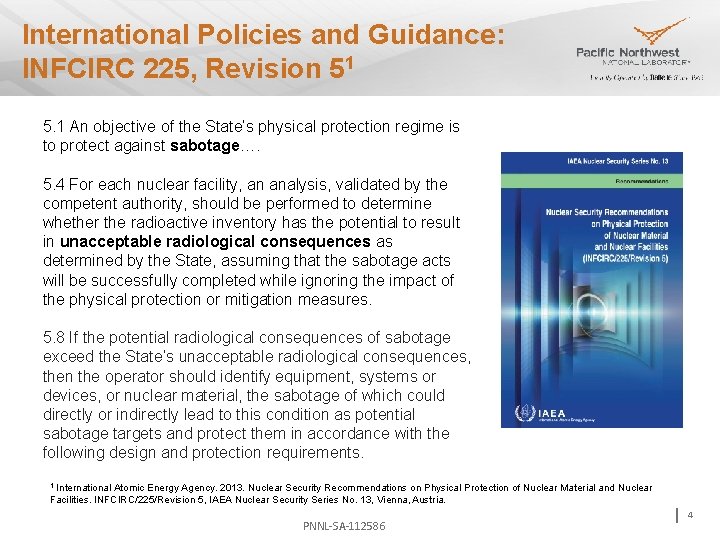
International Policies and Guidance: INFCIRC 225, Revision 51 5. 1 An objective of the State’s physical protection regime is to protect against sabotage…. 5. 4 For each nuclear facility, an analysis, validated by the competent authority, should be performed to determine whether the radioactive inventory has the potential to result in unacceptable radiological consequences as determined by the State, assuming that the sabotage acts will be successfully completed while ignoring the impact of the physical protection or mitigation measures. 5. 8 If the potential radiological consequences of sabotage exceed the State’s unacceptable radiological consequences, then the operator should identify equipment, systems or devices, or nuclear material, the sabotage of which could directly or indirectly lead to this condition as potential sabotage targets and protect them in accordance with the following design and protection requirements. International Atomic Energy Agency. 2013. Nuclear Security Recommendations on Physical Protection of Nuclear Material and Nuclear Facilities. INFCIRC/225/Revision 5, IAEA Nuclear Security Series No. 13, Vienna, Austria. 1 PNNL-SA-112586 4
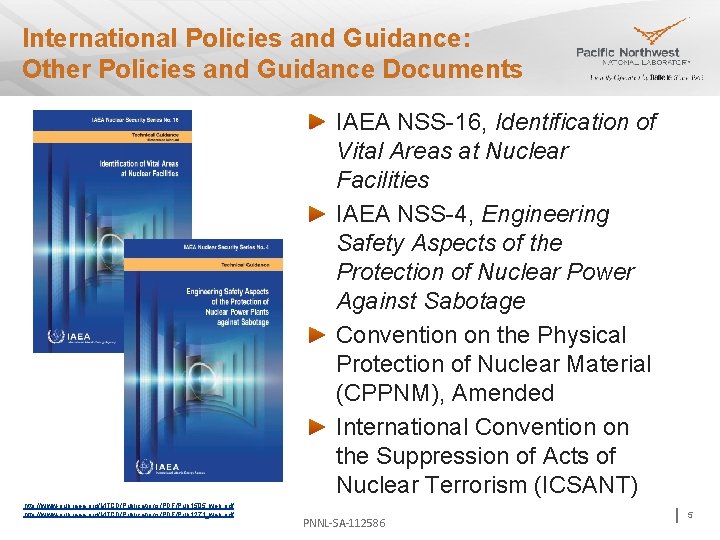
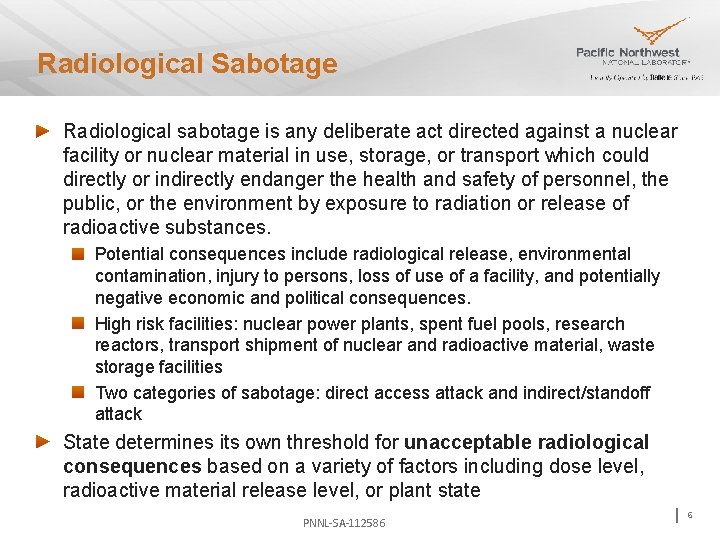
International Policies and Guidance: Other Policies and Guidance Documents IAEA NSS-16, Identification of Vital Areas at Nuclear Facilities IAEA NSS-4, Engineering Safety Aspects of the Protection of Nuclear Power Against Sabotage Convention on the Physical Protection of Nuclear Material (CPPNM), Amended International Convention on the Suppression of Acts of Nuclear Terrorism (ICSANT) http: //www-pub. iaea. org/MTCD/Publications/PDF/Pub 1505_web. pdf http: //www-pub. iaea. org/MTCD/Publications/PDF/Pub 1271_web. pdf PNNL-SA-112586 5
Radiological Sabotage Radiological sabotage is any deliberate act directed against a nuclear facility or nuclear material in use, storage, or transport which could directly or indirectly endanger the health and safety of personnel, the public, or the environment by exposure to radiation or release of radioactive substances. Potential consequences include radiological release, environmental contamination, injury to persons, loss of use of a facility, and potentially negative economic and political consequences. High risk facilities: nuclear power plants, spent fuel pools, research reactors, transport shipment of nuclear and radioactive material, waste storage facilities Two categories of sabotage: direct access attack and indirect/standoff attack State determines its own threshold for unacceptable radiological consequences based on a variety of factors including dose level, radioactive material release level, or plant state PNNL-SA-112586 6
Threat Assessment Design Basis Threat (DBT) defines the threat characteristics against which the operator should provide protection (Category I facilities) Category II and III facilities can have either a threat assessment or a formal DBT Obtain an inventory of nuclear and radiological material on site, specifically noting the form, activity level, and location on site for each inventory item Identify critical safety functions and potential sabotage targets for the nuclear facility PNNL-SA-112586 7
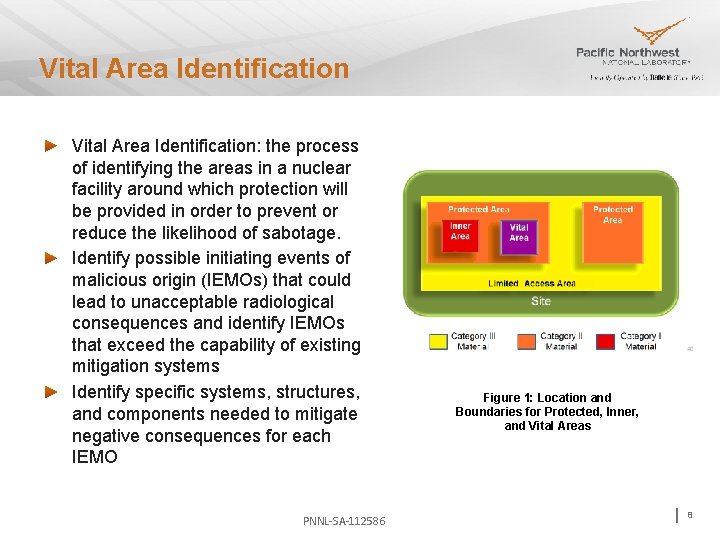
Vital Area Identification: the process of identifying the areas in a nuclear facility around which protection will be provided in order to prevent or reduce the likelihood of sabotage. Identify possible initiating events of malicious origin (IEMOs) that could lead to unacceptable radiological consequences and identify IEMOs that exceed the capability of existing mitigation systems Identify specific systems, structures, and components needed to mitigate negative consequences for each IEMO PNNL-SA-112586 Figure 1: Location and Boundaries for Protected, Inner, and Vital Areas 8
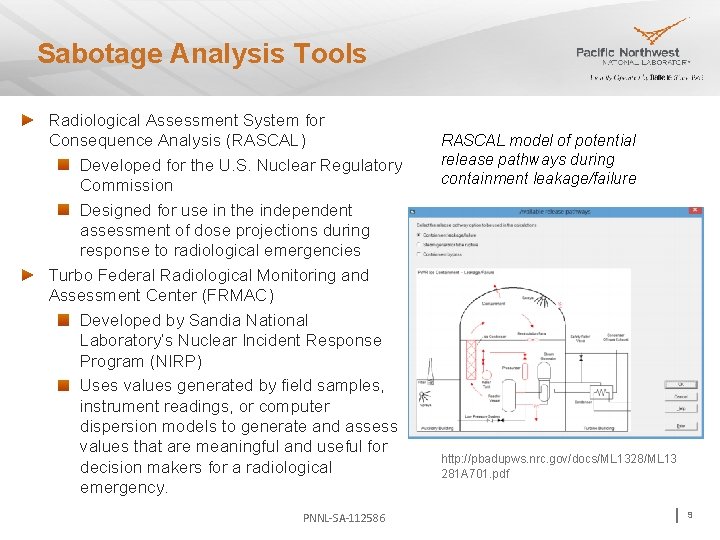
Sabotage Analysis Tools Radiological Assessment System for Consequence Analysis (RASCAL) Developed for the U. S. Nuclear Regulatory Commission Designed for use in the independent assessment of dose projections during response to radiological emergencies Turbo Federal Radiological Monitoring and Assessment Center (FRMAC) Developed by Sandia National Laboratory’s Nuclear Incident Response Program (NIRP) Uses values generated by field samples, instrument readings, or computer dispersion models to generate and assess values that are meaningful and useful for decision makers for a radiological emergency. PNNL-SA-112586 RASCAL model of potential release pathways during containment leakage/failure http: //pbadupws. nrc. gov/docs/ML 1328/ML 13 281 A 701. pdf 9
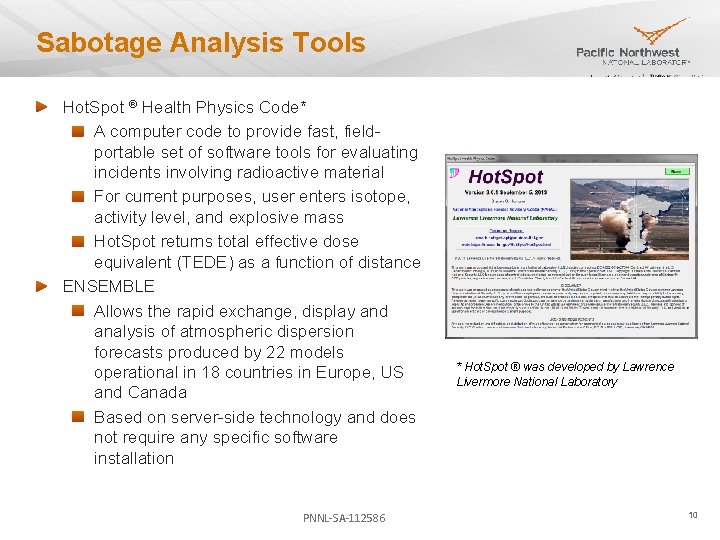
Sabotage Analysis Tools Hot. Spot ® Health Physics Code* A computer code to provide fast, fieldportable set of software tools for evaluating incidents involving radioactive material For current purposes, user enters isotope, activity level, and explosive mass Hot. Spot returns total effective dose equivalent (TEDE) as a function of distance ENSEMBLE Allows the rapid exchange, display and analysis of atmospheric dispersion forecasts produced by 22 models operational in 18 countries in Europe, US and Canada Based on server-side technology and does not require any specific software installation PNNL-SA-112586 * Hot. Spot ® was developed by Lawrence Livermore National Laboratory 10
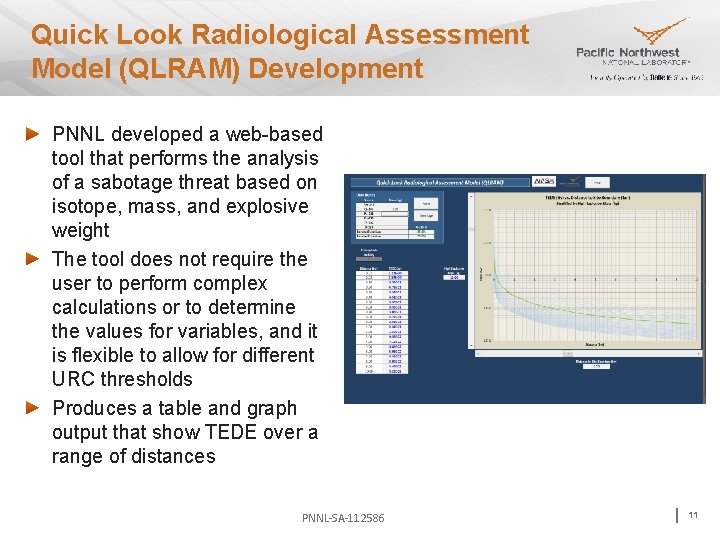
Quick Look Radiological Assessment Model (QLRAM) Development PNNL developed a web-based tool that performs the analysis of a sabotage threat based on isotope, mass, and explosive weight The tool does not require the user to perform complex calculations or to determine the values for variables, and it is flexible to allow for different URC thresholds Produces a table and graph output that show TEDE over a range of distances PNNL-SA-112586 11