
International Organization and Transnational Actors Lecture 5 March
- Slides: 16
International Organization and Transnational Actors Lecture #5: March 21, 2017 POLI 140
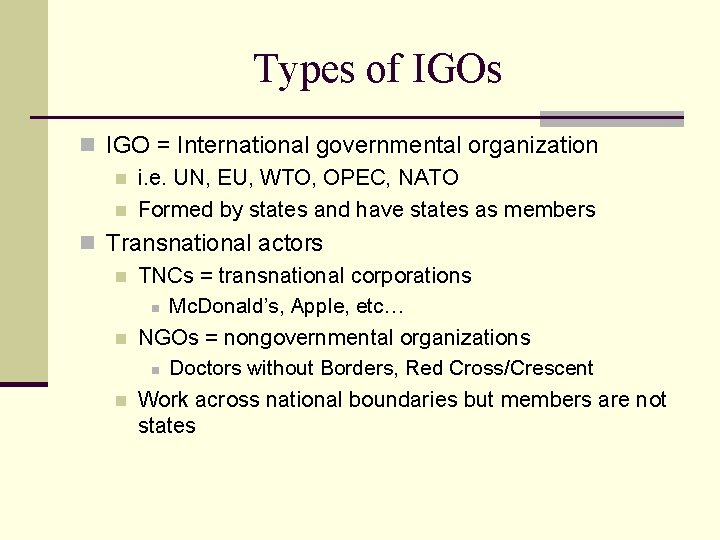
Types of IGOs n IGO = International governmental organization n i. e. UN, EU, WTO, OPEC, NATO n Formed by states and have states as members n Transnational actors n TNCs = transnational corporations n Mc. Donald’s, Apple, etc… n NGOs = nongovernmental organizations n Doctors without Borders, Red Cross/Crescent n Work across national boundaries but members are not states
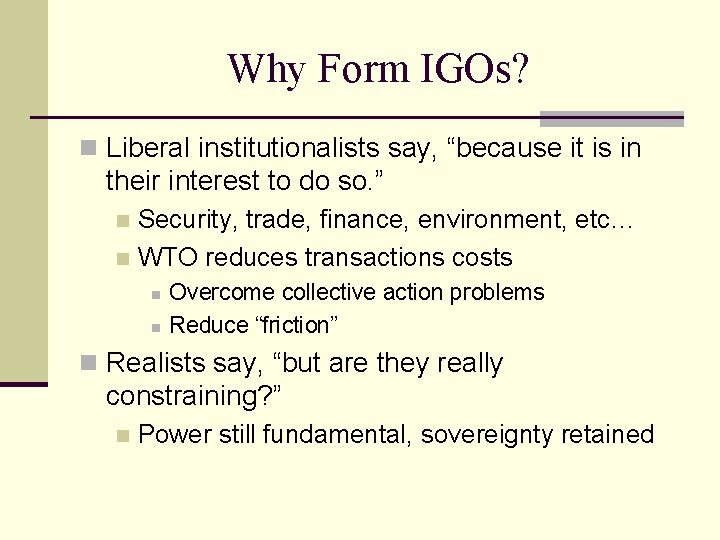
Why Form IGOs? n Liberal institutionalists say, “because it is in their interest to do so. ” Security, trade, finance, environment, etc… n WTO reduces transactions costs n n n Overcome collective action problems Reduce “friction” n Realists say, “but are they really constraining? ” n Power still fundamental, sovereignty retained
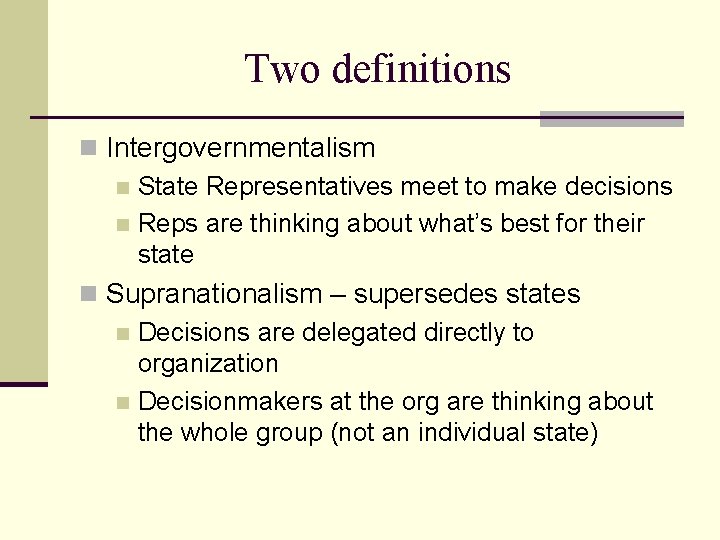
Two definitions n Intergovernmentalism n State Representatives meet to make decisions n Reps are thinking about what’s best for their state n Supranationalism – supersedes states n Decisions are delegated directly to organization n Decisionmakers at the org are thinking about the whole group (not an individual state)
United Nations n UN formed after WWII n Membership is universal n Closest thing to a world gov’t that exists n Viewed as both a hope of mankind and potential threat to national sovereignty n Recognizes primacy of “great powers” given permanent seats and veto power on security council
United Nations n UN = IGO n General Assembly, all members have a rep. n One state, one vote n Resolutions do not have the force of law n n n They can…. and are ignored. But it can embarrass a state UN does not have the power to tax n Relies on voluntary contributions § More than 80% of members fail to pay on time and in full
United Nations n Does sometimes engage in deterrence and counter- aggression try to somewhat replicate the purpose of League of Nations n Security council could deter agression through collective action n n Rarely works in practice, e. g. USA invades Iraq in 2003 n Peacekeeping – this has been more successful n But often not – Rwanda, Yugoslavia, for example n Tight rules of engagement, lightly armed
United Nations n ECOSOC – economic and social council n Provides funds, advice for development n WHO, UN Statistical group n Forum to provide goods of global importance n ICJ – international court of justice n Court that can adjudicate treaty obligations n Interprets international law n Lowers transactions costs, provides neutrality
Views of the UN n World Government – nobody really takes this one seriously n Irrelevant – realists, mostly n Tool for states – liberals, mostly n Source of norms – social constructivists, mostly
So…what is Brexit? n Brexit = British exit from the EU n EU = European Union n Began in 1951 as Eur. Coal & Steel Comm. n Envisioned as future “United States of Europe” 6 original members, now 28 n largest economy in the world, peace & prosperity on continent, 26 of 28 score very high on HD index n Free trade, free movement of people, common currency, common laws and regs. n
United States of Europe n European project premised on common European identity n Christian or “post-Christian” n Western culture – EU Anthem: “Ode to Joy” n Enlightenment ideals – human rights, democracy, welfare state n Benefits to member states n Free trade, larger markets n Improve governance n Cooperate to face the world united n Airbus, for example. n Immanuel Kant’s “Perpetual Peace” –It’s worked!
So, why leave? n Well, UK always “Euroskeptical” n Traditional UK identity as not “Europe” n Strong ties to USA and Commonwealth n Conservatives, Churchill opposed n Belief that the EU weakens the nation-state n Not original member, France opposed n Consistent holdout on deepening ties n n Kept the Pound Not a part of Schengen treaty
Okay, but why now? n Increasing Euroscepticism because: n Increasing Immigration n Though most UK immigration from non-EU countries $ sent to poorer regions/ distressed regions n General Malaise n n n Technocrats/elites/bureaucrats not listening, send a message for accountability UKIP and some Tories pressure for Referendum – PM David Cameron agrees
What went wrong? n Expand to quickly? Possibly from UK perspective, but not from EE perspective n What happens to Baltic states, Poland, etc… w/o EU? n Problem of rich/poor? n Yes, at least to some degree for UK n UK rich, low farmers – but Scotland! n So-called PIIGS not part of recent expansion n Regional inequality has been there, benefits MNC n European Monetary Union – It’s a problem, but not for UK n But if the forces that are roiling the EU are related to those of USA, may not be EU’s fault.
Is this the beginning of the end? n Predictions are hard, especially about the future. n Short answer yes… with an if. n yes, if you mean United States of Europe project and deepening ties (at least for now) n Long answer no…with a but. n No, the European Union unlikely to end, but if they are incapable of adapting they will… n Need to be able to adapt to challenges: security, immigration, economic recession w/ creativity and erase “democratic deficit”
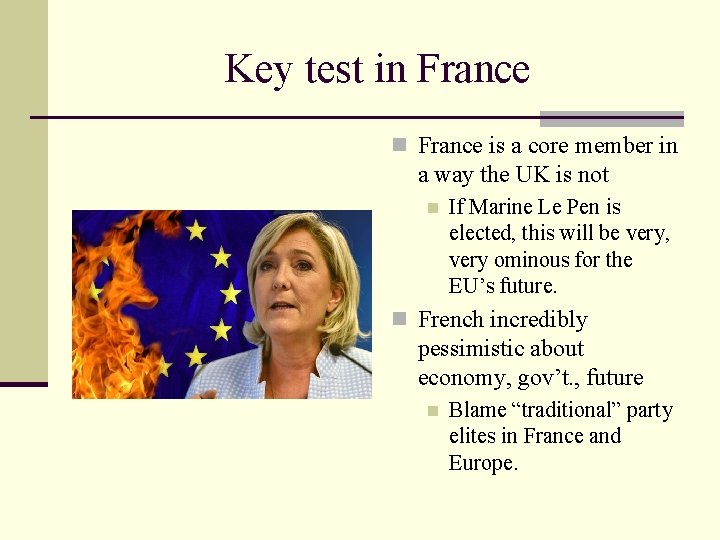
Key test in France is a core member in a way the UK is not n If Marine Le Pen is elected, this will be very, very ominous for the EU’s future. n French incredibly pessimistic about economy, gov’t. , future n Blame “traditional” party elites in France and Europe.