
International Marketing Trade policy Culture Consumer buying power
International Marketing Trade policy Culture Consumer buying power Product strategies MKTG 370 INTERNATIONAL MARKETING Lars Perner, Instructor 1
Obstacles to Trade: Protectionism Differing interests of consumers and manufacturers Benefits of trade tend to be more diffused than benefits to specific groups of protectionism MKTG 370 INTERNATIONAL MARKETING Lars Perner, Instructor 2
Approaches to Protectionism Tariffs Quotas “Voluntary” export restrictions Subsidies to domestic producers/exporters Non-tariff barriers legal obstacles differential treatment MKTG 370 INTERNATIONAL MARKETING Lars Perner, Instructor 3
Cultural Lessons Diet Coke is named Light Coke in Japan-dieting was not well regarded Red circle trademark was unpopular in Asia due to its resemblance of Japanese flag Packaging of products is more important in some countries than in U. S. Advertisement featuring man and dog failed in Africa--dogs were not seem as man’s best friend MKTG 370 INTERNATIONAL MARKETING Lars Perner, Instructor 4
More Cultural Lessons. . . Cologne ad featuring a man “attacked” by women failed in Africa Food demonstration did well in Chinese stores but not in Korean ones--older women were insulted by being “taught” by younger representatives Pauses in negotiations Level of formality MKTG 370 INTERNATIONAL MARKETING Lars Perner, Instructor 5
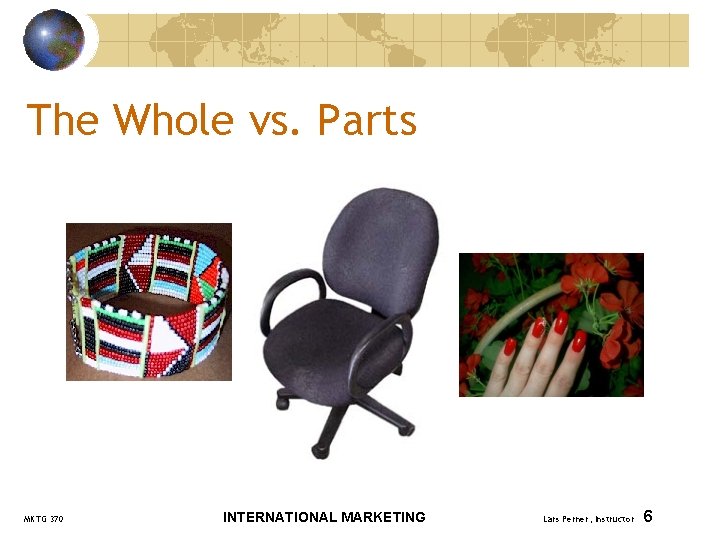
The Whole vs. Parts MKTG 370 INTERNATIONAL MARKETING Lars Perner, Instructor 6
Definitions Culture: “That complex whole which includes knowledge, belief, art, morals, custom, and any other capabilities and habits acquired by man as a member of society. ” Alternative definition: “Meanings that are shared by most people in a group” [at least to some extent]. (Adapted from Peter and Olson, 1994) MKTG 370 INTERNATIONAL MARKETING Lars Perner, Instructor 7
Hofstede’s Cultural Based on interviews with Dimensions IBM executives throughout Individualism (vs. the World--1980 s collectivism) Power distance Masculine vs. feminine Strong vs. weak uncertainty avoidance Short vs. long term orientation (Confucianist dynamics) “The Foolish Old Man Who Moved the Mountain” MKTG 370 INTERNATIONAL MARKETING Lars Perner, Instructor 8
Negotiation Content Non-task sounding Task-related exchange of information Persuasion Concessions and agreements MKTG 370 INTERNATIONAL MARKETING Lars Perner, Instructor 9
Geography--Surprisingly Impactful U. S. and most Western European areas are highly generally accessible Compare to areas in the developing World: China Russia Latin America (even Mexico), Africa Communication vs. shipping MKTG 370 INTERNATIONAL MARKETING Lars Perner, Instructor 10
Climate and Topography: The Case of Latin America 4, 500 by 3, 000 miles (at widest) 48% forests West coast dominated by mountain ranges 5% of land arable Natural barriers inhibiting growth Large proportion of residents in cities; people in rural areas often do not associate themselves with countries MKTG 370 INTERNATIONAL MARKETING Lars Perner, Instructor 11
Climate and Topography: The Case of Latin America 4, 500 by 3, 000 miles (at widest) 48% forests West coast dominated by mountain ranges 5% of land arable Natural barriers inhibiting growth Large proportion of residents in cities; people in rural areas often do not associate themselves with countries MKTG 370 INTERNATIONAL MARKETING Lars Perner, Instructor 12
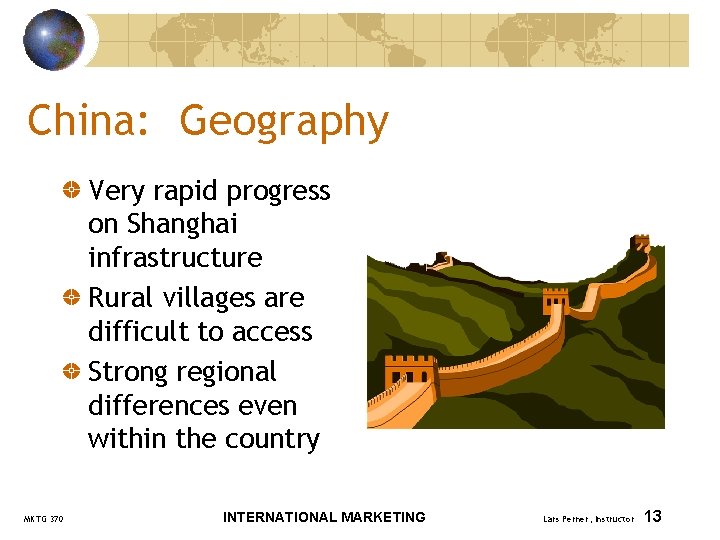
China: Geography Very rapid progress on Shanghai infrastructure Rural villages are difficult to access Strong regional differences even within the country MKTG 370 INTERNATIONAL MARKETING Lars Perner, Instructor 13
Some Issues in Culture Time Symbols monochronic vs. polychronic meanings Personal space preferred distance territoriality interaction with/ignoring people in close proximity MKTG 370 colors historical associations Friendship and acquaintance Agreements Etiquette INTERNATIONAL MARKETING Lars Perner, Instructor 14
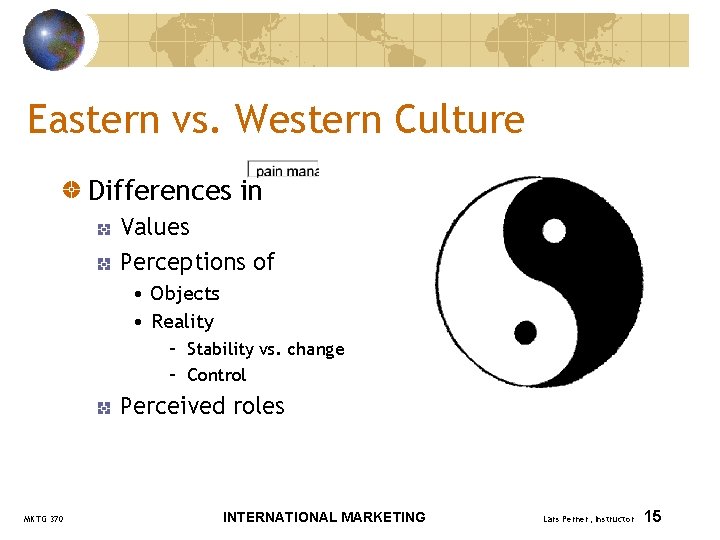
Eastern vs. Western Culture Differences in Values Perceptions of • Objects • Reality – Stability vs. change – Control Perceived roles MKTG 370 INTERNATIONAL MARKETING Lars Perner, Instructor 15
Perceived Control Over Reality World is not generally seen as predictable Trends are not expected to continue Individual has little control over the world BUT Outcome is believed to be tied to effort, not individual skill MKTG 370 INTERNATIONAL MARKETING Lars Perner, Instructor 16
More Tendencies Westeners tend to rate themselves More unique than average and what they are “Above average” in ability Easteners tend to rate themselves Less unique than they really are “Below average” MKTG 370 INTERNATIONAL MARKETING Lars Perner, Instructor 17
Proverbs Western: “The early bird gets the worm” Eastern: “The first bird in the flock gets shot” “A nail that stands out will be hammered down. ” MKTG 370 INTERNATIONAL MARKETING Lars Perner, Instructor 18
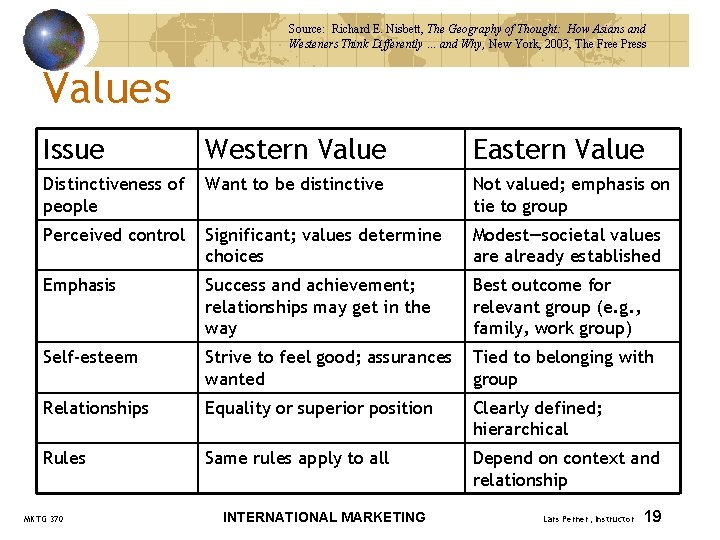
Source: Richard E. Nisbett, The Geography of Thought: How Asians and Westeners Think Differently … and Why, New York, 2003, The Free Press Values Issue Western Value Eastern Value Distinctiveness of people Want to be distinctive Not valued; emphasis on tie to group Perceived control Significant; values determine choices Modest—societal values are already established Emphasis Success and achievement; relationships may get in the way Best outcome for relevant group (e. g. , family, work group) Self-esteem Strive to feel good; assurances wanted Tied to belonging with group Relationships Equality or superior position Clearly defined; hierarchical Rules Same rules apply to all Depend on context and relationship MKTG 370 INTERNATIONAL MARKETING Lars Perner, Instructor 19
Some implications Thanking people—for things they are clearly supposed to do? Why the need for a choice between 40 different brands of cereal? MKTG 370 INTERNATIONAL MARKETING Lars Perner, Instructor 20
Socialization Western textbook: “See Dick run. See Dick play. See Dick run and play. ” Chinese: “Big brother takes care of little brother. Big brother loves little brother. Little brother loves big brother. ” MKTG 370 INTERNATIONAL MARKETING Lars Perner, Instructor 21
Perception of People Western: People have characteristics independent of the situation Fundamental attribution error: People attribute their own behavior to the circumstances but that of others to innate characteristics. Eastern: Person is connected; behavior is the result of specific roles played at the time MKTG 370 INTERNATIONAL MARKETING Lars Perner, Instructor 22
Contrasting Advertising Perspectives (Aithison 2002) Western Asian “Atomistic”—broken down to smallest component parts “Unique selling propositions” “How to” Positioning May be “dull and boring” “Copy focused” Holistic “Everything relates to everything else” How things “fit together” and “relate” Visual and oral Jim Aitchison, How Asia Advertises, New York: Wiley, 2002. MKTG 370 INTERNATIONAL MARKETING Lars Perner, Instructor 23
Advertising Content Comparisons American: Individual benefit and pleasure (e. g. , “Make your way through the crowd) Korean Collective values (e. g. , “We have a way of bringing people together) MKTG 370 INTERNATIONAL MARKETING Lars Perner, Instructor 24
Debate and Conflict “The first person to raise his voice has lost the argument. ” (Chinese proverb) Use of indirection and projection Face-to-face vs. anonymous comments Western adversarial “rule of law” based on consistent universal ideals vs. solution for the case at hand in context MKTG 370 INTERNATIONAL MARKETING Lars Perner, Instructor 25
Relationships, Education, and Work Western Standing out; being “better” Self perceived favorably Self-esteem building Work longer on successful job Eastern Harmony Must “weed out” personal characteristics that might annoy others Taught self-criticism Not recognized in profession until after many years of practice Work longer on unsuccessful job MKTG 370 INTERNATIONAL MARKETING Lars Perner, Instructor 26
Physical Product vs. Communication Adaptations MKTG 370 INTERNATIONAL MARKETING Lars Perner, Instructor 27
CONSUMER INCOMES AND BUYING POWER Measuring country wealth gross domestic product “purchase parity” vs. nominal Government role in the economy Tax burden Services provided by the Government— e. g. , health care, education MKTG 370 INTERNATIONAL MARKETING Lars Perner, Instructor 28
Country of Origin Effects Perception of product quality (e. g. , Japan, Germany) elegance and style (e. g. , France, Italy) Historical associations Positioning strategies Emphasis on origin (e. g. , French wine) De-emphasis/obfuscation of of country of origin (e. g. , French beer, American products with French language labels) MKTG 370 INTERNATIONAL MARKETING Lars Perner, Instructor 29
Nominal vs. Purchase Parity Adjusted GNPs—Examples (2003) Source: World Bank (http: //www. worldbank. org/databytopic/GNIPC. pdf) MKTG 370 INTERNATIONAL MARKETING Lars Perner, Instructor 30
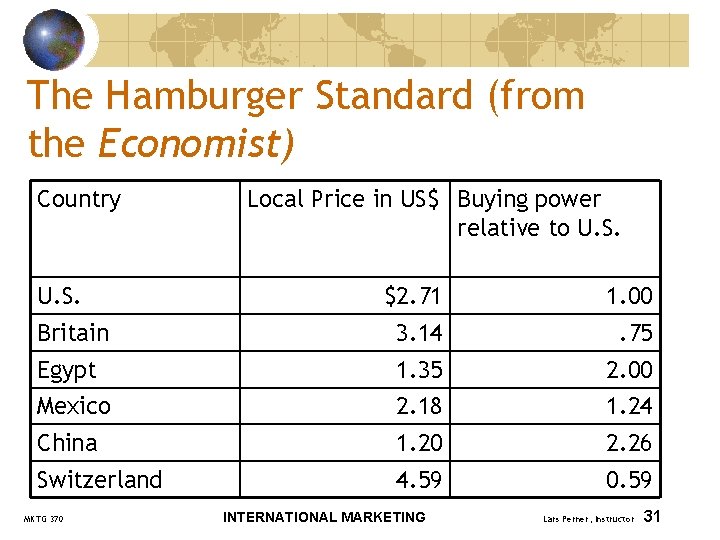
The Hamburger Standard (from the Economist) Country U. S. Local Price in US$ Buying power relative to U. S. $2. 71 1. 00 Britain 3. 14 . 75 Egypt 1. 35 2. 00 Mexico 2. 18 1. 24 China 1. 20 2. 26 Switzerland 4. 59 0. 59 MKTG 370 INTERNATIONAL MARKETING Lars Perner, Instructor 31
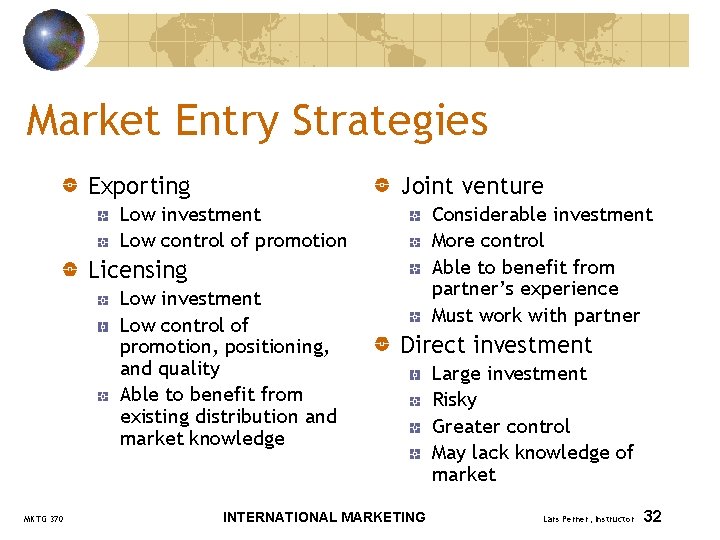
Market Entry Strategies Exporting Joint venture Low investment Low control of promotion Considerable investment More control Able to benefit from partner’s experience Must work with partner Licensing Low investment Low control of promotion, positioning, and quality Able to benefit from existing distribution and market knowledge MKTG 370 Direct investment INTERNATIONAL MARKETING Large investment Risky Greater control May lack knowledge of market Lars Perner, Instructor 32
Market Positioning Strategies Across Countries Häagen-Dazs—U. S. vs. Japan Corona Beer—Mexico vs. U. S. Mercedes-Benz—Europe vs. U. S. Mc. Donald’s U. S. Europe Developing countries—e. g. , China MKTG 370 INTERNATIONAL MARKETING Lars Perner, Instructor 33
U. S. Laws of Interest to firms with U. S. Involvement Anti-trust Foreign Corrupt Influences Anti-boycott laws Trading With the Enemy MKTG 370 INTERNATIONAL MARKETING Lars Perner, Instructor 34
The International Life Cycle Market for older technology tends to exist in less developed countries Manufacturing of older generation technology-e. g. , Pentium I computers Resale of capital equipment—e. g. , DC 8 aircraft, old three part canning machines Some countries tend to be more receptive to innovation than others MKTG 370 “Leap frogging” Going directly from old technology to the very newest, skipping intermediate step (e. g. , wireless rather than wired technology) Shortening of product life cycles INTERNATIONAL MARKETING Lars Perner, Instructor 35
- Slides: 35