
INTERNATIONAL MARKETING RESEARCH TRADE DATA ANALYSIS MARKET ATTRACTIVENESS


- Slides: 36
INTERNATIONAL MARKETING RESEARCH • TRADE DATA ANALYSIS • MARKET ATTRACTIVENESS/ COMPANY STRENGTH. . ANALYSIS • SWOT ANALYSIS
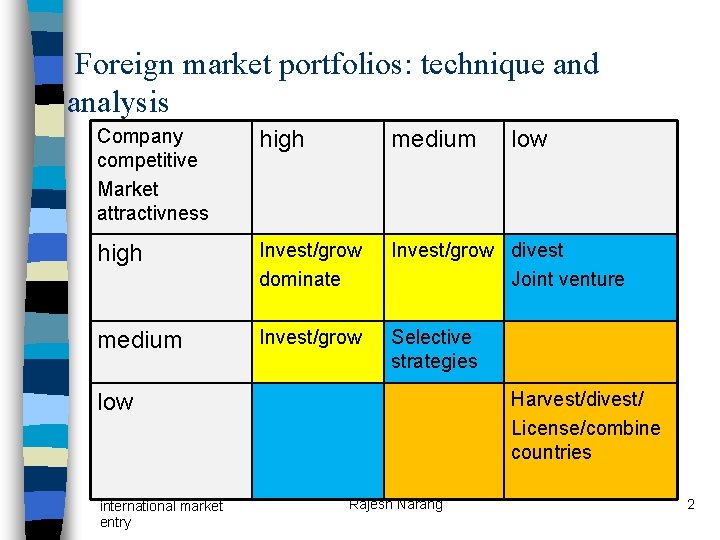
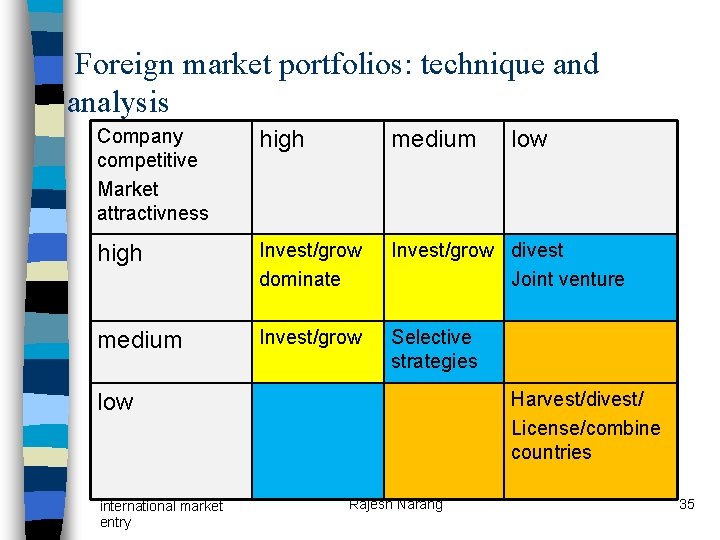
Foreign market portfolios: technique and analysis Company competitive Market attractivness high medium high Invest/grow dominate Invest/grow divest Joint venture medium Invest/grow Selective strategies Harvest/divest/ License/combine countries low international market entry low Rajesh Narang 2
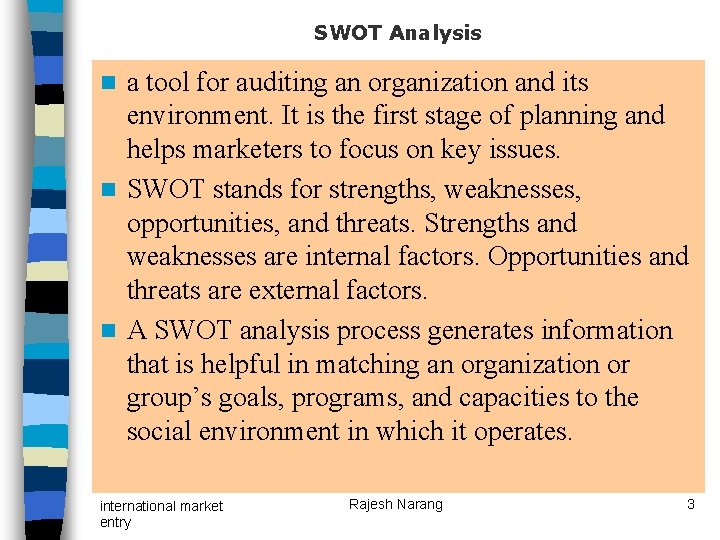
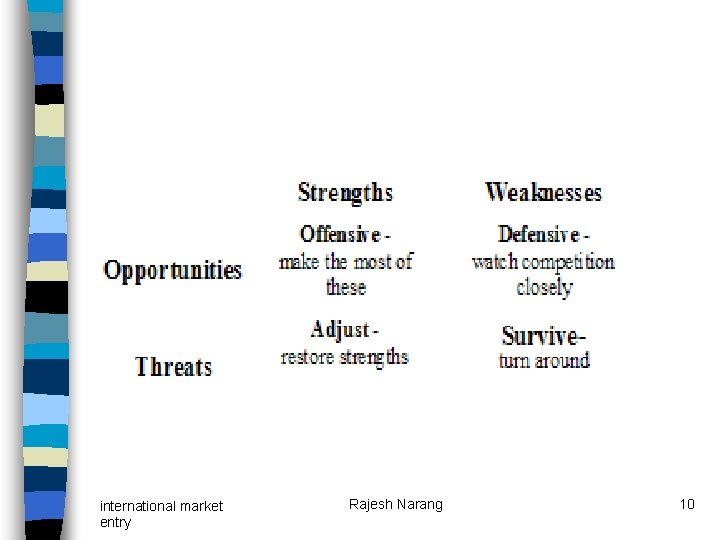
SWOT Analysis a tool for auditing an organization and its environment. It is the first stage of planning and helps marketers to focus on key issues. n SWOT stands for strengths, weaknesses, opportunities, and threats. Strengths and weaknesses are internal factors. Opportunities and threats are external factors. n A SWOT analysis process generates information that is helpful in matching an organization or group’s goals, programs, and capacities to the social environment in which it operates. n international market entry Rajesh Narang 3
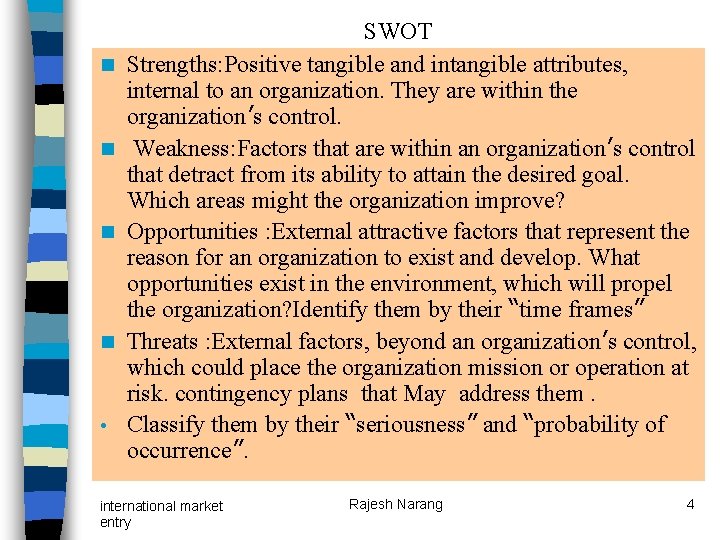
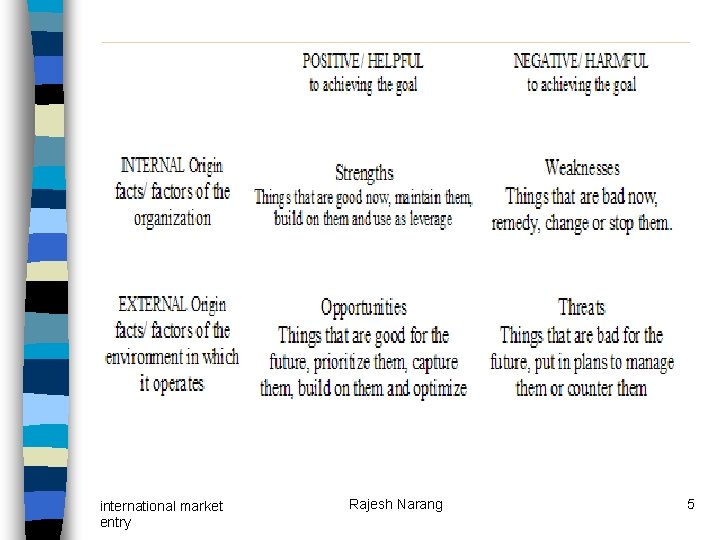
n n • SWOT Strengths: Positive tangible and intangible attributes, internal to an organization. They are within the organization’s control. Weakness: Factors that are within an organization’s control that detract from its ability to attain the desired goal. Which areas might the organization improve? Opportunities : External attractive factors that represent the reason for an organization to exist and develop. What opportunities exist in the environment, which will propel the organization? Identify them by their “time frames” Threats : External factors, beyond an organization’s control, which could place the organization mission or operation at risk. contingency plans that May address them. Classify them by their “seriousness” and “probability of occurrence”. international market entry Rajesh Narang 4
international market entry Rajesh Narang 5
SW : PRIMO-F People II Resources III Innovation & Ideas II Marketing II Operations II Finance strength could be: What do you do well? Is there anything you do better than most? Better than anyone else? n Your specialist marketing expertise. n A new, innovative product or service. n Location , Quality processes that adds value to your product or service. A weakness could be: What should be improved? What do you do poorly? What should you avoid, based on mistakes in the past? Lack of marketing expertise. n Undifferentiated products , Poor quality n Damaged reputation. international market entry Rajesh Narang 6
• • o n OT Profile Opportunities : Where can you find, or create, a competitive advantage? What are some major trends in your business? - Consolidation / Diversification? Specialization / Generalization? - Changes in technology. Such as computer software. - Changes in the types of businesses in your market. - Changes in social patterns, population profiles, lifestyle. - trends. Changes in demand Threats : What obstacles do you face? What are your competitors doing that may result in a loss of clients, customers, market share? Are the required specifications for your job, products or services changing? Is changing technology threatening your position? Do you have cash-flow problems? international market entry Rajesh Narang 7
SWOT Analysis Examples n Example 1 - Wal-Mart SWOT Analysis. Strengths - Wal-Mart is a powerful retail brand. It has a reputation for value for money, convenience and a wide range of products all in one store. Weaknesses - Wal-Mart is the World's largest grocery retailer and control of its empire, despite its IT advantages, could leave it weak in some areas due to the huge span of control. Opportunities - To take over, merge with, or form strategic alliances with other global retailers, focusing on specific markets such as Europe or the Greater China Region. Threats - Being number one means that you are the target of competition, locally and globally. international market entry Rajesh Narang 8
. n Example 2 - Starbucks SWOT Analysis. Strengths - Starbucks Corporation is a very profitable organisation, earning in excess of $600 million in 2004. Weaknesses - Starbucks has a reputation for new product development and creativity. Opportunities - New products and services that can be retailed in their cafes, such as Fair Trade products. Threats - Starbucks are exposed to rises in the cost of coffee and dairy products. n Example 3 - Nike SWOT Analysis. Strengths - Nike is a very competitive organisation. Phil Knight (Founder and CEO) is often quoted as saying that 'Business is war without bullets. 'Weaknesses - The organisation does have a diversified range of sports products. Opportunities - Product development offers Nike many opportunities. Threats - Nike is exposed to the international nature of trade. international market entry Rajesh Narang 9
international market entry Rajesh Narang 10
INTERNATIONAL MARKET ENTRY STRATEGIES • International market entry concept & modes • Factors affecting the selection of entry mode
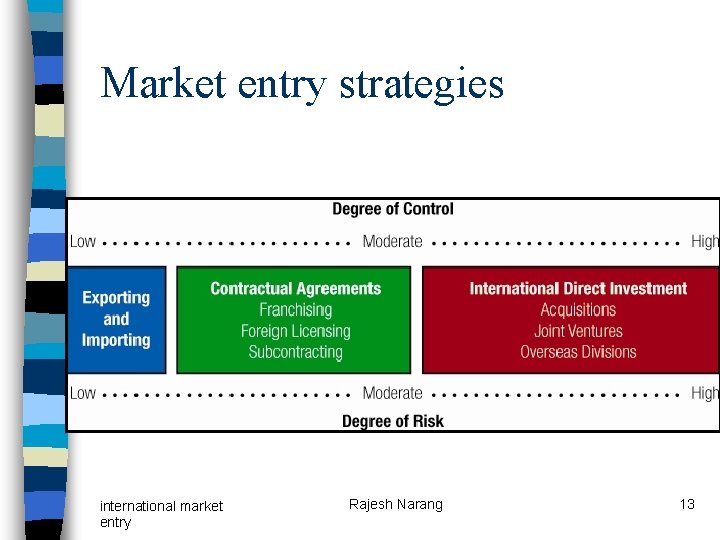
Concept of international market entry • mode of entry: an institutional mechanism by which a firm makes its products or services available consumers in international markets. • mode of entry determined by: - the ability and willingness of the firm to commit resources - the firms’ desire to have a level of control over international operations - the level of risk the firm is willing to take international market entry Rajesh Narang 12
Market entry strategies international market entry Rajesh Narang 13
Market entry strategies Exporting n Direct – Domestic base – Overseas sales branch – Traveling sales representative – Foreign-based distributors/agent n Indirect-occasional, or active exporting – Domestic-based export merchant – Domestic-based export agent – Cooperative organizations – Export-management company international market entry Rajesh Narang 14
Market entry strategies Contractual Agreements – Franchising: A contractual arrangement where a wholesaler or retailer (the Franchisee) agrees to make some payment and to meet the operating requirements of a manufacturer or other franchiser in exchange for the right to use the firm’s name and to market its goods or services – Foreign Licensing: an agreement that grants foreign marketers the right to distribute a firm’s merchandise or to use its trademark, patent, or process in a specified geographic area. – Subcontracting: a contractual agreement where a firm hires a local company to produce goods or services in a specific geographic area. international market entry Rajesh Narang 15
Market entry strategies International Direct Investment An additional strategy for entering global markets n Requires direct investment in foreign firms, production, and/or marketing facilities n Advantages – cheaper labor cost in some countries – government incentives – creates better image – deeper relationships with government, customers, suppliers and distributors – full control of operations and marketing n Risks involved: – economic difficulties of the host country – political instability and negative perception n international market entry Rajesh Narang 16
Modes of international market entry Production in home country exports: production is carried out in home country and finished goods are shipped to the overseas markets for sale indirect exports: process of selling products to an export intermediary in the company’s home country who in turn sells the products in the overseas markets direct exports: process of selling the firm’s products directly to an importer in the overseas market international market entry Rajesh Narang 17
Modes (contd) complementary exporting: use of distribution channels of an overseas firm to make the product available in the overseas market provide offshore services: to overseas clients with the help of information and communication technology international market entry Rajesh Narang 18
Modes (contd) Production in a foreign country • contractual entry modes international licensing: process by which a domestic company allows a foreign company to use its intellectual property and specific business skills for a compensation (royalty) international franchising: transfer of intellectual property and other assistance over an extended period of time with greater control compared to licensing international market entry Rajesh Narang 19
Selecting the International Entry Mode, continued n Licensing § § Licensor offers know-how, shares technology, and shares brand name with licensee Licensee pays royalties Lower-risk entry mode; limits exposure to economic, financial, and political instability Permits the company access to markets that may be closed or that may have high entry barriers DOWNSIDE: Can produce competitor in the licensee international market entry Rajesh Narang 20
Selecting the International Entry Mode, continued n Franchising § Franchisor gives franchisee right to use brand name, trademarks and business know-how Less risk, higher level of control Very rapid market penetration DOWNSIDE: Can create future competitors who understand the operations of the franchise international market entry Rajesh Narang 21
Modes (contd) overseas turnkey projects: conceptualize, design, install, construct, and carry out primary testing of manufacturing facilities or engineering structures for an overseas client organisation types : built and transfer (BT), built, operate, and transfer (BOT), built, operate, own (BOO) international management contracts: a company provides its technical and managerial expertise for a specific duration to an overseas firm international market entry Rajesh Narang 22
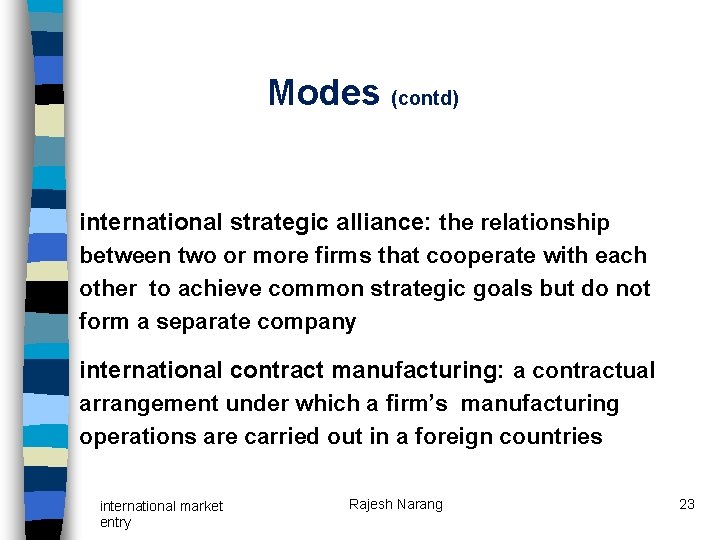
Modes (contd) international strategic alliance: the relationship between two or more firms that cooperate with each other to achieve common strategic goals but do not form a separate company international contract manufacturing: a contractual arrangement under which a firm’s manufacturing operations are carried out in a foreign countries international market entry Rajesh Narang 23
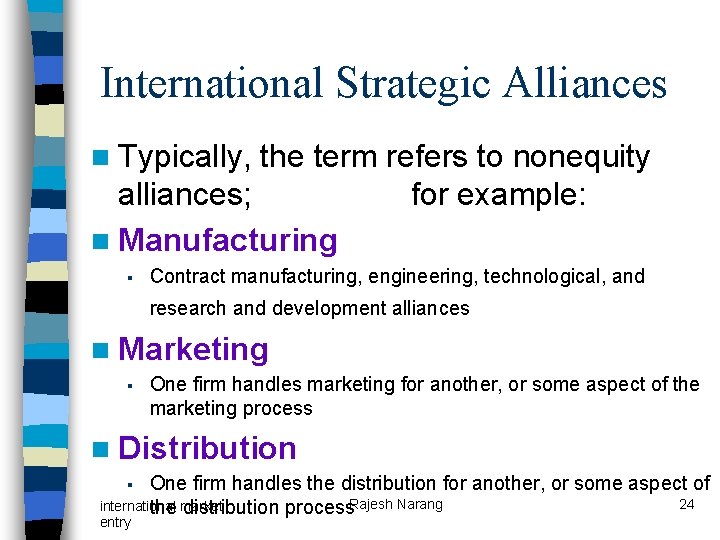
International Strategic Alliances n Typically, the term refers to nonequity alliances; for example: n Manufacturing § Contract manufacturing, engineering, technological, and research and development alliances n Marketing § One firm handles marketing for another, or some aspect of the marketing process n Distribution One firm handles the distribution for another, or some aspect of 24 international the market distribution process. Rajesh Narang § entry
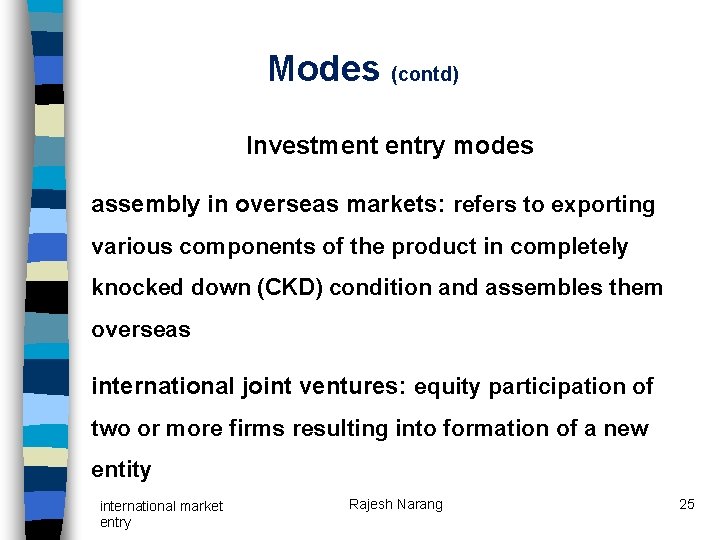
Modes (contd) Investment entry modes assembly in overseas markets: refers to exporting various components of the product in completely knocked down (CKD) condition and assembles them overseas international joint ventures: equity participation of two or more firms resulting into formation of a new entity international market entry Rajesh Narang 25
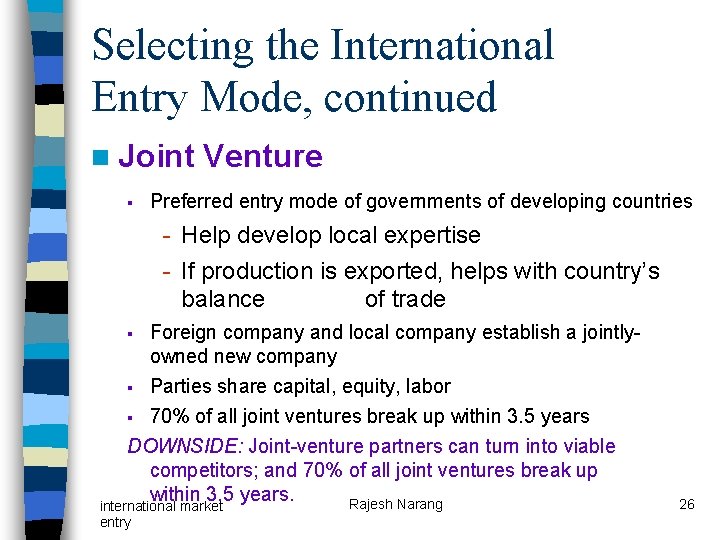
Selecting the International Entry Mode, continued n Joint § Venture Preferred entry mode of governments of developing countries - Help develop local expertise - If production is exported, helps with country’s balance of trade § Foreign company and local company establish a jointlyowned new company Parties share capital, equity, labor § 70% of all joint ventures break up within 3. 5 years DOWNSIDE: Joint-venture partners can turn into viable competitors; and 70% of all joint ventures break up within 3. 5 years. Rajesh Narang international market § entry 26
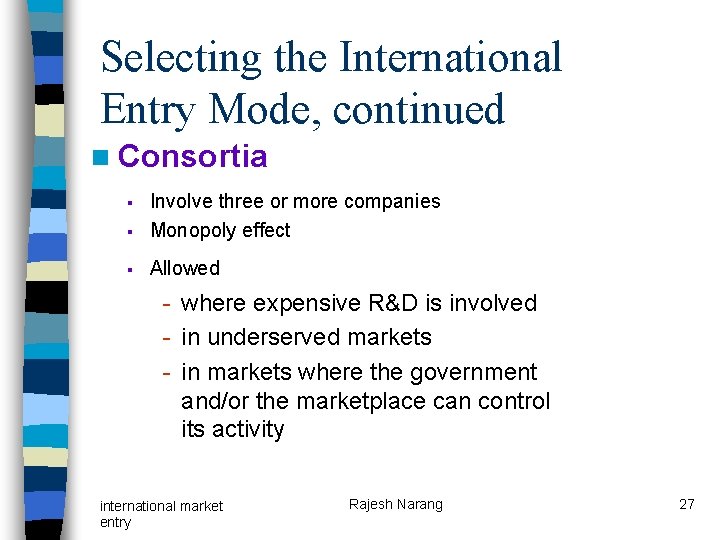
Selecting the International Entry Mode, continued n Consortia § Involve three or more companies Monopoly effect § Allowed § - where expensive R&D is involved - in underserved markets - in markets where the government and/or the marketplace can control its activity international market entry Rajesh Narang 27
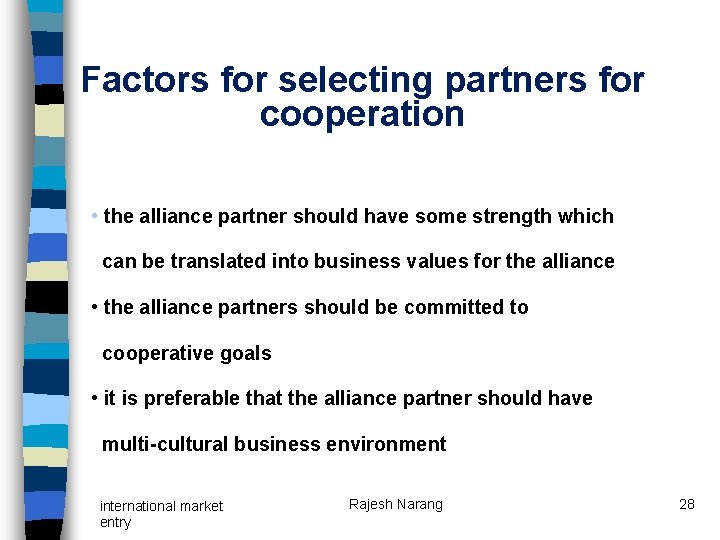
Factors for selecting partners for cooperation • the alliance partner should have some strength which can be translated into business values for the alliance • the alliance partners should be committed to cooperative goals • it is preferable that the alliance partner should have multi-cultural business environment international market entry Rajesh Narang 28
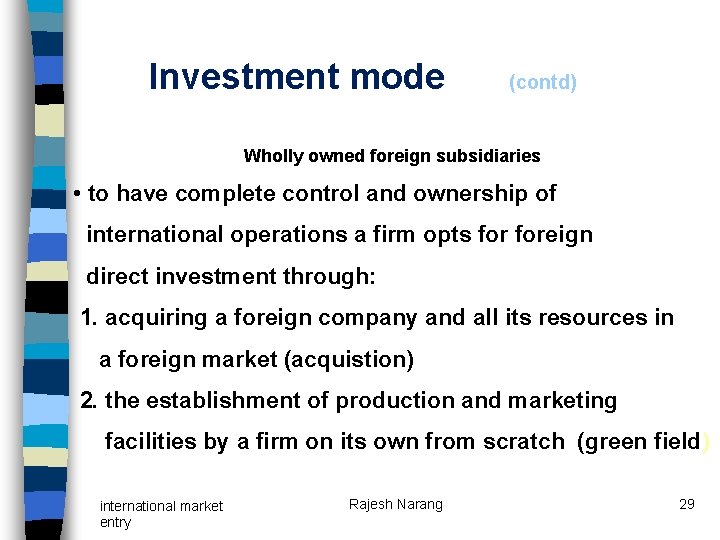
Investment mode (contd) Wholly owned foreign subsidiaries • to have complete control and ownership of international operations a firm opts foreign direct investment through: 1. acquiring a foreign company and all its resources in a foreign market (acquistion) 2. the establishment of production and marketing facilities by a firm on its own from scratch (green field) international market entry Rajesh Narang 29
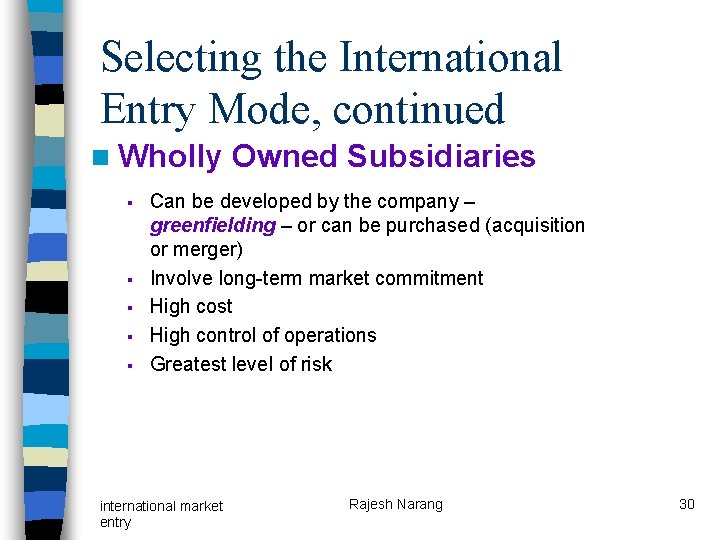
Selecting the International Entry Mode, continued n Wholly § § § Owned Subsidiaries Can be developed by the company – greenfielding – or can be purchased (acquisition or merger) Involve long-term market commitment High cost High control of operations Greatest level of risk international market entry Rajesh Narang 30
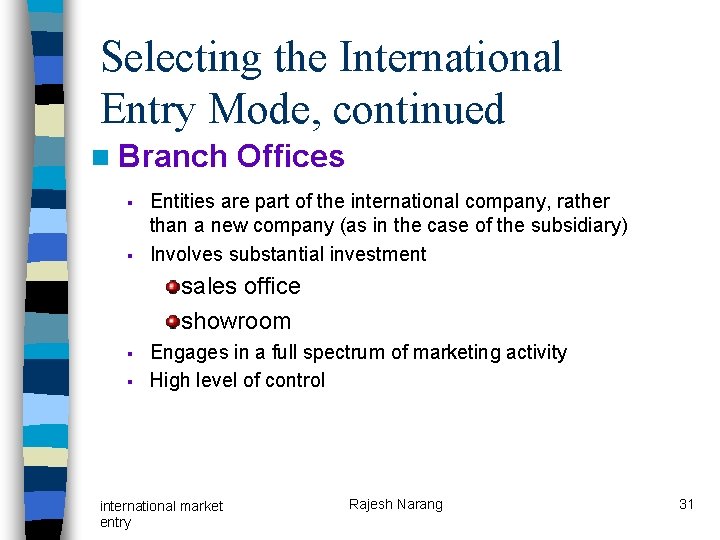
Selecting the International Entry Mode, continued n Branch § § Offices Entities are part of the international company, rather than a new company (as in the case of the subsidiary) Involves substantial investment sales office showroom § § Engages in a full spectrum of marketing activity High level of control international market entry Rajesh Narang 31
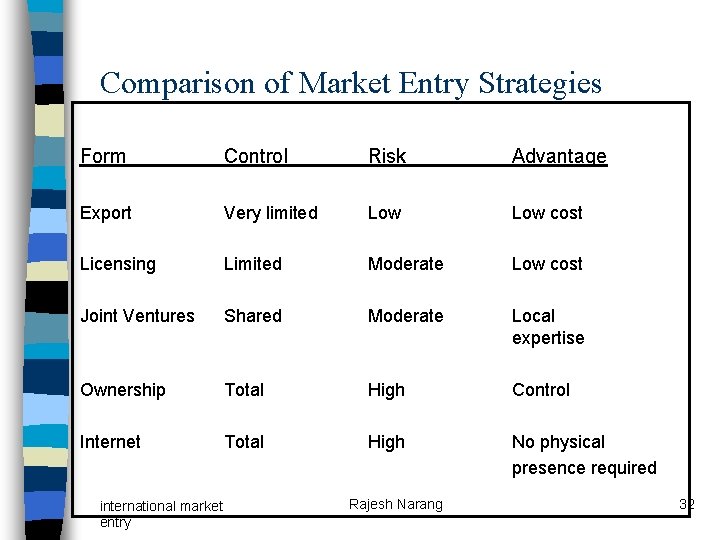
Comparison of Market Entry Strategies Form Control Risk Advantage Export Very limited Low cost Licensing Limited Moderate Low cost Joint Ventures Shared Moderate Local expertise Ownership Total High Control Internet Total High No physical presence required international market entry Rajesh Narang 32
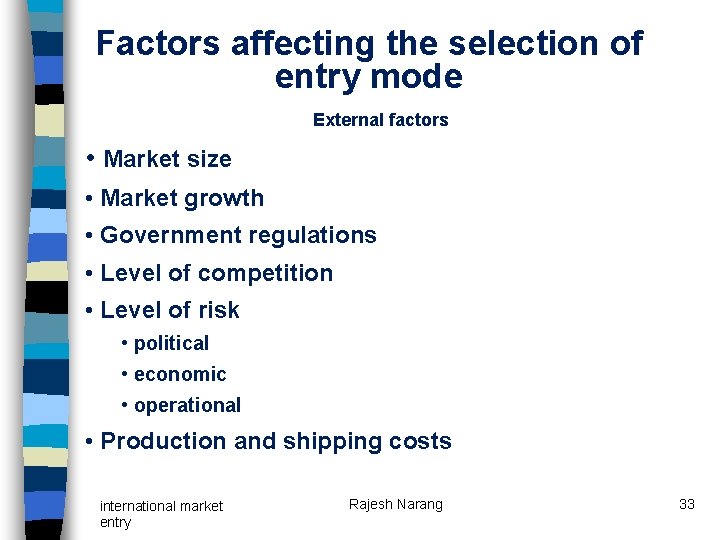
Factors affecting the selection of entry mode External factors • Market size • Market growth • Government regulations • Level of competition • Level of risk • political • economic • operational • Production and shipping costs international market entry Rajesh Narang 33
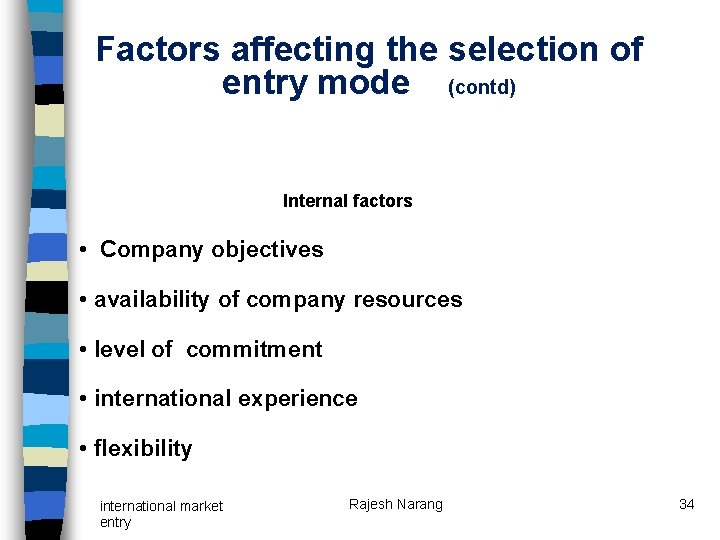
Factors affecting the selection of entry mode (contd) Internal factors • Company objectives • availability of company resources • level of commitment • international experience • flexibility international market entry Rajesh Narang 34
Foreign market portfolios: technique and analysis Company competitive Market attractivness high medium high Invest/grow dominate Invest/grow divest Joint venture medium Invest/grow Selective strategies Harvest/divest/ License/combine countries low international market entry low Rajesh Narang 35
Thank you