
International Marketing Global Strategic Planning Global Marketing Evolution

International Marketing Global Strategic Planning
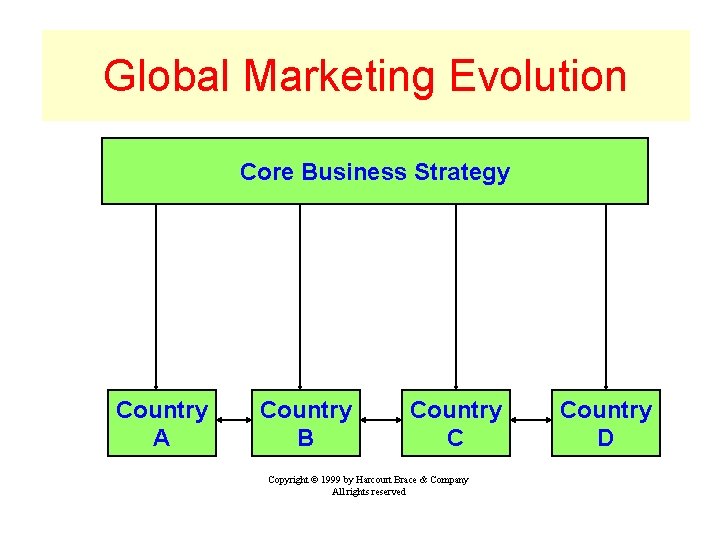
Global Marketing Evolution Core Business Strategy Country A Country B Country C Copyright © 1999 by Harcourt Brace & Company All rights reserved Country D

Globalization Drivers • Market Factors • Cost Factors • Environmental Factors • Competitive Factors Copyright © 1999 by Harcourt Brace & Company All rights reserved
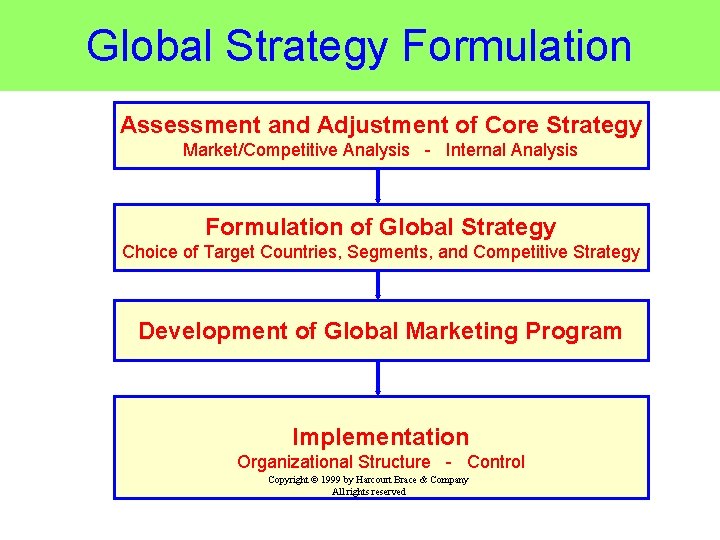
Global Strategy Formulation Assessment and Adjustment of Core Strategy Market/Competitive Analysis - Internal Analysis Formulation of Global Strategy Choice of Target Countries, Segments, and Competitive Strategy Development of Global Marketing Program Implementation Organizational Structure - Control Copyright © 1999 by Harcourt Brace & Company All rights reserved

Understanding and Adjusting the Core Strategy The SBU: Based on Product Market Similarities • Similar needs or wants to be met • Similar end user customers to be targeted • Similar products or services used to meet needs of specific customers Copyright © 1999 by Harcourt Brace & Company All rights reserved
Analysis is the First Step • Market Analysis • Competitor Analysis • Internal Analysis Copyright © 1999 by Harcourt Brace & Company All rights reserved

Formulating Global Marketing Strategy Starts With a Series of Decisions • • • Country-Market Choice of Competitive Strategy Segmentation Choices Concentration Diversification Copyright © 1999 by Harcourt Brace & Company All rights reserved
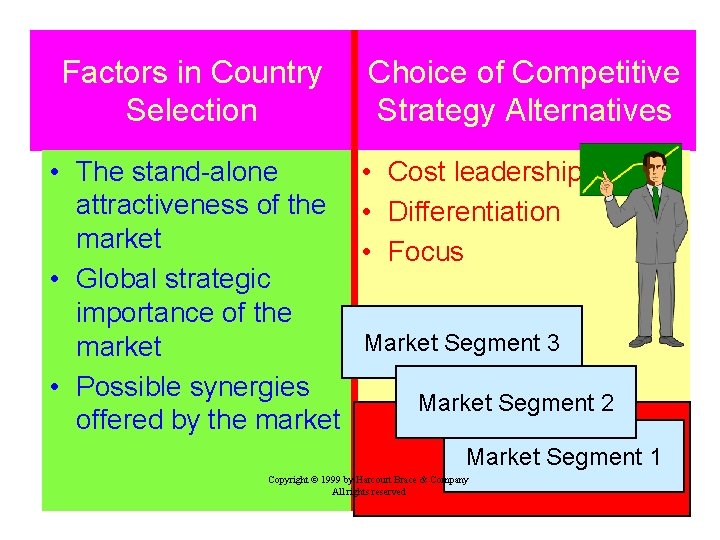
Factors in Country Selection • The stand-alone attractiveness of the market • Global strategic importance of the market • Possible synergies offered by the market Choice of Competitive Strategy Alternatives • Cost leadership • Differentiation • Focus Market Segment 3 Market Segment 2 Market Segment 1 Copyright © 1999 by Harcourt Brace & Company All rights reserved

Bases for Global Market Segmentation Marketing Management Variables Environmental Variables Geographic Variables Product Variables Political Variables Promotion Variables Economic Variables Price Variables Copyright © 1999 by Harcourt Brace & Company All rights reserved Cultural Variables Distribution Variables
Global Marketing Program Development Decisions • • The degree of standardization in the product offering The marketing program beyond the product variable The location and extent of value-adding activities Competitive moves to be made • The Product Offering : What degree of standardization or adaptation should be offered? Copyright © 1999 by Harcourt Brace & Company All rights reserved
The Location of Value-Added Activities – Pooling production ( single design center for each chip - Intel) – Exploiting factor costs or capabilities – Strategic alliances – Concurrent engineering Competitive Moves: Cross-subsidization – “…resources accumulated in one part of the world and used to fight a competitive battle in another…” Implementing Global Marketing : Success will come from a balance between local and regional / global concerns. The Challenges of Global Marketing and the Pitfalls to be Avoided: – – Insufficient research The tendency to overstandardize Inflexibility in planning and implementation Copyright © 1999 by Harcourt Brace & Company All rights reserved The “Not-Invented-Here” Syndrome (NIH)

Localizing Global Marketing : Achieving a balance between country managers and global product managers at headquarters. The Management Process • Enhancing the global transfer of communications • Personnel interchange to gain experience abroad • Headquarters should coordinate and leverage resources • Permit local managers to develop their own programs within defined parameters Copyright © 1999 by Harcourt Brace & Company All rights reserved
How to Avoid the NIH Syndrome • Ensure that local managers participate in the development of global brand marketing strategies • Encourage local managers to develop ideas for regional or global use • Maintain a product portfolio that includes local as well as regional or global brands • Allow local managers control over marketing budgets to respond to local customer needs and counter global competition Copyright © 1999 by Harcourt Brace & Company All rights reserved

Emerging Global Organization Structures • • Global Account Management Changes in the Corporate Culture for Going Global: The World is Not One Single Market. Planning and Executing Programs on a Worldwide Basis. • A Global Identity that Favors No Specific Country. • Product Choices Should Consider Individual Markets as well as Transfer Products from One Region to Another. Copyright © 1999 by Harcourt Brace & Company All rights reserved
International Marketing Global Pricing Strategies Copyright © 1999 by Harcourt Brace & Company All rights reserved. Requests for permission to make copies of any part of the work should be mailed to the following address: Permissions Department, Harcourt Brace & Company, 6277 Sea Harbor Drive, Orlando, Florida 32887 -6777.
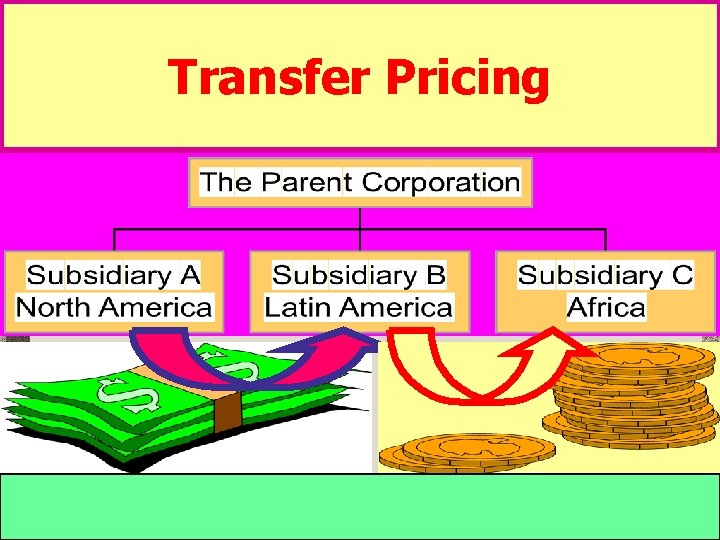
Transfer Pricing
Objectives of Transfer Pricing • • • Competitiveness in the international marketplace Reduction of taxes and tariffs Management of cash flows Minimization of foreign exchange risks Avoidance of conflicts with home and host governments • Internal concerns - goal congruence or subsidiary manager motivation

Use of Transfer Prices to Achieve Corporate Objectives
Three Philosophies of Pricing have Developed • Cost-based philosophy – Every affiliate is a profit center • Market-based philosophy – It takes local conditions into account • Arm’s-length price
Transfer Pricing Challenges • Internal to the MNC • External between the home and host country tax authorities • Performance Measurement: The effects of manipulating intra-corporate prices will cause major problems. • Taxation: Section 482 of the Internal Revenue Code (IRS has vast authority to reallocate income between controlled foreign operations and US parents)
Determining Arm’s Length Price under Section 482 • The comparable uncontrolled price method • The resale price method • The cost-plus method • Any other reasonable method
Pricing Within Individual Markets is Determined by: • • • Corporate objectives Costs Customer behavior and market conditions Market structure Environmental constraints

Corporate Pricing Objectives • Skimming • Penetration Pricing Why Prices Change? Foreign Exchange Rates Market Strategies
Costs - Frequently used as the basis of price determination. • Labor • Raw materials • Supplies • Utilities • Shipping • Demand Market Factors: – Price elasticity of consumer demand

Market Structure and Competition • Competition sets the price within the parameters of cost and demand. – Competitors under selling your company – Eroding Market share – Strategic Alliances
• Environmental Constraints: Price controls • Governments Influence Prices and Pricing Directly • Under Price Controls, the International Marketer must Operate as if in a Regulated Industry
Arguments Against Price Controls • • the maximum price becomes the minimum price the wage-price spiral advances labor turns against restrictions non-inflationary wage increases are forestalled government controls are difficult to enforce less tax is raised because less money is made governments may need to bail out companies to prevent bankruptcies and unemployment

Parallel Imports will Surface in Any Markets Where Price Discrepancies Exist
- Slides: 28