
International Marketi ng International Marketing Channels Chapter 14

- Slides: 30
International Marketi ng International Marketing Channels Chapter 14
What Should You Learn? • The variety of distribution channels and how they affect cost and efficiency in marketing • The Japanese distribution structure and what it means to Japanese customers and to competing importers of goods • How distribution patterns affect the various aspects of international marketing • The growing importance of e-commerce as a distribution alternative • The functions, advantages, and disadvantages of various kinds of middlemen • The importance of middlemen to a product’s success and the importance of selecting and maintaining middlemen 14 -2
Global Perspective – A Single Stick of Doublemint Today – 18 Billion Tomorrow • A product must be made accessible to the target market at an affordable price • Getting the product to the target market – Can be a costly process • Forging an aggressive and reliable channel of distribution – The most critical and challenging task facing the international marketer • Competitive advantage – For the marketer best able to build the most efficient channel from among the alternatives available 14 -3
Channel-of-Distribution Structures • All consumer and industrial products eventually go through a distribution process – Physical handling and distribution of goods – Passage of ownership – Buying and selling negotiations between producers and middlemen – Buying and selling negotiations between middlemen and customers • Each country market has a distribution structure – Goods pass from producer to user 14 -4
Import-Oriented Distribution Structure • In an import-oriented or traditional distribution structure: – Importer controls a fixed supply of goods – Marketing system develops around the philosophy of selling a limited supply of goods at high prices to a small number of affluent customers 14 -5
Import-Oriented Distribution Structure • Demand exceeds supply • The customer seeks the supply from a limited number of middlemen • Distribution systems are local • Few countries fit the import-oriented model 14 -6
Japanese Distribution Structure 1. A structure dominated by many small middlemen dealing with many small retailers 2. Channel control by manufacturers 3. A business philosophy shaped by a unique culture 4. Laws that protect the foundation of the system 14 -7
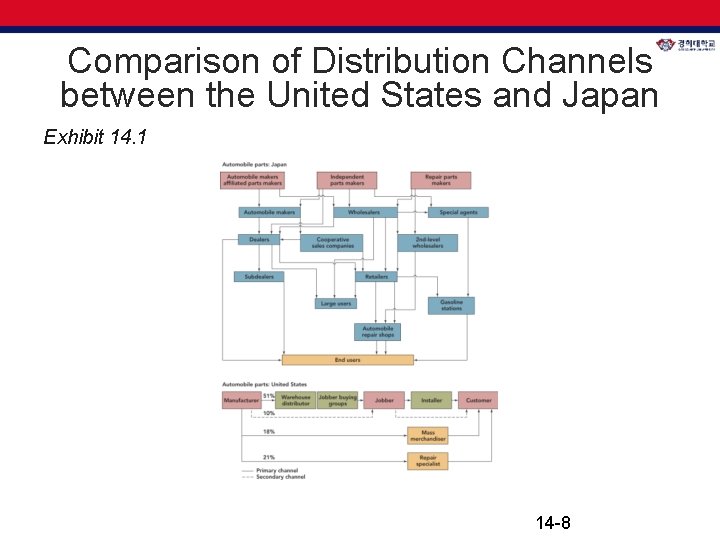
Comparison of Distribution Channels between the United States and Japan Exhibit 14. 1 14 -8
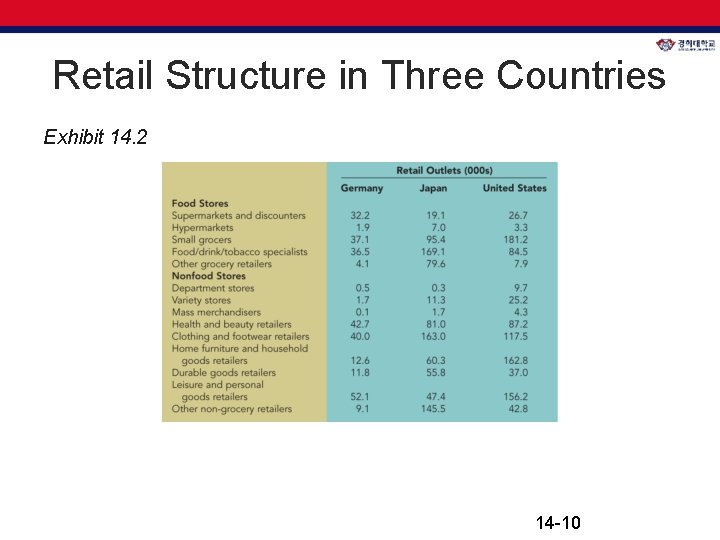
High Density of Middlemen • Not unusual for consumer goods to go through three or four intermediaries before reaching the consumer • Japan has a large number of independent groceries and bakers (94. 7% or all retail stores) – Small stores account for 59. 1% of retail food sales • U. S. emphasis is on supermarkets, discount food stores, and department stores – Small stores generate 35. 7% of food sales 14 -9
Retail Structure in Three Countries Exhibit 14. 2 14 -10
Channel Control • Inventory financing • Cumulative rebates • Merchandise returns • Promotional support 14 -11
Business Philosophy • Emphasizes loyalty, harmony, and friendship • Supports long-term dealer-supplier relationships • The cost of Japanese consumer goods are among the highest in the world • Japanese law gives the small retailer enormous advantage over the development of larger stores 14 -12
Large-Scale Retail Store Law and Its Successor • Daitenho – the Large-Scale Retail Store Law – Large stores must have approval from the prefecture government – All proposals first judged by the Ministry of International Trade and Industry (MITI) – If all local retailers unanimously agreed, the plan was approved – Could be a lengthy process – Applied to both domestic and foreign companies • Replaced by the Large-Scale Retail Store Location Act of June 2000 – MITI out of the process – Relaxed restrictions 14 -13
Changes in the Japanese Distribution System • Structural Impediments Initiative • Deregulation • Wal-Mart • “New” retailers • The Internet 14 -14
Trends: From Traditional to Modern Channel Structures • European retailers merging with former competitors and other countries to form Europe-wide enterprises • Foreign retailers attracted by high margins and prices • The Internet may be most important distribution trend • Covisint • Global. Net. Xchange • E-commerce • 7 -Eleven competes with Fed. Ex and UPS 14 -15
General Distribution Patterns • Middlemen services • Costs and margins • Channel length • Power and competition 14 -16
Retail Distribution Patterns • Size patterns • Direct marketing • Resistance to change 14 -17
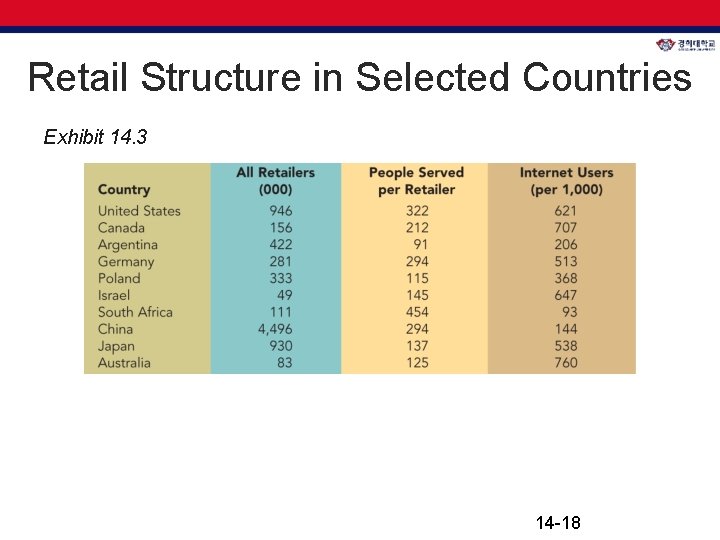
Retail Structure in Selected Countries Exhibit 14. 3 14 -18
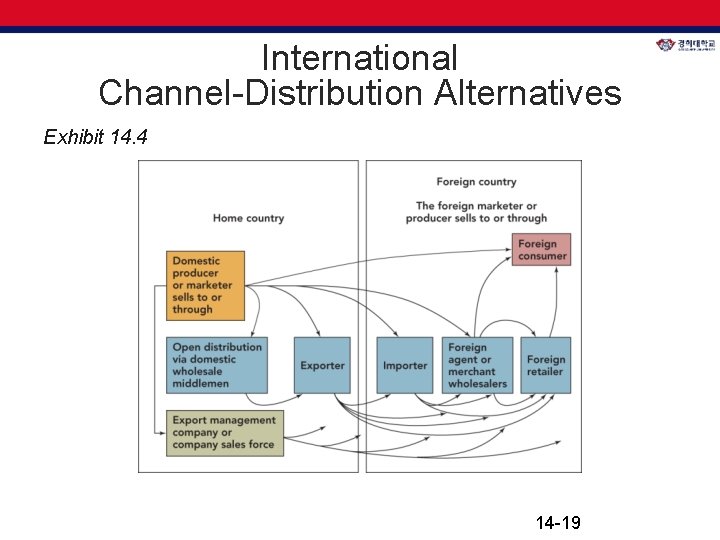
International Channel-Distribution Alternatives Exhibit 14. 4 14 -19
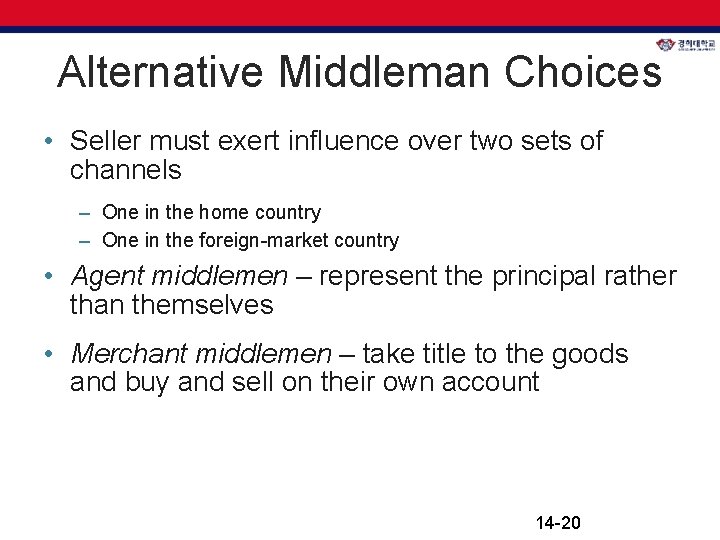
Alternative Middleman Choices • Seller must exert influence over two sets of channels – One in the home country – One in the foreign-market country • Agent middlemen – represent the principal rather than themselves • Merchant middlemen – take title to the goods and buy and sell on their own account 14 -20
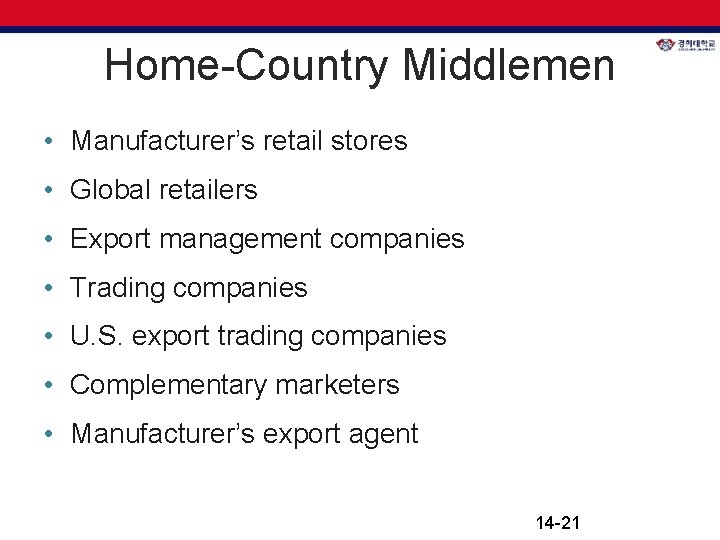
Home-Country Middlemen • Manufacturer’s retail stores • Global retailers • Export management companies • Trading companies • U. S. export trading companies • Complementary marketers • Manufacturer’s export agent 14 -21
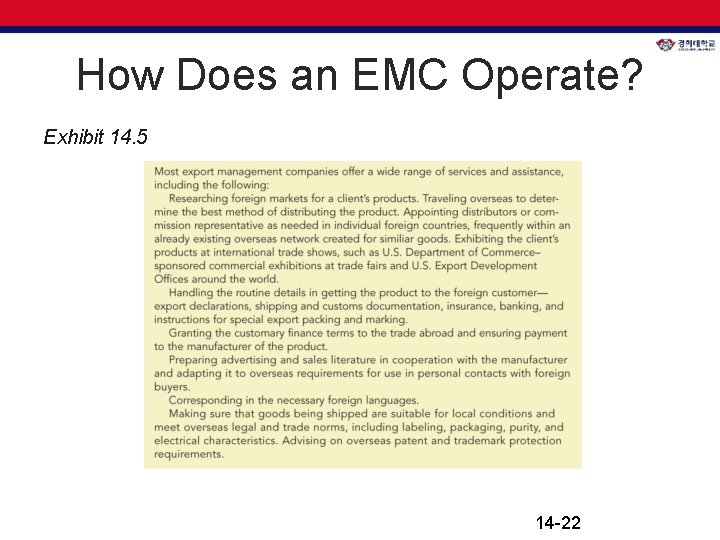
How Does an EMC Operate? Exhibit 14. 5 14 -22
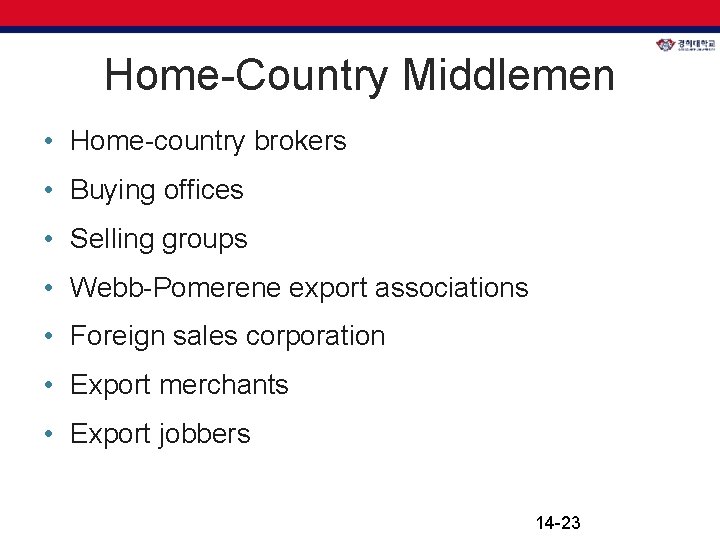
Home-Country Middlemen • Home-country brokers • Buying offices • Selling groups • Webb-Pomerene export associations • Foreign sales corporation • Export merchants • Export jobbers 14 -23
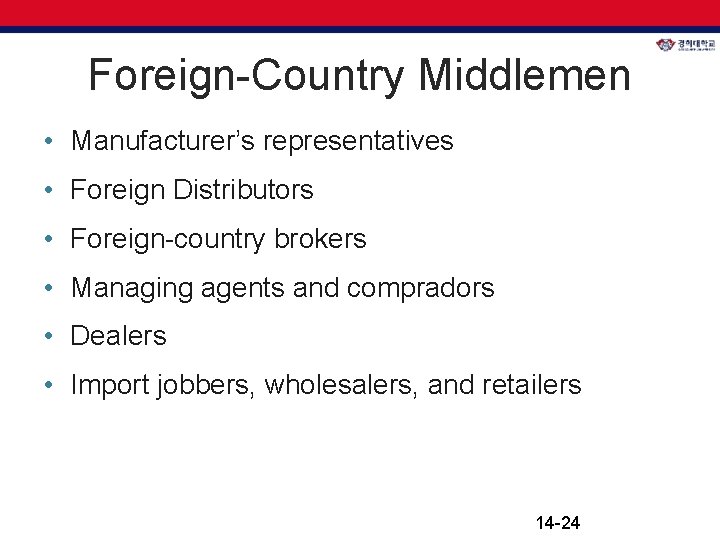
Foreign-Country Middlemen • Manufacturer’s representatives • Foreign Distributors • Foreign-country brokers • Managing agents and compradors • Dealers • Import jobbers, wholesalers, and retailers 14 -24
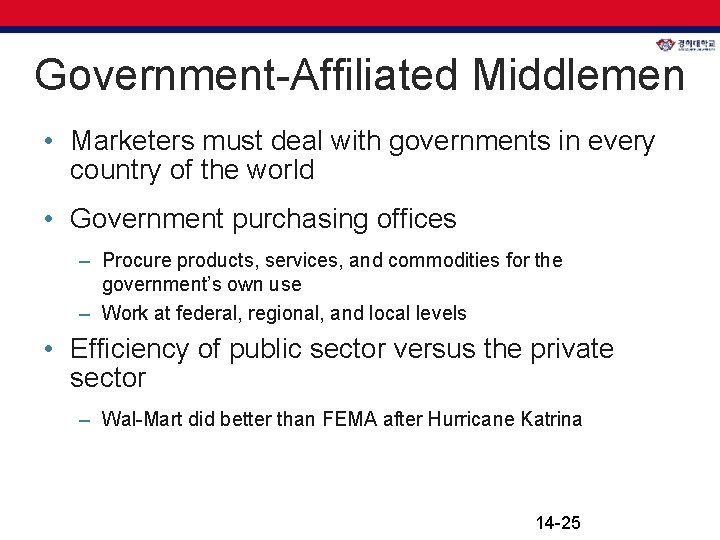
Government-Affiliated Middlemen • Marketers must deal with governments in every country of the world • Government purchasing offices – Procure products, services, and commodities for the government’s own use – Work at federal, regional, and local levels • Efficiency of public sector versus the private sector – Wal-Mart did better than FEMA after Hurricane Katrina 14 -25
Factors Affecting Choice of Channels • Cost • Capital requirements • Control • Coverage • Character • Continuity 14 -26
Locating, Selecting, and Motivating Channel Members • Locating middlemen • Selecting middlemen – Screening – The agreement • Motivating middlemen • Terminating middlemen • Controlling middlemen 14 -27
The Internet • E-commerce – Business-to-business (BSB) services – Consumer and industrial products • E-commerce is more developed in U. S. than in rest of world • B 2 B enables companies to cut costs – Reduces procurement costs – Allows better supply-chain management – Makes possible tighter inventory control 14 -28
Concerns for e-Vendors • Culture • Adaptation • Local contact • Payment • Delivery • Promotion 14 -29
Summary • The international marketer has a broad range of alternatives for developing a distribution system • Three primary alternatives for using agent middlemen – Agent middlemen – Merchant middlemen – Government-affiliated middlemen • Channel structure varies – Nation to nation – Continent to continent • Information and advice are available relative to the structuring of international distribution systems • The Internet is challenging traditional channels, offering a wider range of possibilities for entering foreign markets 14 -30