
INTERNATIONAL LAW BY DR SURENDRA SINGH M A
INTERNATIONAL LAW BY DR. SURENDRA SINGH M. A. , LL. M. , PGDADR, Ph. D. (LAW) UGC NET(LAW), U. P. SLET(LAW), RAJASTHAN SLET (LAW) CONTACT NO: 9990736929 E MAIL: surendra_67@yahoo. co. in 1
UNIT-1 BACKGROUND TO INTERNATIONAL LAW • The expression `International Law’ and `Law of Nations’ are synonymous and are equivalent terms. The former was introduced by Bentham in the year 1780. Prior to it, International law was known as Law of Nations. There are two approaches to the International Law: 1. Traditional and 2. Modern 2
• The Traditional approach holds that International law is composed solely of rules governing the relations between the states only. This approach, therefore, restricts the domain of the International law. • The Modern approach – During the past six decades, international law has expanded the horizon which not only covers instances of regulation of the conduct of the states inter se but also covers fields of regulation of conduct of international organization and individual. The dynamics of international law has grown to such an enormous extent that international law has acquired completely new dimensions. • Historical Development of IL 3
Definition of International Law Most of the classical jurists laid down that – International law regulates the relations of states with one another and therefore, has defined the term in this sense only. • According To L. Oppenheim “Law of nations or international law is the name of the body of the customary and conventional rules which are considered legally binding by civilized states in their intercourse with each other. ” This definition contains three important elements – 4
• Firstly, international law consists of a body of rules governing the relations between states. By the term relation, is meant that official intercourse which is maintained by states through their foreign officers or Department of External Affairs. • Secondly, state regards these rules as being binding on them in their relations with one another. • Thirdly, such rules are derived from customs and treaties. 5
• The above definition was given by Oppenheim in 1905. Due to the drastic changes that have taken place in the concept of international law during the last century; this definition has become too narrow. It does not stand correct at the present day international law. The editors of the Ninth addition of Oppenheim book Sir Robert Jennings & Arthur Watts have revised Oppenheim’s definition as follows: 6
• “International Law is the body of rules which are legally binding on the States in their intercourse with each other. These rules are primarily those which govern the relations of state, but states are not the only subjects of international law. International organizations and to some extent also individuals may be subjects of rights conferred and duty imposed by International Law. ” • The above definition is wider than the earlier one in the sense that it states that international organizations and individuals are also the subjects of international law. 7
Starke’s definition • Starke’s definition of international law is similar to the new definition of L. Oppenheim in scope. He lays down that international law is – • “That body of law which is composed for its greater part of the principles of rules of conduct which states feel themselves bound to observe and therefore, do commonly observe in their relations with each other and which includes also : 1. The rules of law relating to the functioning of international institutions or organization, their relations, with each other, and their relations with states and individuals. 2. Certain rules of law relating to individuals and non state entities so far as rights and duties of such individuals and non state entities are the concern of international communities. ” • The definition of Starke is appropriate because it takes into account the changing character of international law and truly reflects the present position of international law. 8
• On the basis of above analyzed definitions, we may conclude that international law is a body of rules and principles which regulate the conduct and relations of the members of international community. The contention that states alone are the subject matter of international law is not only inconsistent with the changing character of international law but has become completely obsolete and inadequate. Individualistic character of international law is being replaced by the law of social inter dependence. 9
NATURE OF INTERNATIONAL LAW What is the nature of international law? Whether it is true law or not? Or International law is the vanishing point of jurisprudence. Holland Elucidate. Or International law is a weak law. J. G. Starke. Do you agree with the view? Comment. John Austin – was a strong critic of international law and he is of the view that international law is not a true law. Austin’s supposition to international law stems from his definition of law. ACC to Austin – Law properly so called is the command of Sovereign backed by a superior political authority. Austin called such commands as positive law which he regarded as the appropriate matter of jurisprudence. If the concerned rules were not issued by the sovereign authority then they cannot be legal rules. 10
According to this test, rules of international law do not qualify as rules of positive law. Austin categorized them as laws improperly so called. Due to inability of international law to satisfy this test, Austin described international law positive international morality or positive morality which consists of opinions or sentiments current among nations generally. It is analogous to the rules binding the members of a club or a society. • Other supporters of this view were Bentham, Hobbes; Pufendorf also questioned the legal character of international law and termed it as merely moral ethical rules. 11
• Thomas Holland – Like Austin, he also denies the legal character of International law and calls it as the vanishing point of jurisprudence. He observes that rules of International law are followed by courtesy. The rules of International law are in reality no more than the Moral code for nations. • However, the historical school of jurisprudence has discounted Austin’s theory of law by stating that he disregarded law in its various phases of development. (Maine) 12
• Austin’s views do not apply to Modern International law as its binding force cannot be doubted. Even in the absence of any centralized legislative authority, a substantial amount of International legislations in the form of treaties and conventions has come into existence. Further, the states consider themselves bound by it as members of international society irrespective of their individual will. 13
• Although not blurring/mingling the legal force of International law, it has been termed as Weak law by J. G. Starke because it lacks sanctions, Sovereignty and the effective mechanism to deal with the disputes. Further, he has observed that the roots of International law suffer from great uncertainty. International law can not intervene in the matters within the domestic jurisdiction of the States and it has failed to maintain order and peace at global footprint. 14
• The arguments of lack of sanctions or in effective sanctions and non enforceability of International law has been countered by pointing out Ch VII (enforcement action) of UN Charter which endorses sanctions for any violation of the rules of International law enshrined in the charter and is supported by Art. 94 of the charter. 15
Conclusion • It is true that International law is not as effective as national law nevertheless it is wrong to assert that the role of International law in most of the cases is negligible. It is also wrong to say that to maintain peace and order at global footprint is the only purpose of International law. Therefore, in the light of the arguments forwarded by the International jurists for and against, in spite of the suggested lacking, it is respectfully submitted that in this era of globalization International law sometimes plays comparatively more effective role for various issues relating to the nations in comparison of the municipal/national law. Thus, International law appears to assume the true and legal character. 16
Basis of International Law As regards true basis of International Law, there are two main theories. 1. Theories as to Law of Nature 2. Positivism Theory 1. Theories as to Law of Nature: The jurists who adhere to this theory, are of the view that international law is a part of the law of nature. In their view, States follow International Law, because it is a part of the law of nature. Explaining the view point of natural law Theorists, Starke has written: “…… States submitted to International Law because their relations were regulated by higher law, ‘the law of nature’ of which international law was but a part. ” In order to understand this theory, it is necessary to understand the meaning of `Law of Nature’. 17
In the beginning the law of nature was connected with religion. It was regarded as the divine law. The jurist of 16 th and 17 th centuries secularized the concept of law of nature. Much of the credit for this goes to eminent jurist Grotius. He expounded the secularized concept of the Law of Nature. According to him, natural Law was the `dictate of right reason’. His followers applied the Law of Nature as an ideal Law which was founded on the nature of man as a reasonable being. International Law was considered binding because it was, in fact, natural law was applied in special circumstances. Vattel, a famous jurist of 18 th century also expressed the view that natural law was the basis of the International Law. Pufendorf, Christian Thomasius etc. are other prominent exponent of Law of Nature. 18
2. Positivism: • Positivism is based on the positivum i. e. Law which is in fact as contrasted with the Law which ought to be. According to the positivists, Law enacted by the appropriate legislative authority is binding. The positivists base their views on the actual practice of the States. In their view, treaties and customs are the main sources of International Law. The positivist’s view was in vogue in the eighteenth century. In view of the positivists, in the ultimate analysis will of the States is main source of International Law. As pointed by Starke, “International Law can in logic be reduced to a system of rules depending for their validity only on the fact that States have consented to them. As pointed by Brierly, “the doctrine of positivism teaches that international law is the sum of rules by which states have consented to be bound and that nothing can be law to which they have not consented to be bound”. 19
• The concept of the will of the State was first propounded by the German philosopher Hegel. According to the positivists, international law is a body of rules which has been consented to by the States and accepted as binding by way of voluntary restriction or auto –limitation. ’ The Italian jurist, Anzilotti, one of the chief exponents of the Positivist School deserves a special mention. According to him, the binding force of international law is founded on a supreme principle or norm known, as pacta sunt servanda in some or the other way. The positivist admits that their view fails to explain the basis of customary international law. In their view, there is an implied consent in regard to customary rules of international law. 20
True basis of international Law In the modern period no State can keep itself aloof from the affairs of the world. The means of transport and communication and other scientific inventions have brought the States of World closer to each other. The practices of States are, therefore, of great significance. As pointed out, the positivists have greatly encouraged the realistic outlook in international law have thus rendered a signal service. However no specific theory is capable of explaining the true basis of International Law. Indeed no single theory has received general agreement and sanctions. It appears as though there as many theories as there are scholars. 21
According to Sir Cecil Hurst, no State can escape from the influence of international law. He has rightly pointed out: “International law is in fact binding on States because they are States. ” Thus States obey international law because they are States obey international law because it is in their interest to do so. “ The ultimate explanation of the binding force of all law is that man, whether he is single, individual or whether he is associated with other men in a State, is constrained in so far as he is reasonable being, to believe that order and not chaos is the governing principles of the world in which he has to live”. 22
Subjects of International Law • Any entity which possesses International personality is called an international person or a subject of International law. Possession of International personality is therefore, the determining factor in deciding as to which entities are the subjects of International law. An entity may be deemed to possess International personality if it is capable of possessing international rights and duties and having the capacity to maintain its rights by bringing international claims. 23
• Generally, international law deals with the rights and duties of the states. This does not however, mean that other entities or individuals are outside the scope of International law applies upon individual and certain non state entities in addition to states in certain circumstances. • Views of jurists differ on the question as to what entities are deemed to be subjects of International law. The difference of opinion has led to the emergence of three popular theories. 24
(1) Realist Theory • ACC to this view states only are subjects of International law as states alone are the bearers of right and obligations under International law. Whereas individuals lack any juridical personality because they possess neither rights nor duties under International law. If they have any rights at all, that can be claimed only through the states. This is traditional concept of International law. Wherein states alone, as sovereign political entities, were regarded as the subjects of International law. • The above view has been criticized mainly by modern International law jurists on the ground that certain rights and obligations have been endowed to entities other than states by the rules of International law and therefore, they also possess International personality. • To say, that states only are the subjects of International law is no longer tenable. Moreover, the expansion of International law into economic and social welfare has stimulated an increasing number of participants in the international legal order. The theory is, therefore, stands inadequate. 25
(2) Fictional theory • This theory is opposite to realist theory. Acc to it, individuals only are the subjects of International law like municipal law. It is so because states do not have soul and they have no capacity to form and express an autonomous will. They are abstract structures acting through individuals. • Kelsen is of the view that rules of Municipal law as well as those of International law are meant for human beings. While the former is binding on them directly, the later is binding indirectly, that is, through states. The theory is based on a fiction that duties and rights of the states are only the duties and rights of human beings who have composed that, and therefore, ultimately individuals are the subjects of International law. • Kelsen’s views appear to be logically sound. But so far as the practice of the states is concerned, it is seen that the primary concern of the International law is with the rights and duties of the states. 26
(3) Functional Theory • The supporters of the functional theory adhere not only on any one suggestion or recommendation of the earlier two theories. They opined that the proper subject matter of International law are not only the states but International organizations, international entities and individuals as well. • Therefore, in the present context, it may be rightly submitted that the approach of the supporters of functional theory relating to the subjects of International law is more close and accurate. 27
Place of Individual in International Law • Individuals are also treated as subjects of International law, although they enjoy lesser rights than states. Under International law, some of the provisions of the International law under which rights have been conferred upon individuals and obligation that have been imposed upon them are as follows: 28
• (1) Pirates under International law pirates are treated as enemies of mankind. Hence, every state is entitled to apprehend them and punish them. • (2) Harmful acts of individuals – For the amicable and cordial relations of the states, it is necessary that the individuals should not be involved in such acts as may prove detrimental for the good relations among states. Therefore, under International law there are several such provisions which provide that the person who commit such crime, may be punished. • (3) Foreigners – To some extent, International law also regulates the conduct of the foreigners. Acc. to International law, it is the duty of each state to give them those rights which it confers upon its own citizens. • (4) War Criminals – War criminals can be punished under International law. • (5) Espionage – Espionage is a crime under International law. Hence, when the spies are apprehended, they may be punished. 29
• (6) Under some treaties, individuals have been conferred upon some rights whereby, they can claim compensation or damages against the states. • The Treaty of Versailles 1919 provided under Art. 297 that any individual can file suit against Germany for compensation. • (7) The UN Charter has also given a place of importance of the rights of individuals. The preamble of UN Charter began with the word `peoples of the UN’. • (8) Beside the above mentioned examples, some very important steps have been taken in respect of rights of individuals under International law now confers rights not only mediate but immediate. • (9) The International convention of civil and political rights, 1966 and the optional protocol confer rights directly upon the individuals. • To conclude states are becoming increasingly realistic in acknowledging the position of individuals in International law. 30
Relation between International law and Municipal law • International law primarily deals with states whereas the municipal law deals with individuals and corporate entities. But in modern era, International law also applies to individuals and hence the conflict. The conflict is that which law will hold primacy International law or municipal law? • Human rights are a prime subject of conflicts. What happens International law and municipal law say different things on the same point. • It is the law of the nations that applies among nations. Whereas municipal law is applied within a state to the individuals and other entities which are bearers of rights and duties. • Apparently, it seems that there is no conflict as they operate in two different legal systems but it is not the truth. There may be differences between International law and municipal law in one case and in other case, there may not be difference. 31
• In those cases, where there is conflict between I/L and M/L, the question arises, whether I/L and M/L should be considered prime? • If the conflict arises before a municipal court, then the answer generally depends on how far constitutional law of a state allows application of I/L. For Example- Diplomatic immunity granted by I/L will be useless, If they are not recognized by M/L. I/L can not work without co operation and support of national legal system. The question of relationship between the two laws has acquired importance in modern I/L because a large part of I/L is now directly concerned with the activities before M/L. In above, generalization has necessitated to ascertain the relationship of the two systems of law of the primacy of the two laws when they contradict to each other. The views of jurists on the question of relationship of I/L and M/L are divergent which have led to the emergence of prominently two main theories : (1) Monistic Theory – the exponent of this theory are two German Scholars mainly Moser and Mortens. Acc. to this theory, I/L and M/L are simply two components of single body of knowledge called Law. They do not find any basic difference between I/L and M/L. The views expressed by the exponents of this theory are, however, in favour of I/L in case any conflict between the two arises. 32
(2) Dualistic Theory – The exponent of this theory is also German Scholar namely Triepel. Acc. to supporters of this theory, I/L and M/L both are existed on separate planes. I/L governs International relations between the states. Whereas M/L govern the relations between individuals and between the individuals and the state. Starke is one of the supporter of this theory. • Further, the supporters of this theory clearly demarcate the differences between I/L and M/L in relation to sources, subjects, substance of law, various legal principles and the dynamism of the subject matter. • Anzilotti is of the opinion that both I/L and M/L operate so distinctly in two independent spheres that no conflict between these two is possible. 33
Difference between I/L and M/L (1) I/L deals with relationship between state and state whereas M/L deals with relationship between individual and the state. (2) I/L is the product of custom, International treaties, conventions, and general principles of law. Whereas M/L is the product of legislature of a particular state. (3) I/L is administered through ICJ and the decisions of ICJ are binding only to the concerned parties whereas M/L is administered through municipal courts and the decision of municipal courts are binding to all irrespective of being a party to the suit or not. (4) I/L is being followed by the nations on the basis of pacta sunt servanda whereas M/L is being followed by the individuals of a particular state due to the inter alia prescribed penalties/punishments in the municipal statutes. 34
Sources of International law • The term source refers to methods or procedures by which International law is created. The sources of International law may be classified into 5 categories : 1. International conventions or Treaties 2. International Customs 3. General principles of law – recognized by civilized nations. 4. Decisions of judicial or arbitral tribunals and juristic works. 5. Decisions or determination of the organs of international institutions. • The above mentioned 3 rd source general principles of law recognized by civilized nations was first mentioned in Art. 38 of the statute of the permanent court of Intl. justice. It was retained in Art. 38 of the statutes of the international court of justice which mentions the following sources of International law; 35
• 1. International conventions/Treaties 2. International Customs 3. General principles of law recognized by civilized nations 4. Judicial decisions or the teachings of the most highly qualified publicists of the various countries as subsidiary means for the determination of rules of law. The above mentioned 5 th source i. e. , Decisions or Determination of the organs of international institutions does not find mention in Art. 38 of the statute of the court but it has now become well recognized source. 36
• Art. 38 lays down the hierarchy of the sources of International law for the courts. In a particular dispute before the Court, its search for relevant rules first take into the treaties which are expressly recognized by the parties, custom or to general practice accepted as law by states or to general principles of law/ recognized by states. If the conventions, practice and principles are not found relevant or clear, the court may resort to judicial decisions or the teachings of the most highly qualified publicists as subsidiary means for the determination of rules of law and also to the decisions of the international organs. In order to avoid, a situation of non-liquet, i. e. no law exists or law is silent on the issue, Art. 38 Para 2 empowers the court to decide a case ex aqua et bono if the parties agree thereto (a roman maxim which means what is just and good). 37
(a) International Conventions and Treaties • In the modern period, international treaties are the most important source of law because states have found in this source a deliberate method which creates binding International law Art. 38(1)(a) of the statute of the ICJ lays down that the court while deciding any dispute shall apply international convention, whether general or particular, establishing rules expressly recognized by the Contesting states, in preference to other sources of International law. Treaties therefore have acquired a dominant importance in International law. General and Particular Treaty – • ICJ in accordance with Art. 38 of the statute applies general as well as particular treaties when a dispute is brought before it. • General treaties are those where in most of the states of the world community are parties and which are opened to accession by others. They in course of time, crystallize into rules of international universal law which are binding on all the member states of the world community, be they parties to them or not. 38
• General treaties may also be called law making treaties which create general norms for the future conduct of the parties in term of legal propositions and obligations. Eg. Of such treaties are : Vienna Convention, Hague Convention and Geneva Protocol, etc. • Particular Treaties – are generally referred to bi lateral treaties. Also called contractual type of treaties. The difference between general and particular treaty is that : P/T is binding only on the parties of that treaty. Whereas G/T are general law making treaties which are binding on every state whether it is a party or not. • Particular treaty has higher value than that of universal treaty i. e. Particular Treaty is higher in authenticity. 39
• (b) International Custom • International custom has been regarded as one of the prominent sources of International law for a long time. It is the oldest and original source of International as well as of law general. Though, its importance has lessened in the modern times due to the increasing use of treaties and convention as a law creating method but it still remain a vital source of International law. Customary rule of International law are the rules which have been developed in a long process of historical development. • Art. 38(b) of the statute of ICJ recognizes international custom, as evidence of general practice accepted as law as one of the sources of International law. Customary rule of International law may be defined as a rule which the community of states has long recognized as a right rule of conduct and which has the force of law. In the Asylum case, Columbia v/s Peru (1950) the ICJ described custom as a constant and uniform usage accepted as law. 40
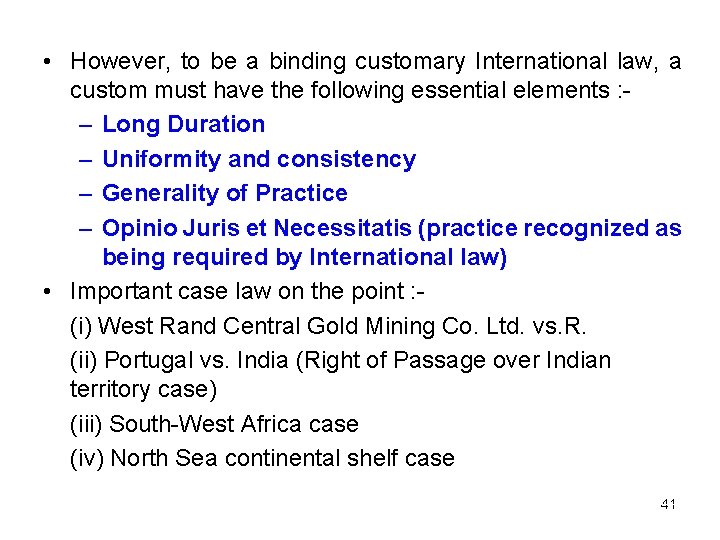
• However, to be a binding customary International law, a custom must have the following essential elements : – Long Duration – Uniformity and consistency – Generality of Practice – Opinio Juris et Necessitatis (practice recognized as being required by International law) • Important case law on the point : (i) West Rand Central Gold Mining Co. Ltd. vs. R. (ii) Portugal vs. India (Right of Passage over Indian territory case) (iii) South West Africa case (iv) North Sea continental shelf case 41
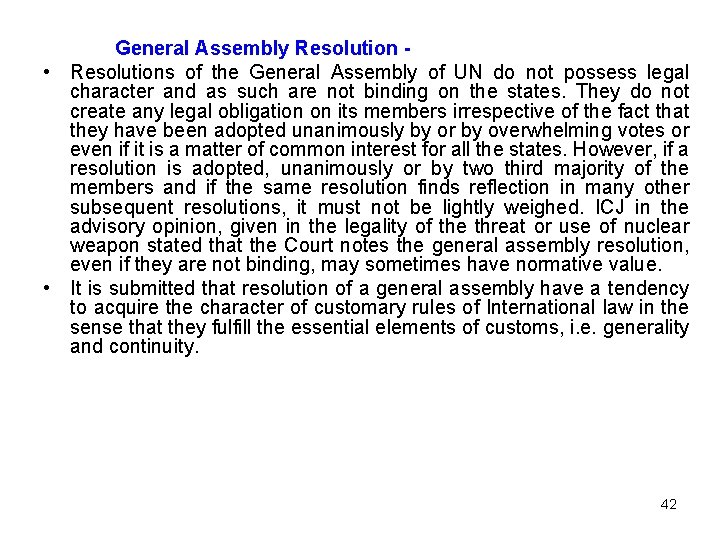
General Assembly Resolution - • Resolutions of the General Assembly of UN do not possess legal character and as such are not binding on the states. They do not create any legal obligation on its members irrespective of the fact that they have been adopted unanimously by or by overwhelming votes or even if it is a matter of common interest for all the states. However, if a resolution is adopted, unanimously or by two third majority of the members and if the same resolution finds reflection in many other subsequent resolutions, it must not be lightly weighed. ICJ in the advisory opinion, given in the legality of the threat or use of nuclear weapon stated that the Court notes the general assembly resolution, even if they are not binding, may sometimes have normative value. • It is submitted that resolution of a general assembly have a tendency to acquire the character of customary rules of International law in the sense that they fulfill the essential elements of customs, i. e. generality and continuity. 42
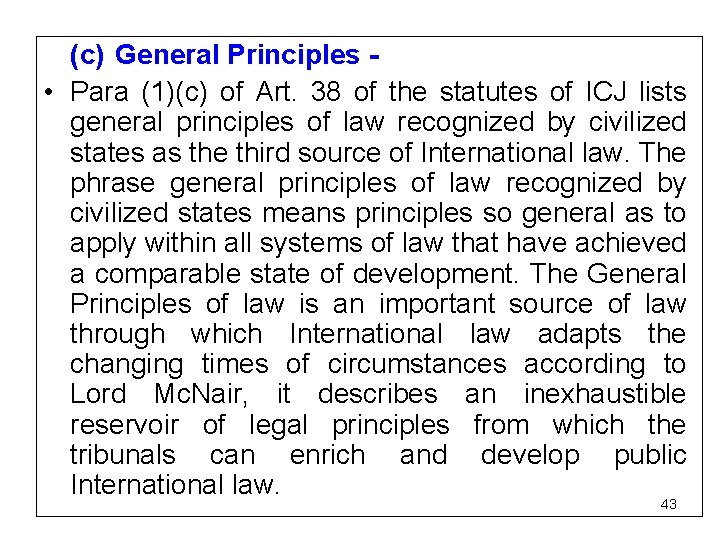
(c) General Principles • Para (1)(c) of Art. 38 of the statutes of ICJ lists general principles of law recognized by civilized states as the third source of International law. The phrase general principles of law recognized by civilized states means principles so general as to apply within all systems of law that have achieved a comparable state of development. The General Principles of law is an important source of law through which International law adapts the changing times of circumstances according to Lord Mc. Nair, it describes an inexhaustible reservoir of legal principles from which the tribunals can enrich and develop public International law. 43
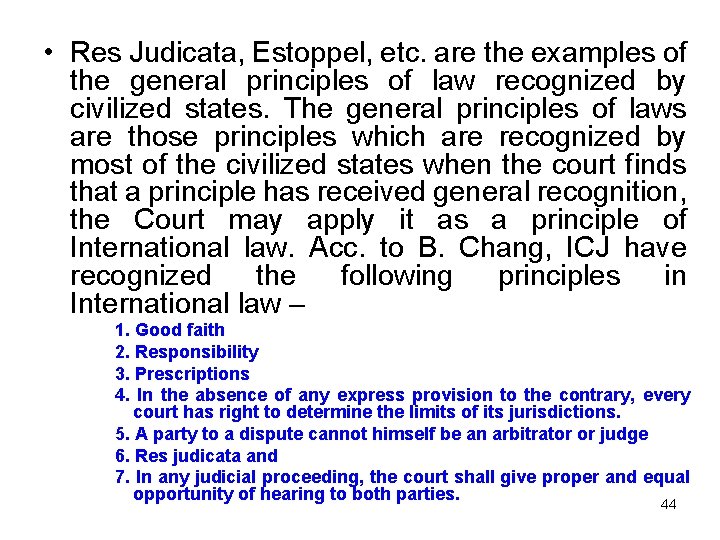
• Res Judicata, Estoppel, etc. are the examples of the general principles of law recognized by civilized states. The general principles of laws are those principles which are recognized by most of the civilized states when the court finds that a principle has received general recognition, the Court may apply it as a principle of International law. Acc. to B. Chang, ICJ have recognized the following principles in International law – 1. Good faith 2. Responsibility 3. Prescriptions 4. In the absence of any express provision to the contrary, every court has right to determine the limits of its jurisdictions. 5. A party to a dispute cannot himself be an arbitrator or judge 6. Res judicata and 7. In any judicial proceeding, the court shall give proper and equal opportunity of hearing to both parties. 44
Status of general principles of law – • The question arises whether general principles of law are a distinct source of International law. If a given principle affirmed constantly in International judicial decisions and accepted in the practice of states, it acquires the status of custom. It matters little if the principle has been originally borrowed from the municipal law. Such a principle becomes part of International law by the normal operation of the sources of that system. The question of the status of general principles of law which assumes importance is in relation to those principles which are not part of customary or conventional law. • The correct view is that the general principles of law are a primary source of International law because these are valid through all kinds of human societies. These principles are established by a process of reasoning, based on the common identity of all legal system. 45
(d) Determination of Judicial and Arbitral Tribunals • Acc. to Art. 38 of ICJ, the decisions of the judicial and Arbitral Tribunals are subsidiary means for the determination of the rules of law. This source includes international as well as state decisions. As regards the decisions of ICJ, Art. 59 of the Statute of ICJ, provides that they have no binding force except between the parties and in respect of that particular case. • Since the doctrine of precedent does not apply in the field of International law, the international judicial decisions are not generally binding. They are regarded as subsidiary means for the determination of the rules of International law. 46
Juristic Works/Juristic Writings • The opinions of jurists are also regarded as subsidiary means for the determination of Rules of International law. While deciding the case, if the court does not finds any treaty or judicial decision or legislative acts or any established custom, the courts may take the help of opinion of jurists as subsidiary means for determination of rules of International law. 47
(e) Decisions or determinations of the organs of International Institutions • In the modern age, the decision of organs of international institutions are also treated as sources of International law. In view of the constant changes in the form of contents of International law, international organizations have also become a subject of International law. The decision or determinations of the organs of International institutions are also therefore, regarded as source of International law because they help in the development of customary rules of International law. 48
(f) Other Sources • The following are some of the other subsidiary sources of International law. • (i) International Comity – The mutual relations of nations are based on the principle of comity. In other words, when a state behaves in a particular way with other states, the later have also to behave in the same way. This practice has generally a normal binding force between states. • (ii) State papers – In the modern period, almost all the civilized states have diplomatic relations with each other. They send letters to each other in respect of matters of mutual interest. These letters are sometimes published. A study of these letters reveals that certain principles are reportedly followed by states in their mutual inter course and sometimes these state papers help in the solution of a conflict. 49

• (iii) State guidance for their officers – It is mostly seen that a no. of matters of the Govts. of respective states are resolved on the advice of their legal advisor. These advices are also therefore, sometimes treated as sources of International law. • (iv) Reasons It has occupied a special position in all the ages in resolving the national as well as international conflicts. It has performed a special role in development of International law. • (v) Equity and Justice – There is the general principle of law inherent in every legal system that in case of absence of any legal, statutory or customary provision of law, the disputes may finally be decided on the basis of equity, justice and good conscience. It is equally applicable at international scenario. 50
• Though rules of equity do not form part of International law and they are not source of International law, but many rules which formerly were the rules of equity have transformed into customary rules with the passage of time. • The concept of equity has been referred to in several cases. For instance, in the Rann of Kutch arbitration between India and Pakistan in 1968, the tribunal agreed that equity formed part of International law and that accordingly the parties could rely on such principles in the presentation of their cases. 51
• NATIONALITY • Definition and Meaning: "Nationality may be defined as the bond which unites a person to a given State which constitutes his membership in the particular State, which gives him a claim to the protection of that State and which subjects him to the obligation created by the laws of that State". In the famous case of Re Lynch, the British Mexican Claims Commission defined the term "Nationality" in the following words: "A man's nationality forms a continuing state of things and not a physical fact which occurs at a particular moment. A man's nationality is a continuing legal relationship between the sovereign State on the one hand the citizen on the other. The fundamental basis of a man's nationality is membership of an independent political community. 52
• Development of the Law of Nationality and its Importance: The rules of nationality are determined by State law. But due to the lack of uniformity in State laws in regard to the nationality, many difficulties were experienced. Consequently, difficult problems of statelessness, double nationality, etc. arose. In this connection, an attempt was made to resolve the problems relating to nationality and statelessness. Besides this, Convention of the Nationality of Married Women was adopted in 1957. Last but not least, Convention on the Reduction of Statelessness was adopted in 1961. 53

• International Importance of Nationality: Nationality is often determined by State laws. "Nationality is the principal link between an individual and International Law. " • As pointed out by Starke, the laws relating to nationality have following points of importance under International law: • 1) The protection rights of diplomatic of agents the consequence as of nationality. • 2) to commit such harmful acts as might affect other States, then that State shall be responsible for the acts committed by such a person. • 3) nationality. By nationality we may mean loyalty towards particular State. • 4) compelled to do military service for the State. ality of effect Another • 5) its own nationals. • 6) enemy character is determined on the basis of nationality. ther ters frequently criminal and State • exercises jurisdiction 7) in over the persons of their nationality. 54
• In a number of cases, the Permanent Court of International Justice has held that State may by agreement take matters, such as nationality, out of domestic jurisdiction and make them of international concern and subject to international jurisdiction. • Modes of Acquisition of Nationality: Following are the modes of acquisition of nationality _ • 1) By Birth. A person acquires nationality of the State where he is born. He also acquires the nationality of his parents at the time of his birth. • 2) Naturalization: when a person living in a foreign State for a long time acquires the citizenship of that Sate. In Nottebohm case, International Court of Justice held that in respect of grant of nationality there is no obligation of the States if that man has no relationship with the State of Naturalization. In this case, the court applied the principle of effective nationality. • 3) By Resumption: Sometimes it so happens that a person may lose his nationality because of certain reasons. Subsequently, he may resume his nationality after fulfilling certain conditions. • 4) citizens acquire the nationality of the conquering State. • 5) Cession: When a State has ceded to another State, all the people of the territory acquire nationality of the State in which their territory has been merged. 55
• There may be some other modes also. For example, if a person is appointed in the public service of another State, he acquires the nationality of that State. • Loss of Nationality: Following are the modes of loss of nationality • 1) By Release: In some States law provides that the citizens may lose nationality by release. In the loss of nationality by release it is necessary to submit an application for the same. If the application is accepted, the person concerned is released from the nationality of the State concerned. • 2) the national of that State without seeking prior permission of the government obtains employment in another State, he will be deprived of his nationality. • Long 3) Residence Abroad: another Yet loss of the mode of nationality is the long residence abroad. State laws of many States contain provisions in this connection that if a person resides for a long period abroad, his nationality ends. 56
• Double Nationality and Nationality of Married Women: A situation often arises when a person possesses nationality of more than one State. For example, a woman, who after her marriage acquires the nationality of her husband, may continue to possess her original nationality. Double nationality may also be acquired by birth such as by the parents who are at the time of birth in a Foreign State. Treaties may provide that persons may by their will select their nationality. • Statelessness: Sometimes it so happens that a person does not possess the nationality of any State. Such a state is referred to as the state of Statelessness. At present this is one of the burning problems and an individual cannot exercise the rights conferred upon him by international law. In Stoeck v. The Public Trustee, 1921 it was held that if a person is not a citizen of any State, he will be called Stateless. 57
• DIPLOMATIC AGENTS • Diplomatic Agents are the persons who reside in a foreign country as representative of the state by which they are sent. They provide an important link between the countries and are accredited. They are, therefore, experts in the act of diplomacy which in IL means the methods by which States establish or maintain mutual relations and carry out political or legal transactions based on their foreign policies, Diplomacy may be performed by the head of the state, by the government, minister of foreign relations, delegations of international conferences and missions of international organizations and by diplomatic agents. • Thus, practice of sending and receiving diplomatic agents by states has been followed since ancient times. One can find the practice when 'doots' were sent from one rajya to another rajya. They were sent to other states for some specific purpose and when the purpose was fulfilled they used to come back to their own states. 58
• The practice of sending of diplomatic agents started from the seventeenth century. The Congress of Vienna of 1815 for the first time codified the customary rules of International Law with regard in diplomatic representatives. But that was not the end. The institution of diplomatic agents continued to develop even after 1815. After the establishment of UN the task for codifying the law relating to diplomatic agents was given to the International Law Commission and in 1961 the law was adopted by the name of Vienna Convention on Diplomatic Relations. 59
• Classification of Diplomatic Agents: According to the Congress of Vienna 1815, three categories were there, fourth one was added in Congress of Aix Ia Chappele, 1818 namely Ministers Resident but dropped in 1961. At present the classification of diplomatic envoys is as follows • 60
• The Basis of Immunities and Privileges of Diplomatic Agents • 61
• Immunities and Privileges of Diplomatic Agents • 1) Inviolability of Persons of Envoys: He shall not be liable to any form of arrest or detention. • The receiving state shall treat him with due respect and shall take appropriate steps to prevent any attack on his person, freedom or dignity but the diplomatic agents have a duty not to interfere in the internal affairs of that State. • 2) Immunity from Criminal Jurisdiction of the Courts: The diplomatic agents also enjoy immunities from criminal jurisdiction of courts. However, it is generally believed that they will not violate the provisions of the law of the State where they are appointed. Beside this, it may also be noted that there are conditions under which the diplomatic agents may lose their immunities e. g. , guilty of 62 conspiracy against state. .

• 4) Immunity Regarding Residence: Ordinarily their residences are regarded inviolable. This immunity has been refined by the ICJ in case concerning the United States Diplomatic and Consular Staff in Tehran. (l. CJ Reports, 1980) If a person is wanted by police and he Is not enjoying any immunity of arrest then the proper Course is that the diplomatic agents should hand over such person to the police. • 64

• 8) Right to Worship: They are free to follow any religion or perform the religious functions, ceremonies etc. in their own way and no interference can be made in this respect. • 9) Right to exercise control and jurisdiction over their officers and families. • 65
• Unless there are serious grounds for presuming that it contains articles not Covered by exemption which is prohibited by law or controlled by the quarantine regulations of receiving state. • Duties of Diplomatic Agents etc. • 1. according to Vienna convention on Diplomatic Relations, 1961. Without prejudice to their privileges and immunities, it is the duty of all persons enjoying such privileges and immunities to respect the laws and regulations of the receiving state. • 2. Duty not to interfere in the internal affairs of the state. • 3. Foreign Affairs of receiving state or such other Ministry as may be agreed, upon. mission not • Premises of 4. the function of the mission or by other rules of general imitational law or by special agreement in force between the sending and receiving states. nt plomatic • 5. activity. 66
• • Termination of Diplomatic Mission: 1. Recall of Envoy 2. Notification in regard to the end of envoy function 3. On request of the receiving state 4. By delivery of passport 5. Persona non gratia 6. End of the object of Mission 7. Expiration of letter of credence (Expiration of a fixed period). • Some more points (a) By death (b) Removal from post (c) Breaking of diplomatic relations (d) Constitutional changes (e) War (f) Change in the 67 Post of diplomatic agent.
• Can a State Refuse to Accept a Diplomatic Agent: A receiving state may refuse to accept a diplomatic agent on the following grounds: nt • 1. diplomatic agent in a particular state is harmful for the receiving state. • 2. If the diplomatic agent has by his declaration or conduct done some enemical thing. 68
• SOVEREIGNTY • The state has four essential elements population, territory, government and sovereignty. As regards sovereignty, it is the most essential and significant attribute of the state, and it is that distinguishes it from other associations. In the words of Harold J. Laski, "It is by the possession of sovereignty that the state is distinguished from other forms of human associations. " One of the reasons of its specific significance is that state is internally supreme and independent from external view and it provides meaning and authority to the laws and commands of the state and the individual follows them. The emergence of the feeling of unity among the inhabitants of the state is also the result of it, because they all feel unity under one and same supreme authority. That is why the concept of sovereignty is regarded as the chief characteristic of the state. 69
• Meaning and Definition • The English term 'sovereignty' has been derived from the Latin word 'Superanus', which originated due to the combination of the two Latin words' 'Super' and 'Enus', and which literally mean supreme or paramount. In political science, sovereignty implies the supreme power of the state and it is the unique feature of the state only. • • In the modern period, the credit of propounding the concept of sovereignty goes to John Bodin who in 1576 in his book, 'De Republic" has put forward the conception of sovereignty. According to him, the essential element of sovereignty is the law making power of the sovereign. Since the sovereign makes the law, he does not intend to bind himself by that law. But he hastened to add that the sovereign is however bound by the Divine Law. Slowly and gradually this concept of sovereignty became distorted and it became synonymous with absolution. In sixteenth century, Hobbes expressed that by sovereignty is meant the absolute and complete power of the sovereign. It came to be defined as the Supreme power over a definite territory unrestricted by any earthly power. Every sovereign State can exercise the functions of State, to the exclusion of all other States. In other words, it exercises complete sovereignty within its territories. 70
• Since territories of a State are circumscribed by its boundaries, it has been rightly said, "Boundaries are one of the most significant manifestation of State territorial sovereignty". According to Austin, sovereignty is indivisible and illimitable. While accepting the despotic power of state in his book 'Leviathan', Thomas Hobbes proclaimed that the state is supreme and its will is law. It must be mentioned here that the idea of sovereignty was common even before Bodin, though instead of using the exact word the sovereignty, it was called by other names. Aristotle too had mentioned the 'supreme power' in the state and Roman jurists and medieval writers speak of the 'fullness of power' of the state. In post Bodin period, Locke, Rousseau, Montesquieu, etc. developed the concept of sovereignty. But the juristic concept of the idea was propounded by the famous jurist thinker John Austin. 71
• Defining the term sovereignty, Bodin wrote " Sovereignty is the supreme power of the state over citizens and subjects unrestrained by law. " • In the words of Burgess, "Sovereignty is the original, absolute and unlimited power over individual subjects and association of subjects. " • 'According to Jellineck, “It is that characteristic of the state by virtue of which it cannot be legally bound except its own will or limited by any other power than itself. " • Duguit is of the opinion, "Sovereignty is the commanding power of the state, it is the will of the nation organized in the state. It is right to give unconditional orders to all individuals in the territory of state. " • A detailed interpretation of the sovereignty has been given by John Austin "If a determinate superior, not in the habit of obedience to a like superior, receive habitual obedience from the bulk of a given society, the determinate superior is sovereign in the Society, and the society, including the superior, is a society political and Independent. ” 72
• The afore mentioned definitions are sufficient to bring out this fact that there are two aspects of sovereignty internal and external. The internal aspect of sovereignty means each and every individual and institutions residing in the state are under the full control of the state. So if individuals or institutions disobey the state, it has full authority to punish them. According to Laski, it issues order to all men and all associations within the area; it receives orders from none of them. Its will is subject to no legal limitations of any kind. What it proposes is right by mere announcement of intention. " As far as the question of external aspect of sovereignty is concerned, it implies that the state is not under any other state or institution. Each state has full right to enter into any commercial treaty and military contract. Every state is free to determine or to pursue its foreign policy in any manner, to make treaty with any state and form any alliance with any other state. No other state has the authority at all to interfere into its affairs. It means that the external aspect of the sovereignty means that it should be totally free from any external pressure, which may be termed as national freedom. 73
• Harold J. Laski says, "The modern state is a sovereign state. It is, therefore, independent in the face of other communities. It may infuse its will towards them with a substance which need not be affected by the will of any external power. " Thus, it is quite clear from these two views' regarding both aspects of sovereignty that the state is completely sovereign both externally and internally. • • Features of Sovereignty • 1. Permanence • 2. Originality • 3. Absoluteness • 4. Universally applicable • 5. Exclusiveness • 6. Indivisibility • 7. Inalienability • 8. imprescriptibly • 9. Unity • 10. Exclusiveness • 11. Independence 74
• In International law, a good example of the application of the principle of sovereignty is the 'Theory of auto limitation'. According to this theory, States follow international law because they have by their consent reduced their powers. This principle is based on the principle of State sovereignty. The chief exponents of this principle were Anzilotti and Triepel. It may be pointed out that theory of auto limitation suffers from several defects and does not appear to be correct. It has been severely criticized by many jurists. In the modern period, there have been revolutionary changes in respect of theory of sovereignty of States. In the present time it is not proper to say that State sovereignty is indivisible and illimitable. Ordinarily over one and the same territory there can be only one sovereign. In practice, however, there can be several exceptions such as. 75
• (1) The first and probably the only real exception is the condominium which exists between two or more States exercising sovereignty jointly over a territory, e. g. , condominium of Austria and Prussia over Schlesinger Holstein Lunenburg from 1864 till 1866, condominium of Great Britain and Egypt over Sudan from 1898 to 1955 and condominium of Great Britain and France over the New Hebrides (now the independent State of Vanuatu) can be cited as example. • (2) One State exercising sovereignty which is, in law vested elsewhere, i. e. , where a territory is administered by a foreign power with the consent of the owner State. For example, Great Britain exercised sovereignty over Turkish Island from 1878 to 1914. • (3) The third exception is that of giving territory on lease or pledge by the owner State to a foreign power. For example, in 1998 China leased the district of Kiaochow to Germany, Wei Hai Wei and the land opposite the Island of Hongkong to Great Britain, Kuang Chouwan to France and Port Arthur to Russia. • (4) Where the use, occupation and control of the territory are granted in perpetuity by the grantor State to the other State. For example, in 1903 the Republic of Panama transferred to the United States of America a ten mile territory for construction, administration and defence of the Panama Canal. 76
• (5) The next exception is that of a federal State because sovereignty is divided between a federal State and its member States. • (6) The last exception is that of a mandated or trust territory. The State, which is given a mandate or a trust territory, exercises sovereignty over it although the territory is not its own. • As aforementioned, in the present time, States have accepted many restrictions under international treaties and in international institution whereby they have impliedly surrendered a part of their sovereignty. For example, the members of the United Nations and International labour Organization, have accepted many obligations because of which their sovereignty has ceased to be illimitable and indivisible. Thus, "Sovereignty" has a much restricted meaning today than in eighteenth and nineteenth centuries, when, with the emergence of powerful highly nationalised States, few limits on State's autonomy were acknowledged. At the present time there is hardly a State which in the interests of the International community has not accepted restrictions on its liberty of action. 77
• Thus most states are members of the United Nations and the International labour Organisation (l. LO), in relation to which they have undertaken obligations limiting their unfettered discretion in matters of international policy. Therefore, it is probably more accurate today to say that the sovereignty of a State means the residuum of power which it possesses within the confines laid down by international law. " Judge Lauterpacht has also rightly remarked: "International Law, whether codified or not, implies essentially a restriction of the sovereignties of States whose relations it governs. " Though this is true, even new States do not accept this sound proposition in theory as well as practice. There is much force in the following words of Prof. Edward Hambro : "In the world of the twentieth century no frontal attack on national sovereignty will avail. The charter is based on the Sovereign equality of the Members. But and this is very important indeed no rule prevents the States from disposing of part of their freedom of action for the common good. " Sovereignty has been defined as "the supreme authority" in an independent political Society. It is essential, indivisible and illimitable. 78
• However, as remarked by Sabyasachi Mukharji, C. J. in Union of India v. Sukumar Sen Gupta (1990) "it is now considered and accepted as both divisible and limitable and we must recognise that it should be so. Sovereignty is limited externally by the possibility of general resistance. Internal Sovereignty is paramount power over all action within, and is limited by the nature of power itself. " • His Lordship quoted with approval the above mentioned passage from Starke's book and observed: "Any State in the modern times has to acknowledge and accept customary restraints on its sovereignty in as much as no State can exist independently and without reference to other States. Under the general international law the concept of interdependence of States has come to be accepted. " • • Further, "the complexities of modern developed societies need peaceful co existence, if the world is to survive. Amicable and peaceful settlement of boundary disputes are in the interest of international community. The older and absolute ideas of sovereignty and independence has thus necessarily to be modified in the 21 st century. 79

• It may be noted that the world today bears little resemblance to the world of 1945 when the U. N. system was set up. A recent study, "Tomorrow's United Nations" has pointed out: "We live in a period when governments, the basic units of the U. N. system, have less and less control over the forces that are shaping the future. Nationalism and sovereignty are increasingly problematic concepts. Their relationship to international responsibility and to the realities and hard facts of contemporary life are inevitably changing. " • Thus the traditional concept of national sovereignty is under a serious strain. It is in the interest of the developing countries to watch and respond continuously the new ideas relating to sovereignty. 80
• EXTRADITION • Basis of the principle of extradition. -Ordinarily each State exercises complete jurisdiction over all the persons within its territory. But sometimes there may be cases when a person after committing crime runs away to another country. In such a situation, the country affected finds itself helpless to exercise jurisdiction to punish the guilty person. This situation is undoubtedly very detrimental for peace and order. In such a situation peace and order can be maintained only when there is international co operation among the States. There is social need to punish such criminals and in order to fulfil this social necessity the principle of extradition has been recognised. The inability of a State to exercise its jurisdiction within the territory of another State would seriously undermine the maintenance of law and order if there were no cooperation in the administration of justice. The awareness among national decision makers of the social necessity of jurisdictional co operation is illustrated by the widespread practice of returning a person who is accused or who has been convicted of a crime to the State in which the crime was committed. 81
• Meaning and definition of the term extradition Extradition is the delivery of an accused or a convicted individual to the State on whose territory he is alleged to have committed or to have been convicted of a crime, by the State on whose territory the alleged criminal happens to be for the time being. According to Starke, "The term 'extradition' denotes the process whereby under treaty or upon a basis of reciprocity one State surrenders to another State at its request a person accused or convicted of a criminal offence committed against the laws of the requesting State, such requesting State being competent to try the alleged offender. ” In the view of eminent jurist Grotius, it is the duty of each State either to punish the criminals or to return them to the States where they have committed crime. In practice, however, States do not accept such obligation. Under International Law, extradition is mostly a matter of bilateral treaty. Thus there is no universal rule of customary international law in existence imposing the duty of extradition. 82
• Is there a general duty of States in respect of extradition? International Law does not recognise any general duty of States in respect of extradition. Extradition depends on the provisions of the existing extradition treaties. In Factor v. Laubenheimer the Court held: "The priniples of International Law recognize no right to extradition apart from treaty while a government may, if agreeable to its own Constitution and laws, voluntarily exercise the power to surrender a fugitive from justice to the country from which he fled…. . the legal right to demand his extradition and the correlative duty to surrender him to the demanding State exist only when created by treaty. " But as pointed out in Wheaton's International Law, there is no universally recognised practice that there 83
• can be no extradition except under a treaty, for, some countries grant extradition without a treaty. Reference may be made here to the Extradition Act, 1962, which governs the law relating to extradition in India. Chapter III of the Act deals with the return of fugitive criminals from Commonwealth countries with extradition arrangements. Chapter II deals with extradition of fugitive criminals to foreign States and to Commonwealth countries to which Chapter III does not apply. Under Section 4 of the Act, a requisition for the surrender of a fugitive criminal of a foreign State can be made to the Central Government. The Central Government may, if it thinks fit, order for magisterial inquiry. Under sub section (4) of Section 7, if the magistrate is of the opinion that a prima facie case is made out in support of the requisition of the foreign State or Commonwealth country, he may commit the fugitive criminal to prison to await the orders of the Central Government, and shall report the result of his inquiry to the Central Government. If on the receipt of the said report and statement, the Central Government is of the opinion that the fugitive criminal ought to be surrendered to the foreign State or Commonwealth country, it may issue a warrant for the custody and removal of the fugitive criminal and for his delivery at a place and to a person to be named within the warrant. Thus, extradition treaty is not the only basis for extradition of a fugitive criminal. Further, definition of the words "extradition offence" in section 2 (c) includes "(ii) in relation to a foreign State other than a treaty State an offence which is specified by notification under the second Schedule": Thus the second Schedule enumerates offence in relation to foreign States other than treaty States or in relation to Commonwealth countries. 84
• It may, therefore, be concluded that although there is no universal rule of customary international law imposing a general duty of States in respect of extradition and generally extradition is granted on the basis of a treaty, it would be wrong to say that there can be no extradition apart from a treaty. As remarked by the Supreme Court of India, "Extradition with foreign States is, except in exceptional cases, governed by treaties or arrangements made. " (State of Madras vs. C. G. Menon, AIR, 1954). • European Convention on Extradition (1957) • European Convention on Extradition was adopted at Paris on 13 th December, 1957. Under Article 1 of the convention, the contracting parties have undertaken to surrender to each other, subject to the provisions laid down in the convention, all persons against whom the competent authorities of the requesting party are proceeding for an offence or who are wanted by the said authorities for carrying out of a sentence or detention order. The convention also lays down extraditable offences (Article 2), the principle of non extradition for political offences (Article 3); Principle of non extradition for military offences (Article 4). Contracting parties, right to refuse extradition of its own nationals etc. 85
• The European Convention on Extradition (1957) entered into force on 18 th April, 1964. It may be noted that the European Convention on Extradition was amended by Additional Protocol to the European Convention. The Additional Protocol was concluded on 15 th October, 1975. It came into force on 20 th August, 1979. The European Convention on Extradition was further amended by Second Additional Protocol to the European Convention which was concluded on 17 th March, 1978 and entered into force on 5 th June, 1983. It is suggested that since for the last two to three decades, number of international crimes especially acts of terrorism have witnessed a phenomenal increase, an Universal Convention on the lines of above mentioned European Convention is needed to curb the menace of terrorism 86
• Distinction between Expulsion' (under Foreigners Act, 1946) and Extradition In Hans Muller of Nuremburg v. Superintendent, Presidency Jail, Calcutta and others, the Supreme Court clarified the distinction between 'expulsion' and 'extradition'. The Supreme Court observed that the Foreigners Act confers the power to expel foreigners from India. It vests the Central Government with absolute and unfettered discretion and, as there is no provision fettering this discretion in the Constitution, an unrestricted right to expel remains. The law of extradition is quite different. Because of treaty obligations it confers a right on certain countries (not all) to ask the persons who are alleged to have committed certain specified offences on the territories; or who have already been convicted of those offences by their courts, be handed over to them in custody for prosecution or punishment. But despite that the Govenment of India is not bound to comply with the request and has an absolute and unfettered discretion to refuse. The Extradition Act is really a special branch of the law of criminal procedure. It deals with criminals and those accused of certain crimes. The Foreigners Act is not directly concerned with criminals or crime though the fact that a foreigner has committed offences or is suspected of that may be a good ground for regarding him as undesirable. 87
• Therefore, under the Extradition Act warrants or summons must be issued; there must be magisterial enquiry and when there is an arrest it is penal in character and this is most important distinction of all when the person to be extradited leaves India he does not leave the country as a free man. The police in India hands him over to the police of the requisitioning State and he remains in custody throughout. In the case of expulsion, no idea of punishment is involved, at any rate, in theory, and if a man is prepared to leave voluntarily he can ordinarily go as and when he pleases. But the right is not his under the Indian Law, the matter is left to the unfettered discretion of the Union Government. Finally, the Supreme Court held that the Foreigners Act is not governed by the provisions of the Extradition Act. The two are distinct and neither impinges on the other. Even if there is a requisition and a good case for extradition, Government is not bound to accede to the request. It is given an unfettered right to refuse for section 3 (1) of the Extradition Act says, "the Central Government may, if thinks fit. " Therefore, if it chooses not to comply with the request, the person against whom the request is made cannot insist that it should. The right is not his; and the fact that a request has been made does not fetter the discretion of Government to choose the less cumbrous procedure to the Foreigners Act when a foreigner is concerned. 88
• • • Essential conditions of granting extradition or restrictions on surrender. As pointed out earlier, under International Law extradition mostly depends on treaties among the States. However, the courts have also established certain principles and rules in regard to law of extradition. In other words, we may say that following are some restrictions on surrender of fugitive criminals or essential conditions for extradition : Non-extradition of Political Criminal It is a very important principle of International Law that extradition for political crimes is not allowed. Most States refuse to commit themselves to extradite any person charged with 'political crimes' that is to say crime committed for political purposes or crimes that are politically motivated. The difficulty of applying political exception is obviously a problem that regularly plagues the courts. The practice of non extradition for political crimes began with the French Revolution of 1789. Later on other States also subscribed to this view. In the present period, almost all the States subscribe to this view although many difficulties arise in the enforcement of this principle. The most difficult problem is of the definition of the term 'political crimes'. Although the principle is now widely accepted that political criminals , should not be extradited, there is probably no rule of customary international law which prevents their extradition. However, serious difficulties. exist concerning the concept of 'political crimes', . Many attempts have been made to define the term 'political crime', but success has so far eluded. Reference may be made here to Re Castioni, which is a leading case on non extradition of political crimes. In this case the Swiss Government requested for the extradition of Castioni who was charged with murdering a member of the State Council of the Canton of Ticinio. Political dissatisfaction was prevailing in the said Canton for some time. An armed crowd including Castioni attacked the Municipal Palace and killed a member of the State Council. There was evidence that the shot was fired by Castioni. The Queen's Bench of England held that Castioni was guilty of a political crime and therefore he could not be extradited. Another important case on the point is Re Meunier. In this 89

• case, the accused was an anarchist and was charged with causing two explosions in a Paris Cafe and two barracks. After committing the offence, he fled to England. France demanded his extradition. The accused contended that the nature of his crime was political and therefore he could not be extradited. The Court held that for an offence to be political, it is necessary that there should be two or more than two parties in the State, each wanting to establish its Government in the State. If an offence is committed with this objective, it will be called a political offence. In the present case, the offence committed was not a political offence. • Oppenheim has also pointed out, "Up to the present day all attempts to formulate a satisfactory conception of the term have failed, and the reason of the thing will probably, for ever exclude the possibility of finding a satisfactory definition. “ • From the above, it may be concluded that it is not easy to define a ‘political crime’, although a clear case would be that where it is evident that the fugitive is to be punished for political activities rather than for the offence itself. 90
• • Different criteria have been adopted: a. the motive of the crime; b. the circumstances of its commission; c. that it embraces specific offences only, eg. treason or attempted treason; d. that the act is directed against the political organisation, as such’ of the requesting State; e. the test followed in the English case, Re Meunier and Re Castioni, that there must be two parties striving for political control in the State where the offence is committed, the offence being committed in pursuance of that goal, thereby excluding anarchist and terrorist acts from the category of ‘Political crimes’. (2) Extradition is not allowed for military criminals also. (3) Similarly, for religious crimes also, persons are not extradited. 91
• (4) The Rule of Speciality. An accused is extradited for a particular crime, and the country which gets back the criminal is entitled to prosecute that person only for the crime for which he was extradited. This is known as the rule of speciality. In U. S. v. Rauscher, America got Rauscher extradited from Britain on the ground that he had fled to Britain after murdering a fellow servant in an American ship. In America, Rauscher was tried not for murder but for causing grievous hurt to a man named Janssen. The Supreme Court of the United States of America held that when a person is brought under the jurisdiction of the Court under the extradition treaty, he may be tried only for such offence for which his extradition was sought. The same law prevails in India. 92
• 5) Double criminality The crime for which extradition is claimed should be crime in both the countries (the country claiming the extradition and the country extraditing). This is called the rule of Double criminality. • (6) There should be sufficient evidence for crimes relating to extradition. In other words, the crime should be such that it should appear to be a crime prima facie. • (7) For extradition it is also necessary that certain other prescribed formalities should be fulfilled. • (8) The conditions and the terms mentioned in the Extradition Treaty should be generally fulfilled. In this connection, a leading case is that of Savarkar (1911). In this case, the Permanent Court of Arbitration, Hague held that once a person is extradited, even though that was done in irregular way, the country receiving the fugitive or the criminal is not bound under the International Law to return the accused. That is to say, once a person is extradited, even though it was done in irregular way, the country receiving the fugitive or the criminal is not bound under international law to return the accused. This decision has been severely criticized by the jurists. In their view, it was not based on the sound principle of justice. 93
• (9) When a person is charged with having been an accessory in a crime committed in a foreign State which seeks his extradition, it is not necessary that at the time of offence the said person must be present in the said foreign State. This was held in Rex v. Godfrey. In this case Godfrey was a member of the firm which traded in England. The said firm obtained some goods in Switzerland on false assurances. At that time Godfrey was in England. On the request of Switzerland, the court ordered the extradition of Godfrey. The same view was taken by the Supreme Court of India in Mobarak Ali Ahmad v. State of Bombay. In this case the Supreme Court held, "The fastening of criminal liability on a foreigner in respect of culpable acts or omissions in India which are judicially attributable to him notwithstanding that he is corporeally present outside India at that time, is not to give any extra territorial operation to the law: for it is in respect of an offence whose locality is in India, that the liability is fastened on the person and punishment is awarded by the law, if his presence in India for the trial can be secured”. 94
• (10) As pointed out earlier, extradition is generally a matter of bilateral treaty. It has been held that there must be a 'formal treaty' not Simply an agreement or notification. • (11) Generally States do not allow the extradition of their own citizens. In Regina v. Wilson, it was observed that where the high contracting parties expressly provide that their own subject shall not be delivered up as in the case of treaty between England SWitzerland, the power to arrest does not exist. Thus what was observed by Cockburn, C. J. , in that case was a "serious blot" on the British system of extradition and the Royal Commission on extradition of which he was the Chairman recommended in their report that "reciprocity in this 95
• matter should no longer be insisted upon whether the criminal be a British subject or not. If he has broken the laws of a foreign country his liability ought not to depend upon his nationality. The convenience of trying crimes in the country where they were committed is obvious. It is very much easier to transport the criminal to the place of offence than to carry all the witnesses and proofs to some other country where the trial is to be held. " Evidently, similar consideration led to the passing of the Extradition Act (1903) by the Indian Legislature providing for the surrender of criminals including Indian subjects for a variety of offences. The Extradition Act, 1962 also provides for the surrender of criminals including Indian subjects. • Restrictions on Surrender under Indian Law. Section 31 of the Extradition Act, 1962, provides certain restrictions on surrender of fugitive criminals. These restrictions are as follows : • 1) Offence of political character. -A fugitive criminal shall not be surrendered or returned to a foreign State or Commonwelath country if the offence in respect of which his surrender is sought is of a political character or if he proves to the satisfaction of the magistrate or court before whom he may be produced or of the Central Government that the requisition or warrant for his surrender has, in fact, been made with a view to try or punish him for an offence of a political character. " 96
• • • (2) Prosecution for offence being barred by time. -A fugitive criminal shall not be surrendered if prosecution for the offence in respect of which his surrender is sought is according to the law of that State or country barred by time. (3) Extradition treaty or provision by law of Foreign State that Fugitive Criminal shall not be tried or detained in that State for any offence committed prior to his surrender or return. -A fugitive criminal shall not be surrendered or returned to a foreign State or Commonwealth country unless provision is made by the law of the foreign State or Commonwealth country or in the extradition arrangement with the Commonwealth country that the fugitive criminal shall not, until he has been restored or has had an opportunity of returning to India, be detained or tried in that State or country for any offence committed prior to his surrender or return other than the extradition offence proved by the facts of which his surrender or return is based. “ (4) If accused of some offence in India other than offence for which extradition is sought. -A fugitive criminal shall not be surrendered or returned if he has been accused of some offence in India, not being the offence for which his surrender or return is sought or is undergoing sentence under any conviction in India until after he has been discharged, whether by acquittal or on expiration of his sentence or otherwise. (5) After expiration of 15 days after being committed to prison. -Lastly a fugitive criminal shall not be surrendered or returned until after the expiration of fifteen days from the date of his being committed to prison by the magistrate. Unfettered power or discretion of Central Government to discharge any fugitive criminal. Despite the provisions of the Extradition Act, 1962, 97
• • • particularly section 3 and section 12, The Central Government has unfettered powers or discretion to discharge any fugitive criminal. If it appears to the Central Government that by reason of the trivial nature of the case or by reason of the application for the surrender or return of a fugitive criminal not being made in good faith or in the interests of Justice or for political reasons or otherwise it is unjust or inexpedient to surrender or return the fugitive criminal, it may, by order at any time stay any proceedings under this Act and direct any warrant issued or endorsed under this Act to be cancelled and the person for whose arrest the warrant has been issued or endorsed to be discharged. " It is further provided that notwithstanding anything to the contrary contained in section 3 or section 12 the provisions of section 29 and 31 shall apply without any modification to every foreign State or Commonwealth country. ” Case relating to refusal to grant of extradition of two Burmese students -In November 1990, two Burmese students were persuaded to land at Calcutta airport. They had hijacked Thai International Airbus with 205 passengers and 16 member to highlight the cause of restoration of democracy in their country. Their six point Charter of demands, written in blood, included restoration of democracy in Burma, ending military rule, release of all political prisoners and a direct dialogue with the Burmese Government. The Indian Government refused to hand them over to Burmese or Thai authorities. However, the Indian Government have charged them under Anti Hijacking Act, 1982 and for criminal conspiracy. 98
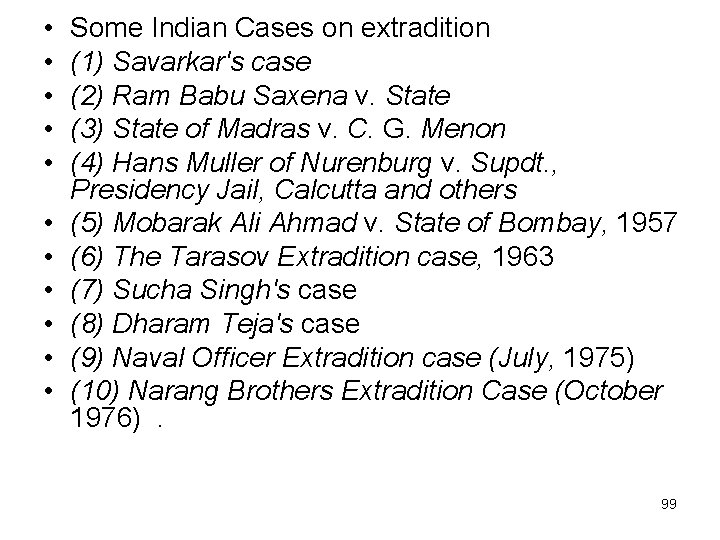
• • • Some Indian Cases on extradition (1) Savarkar's case (2) Ram Babu Saxena v. State (3) State of Madras v. C. G. Menon (4) Hans Muller of Nurenburg v. Supdt. , Presidency Jail, Calcutta and others (5) Mobarak Ali Ahmad v. State of Bombay, 1957 (6) The Tarasov Extradition case, 1963 (7) Sucha Singh's case (8) Dharam Teja's case (9) Naval Officer Extradition case (July, 1975) (10) Narang Brothers Extradition Case (October 1976) . 99
RECOGNITION • Recognition is a unilateral act of cognitive nature of a recognizing State which is followed by certain legal consequences. According to the Institute of I/L, the Recognition of a new State is the free act by which one or more States acknowledge (s) the existence on a definite territory of a human society politically organized independent of any existing State and capable of observing the obligations of I/L and by which they manifest their intention to consider it as a member of the International community. ACT OF RECOGNITION – LEGAL OR POLITICAL? • The Practice of States shows that States have frequently delayed, refused or eventually accorded recognition to newly formed States or Govt. for reasons that lacked legal justification. In actual practice, recognition is much more a question of policy than Law. The policy of the recognizing State is conditioned principally by the necessity of protecting its own interests which lie in maintaining proper relations with 100 any new State or new Govt. that is likely to be stable and permanent. Thus, in the sense of profound realism,
THEORIES OF RECOGNITION There are two main theories of Recognition: • 1. Constitutive Theory 2. Declaratory or Evidentiary Theory Constitutive Theory: • According to this theory, act of recognition alone confers international personality on an entity purporting to be a State or clothes new Govt. with an authority to enter into international relations. Political acts of recognition on the part of other States constitute or create the new State or Govt. Thus, Constitutive theory looks at the acts of recognition to decide whether an entity is a State. This amounts to saying that the very existence of a State may depend on the political decision of other States. Obviously, Constitutive theory is unacceptable. An entity which meets the conditions/requirements of state hood can not, because of the lack of the recognition, be denied its rights or can not escape its obligations. Hegal, Anzilotti, Oppenheim etc. are the chief exponent of this theory. • In the words of Oppenheim, “a State is and becomes an International Person through recognition only and exclusively. ” • This theory advocates that a new entity can not become a State ipso facto, but has to be recognized by other nations to become an International Person. • But this theory has serious draw backs and is not supported by State Practice. When a new entity emerges with all the attributes of statehood, it may happen that it is recognized by State ‘A’ but not recognized by State ‘B’ and therefore it 101 is apparently both an international person and not an international person at the

Declaratory or Evidentiary Theory • • • The declaratory theory holds the opposite view. According to it, a new state or Govt. exists prior to recognition & recognition is merely a declaratory to that effect. Recognition has evidentiary value in as much as it is an evidence of the fact which already exists (i. e. prior to recognition). Accordingly, a state may exist without being recognized. The primary function of recognition, acc to declaratory theory, is to acknowledge the fact of the new state’s political existence and to declare the recognizing state’s willingness to treat the entity as an Int. person, with the rights & obligations of states. The bulk of Int. practice supports the evidentiary theory. The chief exponents of this theory are Hall, Wagner, Brierly, Pitt Cobbet and Fisher. Acc. to Prof. Hall, a state enters into the family of nations as of right when it has acquired the essential attributes of statehood. Brierly has also remarked, the granting of recognition to a new state is not a constitutive but a declaratory act. This theory has also been subject to criticism. The view that recognition is only a declaratory of an existing fact is not completely correct. In fact, when a state is recognized, it is a declaratory act. But the moment it is recognized, there ensue some legal effects of recognition, which may be set to be of constitutive nature. On the basis of the above discussion, it may be concluded that recognition is 102 constitutive as well as declaratory act. “Probably the truth lies somewhere

De-facto & De-jure Recognition De facto recognition • When an existing state considers that the new state has not acquired sufficient stability, it may grant recognition to the latter provisionally which is termed as De facto recognition is granted normally when the recognizing state considers that the new state although has a legitimate Govt. , its effectiveness & continuance to govern the territory is doubtful. De jure Recognition • When an existing state considers that the new state is capable of possessing all the essential attributes of statehood with stability & permanency, the recognition granted is known as de jure recognition. In other words, de jure recognition is final. De jure recognition may be given, with or without prior to de facto recognition. When a new state comes into existence peacefully & constitutionally, de jure recognition may be granted directly. However, when it is not so, to say when the new state is formed through revolt, recognition may be granted after granting 103 de facto recognition.
Difference between De Facto and De Jure recognition 1. De facto is a provisional one, can be withdrawn at any time before granting de jure recognition, Whereas, De jure recognition is permanent & can’t be withdrawn. 2. De facto recognition is generally granted by the recognizing state to the recognized state while keeping in an element of non effectiveness of the Govt. of that recognized state, Whereas, De jure Recognition is granted on the consideration of all the attributes of statehood as well as the effectiveness of the Govt. of recognized state. 3. Full diplomatic relations can’t be established with a de facto recognized state, whereas, It can be done when a state is recognized de jure. 4. While full diplomatic immunities are not granted to the representatives of the de facto recognized state. Whereas, the representatives of de jure recognized state are granted such immunities 104 5. The De jure recognized state can claim to receive the property

• I/L doesn’t specify any form or manner of granting recognition. But in the practice of the states, it may be either Implied or express. Implied recognition • When the existing states do not make any formal declaration as Manner of Recognition express and implied regards recognition of new state but at the same time they indicate their intention to recognize the new state by some acts, it amounts to recognition. Montevideo Convention of 1993 under Art. 7 states – that the tacit or implied recognition results from any act which implies the intention of recognizing the new state. • The intention may be indicated by the states either unitarily or collectively • In case of unilateral act or way, the recognizing state generally establish the Int. relation with the recognized state, such as – Interchange of diplomatic representatives (ambassadors). • Whereas in case of collective act or way of the recognized state, it is very simple to understand that they all undertook to perform all the obligations of Int. community and they generally participate in 105 all multilateral treaties, conferences or seminars etc. along with
• Withdrawal of recognition Recognition de jure is final and once given can’t be withdrawn. If the recognizing state finds that the state recognized de facto is not capable of fulfilling its Int. Obligation or lacks the signs of stability, it will not grant de jure recognition to such a state. In other words, we may say that – in certain circumstances, de facto recognition may be withdrawn. But de jure recognition once given can never be withdrawn & it is final and permanent. Retroactive effects of recognition – • De jure as well as De facto recognition has a retro active effect in the sense that all the acts of newly recognized state are treated valid dating back on the commencement of the activities of the authority thus recognized. In other words, after a state is recognized its acts done prior to recognition are also recognized for instance, if the communist china was recognized by U. S. A. in 1979, the latter would treat all the act as of the former from the date when it in fact came into existence, Civil Air Transport Incorporated Company v/s Central Air Transport Corporation is a leading case on the retro active 106 effect of recognition.

Human Rights • Broadly speaking, human rights may be regarded as those fundamental and inalienable rights which are essential for life as human being. Human rights are the rights which are possessed by every human being irrespective of his or her nationality, race, religion, sex, etc. simply because he or she is a human being. Human rights are thus those rights which are inherent in our nature & without which we can’t live as human beings. Human rights and fundamental freedoms allow us to fully develop and use our human qualities, our intelligence, our talents and our conscience and to satisfy our physical, spiritual and other needs. They are based 107 on mankind’s increasing demand for a life in which
• Human rights are sometime called fundamental rights or natural rights. As fundamental and basic rights, they are the rights which can’t, rather must not, be taken away by any legislature or any act of the Govt. and which are often set out in a constitution. As natural rights, they are seen as belonging to men and women by their very nature. They may also be described as common rights, for they are rights which all men and women in the world would share, just as the common law in England, for example, was the body of rules and customs which, unlike local customs, governed the whole country. • Since human rights are not created by any legislation, they resemble very much to the natural rights. Any civilized country or body like the United Nations must recognize them. They can’t be subjected to the process of amendment even. 108
Development of International Human Rights Law • • In the 19 th century, the positivists doctrines of state sovereignty and domestic jurisdiction reigned supreme. Virtually all matters that today would be classified as human rights issues were at that stage universally regarded as within the internal sphere of National Jurisdiction. The major exceptions to this were related to piracy and slavery. In the latter case, a number of treaties were entered into to bring about its abolition. Concern also with the treatment of sick & wounded soldiers & with prisoners of war developed as from 1864 in terms of International Instruments, while states were required to observe certain minimum standards in the treatment of aliens. In the development of the International Human Rights Law, various sources have contributed towards its flourishment, such as International treaties, International customs, various other International Instruments like UDHR 1948, Tehran Conference 1968 and the Vienna Conference 1993 along with various judicial decisions and official documentation of United Nations Organization. In addition, certain agreements of a general welfare nature were beginning to be adopted by the turn of the century. An important change occurred with the establishment of League of Nations in 1919, which was basically created for the welfare of the general public through creating some specialized organs. But the desired results couldn’t be achieved & 109 the world saw & faced the II world war. It was basically due to the poor affairs of international organs. Undoubtedly these poor affairs have been the hurdle in the

• The consequences of the II world war which were witnessed by the world society have been the mass deaths & destruction of the property world over in general. • Specifically speaking the turning point for the traditional approach in International law came in 1940’s in midst of the extreme human rights abuses in war torn Europe. During the world war II, shocking crimes were committed against the humanity and there was a total suppression of fundamental human rights. Nazi leaders of Germany had established a regime of complete lawlessness tyranny. They had barbarously negated human values and dignity within their territories under their occupation. • The holocaust created by II world war led to the creation of United Nations Organization (UNO) in 1945 to establish peace. Many declarations adopted by the conferences laid down the importance of human rights. The joint declaration issued by President Franklin D. Roosevelt of the United States of America and the Prime Minister Winston Churchill of England (United Kingdom) on` Aug 14, 1941 in a document known as the Atlantic Charter, Cherished the hope for the peace which will afford assurance that all the men in all the lands may live out their lives in freedom from fear & want. 110
• The declaration of the United Nations signed on January 1, 1942 at Washington was the first document which used the term ‘human rights’. In this document the signatories who were fighting against the Axis Power recognized the need “to pressure human rights & justice in our (own) land as well as in other lands”. The declaration confirmed the principles of the Atlantic charter when it proclaimed that the protection of human rights in all countries was to be one of the results which was desired to be obtained from the victory over the Axis. • At the Moscow conference, a declaration was signed on Oct 30, 1943 wherein it was stated that the individual German shall be held responsible for their violation of rules of International Law. They signed the agreement for the prosecution and punishment of the major war criminals of the European Axis on Aug 8, 1945. The Nuremberg Charter unequivocally raised the issue of individual accountability for war crimes and crimes against humanity. Dumbarton Oaks proposals contained only a brief reference to the promotion of human rights as one of 111 the activities to be performed by the proposed General
• The period since the formation of United Nations in 1945, has witnessed an unprecedented expansion in the Internationally recognized rights of all people with acceptance of a human rights dimension to the quest for international peace & security. In comparatively short period of time, the United Nations has styled itself as protector of the Internationally proclaimed rights of all. 112

UN Charter and Human Rights UDHR( Universal Declaration of Human Rights) • The UDHR was created following the holocaust during world war II. The Sheer atrocities committed by the Nazi’s through the enslavement and annihilation of Jews in Europe cause the worries to cry out for Justice. The holocaust changed the world view on human rights prior to the view on human rights. Prior to the war, human rights were initially considered a Domestic Concern, they were to be enforced by only the Govt. of individual countries. This view shifted during the war as human rights were then considered as a Universal Concern, they were to be concern for every person. By the end of the war, the world as a whole felt the need for the security of inalienable human rights. • The UDHR 1948 has been hailed as an historic event of the profound significance and as one of the greatest achievement of the United Nations. ” The declaration on Human Rights was prepared by the commission in 1947 and 1948 and was adopted by the General Assembly on Dec, 10, 1948. When the UDHR was adopted, it was most eloquent expression of hope by a world emerging from the most devastating war in the history of 113 human race. The experience gave the Universal Declaration a

Scheme of the enumeration of the rights in the declaration The Universal declaration consists of a preamble and 30 Articles covering both civil and political rights and economic, social and cultural rights. • The preamble refers to the “faith in the fundamental human rights, in the dignity and worth of the human person and the equal rights of men and women, which the peoples of the UN have re affirmed in the charter of the UN and their determination to promote social progress and better standards of life in Larger freedom”. It also refers to the pledge taken by the members state to achieve, in co operation with the united nations the promotion of the universal respect for the observance of human rights & fundamental freedom. ” All member states of UDHR will respect 114 the HR.
• Through the preamble, the General Assembly proclaimed the UDHR as a common standard of achievement for all peoples & all nations, to the end that every individual & every organ of the society keeping this declarations constantly in mind, shall strive by teaching and education to promote respect for these rights & freedoms and by progressive measures, national & international to secure their Universal & effective recognition & observance, both among the peoples of member states themselves & among the peoples of territories under their Jurisdiction. • The preamble also notes the reasons which impelled the General Assembly to proclaim the declaration of human rights and also the need for such proclamation after having stated this in the preamble, the General Assembly goes onto proclaim the rights civil & political as well as economic, social and cultural. • It may be noted that the declaration is neither addressed to the nations nor to the member states but to the every individual. This is in keeping with the words “We the people of the United Nations with which the preamble of UN charter commence. 115
• The rights proclaimed in the UDHR may be classified into following four categories 1. General (Art 1 & 2) 2. Civil and political rights (Art 3 -21) 3. Economic, Social and Cultural rights (Art 22 -27) 4. Concluding Articles (Art 28 -30) 116
General (Art-1 and 2) • Article 1. of the declaration provides that all human beings are born free & equal in dignity and rights they are endowed with reason and conscience and should act towards one another in a spirit of brotherhood. Article 1. Thus proclaims the inherent freedom and equality in dignity and rights of all human beings. • Article 2. of the UDHR provides that everyone is entitled to all the rights & freedoms. Set forth in the declaration, without distinctions of any kind, such as race color, sex, language, religions, political or other opinion, national or social origin, property, birth or other status. • Furthermore, no distinction shall be made on the basis of political, Jurisdictional or international 117 status of the country to which a person belongs,
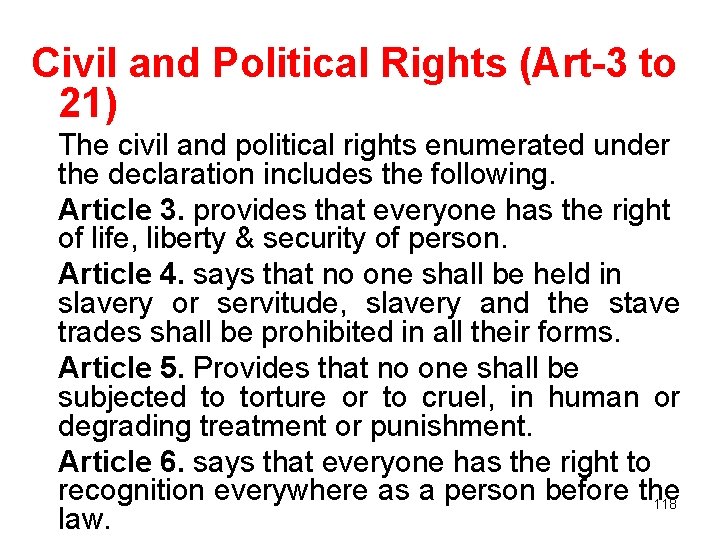
Civil and Political Rights (Art-3 to 21) The civil and political rights enumerated under the declaration includes the following. Article 3. provides that everyone has the right of life, liberty & security of person. Article 4. says that no one shall be held in slavery or servitude, slavery and the stave trades shall be prohibited in all their forms. Article 5. Provides that no one shall be subjected to torture or to cruel, in human or degrading treatment or punishment. Article 6. says that everyone has the right to recognition everywhere as a person before the 118 law.
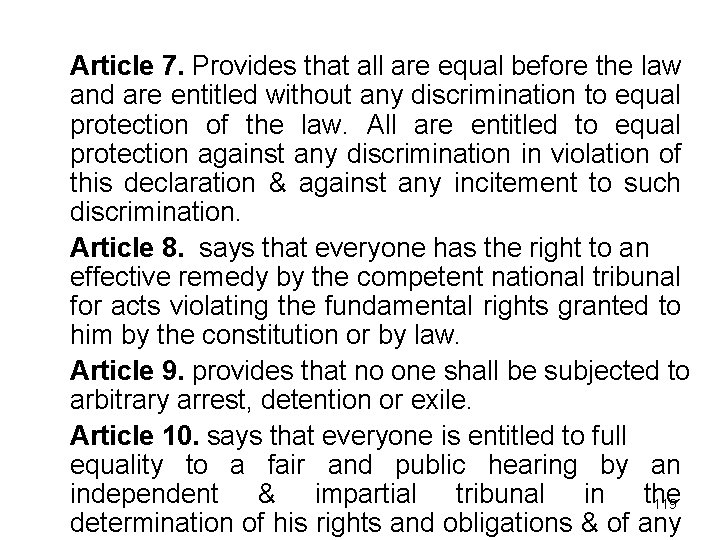
Article 7. Provides that all are equal before the law and are entitled without any discrimination to equal protection of the law. All are entitled to equal protection against any discrimination in violation of this declaration & against any incitement to such discrimination. Article 8. says that everyone has the right to an effective remedy by the competent national tribunal for acts violating the fundamental rights granted to him by the constitution or by law. Article 9. provides that no one shall be subjected to arbitrary arrest, detention or exile. Article 10. says that everyone is entitled to full equality to a fair and public hearing by an independent & impartial tribunal in the 119 determination of his rights and obligations & of any

Article 11. says that: I. Everyone charge with a penal offence has the right to be presumed innocent until proved guilty according to law in a public trial at which he has had all the guarantees necessary for his defence II. No one shall be held guilty of any penal offence on account of any act or omission which did not constitute a penal offence under national or International law at the time when it was committed. III. Nor shall a higher penalty be imposed than the penalty be imposed that the one that was applicable at the time, the penal offence was committed. Article 12. provides that no one shall be subjected to arbitrary interference with privacy, family, home, correspondence, or attack on honour or reputation. Everyone has the right to the protection of the law against such interference or attacks. Article 13. Provides that everyone has the right to 120 freedom of movement of each state. (Art. 19 (i) (d) of
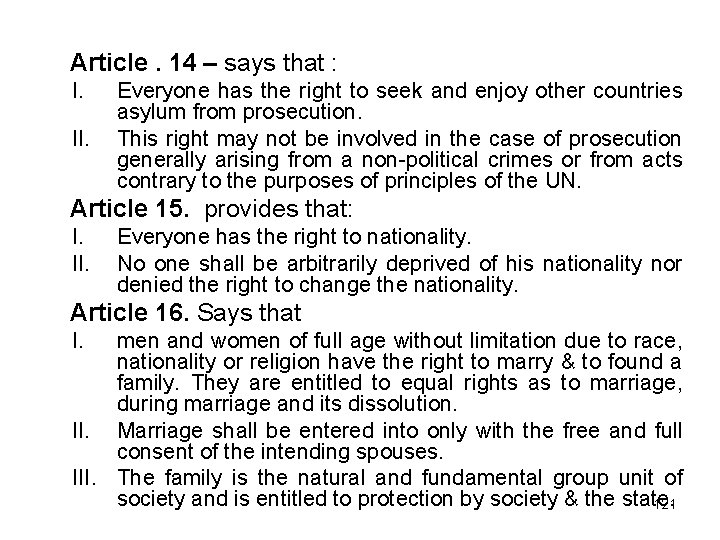
Article. 14 – says that : I. II. Everyone has the right to seek and enjoy other countries asylum from prosecution. This right may not be involved in the case of prosecution generally arising from a non political crimes or from acts contrary to the purposes of principles of the UN. Article 15. provides that: I. II. Everyone has the right to nationality. No one shall be arbitrarily deprived of his nationality nor denied the right to change the nationality. Article 16. Says that I. men and women of full age without limitation due to race, nationality or religion have the right to marry & to found a family. They are entitled to equal rights as to marriage, during marriage and its dissolution. II. Marriage shall be entered into only with the free and full consent of the intending spouses. III. The family is the natural and fundamental group unit of society and is entitled to protection by society & the state. 121
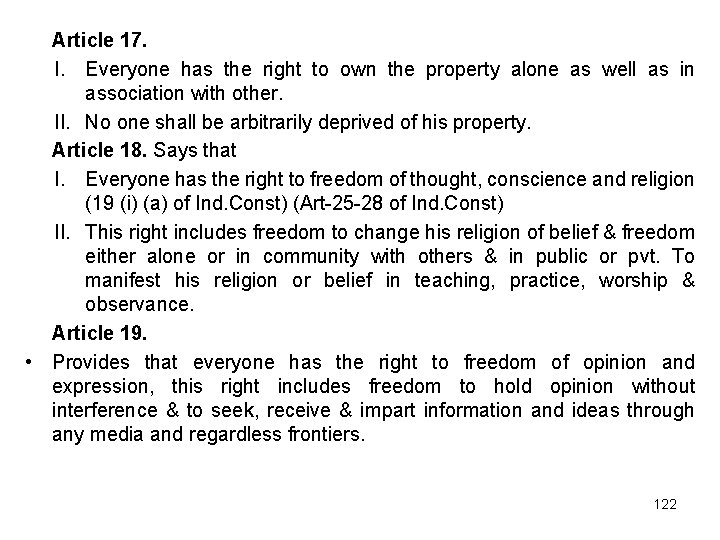
Article 17. I. Everyone has the right to own the property alone as well as in association with other. II. No one shall be arbitrarily deprived of his property. Article 18. Says that I. Everyone has the right to freedom of thought, conscience and religion (19 (i) (a) of Ind. Const) (Art 25 28 of Ind. Const) II. This right includes freedom to change his religion of belief & freedom either alone or in community with others & in public or pvt. To manifest his religion or belief in teaching, practice, worship & observance. Article 19. • Provides that everyone has the right to freedom of opinion and expression, this right includes freedom to hold opinion without interference & to seek, receive & impart information and ideas through any media and regardless frontiers. 122
Article 20. Says that I. Everyone has the right to freedom of peaceful assembly association (Art. 19 (i) (b) of (. C). II. No one may be compelled to belong to an association. Article 21. I. Everyone has the right to take part in the Govt. of his country, directly or through freely choosen representatives. II. Everyone has the right of equal access to public service in his country. The will of the people shall be the basis of the authority of the Govt. This will be expressed in periodic and genuine elections which shall be by 123 universal and equal sufferage and shall be held by secret vote or by equivalent free voting procedure.

Economic, social and cultural rights- (Art. 2227) • • Article 22. Says that Everyone as a member of society has the right to social security and is entitled to realization through national efforts & International co operation & in accordance with the org & resources of each states. Article 23. Says that Everyone has the right to work to free choice of employment, to just & favorable condition of work, to protection against employment, right to equal pay for equal right to just & favorable remuneration ensuring for himself & his family & existence worthy of human dignity & right to form & join trade unions for the protection of his interest. Article 24. Says that Everyone has the right to rest & leisure including reasonable limitations of working hours & periodical holidays with pay. Article 25. Says that Everyone has a right to a standard of living adequate for the health & well being of himself & of his family, including foods, clothing housing, & medical care & necessary social services & the right to security in the event of unemployment, sickness, disability widowhood, old age or other lack of livelihood in circumstances beyond his control. Motherhood & childhood are entitled to special care & assistance. All wedlock shall enjoy the some social protection. 124
Article 26 Provides the following rights: I. III. Everyone has the right to education, education shall be free, at least in the elementary and fundamental stages elementary education shall be compulsory. Technical & professional education shall be made generally available & higher education shall be equally accessible to all on basis of merit. Education shall be directed to the full development of the human personality & to the strengthening of respect for human rights & fundamental freedom. It shall promote understanding, tolerance and friendship among all nations, racial or religions group, & shall further the activities of UN for the maintenance of peace. Parents have the prior right to choose the kind of education, that shall be given to their children. Article 27. Says that I. II. Everyone has the right freely to participate in the cultural right of the community, to enjoy the arts & to share in the scientific advancement & its benefits. Everyone has the right to protection of the moral & material interest resulting from any scientific, literally or artistic production of which he is the author. 125
Concluding Articles (Arts. 28 -30) Article -28, says that • Everyone is entitled to a social and international order in which the rights & freedom set forth in the declaration can be fully realized. Article 29. Says that I. II. III. Everyone has duties to the communities in which alone the free & full development of his personality possible. In the exercise of his rights & freedoms, everyone shall be subject only to such limitations as are determined by law solely for the purpose of securing the recognition & respect for the rights & freedoms of other & of meeting the just requirements of morality, public order & the general welfare in a democratic society. These rights & freedoms may, in no case, be exercised contrary to the purposes & principles of the UN. Article -30. says that • Nothing in this declaration may be interpreted as implying for any state, group or person any right to engage in any activity or to perform any act aimed at the destruction of any of the rights & 126 freedoms set forth herein.
Legal effect of the UDHR • The declaration was not intended to be legally binding & therefore, it didn’t impose any legal obligations on the states to give effects to its provisions. In other words, from the legal point of view, the declaration was only a recommendation, it was not strictly binding on the states. However, a fair resolution is adopted by an over whelming majority of the General Assembly, it can also constitutes generally excepted principles of International law. It has legal value in as such as it Contains an authoritative interpretation of the provisions of the charter. • The General Assembly proclaimed the declaration as “ A common standard of achievement for all peoples & all nation” and called upon all member states & all people to promote & secure the effective recognition the observance of the rights & freedoms set forth therein. The declaration has made the human rights universal but they are not universally accepted due to political, economic & social limitations. 127

Shortcomings of UDHR • The declaration is deficient in three aspects I. It is not binding on states as law but rather a UN recommendation to states. II. Some of its provision is as general as that of Art 55 of the UN charter. III. The Declaration offered no means of implementation other than state goodwill. Suggestions may be given for making amendments in the Universal Declaration as human concepts of rights do change and there is no reason to believe that the present nations and norms shall be identical 128 in those of the time when the declaration was
International Bill of Human Rights • On the recommendation of IIIrd committee, the General assembly unanimously adopted the two International covenants, namely. • International covenants on civil and political rights. • International covenants on economic, social and cultural rights on Dec, 16, 1966. • The General Assembly also adopted an optional protocol to the International covenants on civil and political rights, 1996. After 23 yrs, i. e. , in Dec, 1989, the General Assembly adopted yet another protocol i. e. , IInd optional protocol to the 129 International covenants on civil & political rights on
• In spite of the above mentioned short comings, the UDHR has exercised a powerful influence both Nationally and internationally since its adoption. • UDHR is a public and indeed a global proclamation of “A common standard of achievement for all peoples and all nations”…whatever the legal quality, the declaration has set a standard by which national behavior can be measured & to which nations can apprise. The declaration has helped to give contour and contents to generalities of the charter reflecting the spirit & the need of the day. The declaration has paved the way for transformation of the substantive norms of Human rights into national & International law. It would not be inappropriate to state that UDHR is a cornerstone of all UN activities relating to 130 human rights.
Composition of the International bill of the Human rights. • The International bill of human rights comprises of the following I. The UDHR, 1948 II. The International covenant on civil and political rights, 1966. III. The International covenant on economic social and cultural rights 1966. IV. The optional protocol to the International covenant on civil and political rights, 1966. • The key stone of the covenants is the UDHR, 1948 which was adopted by the General Assembly on 10 Dec, 1948. The covenants generally elaborate 131 on the rights set forth in the UDHR, 1948.
International covenant on civil and political rights 1966 • This covenant comprises of 53 articles divided in 6 part. These articles may be classified into following categories. I. III. IV. V. Preamble General (Art. 1 -3 and 5) Right in Emergency (Art-4) Substantive rights (Art 6 -27) Implementation enforcement machinery (Art. 28 -45) 132 VI. Interpretation or saving provisions (Art. 46 -47)
• • Preamble The key stone of the covenant on civil & political rights 1966 are the charter provisions concerning the Human rights and UDHR, 1948 which is rightly reckoned as the mine from all instruments on Human Rights have quarried. That is why, considering that in accordance with the principles procalmied in the charter of the United Nations, recognition of the inherent dignity and of the equal and inalienable rights of all the members of the human family is the foundation of freedom, justice & peace in the world, the state parties to the covenant recognized that these derive & from the inherent dignity of the human person & that in accordance with the UDHR, the ideal of free human beings enjoying civil & political freedom and freedom from fear and want, can only be achieved if conditions are created whereby everyone may enjoy his civil & political rights as well as his economics, social & cultural rights. 133
• • • General Art 1. Provides that, All peoples have the right of self determination. By virtue of that right, they freely determine their political status and freely pursue there economic social & cultural development. All people may for their own ends freely dispose of their natural wealth and resources without prejudice to any obligations arising out of International economic co operation, based upon the principle of mutual benefit and international law. In no case may a people be deprived of its own means of subsistence. The States parties to the present covenant, including those having responsibility for the administration of non self Governing & trust territories, shall promote the realization of the right of self determination, and shall respect that right, in conformity with the provisions of the charter of the UN. 134
• Art 2. • Which occurs in part II of the covenant, provides that • Each state party to the covenant undertakes to respect & to ensure to all individuals within its territory & subjects to its jurisdiction the right recognized in the present covenant, without distinction of any kind, such as race, colour, sex language, religion, political or other opinion, national or social origin, property, birth or other status. • Art 3. Provides that, • The states parties to the present covenant undertake to ensure the principle of equal right of men and women to the enjoyment of all civil & political rights set forth in the covenant. 135
• • • Art 5. Makes it clear that, Nothing in the covenant may be interpreted as implying for any state, group or person any right to engage in any activity or perform any act aimed at the destruction of any of the rights and freedoms recognized herein or at their limitations to a greater extent than is provided for in the present covenant further, there shall be no restriction upon or derogation from any of the fundamental human rights recognized or existing in any state party to the present covenant pursuant to law, conventions, regulations or custom on the pretxt that the present covenant doesn’t recognize such rights or that it recognizes them to a lesser extent. Right in Emergency- Art 4. Provides that, In time of public emergency which threatens the life of the nation & the existence of which is officially proclaimed, the state parties to the present covenant may take measures derogating from their obligations under the present covenant to the extent strictly required by the exigencies of the situation, provided that such, measures are not inconsistent with their obligations under International law and don’t involve discrimination solely on the grounds of race, colour, sex, language, religion or social origin. No derogation from Arts 6, 7, 8 (paras 1 & 2) 11, 15, 16 & 18 may be made under this provision. Any state party to the present covenant availing itself of the right of derogation shall immediately inform the other states parties to the present covenant, through the intermediary of the secretary general of the UN, of the provisions from which it has derogated and of the reasons by which it was actuated. 136
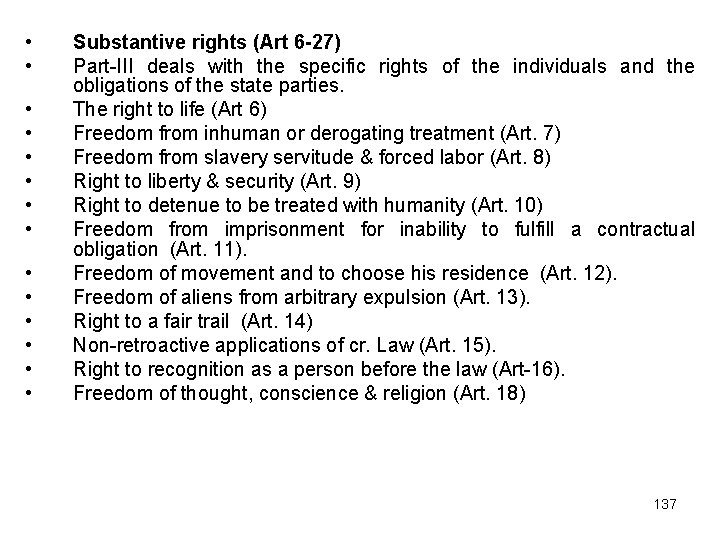
• • • • Substantive rights (Art 6 -27) Part III deals with the specific rights of the individuals and the obligations of the state parties. The right to life (Art 6) Freedom from inhuman or derogating treatment (Art. 7) Freedom from slavery servitude & forced labor (Art. 8) Right to liberty & security (Art. 9) Right to detenue to be treated with humanity (Art. 10) Freedom from imprisonment for inability to fulfill a contractual obligation (Art. 11). Freedom of movement and to choose his residence (Art. 12). Freedom of aliens from arbitrary expulsion (Art. 13). Right to a fair trail (Art. 14) Non retroactive applications of cr. Law (Art. 15). Right to recognition as a person before the law (Art 16). Freedom of thought, conscience & religion (Art. 18) 137
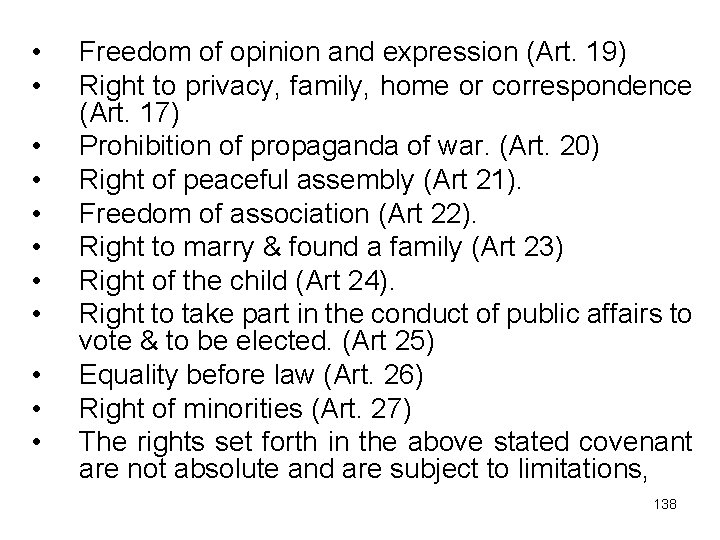
• • • Freedom of opinion and expression (Art. 19) Right to privacy, family, home or correspondence (Art. 17) Prohibition of propaganda of war. (Art. 20) Right of peaceful assembly (Art 21). Freedom of association (Art 22). Right to marry & found a family (Art 23) Right of the child (Art 24). Right to take part in the conduct of public affairs to vote & to be elected. (Art 25) Equality before law (Art. 26) Right of minorities (Art. 27) The rights set forth in the above stated covenant are not absolute and are subject to limitations, 138
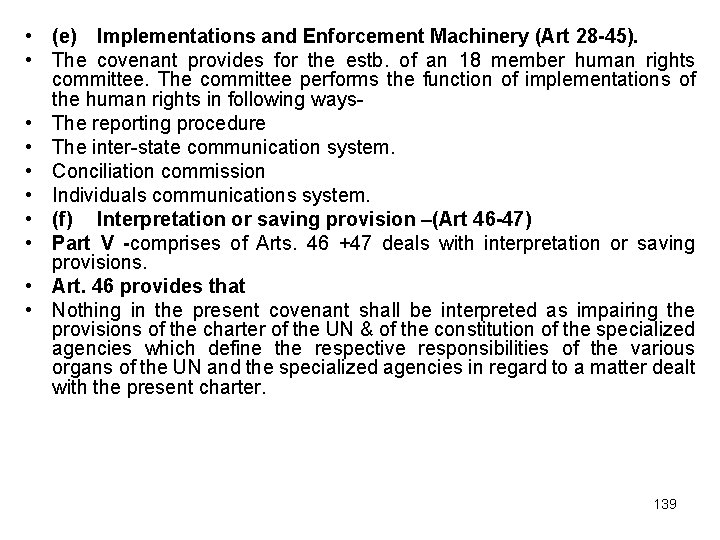
• (e) Implementations and Enforcement Machinery (Art 28 -45). • The covenant provides for the estb. of an 18 member human rights committee. The committee performs the function of implementations of the human rights in following ways • The reporting procedure • The inter state communication system. • Conciliation commission • Individuals communications system. • (f) Interpretation or saving provision –(Art 46 -47) • Part V -comprises of Arts. 46 +47 deals with interpretation or saving provisions. • Art. 46 provides that • Nothing in the present covenant shall be interpreted as impairing the provisions of the charter of the UN & of the constitution of the specialized agencies which define the respective responsibilities of the various organs of the UN and the specialized agencies in regard to a matter dealt with the present charter. 139
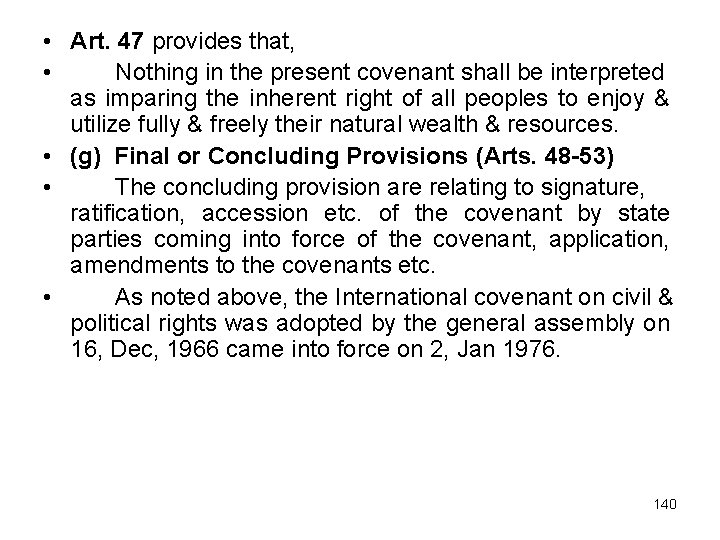
• Art. 47 provides that, • Nothing in the present covenant shall be interpreted as imparing the inherent right of all peoples to enjoy & utilize fully & freely their natural wealth & resources. • (g) Final or Concluding Provisions (Arts. 48 -53) • The concluding provision are relating to signature, ratification, accession etc. of the covenant by state parties coming into force of the covenant, application, amendments to the covenants etc. • As noted above, the International covenant on civil & political rights was adopted by the general assembly on 16, Dec, 1966 came into force on 2, Jan 1976. 140
• International covenant on economic, social & cultural rights • Besides preamble the International covenant on eco, social & cultural rights comprises of 31 articles which are divided into following 5 parts. • Preamble • General (Art. 1 5) • Substantive Rights (Arts 6 to 15) • Measures for implementation (Arts 16 25) • Concluding provisions (Arts 26 31) • (a) Preamble • It is same as the preamble of International covenant on civil & political rights. 141

• • • General (Art. 1 to 5) Art 1, 3, 5 of the covenant on Eco, Social & cultural rights, 1966 are also similar to Art 1, 3, 5, of the covenant on civil & political rights with the only difference that’s Art-3 speaks of the enjoyment of all economic, social & cultural rights in place of civil & political rights. Art -2. of the covenant provides that each state party undertakes to take steps individually and through internal assistance & co operation, especially economic & technical, to the maximum of its available resources, with a view to achieving progressively the full realization of the rights recognised in the present covenant by all appropriate means including particularly the adoption of legislative measures. The state parties to the covenant undertake to guarantee that the rights enunciated provided in the covenant will be exercised without discrimination of any kind as to race, colour, sex, language religion, political or other opinion, national or social origin, property birth or other status. 142

• • • • (c) Substantive Rights (Art 6 to 15) Part III of this covenant deals with economic, social & cultural rights. They are: Right to work (Art 6) Right to just and favorable conditions of work (Art 7) Right to form & join trade unions (Art. 8) Right to Social security (Art. 9) Right relating to motherhood & childhood, marriage & the family (Art. 10) Right to adequate food, clothing, housing & standard of living & freedom from hunger (Art 11) Right to physical & mental health. (Art 12) Right to education including a plan for implementing compulsory primary education (Art 13). Undertaking to implement the principle of compulsory education free of charge for all within a reasonable no of years (Art 14). Right to (i) Take part in cultural life (ii) Enjoy the benefits of scientific progress & its applications. (iii) Benefit from the protections of the moral & material interests resulting from any scientific, literary or artistic production of which he is author (Art 15). 143

• (d) Measures for implementation (Art 16 to 25) • State parties to the covenant have an obligation to submit to the secretary General of the UN reports on the measures which they have adopted and the progress made. The secretary General shall then transit copies of report to the economic and social council. The economic & social council may transmit the reports to the commission on human rights for study & general recommendations. The economics & social council may submit from time to the General Assembly reports with recommendations of general nature & a seminary of the information received from the state parties to the present covenant & the specialized agencies in the measures taken & the progress made in achieving general observance of the rights recognized in the present covenant. • (e) Concluding Provision (Art. 26 -31) • This part deals with final or concluding articles which deals with provision such as signature, ratification, accession (Art 26), entry into force (Art 27) application (Art 28) amendments (Art 29) & authentic language of the text of the covenant (Art 31). 144
• Universal Declaration of Human Rights and the two covenants on Human Rights, 1966. • Apart from the provisions of the U. N. Charter concerning human rights, the' keystone of the Covenants is the Universal Declaration of Human Rights, 1948, which interprets, extends and elaborates the provisions of the Charter. Generally, the two Covenants elaborate on the rights set forth in the Universal Declaration. But there are rights which are proclaimed in the Universal Declaration but are not incorporated in the Covenants and vice versa there are certain rights not proclaimed in the Universal Declaration but are incorporated in the Covenants. 145
• Relationship Between the Two Covenants. - • There is a close relationship between the two Covenants because for both the Covenants the key source of rights is the Universal Declaration of Human Rights. The preamble of both the Covenants are the same so is the case with Articles 1, 3 and 5. The preamble of the Civil Covenant recognizes the need for creation of conditions wherein everyone may enjoy "his civil and political rights as well as his economic, social and cultural rights. " The preamble of the Economic Covenant also recognizes the same need so that everyone may enjoy "his economic, social and cultural rights, as well as his civil and political rights. " Thus they are supplementary to each other. Human rights and fundamental freedoms are indivisible. The realization of civil and political rights is impossible without the enjoyment of economic, social and cultural rights. This relationship between the civil and political rights and economic, social and cultural rights contained in the Civil Covenant and the Economic Covenant respectively was recognized by the International Conference on Human Rights which was held from April 22 to May 13, 1968 at Tehran in connection with the observance of the International year for Human Rights, which marked the twentieth anniversary of the Universal Declaration of Human Rights. The Conference was attended by 84 States. The realization of this relationship and their interdependence was reiterated by the General Assembly in a resolution in 1977. 146
• This was finally affirmed by the Second World Conference on Human Rights held at Vienna from June 14 to 25, 1993. It was in the agenda of the Conference to consider the relationship between development, democracy and unrival enjoyment of all human rights, keeping in view the interrelationship and indivisibility of economic, social, cultural, civil and political rights. The Vienna Declaration adopted in the conference affirmed that all human rights are universal, indivisible, interdependent and interrelated. The international community must treat human rights globally in a fair and equal manner, on the same footing and with the same emphasis. While the significance of the national and regional particularities and various historical, cultural and religious backgrounds must be borne in mind, it was the duty of States regardless of their political, economic and cultural systems to promote and protect all human rights. Further, democracy, development, and respect for human rights are interdependent and mutually reinforcing. Democracy is based on the freely expressed Will of the people to determine their political, economic, social and cultural systems, and their full participation in all aspects of their lives. 147
• Vienna Conference • World Conference on Human Rights, Vienna (14 th to 25 th June, 1993) or Vienna Conference. The World Conference on Human Rights was held at Vienna from 14 th to 25 th June, 1993. This World Conference was held some 25 years later after the International Conference on Human Rights (or Tehran Conference) held at Tehran (Iran) in 1968 to assess the progress achieved under the Universal Declaration on Human Rights (1948) and had laid the foundation for subsequent work in the field of human rights at the international level. The Conference called for specific measures designed to strengthen international human rights instruments and their monitoring mechanism and to improve co ordination of UN activities for the furtherance of human rights. The Conference condemned ethnic cleansing. The Conference also adopted two declarations one on Bosnia and Herzegovina and the other on Angola. The Conference recommended that the General Assembly at its next session consider, as a matter of priority, the question of the establishment of a High Commissioner for Human Rights for the protection and promotion of all human rights. The Conference supported the creation of an International Criminal Court to bring those responsible for serious violations of humanitarian law to justice as individuals. The International Law Commission was encouraged to continue work on an International Criminal Court. 148
• Vienna Declaration. • Vienna Conference adopted a two part Vienna Declaration and a six part 150 paragraph Programme of Action. The Declaration consists of 16 preambular paragraphs and 39 operative paragraphs. The main points of Vienna Declaration are following : • (i) Universality and Indivisibility of Human Rights. AII human rights are universal, indivisible, interdependent and interrelated. The international community must treat human rights globally in a fair and equal manner, on the same footing and with the same emphasis while the significance of national and regional particularities and various historical, cultural and religious backgrounds must be borne in mind. It held that it was the duty of States, regardless of their political, cultural systems, to promote and protect all human rights. • (ii) Right to self Determination. Vienna Declaration reaffirmed the right of all peoples to self determination recognizing the right of peoples to take any legitimate action, in accordance with the Charter to realize their inalienable right of self determination. The declaration, however, hastened to add that "this shall not be construed as authorizing or encouraging any action which would dismember or impair, totally or in part, the territorial integrity or political unity of sovereign and independent 149
• States conducting themselves in compliance with the principle of equal rights and self determination of peoples. “ • (iii) Effective International measures to guarantee and monitor implementation of human rights of peoples under foreign occupation – • The declaration calls for effective international measures to guarantee and monitor the implementation of human rights of people under foreign occupation. It also calls for effective legal protection against the violation of their human rights, in accordance with human rights norms and international law particularly the 1949 Geneva Convention on the Protection of Civilian Persons in Time of War and other applicable norms of humanitarian law. • (iv) Democracy, Development and Respect for Human Rights. The declaration states that democracy, development and respect for human rights are interdependent and mutually reinforcing. Democracy is based on the freely expressed will of the people to determine their own political. economic, social and cultural systems, and their full participation in all aspects of life. 150
• (v) Right to Development. Vienna Declaration reaffirms the right to development, established in the Declaration on the Right to Development, as a universal and inalienable right and an integral part of fundamental human rights. While development facilitates the enjoyment of human rights lack of it may not be invoked to justify abridgement of internationally recognized human rights. • (vi) Alleviation of external debt burden of developing countries. The declaration calls on international community to make all efforts to help alleviate the external debt burden of developing countries to supplement efforts of their Governments to attain the full realization of economic, social and cultural rights of their people. • (vii) Unilateral measures creating obstacles to Trade Relations. The declaration calls on States to refrain from any unilateral measure not in accordance with international law that created obstacles to trade relations among states and impeded the full realization of human rights. It affirmed that "food should not be used as a tool for political pressure". 151
• (viii) Gender based violence and all forms of sexual harassment and exploitation. • The declaration observes that gender based violence and all forms of sexual harassment and exploitation, including those resulting from cultural prejudice and international trafficking were incompatible with the dignity and worth of human person and must be eliminated. That could be achieved by legal measures and through national action and international co operation in economic and social development. education, safe maternity and health care, and social support. • (ix) Right of minorities. The Declaration states that persons belonging to minorities have the right to enjoy their own culture, to practice their own religion and to use their own language in private and in public and without interference or any form of discrimination. 152
• In addition to the foregoing, the Declaration encourages States to accede to international human rights instruments, and to avoid as far as possible, to resort to reservations. The importance of ensuring the universality, objectivity and non selectivity of the consideration of human rights issues was reaffirmed. The declaration urged Governments, UN system as well as other multilateral organization to considerably increase the resources allocated to programmes aimed at the establishment and strengthening of national legislation, national institutions and related infrastructures which upheld the rule of law and democracy; electoral assistance ; human rights awareness through training, teaching and education ; popular participation and civil society. The declaration underlined the importance of objective, responsible and impartial information about human rights and humanitarian issues. The declaration also 153
• encouraged the increased involvement of the media, for whom freedom and protection should be guaranteed within the framework of national law. • One of the greatest achievements of the Vienna Declaration is the proposal to establish a post of High Commissioner for Human Rights. Secondly. while the Declaration has reaffirmed the right of self determination, it has made it clear that this right cannot be used to dismember or unsettle the established States. Thirdly, the Declaration calls upon the international community to enhance co operation to combat terrorism. It also noted that terrorism and its linkage in some countries to drug trafficking are aimed at the destruction of human rights, democracy, territorial integrity, security of States and destablishing of legitimately constituted Governments. Fourthly, its adoption of right to development as an inalienable right is indeed a great achievement. Fifthly its emphasis on prosecution and punishment of persons responsible for the crime of ethnic cleansing is really praiseworthy. So is the case with affirmation of universality, indivisibility and interdependence of human rights and that food should not be used as a tool for political pressure ; affirmation of rights of minorities ; affirmation that democracy, development and respect for human rights are independent and mutual reinforcing etc. 154
• U. N. Commission on Human Rights • The Economic and Social Council (ECOSOC), a principal organ of the United Nations was most directly concerned with the question of human rights. The Council under Article 68 of the U. N. Charter was empowered to set up commissions for the promotion of human rights and such other commissions as may be required for the performance of its functions. Accordingly, it appointed a Commission on Human Rights which was approved by the General Assembly on February 12, 1946. The Commission was composed of 18 members who were elected by ECOSOC. Each State member selected its own representatives. In 1962, the membership was increased to 21, and in 1966 to 32. Since 1990, the Commission has 53 member Governments. The Commission meets annually in Geneva for six weeks beginning in March. The Commission reports to ECOSOC which, in turn, reports to the General Assembly. • The establishment of a Commission on Human Right was recommended in 1945 by the preparatory Commission of the United Nations in order to deal with those human rights issues which could not be resolved during the original drafting of the U. N. Charter. 155
• The Commission, as determined by its terms of reference, was directed to prepare recommendations and, reports on the following items: • 1. on international Bill of rights; l conventions International on, declarations • and 2. liberties; the status of women, freedom of information and similar matters; • 3. The protection of minorities; • prevention The 4. discrimination of grounds race, on of sex, 'language or religion. • The Commission was empowered to carry out 'studies, make recommendations and drafts new international treaties. In addition, it could investigate allegations of human rights violations and could take action when presented with evidence of large scale violations. It was also empowered to establish sub commissions. • 156
• The Commission began its work in January, 1947 under the chairmanship of Mrs. Franklin D. Roosevelt. In its First Session, the Commission on Human Rights established the Sub Commission on Prevention of Discrimination and Protection of Minorities, a body of independent experts. The Commission in the same Session appointed a committee which is known as Drafting Committee for the preparation of the draft of an 157
• International Bill of Rights. It drafted the Universal Declaration of Human Rights which was adopted by the General Assembly on December 10, 1948. Since then the Commission concentrated its efforts on standard setting. Using the Declaration as the basis, the Commission prepared International Covenant on Civil and Political Rights and International Covenant on Economic, Social and Cultural Rights in 1966. In 1967, the Commission was authorized by the Economic and Social Council to start to deal 'with violations of human rights. For, instance in 1967, the Commission set up an ad hoc working group of experts on South Africa and has since established working groups on Chile; Situations revealing a consistent Pattern of Gross Violations on Human Rights; Disappearances and the right to development. 158
• The Commission has set up elaborate machinery and procedures to monitor compliance by States with international human rights law and to investigate alleged violations of human rights. It is done . mainly by dispatching fact finding missions to countries in all parts of the World whether they are rich or poor, developing or developed countries. For instance, in 1994 the Special Reporter on Religious Intolerance visited China and the Special Reporter on Contemporary Forms of Racism visited the United States of America. During 1970 s and 1980 s these implementation and fact finding machinery and procedures became the focus of the Commission's attention. • The Commission in 1990 s has increasingly turned its attention to provide with advisory services and technical assistance to the needy States so that they may overcome the obstacles in securing the enjoyment of human rights by all. At the same time, more, emphasis has been put on the promotion of economic, social and cultural rights, including the right to development and the right to an adequate standard of living. Increased attention is also being given to the protection of the rights of vulnerable groups in society, including minorities and indigenous people and to the protection of the rights of the child and of women. 159
• The General Assembly has decided to replace U. N. Human Rights Commission by Human Rights Council vide its Resolution 60/251 of 15 March, 2006. As per the decision of GA, the elections of the first members of the council took place on 09 May, 2006 and the first meeting of the council was convened on 19 June, 2006. • Total members 47 160
- Slides: 160