
International Labour Movement the ILO ACTRAV Objectives of
International Labour Movement, the ILO & ACTRAV
Objectives of this Session We will discuss on: 1. Brief history of the Labour Movement 2. Structure of Int’l Labour Movement 3. ILO: Principles, Structure & Functions 4. Role of ACTRAV (Bureau for Workers’ Activities) 5. Current Issues facing Actrav-ILO
Origins of the Labour Movement è UK (1770 – 1850) – shift from agriculture to industry Textiles, Coal & later Railways after 1847 è Exploitative work conditions – workers organising illegal (Combination Acts of 1799) – Tolpuddle Martyrs, TU Act of 1925 allowed existence of TUs (but prevented industrial action), Chartist movement - NCA (1840) è Post 1850 s – Unions grew, 1867 Master-Servants Act Voting Rights achieved (1867), TUC formed in 1868, Unions legalised by 1871 TU Act, in 1875 -Employer & Workmen Act,
Origins of the Labour Movement è In continental Europe- Socialist movement gave rise to unions from 1880 s onwards. Germany was the first European country to pass labor laws (social security initiatives from 1883 onwards) è South Asia: TUs illegal till late 19 th C; 1 st formal TU in 1905 (textiles in India) – TU Act 1926 - TUs linked to national struggle for independence later, è Japan: labour unions started in late 19 th C by social reformers; conditions bad – high mobility, union memberships fluctuated, till 1945, no legal protection; US influence; enterprise family concept (welfare, life time employment, loyalty);
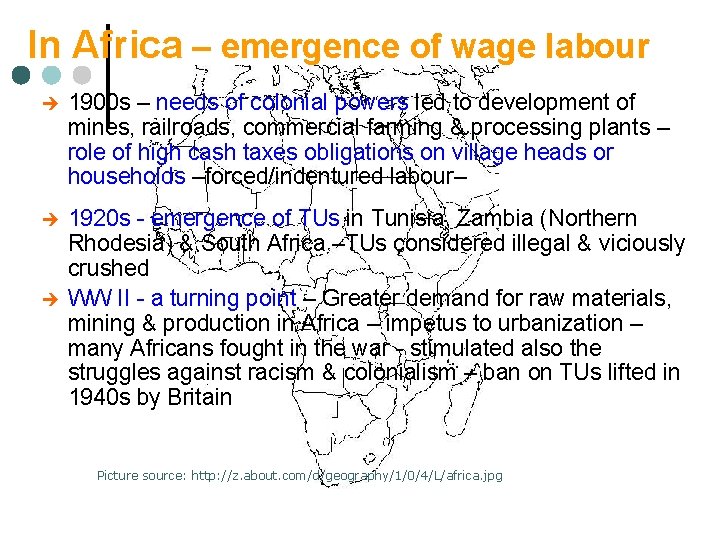
In Africa – emergence of wage labour è 1900 s – needs of colonial powers led to development of mines, railroads, commercial farming & processing plants – role of high cash taxes obligations on village heads or households –forced/indentured labour– è 1920 s - emergence of TUs in Tunisia, Zambia (Northern Rhodesia) & South Africa –TUs considered illegal & viciously crushed WW II - a turning point – Greater demand for raw materials, mining & production in Africa – impetus to urbanization – many Africans fought in the war - stimulated also the struggles against racism & colonialism – ban on TUs lifted in 1940 s by Britain è Picture source: http: //z. about. com/d/geography/1/0/4/L/africa. jpg
In Africa è Post war: rise of communist/socialist movements, return of African soldiers & support of TUs in Europe helped labour movement – 1946 strike of mine workers in SA – inspired TU struggles all over – forced labour abolished in French West Africa after 1946 strike by Railway workers è Workers movement soon linked to political struggles (for freedom) - 1950 General Strike in Ghana ended with autonomy & promise of full independence by the British (which came in 1957) – same thing happened in other parts (Ex. role played by TUs in SA to end Apartheid) Of course the struggle of African workers continues… Picture source: http: //links. org. au/node/449
Women Workers & TUs è Women’s work historically discounted, not recognised & no rights – change started only under industrial life è Women contributed to industrial revolution in many countries – textiles, coal mines, laundry, è But women not well represented; Crafts Unions excluded them mostly; Attempts to organise women came from outside the labour movement - philanthropists; è 1874 : Women's Protective & Provident League formed in UK (later called the Women's Trade Union League) è No voting rights till early 20 century in most countries
Why International Movement? Post WW 1 – emergence of International Labour Movement fueled by the ideals of social justice n Solidarity & Unity - the source of strength for workers to affect political change n Response to Globalization of Capital n To ensure application of basic labour standards globally Need to create a global voice of workers
![International TU Organizations WCL World Confederation of Labour, [1920 & 1968] WFTU World Federation](http://slidetodoc.com/presentation_image_h/033d7680f60b357af9b88e2716be756f/image-9.jpg "International TU Organizations WCL World Confederation of Labour, [1920 & 1968] WFTU World Federation")
International TU Organizations WCL World Confederation of Labour, [1920 & 1968] WFTU World Federation of Trade Unions, [1945] ITUC International Confederation of Free Trade Unions (1949) ITGLWF IFBWW ICEM GUFs IMF ITF Global Union PSI IFJ Federations EI UNI IUF OECDTUAC ETUC [1973] ICFTU & WCL merged in Nov 2006
ILO (estd 1919): Goals, Principles, Structure & Functions
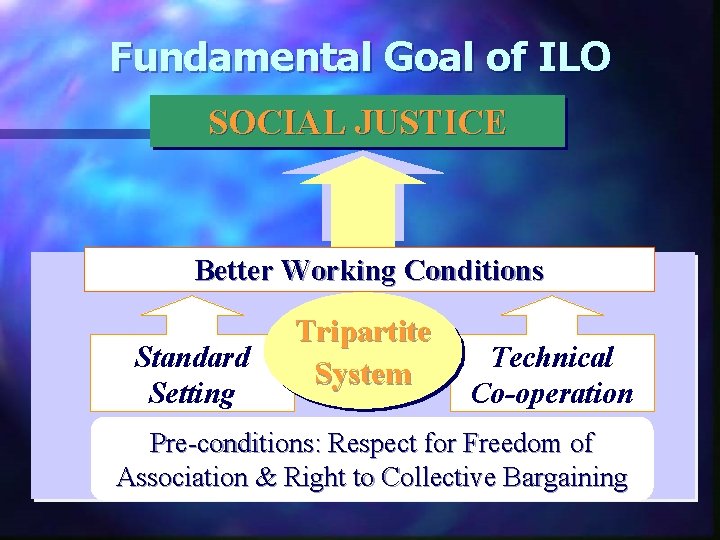
Fundamental Goal of ILO SOCIAL JUSTICE Better Working Conditions Standard Setting Tripartite System Technical Co-operation Pre-conditions: Respect for Freedom of Association & Right to Collective Bargaining
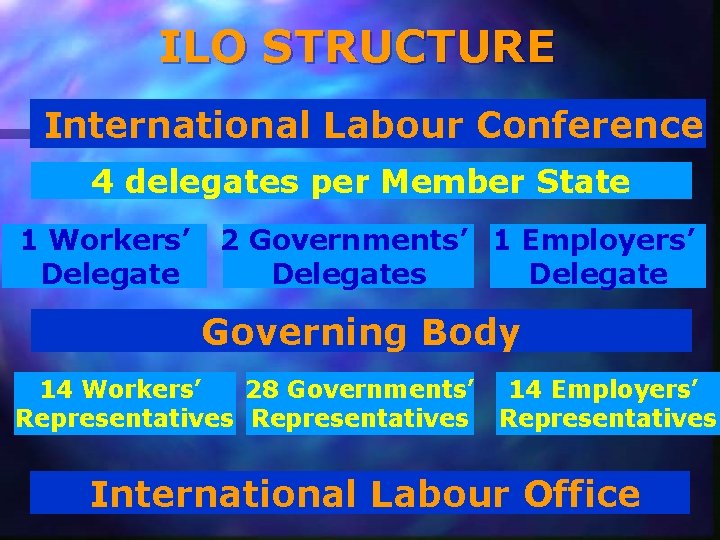
ILO STRUCTURE International Labour Conference 4 delegates per Member State 1 Workers’ Delegate 2 Governments’ 1 Employers’ Delegates Delegate Governing Body 14 Workers’ 28 Governments’ 14 Employers’ Representatives International Labour Office

Major Functions of ILO è Standard Setting - Adoption of Conventions & Recommendations in the ILC; è Assistance in applications of ILS at national level by the countries; è Technical Cooperation – Advisory functions, Action Programs/Projects, Training of Social Partners; è Advocacy for promotion of Decent Work
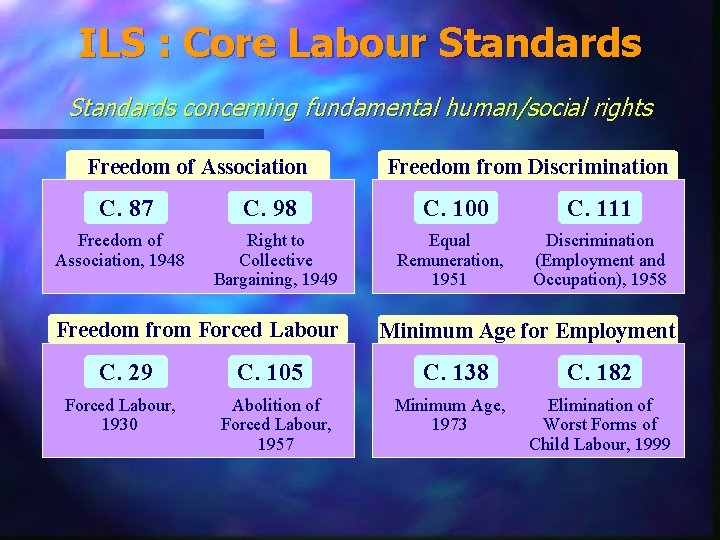
ILS : Core Labour Standards concerning fundamental human/social rights Freedom of Association C. 87 Freedom of Association, 1948 C. 98 Right to Collective Bargaining, 1949 Freedom from Forced Labour C. 29 Forced Labour, 1930 C. 105 Abolition of Forced Labour, 1957 Freedom from Discrimination C. 100 Equal Remuneration, 1951 C. 111 Discrimination (Employment and Occupation), 1958 Minimum Age for Employment C. 138 Minimum Age, 1973 C. 182 Elimination of Worst Forms of Child Labour, 1999
Role of Bureau for Workers' Activities (ACTRAV)
Main role of ACTRAV è Main link between ILO & the Trade Unions; è Develops activities to strengthen TUs & Workers Rights at the international & national levels; è Disseminates policies & programmes of the ILO to trade unions; è Reflects interests of TUs in the programmes & actions of the ILO; è Supports workers’ Group in ILO’s decision making bodies & other activities;
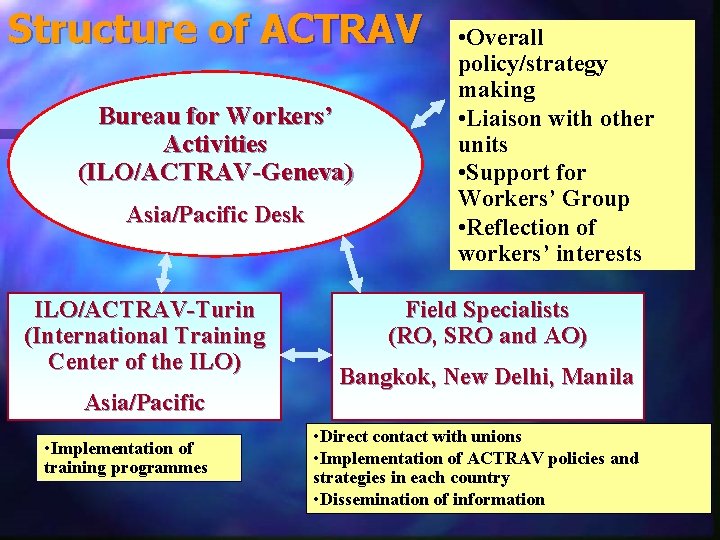
Structure of ACTRAV Bureau for Workers’ Activities (ILO/ACTRAV-Geneva) Asia/Pacific Desk ILO/ACTRAV-Turin (International Training Center of the ILO) Asia/Pacific • Implementation of training programmes • Overall policy/strategy making • Liaison with other units • Support for Workers’ Group • Reflection of workers’ interests Field Specialists (RO, SRO and AO) Bangkok, New Delhi, Manila • Direct contact with unions • Implementation of ACTRAV policies and strategies in each country • Dissemination of information
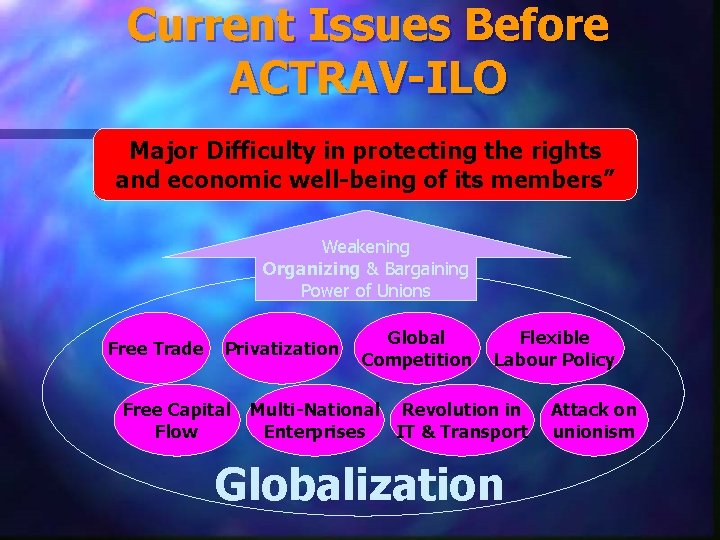
Current Issues Before ACTRAV-ILO Major Difficulty in protecting the rights and economic well-being of its members” Weakening Organizing & Bargaining Power of Unions Free Trade Privatization Free Capital Flow Global Competition Flexible Labour Policy Multi-National Revolution in Enterprises IT & Transport Globalization Attack on unionism
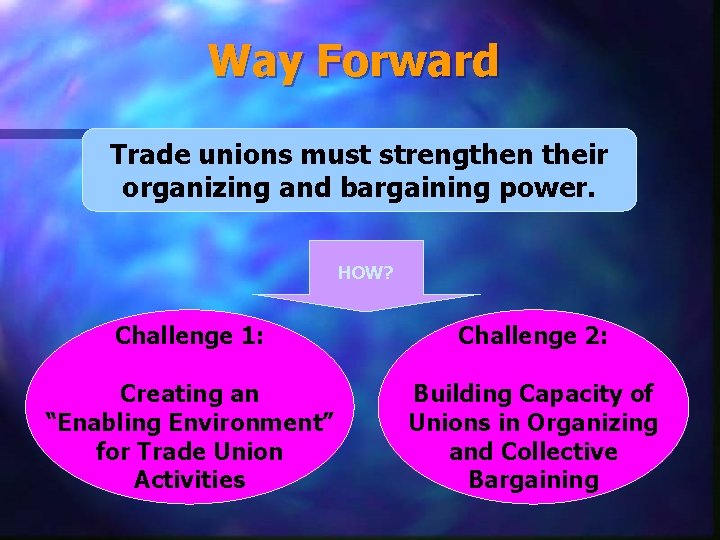
Way Forward Trade unions must strengthen their organizing and bargaining power. HOW? Challenge 1: Challenge 2: Creating an “Enabling Environment” for Trade Union Activities Building Capacity of Unions in Organizing and Collective Bargaining
- Slides: 19