
International interconnection Part 1 Trends in international telecom
- Slides: 26
International interconnection: Part 1: Trends in international telecom traffic Dr Tim Kelly, International Telecommunication Union (ITU) SSGRR, L’Aquila, 26 Oct 1999 Note: The views expressed in this presentation are those of the author and do not necessarily reflect the opinions of the ITU or its membership. Dr Tim Kelly can be contacted by e-mail at Tim. Kelly@itu. int.
International Interconnect: A series of three lectures Part 1: Trends in international traffic Part 2: Managing the transition from revenuesharing to cost-orientation Part 3: The Internet changes everything
Int’l Interconnect: 1. Traffic Trends Agenda l Trends in international traffic ð Steady growth in voice traffic ð Higher percentage originating from mobiles ð Explosive growth of Internet traffic l l l Regional breakdown of traffic Market shares Competitive markets Telecom Italia’s international position ITU/Tele. Geography “Direction of Traffic” publication 3
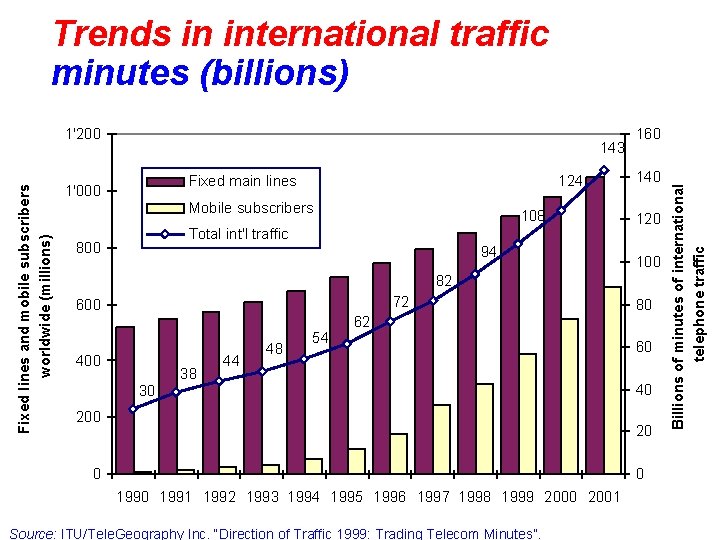
Trends in international traffic minutes (billions) 143 Fixed main lines 1'000 124 Mobile subscribers 108 Total int'l traffic 800 94 160 140 120 100 82 72 600 400 30 38 44 48 54 80 62 200 60 40 20 0 0 1991 1992 1993 1994 1995 1996 1997 1998 1999 2000 2001 Source: ITU/Tele. Geography Inc. “Direction of Traffic 1999: Trading Telecom Minutes”. Billions of minutes of international telephone traffic Fixed lines and mobile subscribers worldwide (millions) 1'200
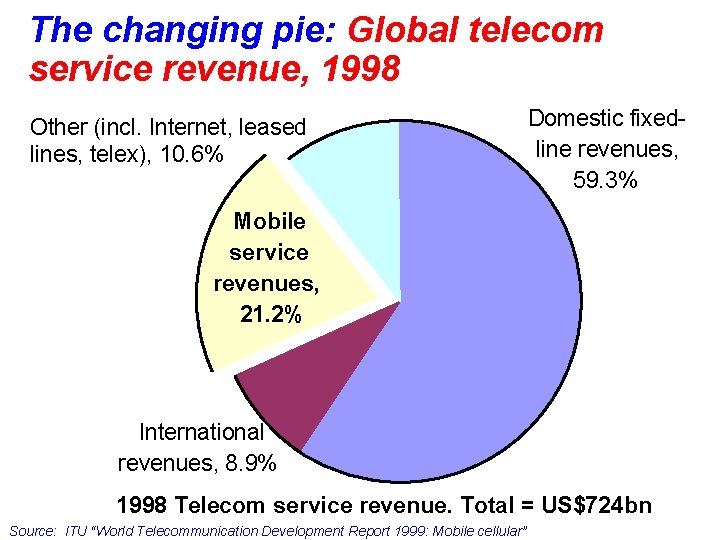
The changing pie: Global telecom service revenue, 1998 Other (incl. Internet, leased lines, telex), 10. 6% Domestic fixedline revenues, 59. 3% Mobile service revenues, 21. 2% International revenues, 8. 9% 1998 Telecom service revenue. Total = US$724 bn Source: ITU “World Telecommunication Development Report 1999: Mobile cellular”
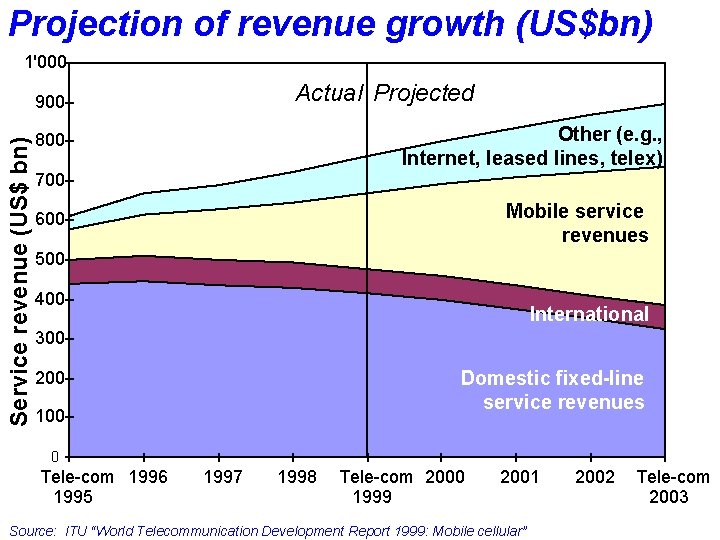
Projection of revenue growth (US$bn) 1'000 Actual Projected Service revenue (US$ bn) 900 Other (e. g. , Internet, leased lines, telex) 800 700 Mobile service revenues 600 500 400 International 300 200 Domestic fixed-line service revenues 100 0 Tele-com 1996 1995 1997 1998 Tele-com 2000 1999 2001 Source: ITU “World Telecommunication Development Report 1999: Mobile cellular” 2002 Tele-com 2003
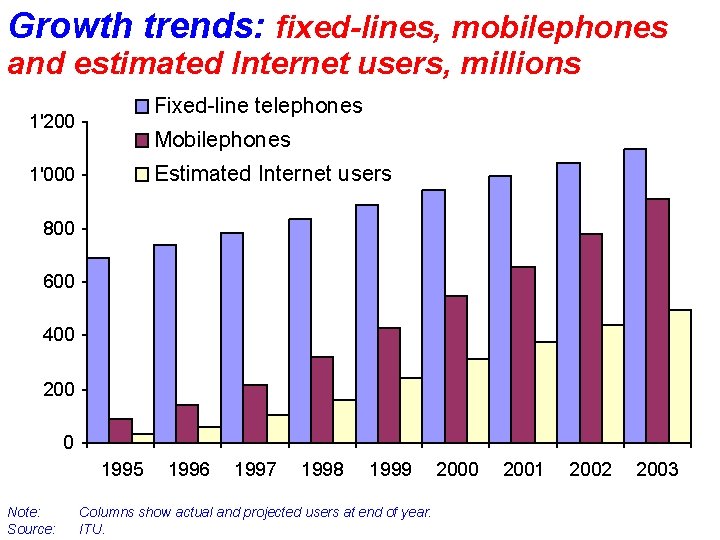
Growth trends: fixed-lines, mobilephones and estimated Internet users, millions Fixed-line telephones 1'200 Mobilephones Estimated Internet users 1'000 800 600 400 200 0 1995 Note: Source: 1996 1997 1998 1999 Columns show actual and projected users at end of year. ITU. 2000 2001 2002 2003
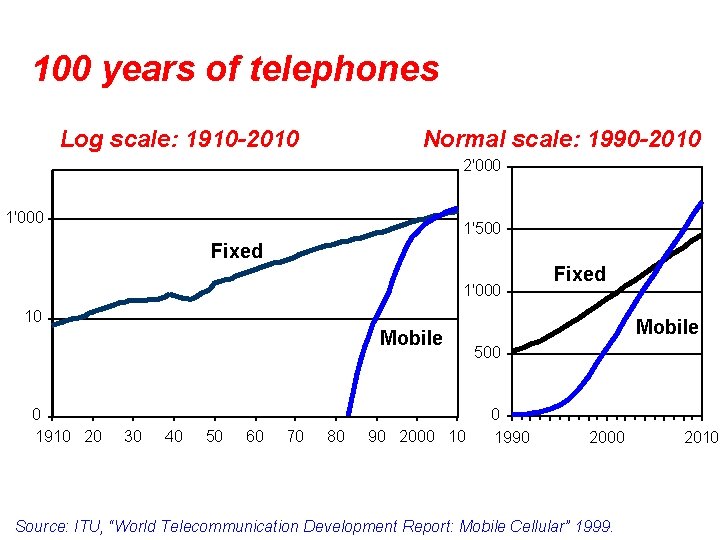
100 years of telephones Log scale: 1910 -2010 Normal scale: 1990 -2010 2'000 1'500 Fixed 1'000 Fixed 10 Mobile 0 1910 20 30 40 50 60 70 80 90 2000 10 Mobile 500 0 1990 2000 Source: ITU, “World Telecommunication Development Report: Mobile Cellular” 1999. 2010
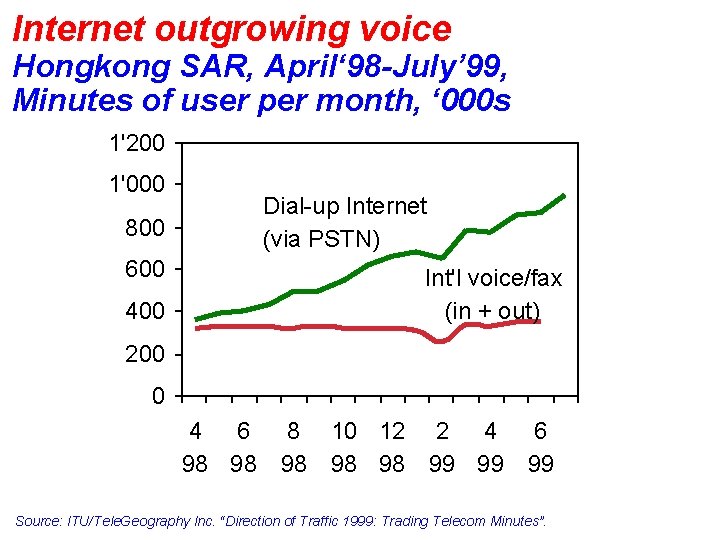
Internet outgrowing voice Hongkong SAR, April‘ 98 -July’ 99, Minutes of user per month, ‘ 000 s 1'200 1'000 800 600 400 Dial-up Internet (via PSTN) Int'l voice/fax (in + out) 200 0 4 6 8 10 12 2 4 6 98 98 98 99 99 99 Source: ITU/Tele. Geography Inc. “Direction of Traffic 1999: Trading Telecom Minutes”.
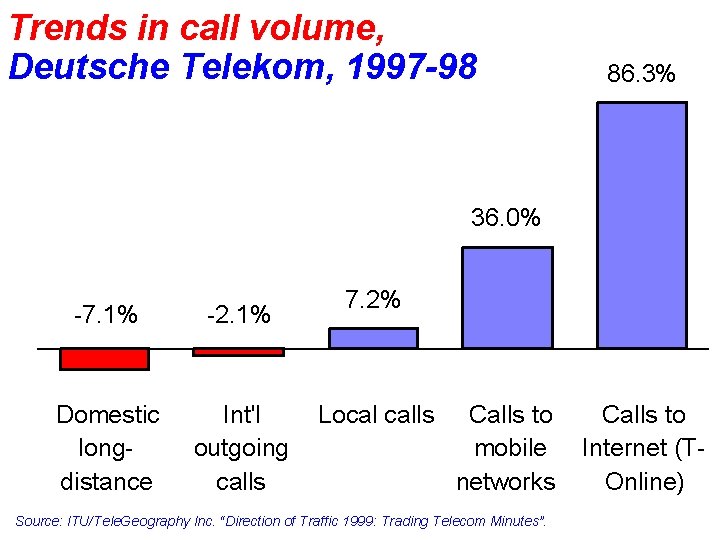
Trends in call volume, Deutsche Telekom, 1997 -98 86. 3% 36. 0% -7. 1% -2. 1% Domestic longdistance Int'l outgoing calls 7. 2% Local calls Calls to mobile networks Source: ITU/Tele. Geography Inc. “Direction of Traffic 1999: Trading Telecom Minutes”. Calls to Internet (TOnline)
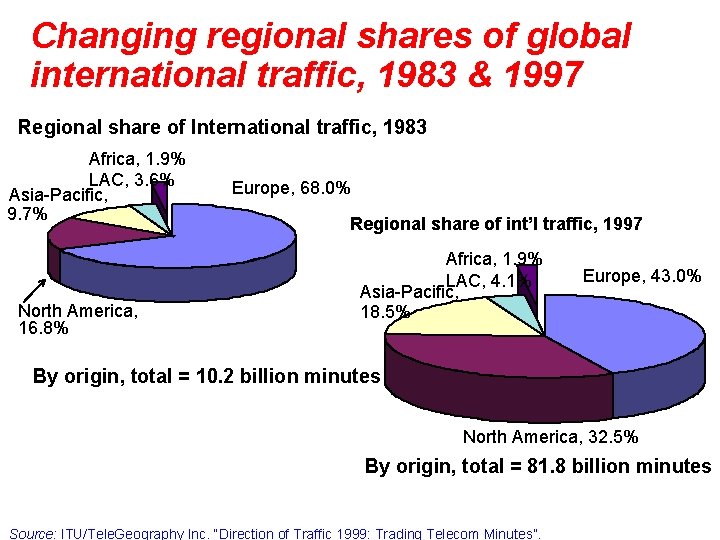
Changing regional shares of global international traffic, 1983 & 1997 Regional share of International traffic, 1983 Africa, 1. 9% LAC, 3. 6% Asia-Pacific, 9. 7% North America, 16. 8% Europe, 68. 0% Regional share of int’l traffic, 1997 Africa, 1. 9% LAC, 4. 1% Asia-Pacific, 18. 5% Europe, 43. 0% By origin, total = 10. 2 billion minutes North America, 32. 5% By origin, total = 81. 8 billion minutes Source: ITU/Tele. Geography Inc. “Direction of Traffic 1999: Trading Telecom Minutes”.
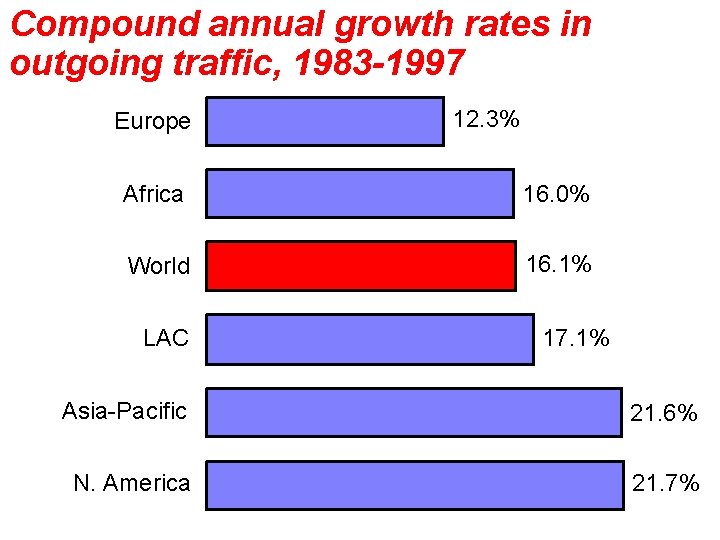
Compound annual growth rates in outgoing traffic, 1983 -1997 Europe 12. 3% Africa 16. 0% World 16. 1% LAC 17. 1% Asia-Pacific 21. 6% N. America 21. 7%
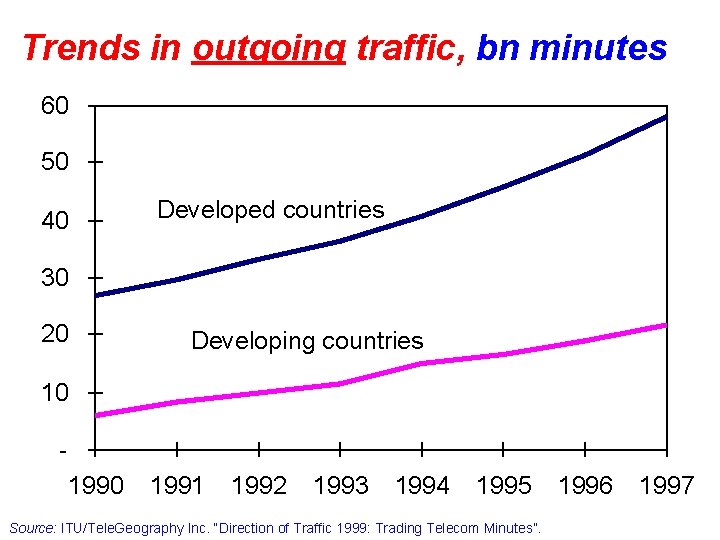
Trends in outgoing traffic, bn minutes 60 50 40 Developed countries 30 20 Developing countries 10 1991 1992 1993 1994 1995 Source: ITU/Tele. Geography Inc. “Direction of Traffic 1999: Trading Telecom Minutes”. 1996 1997
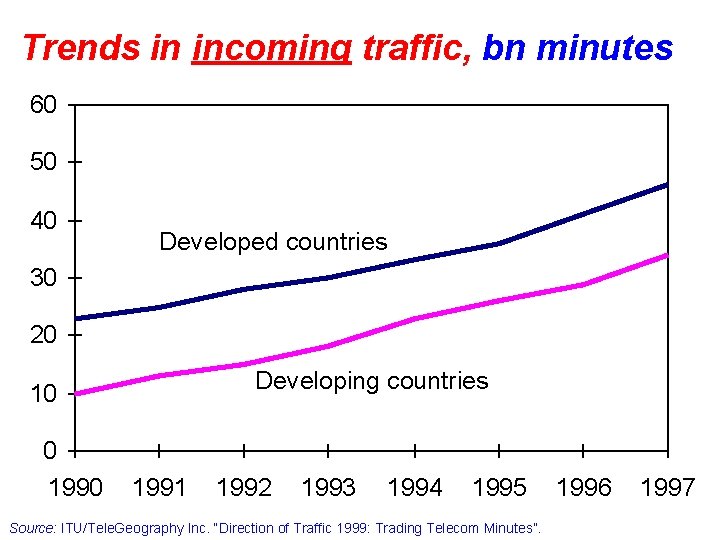
Trends in incoming traffic, bn minutes 60 50 40 Developed countries 30 20 Developing countries 10 0 1991 1992 1993 1994 1995 Source: ITU/Tele. Geography Inc. “Direction of Traffic 1999: Trading Telecom Minutes”. 1996 1997
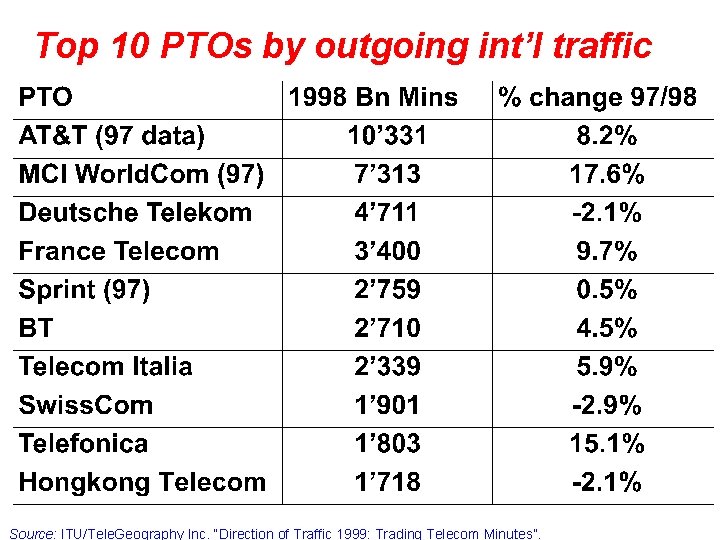
Top 10 PTOs by outgoing int’l traffic Source: ITU/Tele. Geography Inc. “Direction of Traffic 1999: Trading Telecom Minutes”.
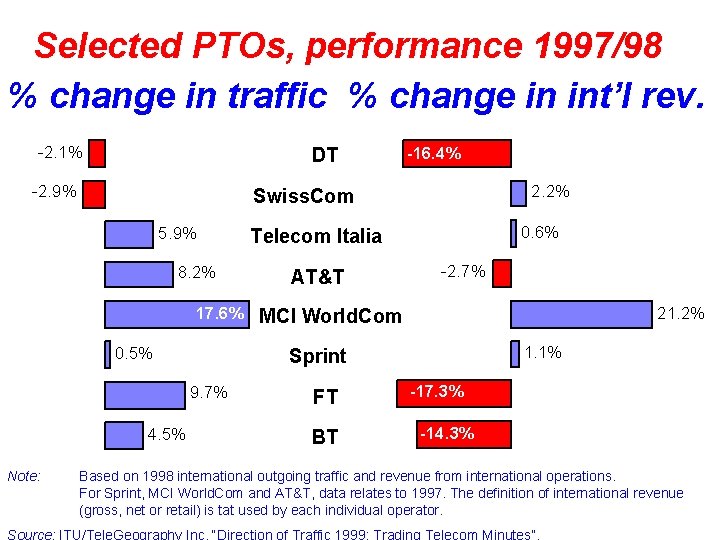
Selected PTOs, performance 1997/98 % change in traffic % change in int’l rev. -2. 1% DT -2. 9% -16. 4% 2. 2% Swiss. Com 5. 9% 8. 2% 0. 6% Telecom Italia AT&T -2. 7% 21. 2% 17. 6% MCI World. Com 0. 5% 9. 7% 4. 5% Note: 1. 1% Sprint FT BT -17. 3% -14. 3% Based on 1998 international outgoing traffic and revenue from international operations. For Sprint, MCI World. Com and AT&T, data relates to 1997. The definition of international revenue (gross, net or retail) is tat used by each individual operator. Source: ITU/Tele. Geography Inc. “Direction of Traffic 1999: Trading Telecom Minutes”.
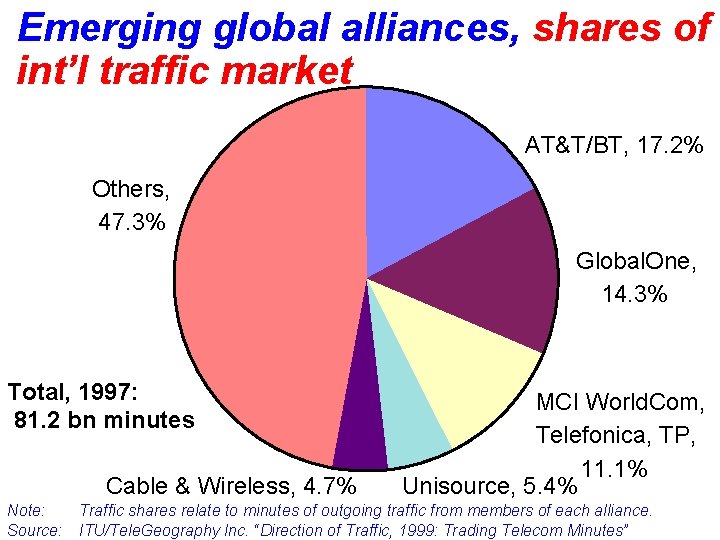
Emerging global alliances, shares of int’l traffic market AT&T/BT, 17. 2% Others, 47. 3% Global. One, 14. 3% Total, 1997: 81. 2 bn minutes Cable & Wireless, 4. 7% Note: Source: MCI World. Com, Telefonica, TP, 11. 1% Unisource, 5. 4% Traffic shares relate to minutes of outgoing traffic from members of each alliance. ITU/Tele. Geography Inc. “Direction of Traffic, 1999: Trading Telecom Minutes”
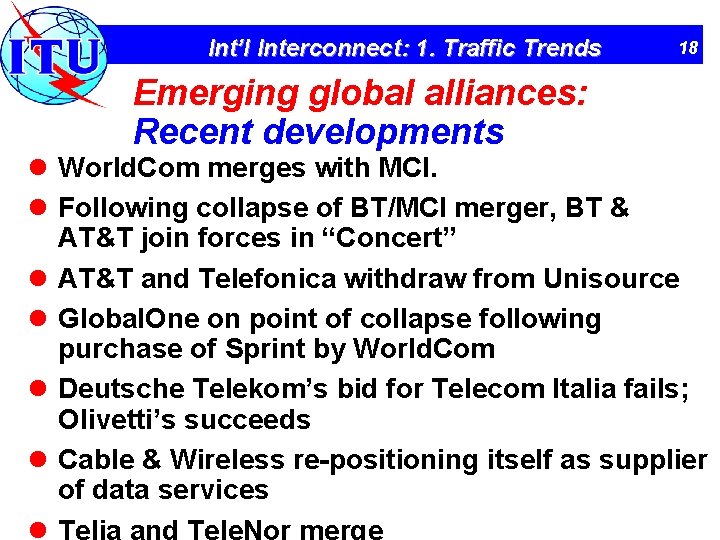
Int’l Interconnect: 1. Traffic Trends Emerging global alliances: Recent developments 18 l World. Com merges with MCI. l Following collapse of BT/MCI merger, BT & AT&T join forces in “Concert” l AT&T and Telefonica withdraw from Unisource l Global. One on point of collapse following purchase of Sprint by World. Com l Deutsche Telekom’s bid for Telecom Italia fails; Olivetti’s succeeds l Cable & Wireless re-positioning itself as supplier of data services l Telia and Tele. Nor merge
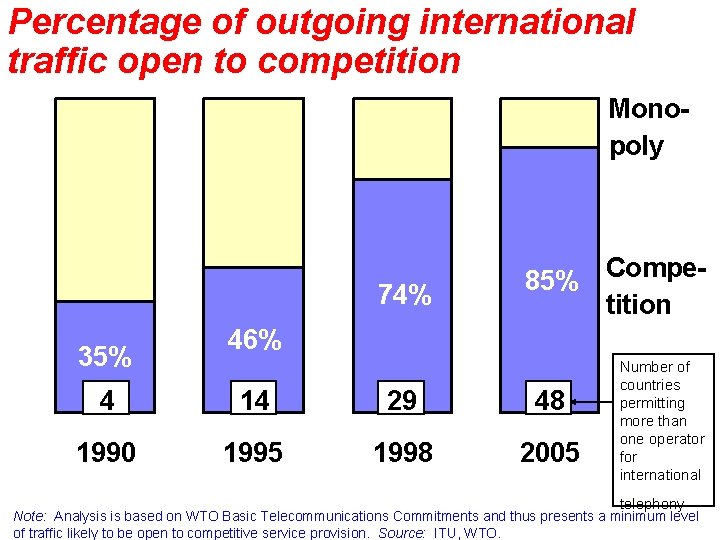
Percentage of outgoing international traffic open to competition Monopoly 74% 35% 85% Competition 46% 4 14 29 48 1990 1995 1998 2005 Number of countries permitting more than one operator for international telephony Note: Analysis is based on WTO Basic Telecommunications Commitments and thus presents a minimum level of traffic likely to be open to competitive service provision. Source: ITU, WTO.
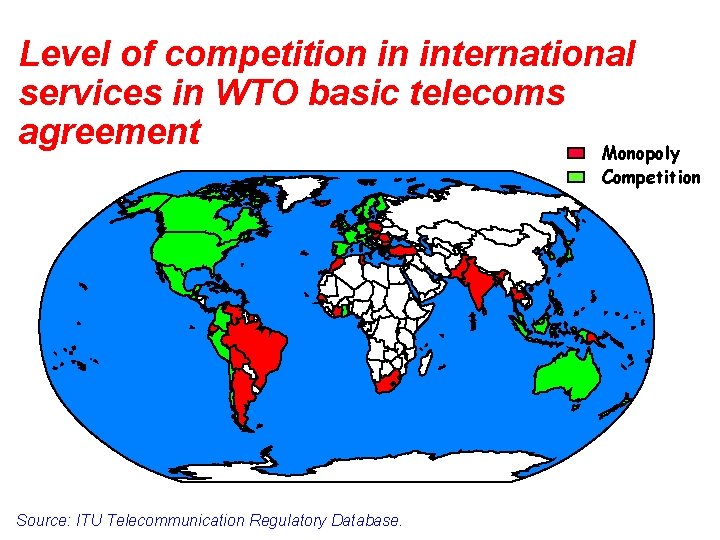
Level of competition in international services in WTO basic telecoms agreement Monopoly Competition Source: ITU Telecommunication Regulatory Database.
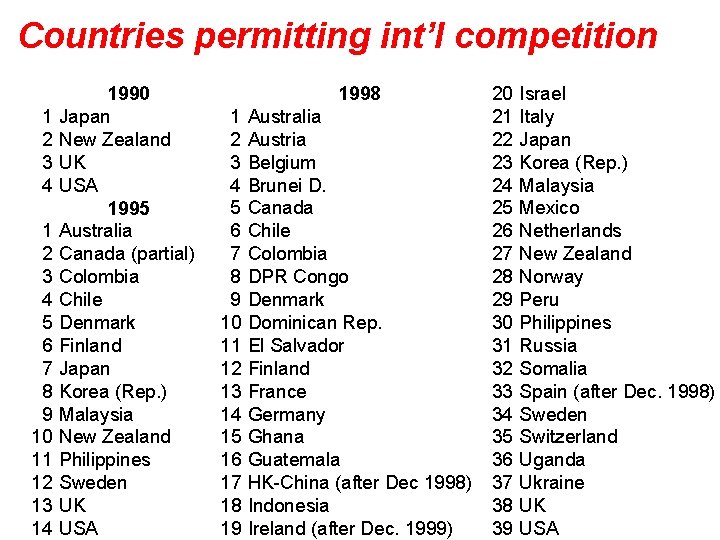
Countries permitting int’l competition 1 2 3 4 5 6 7 8 9 10 11 12 13 14 1990 Japan New Zealand UK USA 1995 Australia Canada (partial) Colombia Chile Denmark Finland Japan Korea (Rep. ) Malaysia New Zealand Philippines Sweden UK USA 1998 1 2 3 4 5 6 7 8 9 10 11 12 13 14 15 16 17 18 19 Australia Austria Belgium Brunei D. Canada Chile Colombia DPR Congo Denmark Dominican Rep. El Salvador Finland France Germany Ghana Guatemala HK-China (after Dec 1998) Indonesia Ireland (after Dec. 1999) 20 21 22 23 24 25 26 27 28 29 30 31 32 33 34 35 36 37 38 39 Israel Italy Japan Korea (Rep. ) Malaysia Mexico Netherlands New Zealand Norway Peru Philippines Russia Somalia Spain (after Dec. 1998) Sweden Switzerland Uganda Ukraine UK USA
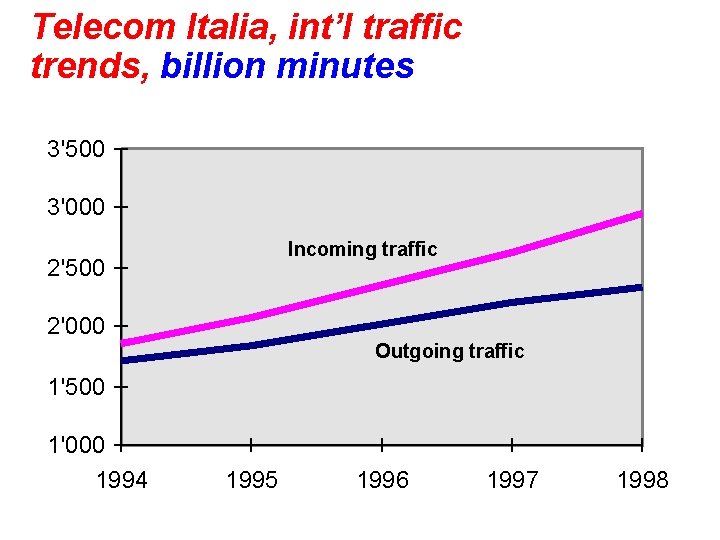
Telecom Italia, int’l traffic trends, billion minutes 3'500 3'000 Incoming traffic 2'500 2'000 Outgoing traffic 1'500 1'000 1994 1995 1996 1997 1998
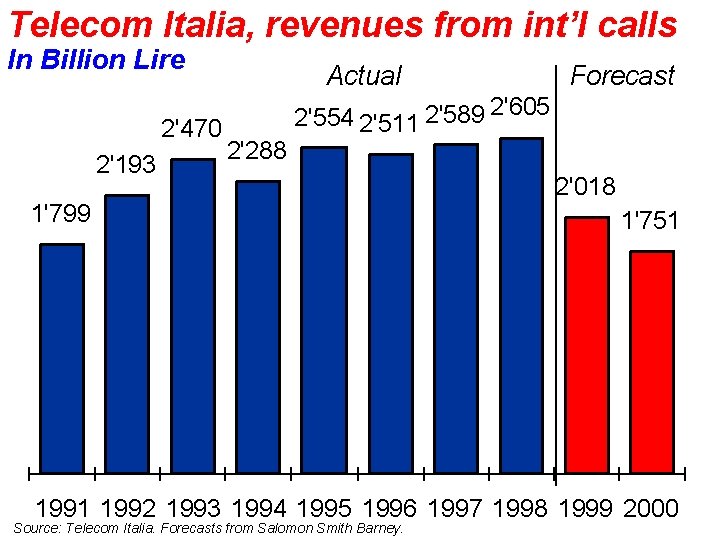
Telecom Italia, revenues from int’l calls In Billion Lire 2'470 2'193 Actual 2'288 Forecast 2'554 2'511 2'589 2'605 1'799 2'018 1'751 1992 1993 1994 1995 1996 1997 1998 1999 2000 Source: Telecom Italia. Forecasts from Salomon Smith Barney.
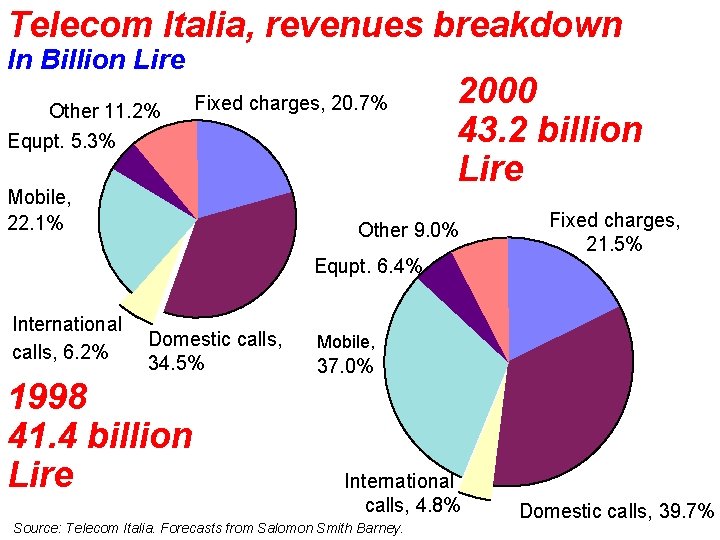
Telecom Italia, revenues breakdown In Billion Lire Other 11. 2% Equpt. 5. 3% Fixed charges, 20. 7% Mobile, 22. 1% 2000 43. 2 billion Lire Other 9. 0% Equpt. 6. 4% International calls, 6. 2% Domestic calls, 34. 5% 1998 41. 4 billion Lire Fixed charges, 21. 5% Mobile, 37. 0% International calls, 4. 8% Source: Telecom Italia. Forecasts from Salomon Smith Barney. Domestic calls, 39. 7%
Int’l Interconnect: 1. Traffic Trends International traffic trends: Conclusions l Voice traffic continuing to grow, but the main action is now elsewhere l Mobile and the Internet will be the major demand drivers for the future l Competitive markets will be the norm, monopolistic markets the exception in the future l Alliances will continue to be formed, but partnerships are still unstable 25
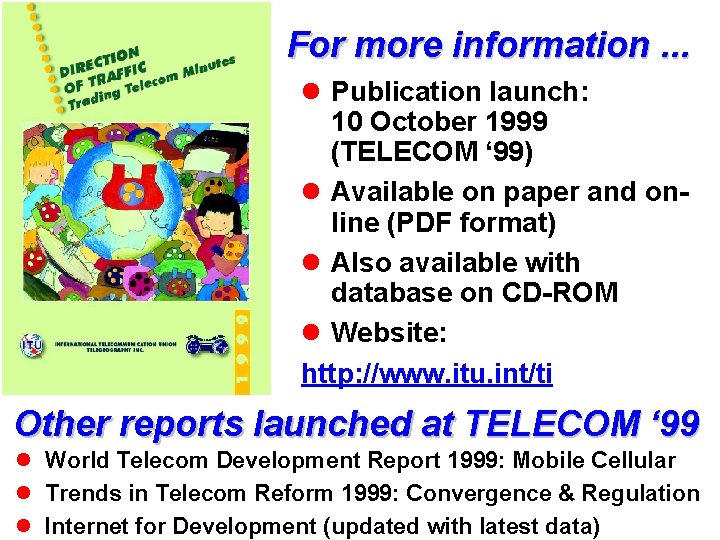
For more information. . . l Publication launch: 10 October 1999 (TELECOM ‘ 99) l Available on paper and online (PDF format) l Also available with database on CD-ROM l Website: http: //www. itu. int/ti Other reports launched at TELECOM ‘ 99 l World Telecom Development Report 1999: Mobile Cellular l Trends in Telecom Reform 1999: Convergence & Regulation l Internet for Development (updated with latest data)