
International Hospitality Marketing Appreciate its role and importance
- Slides: 18
International Hospitality Marketing § Appreciate its role and importance § Understand the impact of the marking environment § Consider why and how the marking mix may need to be adapted in different oversea markets
International Hospitality Marketing § Definition: the process of identifying the goods and services that customers outside the home country want and then providing them at the right price and location Rugman and collinson (2006 p 32) in Clarke, A. , and Chen, w. , (2007)
Global Markets are increasing due to: § Global wealth is increasing § Higher demand § Growth economies: South American , Eastern Europe , Parts of Asian : south east & China and Middle East. BRIC Economies § Consumers seeking choice § More competition § More away from commodity purchase to service products
Global Markets are increasing due to: § Half pf global population is pre-adult § Global older consumer § Top 500 companies account for 70% of world trade and 80% of international investment § Companies are consolidating § technology and communication Ø computer Ø Internet Ø transport
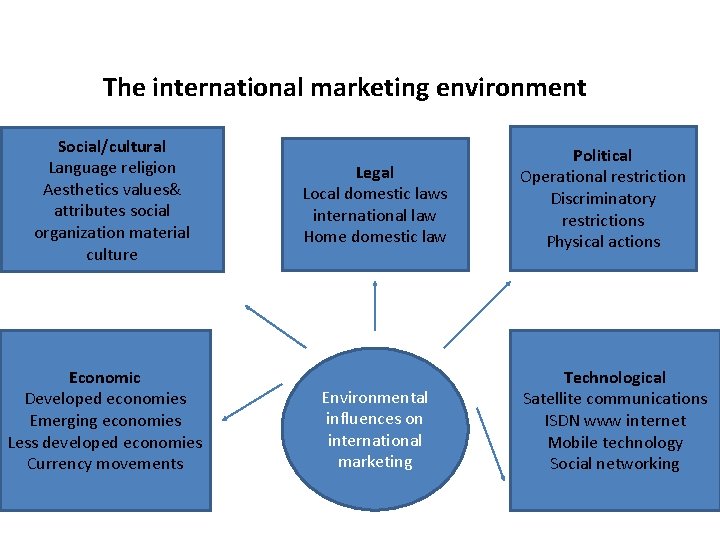
The international marketing environment Social/cultural Language religion Aesthetics values& attributes social organization material culture Economic Developed economies Emerging economies Less developed economies Currency movements Legal Local domestic laws international law Home domestic law Environmental influences on international marketing Political Operational restriction Discriminatory restrictions Physical actions Technological Satellite communications ISDN www internet Mobile technology Social networking
Differences which require particular attention § § Cultural differences Language Social structure and customs Value and attitudes Technological factor Economic and competitive factors Political and legal factors
Marketing research § Identification of cultural , social and technological difficulties. § Language --- questionnaires and translation § Different cultural responses § Samples---are they comparable ? What about bias? § Possible solution…. Employ local market research agency
Key international concepts(as opposed to 4 Marketing Ps) § Product ---production variables ; capacity , delivery of quality, logistics……. § Sale ----can the same product be sold at home and oversea? An assumption that global consumers are similar. Global chains § The Customer -----identifying and satisfying need. Consider need in new marketing § Societal differences need consideration
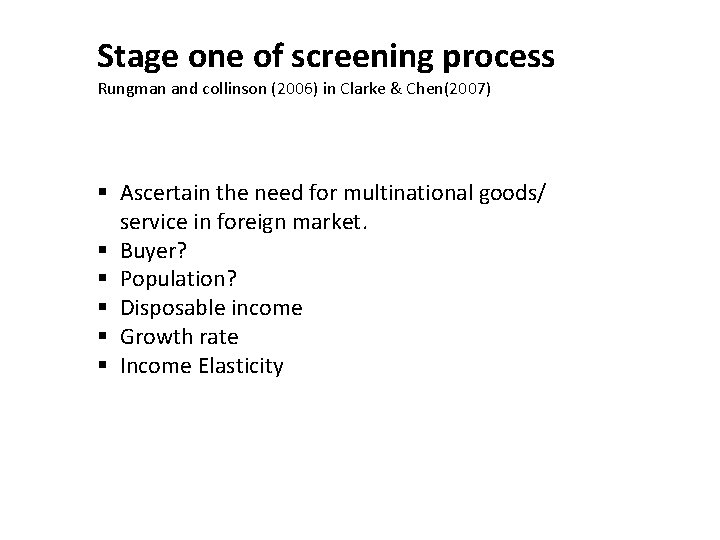
Stage one of screening process Rungman and collinson (2006) in Clarke & Chen(2007) § Ascertain the need for multinational goods/ service in foreign market. § Buyer? § Population? § Disposable income § Growth rate § Income Elasticity
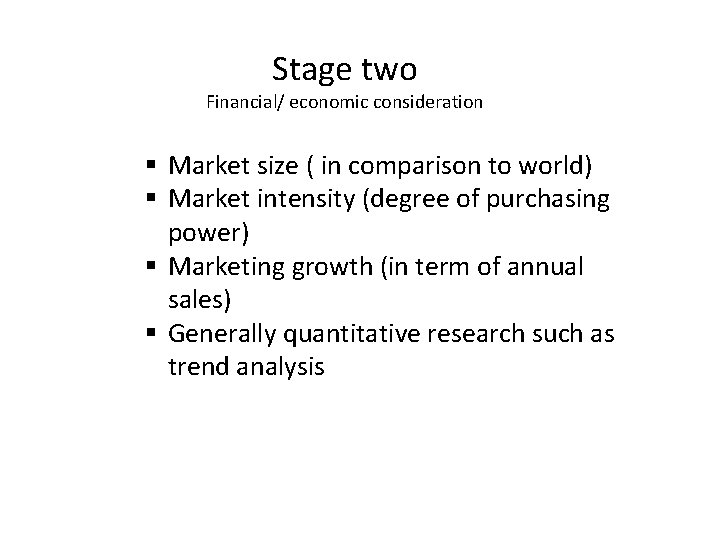
Stage two Financial/ economic consideration § Market size ( in comparison to world) § Market intensity (degree of purchasing power) § Marketing growth (in term of annual sales) § Generally quantitative research such as trend analysis
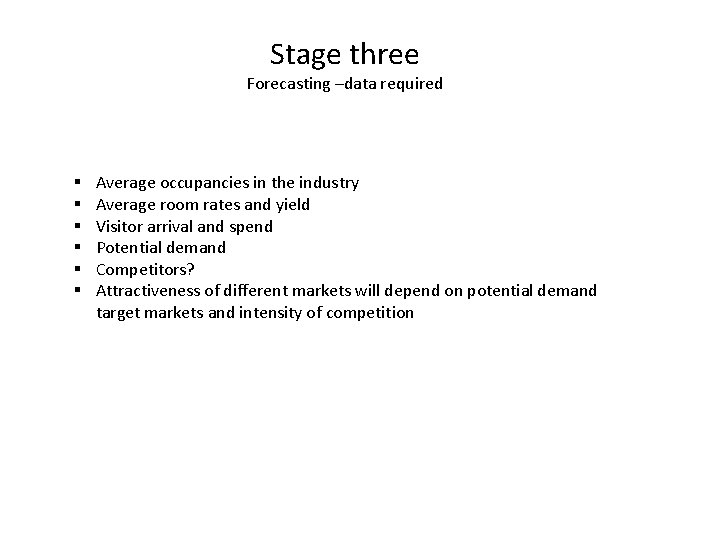
Stage three Forecasting –data required § § § Average occupancies in the industry Average room rates and yield Visitor arrival and spend Potential demand Competitors? Attractiveness of different markets will depend on potential demand target markets and intensity of competition
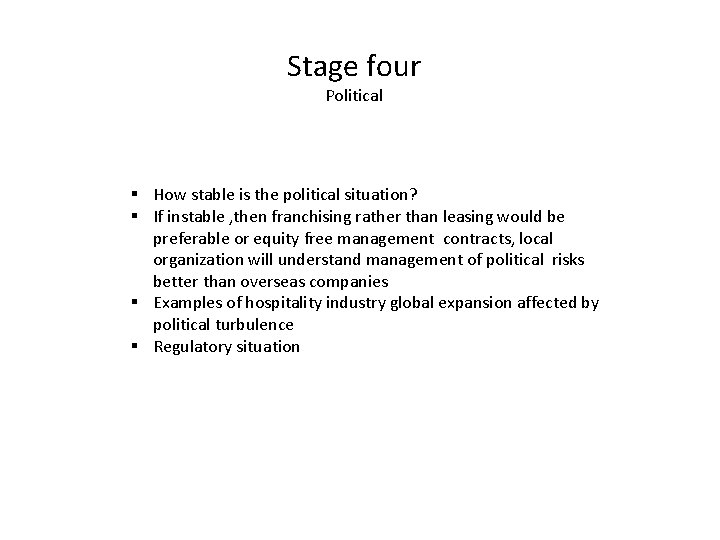
Stage four Political § How stable is the political situation? § If instable , then franchising rather than leasing would be preferable or equity free management contracts, local organization will understand management of political risks better than overseas companies § Examples of hospitality industry global expansion affected by political turbulence § Regulatory situation
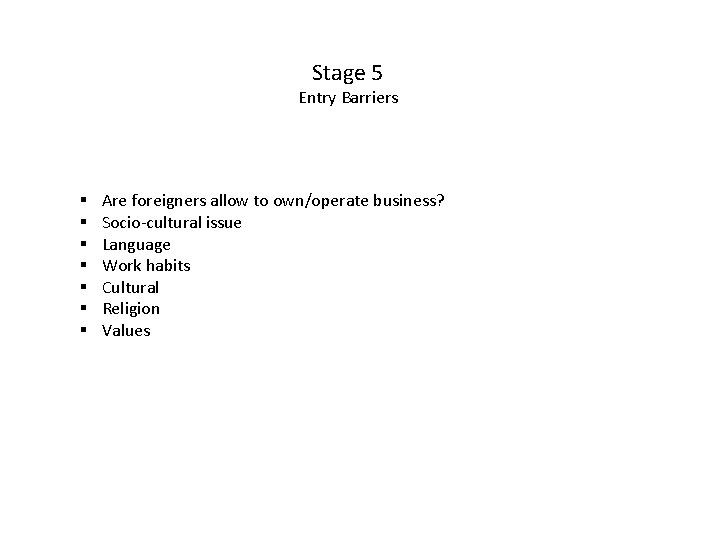
Stage 5 Entry Barriers § § § § Are foreigners allow to own/operate business? Socio-cultural issue Language Work habits Cultural Religion Values
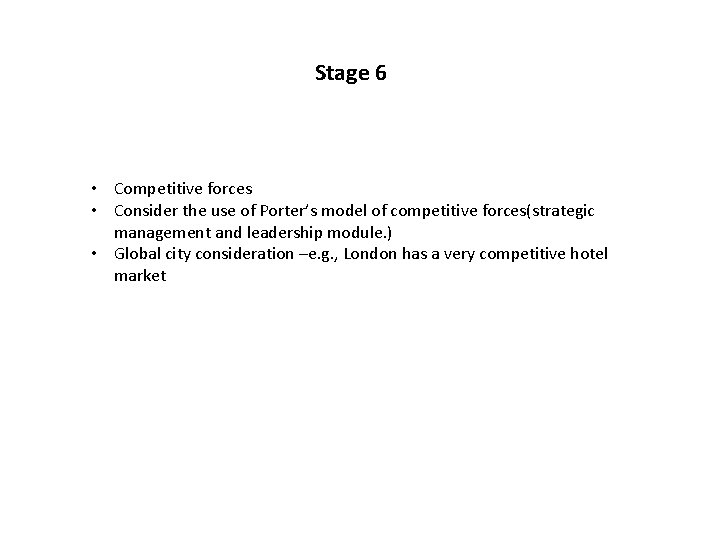
Stage 6 • Competitive forces • Consider the use of Porter’s model of competitive forces(strategic management and leadership module. ) • Global city consideration –e. g. , London has a very competitive hotel market
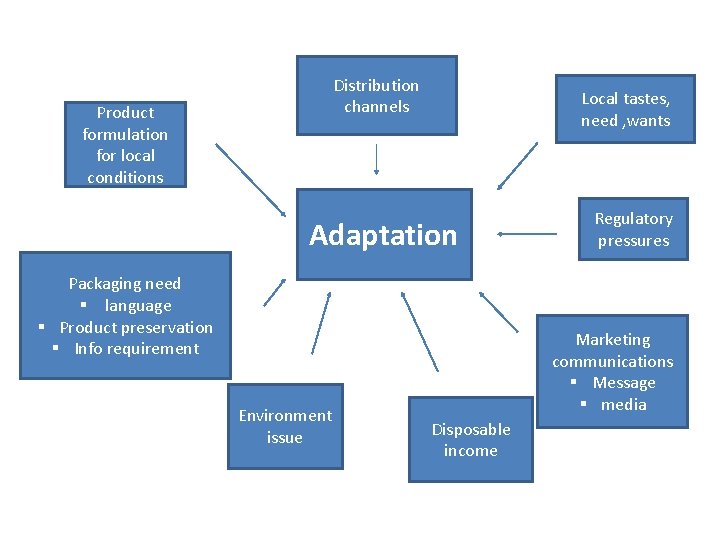
Distribution channels Product formulation for local conditions Local tastes, need , wants Adaptation Packaging need § language § Product preservation § Info requirement Environment issue Regulatory pressures Marketing communications § Message § media Disposable income
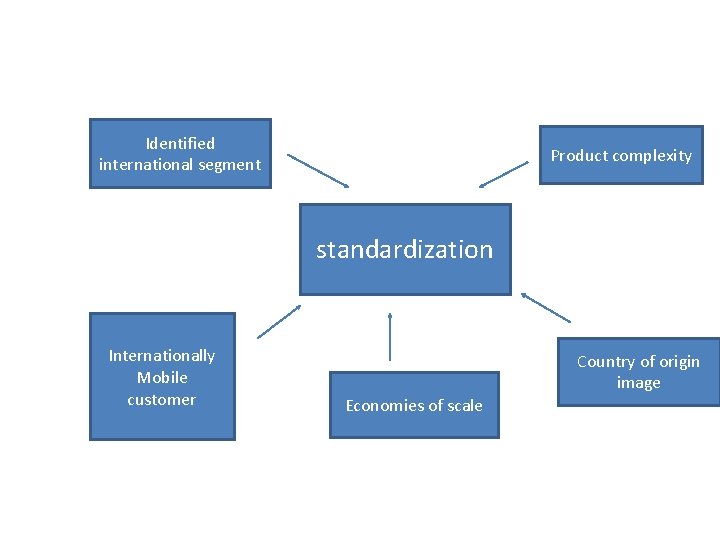
Identified international segment Product complexity standardization Internationally Mobile customer Country of origin image Economies of scale
Global market segmentation § Emergence of new segments ---multi ethic group. § Essential to segment market prior to deciding on marketing mix § Demographic § Income and population § Currency ---why will it buy? § Size of market----GDP terms § Gender---preferences
Market segmentation implications § Ethnic origin, religion, nationality § Food and religion. Breakfast in global business hotels § Marketing material and staff: language proficiency issues § Provision of e. g. cable TV in emerging markets and language: Chinese, Japanese , Korean channel