
INTERNATIONAL FINANCIAL REPORTING STANDARDS PRESENTATION BY FALGUNI AGGARWAL
INTERNATIONAL FINANCIAL REPORTING STANDARDS PRESENTATION BY: FALGUNI AGGARWAL AANCHAL MALHOTRA MISHA CHAHAT SHORI BCOM 3 A
IFRS : MEANING • International Financial Reporting Standards (IFRS) set common rules so that financial statements can be consistent, transparent and comparable around the world. • IFRS are issued by the International Accounting Standards Board (IASB). • They specify how companies must maintain and report their accounts, defining types of transactions and other events with financial impact. • IFRS were established to create a common accounting language, so that businesses and their financial statements can be consistent and reliable from company to company and country to country.
HISTORY • The International Accounting Standards Committee (IASC) was established in June 1973 by accountancy bodies representing ten countries. It devised and published International Accounting Standards (IAS), interpretations and a conceptual framework. These were looked to by many national accounting standard-setters in developing national standards. • In 2001 the International Accounting Standards Board (IASB) replaced the IASC with a remit to bring about convergence between national accounting standards through the development of global accounting standards. During its first meeting the new Board adopted existing IAS and Standing Interpretations Committee standards (SICs). The IASB has continued to develop standards calling the new standards "International Financial Reporting Standards" (IFRS). • In 2002 the European Union (EU) agreed that, from 1 January 2005, International Financial Reporting Standards would apply for the consolidated accounts of the EU listed companies, bringing about the introduction of IFRS to many large entities. Other countries have since followed the lead of the EU.
OBJECTIVES OF IFRS • To promote the use and rigorous application of accounting standards. • To report the information on time i. e. undue delay should be avoided. • To identify the trends in the financial position and performance so that users must be able to compare the financial statements of different enterprises. • To make the information included in financial statement more reliable so that users can take correct decisions. • To take account of as appropriate the special needs of small and medium sized entities and emerging economies.
SCOPE OF IFRS • IASB standards are known as International Reporting Standards • All International Accounting Standards and interpretations issued by former IASC continue to be applicable unless and until they are amended or withdrawn. • Entities other than profit oriented business entities may also find the IFRS appropriate. • IFRS apply to individual company and consolidated financial statement.
NEED FOR IFRS • Uniformity. IFRS provides single set of accounting standards that would enable international standardization and better quality on global scene. • International capital. IFRS would also permit international capital to flow more freely. • Regulators. IFRS would be beneficial to regulators too as it would reduce the complexity associated with reporting regime. • Investors. IFRS gives a better understanding to financial statements and assess the investment opportunities other than home country.
ADVANTAGES OF IFRS • The first factor is that IFRS promise more accurate, timely and comprehensive financial statement information that is relevant to the national standards. • Reducing international differences in reporting standards by applying IFRS, in a sense removes a cross border takeovers and acquisitions by investors. • Due to harmonization and standardization of reporting standards under IFRS, the investors do not need to pay for processing and adjusting the financial statements to be able to understand them, thus eliminating the fees of analysts. Therefore, IFRS reduces the cost for investors. • This also helps new or small investors by making the reporting standards simpler and better quality as it puts small and new investors in the same position with other professional investors as it was impossible under the previous reporting standards.
DISADVANTAGES OF IFRS • It would increase the cost of implementation for small businesses. • It would lead to concerns with standards manipulation. • It would require global consistency in auditing and enforcement. • It would increase the amount of work placed on accountants.
CONVERGENCE OF IFRS AND INDIAN AS • Indian Accounting Standards are formulated by the Accounting Standard Board (ASB) of the ICAI as notified by the Ministry of Corporate Affair. These standards are framed keeping in mind the economic environment and practices of India. They are made to suit the Indian companies and the disclosure requirements of the Indian government. • The IFRS, on the other hand, are made keeping global standards and environment in mind. Convergence would mean bridging the gap between the two, i. e the IFRS and the India AS. Convergence will involve alignment of the two sets of standards. The compromise is done by adopting the policies of the IFRS either fully or at least partially.

BENEFITS OF CONVERGENCE • Beneficial to the Economy • If the accounting standards are converged it will promote international business and increase the influx of capital into the country. • Beneficial to Investors • Convergence is a boon for investors who wish to invest in foreign markets or economies. • Beneficial to the Industry • With globally accepted standards the industry can also surge ahead. So convergence is important for the industry as well. • More Transparency • Convergence will benefit the users of the financial statements as well. It will make it easier for them to understand the financial statements.
DIFFICULTIES OF CONVERGENCE WITH THE IFRS • Other than the Accounting Standards, India has many rules and regulations to implement them. These rules will have to be updated as well. • Accounting is done via software these days, like Tally, Oracle, etc. Convergence with IFRS means this software will have to be updated at great costs. • Also, there is a lack of trained and efficient personnel. The accountants, auditors, etc will have to undergo training and learning programmes for the updated standards.
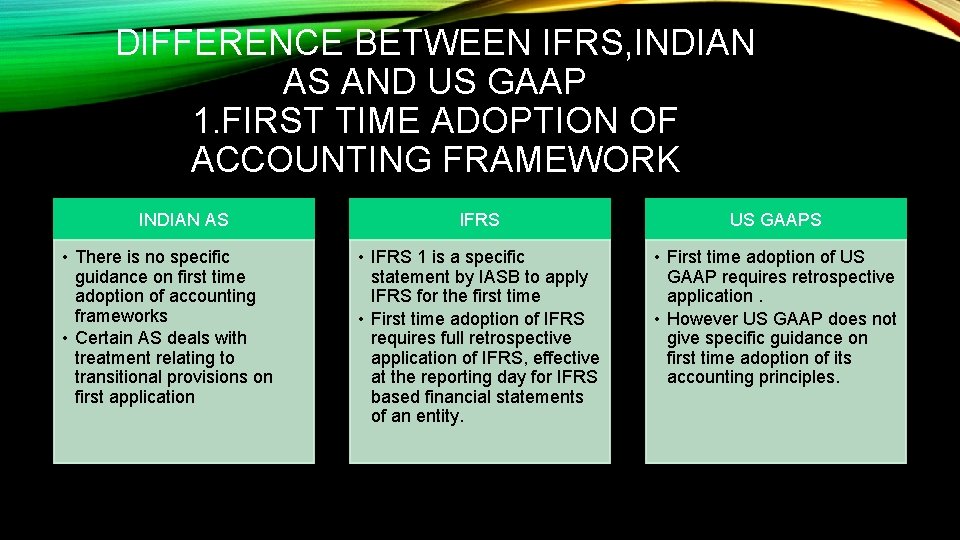
DIFFERENCE BETWEEN IFRS, INDIAN AS AND US GAAP 1. FIRST TIME ADOPTION OF ACCOUNTING FRAMEWORK INDIAN AS • There is no specific guidance on first time adoption of accounting frameworks • Certain AS deals with treatment relating to transitional provisions on first application IFRS US GAAPS • IFRS 1 is a specific statement by IASB to apply IFRS for the first time • First time adoption of IFRS requires full retrospective application of IFRS, effective at the reporting day for IFRS based financial statements of an entity. • First time adoption of US GAAP requires retrospective application. • However US GAAP does not give specific guidance on first time adoption of its accounting principles.
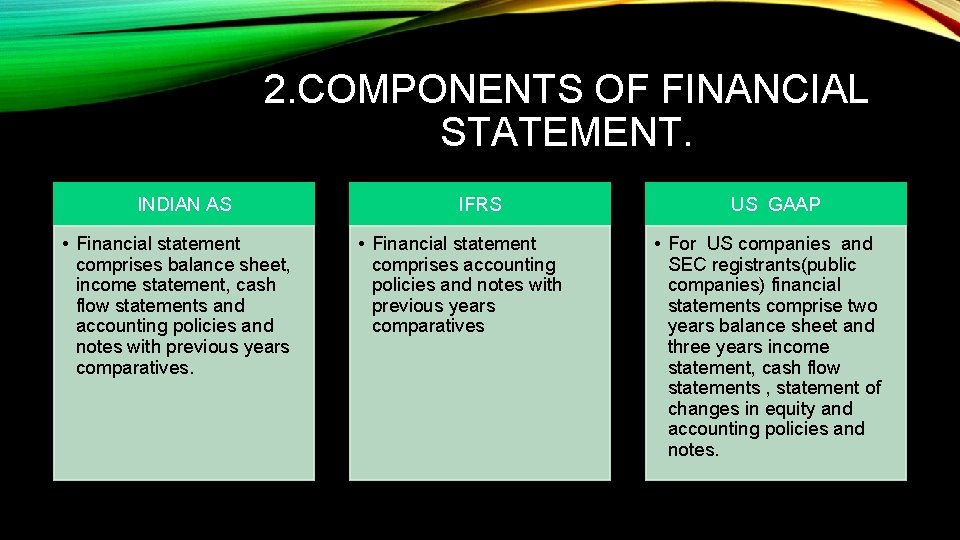
2. COMPONENTS OF FINANCIAL STATEMENT. INDIAN AS • Financial statement comprises balance sheet, income statement, cash flow statements and accounting policies and notes with previous years comparatives. IFRS • Financial statement comprises accounting policies and notes with previous years comparatives US GAAP • For US companies and SEC registrants(public companies) financial statements comprise two years balance sheet and three years income statement, cash flow statements , statement of changes in equity and accounting policies and notes.
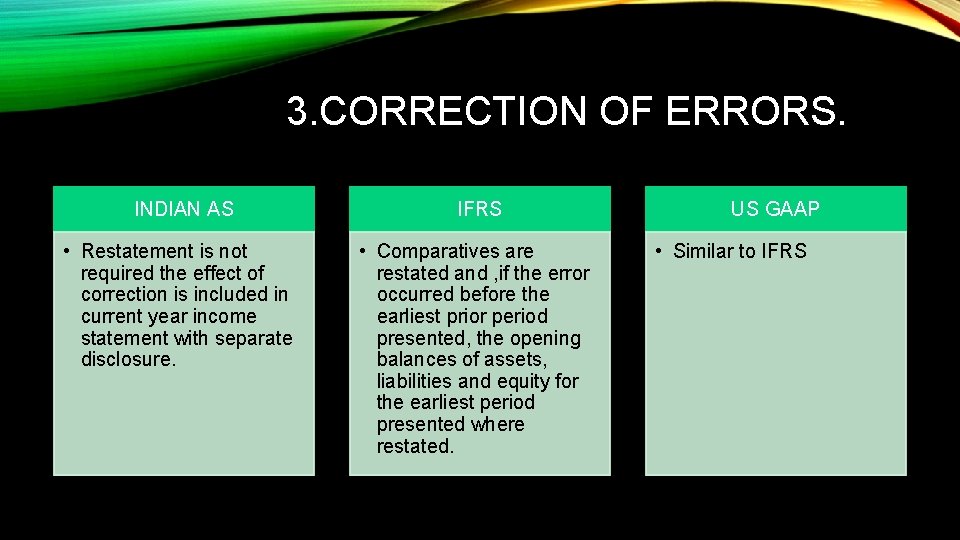
3. CORRECTION OF ERRORS. INDIAN AS IFRS • Restatement is not required the effect of correction is included in current year income statement with separate disclosure. • Comparatives are restated and , if the error occurred before the earliest prior period presented, the opening balances of assets, liabilities and equity for the earliest period presented where restated. US GAAP • Similar to IFRS
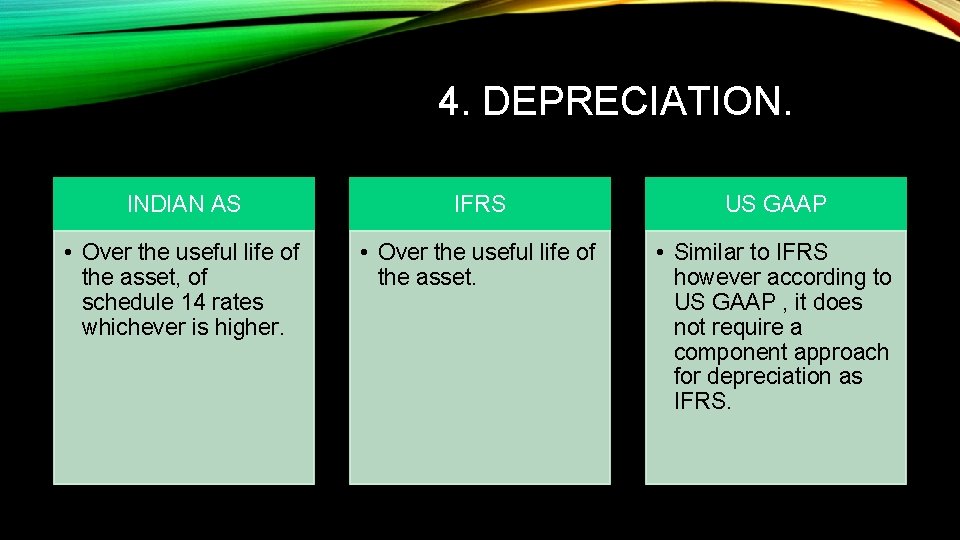
4. DEPRECIATION. INDIAN AS IFRS US GAAP • Over the useful life of the asset, of schedule 14 rates whichever is higher. • Over the useful life of the asset. • Similar to IFRS however according to US GAAP , it does not require a component approach for depreciation as IFRS.
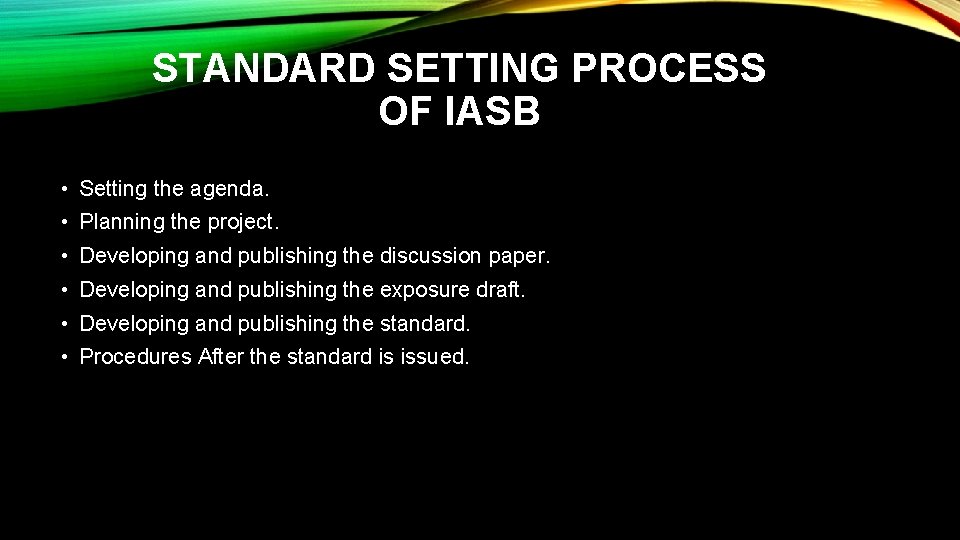
STANDARD SETTING PROCESS OF IASB • Setting the agenda. • Planning the project. • Developing and publishing the discussion paper. • Developing and publishing the exposure draft. • Developing and publishing the standard. • Procedures After the standard is issued.
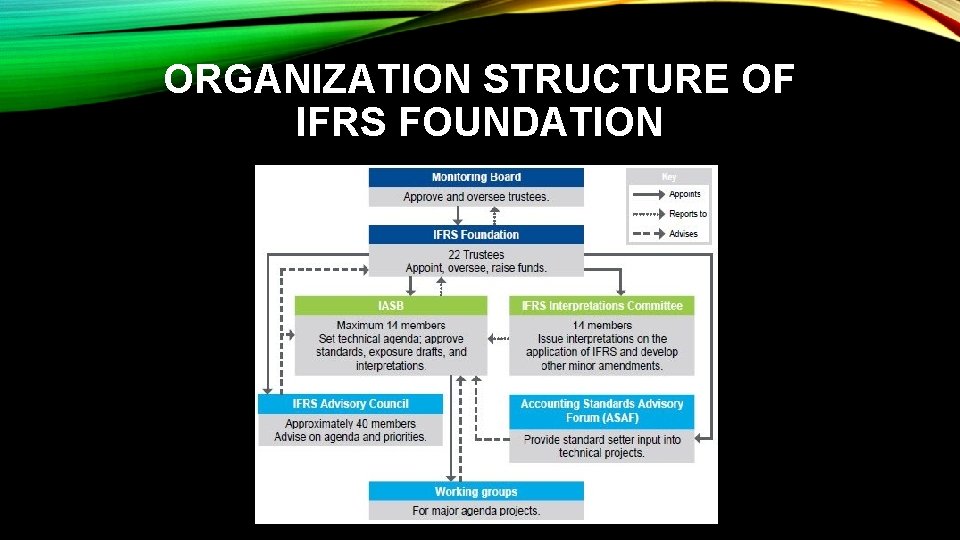
ORGANIZATION STRUCTURE OF IFRS FOUNDATION
- Slides: 17