
International Finance Corporation CDM Regulatory Process A Private




- Slides: 14
International Finance Corporation CDM Regulatory Process: A Private Sector Perspective Market Perspectives on CDM Business Council for Sustainable Energy/ Emissions Marketing Association COP 9 December 3, 2003
International Finance Corporation • Member of World Bank Group -- owned by 175 governments • Invests on a commercial basis in developing countries only - Profitable every year since founded in 1956 - AAA-rated international borrower • Net worth of $6. 8 billion • Committed loan and equity portfolio of $16. 8 billion • In fiscal year 2003, IFC approved $4. 0 billion in financing for 186 new projects with a total cost of $13 billion
IFC Equity Investments $ 3. 5 Billion in equity currently invested in 652 companies in Latin America, Africa, Asia, and Eastern/Central Europe Sectors include: • • Energy – Generation, Distribution, Transmission Oil, Gas, and Mining Manufacturing Agriculture, Forestry, and Wood Products
IFC Carbon Finance Activity IFC-Netherlands Carbon Facility (INCa. F) • € 44 M to to buy GHG emission reductions under CDM • Renewable energy, energy efficiency, fuel switching, waste management, and landfill gas projects Additional Facilities • JI Facility for Central/Eastern Europe to be offered soon • Additional CDM/JI facilities under negotiation Financial Products • Developing specialized financing products for CDM/JI projects
Methodology Approval Process • • 35 distinct methodologies have been reviewed by the Meth Panel since May, 2003 Approved/ A-rated Methodologies: • • Landfill Gas – 4 different methodologies HFC Decomposition – 1 Hydroelectric – 2 Biomass power generation – 1 Fuel Switch, from coal/petroleum to natgas- 1 Methodologies have been largely project specific rather than applicable to a wide range of similar types of projects Project participants becoming increasingly frustrated with methodology approval process and the time it is taking Key Obstacles: • Continued uncertainty and lack of consensus on what demonstrates a project’s “Additionality” • Lengthy process required for approval
Methodology Process - Additionality • Uncertainty among market participants regarding “Additionality” • Some are concerned that “Additionality” is being interpreted and applied in such a rigorous manner that it may dampen the success of CDM • Some worry that the procedures to demonstrate “Additionality” may not reflect the realities of how projects are developed and financed
Investment Decisions vs. CDM Regulatory Approval Process CDM regulator seems to want standardized criteria to determine whether an investment would have been made anyhow. . . and whether potential carbon revenues enabled the project to move forward However, investment decisions by companies are subjective • What is considered a good investment by some companies is not necessarily a good investment from the perspective of other companies • Potential carbon revenues can impact the investment decision process without being a significant reason to move forward. Let’s illustrate with a couple examples. . .
Examples of Investors’ Different Valuations of the Same Energy Asset Brazilian Electricity Asset Privatization- Enersul Electricidade de Portugal CMS Enron Tractebel R$ R$ 625 562 556 432 million Brazil Oil Exploration Rights Auction – Block BM-C-4 Agip/YPF Texaco/Unocal Esso/Mobil/Petrobras R$ 51 million R$ 44 million R$ 31 million http: //www. brasil-rounds. gov. br/geral/RESUMO_geral. asp# Beauty, a. k. a. “Economic Attractiveness”, is in the eye of the beholder
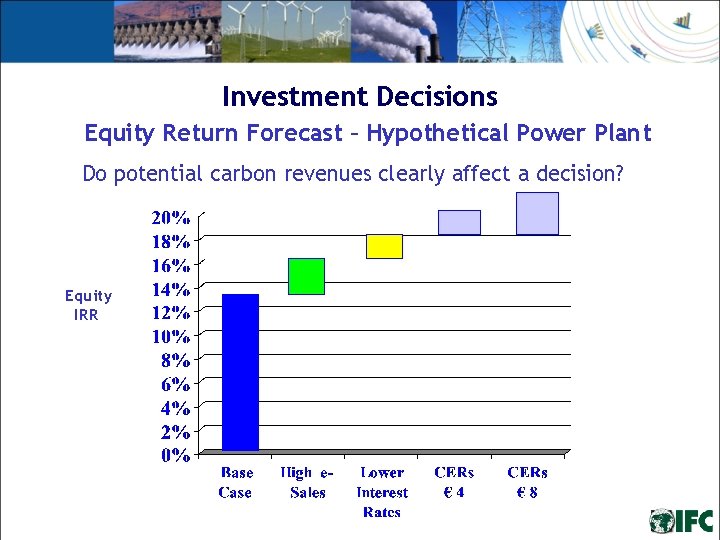
Investment Decisions Equity Return Forecast – Hypothetical Power Plant Do potential carbon revenues clearly affect a decision? Equity IRR
Investment Decisions and Additionality • • 48 b – Using “economic attractiveness” to establish the baseline is the most frequently used approach • However, economic attractiveness depends on the perspective of the company – and these perspectives vary widely among companies • A “reasonableness” test may need to be applied to inputs when the methodology is applied to a specific project to ensure integrity of the process (e. g. , confirm an investor’s forecasts with other market data, test whether project activity is common practice in region) Carbon revenues: this is often considered by companies as an uncertain, but potential, upside in the investment decision – even if it is uncertain, it can impact the final decision
CDM Market Development • CDM Goals • Assist developing countries in achieving sustainable development, including reduction of emissions; • Enable Annex 1 countries to meet obligations in a cost effective manner • Clear, reasonable, and practical standards need to be set by the EB • • Once this happens, the private sector will do the rest and the market will develop • If standards are set inappropriately, the market will be limited, and interest from private sector to participate could be significantly reduced A small market will inhibit development of financing and risk management products and large scale involvement of the private sector
Current Outlook of Project Participants • Many participants have been working actively for several years under commonly understood interpretations of the CDM, spending significant time and resources • In general, frustration levels appear to be high – 2003 was expected by most to lead to a clear, streamlined approval process • While integrity must be maintained in the approval process, this needs to be balanced with what can practically be applied to ensure the market develops
Recommendations • 2003 has been a learning process for all – this learning should be applied quickly in 2004 in order to retain interest and participation of project participants • In addition to streamlining their host country approval processes, developing countries should be active observers of the EB approval process to ensure their long term interests are upheld • The process may not be perfect, but it needs to be pragmatic and efficient to help achieve the primary goals of CDM -- reduce emissions AND facilitate sustainable development in CDM host countries
Natalie Halich Investment Officer phone: +1 202 473 1902 Carbon Finance, Environmental Finance Group International Finance Corporation Washington, DC, USA e-mail: carbonfinance@ifc. org web: www. ifc. org/carbonfinance