
INTERNATIONAL ENERGY AGENCY Sectoral Approaches in Electricity Building
INTERNATIONAL ENERGY AGENCY Sectoral Approaches in Electricity Building Bridges to a Safe Climate Richard Baron Head of climate change unit, IEA © OECD/IEA - 2009
Objective n Identify key areas of intervention Sectoral Approaches in Electricity Building Bridges To a Safe Climate © OECD/IEA - 2009 in the energy sector to achieve a safe global climate n Explore policy options best able to trigger change n Focus of this book: the electricity sector in developing countries
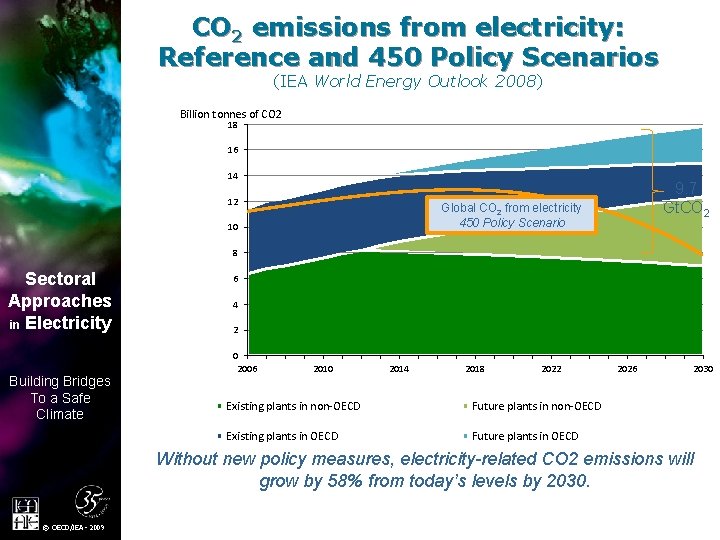
CO 2 emissions from electricity: Reference and 450 Policy Scenarios (IEA World Energy Outlook 2008) Billion tonnes of CO 2 18 16 14 12 9. 7 Gt. CO 2 Global CO 2 from electricity 450 Policy Scenario 10 8 Sectoral Approaches in Electricity Building Bridges To a Safe Climate 6 4 2 0 2006 2010 2014 2018 2022 Existing plants in non-OECD Future plants in non-OECD Existing plants in OECD Future plants in OECD 2026 Without new policy measures, electricity-related CO 2 emissions will grow by 58% from today’s levels by 2030. © OECD/IEA - 2009 2030
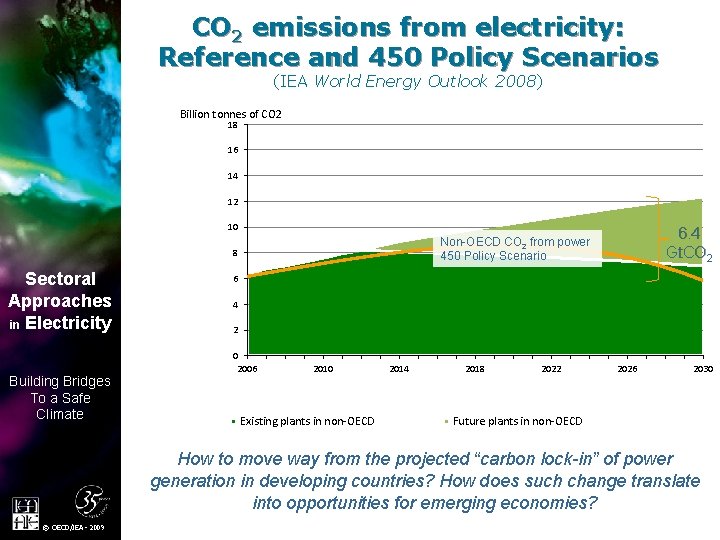
CO 2 emissions from electricity: Reference and 450 Policy Scenarios (IEA World Energy Outlook 2008) Billion tonnes of CO 2 18 16 14 12 10 8 Sectoral Approaches in Electricity Building Bridges To a Safe Climate 6. 4 Gt. CO 2 Non-OECD CO 2 from power 450 Policy Scenario 6 4 2 0 2006 2010 Existing plants in non-OECD 2014 2018 2022 2026 2030 Future plants in non-OECD How to move way from the projected “carbon lock-in” of power generation in developing countries? How does such change translate into opportunities for emerging economies? © OECD/IEA - 2009
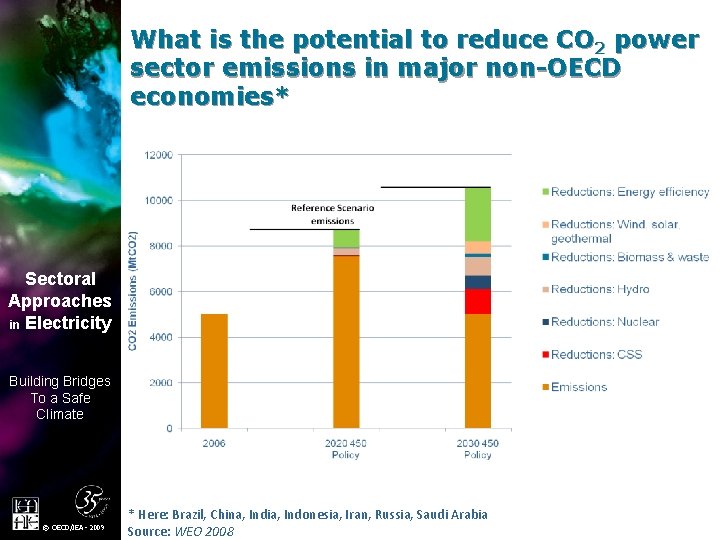
What is the potential to reduce CO 2 power sector emissions in major non-OECD economies* Sectoral Approaches in Electricity Building Bridges To a Safe Climate © OECD/IEA - 2009 * Here: Brazil, China, India, Indonesia, Iran, Russia, Saudi Arabia Source: WEO 2008
From potential to international action – lessons from activities under the Kyoto Protocol n Main instrument to foster action in developing countries: Clean Development Mechanism l Projects reduce emissions l Credits for avoided emissions are sold on the carbon market Sectoral Approaches in Electricity Building Bridges To a Safe Climate © OECD/IEA - 2009 n Some success in power generation n Very small impact on energy efficiency (EE) n A far cry from what is needed to stabilise global climate Sectoral approaches aim to broaden the scope of GHG mitigation in developing countries, with support by developed countries
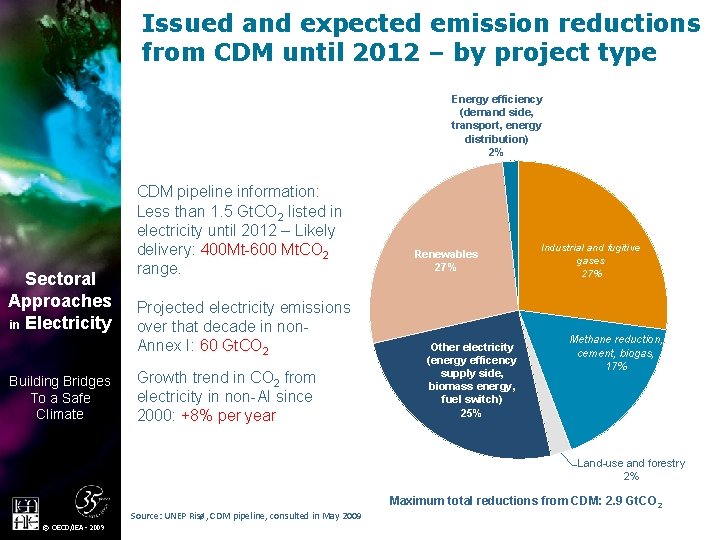
Issued and expected emission reductions from CDM until 2012 – by project type Energy efficiency (demand side, transport, energy distribution) 2% Sectoral Approaches in Electricity Building Bridges To a Safe Climate CDM pipeline information: Less than 1. 5 Gt. CO 2 listed in electricity until 2012 – Likely delivery: 400 Mt-600 Mt. CO 2 range. Projected electricity emissions over that decade in non. Annex I: 60 Gt. CO 2 Growth trend in CO 2 from electricity in non-AI since 2000: +8% per year Renewables 27% Other electricity (energy efficency supply side, biomass energy, fuel switch) 25% Industrial and fugitive gases 27% Methane reduction, cement, biogas, 17% Land-use and forestry 2% Source: UNEP Risø, CDM pipeline, consulted in May 2009 © OECD/IEA - 2009 Maximum total reductions from CDM: 2. 9 Gt. CO 2
IEA recommendation to address CO 2 from electricity: A two-tiered sectoral approach n Broaden the reach of the carbon Sectoral Approaches in Electricity Building Bridges To a Safe Climate © OECD/IEA - 2009 market from projects to sectors n Support more ambitious energy efficiency policy implementation n How does this tie in with the UNFCCC Copenhagenda?
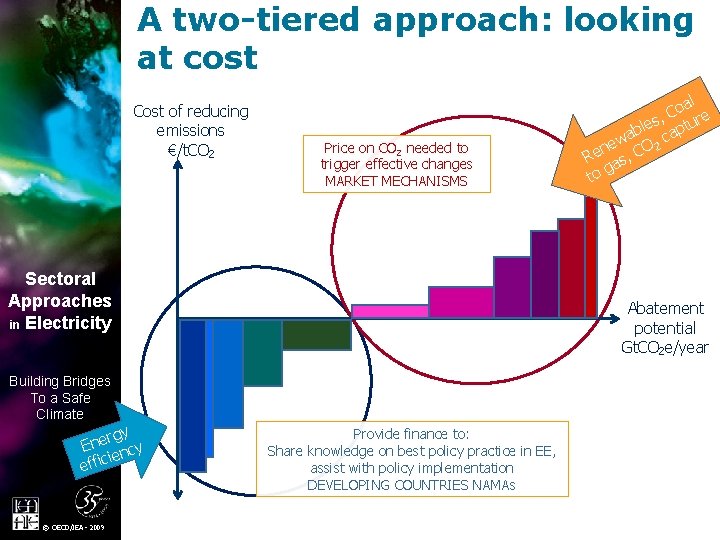
A two-tiered approach: looking at cost Cost of reducing emissions €/t. CO 2 Price on CO 2 needed to trigger effective changes MARKET MECHANISMS Sectoral Approaches in Electricity Abatement potential Gt. CO 2 e/year Building Bridges To a Safe Climate rgy Ene ncy ie effic © OECD/IEA - 2009 l oa e C s, tur e l ab cap w O 2 ne Re as, C g to Provide finance to: Share knowledge on best policy practice in EE, assist with policy implementation DEVELOPING COUNTRIES NAMAs
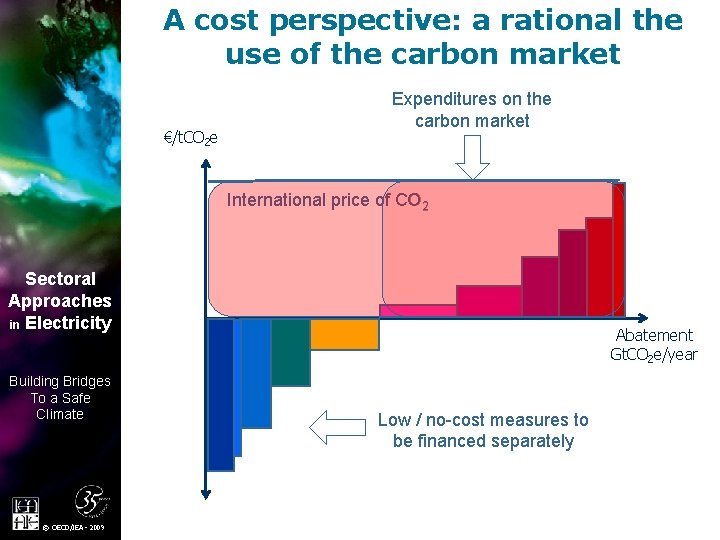
A cost perspective: a rational the use of the carbon market €/t. CO 2 e Expenditures on the carbon market International price of CO 2 Sectoral Approaches in Electricity Building Bridges To a Safe Climate © OECD/IEA - 2009 Abatement Gt. CO 2 e/year Low / no-cost measures to be financed separately
On the generation side n A carbon price is needed urgently l The international carbon market is Sectoral Approaches in Electricity Building Bridges To a Safe Climate © OECD/IEA - 2009 one possible vehicle l Country-specific baselines for crediting / domestic cap-and-trade w How to design/agree sectoral baselines n Other support measures l Experience on best policy practice for development of renewables l Support improvement in performance of existing plants l RD&D on breakthrough technologies (CCS)
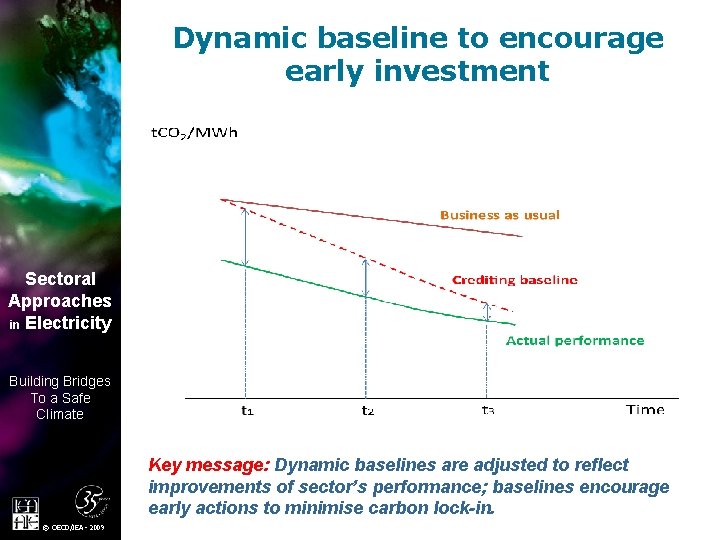
Dynamic baseline to encourage early investment Sectoral Approaches in Electricity Building Bridges To a Safe Climate Key message: Dynamic baselines are adjusted to reflect improvements of sector’s performance; baselines encourage early actions to minimise carbon lock-in. © OECD/IEA - 2009
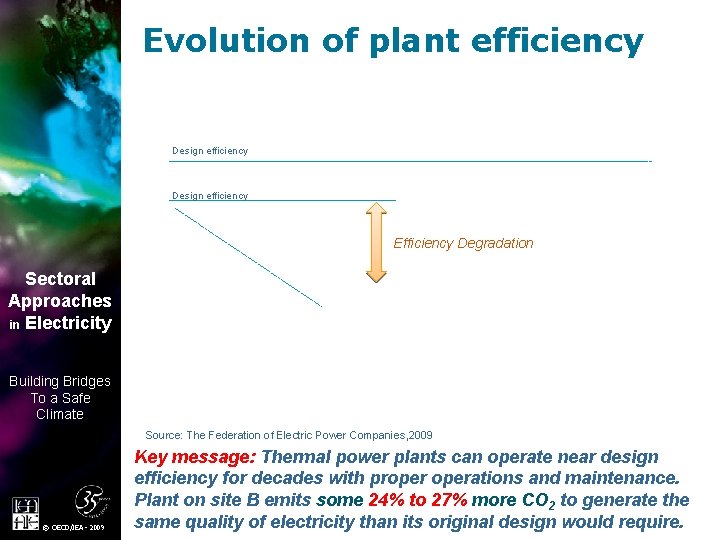
Evolution of plant efficiency Design efficiency Efficiency Degradation Sectoral Approaches in Electricity Building Bridges To a Safe Climate Source: The Federation of Electric Power Companies, 2009 © OECD/IEA - 2009 Key message: Thermal power plants can operate near design efficiency for decades with properations and maintenance. Plant on site B emits some 24% to 27% more CO 2 to generate the same quality of electricity than its original design would require.
Ongoing efforts in emerging economies - CHINA n Electricity output could grow by 100% between 2007 and 2020 l Coal dominates but nuclear and renewables on the rise (goals revised upward) l IEA 450 scenario : Chinese emissions could be 18% below 2007 by 2030 Sectoral Approaches in Electricity Building Bridges To a Safe Climate n National Action Plan on Climate Change, includes: l Renewables and nuclear objectives l Energy efficiency n Top 1000 Entreprises Programme l Energy efficiency in industry n Regional capacity to implement and monitor change © OECD/IEA - 2009
Ongoing efforts in emerging economies - INDIA n Electricity generation: +170% by 2030 Sectoral Approaches in Electricity Building Bridges To a Safe Climate © OECD/IEA - 2009 under “business-as-usual” n Industry is the primary consumer of electricity n Adoption of an energy efficiency certificate system (perform-achievetrade) – 15 energy-intensive industries l Baselines for all large industrial users n Robust and comprehensive CO 2/power sector database already used for CDM
Ongoing efforts in emerging economies - MEXICO n A long term cap (-50% / 2050) n Strategy: l Cap-and-trade (multi sectoral) l Energy efficiency Sectoral Approaches in Electricity Building Bridges To a Safe Climate © OECD/IEA - 2009 w As of 2006, standards related to electricity end-uses saved a total of 16 TWh, and avoided about 2, 926 MW of generation capacity w Considerable potential remains l Renewable energy deployment l Fuel switching
Ongoing efforts in emerging economies – SOUTH AFRICA n Power generation dominated by coal l Capability in renewables & nuclear l A single, large utility Sectoral Approaches in Electricity n Elaborated long-term climate scenarios Building Bridges To a Safe Climate l Large mitigation potential by 2050 n Energy Efficiency Accord with industry © OECD/IEA - 2009
Sectoral approaches in electricity and the Copenhagenda n End goal: how to deliver scaled-up Sectoral Approaches in Electricity mitigation in a sector exposed to lock-in n Broaden carbon market with scaled-up crediting/trading mechanisms (1. b. v) n Create vehicle for policy support, esp. in energy efficiency (NAMAs/MRV) l Finance for effective policy implementation in energy efficiency w Best practice in EE is well known - see IEA 25 recommendations to G 8 (and progress report) Building Bridges To a Safe Climate n Countries have started elaborating strategies for lower-CO 2 electricity l Need a domestic response to the instruments and support measures agreed at UNFCCC, on how to scale-up mitigation in the near term © OECD/IEA - 2009
INTERNATIONAL ENERGY AGENCY Sectoral Approaches in Electricity Building Bridges to a Safe Climate www. iea. org/w/bookshop/add. aspx? id=370 © OECD/IEA - 2009
- Slides: 19