
International dispute settlements Type of international disputes Methods
- Slides: 16
International dispute settlements • Type of international disputes • Methods to deal with international disputes • How to do legal researches
Non-Judicial Methods • Negotiation • Inquiry • Mediation or good offices • Conciliation • Negotiation, mediation, conciliation combined
Quasi-Judicial Methods • Arbitration and adjudication distingushied • International arbitration clauses • Consent to arbitrate • Compromis • Nature and composition of arbitral tribunals • Arbitral award • Applicable law and sources of law • International arbitration and the individual
Judicial Methods • International Court of Justice • International Tribunal for the Law of Sea • Ad hoc international criminal tribunals • International Criminal Court • Court of Justice of Human Rights • The EU judicial system
Art. 36 • 1. The jurisdiction of the Court comprises all cases which the parties refer to it and all matters specially provided for in the Charter of the United Nations or in treaties and conventions in force.
Art. 36 • 2. The states parties to the present Statute may at any time declare that they recognize as compulsory ipso facto and without special agreement, in relation to any other state accepting the same obligation, the jurisdiction of the Court in all legal disputes concerning:
Art. 36 • a. the interpretation of a treaty; • b. any question of international law; • c. the existence of any fact which, if established, would constitute a breach of an international obligation; • d. the nature or extent of the reparation to be made for the breach of an international obligation.
Art. 36 • 3. The declarations referred to above may be made unconditionally or on condition of reciprocity on the part of several or certain states, or for a certain time.
Art. 36 • 4. Such declarations shall be deposited with the Secretary-General of the United Nations, who shall transmit copies thereof to the parties to the Statute and to the Registrar of the Court.
Art. 36 • 5. Declarations made under Article 36 of the Statute of the Permanent Court of International Justice and which are still in force shall be deemed, as between the parties to the present Statute, to be acceptances of the compulsory jurisdiction of the International Court of Justice for the period which they still have to run and in accordance with their terms.
Art. 36 • 6. In the event of a dispute as to whether the Court has jurisdiction, the matter shall be settled by the decision of the Court.
ITLOS 国际海洋法庭 • Establishemnt under the provisions of Annex VI • • • of LOSO; Non-exclusive jurisdiction to interpret the LOSC; Special procedure and its exclusive jurisdiction for the release of vessels detained for the alleged violations of Convention; The Tribunal’s Deep Sea-Bed Chamber(海底争端 分庭) and its jurisdiction to enter into provisional measures;
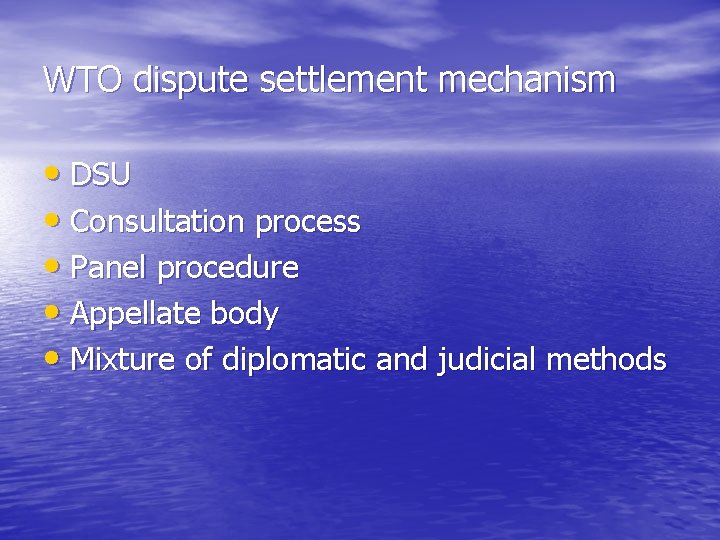
WTO dispute settlement mechanism • DSU • Consultation process • Panel procedure • Appellate body • Mixture of diplomatic and judicial methods
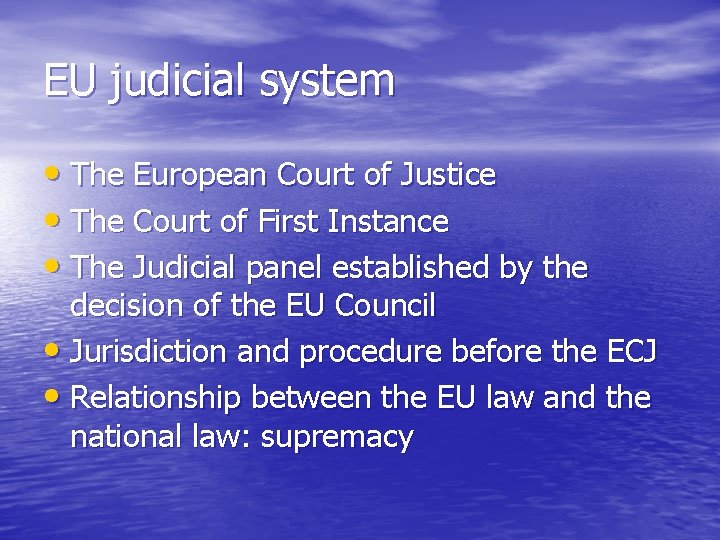
EU judicial system • The European Court of Justice • The Court of First Instance • The Judicial panel established by the decision of the EU Council • Jurisdiction and procedure before the ECJ • Relationship between the EU law and the national law: supremacy
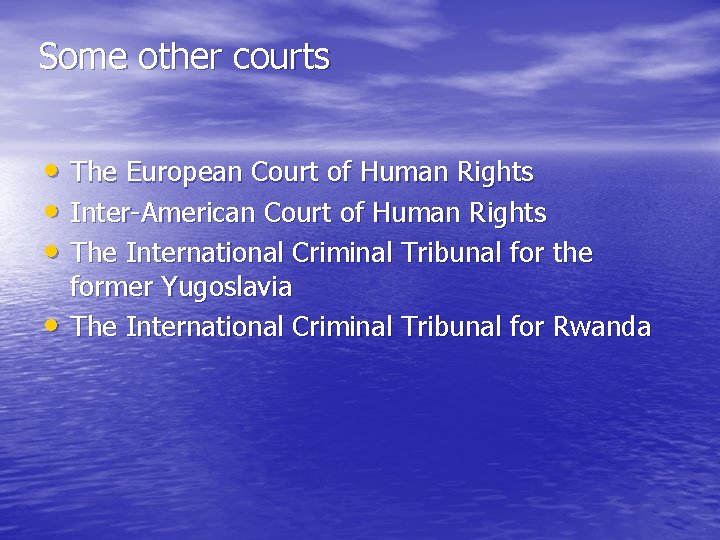
Some other courts • The European Court of Human Rights • Inter-American Court of Human Rights • The International Criminal Tribunal for the • former Yugoslavia The International Criminal Tribunal for Rwanda
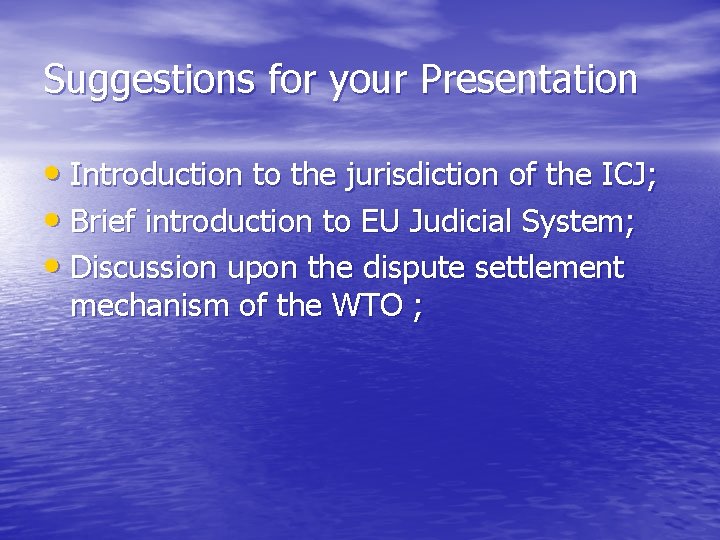
Suggestions for your Presentation • Introduction to the jurisdiction of the ICJ; • Brief introduction to EU Judicial System; • Discussion upon the dispute settlement mechanism of the WTO ;