
International Conference on Power and Energy Engineering September
International Conference on Power and Energy Engineering September 29 -30, 2016 London, UK Implementation of Appropriate Particle Dynamics in CFD for Wet Compression Presented by Jobaidur Rahman Khan, Ph. D University at Buffalo, NY, USA September 29 th, 2016
Outline Ø Introduction to Wet Compression Ø Different Droplet Dynamics (Starting with Navier Stokes Equastion) v Droplet Evaporation v Droplet Coalescence v Droplet Breakup v Droplet Heat Transfer and Mass Transfer v Droplet Drag v Erosion Ø Conclusions
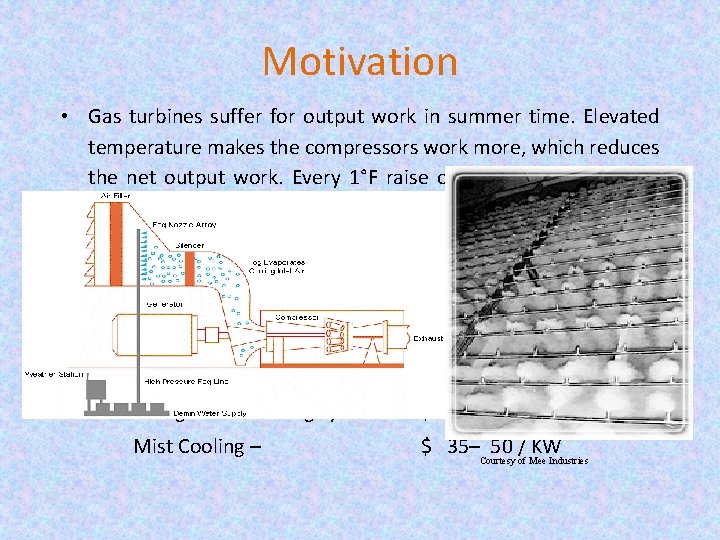
Motivation • Gas turbines suffer for output work in summer time. Elevated temperature makes the compressors work more, which reduces the net output work. Every 1°F raise of ambient temperature reduces gas turbine efficiency by 0. 3 -0. 5%. • A several attempts are taken to recover the energy shortage, e. g. using a standby turbine to recover the shortage, intercooling by intercooler, refrigerated cooling, mist or fog cooling. • The following cost analysis shows mist cooling is preferred: Standby Generator – $ 250– 400 / KW Refrigerated cooling system – $ 150– 250 / KW Mist Cooling – $ 35– 50 / KW Courtesy of Mee Industries
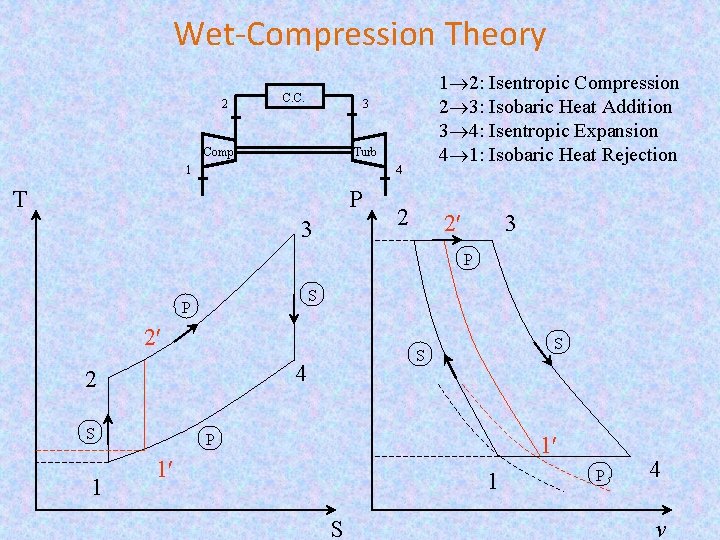
Wet-Compression Theory 2 C. C. 1 2: Isentropic Compression 2 3: Isobaric Heat Addition 3 4: Isentropic Expansion 4 1: Isobaric Heat Rejection 3 Comp Turb 1 4 T P 3 2 2 3 P S P 2 4 2 S 1 S S P 1 1 1 S P 4 v
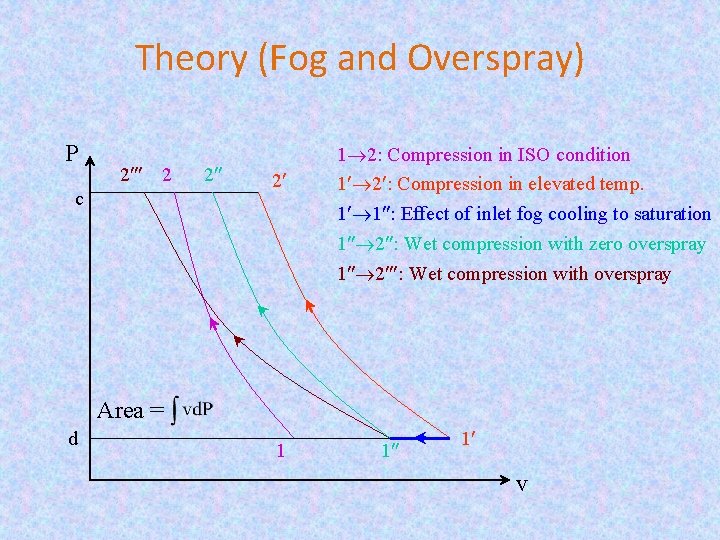
Theory (Fog and Overspray) P 2 2 c 2 2 1 2: Compression in ISO condition 1 2 : Compression in elevated temp. 1 1 : Effect of inlet fog cooling to saturation 1 2 : Wet compression with zero overspray 1 2 : Wet compression with overspray Area = d 1 1 1 v
Turbine System (without fog cooling)
Turbine System (with fog cooling)
Turbine Blades and Droplets
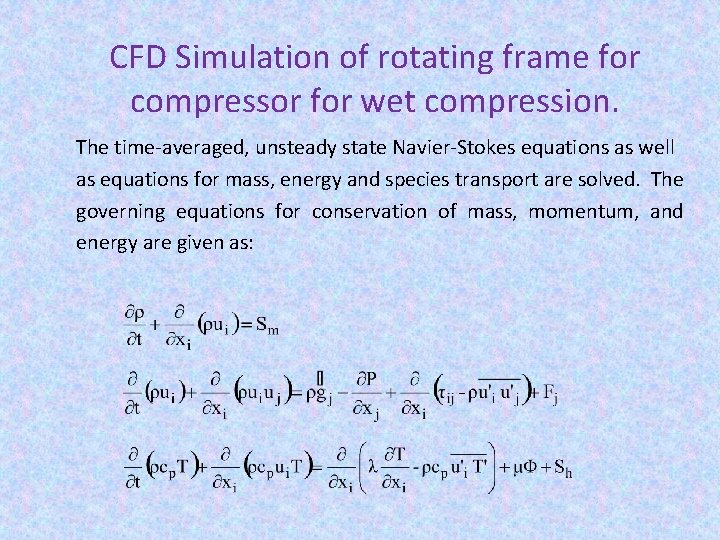
CFD Simulation of rotating frame for compressor for wet compression. The time-averaged, unsteady state Navier-Stokes equations as well as equations for mass, energy and species transport are solved. The governing equations for conservation of mass, momentum, and energy are given as:
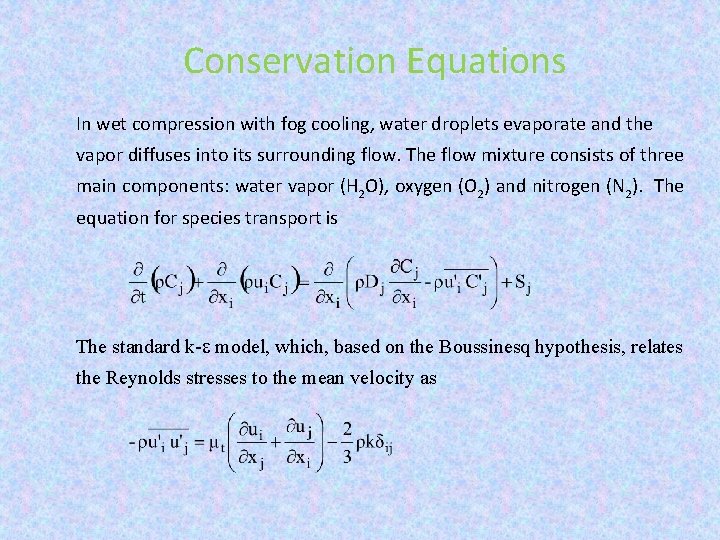
Conservation Equations In wet compression with fog cooling, water droplets evaporate and the vapor diffuses into its surrounding flow. The flow mixture consists of three main components: water vapor (H 2 O), oxygen (O 2) and nitrogen (N 2). The equation for species transport is The standard k- model, which, based on the Boussinesq hypothesis, relates the Reynolds stresses to the mean velocity as
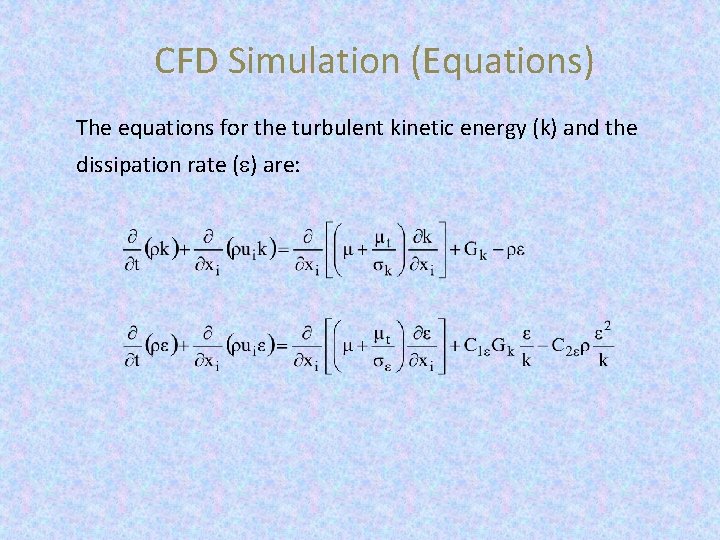
CFD Simulation (Equations) The equations for the turbulent kinetic energy (k) and the dissipation rate ( ) are:
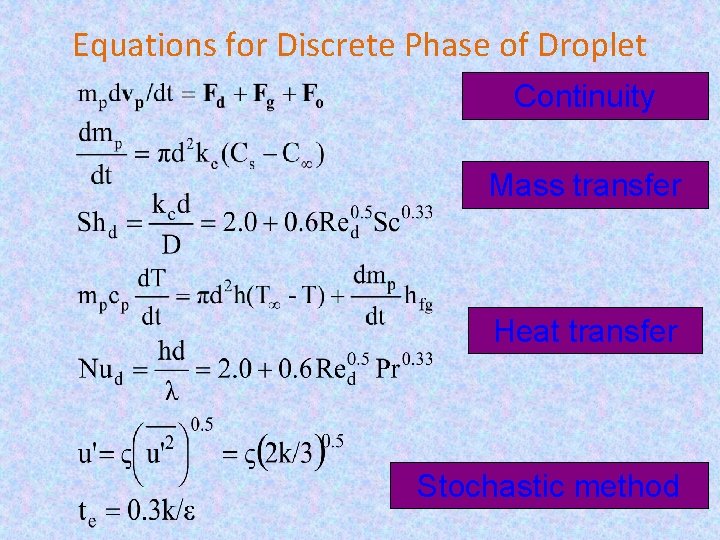
Equations for Discrete Phase of Droplet Continuity Mass transfer Heat transfer Stochastic method
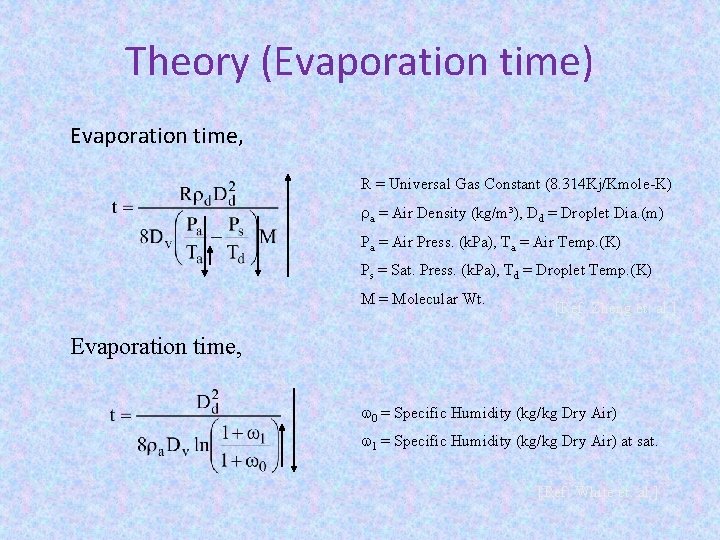
Theory (Evaporation time) Evaporation time, R = Universal Gas Constant (8. 314 Kj/Kmole-K) a = Air Density (kg/m³), Dd = Droplet Dia. (m) Pa = Air Press. (k. Pa), Ta = Air Temp. (K) Ps = Sat. Press. (k. Pa), Td = Droplet Temp. (K) M = Molecular Wt. [Ref: Zheng et. al. ] Evaporation time, 0 = Specific Humidity (kg/kg Dry Air) 1 = Specific Humidity (kg/kg Dry Air) at sat. [Ref: White et. al. ]
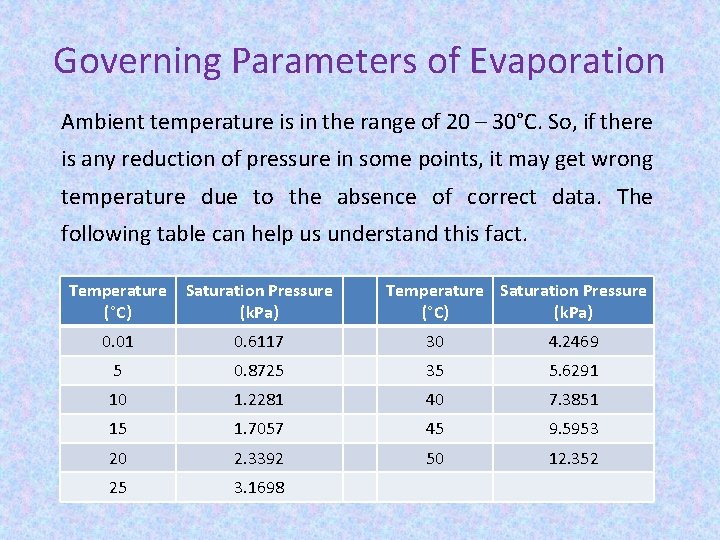
Governing Parameters of Evaporation Ambient temperature is in the range of 20 – 30°C. So, if there is any reduction of pressure in some points, it may get wrong temperature due to the absence of correct data. The following table can help us understand this fact. Temperature (°C) Saturation Pressure (k. Pa) Temperature Saturation Pressure (°C) (k. Pa) 0. 01 0. 6117 30 4. 2469 5 0. 8725 35 5. 6291 10 1. 2281 40 7. 3851 15 1. 7057 45 9. 5953 20 2. 3392 50 12. 352 25 3. 1698
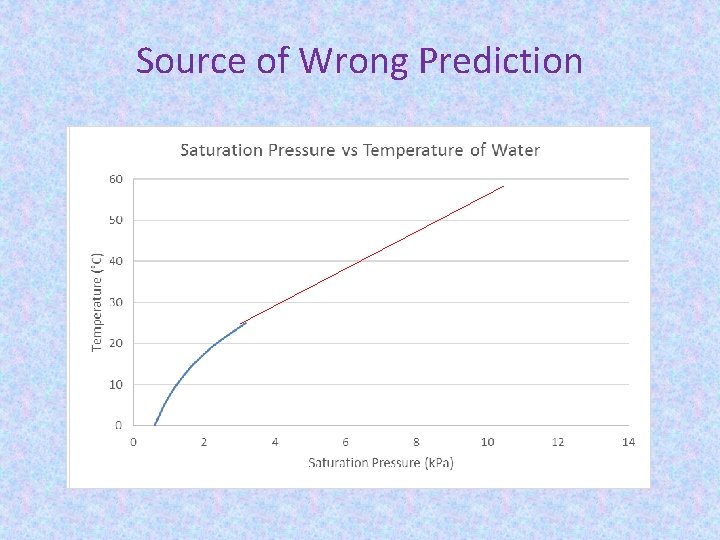
Source of Wrong Prediction
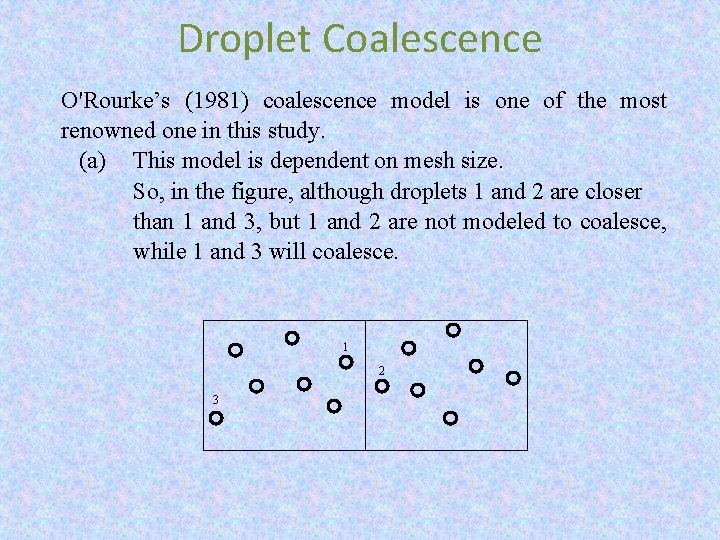
Droplet Coalescence O'Rourke’s (1981) coalescence model is one of the most renowned one in this study. (a) This model is dependent on mesh size. So, in the figure, although droplets 1 and 2 are closer than 1 and 3, but 1 and 2 are not modeled to coalesce, while 1 and 3 will coalesce. 1 2 3
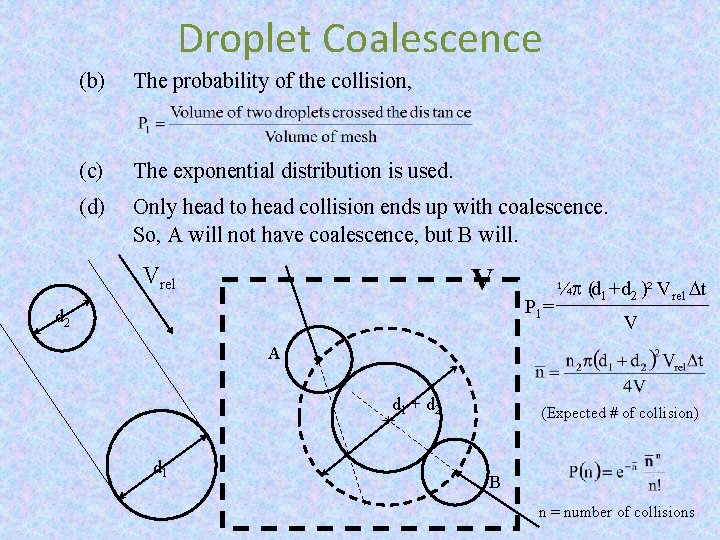
Droplet Coalescence (b) The probability of the collision, (c) The exponential distribution is used. (d) Only head to head collision ends up with coalescence. So, A will not have coalescence, but B will. V Vrel d 2 P 1 = ¼ (d 1 + d 2 )² Vrel t V A d 1 + d 2 d 1 (Expected # of collision) B n = number of collisions
![Break-up The Taylor Analogy Break-up model [O’Rourkes and Amsden (1987)] is used in this](http://slidetodoc.com/presentation_image/794c4064301fb785c51afccc774742cd/image-18.jpg "Break-up The Taylor Analogy Break-up model [O’Rourkes and Amsden (1987)] is used in this")
Break-up The Taylor Analogy Break-up model [O’Rourkes and Amsden (1987)] is used in this study. This method is based upon Taylor's analogy between an oscillating and distorting droplet and a spring mass system as, Fsp ksp Drag Surface Tension dsp Viscous Force
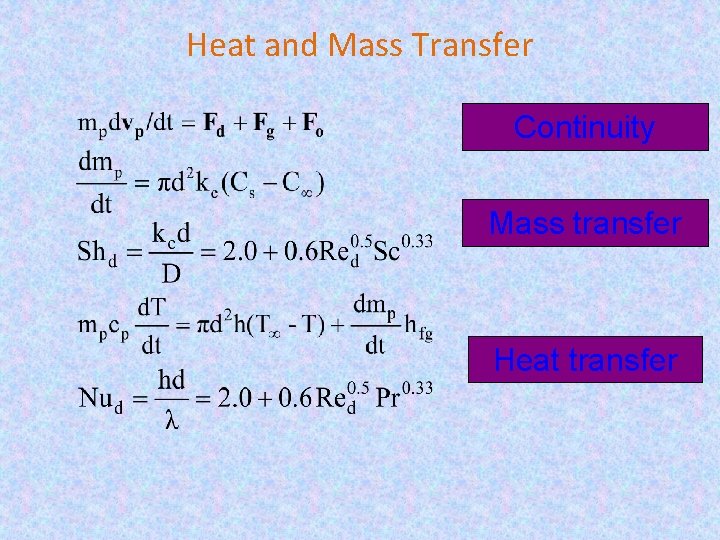
Heat and Mass Transfer Continuity Mass transfer Heat transfer
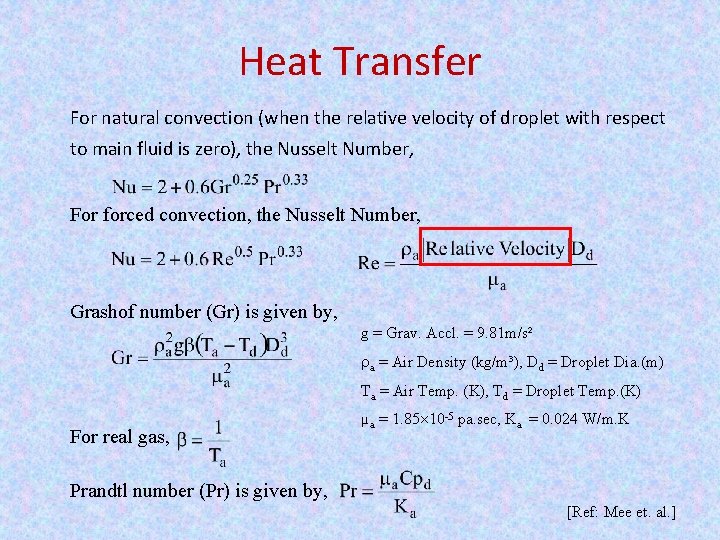
Heat Transfer For natural convection (when the relative velocity of droplet with respect to main fluid is zero), the Nusselt Number, For forced convection, the Nusselt Number, Grashof number (Gr) is given by, g = Grav. Accl. = 9. 81 m/s² a = Air Density (kg/m³), Dd = Droplet Dia. (m) Ta = Air Temp. (K), Td = Droplet Temp. (K) For real gas, µa = 1. 85 10 -5 pa. sec, Ka = 0. 024 W/m. K Prandtl number (Pr) is given by, [Ref: Mee et. al. ]
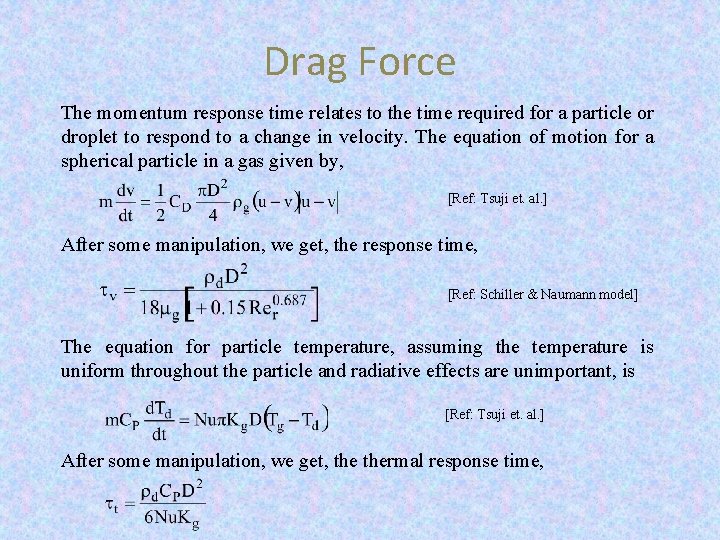
Drag Force The momentum response time relates to the time required for a particle or droplet to respond to a change in velocity. The equation of motion for a spherical particle in a gas given by, [Ref: Tsuji et. al. ] After some manipulation, we get, the response time, [Ref: Schiller & Naumann model] The equation for particle temperature, assuming the temperature is uniform throughout the particle and radiative effects are unimportant, is [Ref: Tsuji et. al. ] After some manipulation, we get, thermal response time,
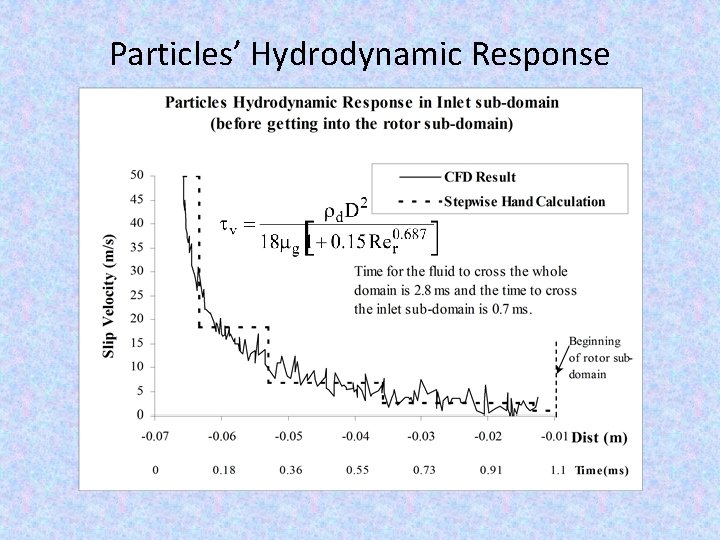
Particles’ Hydrodynamic Response
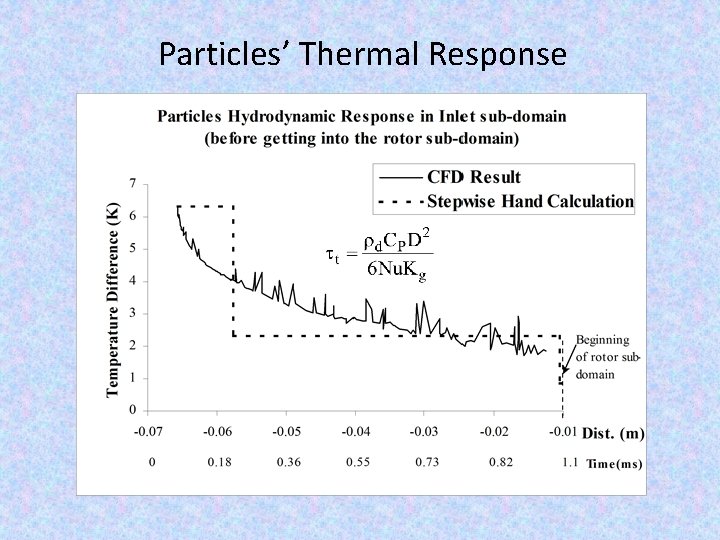
Particles’ Thermal Response
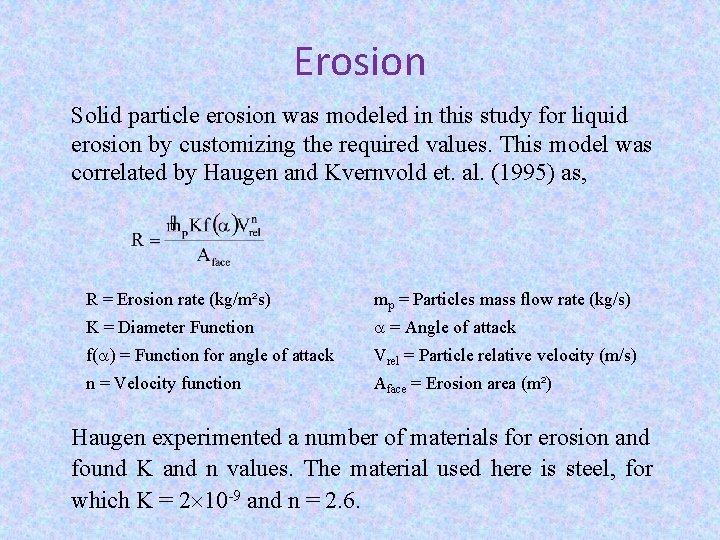
Erosion Solid particle erosion was modeled in this study for liquid erosion by customizing the required values. This model was correlated by Haugen and Kvernvold et. al. (1995) as, R = Erosion rate (kg/m²s) mp = Particles mass flow rate (kg/s) K = Diameter Function = Angle of attack f( ) = Function for angle of attack Vrel = Particle relative velocity (m/s) n = Velocity function Aface = Erosion area (m²) Haugen experimented a number of materials for erosion and found K and n values. The material used here is steel, for which K = 2 10 -9 and n = 2. 6.
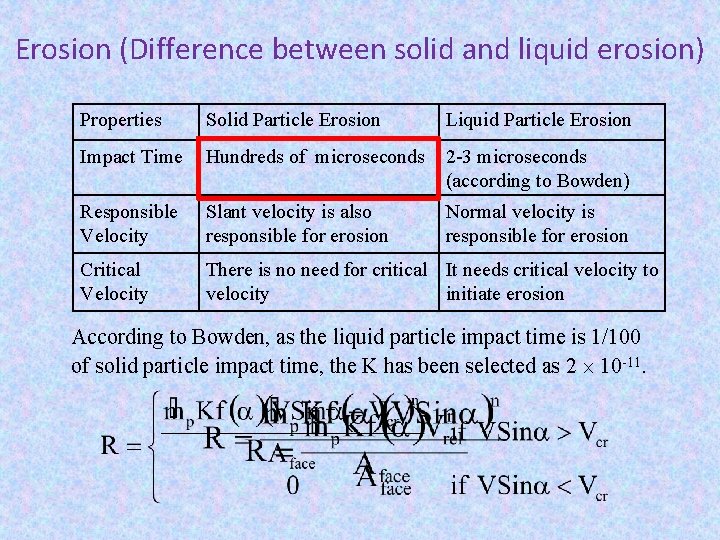
Erosion (Difference between solid and liquid erosion) Properties Solid Particle Erosion Liquid Particle Erosion Impact Time Hundreds of microseconds 2 -3 microseconds (according to Bowden) Responsible Velocity Slant velocity is also responsible for erosion Normal velocity is responsible for erosion Critical Velocity There is no need for critical It needs critical velocity to velocity initiate erosion According to Bowden, as the liquid particle impact time is 1/100 of solid particle impact time, the K has been selected as 2 10 -11.
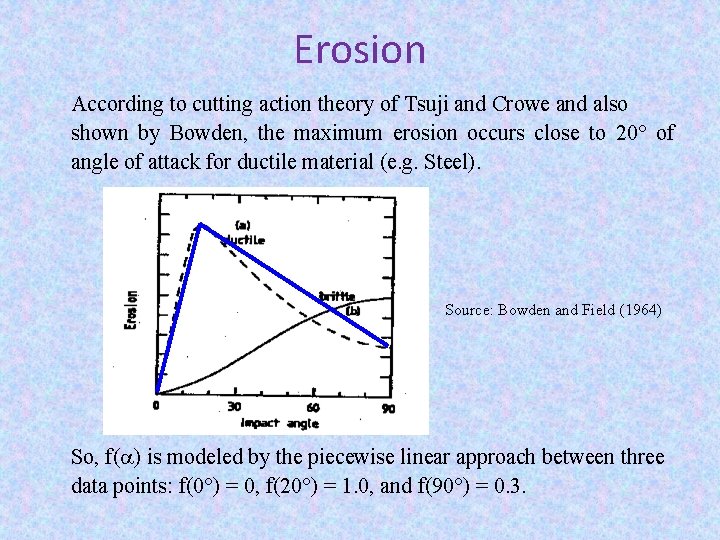
Erosion According to cutting action theory of Tsuji and Crowe and also shown by Bowden, the maximum erosion occurs close to 20° of angle of attack for ductile material (e. g. Steel). Source: Bowden and Field (1964) So, f( ) is modeled by the piecewise linear approach between three data points: f(0°) = 0, f(20°) = 1. 0, and f(90°) = 0. 3.
Conclusion ØThe mentioned model have to be used to have complete analysis. ØThe evaporation model is very straight forward and only changes can be made there is putting more data from steam table. ØCoalescence model can be changed, as there a number of models in literature. ØThe droplet breakup model (TAB method) is very popular one and is almost un-parallel.
Conclusion (Cont …. ) ØThe Heat transfer model is also very popular, but there are few more in literature, but they are not used much. ØDroplet drag model is also a popular one. ØErosion model can be changed by the user, as there a number of erosion model in literature.

- Slides: 29