
International Conference on Pollution Control Sustainable Environment April
International Conference on Pollution Control & Sustainable Environment April 25 -26, 2016 Dubai, UAE Sustainable Utilization of Seaweeds Hassan I. El Shimi 1 and Soha S. Moustafa 2 1 Chemical Engineering Department, Faculty of Engineering, Cairo University (CUFE), Egypt 2 Microbiology Department, Soils, Water and Enviroment Research Institute (SWERI), Agricultural Research Center (ARC), Egypt Dubai, UAE in April 26 th, 2016
Agenda • • Introduction to Seaweed “Macroalgae” Potentials of Seaweeds Nutritional value of Macroalgae Energy extraction from seaweed Bio refinery and Utilization Paths for Macro algae Conclusions References
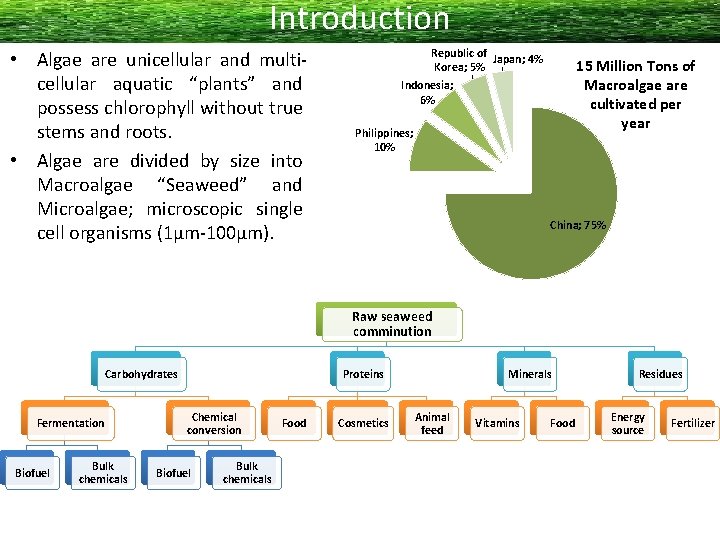
Introduction • Algae are unicellular and multicellular aquatic “plants” and possess chlorophyll without true stems and roots. • Algae are divided by size into Macroalgae “Seaweed” and Microalgae; microscopic single cell organisms (1µm-100µm). Republic of Japan; 4% Korea; 5% 15 Million Tons of Macroalgae are cultivated per year Indonesia; 6% Philippines; 10% China; 75% Raw seaweed comminution Carbohydrates Fermentation Biofuel Bulk chemicals Proteins Chemical conversion Biofuel Bulk chemicals Food Cosmetics Minerals Animal feed Vitamins Food Residues Energy source Fertilizer
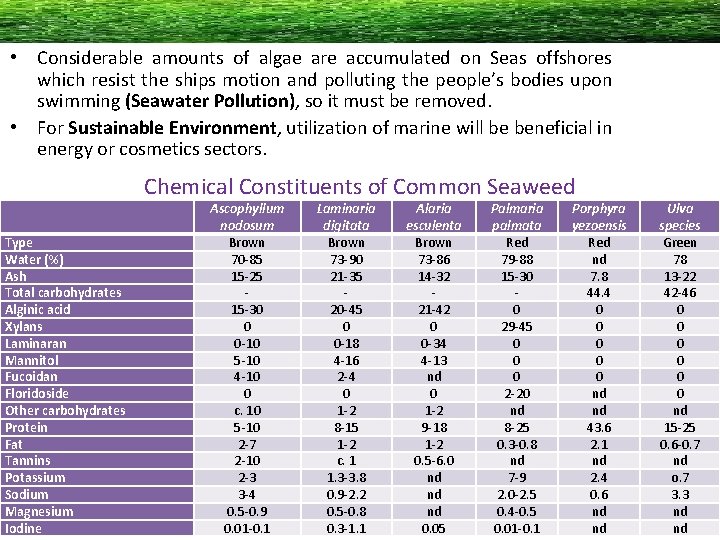
• Considerable amounts of algae are accumulated on Seas offshores which resist the ships motion and polluting the people’s bodies upon swimming (Seawater Pollution), so it must be removed. • For Sustainable Environment, utilization of marine will be beneficial in energy or cosmetics sectors. Chemical Constituents of Common Seaweed Type Water (%) Ash Total carbohydrates Alginic acid Xylans Laminaran Mannitol Fucoidan Floridoside Other carbohydrates Protein Fat Tannins Potassium Sodium Magnesium Iodine Ascophyllum nodosum Brown 70 -85 15 -25 15 -30 0 0 -10 5 -10 4 -10 0 c. 10 5 -10 2 -7 2 -10 2 -3 3 -4 0. 5 -0. 9 0. 01 -0. 1 Laminaria digitata Brown 73 -90 21 -35 20 -45 0 0 -18 4 -16 2 -4 0 1 -2 8 -15 1 -2 c. 1 1. 3 -3. 8 0. 9 -2. 2 0. 5 -0. 8 0. 3 -1. 1 Alaria esculenta Brown 73 -86 14 -32 21 -42 0 0 -34 4 -13 nd 0 1 -2 9 -18 1 -2 0. 5 -6. 0 nd nd nd 0. 05 Palmaria palmata Red 79 -88 15 -30 0 29 -45 0 0 0 2 -20 nd 8 -25 0. 3 -0. 8 nd 7 -9 2. 0 -2. 5 0. 4 -0. 5 0. 01 -0. 1 Porphyra yezoensis Red nd 7. 8 44. 4 0 0 0 nd nd 43. 6 2. 1 nd 2. 4 0. 6 nd nd Ulva species Green 78 13 -22 42 -46 0 0 0 nd 15 -25 0. 6 -0. 7 nd o. 7 3. 3 nd nd
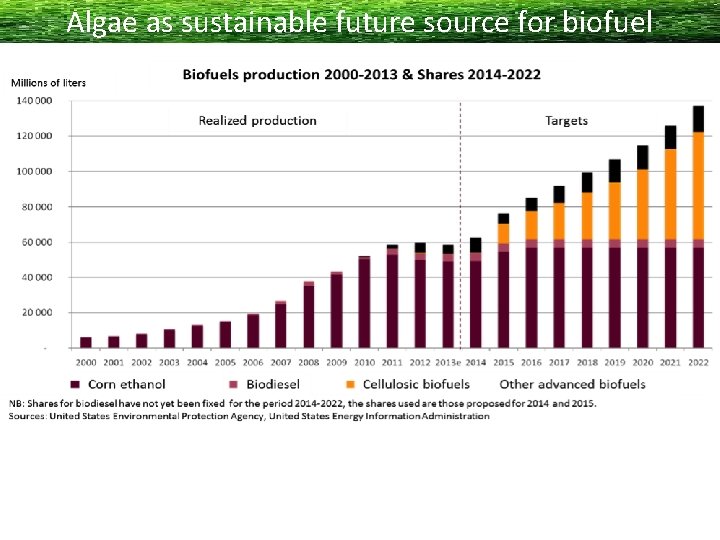
Algae as sustainable future source for biofuel • Algae don not require agricultural land for cultivation as terrestrial crops investigated for biofuel production. • Many species grown on brackish and saline water (1 kg biomass requiring 1 m 3 wastewater) avoiding food competition which required fresh water. • The biomass yield of algae per unit area is higher than that of terrestrial crops; e. g. brown seaweeds having yield of 13. 1 kg dry biomass compared to 10 kg for sugarcane. • Algae convert CO 2 to biofuel (biodiesel, bioethanol and bio butanol) and other chemical feedstocks so, they described as potential sunlight-driven cell factories.
Algae as sustainable future source for biofuel
Algae Business (AB) • Up to now, no economically-viable commercial scale fuel production from micro- or macroalgae; because of the lower Energy Return on Investment (EROI) compared to petroleum products. • Considering full spectrum of products that might be extracted from algal biomass in addition to biofuels, in so-called “Bio refineries” could enhancing the algae business. • Today the global utilization of (non-fuel) products obtained from macroalgae is a multi-billion dollar industry, and Asia is the main market.
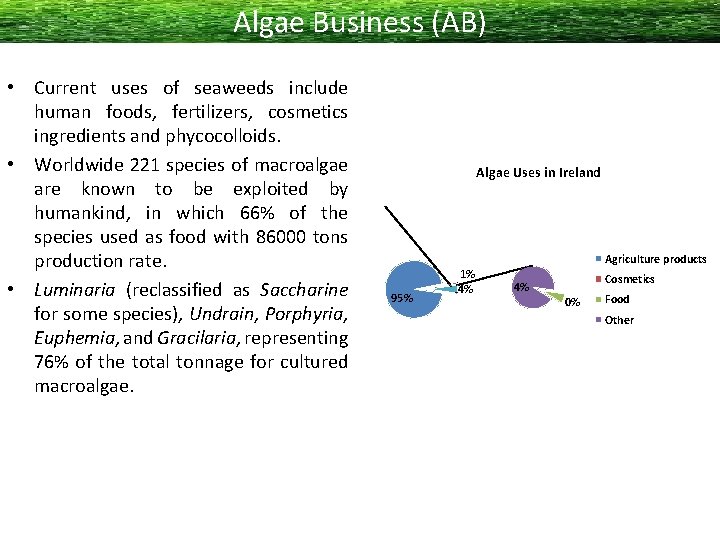
Algae Business (AB) • Current uses of seaweeds include human foods, fertilizers, cosmetics ingredients and phycocolloids. • Worldwide 221 species of macroalgae are known to be exploited by humankind, in which 66% of the species used as food with 86000 tons production rate. • Luminaria (reclassified as Saccharine for some species), Undrain, Porphyria, Euphemia, and Gracilaria, representing 76% of the total tonnage for cultured macroalgae. Algae Uses in Ireland Agriculture products 95% 1% 4% Cosmetics 4% 0% Food Other
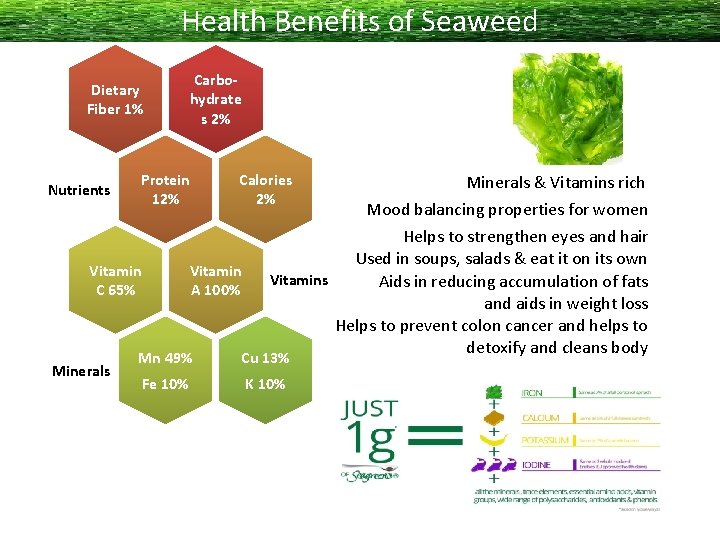
Health Benefits of Seaweed Dietary Fiber 1% Nutrients Protein 12% Vitamin C 65% Minerals Carbohydrate s 2% Calories 2% Vitamin A 100% Minerals & Vitamins rich Mood balancing properties for women Helps to strengthen eyes and hair Used in soups, salads & eat it on its own Vitamins Aids in reducing accumulation of fats and aids in weight loss Helps to prevent colon cancer and helps to detoxify and cleans body Mn 49% Cu 13% Fe 10% K 10%
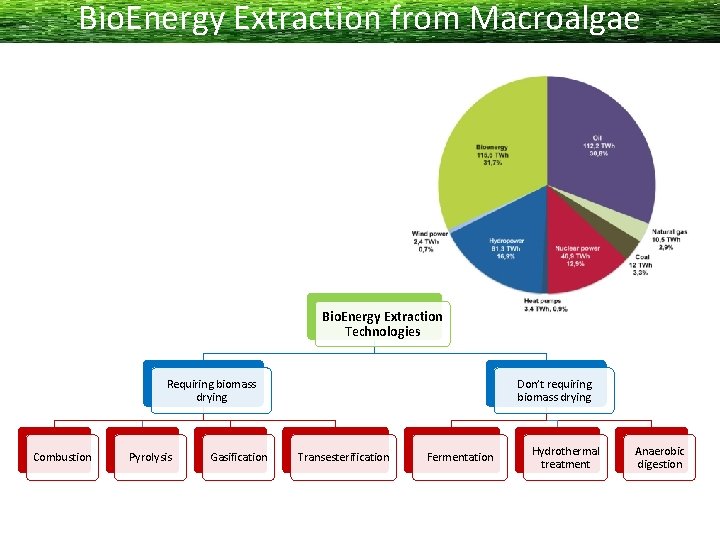
Bio. Energy Extraction from Macroalgae Bio. Energy Extraction Technologies Requiring biomass drying Combustion Pyrolysis Gasification Don’t requiring biomass drying Transesterification Fermentation Hydrothermal treatment Anaerobic digestion
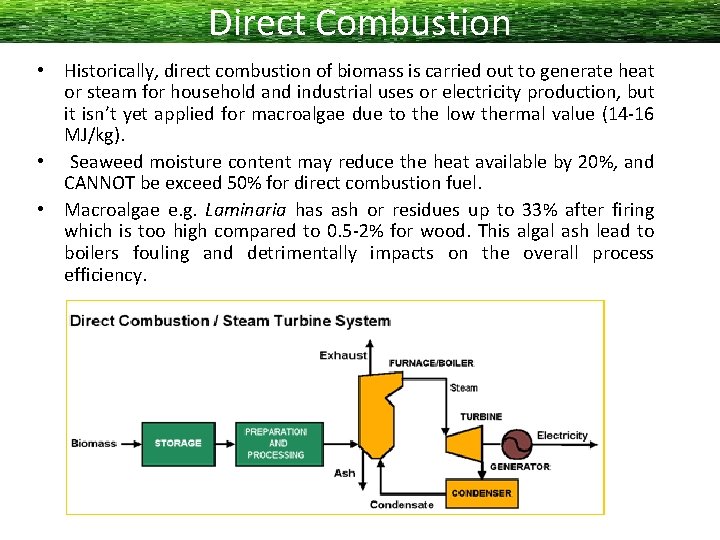
Direct Combustion • Historically, direct combustion of biomass is carried out to generate heat or steam for household and industrial uses or electricity production, but it isn’t yet applied for macroalgae due to the low thermal value (14 -16 MJ/kg). • Seaweed moisture content may reduce the heat available by 20%, and CANNOT be exceed 50% for direct combustion fuel. • Macroalgae e. g. Laminaria has ash or residues up to 33% after firing which is too high compared to 0. 5 -2% for wood. This algal ash lead to boilers fouling and detrimentally impacts on the overall process efficiency.
Direct Combustion • High Sulphur content (1 -2. 5%) and N 2 (1 -5%) contents of Seaweed will also hinder its utilization as a direct combustion fuel. • Fluidized boilers are suggested to fire marine biomass, and the particle size has to be ground down to <0. 18 mm in order to minimize “heattransfer resistance”. Co-combustion of seaweed in coalfired plants is attractive option to improve the process economics and generate electricity, but that requires local heat demand.
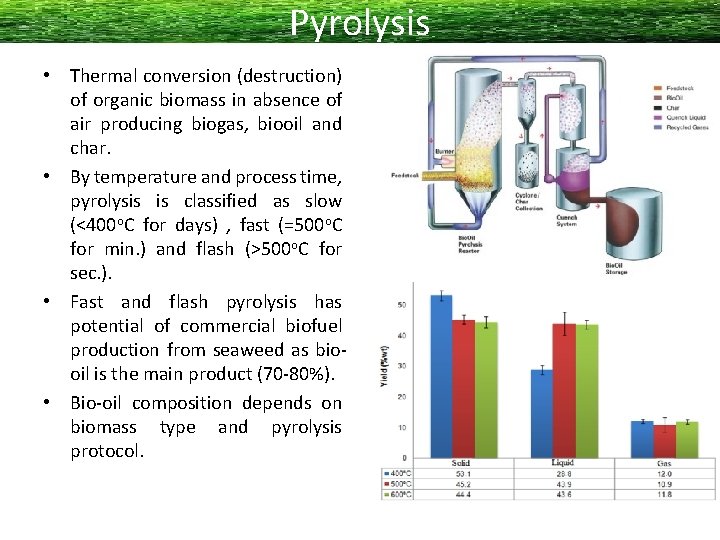
Pyrolysis • Thermal conversion (destruction) of organic biomass in absence of air producing biogas, biooil and char. • By temperature and process time, pyrolysis is classified as slow (<400 o. C for days) , fast (=500 o. C for min. ) and flash (>500 o. C for sec. ). • Fast and flash pyrolysis has potential of commercial biofuel production from seaweed as biooil is the main product (70 -80%). • Bio-oil composition depends on biomass type and pyrolysis protocol.
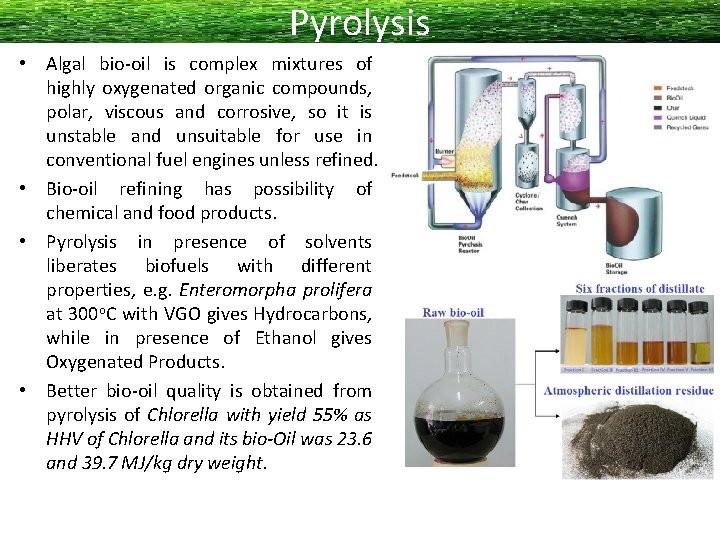
Pyrolysis • Algal bio-oil is complex mixtures of highly oxygenated organic compounds, polar, viscous and corrosive, so it is unstable and unsuitable for use in conventional fuel engines unless refined. • Bio-oil refining has possibility of chemical and food products. • Pyrolysis in presence of solvents liberates biofuels with different properties, e. g. Enteromorpha prolifera at 300 o. C with VGO gives Hydrocarbons, while in presence of Ethanol gives Oxygenated Products. • Better bio-oil quality is obtained from pyrolysis of Chlorella with yield 55% as HHV of Chlorella and its bio-Oil was 23. 6 and 39. 7 MJ/kg dry weight.
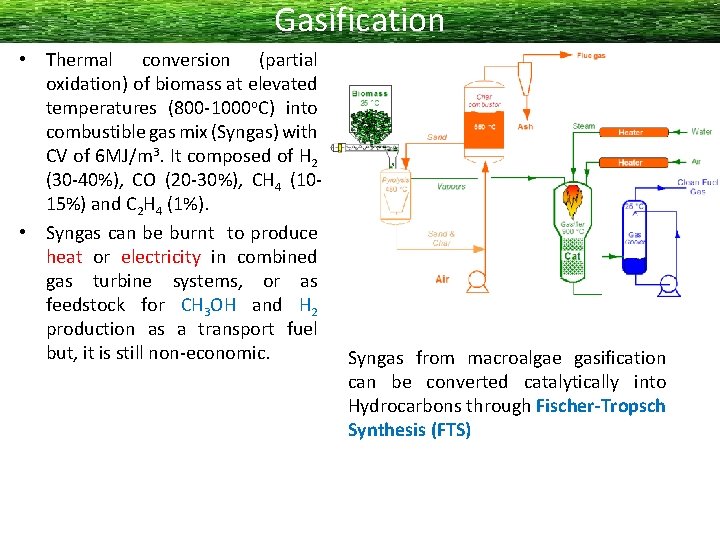
Gasification • Thermal conversion (partial oxidation) of biomass at elevated temperatures (800 -1000 o. C) into combustible gas mix (Syngas) with CV of 6 MJ/m 3. It composed of H 2 (30 -40%), CO (20 -30%), CH 4 (1015%) and C 2 H 4 (1%). • Syngas can be burnt to produce heat or electricity in combined gas turbine systems, or as feedstock for CH 3 OH and H 2 production as a transport fuel but, it is still non-economic. Syngas from macroalgae gasification can be converted catalytically into Hydrocarbons through Fischer-Tropsch Synthesis (FTS)
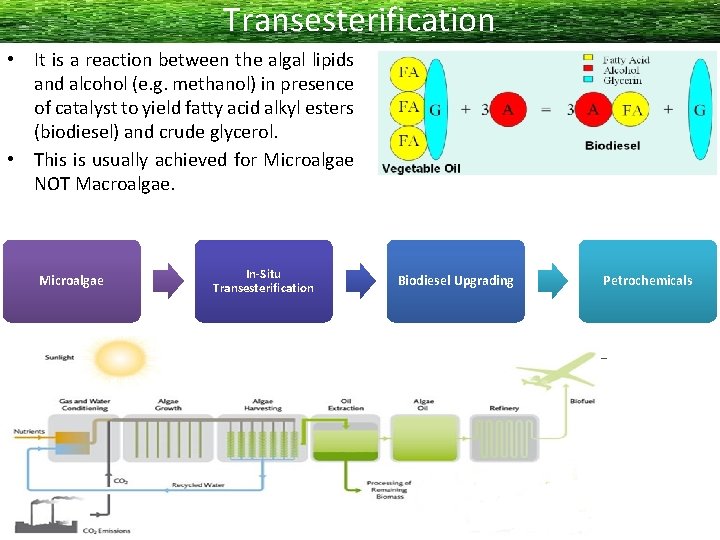
Transesterification • It is a reaction between the algal lipids and alcohol (e. g. methanol) in presence of catalyst to yield fatty acid alkyl esters (biodiesel) and crude glycerol. • This is usually achieved for Microalgae NOT Macroalgae. Microalgae In-Situ Transesterification Biodiesel Upgrading Petrochemicals
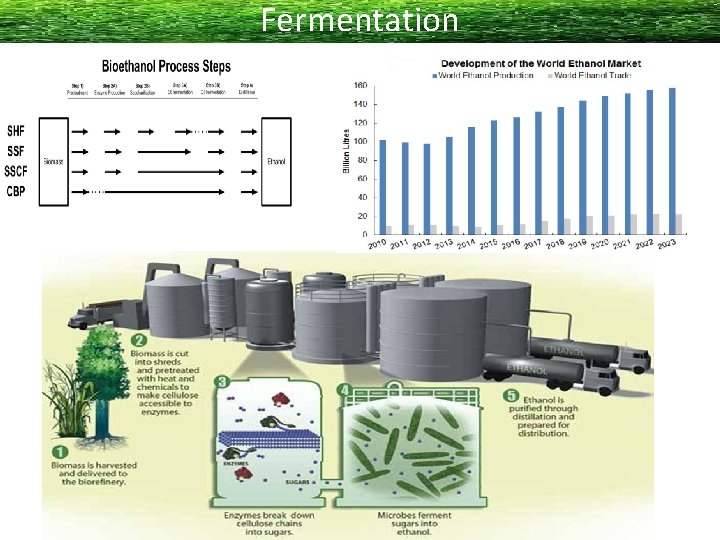
Fermentation
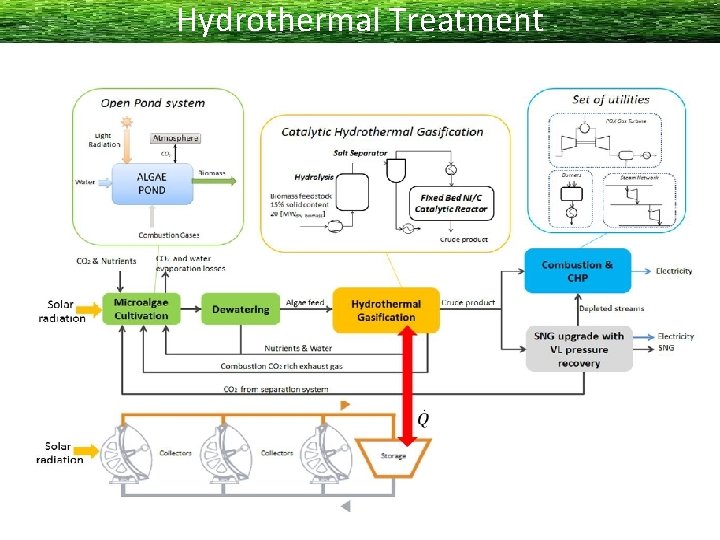
Hydrothermal Treatment
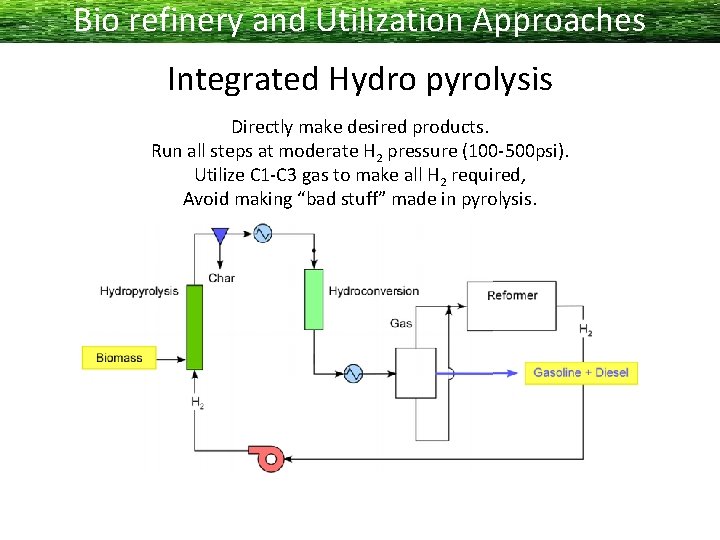
Bio refinery and Utilization Approaches Integrated Hydro pyrolysis Directly make desired products. Run all steps at moderate H 2 pressure (100 -500 psi). Utilize C 1 -C 3 gas to make all H 2 required, Avoid making “bad stuff” made in pyrolysis.
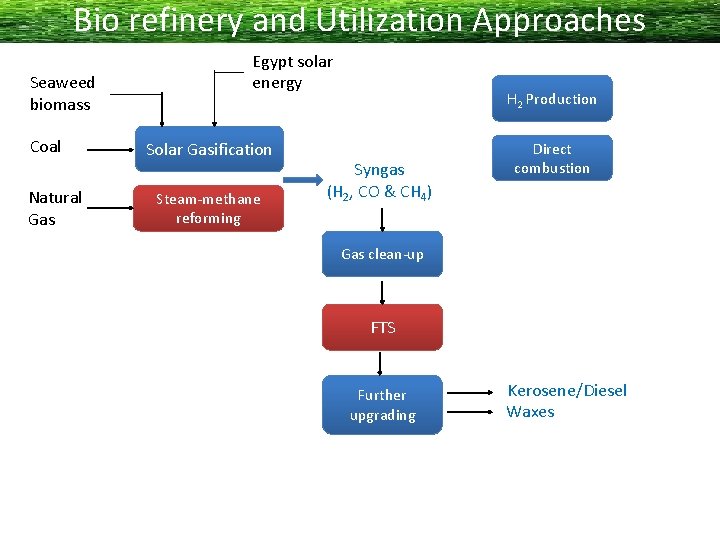
Bio refinery and Utilization Approaches Seaweed biomass Coal Natural Gas Egypt solar energy Solar Gasification Steam-methane reforming H 2 Production Syngas (H 2, CO & CH 4) Direct combustion Gas clean-up FTS Further upgrading Kerosene/Diesel Waxes
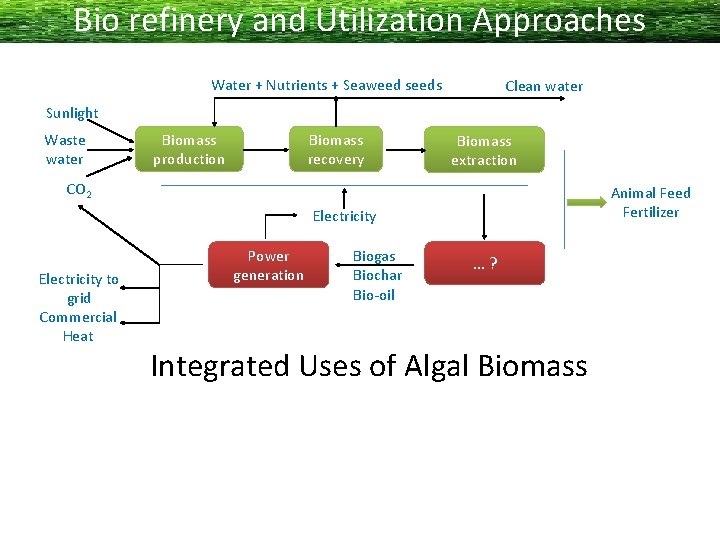
Bio refinery and Utilization Approaches Water + Nutrients + Seaweed seeds Clean water Sunlight Waste water Biomass production Biomass recovery Biomass extraction CO 2 Animal Feed Fertilizer Electricity to grid Commercial Heat Power generation Biogas Biochar Bio-oil …? Integrated Uses of Algal Biomass
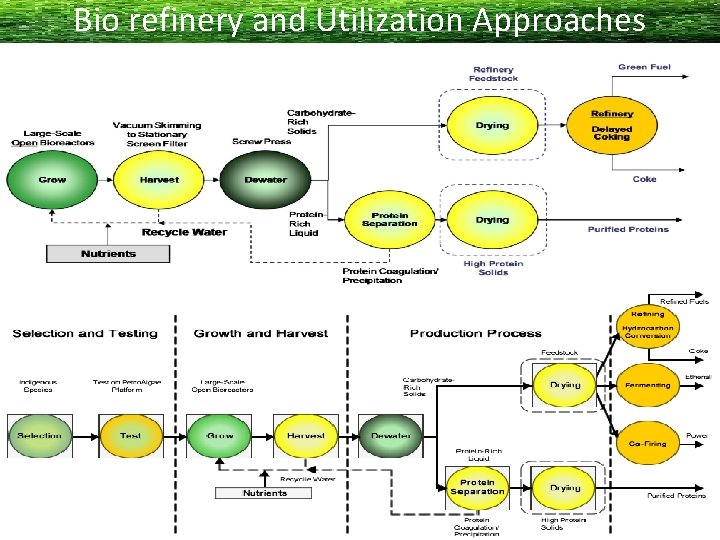
Bio refinery and Utilization Approaches
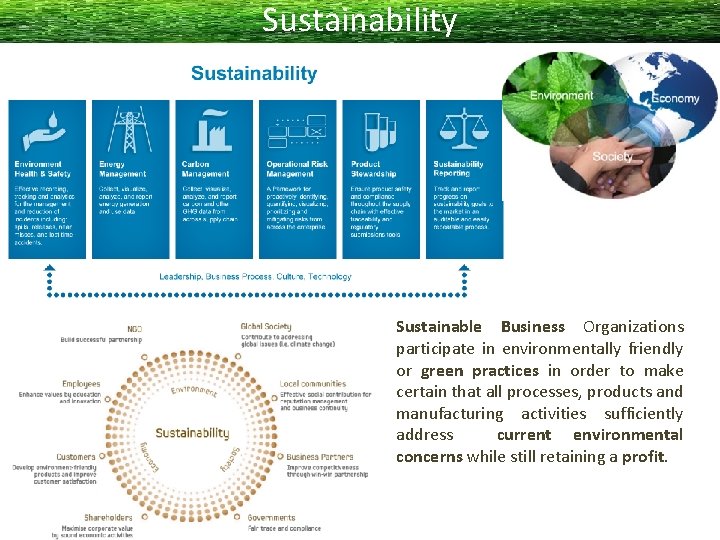
Sustainability Sustainable Business Organizations participate in environmentally friendly or green practices in order to make certain that all processes, products and manufacturing activities sufficiently address current environmental concerns while still retaining a profit.
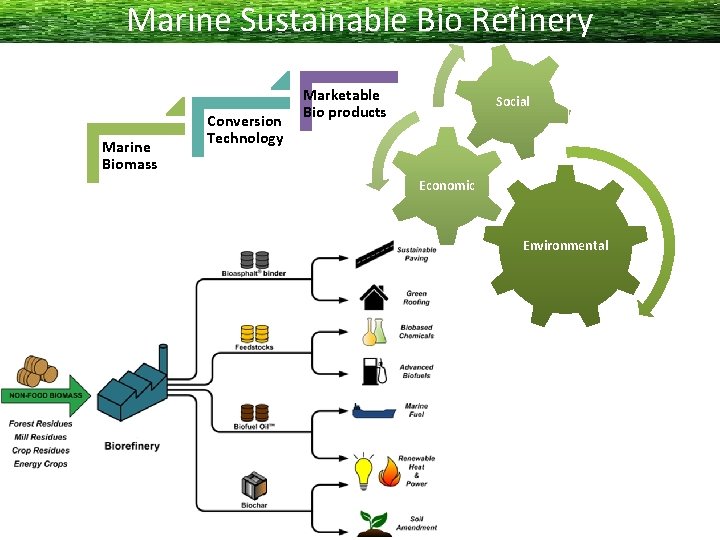
Marine Sustainable Bio Refinery Marine Biomass Conversion Technology Marketable Bio products Social Economic Environmental
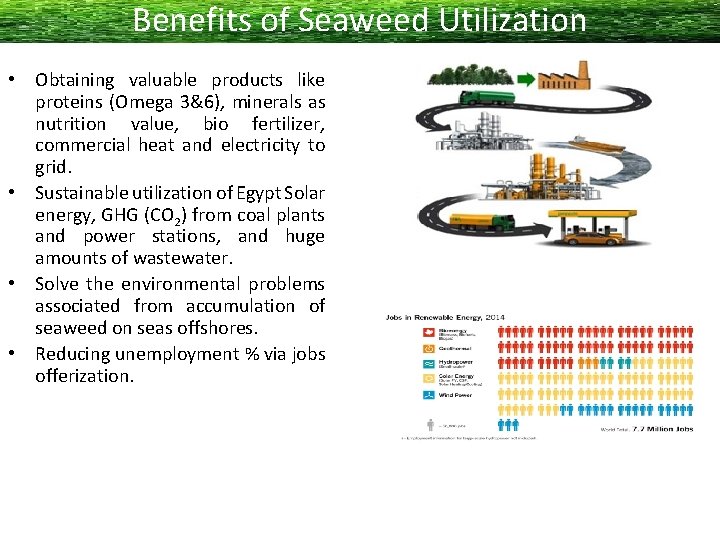
Benefits of Seaweed Utilization • Obtaining valuable products like proteins (Omega 3&6), minerals as nutrition value, bio fertilizer, commercial heat and electricity to grid. • Sustainable utilization of Egypt Solar energy, GHG (CO 2) from coal plants and power stations, and huge amounts of wastewater. • Solve the environmental problems associated from accumulation of seaweed on seas offshores. • Reducing unemployment % via jobs offerization.
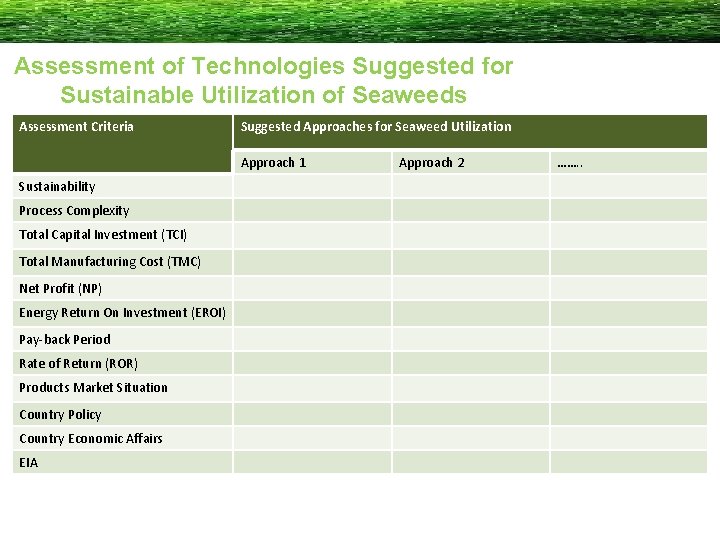
Assessment of Technologies Suggested for Sustainable Utilization of Seaweeds Assessment Criteria Suggested Approaches for Seaweed Utilization Approach 1 Sustainability Process Complexity Total Capital Investment (TCI) Total Manufacturing Cost (TMC) Net Profit (NP) Energy Return On Investment (EROI) Pay-back Period Rate of Return (ROR) Products Market Situation Country Policy Country Economic Affairs EIA Approach 2 ……. .
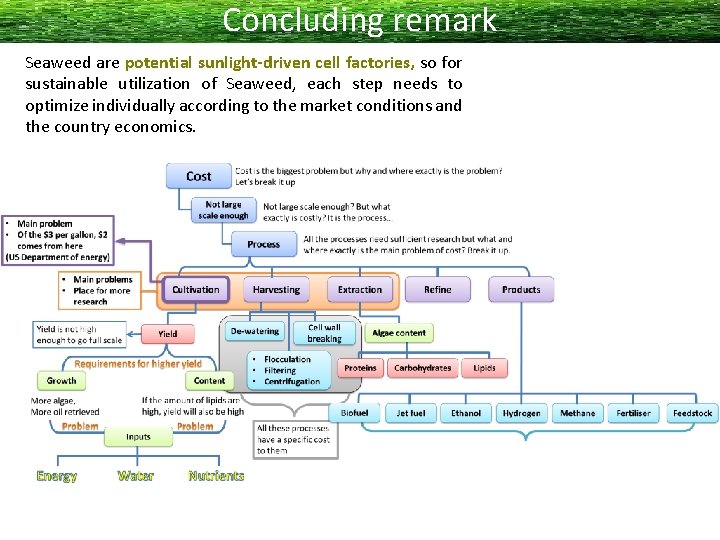
Concluding remark Seaweed are potential sunlight-driven cell factories, so for sustainable utilization of Seaweed, each step needs to optimize individually according to the market conditions and the country economics.

Egypt CAN DO I think Egypt CAN do that but more feasibility studies are still required Cheap labor Wide desert areas Huge wastewater GHG Emissions Seaweeds on Seas Offshores Country policies Incomplexicity of investment regulations Taxes offers Welcome to visit Egypt Welcome to Invest in Egypt
Author Biography Hassan I. El Shimi, Ph. D. Researcher in Green Chemistry Applications Lecturer at Chemical Engineering Department Cairo University, Egypt Member of Arab Engineers’ Federation Linked in: https: //eg. linkedin. com/in/hassan-el-shimi-883755 a 4 Website: http: //scholar. cu. edu. eg/? q=hassanelshimi/ Cairo Univ. St. , Giza, Egypt Tel. : +2 01024497780 : +2 01118087862 Email : hassanshimi@gmail. com Research area Renewable energy "Biofuels", Storage of energy from renewable sources, Environmental engineering "Solid waste management and Wastewater treatment", Process and plant design, Process economics, Industrial Biotechnology, Experiments Statistics. In addition, International arbitration in engineering contracts "FIDIC & BOT".

Thank you for your time!
- Slides: 30