
International Conference APPLICATIONS OF STRUCTURAL FIRE ENGINEERING Prague
- Slides: 1
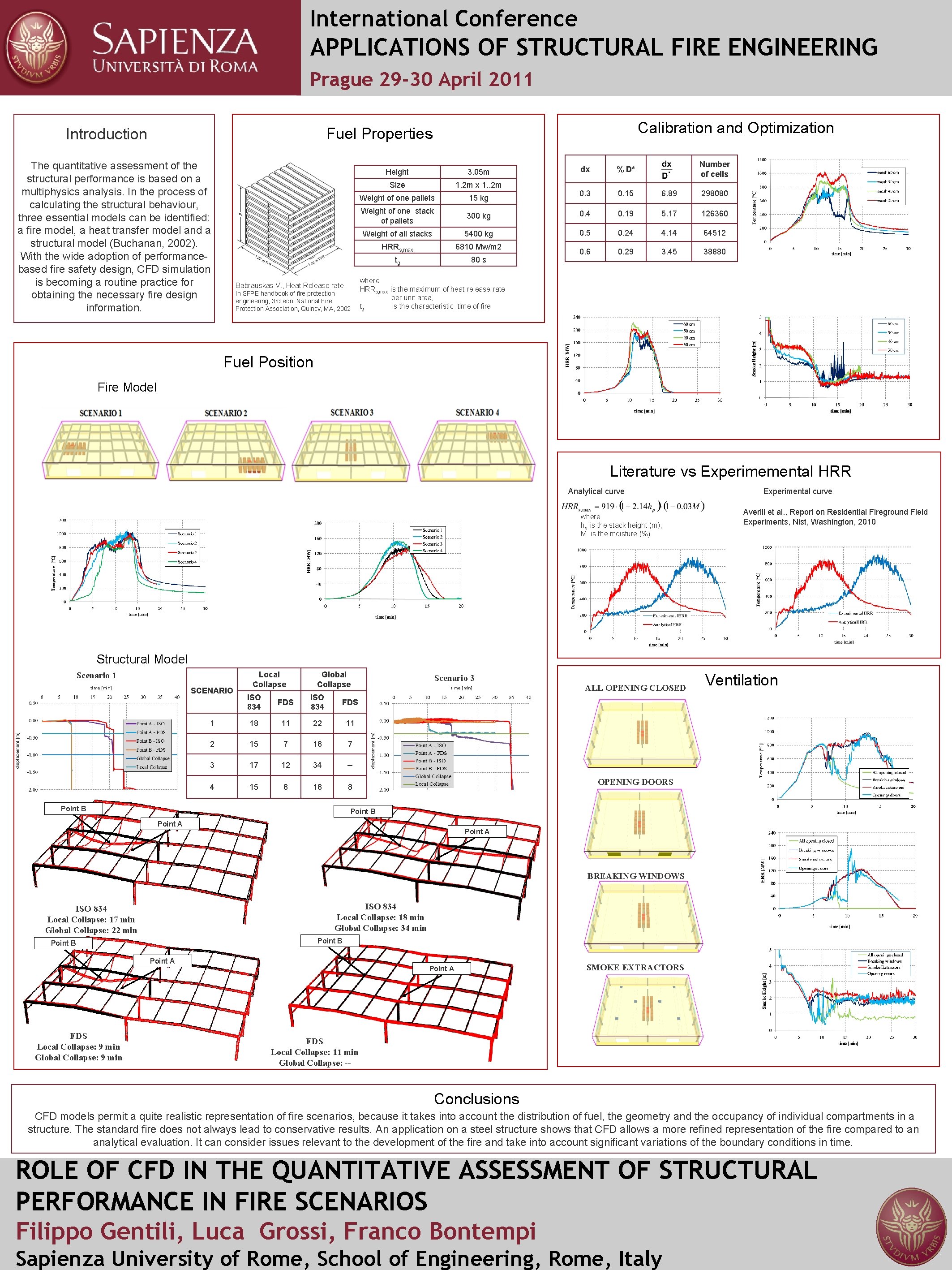
International Conference APPLICATIONS OF STRUCTURAL FIRE ENGINEERING Prague 29 -30 April 2011 Calibration and Optimization Fuel Properties Introduction The quantitative assessment of the structural performance is based on a multiphysics analysis. In the process of calculating the structural behaviour, three essential models can be identified: a fire model, a heat transfer model and a structural model (Buchanan, 2002). With the wide adoption of performancebased fire safety design, CFD simulation is becoming a routine practice for obtaining the necessary fire design information. Babrauskas V. , Heat Release rate. In SFPE handbook of fire protection engineering, 3 rd edn, National Fire Protection Association, Quincy, MA, 2002 Number of cells dx % D* 0. 3 0. 15 6. 89 298080 Height 3. 05 m Size 1. 2 m x 1. . 2 m Weight of one pallets 15 kg Weight of one stack of pallets 300 kg 0. 4 0. 19 5. 17 126360 Weight of all stacks 5400 kg 0. 5 0. 24 4. 14 64512 HRRs, max 6810 Mw/m 2 tg 80 s 0. 6 0. 29 3. 45 38880 where HRRs, max is the maximum of heat-release-rate per unit area, tg is the characteristic time of fire Fuel Position Fire Model Literature vs Experimemental HRR Analytical curve where hp is the stack height (m), M is the moisture (%) Experimental curve Averill et al. , Report on Residential Fireground Field Experiments, Nist, Washington, 2010 Structural Model time [min] displacement [m] SCENARIO Local Collapse Global Collapse ISO 834 FDS 1 18 11 22 11 2 15 7 18 7 3 17 12 34 -- 4 15 8 18 8 Point B Scenario 3 time [min] ALL OPENING CLOSED Ventilation displacement [m] Scenario 1 OPENING DOORS Point B Point A BREAKING WINDOWS ISO 834 Local Collapse: 18 min Global Collapse: 34 min ISO 834 Local Collapse: 17 min Global Collapse: 22 min Point B Point A FDS Local Collapse: 9 min Global Collapse: 9 min Point A SMOKE EXTRACTORS FDS Local Collapse: 11 min Global Collapse: -- Conclusions CFD models permit a quite realistic representation of fire scenarios, because it takes into account the distribution of fuel, the geometry and the occupancy of individual compartments in a structure. The standard fire does not always lead to conservative results. An application on a steel structure shows that CFD allows a more refined representation of the fire compared to an analytical evaluation. It can consider issues relevant to the development of the fire and take into account significant variations of the boundary conditions in time. ROLE OF CFD IN THE QUANTITATIVE ASSESSMENT OF STRUCTURAL PERFORMANCE IN FIRE SCENARIOS Filippo Gentili, Luca Grossi, Franco Bontempi Sapienza University of Rome, School of Engineering, Rome, Italy