
International conditions for the transport of dangerous goods
- Slides: 25
International conditions for the transport of dangerous goods by rail MVMSZ RID workshop, 29 th November 2012, Budapest (HU) Gilles Peterhans technical coordinator UIP
Table of contents UIP: International Union of Wagon keepers International legal framework European legal framework Allocation of responsibilities Operational safety and controls Conclusions 2
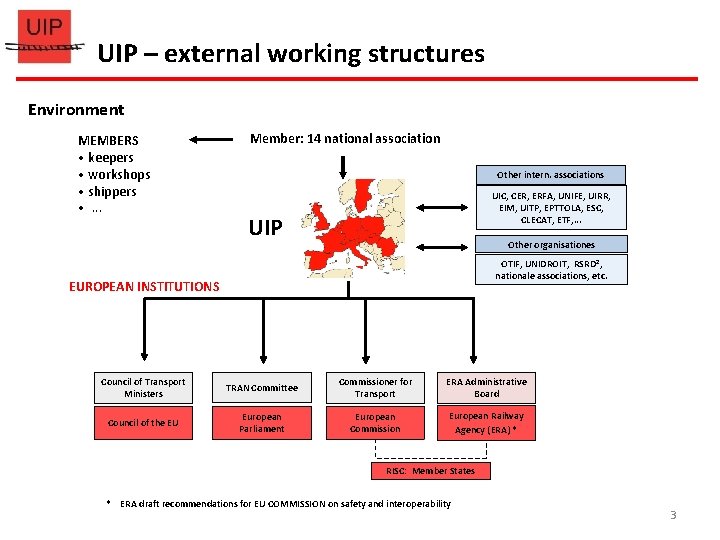
UIP – external working structures Environment MEMBERS • keepers • workshops • shippers • . . . Member: 14 national association Other intern. associations UIC, CER, ERFA, UNIFE, UIRR, EIM, UITP, EPTTOLA, ESC, CLECAT, ETF, . . . UIP Other organisationes OTIF, UNIDROIT, RSRD 2, nationale associations, etc. EUROPEAN INSTITUTIONS Council of Transport Ministers TRAN Committee Commissioner for Transport ERA Administrative Board Council of the EU European Parliament European Commission European Railway Agency (ERA) * RISC: Member States * ERA draft recommendations for EU COMMISSION on safety and interoperability 3
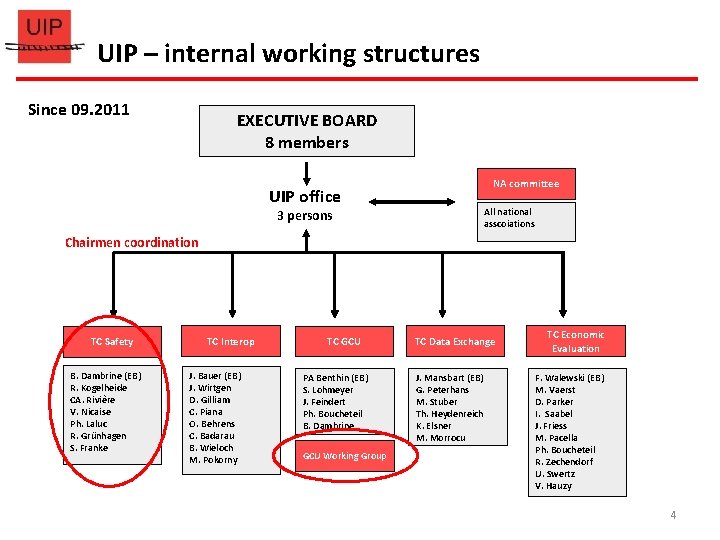
UIP – internal working structures Since 09. 2011 EXECUTIVE BOARD 8 members NA committee UIP office All national asscoiations 3 persons Chairmen coordination TC Safety B. Dambrine (EB) R. Kogelheide CA. Rivière V. Nicaise Ph. Laluc R. Grünhagen S. Franke TC Interop J. Bauer (EB) J. Wirtgen D. Gilliam C. Piana O. Behrens C. Badarau B. Wieloch M. Pokorny TC GCU PA Benthin (EB) S. Lohmeyer J. Feindert Ph. Boucheteil B. Dambrine GCU Working Group TC Data Exchange J. Mansbart (EB) G. Peterhans M. Stuber Th. Heydenreich K. Elsner M. Morrocu TC Economic Evaluation F. Walewski (EB) M. Vaerst D. Parker I. Saabel J. Friess M. Pacella Ph. Boucheteil R. Zechendorf U. Swertz V. Hauzy 4
Inhaltsverzeichnis UIP: International Union of Wagon keepers International legal framework European legal framework Allocation of responsibilities Operational safety and controls Conclusions 5
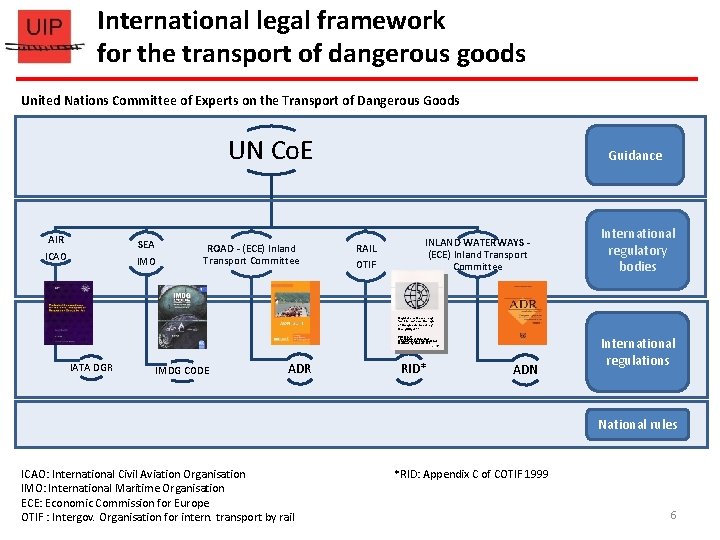
International legal framework for the transport of dangerous goods United Nations Committee of Experts on the Transport of Dangerous Goods UN Co. E AIR SEA IMO ICAO ROAD - (ECE) Inland Transport Committee Guidance RAIL OTIF INLAND WATERWAYS - (ECE) Inland Transport Committee International regulatory bodies Regulations Concerning the International Carriage of Dangerous Goods by Rail (RID) 2011 Publisher: The Intergovernmental Organization for International Carriage by Rail (OTIF) IATA DGR IMDG CODE ADR RID* ADN International regulations National rules ICAO: International Civil Aviation Organisation IMO: International Maritime Organisation ECE: Economic Commission for Europe OTIF : Intergov. Organisation for intern. transport by rail *RID: Appendix C of COTIF 1999 6
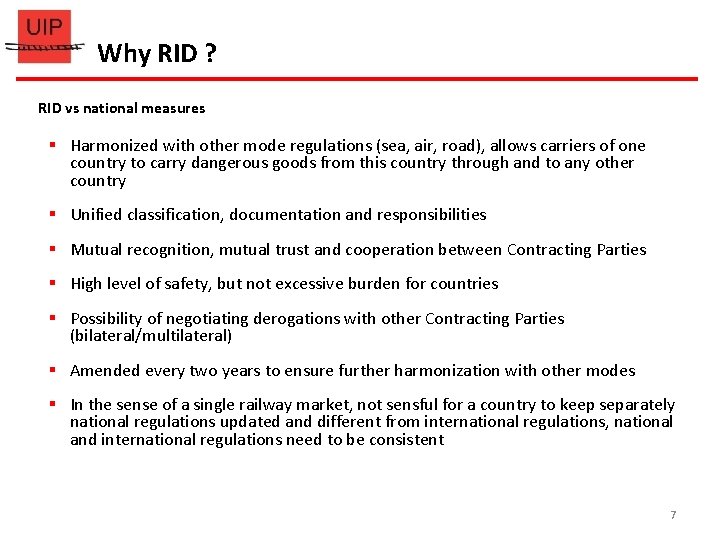
Why RID ? RID vs national measures § Harmonized with other mode regulations (sea, air, road), allows carriers of one country to carry dangerous goods from this country through and to any other country § Unified classification, documentation and responsibilities § Mutual recognition, mutual trust and cooperation between Contracting Parties § High level of safety, but not excessive burden for countries § Possibility of negotiating derogations with other Contracting Parties (bilateral/multilateral) § Amended every two years to ensure further harmonization with other modes § In the sense of a single railway market, not sensful for a country to keep separately national regulations updated and different from international regulations, national and international regulations need to be consistent 7
Inhaltsverzeichnis UIP: International Union of Wagon keepers International legal framework European legal framework Allocation of responsibilities Operational safety and controls Conclusions 8
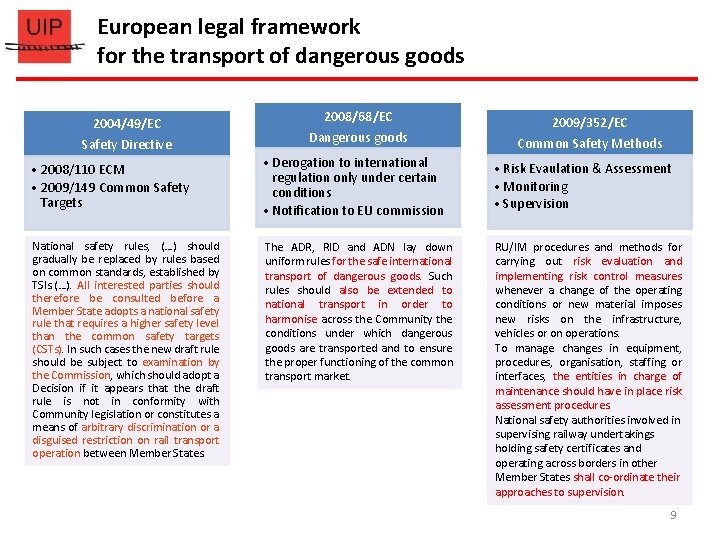
European legal framework for the transport of dangerous goods 2004/49/EC Safety Directive • 2008/110 ECM • 2009/149 Common Safety Targets National safety rules, (…) should gradually be replaced by rules based on common standards, established by TSIs. (…). All interested parties should therefore be consulted before a Member State adopts a national safety rule that requires a higher safety level than the common safety targets (CSTs). In such cases the new draft rule should be subject to examination by the Commission, which should adopt a Decision if it appears that the draft rule is not in conformity with Community legislation or constitutes a means of arbitrary discrimination or a disguised restriction on rail transport operation between Member States. 2008/68/EC Dangerous goods • Derogation to international regulation only under certain conditions • Notification to EU commission The ADR, RID and ADN lay down uniform rules for the safe international transport of dangerous goods. Such rules should also be extended to national transport in order to harmonise across the Community the conditions under which dangerous goods are transported and to ensure the proper functioning of the common transport market. 2009/352/EC Common Safety Methods • Risk Evaulation & Assessment • Monitoring • Supervision RU/IM procedures and methods for carrying out risk evaluation and implementing risk control measures whenever a change of the operating conditions or new material imposes new risks on the infrastructure, vehicles or on operations. To manage changes in equipment, procedures, organisation, staffing or interfaces, the entities in charge of maintenance should have in place risk assessment procedures. National safety authorities involved in supervising railway undertakings holding safety certificates and operating across borders in other Member States shall co-ordinate their approaches to supervision. 9
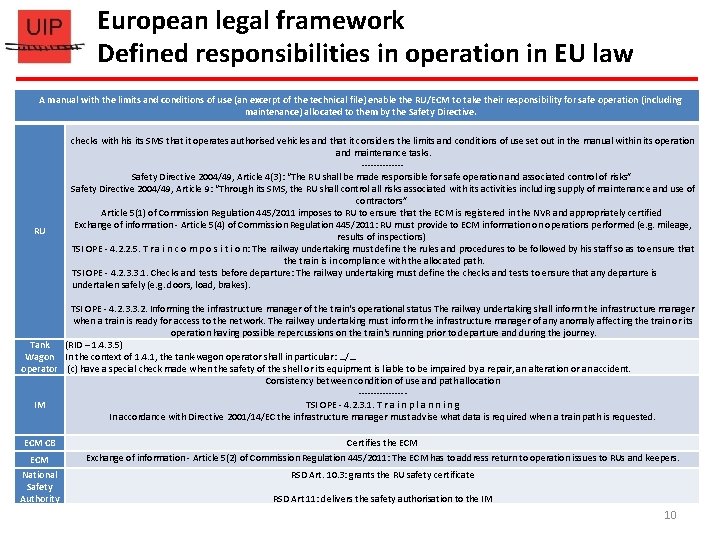
European legal framework Defined responsibilities in operation in EU law A manual with the limits and conditions of use (an excerpt of the technical file) enable the RU/ECM to take their responsibility for safe operation (including maintenance) allocated to them by the Safety Directive. checks with his its SMS that it operates authorised vehicles and that it considers the limits and conditions of use set out in the manual within its operation and maintenance tasks. -------Safety Directive 2004/49, Article 4(3): “The RU shall be made responsible for safe operation and associated control of risks” Safety Directive 2004/49, Article 9: “Through its SMS, the RU shall control all risks associated with its activities including supply of maintenance and use of contractors” Article 5(1) of Commission Regulation 445/2011 imposes to RU to ensure that the ECM is registered in the NVR and appropriately certified Exchange of information - Article 5(4) of Commission Regulation 445/2011: RU must provide to ECM information on operations performed (e. g. mileage, RU results of inspections) TSI OPE - 4. 2. 2. 5. T r a i n c o m p o s i t i o n: The railway undertaking must define the rules and procedures to be followed by his staff so as to ensure that the train is in compliance with the allocated path. TSI OPE - 4. 2. 3. 3. 1. Checks and tests before departure: The railway undertaking must define the checks and tests to ensure that any departure is undertaken safely (e. g. doors, load, brakes). TSI OPE - 4. 2. 3. 3. 2. Informing the infrastructure manager of the train's operational status The railway undertaking shall inform the infrastructure manager when a train is ready for access to the network. The railway undertaking must inform the infrastructure manager of any anomaly affecting the train or its operation having possible repercussions on the train's running prior to departure and during the journey. Tank (RID – 1. 4. 3. 5) Wagon In the context of 1. 4. 1, the tank-wagon operator shall in particular: …/… operator (c) have a special check made when the safety of the shell or its equipment is liable to be impaired by a repair, an alteration or an accident. Consistency between condition of use and path allocation --------IM TSI OPE - 4. 2. 3. 1. T r a i n p l a n n i n g In accordance with Directive 2001/14/EC the infrastructure manager must advise what data is required when a train path is requested. ECM CB Certifies the ECM Exchange of information - Article 5(2) of Commission Regulation 445/2011: The ECM has to address return to operation issues to RUs and keepers. ECM National RSD Art. 10. 3: grants the RU safety certificate Safety Authority RSD Art 11: delivers the safety authorisation to the IM 10
Inhaltsverzeichnis UIP: International Union of Wagon keepers International legal framework European legal framework Allocation of responsibilities Operational safety and controls Conclusions 11
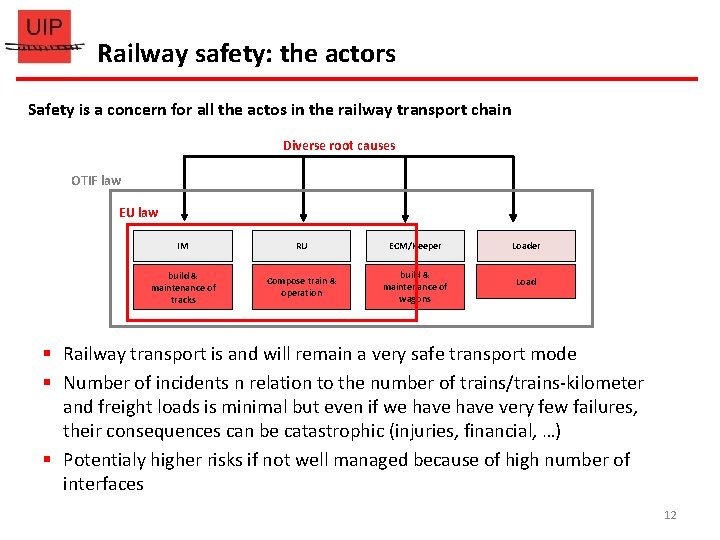
Railway safety: the actors Safety is a concern for all the actos in the railway transport chain Diverse root causes OTIF law EU law IM RU ECM/Keeper build & maintenance of tracks Compose train & operation build & maintenance of wagons Loader Load § Railway transport is and will remain a very safe transport mode § Number of incidents n relation to the number of trains/trains-kilometer and freight loads is minimal but even if we have very few failures, their consequences can be catastrophic (injuries, financial, …) § Potentialy higher risks if not well managed because of high number of interfaces 12
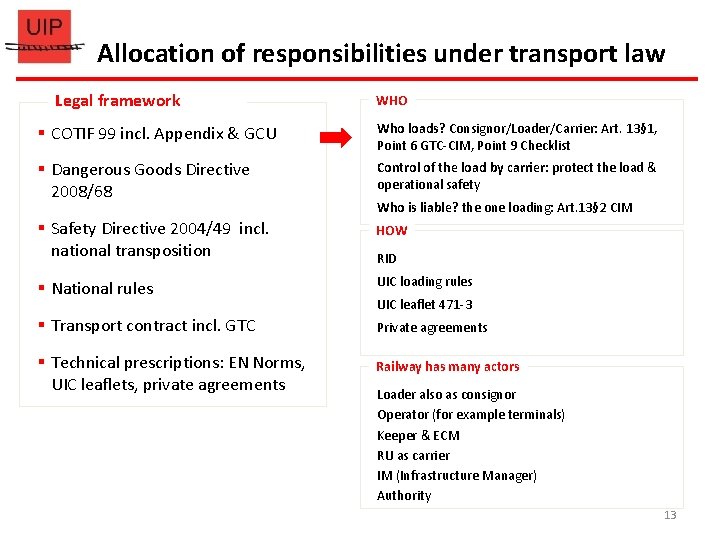
Allocation of responsibilities under transport law Legal framework WHO § COTIF 99 incl. Appendix & GCU Who loads? Consignor/Loader/Carrier: Art. 13§ 1, Point 6 GTC-CIM, Point 9 Checklist § Dangerous Goods Directive 2008/68 Control of the load by carrier: protect the load & operational safety § Safety Directive 2004/49 incl. national transposition HOW § National rules UIC loading rules § Transport contract incl. GTC Private agreements § Technical prescriptions: EN Norms, UIC leaflets, private agreements Railway has many actors Who is liable? the one loading: Art. 13§ 2 CIM RID UIC leaflet 471 -3 Loader also as consignor Operator (for example terminals) Keeper & ECM RU as carrier IM (Infrastructure Manager) Authority 13
Inhaltsverzeichnis UIP: International Union of Wagon keepers International legal framework European legal framework Allocation of responsibilities Operational safety and controls Conclusions 14
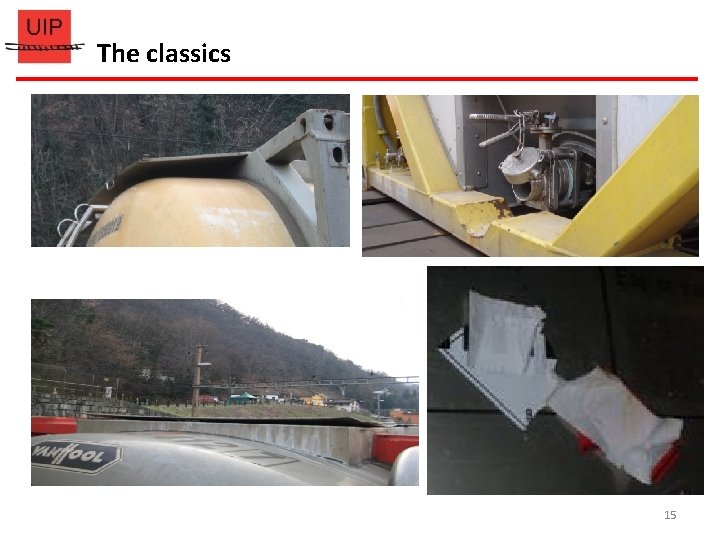
The classics 15
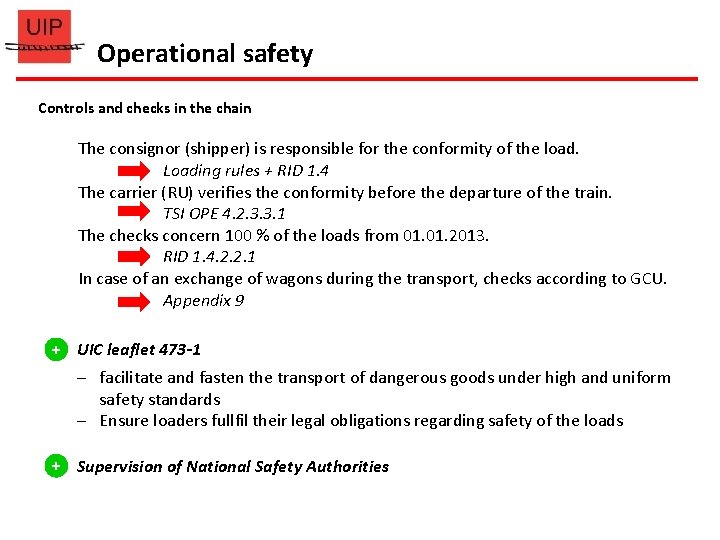
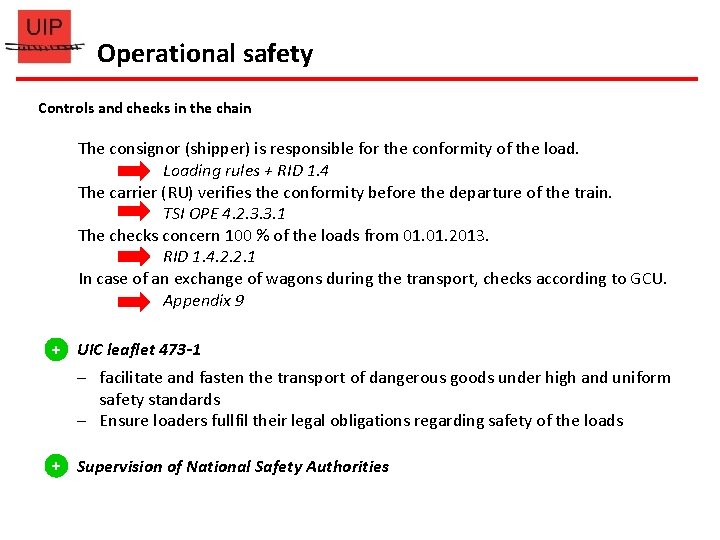
Operational safety Controls and checks in the chain The consignor (shipper) is responsible for the conformity of the load. Loading rules + RID 1. 4 The carrier (RU) verifies the conformity before the departure of the train. TSI OPE 4. 2. 3. 3. 1 The checks concern 100 % of the loads from 01. 2013. RID 1. 4. 2. 2. 1 In case of an exchange of wagons during the transport, checks according to GCU. Appendix 9 UIC leaflet 473 -1 + - facilitate and fasten the transport of dangerous goods under high and uniform safety standards - Ensure loaders fullfil their legal obligations regarding safety of the loads Supervision of National Safety Authorities + 16
Operational safety Controls and checks in the chain The consignor (shipper) is responsible for the conformity of the load. Loading rules + RID 1. 4 The carrier (RU) verifies the conformity before the departure of the train. TSI OPE 4. 2. 3. 3. 1 The checks concern 100 % of the loads from 01. 2013. RID 1. 4. 2. 2. 1 In case of an exchange of wagons during the transport, checks according to GCU. Appendix 9 UIC leaflet 473 -1 + - facilitate and fasten the transport of dangerous goods under high and uniform safety standards - Ensure loaders fullfil their legal obligations regarding safety of the loads Supervision of National Safety Authorities + 17
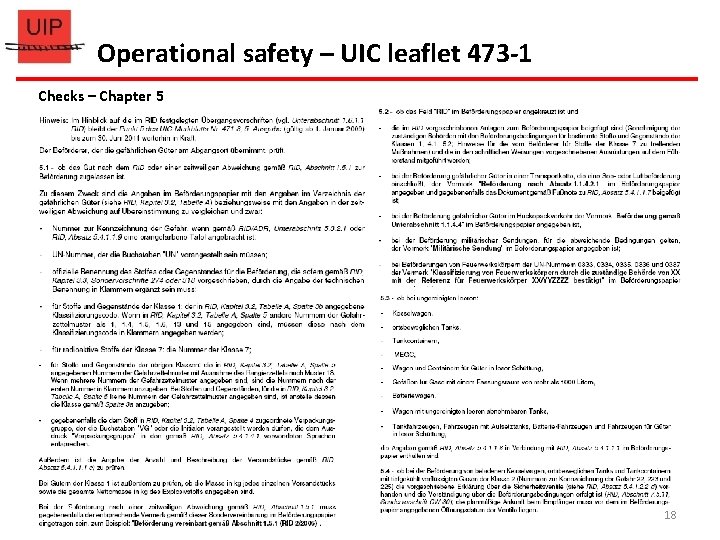
Operational safety – UIC leaflet 473 -1 Checks – Chapter 5 18 18
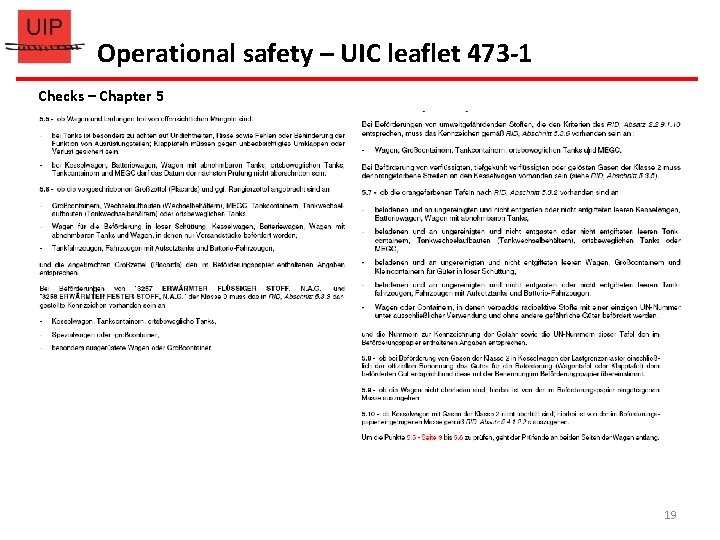
Operational safety – UIC leaflet 473 -1 Checks – Chapter 5 19 19
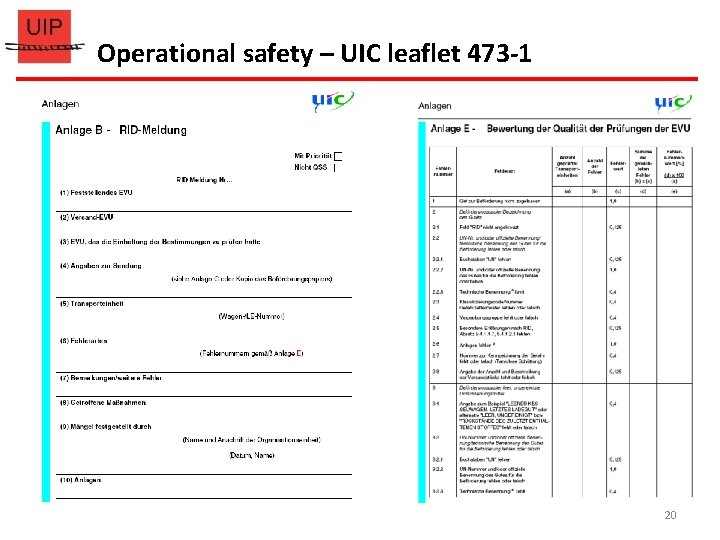
Operational safety – UIC leaflet 473 -1 20 20
Inhaltsverzeichnis UIP: International Union of Wagon keepers International legal framework European legal framework Allocation of responsibilities Operational safety and controls Conclusions 21
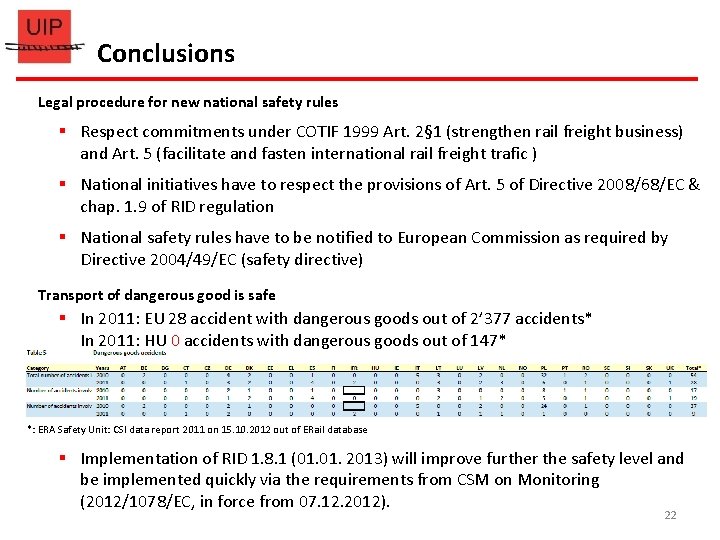
Conclusions Legal procedure for new national safety rules § Respect commitments under COTIF 1999 Art. 2§ 1 (strengthen rail freight business) and Art. 5 (facilitate and fasten international rail freight trafic ) § National initiatives have to respect the provisions of Art. 5 of Directive 2008/68/EC & chap. 1. 9 of RID regulation § National safety rules have to be notified to European Commission as required by Directive 2004/49/EC (safety directive) Transport of dangerous good is safe § In 2011: EU 28 accident with dangerous goods out of 2’ 377 accidents* In 2011: HU 0 accidents with dangerous goods out of 147* *: ERA Safety Unit: CSI data report 2011 on 15. 10. 2012 out of ERail database § Implementation of RID 1. 8. 1 (01. 2013) will improve further the safety level and be implemented quickly via the requirements from CSM on Monitoring (2012/1078/EC, in force from 07. 12. 2012). 22
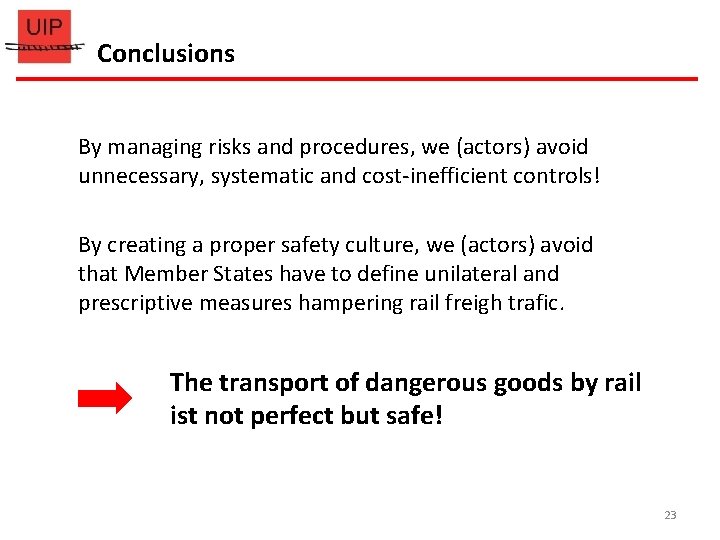
Conclusions By managing risks and procedures, we (actors) avoid unnecessary, systematic and cost-inefficient controls! By creating a proper safety culture, we (actors) avoid that Member States have to define unilateral and prescriptive measures hampering rail freigh trafic. The transport of dangerous goods by rail ist not perfect but safe! 23
Conclusions A way forward 1. 2. 3. Participate to RID sessions (to discuss issues with RID 1. 4. 2. 2. 5 or RID 1. 4. 3. 6) Return of experience form supervision activities on national level Important safety issues should be raised to ERA Joint Network Secretariat Respect Internationalen Übereinkommens zur Harmonisierung der Warenkontrollen an den Grenzen – Appendix 9 (since 30. 11. 2011 in force) 24
Thank you for your attention GILLES PETERHANS Technical Coordinator UIP tec. info@uiprail. org 25