
INTERNATIONAL CODE OF NOMENCLATURE FOR ALGAE FUNGI AND
![HERBARIUM RECORDS Holotype of Asplenium ofeliae Salgado, A. E. 2003 [family ASPLENIACEAE] Collection Type](https://slidetodoc.com/presentation_image_h2/d78fb42df740e17dd07584998a244c00/image-31.jpg "HERBARIUM RECORDS Holotype of Asplenium ofeliae Salgado, A. E. 2003 [family ASPLENIACEAE] Collection Type")
- Slides: 53
INTERNATIONAL CODE OF NOMENCLATURE FOR ALGAE, FUNGI AND PLANTS INTERNATIONAL BOTANICAL CONGRESS MELBOURNE, AUSTRALIA 2011
WHAT IS NOMENCLATURE? • From the Latin NOMEN, name. • It is the formal naming of plants • It follows a set of rules published in the INTERNATIONAL CODE OF NOMENCLATURE FOR ALGAE, FUNGI AND PLANTS. • Nomenclature is closely allied to taxonomy.
WHAT IS TAXONOMY? • The science of identifying, describing and classifying plants. • Modern taxonomy attempts to illustrate the evolutionary relationship of the different taxa. • Classification is based on PHYLOGENY, common descent.
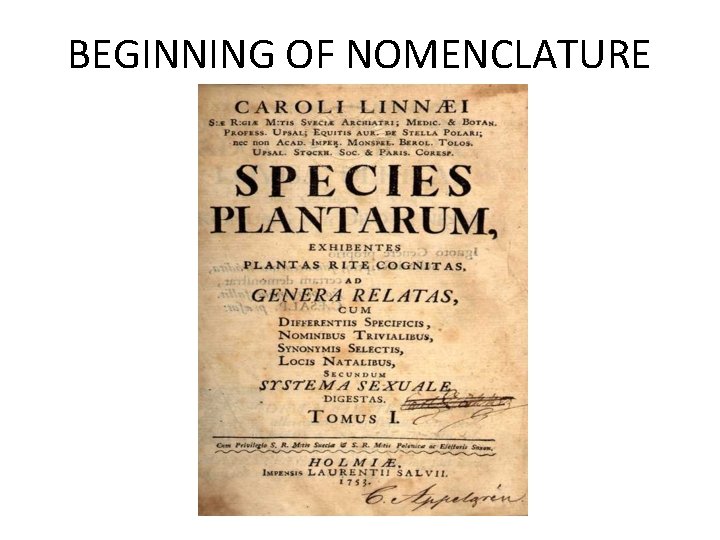
BEGINNING OF NOMENCLATURE
Background • Classification is the basic process of taxonomy. – Define taxon concepts – Group concepts together • Nomenclature is secondary to classification – Defines the rules by which the taxa and groups of taxa are named
Background • Other codes exists for other major groups of organisms: – Cultivated plants – Animals – Bacteria (International code of Nomenclature of cultivated plants) (International Code of Zoological Nomenclature) (International Code of Bacterial Nomenclature)
Background • First rules of plant nomenclature proposed by A. P. De Candolle in 1867. • Current rules governed by the Nomenclatural Committee of the International Botanical Congress (IBC) • First congress held in Vienna in 1908 • Latest code published in 2011
What are two basic activities governed by the ICN? 1) Naming new taxa 2) Determining the correct name for previously named taxa (altered in some way)
What are legitimate and illegitimate names? Legitimate Names in accordance with the rules of the ICN Illegitimate Names violate one or more rules of the ICN
How are changes to the ICN made? International Botanical Congress Last held in Melbourne, Australia - July 2011. Next: Shenzhen, China, 23– 29 July 2017.
CHANGES TO THE CODE • Changes to the code are effected through voting of the members of the IBC. • Proposals for change must be published in taxon prior to the congress in which they are to be discussed. • Changes agreed at congress are incorporated into the code by the Editorial Committee
STRUCTURE OF THE CODE • Physical arrangement • 3 Divisions – Division I – Principles – Division II – Rules and recommendations • 7 Chapters – Sections – Division III – Provisions for the governance of the code – 5 Appendices
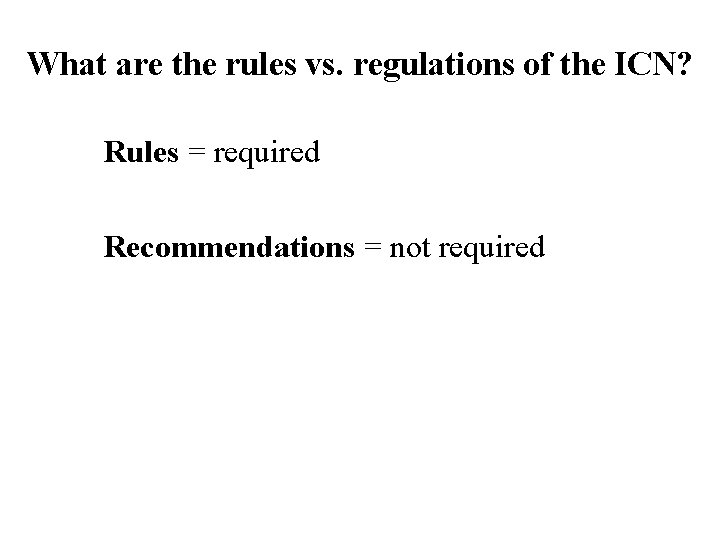
What are the rules vs. regulations of the ICN? Rules = required Recommendations = not required
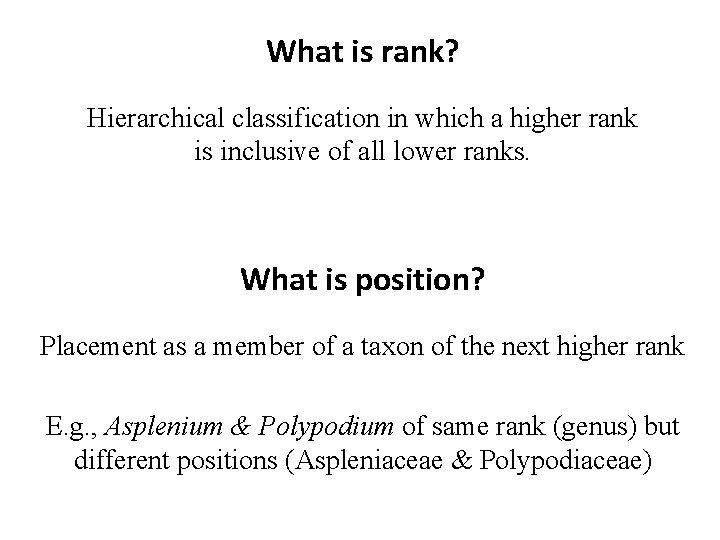
What is rank? Hierarchical classification in which a higher rank is inclusive of all lower ranks. What is position? Placement as a member of a taxon of the next higher rank E. g. , Asplenium & Polypodium of same rank (genus) but different positions (Aspleniaceae & Polypodiaceae)
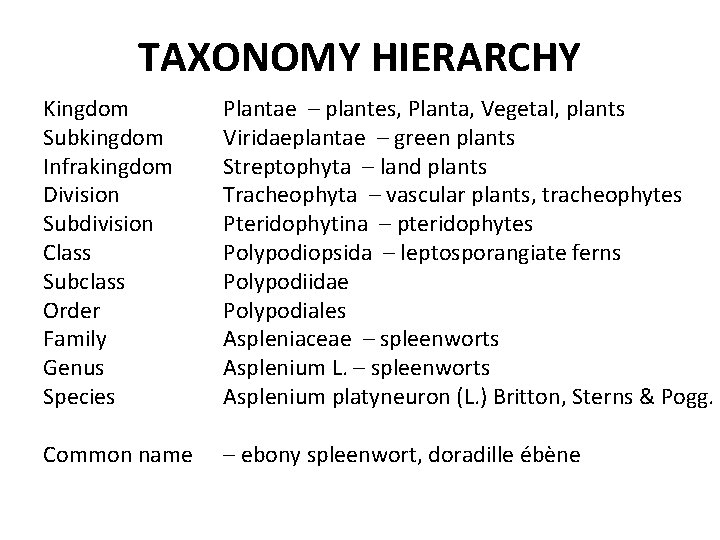
TAXONOMY HIERARCHY Kingdom Subkingdom Infrakingdom Division Subdivision Class Subclass Order Family Genus Species Plantae – plantes, Planta, Vegetal, plants Viridaeplantae – green plants Streptophyta – land plants Tracheophyta – vascular plants, tracheophytes Pteridophytina – pteridophytes Polypodiopsida – leptosporangiate ferns Polypodiidae Polypodiales Aspleniaceae – spleenworts Asplenium L. – spleenworts Asplenium platyneuron (L. ) Britton, Sterns & Pogg. Common name – ebony spleenwort, doradille ébène
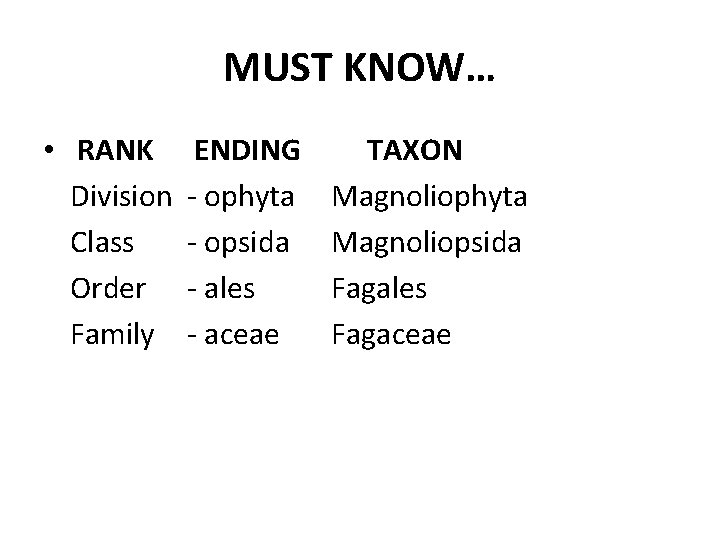
MUST KNOW… • RANK Division Class Order Family ENDING - ophyta - opsida - ales - aceae TAXON Magnoliophyta Magnoliopsida Fagales Fagaceae
THE PRINCIPLES OF THE CODE • There are six principles which are intended to provide a stable naming system by: – Rejecting erroneous names and names that may cause ambiguity or confusion – Avoiding the superfluous creation of new names – Promote grammatical correctness and accuracy
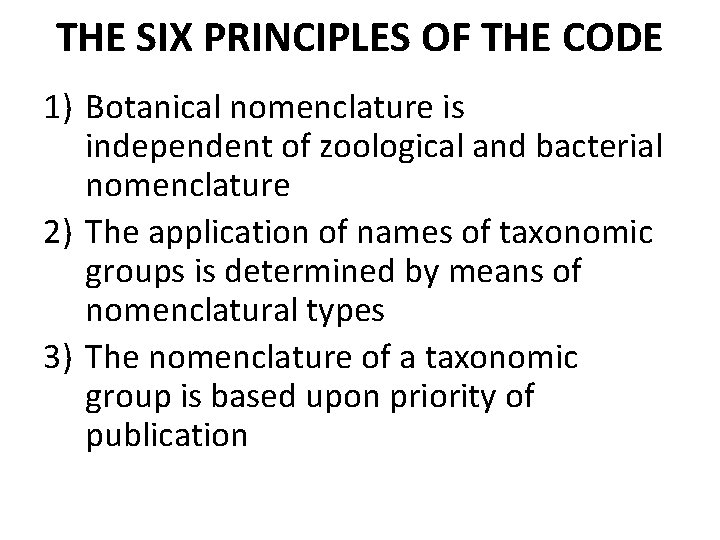
THE SIX PRINCIPLES OF THE CODE 1) Botanical nomenclature is independent of zoological and bacterial nomenclature 2) The application of names of taxonomic groups is determined by means of nomenclatural types 3) The nomenclature of a taxonomic group is based upon priority of publication
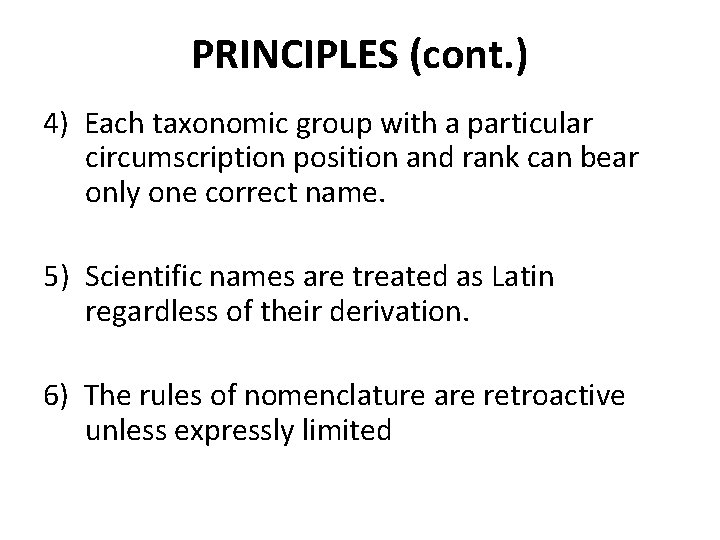
PRINCIPLES (cont. ) 4) Each taxonomic group with a particular circumscription position and rank can bear only one correct name. 5) Scientific names are treated as Latin regardless of their derivation. 6) The rules of nomenclature are retroactive unless expressly limited
THE TYPE CONCEPT (Principle 2) • The nomenclatural type concept and the designation of types is covered in articles 7 -10. • A nomenclatural type (Latin: typus) is the element to which a name is permanently attached. • See chapter II of the ICBN. Status, Typification and Priority of names.
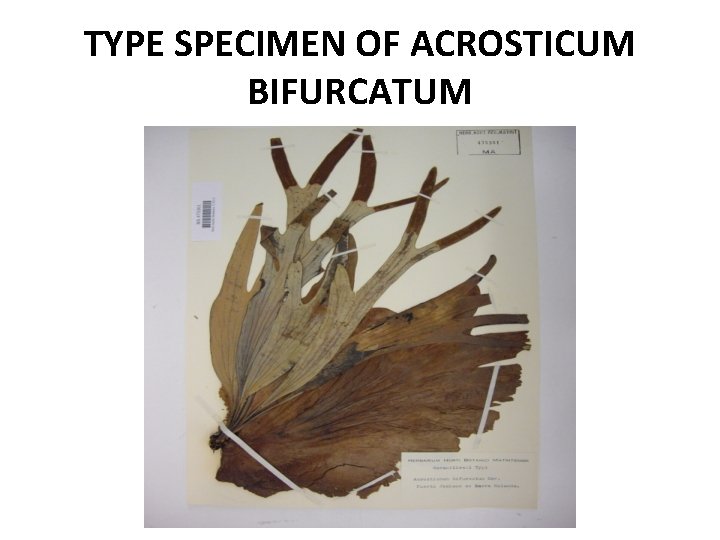
TYPE SPECIMEN OF ACROSTICUM BIFURCATUM
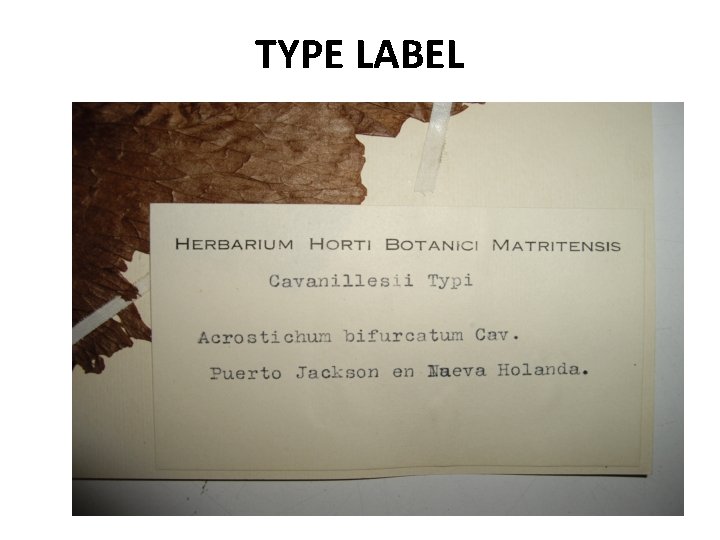
TYPE LABEL
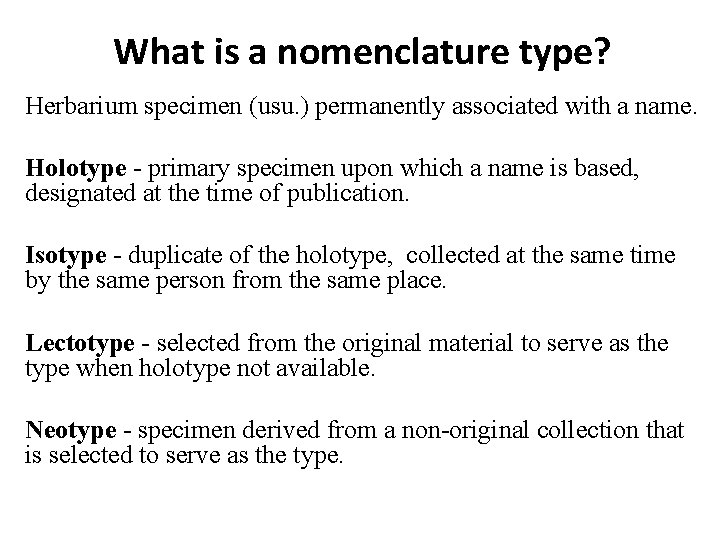
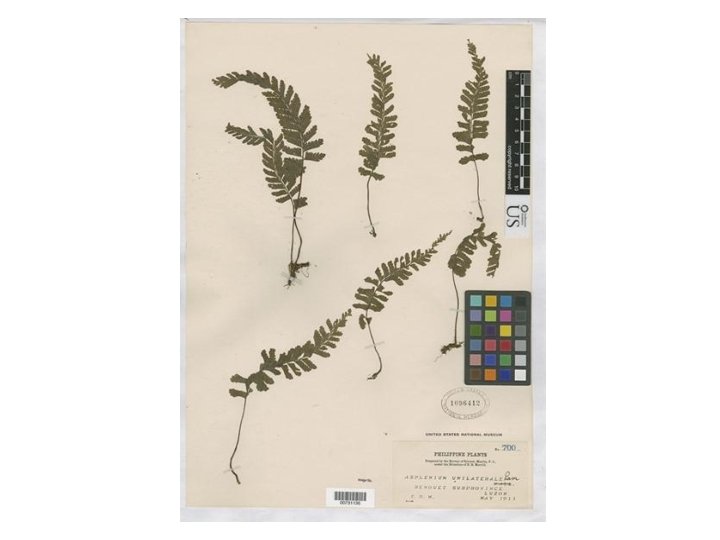
What is a nomenclature type? Herbarium specimen (usu. ) permanently associated with a name. Holotype - primary specimen upon which a name is based, designated at the time of publication. Isotype - duplicate of the holotype, collected at the same time by the same person from the same place. Lectotype - selected from the original material to serve as the type when holotype not available. Neotype - specimen derived from a non-original collection that is selected to serve as the type.
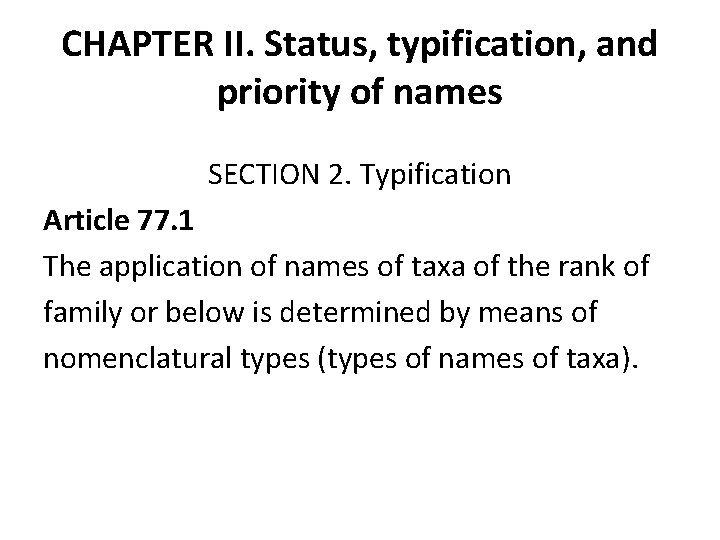
CHAPTER II. Status, typification, and priority of names SECTION 2. Typification Article 77. 1 The application of names of taxa of the rank of family or below is determined by means of nomenclatural types (types of names of taxa).
SECTION 2. Typification cont. • 7. 2 A nomenclatural type (typus) is that element to which the name of a taxon is permanently attached, whether as the correct name or as a synonym. The nomenclatural type is not necessarily the most typical or representative element of a taxon.
TYPES – AN EXPLANATION • A type may be a single specimen, a series of herbarium sheets with parts of one plant on different sheets, or a series of specimens from a single collection mounted on a single sheet. • The type of Homo sapiens is the skeleton of Carl Linnaeus, the type designated by W. T. Stearn.
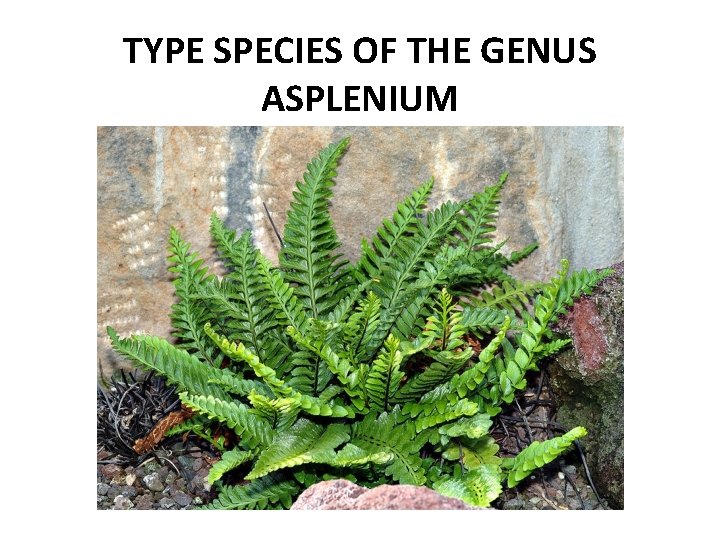
SUMMARY OF TYPIFICATION • the type of a species is a specimen • the type of a genus is a binomial Type species: Asplenium marinum L.
TYPE SPECIES OF THE GENUS ASPLENIUM
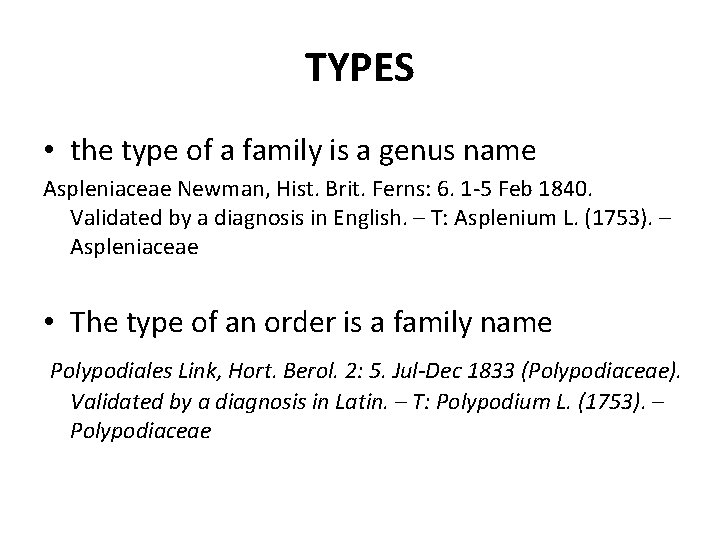
TYPES • the type of a family is a genus name Aspleniaceae Newman, Hist. Brit. Ferns: 6. 1 -5 Feb 1840. Validated by a diagnosis in English. – T: Asplenium L. (1753). – Aspleniaceae • The type of an order is a family name Polypodiales Link, Hort. Berol. 2: 5. Jul-Dec 1833 (Polypodiaceae). Validated by a diagnosis in Latin. – T: Polypodium L. (1753). – Polypodiaceae
HERBARIUM RECORDS Holotype of Asplenium ofeliae Salgado, A. E. 2003 [family ASPLENIACEAE] Collection Type Specimens Resource Type Specimens Collector. Merrill, E. D. , #Phil. Pl. 700 Collection date 1911/5 Locality Luzon Island. Benguet Subprovince, Luzon. • Country Philippines (Philippines) • •
CHAPTER VI. Citation SECTION 1. Author citations Article 49. 1 When a genus or a taxon of lower rank is altered in rank but retains its name or the final epithet in its name, the author of that earlier name, if it is legitimate (i. e. if it is the basionym) is cited in parentheses, followed by the name of the author who effected the alteration (the author of the name).
Example • ASPLENIUM ADIANTOIDES (L. ) Lamarck • Linnaeus first named this spleenwort species Trichomanes adiantoides L. • Lamarck transferred it to the genus Asplenium. • The ICN does not require that the dates of either publication be specified.
Two reasons for name change? 1) Name contrary to the rules (illegitimate). 2) Additional research has changes definition and delimitation of a taxon.
Four major ways that species names are changed? United Divided Changed in rank Changed in Position
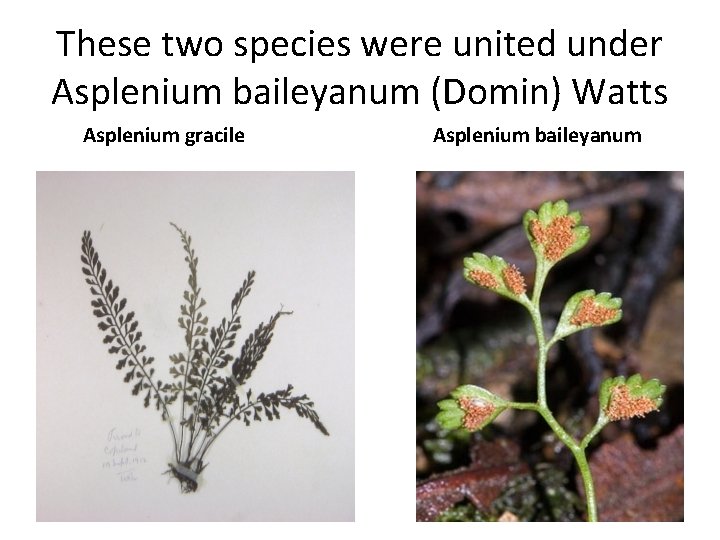
NAMES MAY BE UNITED E. g. Asplenium gracile Fee from the Philippines and Asplenium baileyanum (Domin) Watts from Australia were united by Salgado after studying their morphology. Published in 1852, A. gracile had priority of publication over A. baileyanum published in 1915, but it was later homonym of A. gracile D. Don published in 1825.
These two species were united under Asplenium baileyanum (Domin) Watts Asplenium gracile Asplenium baileyanum
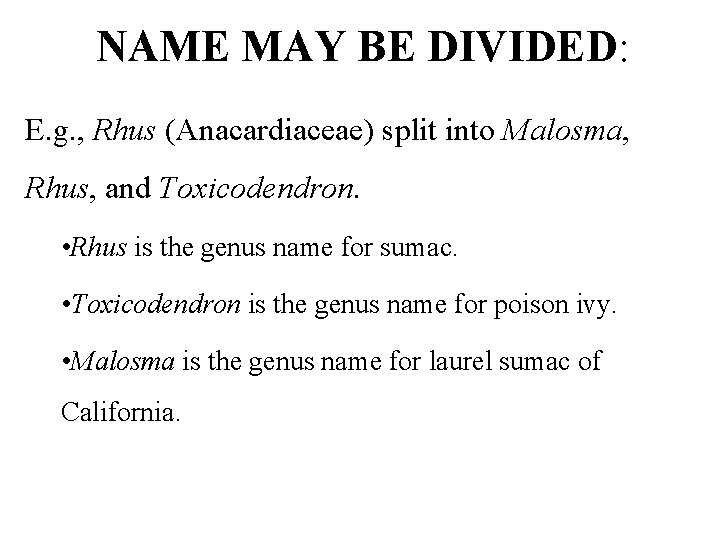
NAME MAY BE DIVIDED: E. g. , Rhus (Anacardiaceae) split into Malosma, Rhus, and Toxicodendron. • Rhus is the genus name for sumac. • Toxicodendron is the genus name for poison ivy. • Malosma is the genus name for laurel sumac of California.
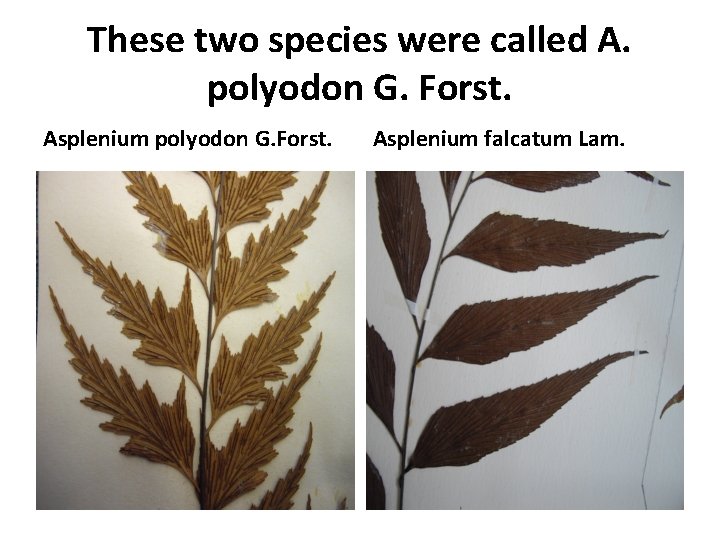
These two species were called A. polyodon G. Forst. Asplenium polyodon G. Forst. Asplenium falcatum Lam.
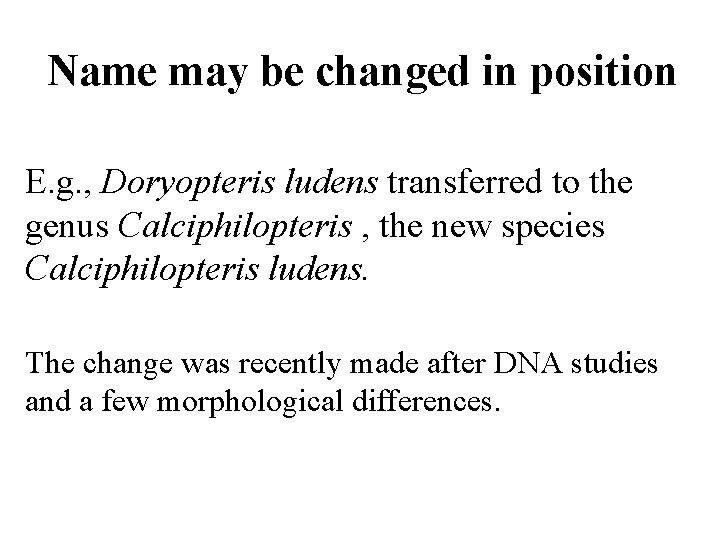
Name may be changed in position E. g. , Doryopteris ludens transferred to the genus Calciphilopteris , the new species Calciphilopteris ludens. The change was recently made after DNA studies and a few morphological differences.
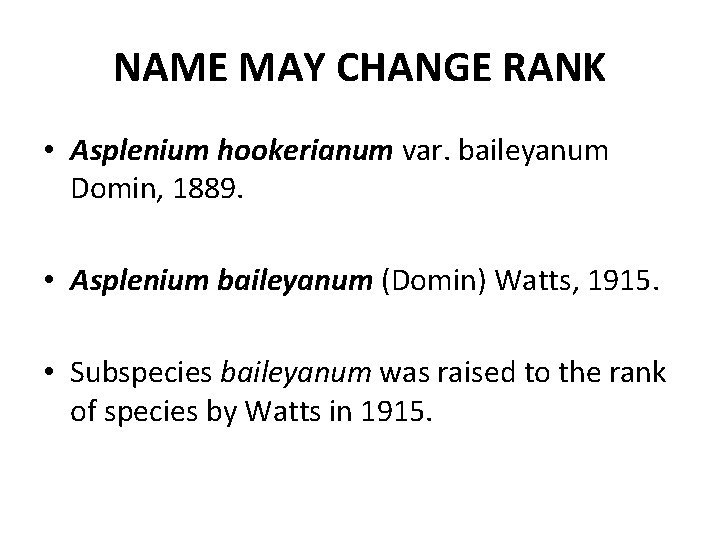
NAME MAY CHANGE RANK • Asplenium hookerianum var. baileyanum Domin, 1889. • Asplenium baileyanum (Domin) Watts, 1915. • Subspecies baileyanum was raised to the rank of species by Watts in 1915.
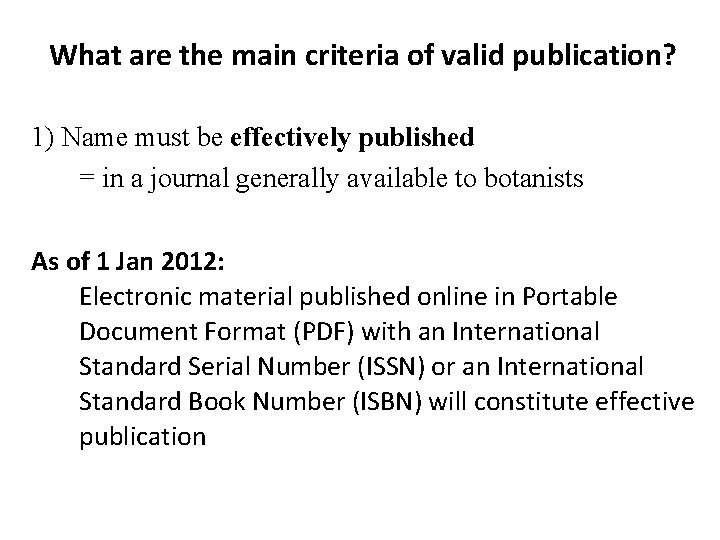
What are the main criteria of valid publication? 1) Name must be effectively published = in a journal generally available to botanists As of 1 Jan 2012: Electronic material published online in Portable Document Format (PDF) with an International Standard Serial Number (ISSN) or an International Standard Book Number (ISBN) will constitute effective publication
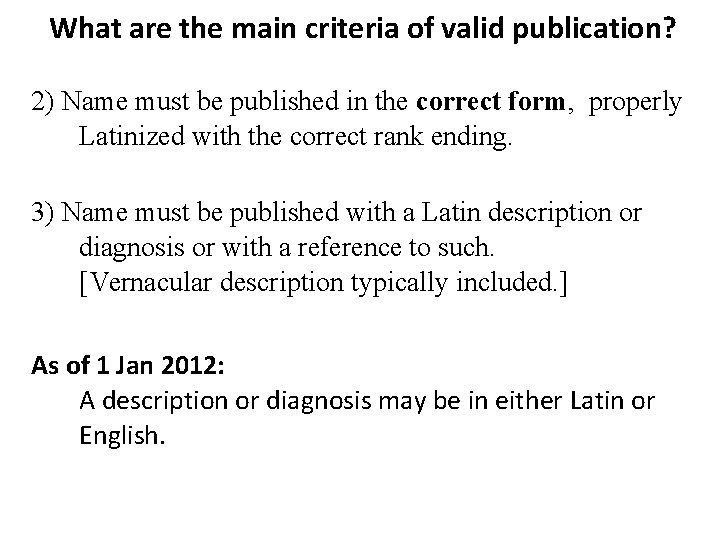
What are the main criteria of valid publication? 2) Name must be published in the correct form, properly Latinized with the correct rank ending. 3) Name must be published with a Latin description or diagnosis or with a reference to such. [Vernacular description typically included. ] As of 1 Jan 2012: A description or diagnosis may be in either Latin or English.
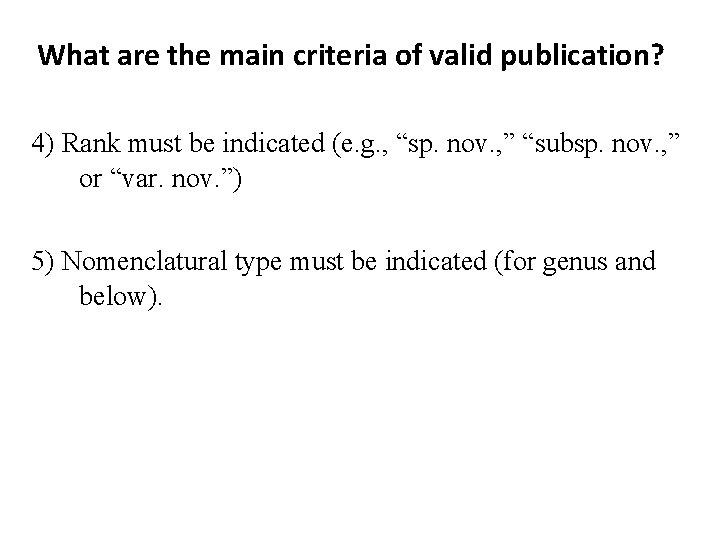
What are the main criteria of valid publication? 4) Rank must be indicated (e. g. , “sp. nov. , ” “subsp. nov. , ” or “var. nov. ”) 5) Nomenclatural type must be indicated (for genus and below).
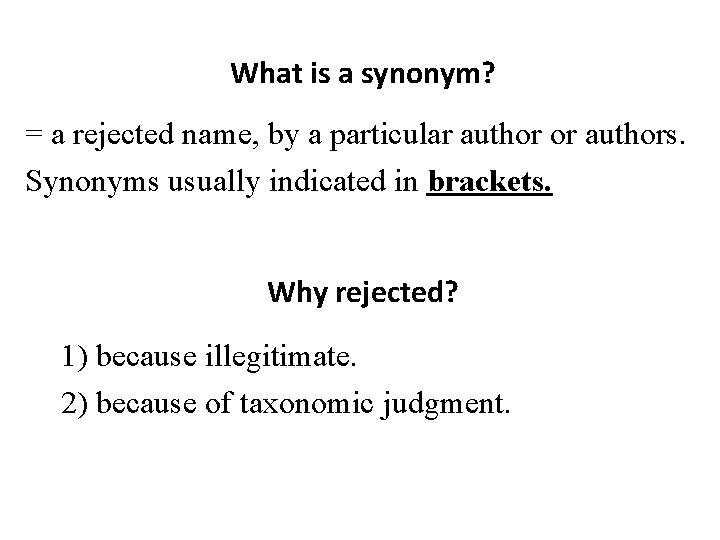
What is a synonym? = a rejected name, by a particular author or authors. Synonyms usually indicated in brackets. Why rejected? 1) because illegitimate. 2) because of taxonomic judgment.
SYNONYMS • Asplenium gracile Fée was rejected for being a later homonym of A. gracile D. Don. • A. gracile D. Don was published in 1825 and has priority over A. gracile Fée, published in 1852.
AUTHOR CITATION • The name of the person(s) who first validly published the name of a taxon. • When species are change from its original genus, the author(s) of the original genus placement and of the new combination are given. • The author of the first published name is given in parentheses.
EXAMPLE Original publication: Trichomanes adiantoides L. was transferred to the genus Asplenium by Lamarck. The new citation is: Asplenium adiantoides (L. ) Lamarck
“ex” AS PART OF THE CITATION • “validly published by…” • When a name does not satisfy the rules of valid publication, it can be validly published at a later date by the same or a different author.
“ex” in a name • The second author may not recognize the publisher of the invalidly published name. • To recognize the first author, the Latin word “ex” is included in the citation of the validly published name.
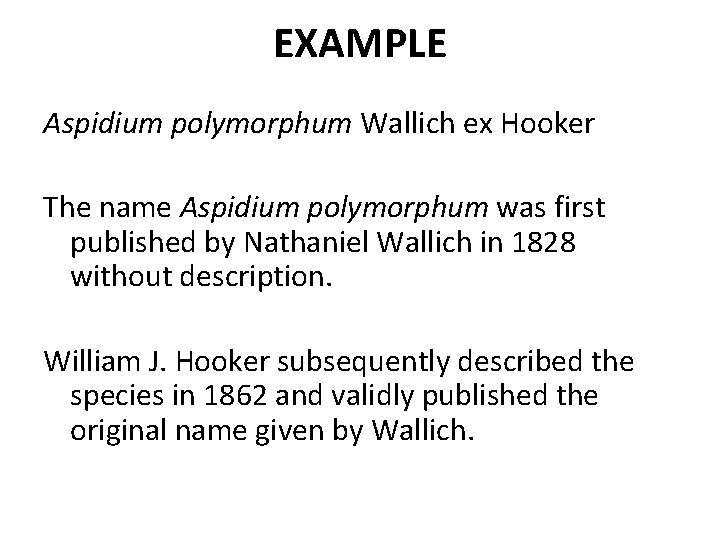
EXAMPLE Aspidium polymorphum Wallich ex Hooker The name Aspidium polymorphum was first published by Nathaniel Wallich in 1828 without description. William J. Hooker subsequently described the species in 1862 and validly published the original name given by Wallich.
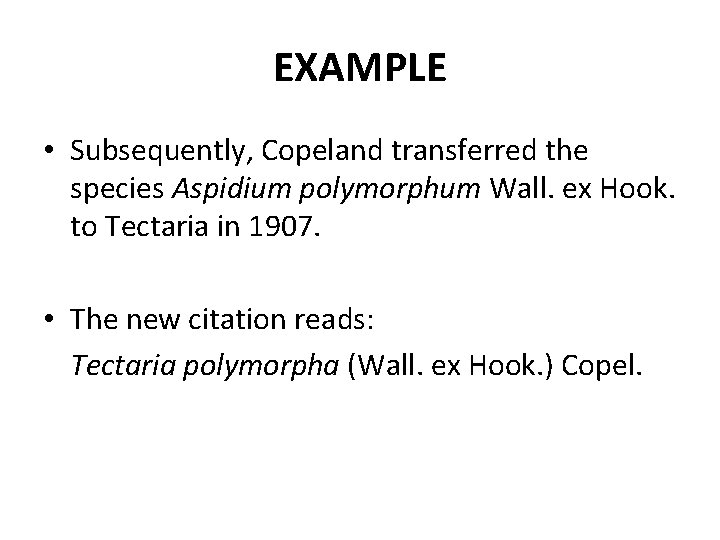
EXAMPLE • Subsequently, Copeland transferred the species Aspidium polymorphum Wall. ex Hook. to Tectaria in 1907. • The new citation reads: Tectaria polymorpha (Wall. ex Hook. ) Copel.
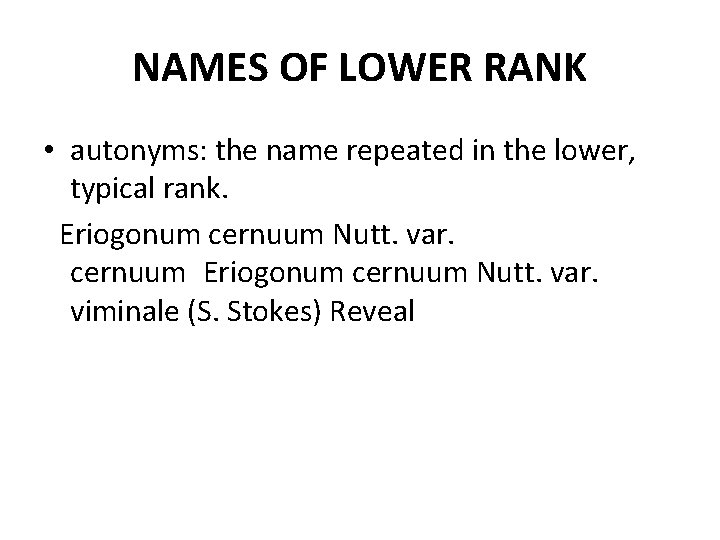
NAMES OF LOWER RANK • autonyms: the name repeated in the lower, typical rank. Eriogonum cernuum Nutt. var. cernuum Eriogonum cernuum Nutt. var. viminale (S. Stokes) Reveal