
INTERNATIONAL CLASSIFICATION of HEADACHE DISORDERS 2 nd edition







- Slides: 34
INTERNATIONAL CLASSIFICATION of HEADACHE DISORDERS 2 nd edition (1 st revision)
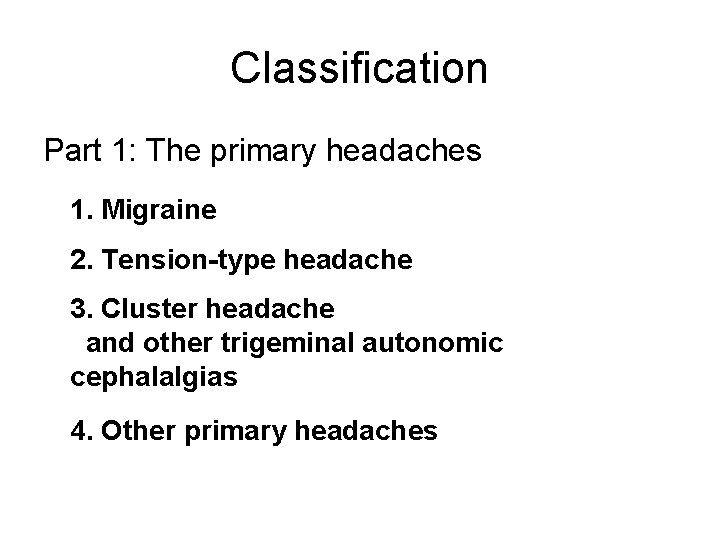
Classification Part 1: The primary headaches 1. Migraine 2. Tension-type headache 3. Cluster headache and other trigeminal autonomic cephalalgias 4. Other primary headaches
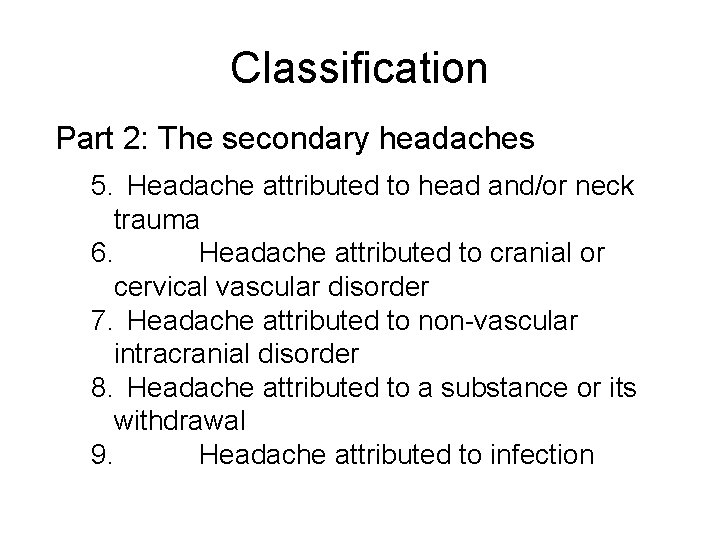
Classification Part 2: The secondary headaches 5. Headache attributed to head and/or neck trauma 6. Headache attributed to cranial or cervical vascular disorder 7. Headache attributed to non-vascular intracranial disorder 8. Headache attributed to a substance or its withdrawal 9. Headache attributed to infection
Classification Part 2: The secondary headaches 10. Headache attributed to disorder of homoeostasis 11. Headache or facial pain attributed to disorder of cranium, neck, eyes, ears, nose, sinuses, teeth, mouth or other facial or cranial structures 12. Headache attributed to psychiatric disorder
Classification Part 3: Cranial neuralgias, central and primary facial pain and other headaches 13. Cranial neuralgias and central causes of facial pain 14. Other headache, cranial neuralgia, central or primary facial pain
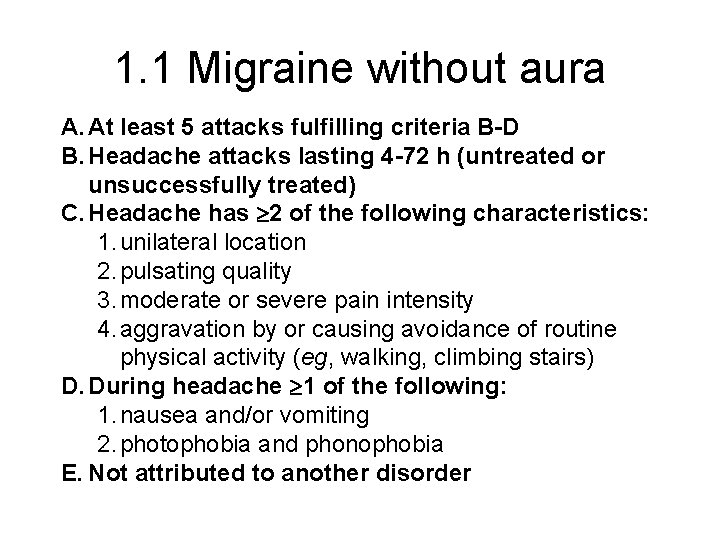
1. 1 Migraine without aura A. At least 5 attacks fulfilling criteria B-D B. Headache attacks lasting 4 -72 h (untreated or unsuccessfully treated) C. Headache has 2 of the following characteristics: 1. unilateral location 2. pulsating quality 3. moderate or severe pain intensity 4. aggravation by or causing avoidance of routine physical activity (eg, walking, climbing stairs) D. During headache 1 of the following: 1. nausea and/or vomiting 2. photophobia and phonophobia E. Not attributed to another disorder
1. 1 Migraine without aura Notes • If <5 attacks but criteria B-E otherwise met, code as 1. 6. 1 Probable migraine without aura • When attacks occur on 15 d/mo for >3 mo, code as 1. 1 Migraine without aura + 1. 5. 1 Chronic migraine • Pulsating means varying with the heartbeat • In children: – attacks may last 1 -72 h – occipital headache requires caution • In young children: – photophobia and/or phonophobia may be inferred from their behaviour
‘Not attributed to another disorder’ Note For all primary headaches, this criterion means: • History and physical/neurological examinations do not suggest any of the disorders listed in groups 512, or history and/or physical/ neurological examinations do suggest such disorder but it is ruled out by appropriate investigations, or such disorder is present but headache does not occur for the first time in close temporal relation to the disorder
1. 2. 1 Typical aura with migraine headache A. At least 2 attacks fulfilling criteria B–D B. Aura consisting of 1 of the following, but no motor weakness: 1. fully reversible visual symptoms including positive and/or negative features 2. fully reversible sensory symptoms including positive and/or negative features 3. fully reversible dysphasic speech disturbance
1. 2. 1 Typical aura with migraine headache C. At least two of the following: 1. homonymous visual symptoms and/or unilateral sensory symptoms 2. at least one aura symptom develops gradually over 5 min and/or different aura symptoms occur in succession over 5 min 3. each symptom lasts 5 and 60 min D. Headache fulfilling criteria B-D for 1. 1 Migraine without aura begins during the aura or follows aura within 60 min E. Not attributed to another disorder
1. 2. 2 Typical aura with non-migraine headache As 1. 2. 1 except: D. Headache that does not fulfil criteria B-D for 1. 1 Migraine without aura begins during the aura or follows aura within 60 min
1. 2. 3 Typical aura without headache As 1. 2. 1 except: D. Headache does not occur during aura nor follow aura within 60 min
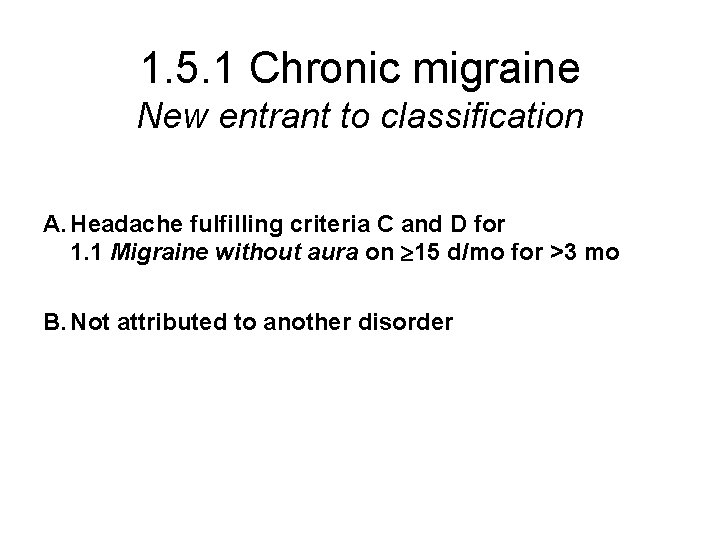
1. 5. 1 Chronic migraine New entrant to classification A. Headache fulfilling criteria C and D for 1. 1 Migraine without aura on 15 d/mo for >3 mo B. Not attributed to another disorder
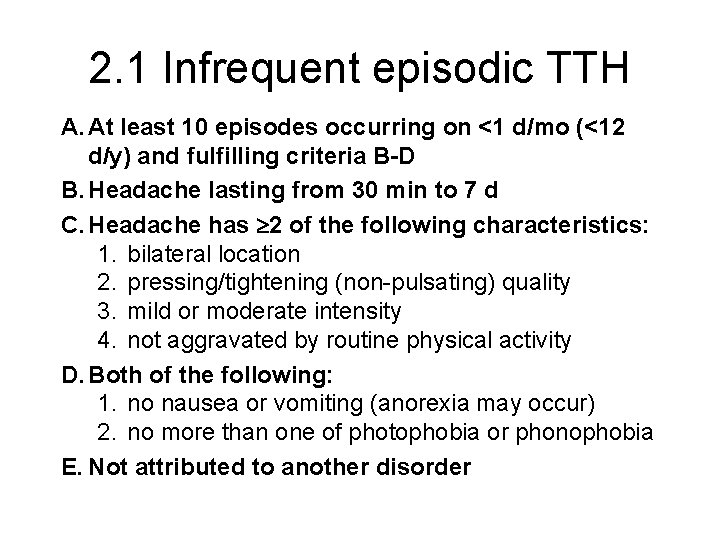
2. 1 Infrequent episodic TTH A. At least 10 episodes occurring on <1 d/mo (<12 d/y) and fulfilling criteria B-D B. Headache lasting from 30 min to 7 d C. Headache has 2 of the following characteristics: 1. bilateral location 2. pressing/tightening (non-pulsating) quality 3. mild or moderate intensity 4. not aggravated by routine physical activity D. Both of the following: 1. no nausea or vomiting (anorexia may occur) 2. no more than one of photophobia or phonophobia E. Not attributed to another disorder
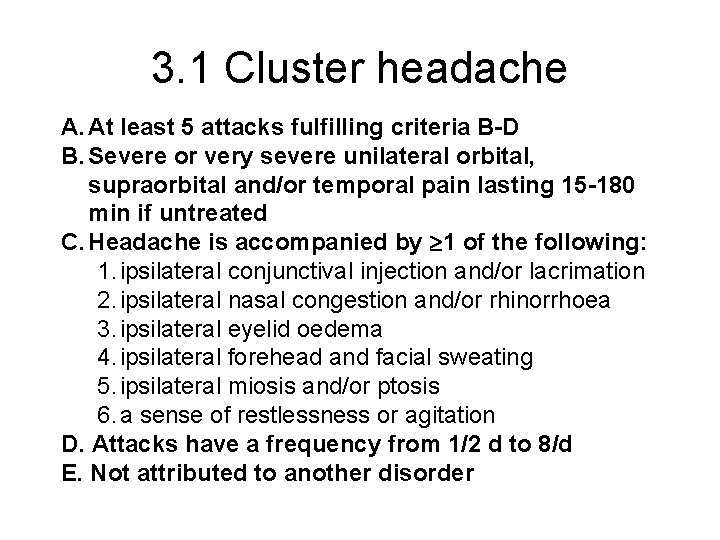
3. 1 Cluster headache A. At least 5 attacks fulfilling criteria B-D B. Severe or very severe unilateral orbital, supraorbital and/or temporal pain lasting 15 -180 min if untreated C. Headache is accompanied by 1 of the following: 1. ipsilateral conjunctival injection and/or lacrimation 2. ipsilateral nasal congestion and/or rhinorrhoea 3. ipsilateral eyelid oedema 4. ipsilateral forehead and facial sweating 5. ipsilateral miosis and/or ptosis 6. a sense of restlessness or agitation D. Attacks have a frequency from 1/2 d to 8/d E. Not attributed to another disorder
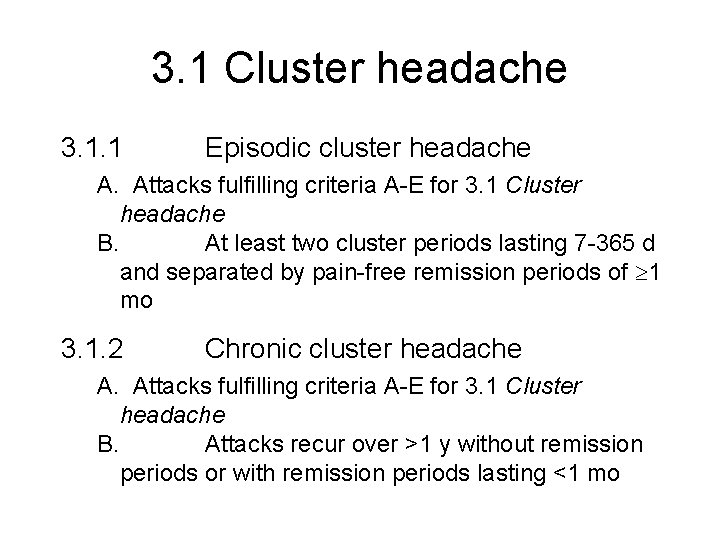
3. 1 Cluster headache 3. 1. 1 Episodic cluster headache A. Attacks fulfilling criteria A-E for 3. 1 Cluster headache B. At least two cluster periods lasting 7 -365 d and separated by pain-free remission periods of 1 mo 3. 1. 2 Chronic cluster headache A. Attacks fulfilling criteria A-E for 3. 1 Cluster headache B. Attacks recur over >1 y without remission periods or with remission periods lasting <1 mo
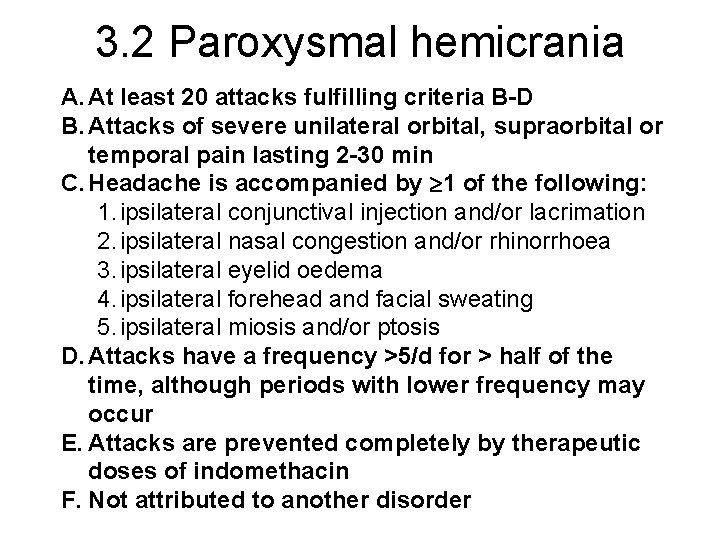
3. 2 Paroxysmal hemicrania A. At least 20 attacks fulfilling criteria B-D B. Attacks of severe unilateral orbital, supraorbital or temporal pain lasting 2 -30 min C. Headache is accompanied by 1 of the following: 1. ipsilateral conjunctival injection and/or lacrimation 2. ipsilateral nasal congestion and/or rhinorrhoea 3. ipsilateral eyelid oedema 4. ipsilateral forehead and facial sweating 5. ipsilateral miosis and/or ptosis D. Attacks have a frequency >5/d for > half of the time, although periods with lower frequency may occur E. Attacks are prevented completely by therapeutic doses of indomethacin F. Not attributed to another disorder
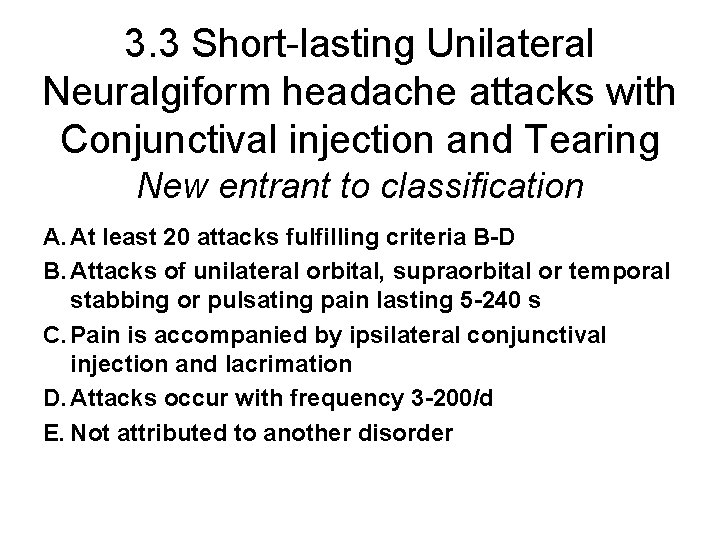
3. 3 Short-lasting Unilateral Neuralgiform headache attacks with Conjunctival injection and Tearing New entrant to classification A. At least 20 attacks fulfilling criteria B-D B. Attacks of unilateral orbital, supraorbital or temporal stabbing or pulsating pain lasting 5 -240 s C. Pain is accompanied by ipsilateral conjunctival injection and lacrimation D. Attacks occur with frequency 3 -200/d E. Not attributed to another disorder
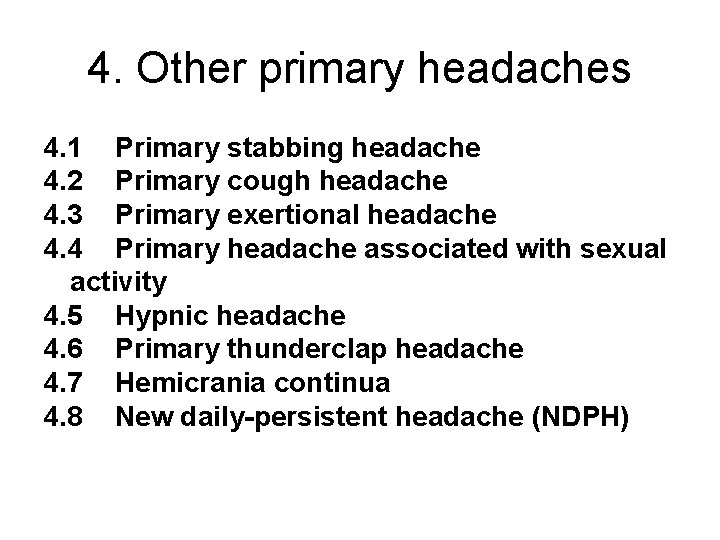
4. Other primary headaches 4. 1 Primary stabbing headache 4. 2 Primary cough headache 4. 3 Primary exertional headache 4. 4 Primary headache associated with sexual activity 4. 5 Hypnic headache 4. 6 Primary thunderclap headache 4. 7 Hemicrania continua 4. 8 New daily-persistent headache (NDPH)
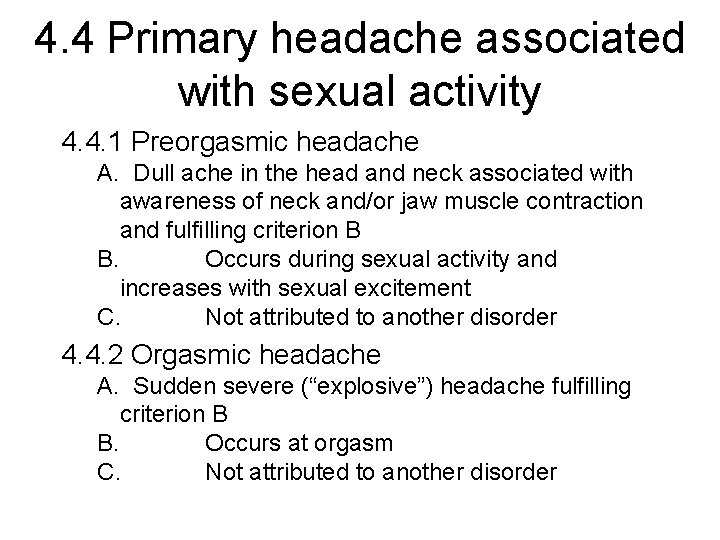
4. 4 Primary headache associated with sexual activity 4. 4. 1 Preorgasmic headache A. Dull ache in the head and neck associated with awareness of neck and/or jaw muscle contraction and fulfilling criterion B B. Occurs during sexual activity and increases with sexual excitement C. Not attributed to another disorder 4. 4. 2 Orgasmic headache A. Sudden severe (“explosive”) headache fulfilling criterion B B. Occurs at orgasm C. Not attributed to another disorder
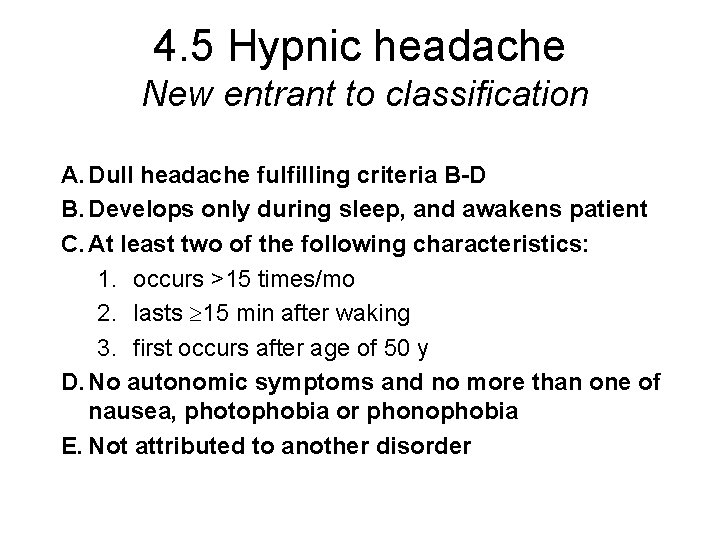
4. 5 Hypnic headache New entrant to classification A. Dull headache fulfilling criteria B-D B. Develops only during sleep, and awakens patient C. At least two of the following characteristics: 1. occurs >15 times/mo 2. lasts 15 min after waking 3. first occurs after age of 50 y D. No autonomic symptoms and no more than one of nausea, photophobia or phonophobia E. Not attributed to another disorder
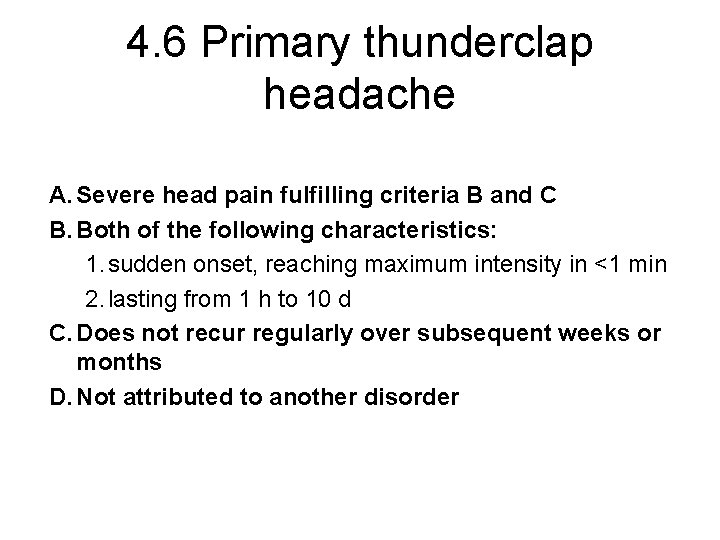
4. 6 Primary thunderclap headache A. Severe head pain fulfilling criteria B and C B. Both of the following characteristics: 1. sudden onset, reaching maximum intensity in <1 min 2. lasting from 1 h to 10 d C. Does not recur regularly over subsequent weeks or months D. Not attributed to another disorder
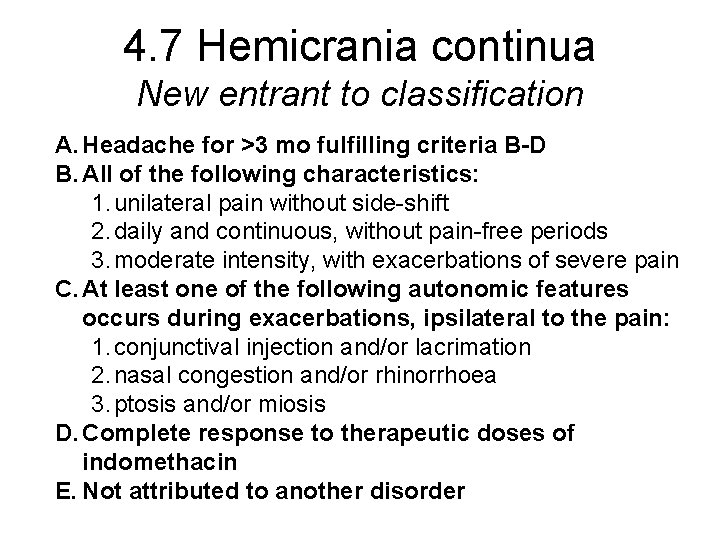
4. 7 Hemicrania continua New entrant to classification A. Headache for >3 mo fulfilling criteria B-D B. All of the following characteristics: 1. unilateral pain without side-shift 2. daily and continuous, without pain-free periods 3. moderate intensity, with exacerbations of severe pain C. At least one of the following autonomic features occurs during exacerbations, ipsilateral to the pain: 1. conjunctival injection and/or lacrimation 2. nasal congestion and/or rhinorrhoea 3. ptosis and/or miosis D. Complete response to therapeutic doses of indomethacin E. Not attributed to another disorder
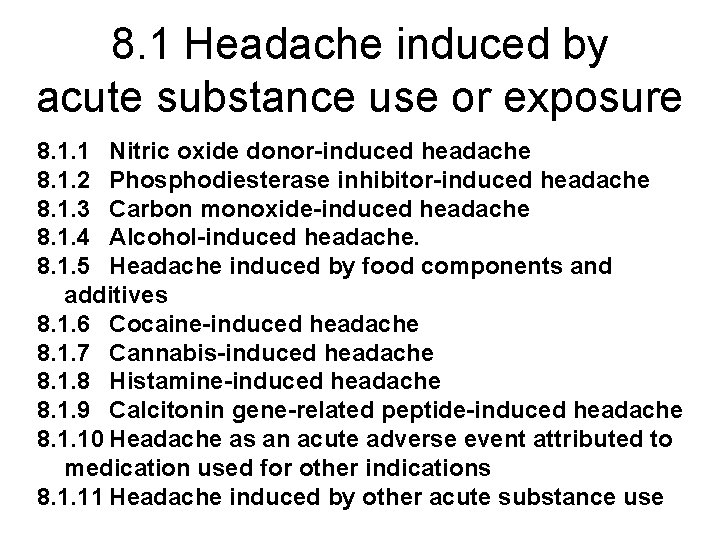
8. 1 Headache induced by acute substance use or exposure 8. 1. 1 Nitric oxide donor-induced headache 8. 1. 2 Phosphodiesterase inhibitor-induced headache 8. 1. 3 Carbon monoxide-induced headache 8. 1. 4 Alcohol-induced headache. 8. 1. 5 Headache induced by food components and additives 8. 1. 6 Cocaine-induced headache 8. 1. 7 Cannabis-induced headache 8. 1. 8 Histamine-induced headache 8. 1. 9 Calcitonin gene-related peptide-induced headache 8. 1. 10 Headache as an acute adverse event attributed to medication used for other indications 8. 1. 11 Headache induced by other acute substance use
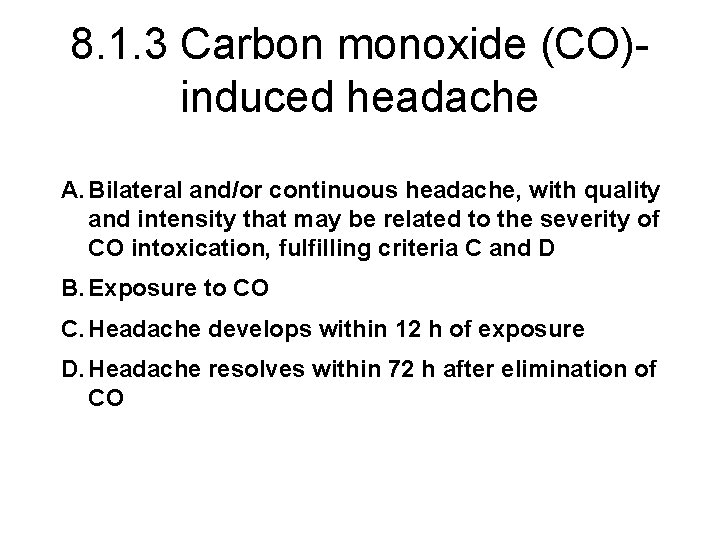
8. 1. 3 Carbon monoxide (CO)induced headache A. Bilateral and/or continuous headache, with quality and intensity that may be related to the severity of CO intoxication, fulfilling criteria C and D B. Exposure to CO C. Headache develops within 12 h of exposure D. Headache resolves within 72 h after elimination of CO
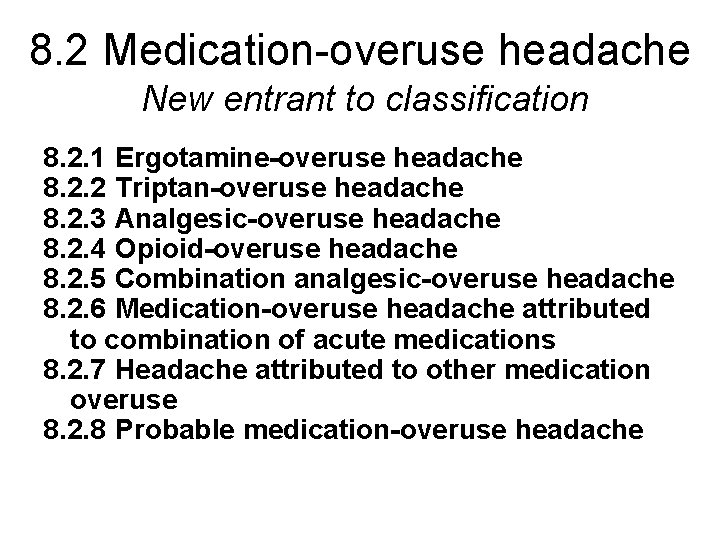
8. 2 Medication-overuse headache New entrant to classification 8. 2. 1 Ergotamine-overuse headache 8. 2. 2 Triptan-overuse headache 8. 2. 3 Analgesic-overuse headache 8. 2. 4 Opioid-overuse headache 8. 2. 5 Combination analgesic-overuse headache 8. 2. 6 Medication-overuse headache attributed to combination of acute medications 8. 2. 7 Headache attributed to other medication overuse 8. 2. 8 Probable medication-overuse headache
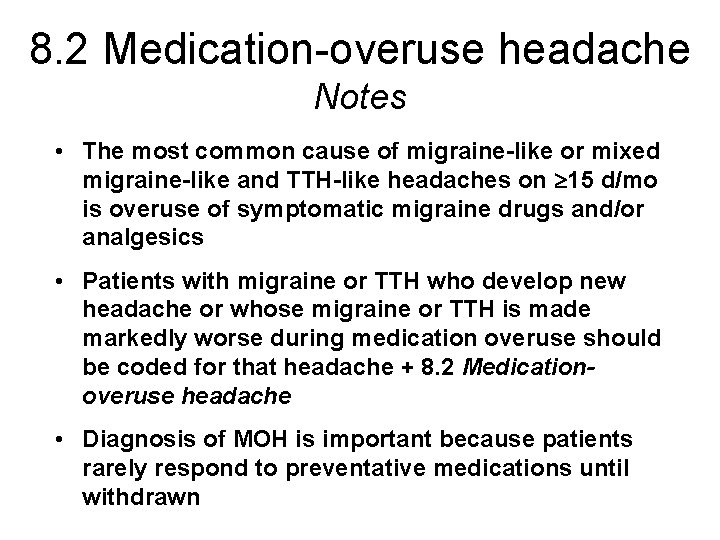
8. 2 Medication-overuse headache Notes • The most common cause of migraine-like or mixed migraine-like and TTH-like headaches on 15 d/mo is overuse of symptomatic migraine drugs and/or analgesics • Patients with migraine or TTH who develop new headache or whose migraine or TTH is made markedly worse during medication overuse should be coded for that headache + 8. 2 Medicationoveruse headache • Diagnosis of MOH is important because patients rarely respond to preventative medications until withdrawn
8. 2 Medication-overuse headache A. Headache present on ≥ 15 d/mo fulfilling criteria C and D B. Regular overuse for >3 mo of one or more drugs that can be taken for acute and/or symptomatic treatment of headache C. Headache has developed or markedly worsened during medication overuse D. Headache resolves or reverts to its previous pattern within 2 mo after discontinuation of overused medication
8. 2. 1 Ergotamine-overuse headache A. Headache fulfilling criteria A, C and D for 8. 2 Medication-overuse headache B. Ergotamine intake on 10 d/mo on a regular basis for >3 mo
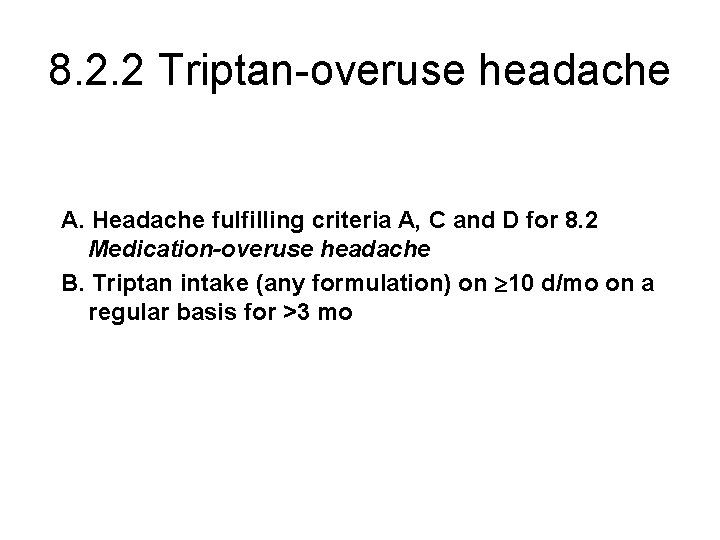
8. 2. 2 Triptan-overuse headache A. Headache fulfilling criteria A, C and D for 8. 2 Medication-overuse headache B. Triptan intake (any formulation) on 10 d/mo on a regular basis for >3 mo
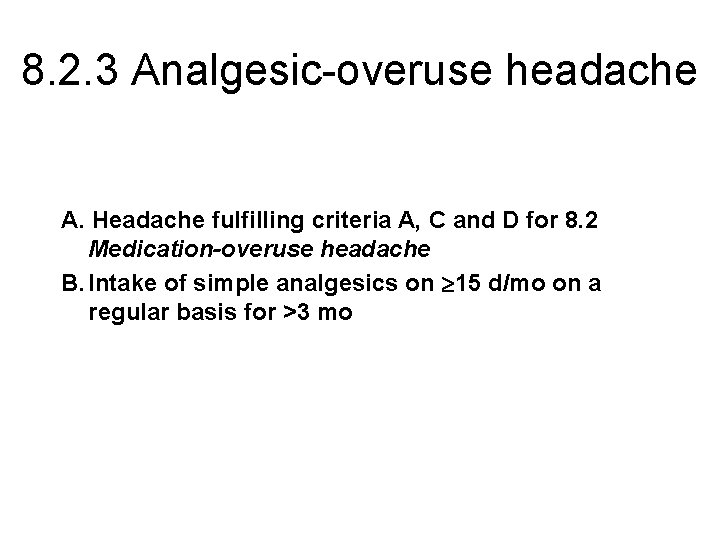
8. 2. 3 Analgesic-overuse headache A. Headache fulfilling criteria A, C and D for 8. 2 Medication-overuse headache B. Intake of simple analgesics on 15 d/mo on a regular basis for >3 mo
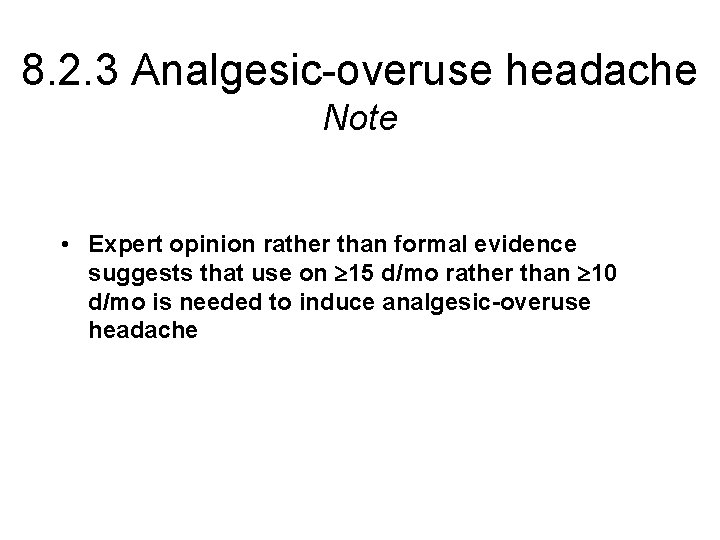
8. 2. 3 Analgesic-overuse headache Note • Expert opinion rather than formal evidence suggests that use on 15 d/mo rather than 10 d/mo is needed to induce analgesic-overuse headache
8. 2. 5 Combination analgesicoveruse headache Name-change in ICHD-IIR 1 A. Headache fulfilling criteria A, C and D for 8. 2 Medication-overuse headache B. Intake of combination analgesic medications* on 10 d/mo on a regular basis for >3 mo *Combinations typically implicated are those containing simple analgesics combined with opioids, butalbital and/or caffeine
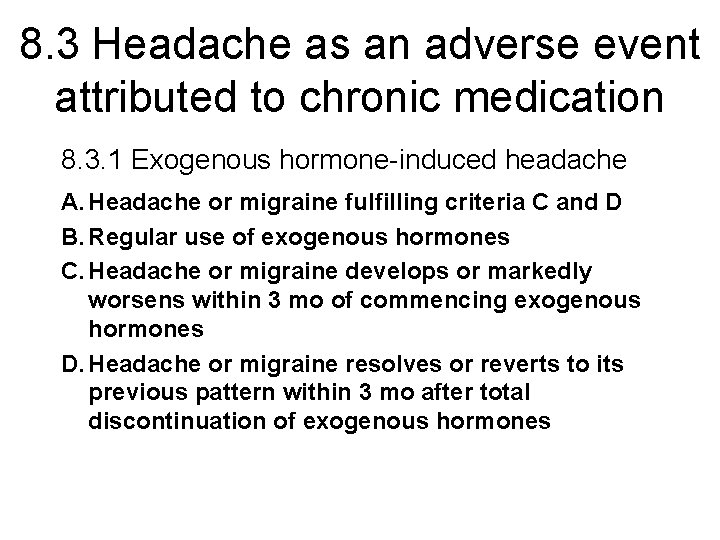
8. 3 Headache as an adverse event attributed to chronic medication 8. 3. 1 Exogenous hormone-induced headache A. Headache or migraine fulfilling criteria C and D B. Regular use of exogenous hormones C. Headache or migraine develops or markedly worsens within 3 mo of commencing exogenous hormones D. Headache or migraine resolves or reverts to its previous pattern within 3 mo after total discontinuation of exogenous hormones