
International Business by Daniels and Radebaugh Chapter 3
International Business by Daniels and Radebaugh Chapter 3 Political and Legal Environments Facing Business © 2001 Prentice Hall 1
Objectives To discuss the different functions that political systems perform To compare democratic and totalitarian political regimes and discuss how they can influence managerial decisions To describe how management can formulate and implement strategies to deal with foreign political environments To study the different types of legal systems and the legal relationships that exist between countries To examine the major legal issues in IB © 2001 Prentice Hall 2
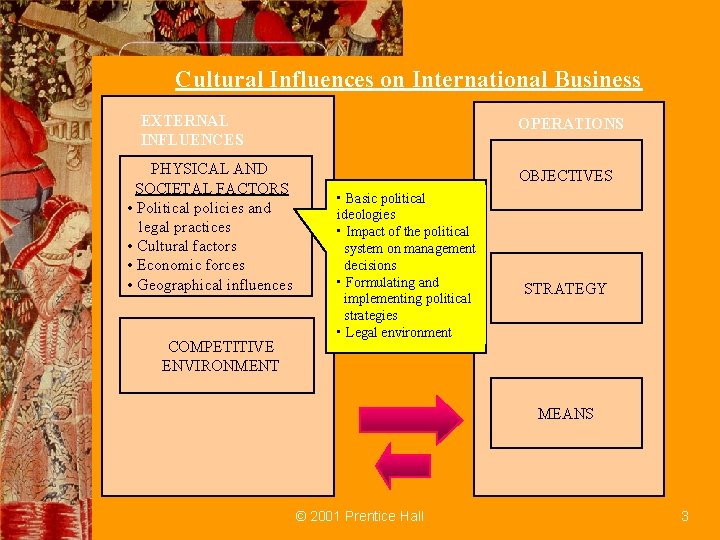
Cultural Influences on International Business EXTERNAL INFLUENCES PHYSICAL AND SOCIETAL FACTORS • Political policies and legal practices • Cultural factors • Economic forces • Geographical influences COMPETITIVE ENVIRONMENT OPERATIONS OBJECTIVES • Basic political ideologies • Impact of the political system on management decisions • Formulating and implementing political strategies • Legal environment STRATEGY MEANS © 2001 Prentice Hall 3
The Political Environment The role of the political system is to integrate the society • Influences how business is conducted Political process functions • Interest articulation • Interest aggregation—the collection of interests in the political system • Policy making • Policy implementation and adjudication MNE management • Lobbies governments on policies that affect business • Avoid appearances of inappropriate influence on the law © 2001 Prentice Hall 4
Basic Political Ideologies Political ideology—a body of constructs, theories, and aims that constitute a sociopolitical program • Pluralist society—different ideologies coexist because there is no one ideology accepted by all – difficult to understand the political environment in a pluralist society • Ultimate test of any political system is its ability to hold a society together despite pressures from different ideologies • Ideologies also help bring countries together The impact of ideological differences on national boundaries • Differences in political ideology have affected boundaries in Europe • When operating in a foreign country, must understand the potential sources of political tension and instability © 2001 Prentice Hall 5
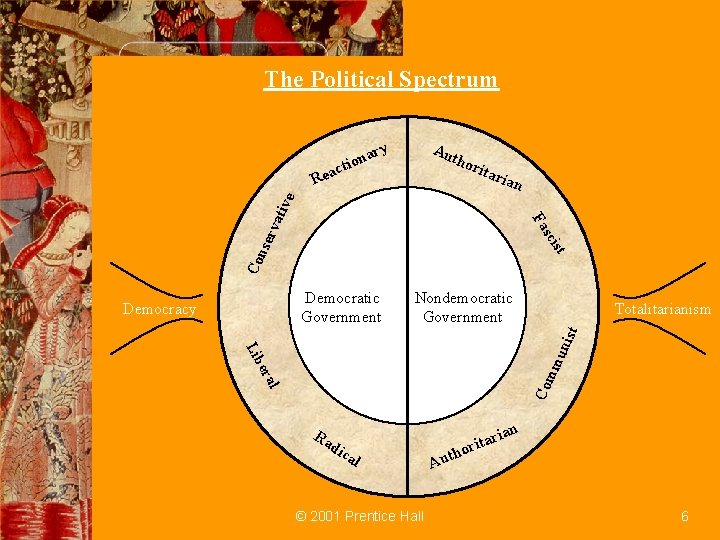
The Political Spectrum ary n o cti Aut hor itar ian Fa rva t ive Rea Co st nse sci Democratic Government Nondemocratic Government Totalitarianism l Co era mm Lib uni st Democracy Ra dic al © 2001 Prentice Hall Aut ian r a t ori h 6
A Political Spectrum Democracy—involves wide participation by citizens in the decisionmaking process • Freedom of opinion, expression, press, and freedom to organize • Election of political representatives • Limited term of elected officials • Independent and fair court system • Nonpolitical bureaucracy and defense infrastructure • Accessibility to the decision-making process Democratic governments differ • Presidential versus parliamentary • Number of important political parties • Amount of citizen participation in decision making • Fragility and stability of new democracies Democracy believed to be the best form of government © 2001 Prentice Hall 7
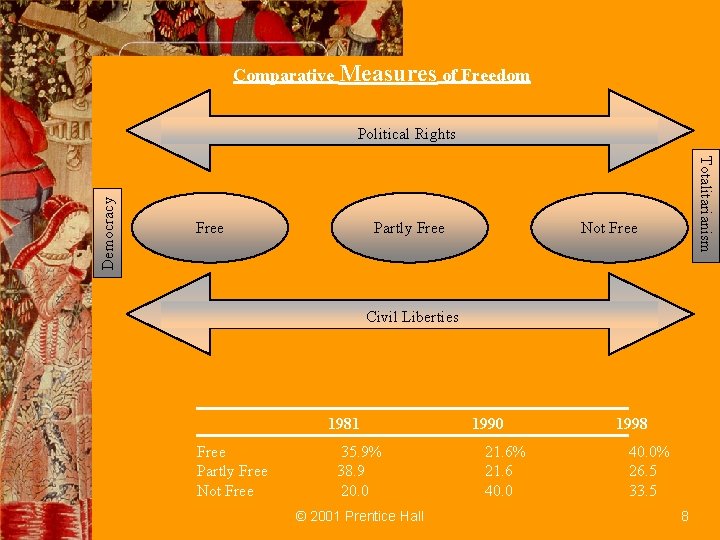
Comparative Measures of Freedom Free Partly Free Totalitarianism Democracy Political Rights Not Free Civil Liberties 1981 Free Partly Free Not Free 35. 9% 38. 9 20. 0 © 2001 Prentice Hall 1990 21. 6% 21. 6 40. 0 1998 40. 0% 26. 5 33. 5 8
A Political Spectrum (cont. ) Totalitarianism—a single party, individual, or group of individuals monopolizes political power • Neither recognizes nor permits opposition • Theocratic—religious leaders are political leaders • Secular—government often imposes order through military power • Totalitarianism takes several forms – Fascism—desires to control people’s minds and souls, converting them to its own faith – Authoritarianism—desires to control the people – Communism—political and economic systems are virtually inseparable » equal distribution of wealth » government ownership and control of resources © 2001 Prentice Hall 9
Impact of the Political System on Management Decisions Political Risk—caused by political instability • Promotes fear that operating position will deteriorate • Tends to be higher in totalitarian regimes Causes of political risk • Change in the opinions of political leadership • Civil disorder stemming from economic conditions, human rights violations, or group animosity • External relations—animosity between host country and foreign investor’s country Types of political risk • Micro—political actions are aimed at specific foreign investments • Macro—political actions affect a broad spectrum of foreign investors © 2001 Prentice Hall 10
Government Intervention in the Economy Individualistic paradigm • Belief in minimal government intervention in the economy • Likely to be democratic and economically free • Promotes marketplace competition – regulates marketplace when competition by itself is unreliable or unacceptable Communitarian paradigm • Government tends to be prestigious – thrives on a respected, centralized bureaucracy • May be democratic or authoritarian – stable political party or coalition in power • Government may start partnership with business Government action toward business is not always consistent © 2001 Prentice Hall 11
Formulating and Implementing Political Strategies Establishing a political strategy in the host country • Identify the issue • Define the political aspect of the issue • Assess the potential political action of other companies and special-interest groups • Identify important institutions and key people • Formulate strategies • Determine the impact of implementation • Select the most appropriate strategy and implement Implementing a strategy—marshal whatever resources necessary to accomplish the company’s goals • Lobbyists educate and persuade government decision makers • Enlist support of consumers © 2001 Prentice Hall 12
Kinds of Legal Systems Common law—based on tradition, precedent, custom, and usage • Interpretation by the courts Civil law—codified legal system • Based on a detailed set of laws that make up a code • Rules for business transaction included • Based on how the law is applied to the facts Theocratic law—based on religious precepts • e. g. , Islamic law – has remained frozen – moral rather than commercial law – intended to govern all aspects of life Consumer safeguards—differ in different legal systems • Deal with product liability issues © 2001 Prentice Hall 13
The Legal Profession Lawyers and their firms • Vary among countries in terms of how they practice law and serve clients • Most firms are quite small • Firms have expanded abroad in order to serve their clients – large legal firms often created through mergers or correspondent relationships with firms in other countries • Legal staffs have to understand local laws and practices © 2001 Prentice Hall 14
Legal Issues in International Business Affect many aspects of IB National laws • May affect both domestic and foreign companies operating within the country’s borders – health and safety standards – employment practices – antitrust prohibitions – contractual relationships – environmental practices – patents and trademarks • May govern cross-border activities – investment of capital – payment of dividends to foreign investors – customs and duties on imports © 2001 Prentice Hall 15
- Slides: 15