
International Atomic Energy Agency IAEA Safety Standards and
- Slides: 37
International Atomic Energy Agency IAEA Safety Standards and the National Register of Sources Ibrahim Shadad Control of Sources Unit Regulatory Infrastructure and Transport Safety Section Division of Radiation, Transport and Waste Safety International Atomic Energy Agency
• Source: Definitions Anything that may cause radiation exposure — such as by emitting ionizing radiation or by releasing radioactive substances or material (IAEA Glossary) v. Radiation Generators vradioactive material vradioactive source (sealed sources) International Atomic Energy Agency
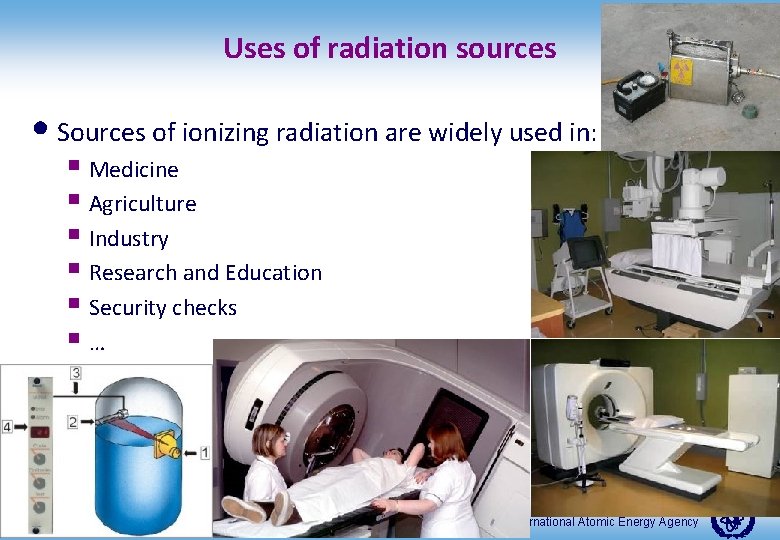
Uses of radiation sources • Sources of ionizing radiation are widely used in: § Medicine § Agriculture § Industry § Research and Education § Security checks §… International Atomic Energy Agency
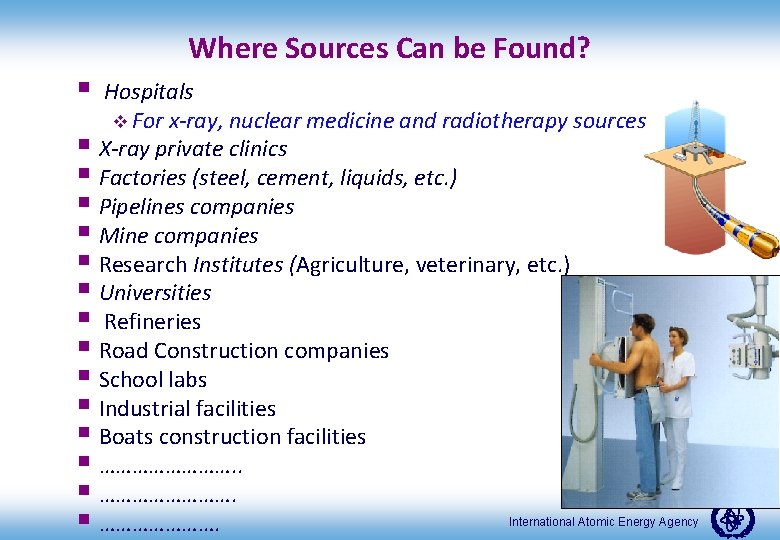
Where Sources Can be Found? § Hospitals v For x-ray, nuclear medicine and radiotherapy sources § X-ray private clinics § Factories (steel, cement, liquids, etc. ) § Pipelines companies § Mine companies § Research Institutes (Agriculture, veterinary, etc. ) § Universities § Refineries § Road Construction companies § School labs § Industrial facilities § Boats construction facilities § …………. International Atomic Energy Agency § ………………….
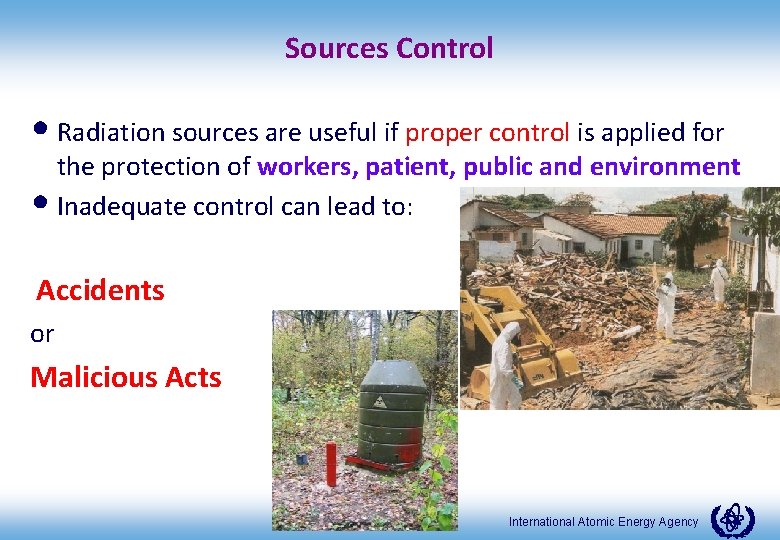
Sources Control • Radiation sources are useful if proper control is applied for the protection of workers, patient, public and environment • Inadequate control can lead to: Accidents or Malicious Acts International Atomic Energy Agency
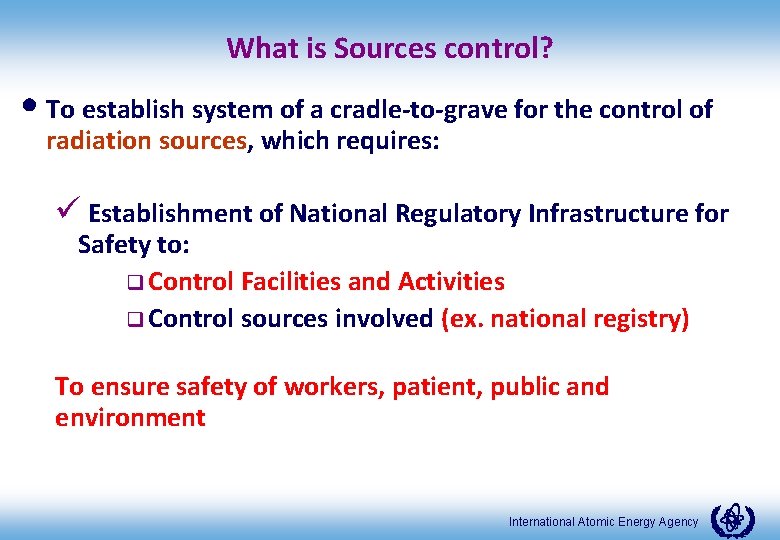
What is Sources control? • To establish system of a cradle-to-grave for the control of radiation sources, which requires: ü Establishment of National Regulatory Infrastructure for Safety to: q Control Facilities and Activities q Control sources involved (ex. national registry) To ensure safety of workers, patient, public and environment International Atomic Energy Agency
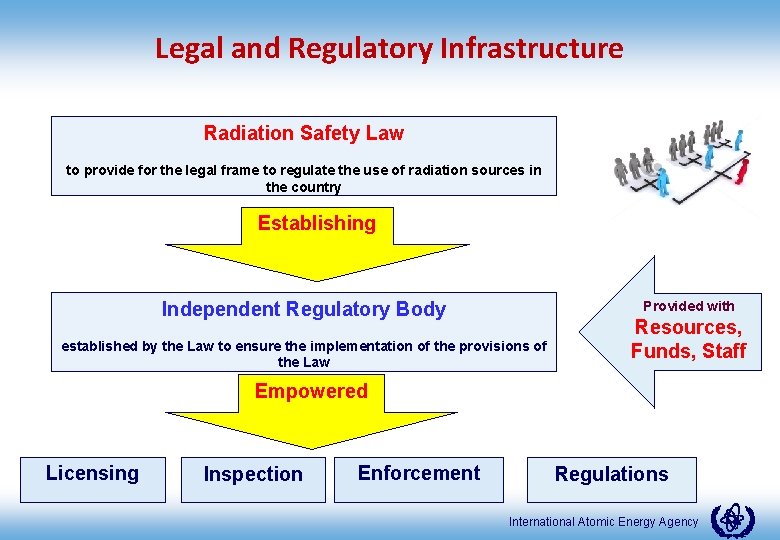
Legal and Regulatory Infrastructure Radiation Safety Law to provide for the legal frame to regulate the use of radiation sources in the country Establishing Independent Regulatory Body Provided with established by the Law to ensure the implementation of the provisions of the Law Resources, Funds, Staff Empowered Licensing Inspection Enforcement Regulations International Atomic Energy Agency
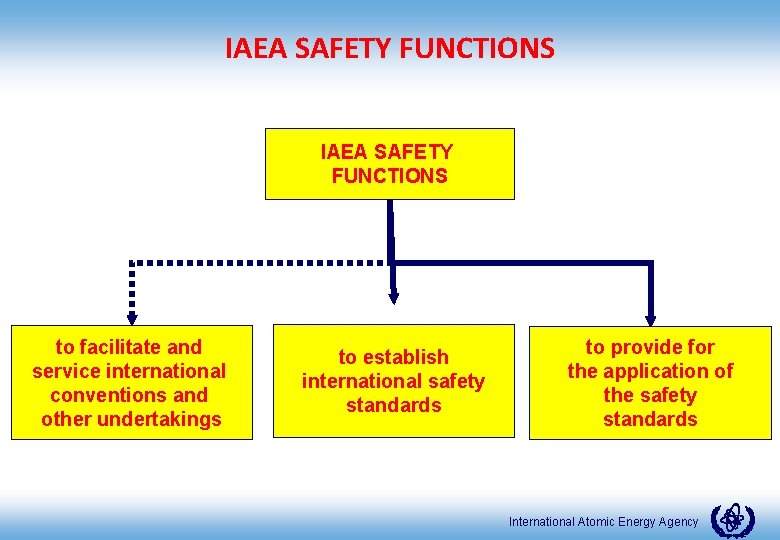
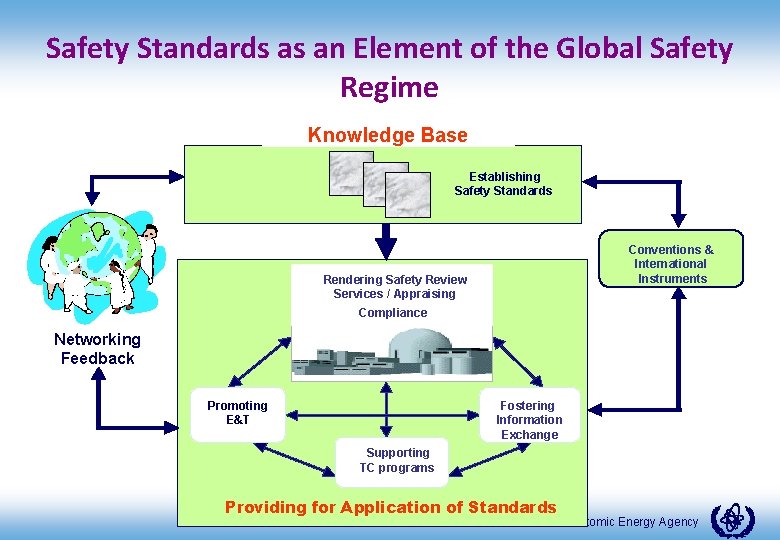
IAEA SAFETY FUNCTIONS to facilitate and service international conventions and other undertakings to establish international safety standards to provide for the application of the safety standards International Atomic Energy Agency
Safety Standards as an Element of the Global Safety Regime Knowledge Base Establishing Safety Standards Conventions & International Instruments Rendering Safety Review Services / Appraising Compliance Networking Feedback Promoting E&T Fostering Information Exchange Supporting TC programs Providing for Application of Standards International Atomic Energy Agency
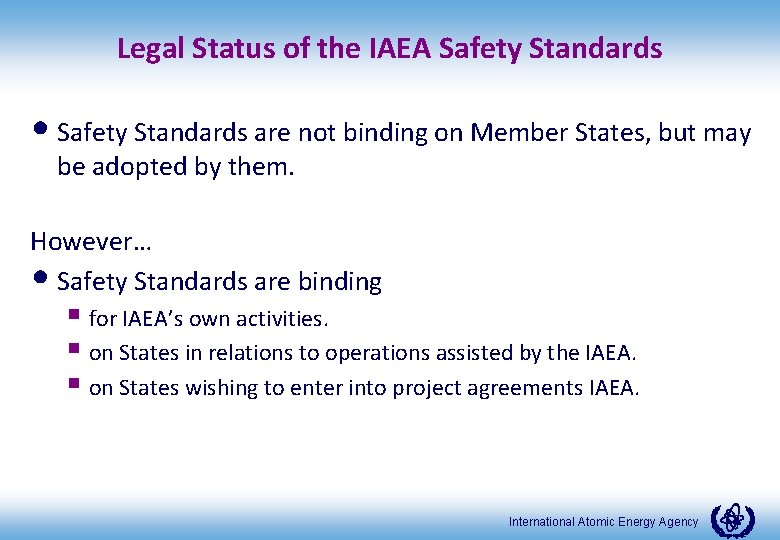
Legal Status of the IAEA Safety Standards • Safety Standards are not binding on Member States, but may be adopted by them. However… • Safety Standards are binding § for IAEA’s own activities. § on States in relations to operations assisted by the IAEA. § on States wishing to enter into project agreements IAEA. International Atomic Energy Agency
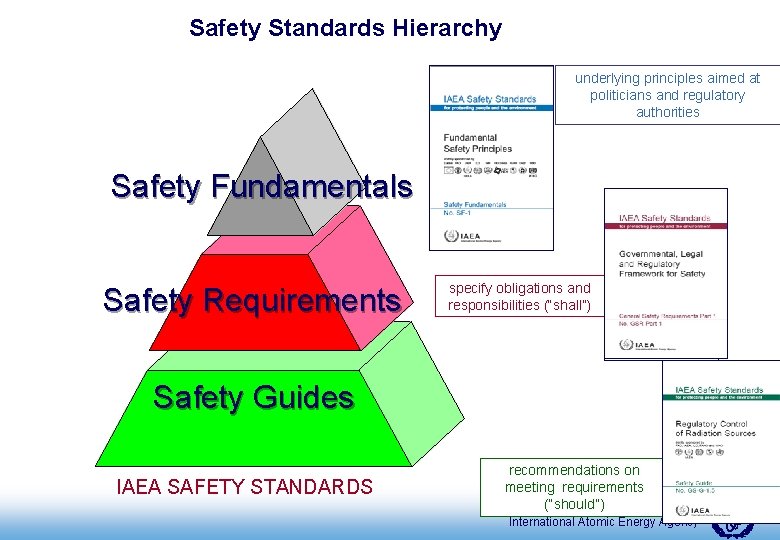
Safety Standards Hierarchy underlying principles aimed at politicians and regulatory authorities Safety Fundamentals Safety Requirements specify obligations and responsibilities (“shall”) Safety Guides IAEA SAFETY STANDARDS recommendations on meeting requirements (“should”) International Atomic Energy Agency
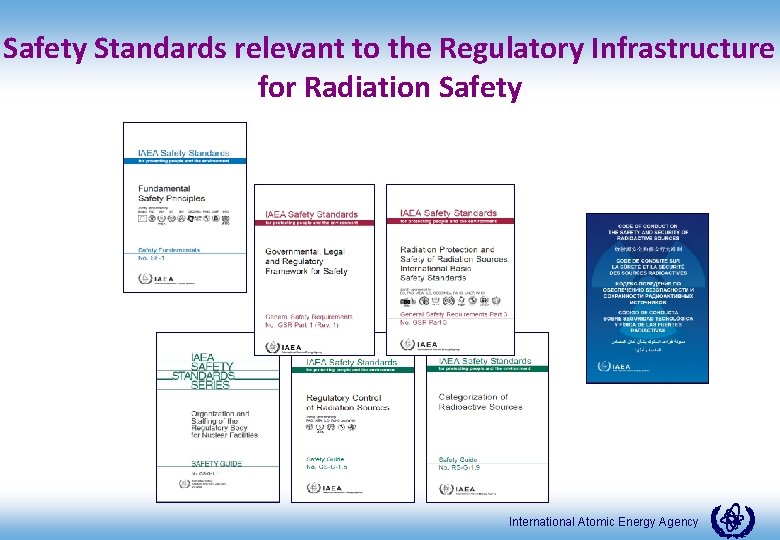
Safety Standards relevant to the Regulatory Infrastructure for Radiation Safety International Atomic Energy Agency
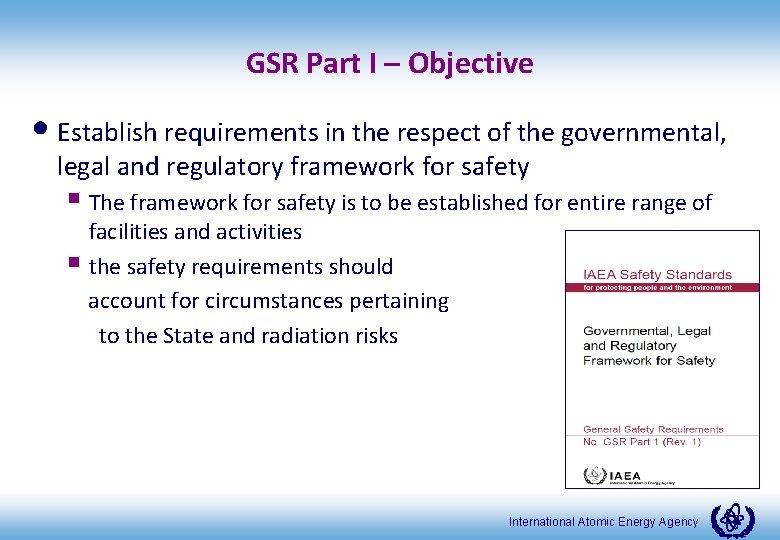
GSR Part I – Objective • Establish requirements in the respect of the governmental, legal and regulatory framework for safety § The framework for safety is to be established for entire range of facilities and activities § the safety requirements should account for circumstances pertaining to the State and radiation risks International Atomic Energy Agency
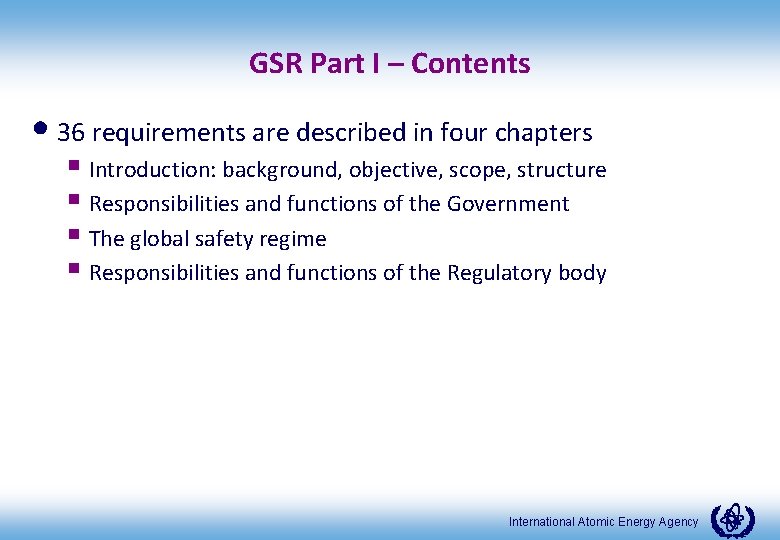
GSR Part I – Contents • 36 requirements are described in four chapters § Introduction: background, objective, scope, structure § Responsibilities and functions of the Government § The global safety regime § Responsibilities and functions of the Regulatory body International Atomic Energy Agency
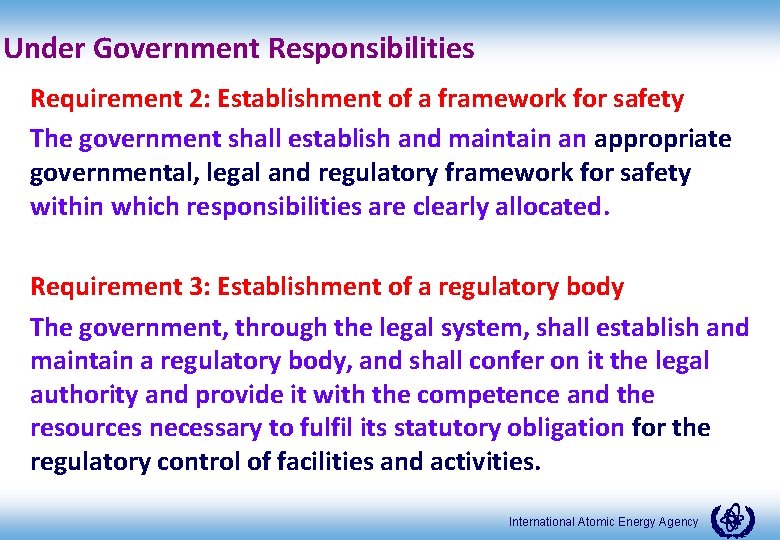
Under Government Responsibilities Requirement 2: Establishment of a framework for safety The government shall establish and maintain an appropriate governmental, legal and regulatory framework for safety within which responsibilities are clearly allocated. Requirement 3: Establishment of a regulatory body The government, through the legal system, shall establish and maintain a regulatory body, and shall confer on it the legal authority and provide it with the competence and the resources necessary to fulfil its statutory obligation for the regulatory control of facilities and activities. International Atomic Energy Agency
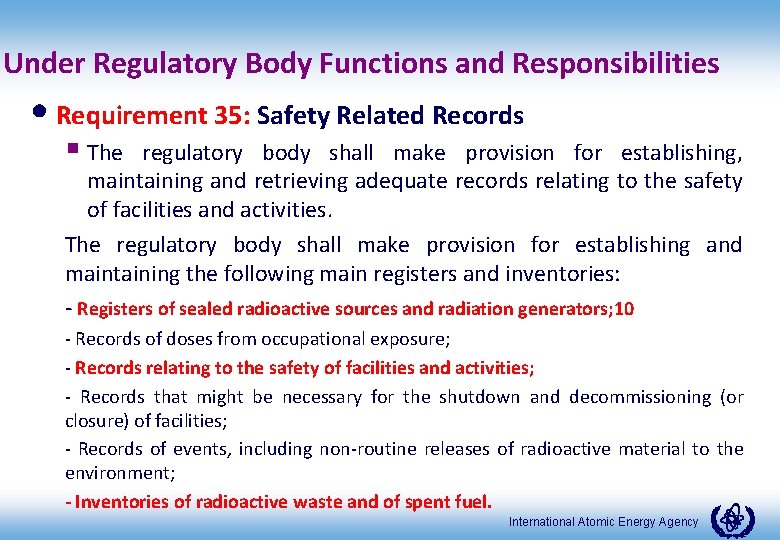
Under Regulatory Body Functions and Responsibilities • Requirement 35: Safety Related Records § The regulatory body shall make provision for establishing, maintaining and retrieving adequate records relating to the safety of facilities and activities. The regulatory body shall make provision for establishing and maintaining the following main registers and inventories: - Registers of sealed radioactive sources and radiation generators; 10 - Records of doses from occupational exposure; - Records relating to the safety of facilities and activities; - Records that might be necessary for the shutdown and decommissioning (or closure) of facilities; - Records of events, including non-routine releases of radioactive material to the environment; - Inventories of radioactive waste and of spent fuel. International Atomic Energy Agency
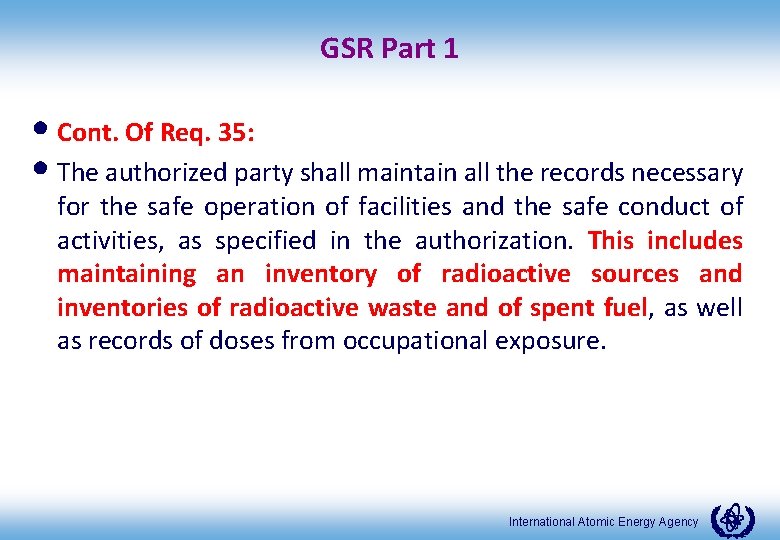
GSR Part 1 • Cont. Of Req. 35: • The authorized party shall maintain all the records necessary for the safe operation of facilities and the safe conduct of activities, as specified in the authorization. This includes maintaining an inventory of radioactive sources and inventories of radioactive waste and of spent fuel, as well as records of doses from occupational exposure. International Atomic Energy Agency
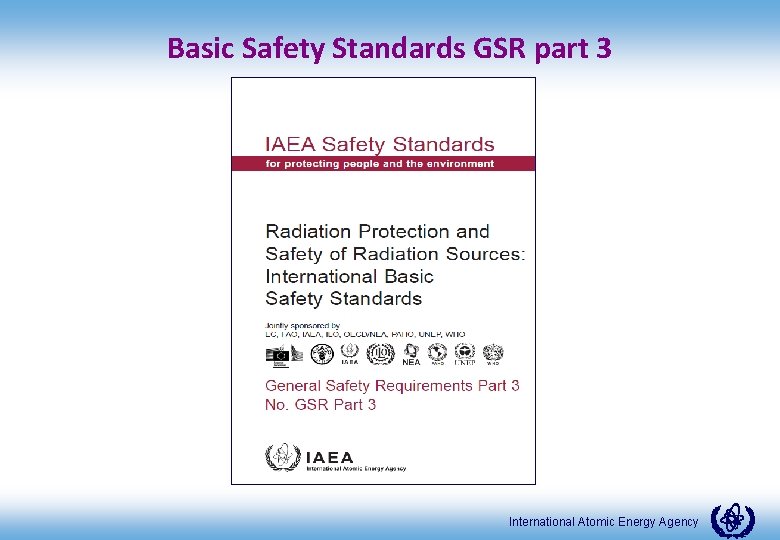
Basic Safety Standards GSR part 3 International Atomic Energy Agency
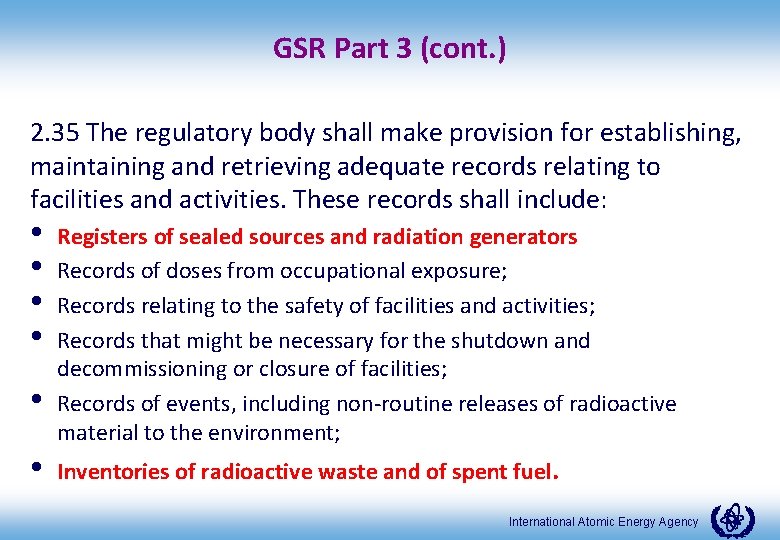
GSR Part 3 (cont. ) 2. 35 The regulatory body shall make provision for establishing, maintaining and retrieving adequate records relating to facilities and activities. These records shall include: • • • Registers of sealed sources and radiation generators Records of doses from occupational exposure; Records relating to the safety of facilities and activities; Records that might be necessary for the shutdown and decommissioning or closure of facilities; Records of events, including non-routine releases of radioactive material to the environment; Inventories of radioactive waste and of spent fuel. International Atomic Energy Agency
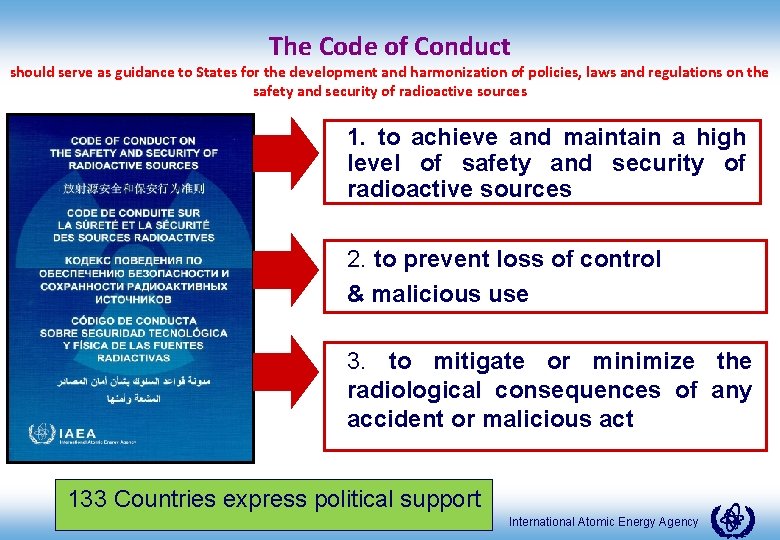
The Code of Conduct should serve as guidance to States for the development and harmonization of policies, laws and regulations on the safety and security of radioactive sources 1. to achieve and maintain a high level of safety and security of radioactive sources 2. to prevent loss of control & malicious use 3. to mitigate or minimize the radiological consequences of any accident or malicious act 133 Countries express political support International Atomic Energy Agency
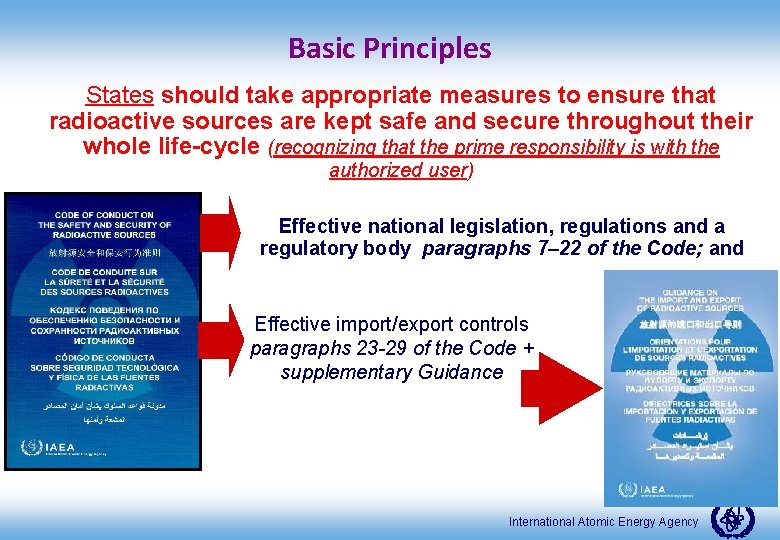
Basic Principles States should take appropriate measures to ensure that radioactive sources are kept safe and secure throughout their whole life-cycle (recognizing that the prime responsibility is with the authorized user) This requires: Effective national legislation, regulations and a regulatory body paragraphs 7– 22 of the Code; and Effective import/export controls paragraphs 23 -29 of the Code + supplementary Guidance International Atomic Energy Agency
Code of Conduct (cont. ) • Every state should establish a national register of a radioactive sources which should include as a minimum Category 1 and 2 • Information contained in the register should be appropriately protected • RB should establish system for ensuring that radioactive sources are identifiable and traceable • RB should ensures that inventory controls are conducted on a regular basis by persons with authorizations International Atomic Energy Agency
National register of radiation sources includes: vexisting radiation sources in the country vimported radiation generators v. Imported and exported radioactive sources vdisused radioactive sources vcollected orphan radioactive sources vradioactive waste and spent fuel International Atomic Energy Agency
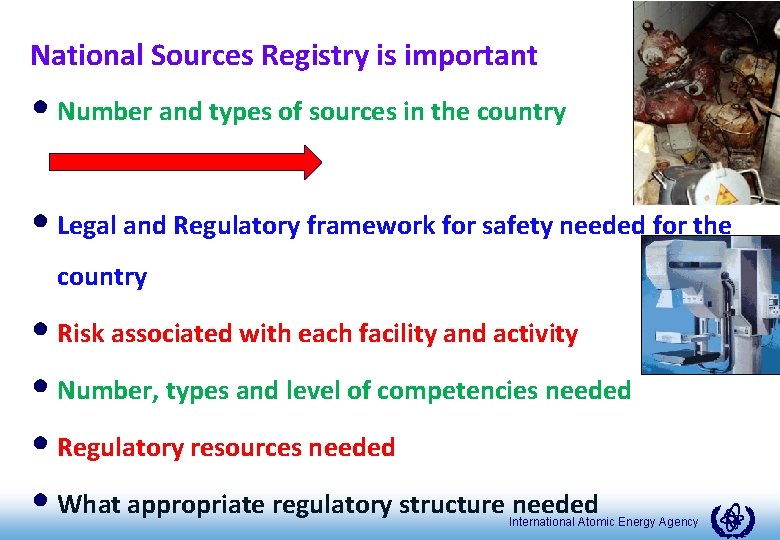
National Sources Registry is important • Number and types of sources in the country • Legal and Regulatory framework for safety needed for the country • Risk associated with each facility and activity • Number, types and level of competencies needed • Regulatory resources needed • What appropriate regulatory structure needed International Atomic Energy Agency
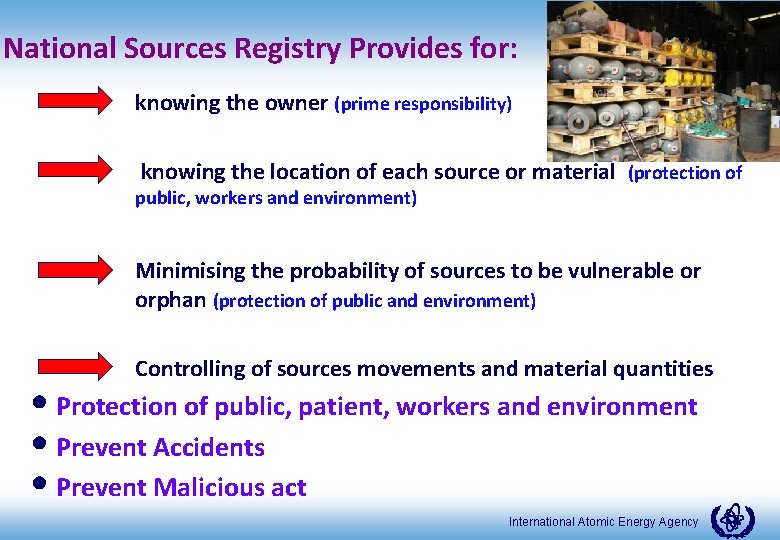
National Sources Registry Provides for: knowing the owner (prime responsibility) knowing the location of each source or material (protection of public, workers and environment) Minimising the probability of sources to be vulnerable or orphan (protection of public and environment) Controlling of sources movements and material quantities • Protection of public, patient, workers and environment • Prevent Accidents • Prevent Malicious act International Atomic Energy Agency
National Sources Registry • Completed, all radiation sources are included • Updated, effective mechanisms for inventory updating should established • Maintained, efficient methods shall be used (database software, …) § Regulatory Authority Information System (RAIS) (IAEA) International Atomic Energy Agency
Responsibility of keeping the sources registry • Regulatory body § All sources at the national level • Manufacturer and suppliers § Maintain of records relating to their products and shipments • User or owners § Maintain records for radiation sources under their responsibilities • Waste management organisation § Maintain records of sources received, conditioned, stored, disposed, etc. International Atomic Energy Agency
Challenges in National Sources Registry Grouped: • Country without regulatory infrastructure or just starting developing national sources registry • Country with established regulatory infrastructure International Atomic Energy Agency
Country without regulatory infrastructure or just starting developing national sources registry Challenges could be: • Identification of users and potential users of radiation sources in the country • Communication with the users (especially if no law to regulate use of radiation sources in the country) • Medical X-ray especially the private sector • Old radioactive sources (legacy sources) • Orphan sources • Maintaining of radiation sources registry International Atomic Energy Agency
Country with established regulatory infrastructure • Maintaining of radiation sources registry • Import and export of radiation sources • Updating the national sources registry • Industrial radiography (NDT)sources in the fields International Atomic Energy Agency
IAEA Assistance 1 - Training courses (national or Regional): “Development of National Register for Radiation Sources Including Regulatory Authority Information System RAIS” • For Countries without regulatory infrastructure or just start developing national sources registry • Objective: § Provide the participants information on how to develop radiation sources registry § Challenges in developing radiation sources registry § Practical sessions on using of RAIS system as a tool to maintain the national radiation sources registry International Atomic Energy Agency
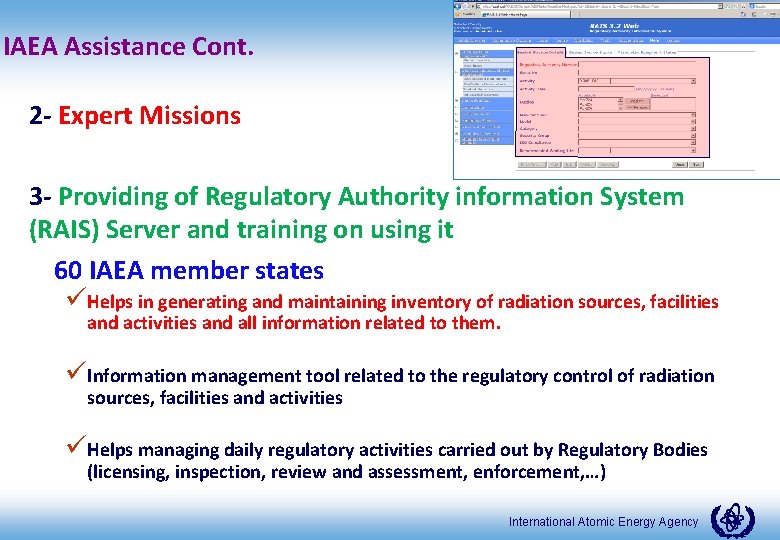
IAEA Assistance Cont. 2 - Expert Missions 3 - Providing of Regulatory Authority information System (RAIS) Server and training on using it 60 IAEA member states üHelps in generating and maintaining inventory of radiation sources, facilities and activities and all information related to them. üInformation management tool related to the regulatory control of radiation sources, facilities and activities üHelps managing daily regulatory activities carried out by Regulatory Bodies (licensing, inspection, review and assessment, enforcement, …) International Atomic Energy Agency
Objectives of the International Workshop Exchange experiences among Member States in relation to q. Establishing radiation source registers q. Maintaining radiation source registers q. Updating radiation source registers AND to Discuss the challenges on these topics International Atomic Energy Agency
Objectives of the International Workshop Cont. • Assist MS in their national efforts in establishing, maintaining and updating a register of radiation sources by enabling them to learn from the experiences of others and to evaluate their own national source register systems; • Enhance the IAEA Secretariat’s understanding of the use of RAIS by States, including the challenges and lessons learned, which will assist the Secretariat in improving RAIS to address States’ needs; and • Encourage more States to use RAIS for their regulatory programmes, including a national register of radiation sources. International Atomic Energy Agency
Expected output • Clear recommendations on what needs to be done to improve radiation source registers worldwide, including the use of sources register systems (ex. RAIS) • May be Expected IAEA Assistance International Atomic Energy Agency
The Workshop Programme • 20 min for each presentation § 15 mins + 5 mins discussion • Tow Plenary Sessions : I. II. • Tuesday 10: 30 - 11: 30: Reliability of the National Register of Sources Wednesday 10: 45 – 11: 45: Needs for sharing the National Register of Sources Closing: Chairperson Report (including the recommendations) International Atomic Energy Agency
Thank You RIT 37 International Atomic Energy Agency