
Internalisation of external costs Polluter Pays Problem Stays
Internalisation of external costs: Polluter Pays - Problem Stays! UNECE Geneva 9 September 2008 1 © International Road Transport Union (IRU) 2007
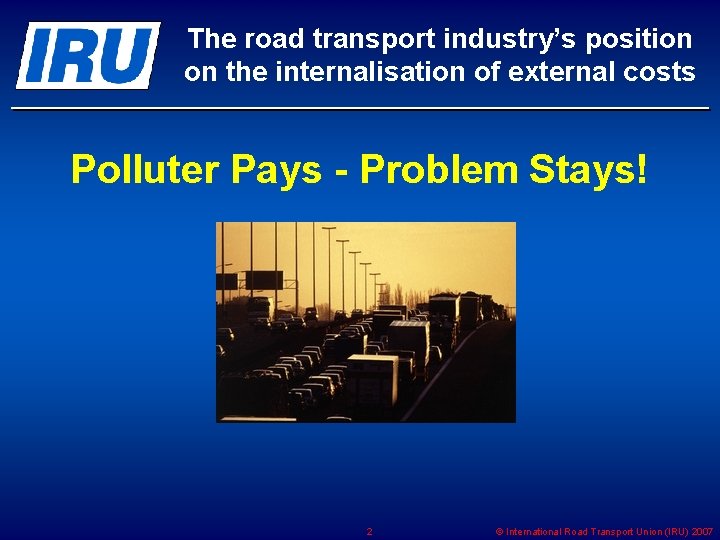
The road transport industry’s position on the internalisation of external costs Polluter Pays - Problem Stays! 2 © International Road Transport Union (IRU) 2007
Road transport is vital for the economy Any penalty on road transport is an even greater penalty on the economy as a whole! § In today’s globalised economy, road transport has become a vital production tool. § Due to its unique, high-quality, door-to-door services, road transport plays a crucial role in trade and tourism. It interconnects all businesses and unites people. § 85% of road transport occurs under 150 km, a distance for which no viable alternative exists. 3 © International Road Transport Union (IRU) 2007
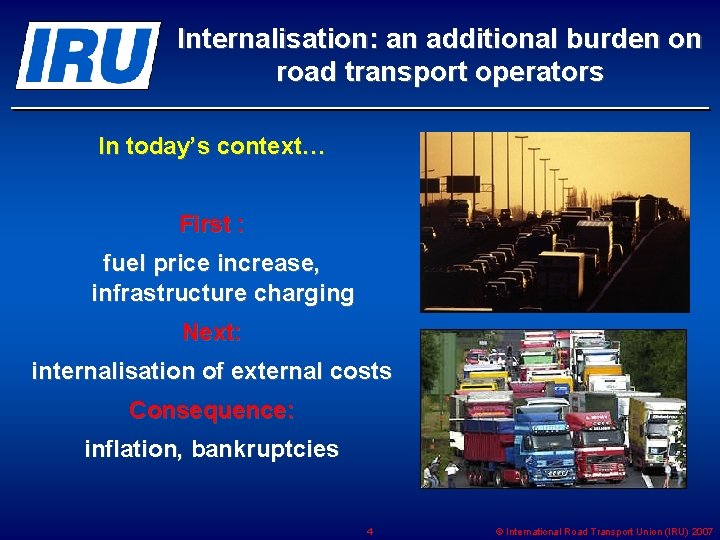
Internalisation: an additional burden on road transport operators In today’s context… First : fuel price increase, infrastructure charging Next: internalisation of external costs Consequence: inflation, bankruptcies 4 © International Road Transport Union (IRU) 2007
Internalisation: an additional burden on the economy Only the EU is putting in place such a system, while road transport in Europe is already 20 -40% more expensive than in the US! The Eurovignette Directive will cause even further delocalisation, which will, in turn, generate more road transport from abroad! 5 © International Road Transport Union (IRU) 2007
Internalisation: an additional burden on the EU economy Making road transport more expensive will not lead to an increase in modal shift from road to rail, whereas increased quality of rail service will foster a potential increase in rail transport study by “… a 1 Euro per km road toll increase will only lead to a less than 1. 22% shift of road transport volume to rail” (Trans. Care study, 2006) External costs are already internalised. 2/3 of road transport external costs are already internalised through duties on petrol, road tax, insurance premiums, existing Eurovignette charges and tolls. The other 1/3 attributable to congestion is already internalised by road transport operators. 6 © International Road Transport Union (IRU) 2007
A modern economic approach The Cheapest Cost Avoider Principle Prof. Dr. Dieter Schmidtchen Centre for the Study of Law and Economics, Saarland University, Germany 7 © International Road Transport Union (IRU) 2007
Conclusions To achieve sustainable development, economic growth and competitiveness according to the EU Lisbon Agenda: - Internalisation strategies must apply to all modes of transport at the same time. - Revenues from road charging must be earmarked to reduce the external impact of the road transport sector. - A sound cost-benefit analysis, as required by the Cheapest Cost Avoider approach, must be applied to calculate who should pay. 8 © International Road Transport Union (IRU) 2007
5 th Euro-Asia Conference: Almaty 11 -12 June 2009! 9 © International Road Transport Union (IRU) 2007

10 © International Road Transport Union (IRU) 2007
- Slides: 10