
Internal Respiration Warm Up 1 In pairs chose
- Slides: 18
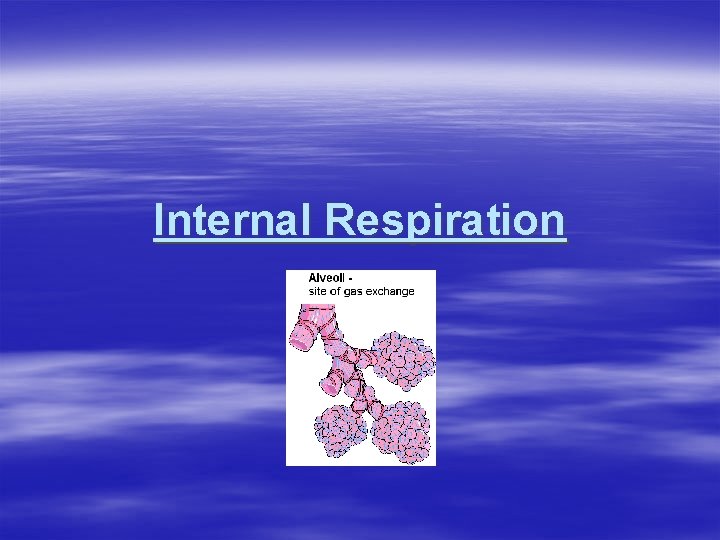
Internal Respiration
Warm Up 1 § In pairs chose either inspiration or expiration. § You have one minute each to describe your chosen process. § You must explain…. – Pressures of air in lungs and outside of body – Which type of intercostals used – How this changes when you exercise
Warm Up 2 § § § A sticker will be placed on your back You have 5 questions to guess what you are. The person you are asking can only answer ‘yes’ or ‘no’ § The topic is ‘Lung Volumes’
Internal Respiration § Pulmonary diffusion is the process used to explain the process of gaseous exchange in the lungs- it has 2 functions 1. Replenish blood with oxygen- can then be taken to tissues an muscles 2. Remove carbon dioxide form the blood which has resulted from metabolic processes.
Partial Pressure of Gases § The individual pressure that the gas exerts when it occurs in a mixture of gases § The gas will exert a pressure proportional to its concentration within a whole gas. § Partial pressures of each gas adds up to the total pressure of the gas
Air § Nitrogen 79% § Oxygen 20. 9% § CO 2 0. 03 % § Total atmospheric pressure at sea level is 769 mm. Hg
Partial Pressure of Oxygen § Concentration of O 2 is 21% and nitrogen is 79% together they exert a pressure of 760 mm. Hg § p. O 2 Can be calculated as follows; § = Barometric pressure x fractional concentration § = 760 x 0. 21 § = 159. 6 mm. Hg The partial pressure of a gas explains the movement of gases within the body
? ? § Work out the partial pressure of nitrogen
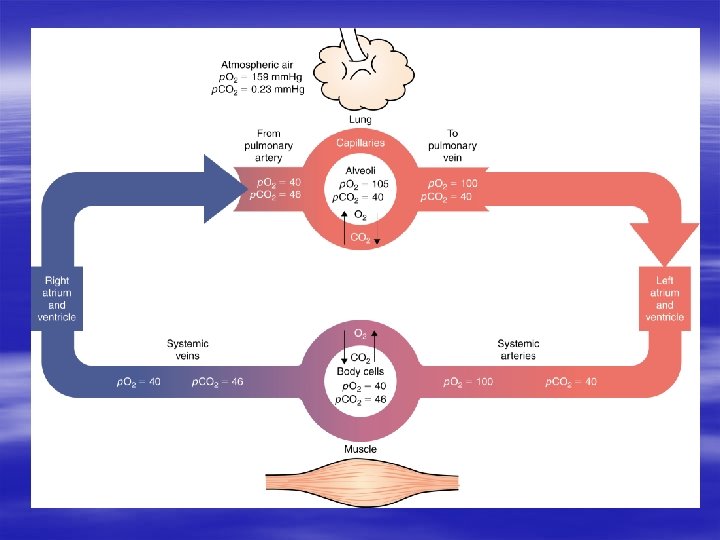
Gaseous Exchange at the Lungs § The imbalances of gases at the alveoli and the blood that causes a pressure gradient which results in a movement of gases across the membrane. § It is a 2 -way movement with oxygen moving from the alveoli to the blood and CO 2 moving from the blood to the alveoli
Gaseous Exchange at the Lungs § Partial pressure of O 2 in the atmosphere is 159 mm. Hg § This drops to 105 mm. Hg in the alveoli The diffusion gradient § Blood in the pulmonary arteries has a p. O 2 of 45 mm. Hg as most of the O 2 has been used by the working muscles
The diffusion gradient § This makes a pressure gradient of approx 60 mm. Hg § (p. O 2 of 105 mm. Hg in the alveoli) § This forces the oxygen to move from the alveoli to the blood until pressure is equal on both sides. § High- Low
The diffusion gradient § In the same way, CO 2 moves from the pulmonary capillaries to alveoli § There is a p. CO 2 of 45 mm. Hg in the blood returning to the lungs and p. CO 2 of 40 mm. Hg in the alveoli § This is a small pressure gradient 5 mm. Hg § CO 2 can diffuse a lot quicker than O 2.
Endurance Athletes § Endurance athletes with larger aerobic capacities will have greater oxygen diffusion ability as a result of increased cardiac output, and resistance to diffusion.
Gaseous Exchange at the Muscles § p. O 2 in blood of 100 mm. Hg and a low p. O 2 in muscle of 40 mm. Hg causes a diffusion gradient. § High to Low § p. CO 2 of 40 mm. Hg in blood and 46 mm. Hg in muscle causes a small pressure gradient § High to Low
§ Oxygen dissociates from haemoglobin to travel into the muscle. § Once it is on the cell it attaches to myoglobin which takes it to the mitochondria where aerobic respiration can take place § Myoglobin has a higher affinity for O 2 than haemoglobin and acts like an oxygen reserve so when we need more oxygen i. e. in exercise, there is a readily available source.
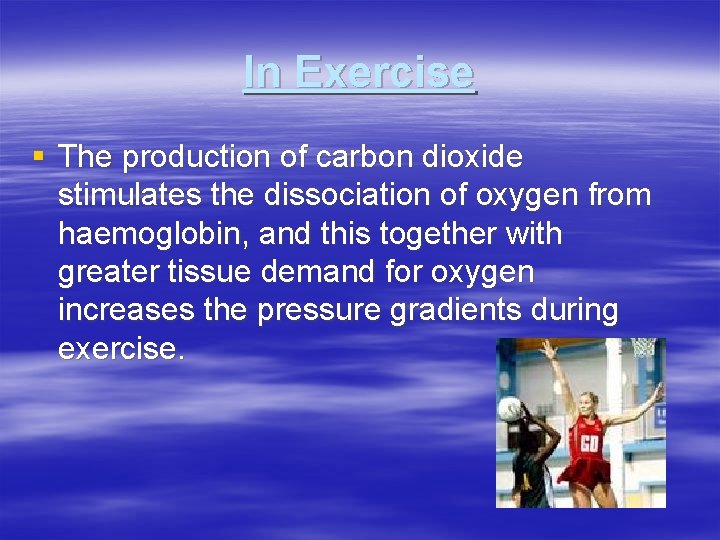
In Exercise § The production of carbon dioxide stimulates the dissociation of oxygen from haemoglobin, and this together with greater tissue demand for oxygen increases the pressure gradients during exercise.
Exam Questions § Explain how gaseous exchange occurs in the lungs (3 marks) § Explain how gaseous exchange occurs in the muscle tissue (3 marks) § Explain how this process changes during exercise (3 marks)