
Internal Rate of Return Multiple Rates of Return
- Slides: 14
Internal Rate of Return (Multiple Rates of Return Problem) Lecture No. 20 Professor C. S. Park Fundamentals of Engineering Economics Copyright © 2005
Return on Invested Capital • Definition 3: Return on invested capital is defined as the interest rate earned on the unrecovered project balance of an investment project. It is commonly known as internal rate of return (IRR). • Example: A company invests $10, 000 in a computer and results in equivalent annual labor savings of $4, 021 over 3 years. The company is said to earn a return of 10% on its investment of $10, 000.
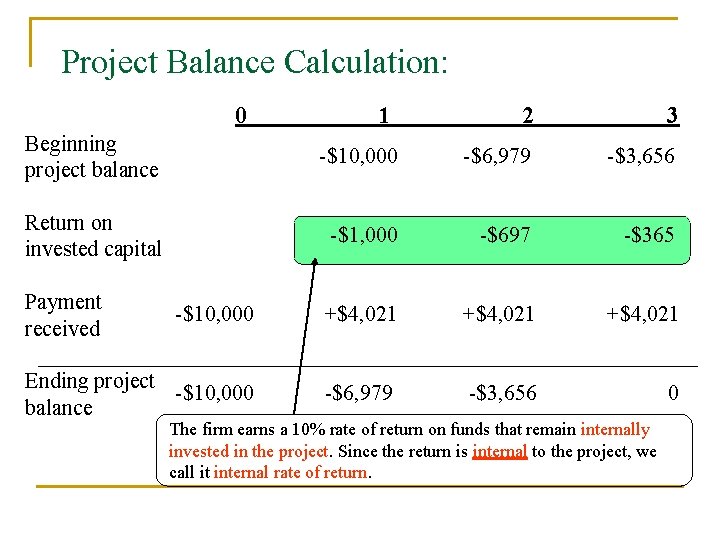
Project Balance Calculation: 0 1 2 3 Beginning project balance -$10, 000 -$6, 979 -$3, 656 Return on invested capital -$1, 000 -$697 -$365 -$10, 000 +$4, 021 Ending project -$10, 000 balance -$6, 979 -$3, 656 0 Payment received The firm earns a 10% rate of return on funds that remain internally invested in the project. Since the return is internal to the project, we call it internal rate of return.
Multiple Rates of Return n If a project has more than one rate of return, how would you make an accept/reject decision?
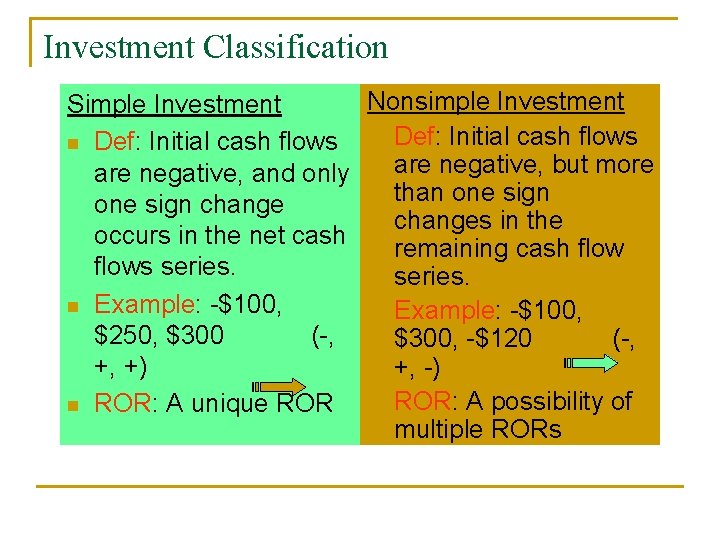
Investment Classification Nonsimple Investment Simple Investment n Def: Initial cash flows are negative, but more are negative, and only than one sign changes in the occurs in the net cash remaining cash flows series. n Example: -$100, $250, $300 (-, $300, -$120 (-, +, +) +, -) n ROR: A possibility of n ROR: A unique ROR multiple RORs
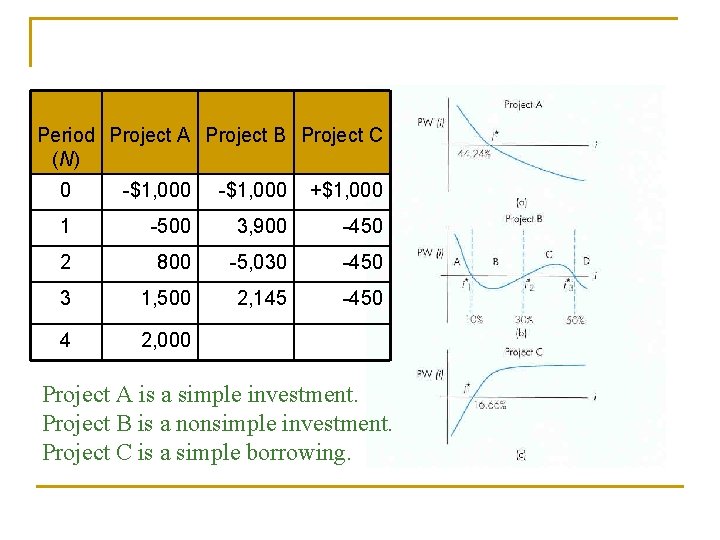
Period Project A Project B Project C (N) 0 -$1, 000 +$1, 000 1 -500 3, 900 -450 2 800 -5, 030 -450 3 1, 500 2, 145 -450 4 2, 000 Project A is a simple investment. Project B is a nonsimple investment. Project C is a simple borrowing.
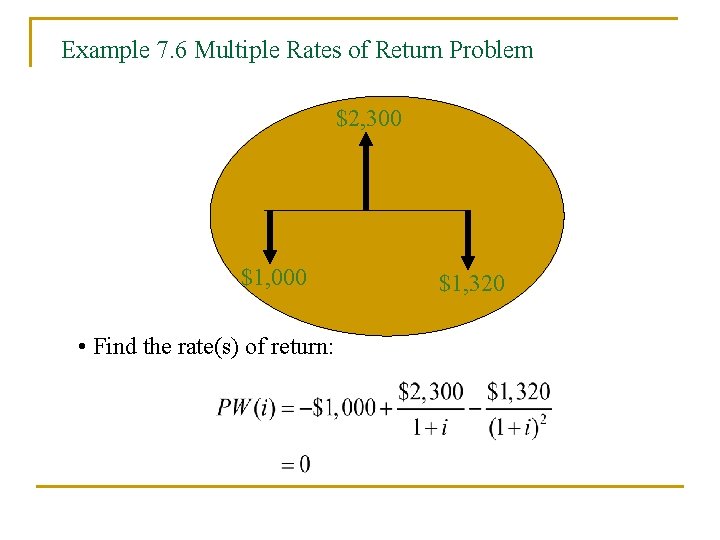
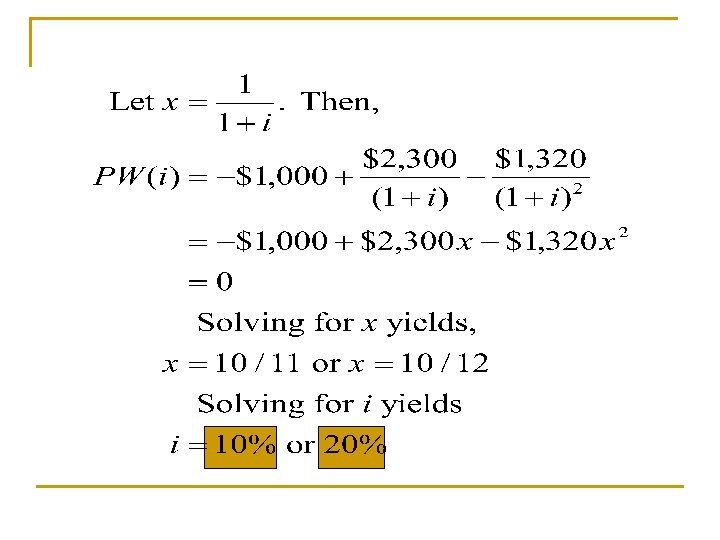
Example 7. 6 Multiple Rates of Return Problem $2, 300 $1, 000 • Find the rate(s) of return: $1, 320
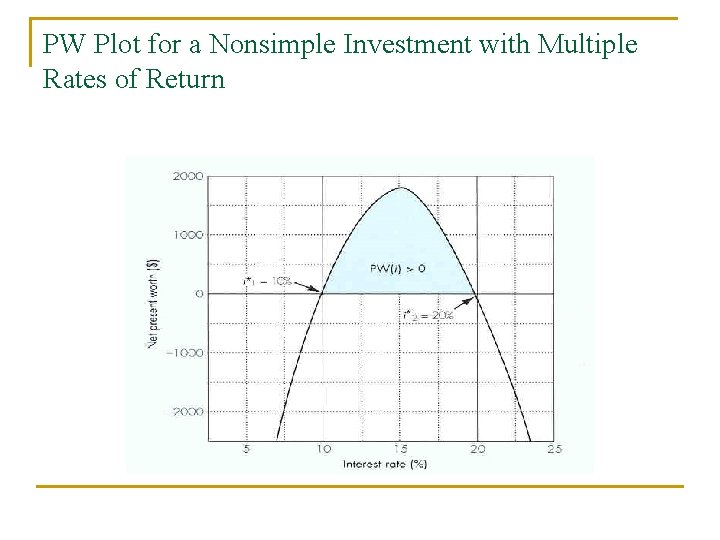
PW Plot for a Nonsimple Investment with Multiple Rates of Return
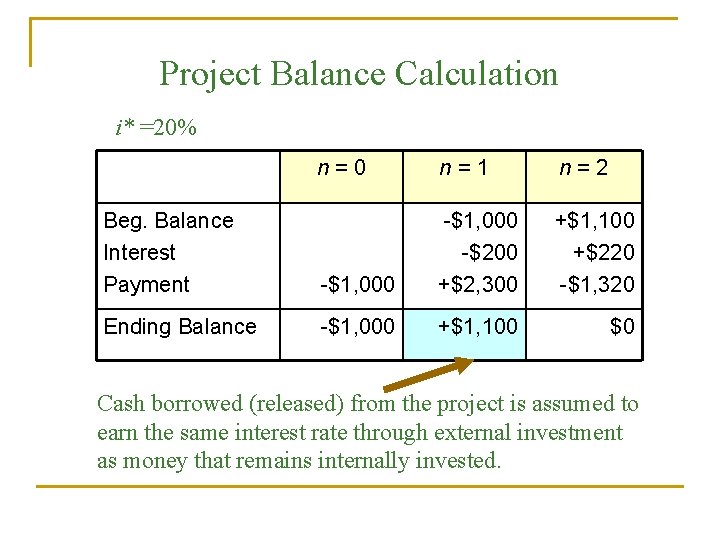
Project Balance Calculation i* =20% n=0 n=1 n=2 Beg. Balance Interest Payment -$1, 000 -$200 +$2, 300 +$1, 100 +$220 -$1, 320 Ending Balance -$1, 000 +$1, 100 $0 Cash borrowed (released) from the project is assumed to earn the same interest rate through external investment as money that remains internally invested.
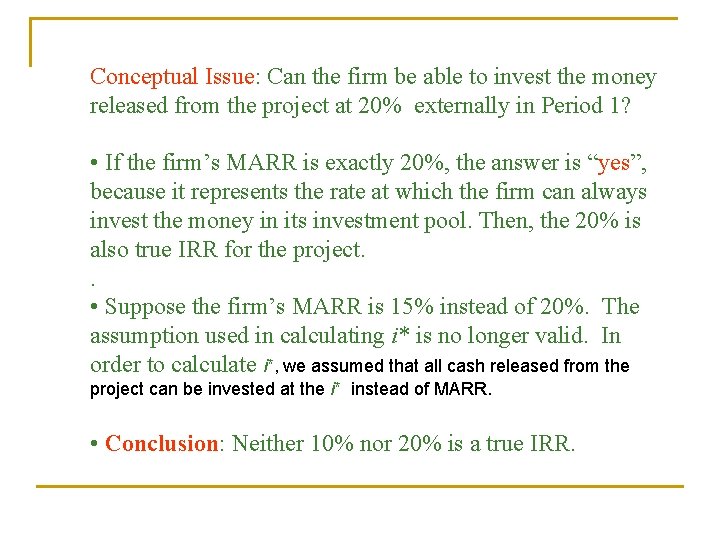
Conceptual Issue: Can the firm be able to invest the money released from the project at 20% externally in Period 1? • If the firm’s MARR is exactly 20%, the answer is “yes”, because it represents the rate at which the firm can always invest the money in its investment pool. Then, the 20% is also true IRR for the project. . • Suppose the firm’s MARR is 15% instead of 20%. The assumption used in calculating i* is no longer valid. In order to calculate i*, we assumed that all cash released from the project can be invested at the i* instead of MARR. • Conclusion: Neither 10% nor 20% is a true IRR.
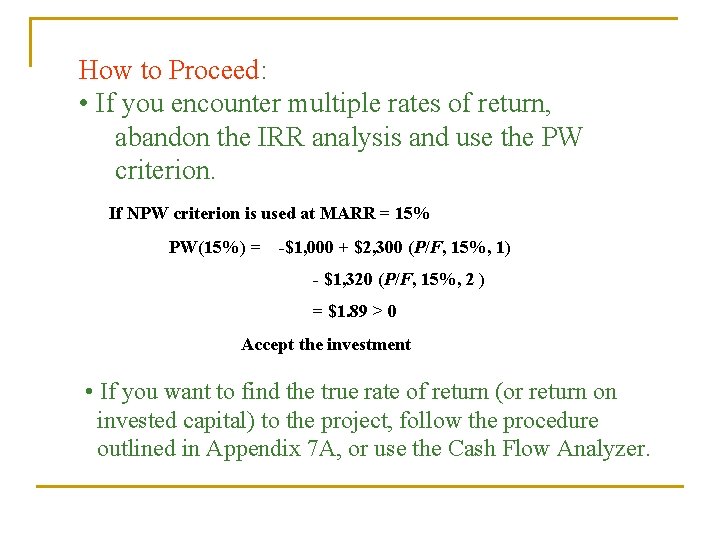
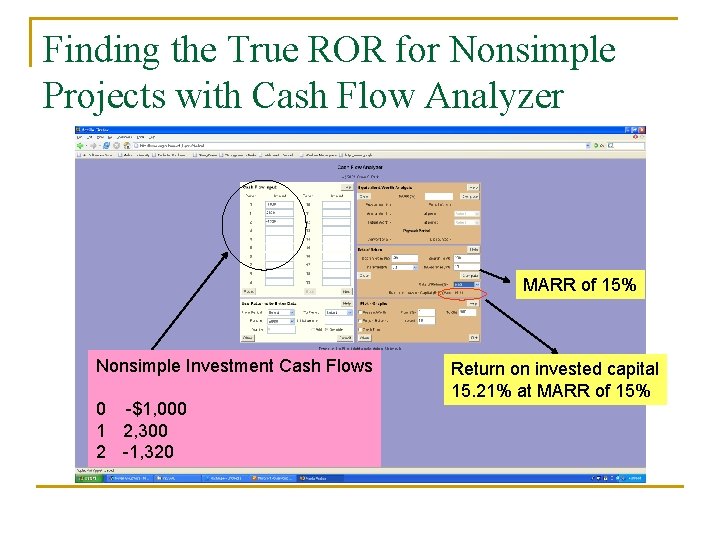
How to Proceed: • If you encounter multiple rates of return, abandon the IRR analysis and use the PW criterion. If NPW criterion is used at MARR = 15% PW(15%) = -$1, 000 + $2, 300 (P/F, 15%, 1) - $1, 320 (P/F, 15%, 2 ) = $1. 89 > 0 Accept the investment • If you want to find the true rate of return (or return on invested capital) to the project, follow the procedure outlined in Appendix 7 A, or use the Cash Flow Analyzer.
Finding the True ROR for Nonsimple Projects with Cash Flow Analyzer MARR of 15% Nonsimple Investment Cash Flows 0 -$1, 000 1 2, 300 2 -1, 320 Return on invested capital 15. 21% at MARR of 15%
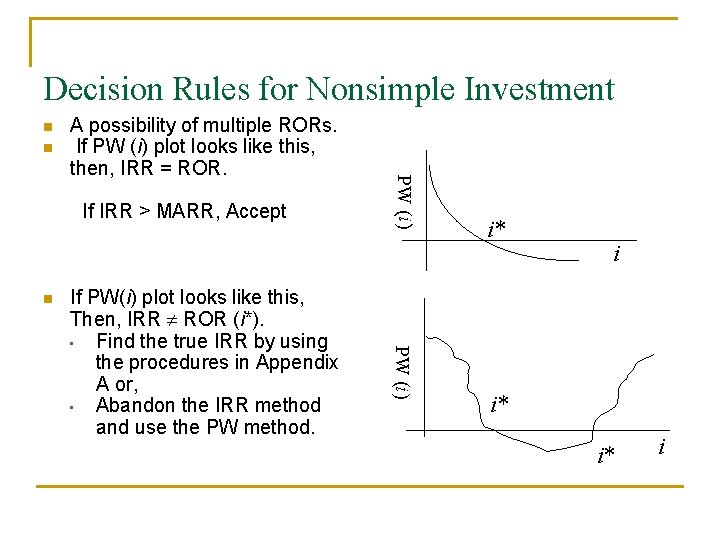
Decision Rules for Nonsimple Investment n n If IRR > MARR, Accept n PW (i) If PW(i) plot looks like this, Then, IRR ROR (i*). • Find the true IRR by using the procedures in Appendix A or, • Abandon the IRR method and use the PW method. PW (i) A possibility of multiple RORs. If PW (i) plot looks like this, then, IRR = ROR. i* i* i