
Internal overview of the Department of Defense Architecture
- Slides: 28
Internal overview of the Department of Defense Architecture Framework (Do. DAF) v 2. 0 and GIG 2. 0
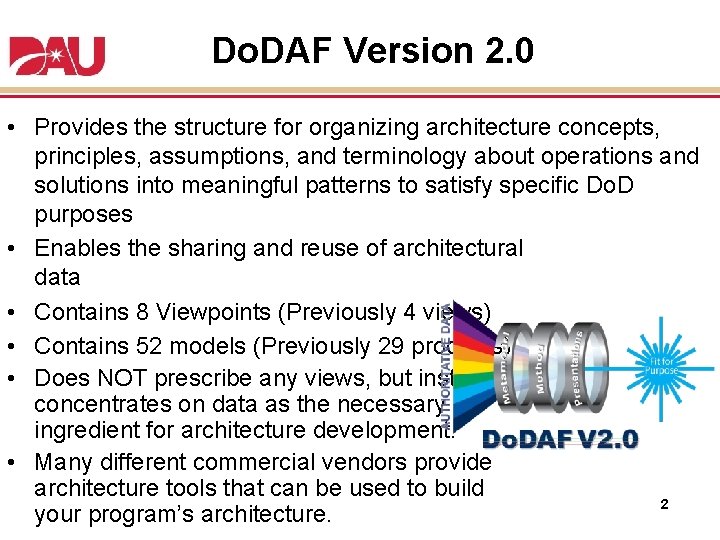
Do. DAF Version 2. 0 • Provides the structure for organizing architecture concepts, principles, assumptions, and terminology about operations and solutions into meaningful patterns to satisfy specific Do. D purposes • Enables the sharing and reuse of architectural data • Contains 8 Viewpoints (Previously 4 views) • Contains 52 models (Previously 29 products) • Does NOT prescribe any views, but instead concentrates on data as the necessary ingredient for architecture development. • Many different commercial vendors provide architecture tools that can be used to build 2 your program’s architecture.
Do. DAF Law / Policy • Clinger-Cohen Act – Chief Information Officers are assigned the responsibility for “developing, maintaining, and facilitating the implementation of a sound and integrated IT architecture for the executive agency”. • OMB Circular-130 – Calls for the use of Enterprise Architectures to support capital planning and consists of a baseline architecture, a target architecture, and a transition strategy. • E-Government Act of 2002 – Calls for the development of Enterprise Architecture to aid in enhancing the management and promotion of 3 electronic government services and processes.
Do. DAF Version 2. 0 Key Terms • Model (Formerly product) – Serve as a template for organizing and displaying data. • View – A representation of data in any understandable format • Viewpoint – Organized collection of views useful to management decision making • Fit-for-Purpose – User-defined views (subset of architectural data) created for a specific purpose • Do. DAF Meta Model (DM 2) – Data construct that facilitates reader understanding of the use of data within an architecture document 4
Do. DAF Meta Model (DM 2) • Provides information needed to collect and organize data in a way that is easy to understand • The vocabulary for description and discourse about Do. DAF models (formerly “products”) • Replaces the Core Architecture Data Model (CADM) • The basis for generation of the “physical” exchange specification (PES) for exchange of data between architecture tools and databases 5
Do. DAF Version 2. 0 Conformance • Conformance is met when: – Data within your architecture is defined IAW Do. DAF Meta Model (DM 2 – Data is capable of physical exchange per the Physical Exchange Specification (PES) 6
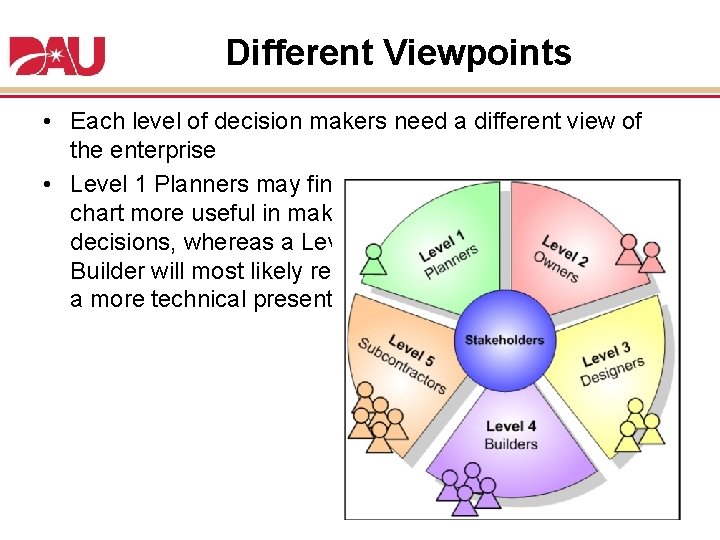
Different Viewpoints • Each level of decision makers need a different view of the enterprise • Level 1 Planners may find a graphical wall chart more useful in making decisions, whereas a Level 4 Builder will most likely require a more technical presentation. 7
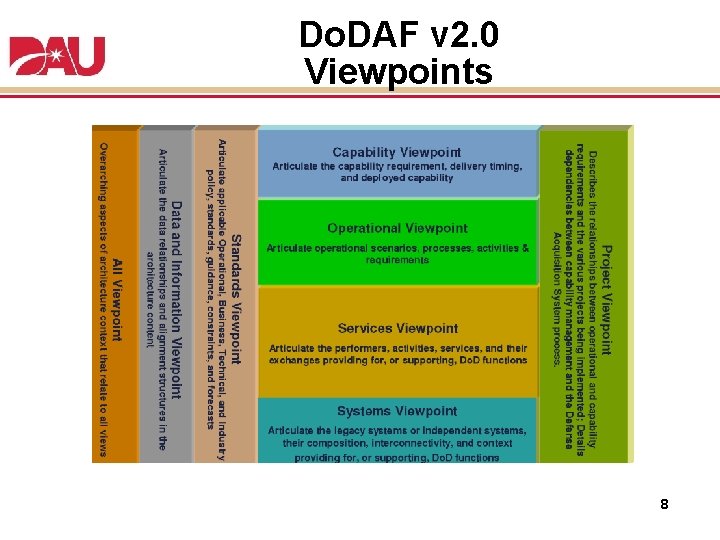
Do. DAF v 2. 0 Viewpoints 8
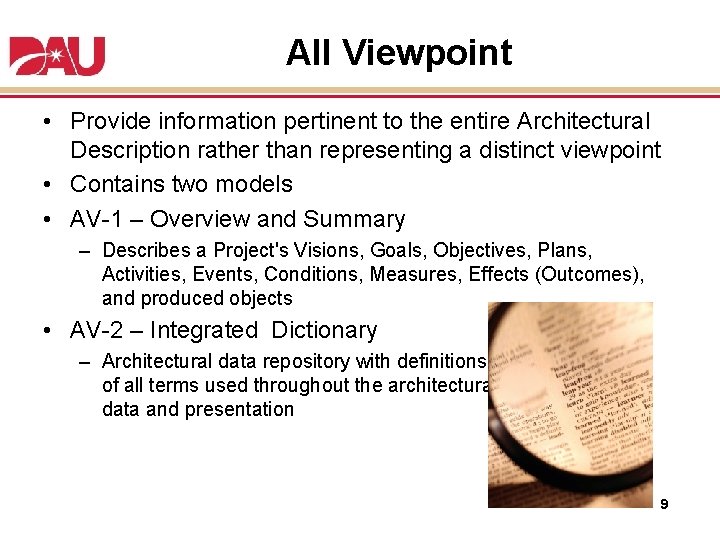
All Viewpoint • Provide information pertinent to the entire Architectural Description rather than representing a distinct viewpoint • Contains two models • AV-1 – Overview and Summary – Describes a Project's Visions, Goals, Objectives, Plans, Activities, Events, Conditions, Measures, Effects (Outcomes), and produced objects • AV-2 – Integrated Dictionary – Architectural data repository with definitions of all terms used throughout the architectural data and presentation 9
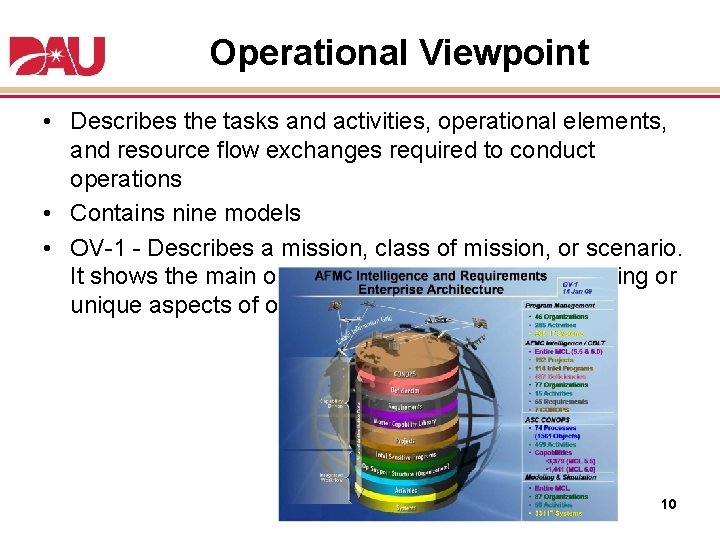
Operational Viewpoint • Describes the tasks and activities, operational elements, and resource flow exchanges required to conduct operations • Contains nine models • OV-1 - Describes a mission, class of mission, or scenario. It shows the main operational concepts and interesting or unique aspects of operations 10
Do. D Information Enterprise Architecture (Do. D IEA) v 1. 1 • “Provides a common Do. D Information Enterprise foundation to support accelerated Department of Defense (Do. D) transformation to net-centric operations. It presents the vision of net-centric operations and establishes near-term priorities to address critical barriers that must be overcome in order to achieve the vision. ” • Subsumed NCOW-RM – Appendix F Maps the activities of the NCOW-RM to the Do. D IEA – The DIEA and the NCOW-RM were derived from the same source documents
Do. D Architecture Registry System (DARS) • The “Mother of all Architecture Registries” – A Central, Common Repository of all Do. D systems of systems– level Architectures – Data-Centric vice Graphic/Textual • Collaborative Environment – Share, review and gain approval of architectures • Ability to use commercial tools to display/manipulate • 4 ways to publish/register your architecture to the DARS system. – – On-line AV-1 editor AV-1 template upload Registration web services File upload (creates editable default metadata record) https: //dars 1. army. mil 12
DOD Information Technology Standards Registry (DISRonline) • DISR replaces the Joint Technical Architecture (JTA) per Do. DD 5101. 7, 21 May 2004. • Online repository for a minimal set of primarily commercial IT standards. • Can be used to populate the Standards Models (Std. V-1 and Std. V 2), conversely, the Standards Models can identify additional or new standards that need to be added to DISR Puts you on the ROAD to Interoperability; DISR does NOT Guarantee interoperability! https: //disronline. disa. mil 13
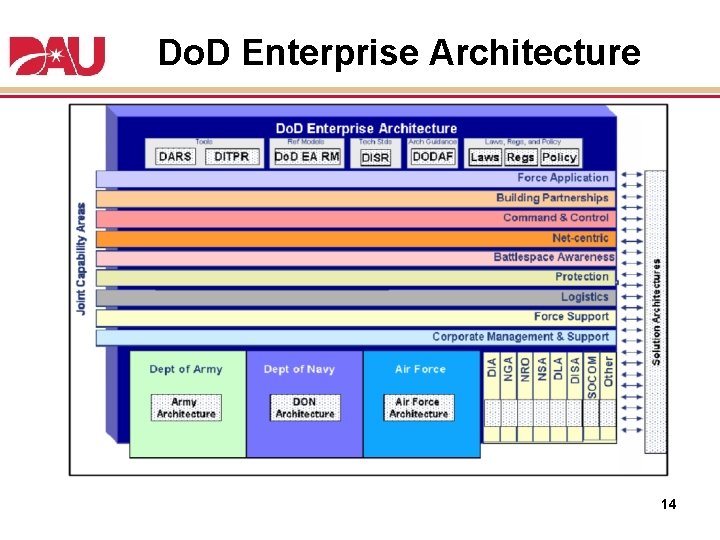
Do. D Enterprise Architecture 14
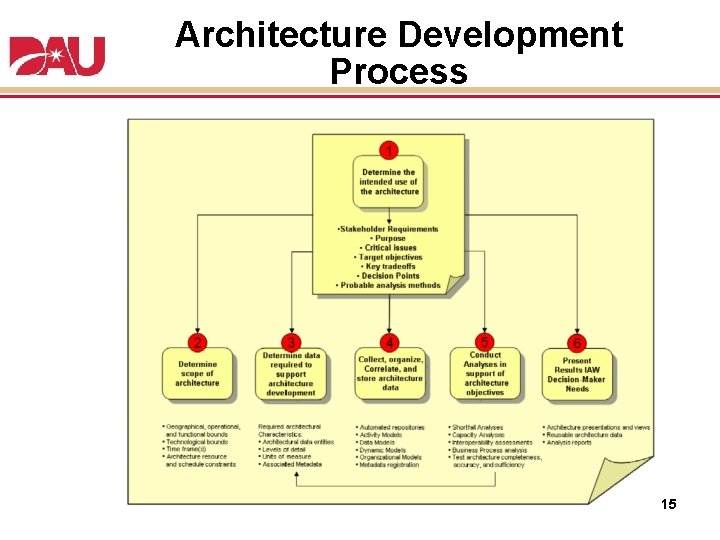
Architecture Development Process 15
GIG 2. 0 16
GIG v 2. 0 Vision “… single coherent, secure, and consolidated information environment which represents a fundamental shift in how we design, implement, manage, operate, and maintain Do. D information technology (IT) and network capabilities at all levels by focusing first on the technical, functional, and operational agility required by those at the tactical edge” (GIG 2. 0 Operational Reference Architecture, V 1. 1, October 13, 2008)
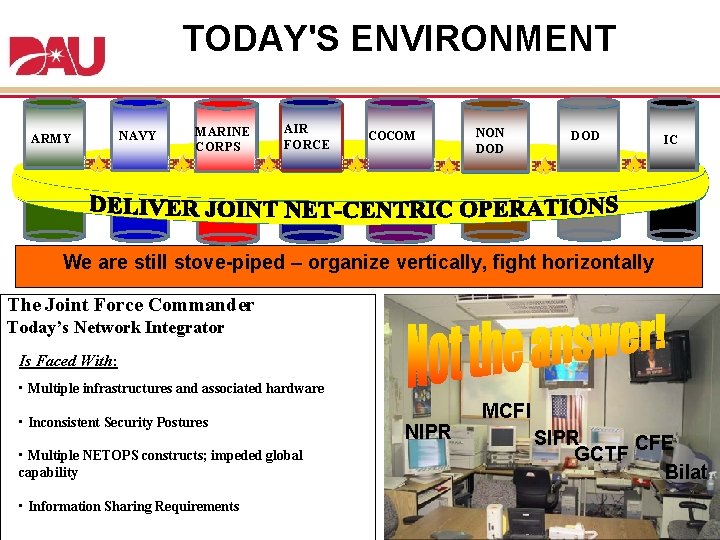
TODAY'S ENVIRONMENT ARMY NAVY MARINE CORPS AIR FORCE COCOM NON DOD IC We are still stove-piped – organize vertically, fight horizontally The Joint Force Commander Connectivity & Internet Today’s Network Integrator Is Faced With: • Multiple infrastructures and associated hardware • Inconsistent Security Postures • Multiple NETOPS constructs; impeded global capability • Information Sharing Requirements NIPR MCFI SIPR CFE GCTF Bilat
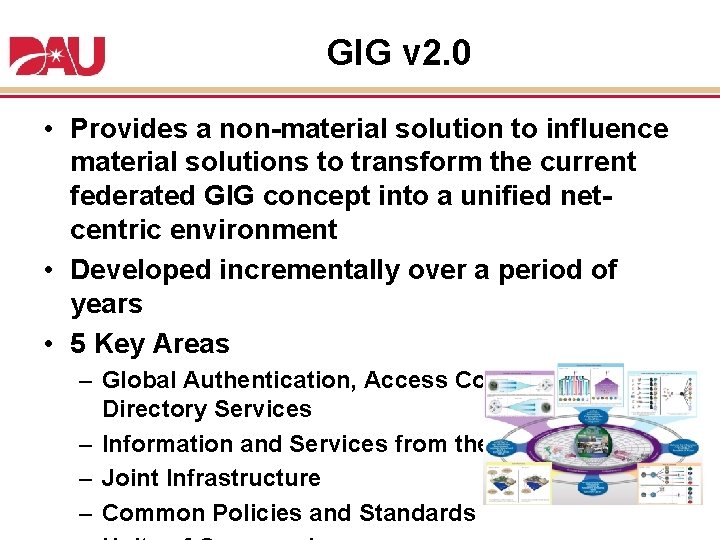
GIG v 2. 0 • Provides a non-material solution to influence material solutions to transform the current federated GIG concept into a unified netcentric environment • Developed incrementally over a period of years • 5 Key Areas – Global Authentication, Access Control, and Directory Services – Information and Services from the Edge – Joint Infrastructure – Common Policies and Standards
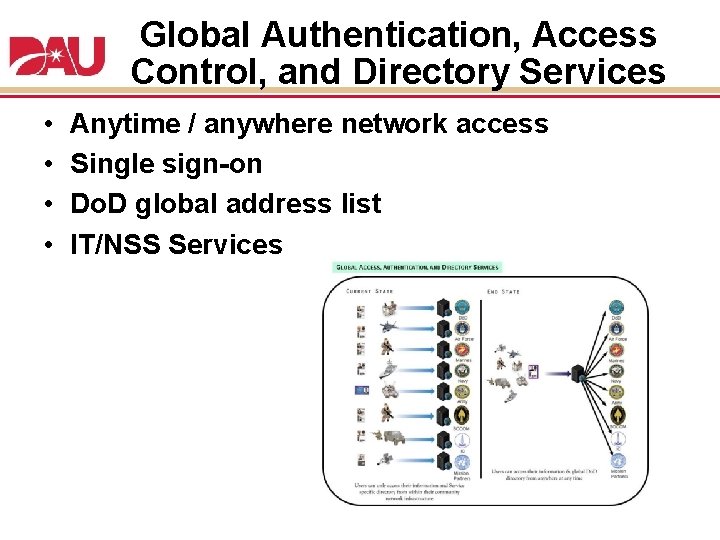
Global Authentication, Access Control, and Directory Services • • Anytime / anywhere network access Single sign-on Do. D global address list IT/NSS Services
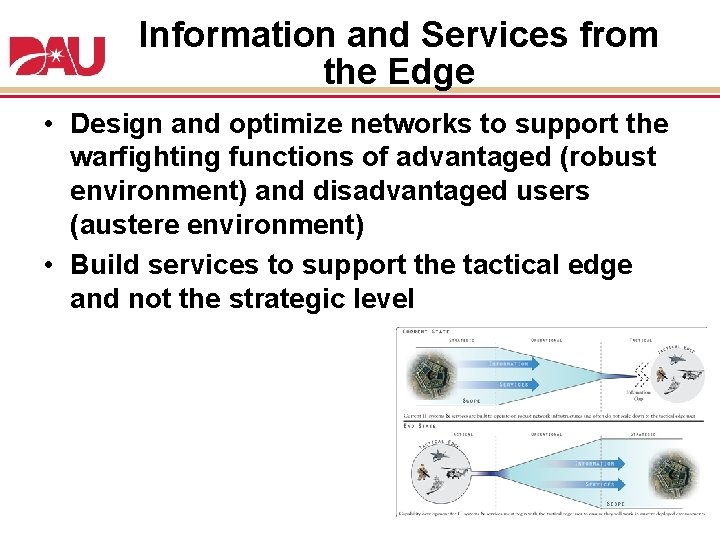
Information and Services from the Edge • Design and optimize networks to support the warfighting functions of advantaged (robust environment) and disadvantaged users (austere environment) • Build services to support the tactical edge and not the strategic level
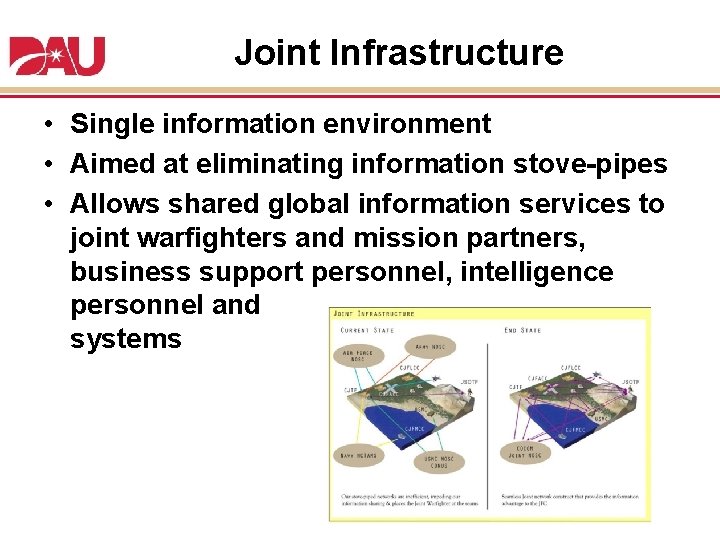
Joint Infrastructure • Single information environment • Aimed at eliminating information stove-pipes • Allows shared global information services to joint warfighters and mission partners, business support personnel, intelligence personnel and systems
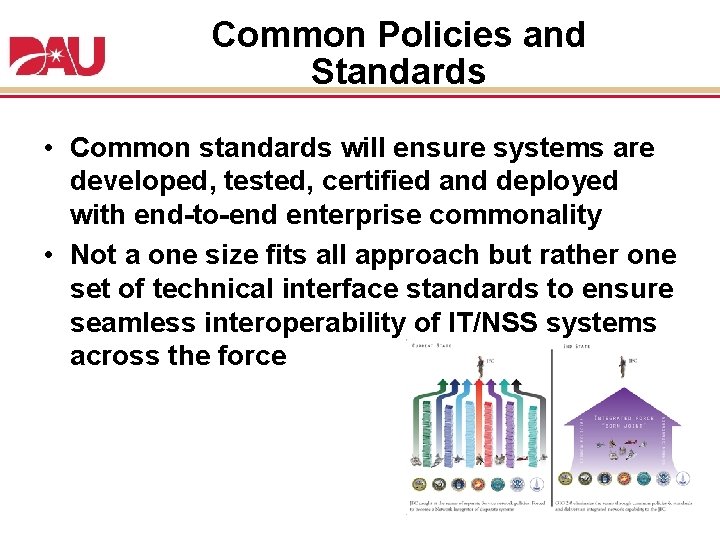
Common Policies and Standards • Common standards will ensure systems are developed, tested, certified and deployed with end-to-end enterprise commonality • Not a one size fits all approach but rather one set of technical interface standards to ensure seamless interoperability of IT/NSS systems across the force
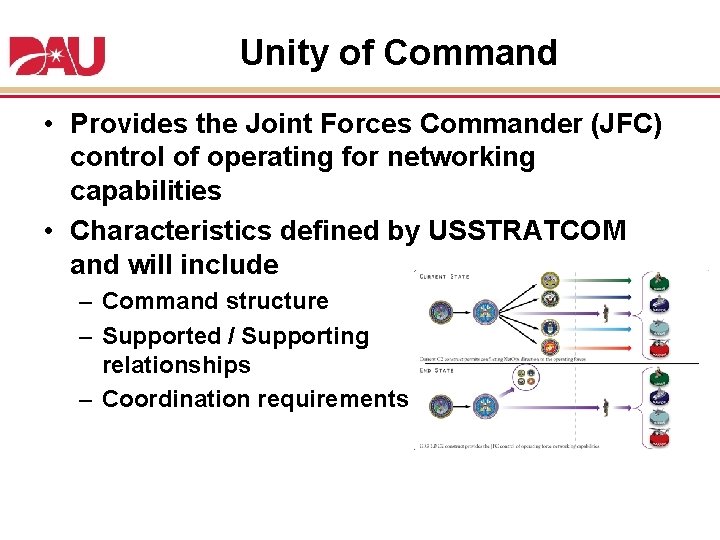
Unity of Command • Provides the Joint Forces Commander (JFC) control of operating for networking capabilities • Characteristics defined by USSTRATCOM and will include – Command structure – Supported / Supporting relationships – Coordination requirements
BACKUPS 25
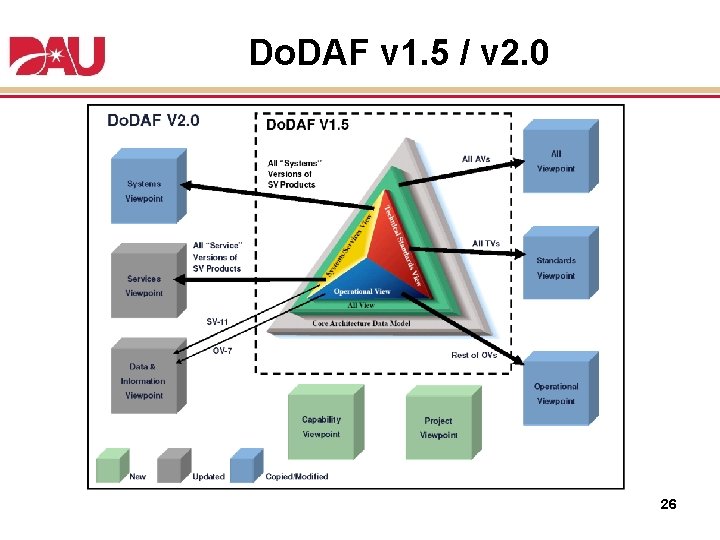
Do. DAF v 1. 5 / v 2. 0 26
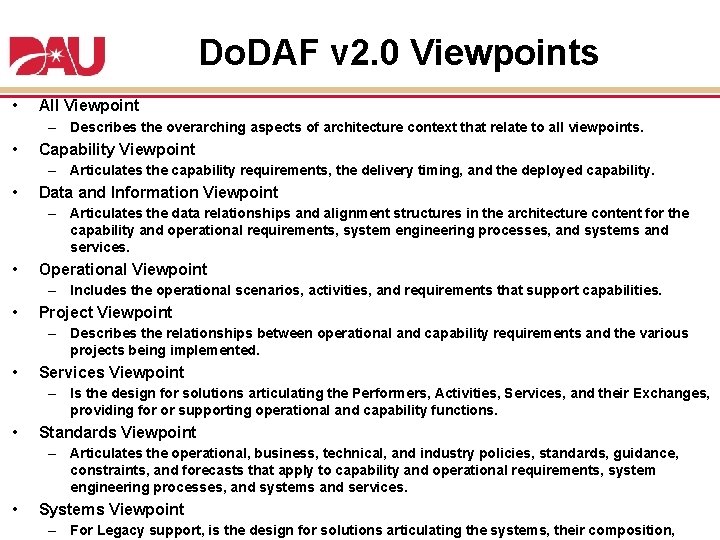
Do. DAF v 2. 0 Viewpoints • All Viewpoint – Describes the overarching aspects of architecture context that relate to all viewpoints. • Capability Viewpoint – Articulates the capability requirements, the delivery timing, and the deployed capability. • Data and Information Viewpoint – Articulates the data relationships and alignment structures in the architecture content for the capability and operational requirements, system engineering processes, and systems and services. • Operational Viewpoint – Includes the operational scenarios, activities, and requirements that support capabilities. • Project Viewpoint – Describes the relationships between operational and capability requirements and the various projects being implemented. • Services Viewpoint – Is the design for solutions articulating the Performers, Activities, Services, and their Exchanges, providing for or supporting operational and capability functions. • Standards Viewpoint – Articulates the operational, business, technical, and industry policies, standards, guidance, constraints, and forecasts that apply to capability and operational requirements, system engineering processes, and systems and services. • Systems Viewpoint – For Legacy support, is the design for solutions articulating the systems, their composition,
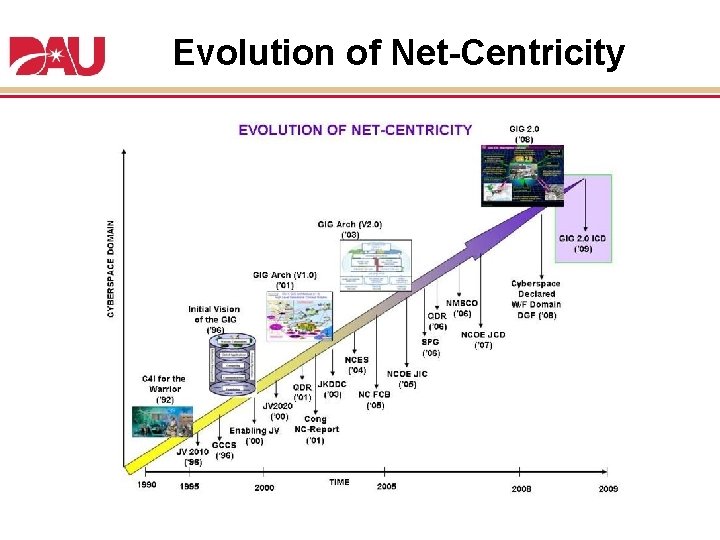
Evolution of Net-Centricity