
Internal Factors Learning Objectives To know what is

Internal Factors • Learning Objectives • To know what is meant by labelling. • To be able to apply labelling theories to your knowledge and understanding. To be able to evaluate differences between workingclass and middle-class children as a result of labelling.
s e c n e r e f f i D s s a l C l a i c So : n o i t a in Educ Internal/ Inside School Explanations Labelling / Interactionist Theories: These theories suggest that the W/C are disadvantages within education due to the processes within, & organisation of, the education system itself. The focus here is on the ‘Interactions’ between pupils are their teachers & their institutions, and how these interactions can determine whether a pupil is successful or not.
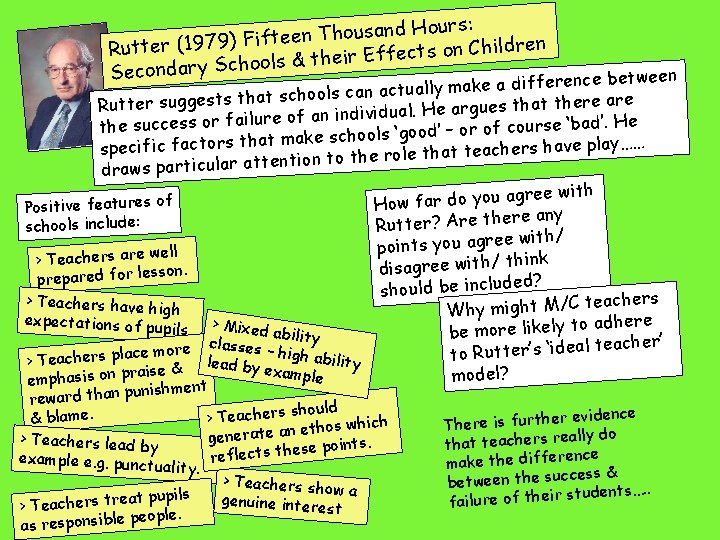
ours: H d n a s u o h T n e e ift hildren C Rutter (1979) F n o s t c e f f E ir ols & the Secondary Scho rence between fe if d a e ak m ly al tu schools can ac that there are Rutter suggests that s ue g ar e H l. ua id iv d e of an in ‘bad’. He se ur the success or failur co of or – ’ d oo ‘g make schools specific factors that hers have play…… ac te at th le ro e th ntion to draws particular atte ou agree with y o d of r a es f ur at w o fe H ve ti Posi re any Rutter? Are the schools include: agree with/ u o y s t in o p ell > Teachers are w e with/ think e r g a is. d n o s s le r o prepared f d? should be include > Teachers have h achers e t C / M t h ig igh m y Wh expectations of p > M to adhere ly ixed abi e k upils. li e r o m e b lity classes teacher’ l a e d ‘i e r ’s o r – e m t e t h u c R i la g p to h ability > Teachers lead by & e e xample rais model? emphasis on p nishment u p n a h t d r a w re should & blame. > Teachers s which o h t e n a e t a gener > Teachers lead b points. y e s e h t s t c refle example e. g. punc tuality. > Teachers sh ow a s il p u p t a e r g t e s n r u e interest > Teach. le p o e p as responsible r evidence There is furthe ally do that teachers re ence make the differ cess & between the suc students…. . failure of their
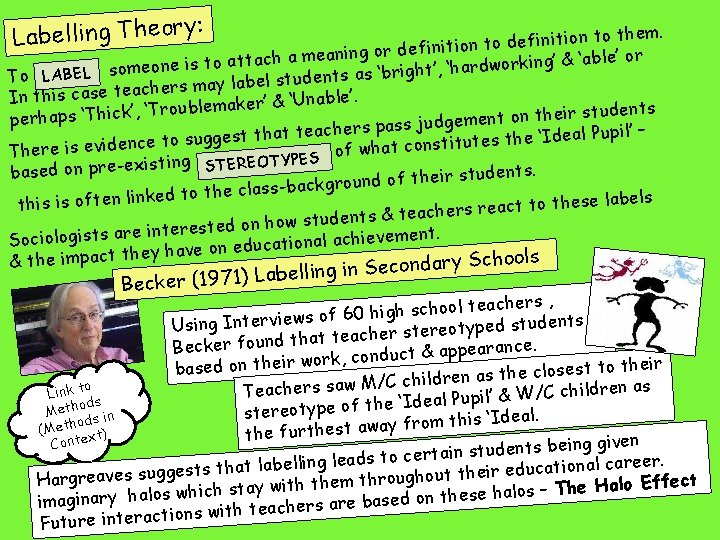
: Labelling Theory n to them. io it in f e d o t n io ing or definit n a e m a h c a t ’ & ‘able’ or t g a in k to r o is w e d n r o a e ‘h m ’, o t s To LABEL ents as ‘brigh d u t s l e b la y a m chers In this case tea ‘Unable’. & ’ r e k a m le b u o r ‘T students ir e h t n o t n e perhaps ‘Thick’, m e g ers pass jud h c a e t t Pupil’ – a l h a t e t d s ‘I e g h u t s s o e t t u e what constit f o There is evidenc S isting STEREOTYPE based on pre-ex udents. t s ir e h t f o d n u lass-backgro c e h t o t d e k n li se labels e h t o t this is often t c a e r s r nts & teache e d u t s w o h n o d intereste vement. ie h c a Sociologists are l a n io t a c u ey have on ed h t t c a p im hools e c h t S & y r a d n o c e S in elling ab Becker (1971) L eachers , t l o o h c s h ig h 0 s of 6 students d Using Interview e p y t o e r e t s r e at teach Becker found th earance. p p a & t c u d n o c , ork based on their w est to their s lo c e h t s a n e r C child o ren as d il h eachers saw M/ c T C Link t / W & ’ il p l Pu ds ype of the ‘Idea t o Metho in e r e t s this ‘Ideal. ods m o r f y a w a t s (Meth xt) e h the furt Conte eing given b s t n e d u t s in a t leads to cer g in ll e b al career. la n t io a t h a t c u s d t e s e ir g e g u h s t throughout Hargreaves m e h t h alo Effect it H w e y h a t T s – h s ic lo h a w h s e ased on thes b imaginary halo e r a s r e h c a e t ns with Future interactio
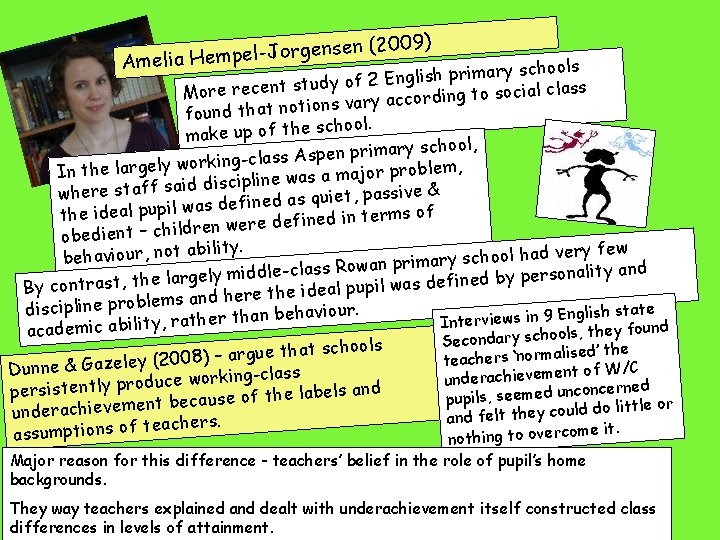
orgensen J le p m e H a li e Am (2009) imary schools r p h s li g n E 2 f o dy More recent stu social class o t g in d r o c c a y r ns va found that notio chool. make up of the s ry school, a im r p n e p s A s s orking-cla In the largely w jor problem, a m a s a w e n li ip disc ssive & a where staff said p , t ie u q s a d e as defin the ideal pupil w terms of in d e in f e d e r e w ren obedient – child bility. d very few a h l o o h c s behaviour, not a y r a im lass Rowan pr c le d nality and id o s m r e ly p e g y r b la d e e h in t f , e By contrast al pupil was d e id e h t e r e h d n ms a discipline proble haviour. e English state b 9 n a in h s t w r ie e v h r t e a t r n , I ound academic ability y schools, they f r a d n o c e S schools t a h t e u g malised’ the r r a o ‘n – s ) r 8 e 0 h c 0 a e (2 t y Dunne & Gazele ss la vement of W/C c ie g h c in a k r r e o d n w u e c u d nd a concerned n ls u e persistently pro d b e la m e e e h s t , s f il o p pu or nt because ey could do little h underachieveme t lt e f d n a achers. e t f o s n io t ome it. p m u s as nothing to overc Major reason for this difference - teachers’ belief in the role of pupil’s home backgrounds. They way teachers explained and dealt with underachievement itself constructed class differences in levels of attainment.
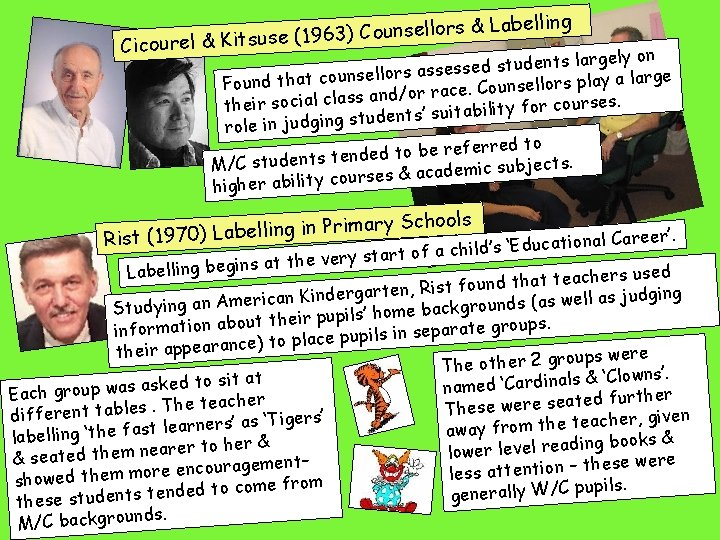
s & Labelling r o ll e s n u o C ) 3 6 9 (1 e Cicourel & Kitsus s largely on t n e d u t s d e s sellors as lay a large p s r o Found that coun ll e s n u o C. e s and/or rac courses. r their social clas o f y it il b a it u s ’ tudents role in judging s referred to e b o t d e d n e t s M/C student ic subjects. m e d a c a & s e s r u higher ability co y Schools r a im r P in g in ll e b a L Rist (1970) l Career’. ild’s ‘Educationa of a ch t r a t s y r e v e h t at Labelling begins chers used a e t t a h t d n u o f garten, Rist r e d in K s judging n a a ll ic e r w e s m (a A s n a d n g u o in Study home backgr ’ s il p u p ir e h t t u ate groups. r a p information abo e s in s il p u p e) to place their appearanc ups were o r g 2 r e h t o e h T ‘Clowns’. t & a ls it a s in o t d r d a e ‘C k s d a e nam Each group was r e h c ated further a e e s t e e r h e T w. e s s e le h b T a different t ‘Tigers’ cher, given a s e a t ’ s e r h e t n r m a o le r f t s y a a aw labelling ‘the f ooks & b & g r in e d h a e o r t l r e e v r a le e lower & seated them n – t n e m e these were g a – r n u o io c t n n e e t r a o s m s le showed them m o r f e m o c o t /C pupils. d W e y d ll n a e r t e s n t e n g e d u these st s. M/C background
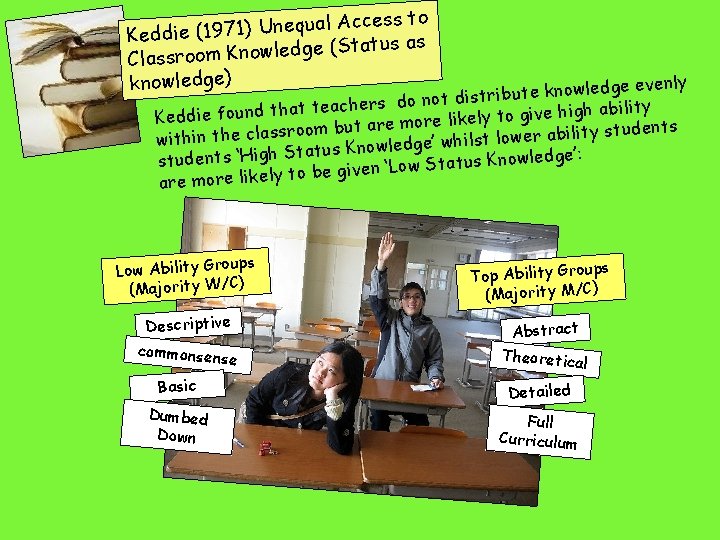
ss to e c c A l a u q e n U ) 1 Keddie (197 (Status as e g d le w o n K m o o r Class knowledge) wledge evenly o n k e t u ib r t is d achers do not e t t a h t d n u e high ability o f iv g o t ly Keddie e k li e r o om but are m o r s s la ility students c b a e h r t e w in h lo t s wit il h w Knowledge’ s u t a t S h ig ‘H s t s Knowledge’: studen u t a t S w o ‘L n e iv o be g are more likely t ps Low Ability Grou (Majority W/C) ps Top Ability Grou (Majority M/C) Descriptive commonsen se Abstract Theoretica l Basic Dumbed Down Detailed Full Curriculum
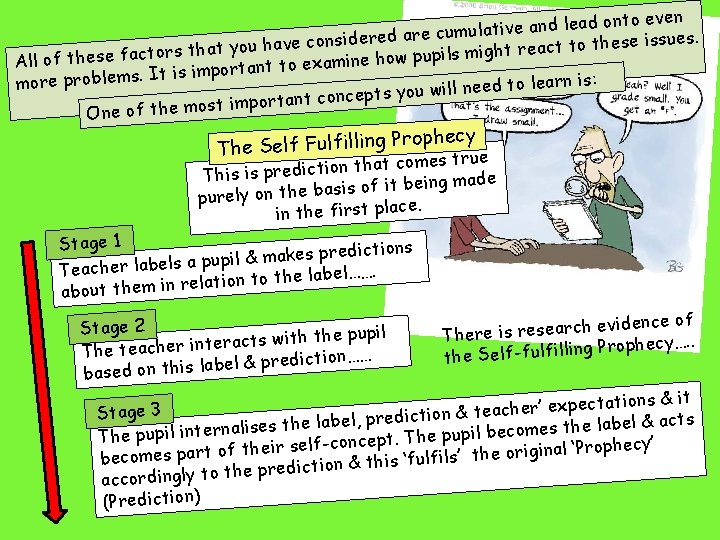
nto even o d a le d n a e iv t ed are cumula r e id s issues. n o e s c e e h v t a o h t u t o c y a t e a r h t tors t pupils migh w o h e in m All of these fac a x e o t is important t I. s m le b o r p e r mo to learn is: d e e n l il w u o y s t rtant concep o p im t s o m e h t One of The Self Fulfilling P rophecy mes true o c t a h t n io t ic d This is pre being made it f o is s a b e h t n purely o e. in the first plac Stage 1 s predictions e k a m & il p u p a Teacher labels the label……. o t n io t la e r in about them Stage 2 h the pupil it w s t c a r e t in r The teache rediction…… p & l e b la is h t n based o evidence of h c r a e s e r is e r The phecy…. . o r P g n li il lf u f lf the Se ions & it t a t c e p x e ’ r e h c 3 Stage diction & tea e r p l, e b la e h label & acts t s e e h s t li s a e n r m e o t c e in b il il p The pu ept. The pup c n o c lf e s ir e h l ‘Prophecy’ t a f in o ig t r r o a p e h s t e ’ m s o il c be ion & this ‘fulf t ic d e r p e h t o t accordingly (Prediction)
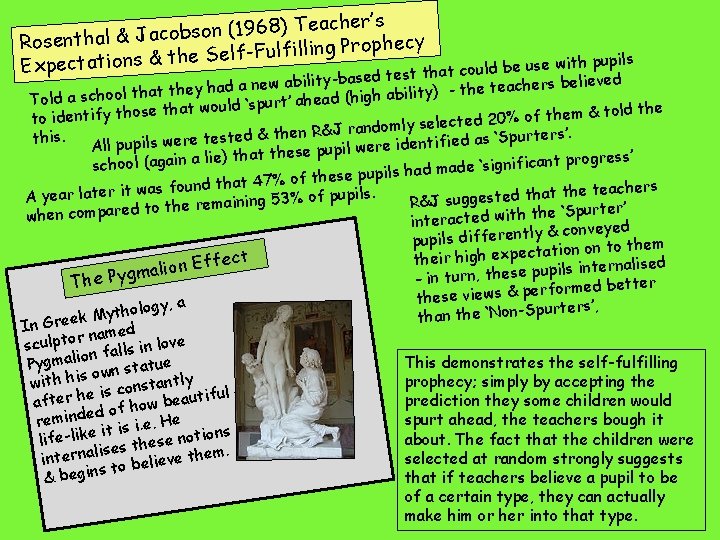
acher’s e T ) 8 6 9 (1 n o s b o Rosenthal & Jac ng Prophecy li il lf u F lf e S e h t use with pupils Expectations & st that could be ability-based te w e n a achers believed d e a t h e y h e t h t t ) a y h it t il l b o a Told a scho rt’ ahead (high u p ‘s ld u o w t a h t e hem & told the t f o % 0 to identify thos 2 d e t c &J randomly sele R n e h t & d e t s this. e s ‘Spurters’. a d ie if t n e id e r All pupils were t t these pupil we a h t ) e li a in a g (a icant progress’ if n ig school ‘s e d a m d a f these pupils h o % 7 4 t a h t d n u as fo teachers e h t. t s a il h p t u p d e f t o A year later it w s e % g R&J sug the remaining 53 o t d e r a p m o c the ‘Spurter’ n whe interacted with conveyed & ly t n e r e f if d s pupil tion on to them a t c e p x e h ig h t ir the Effec ernalised n t in o s i il l p u p a e s e m h t – in turn, The Pyg ed better m r o f r e p & s w ie these v a , y g o l o -Spurters’, n h o t ‘N y e h t M n a h t k In Gree amed rn sculpto n love i s l l a f on This demonstrates the self-fulfilling Pygmali atue t s n w o prophecy; simply by accepting the with his nstantly ful & o c s i e prediction they some children would after h of how beauti d e spurt ahead, the teachers bough it remind i. e. He s i t i s e n k o about. The fact that the children were life-li se noti e h t s e s i. l a m n e selected at random strongly suggests inter lieve th e b o t s that if teachers believe a pupil to be & begin of a certain type, they can actually make him or her into that type.

Starter Task Write a summary sheet about what sociologists suggest labelling does to achievement of students and how they suggest it has an impact. You have 8 minutes.

Streaming
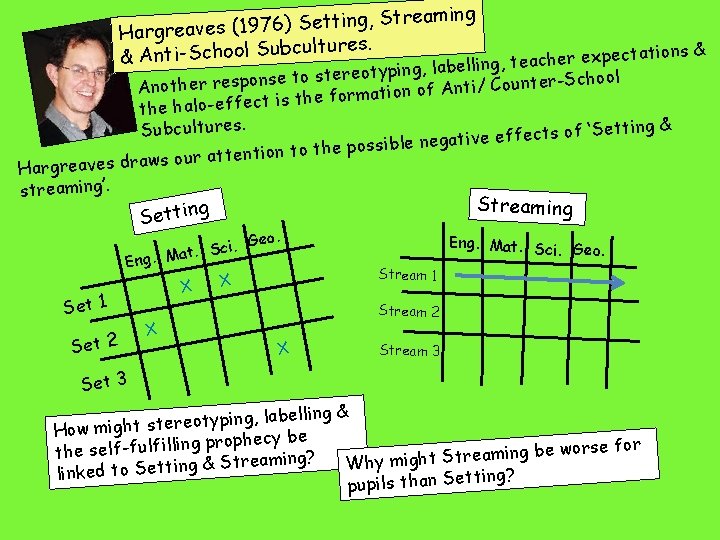
g, Streaming in t t e S ) 6 7 9 (1 s e v a Hargre ultures. tions & a t c e p x e & Anti-School Subc r e h c a e ing, t g, labell in p y t o e r e t s o t e r-School e t n u o C i/ t n Another respons A f formation o e h t is t c e f f e lo the ha etting & ‘S Subcultures. f o s t c e f f e e ssible negativ o p e h t o t n io t n s our atte Hargreaves draw streaming’. g Settin Set 1 Sci. . t a M. Eng X X Set 2 Set 3 X Streaming Geo. Eng. Mat. Sci. Geo. Stream 1 Stream 2 X Stream 3 labelling & , g in p y t o e r e t s t How migh ophecy be r p g n li il lf u f lf worse for e e b g the s in m a e r t ? S g Why might g & Streamin in t t e S o t d e k n li ing? pupils than Sett
Thinking harder Streaming involves separating children into different ability groups called ‘streams’. Each ability group is then taught separately from the others for all subjects. Studies show that the self-fulfilling prophecy is particularly likely to occur when children are streamed. Becker showed that teachers do not usually see working-class children as ideal pupils. They tend to see them as lacking ability and have low expectation of them. As a result, working-class children are more likely to find themselves put in a lower stream. Once streamed, it is usually difficult to move up to a higher stream; children are more or less locked into their teachers’ low expectations of them. Children in the lower streams ‘get the message’ that their teachers’ have written them off as no-hopers. This creates a self-fulfilling prophecy in which the pupils live up to their teachers expectations by underachieving. For example, Douglas found that children placed in a lower stream at age 8 had suffered a decline in their IQ score by age 11. By contrast, middle-class pupils tend to benefit from streaming. They are likely to be placed in higher streams, reflecting teachers’ view of them as the ideal pupils. As a result, they develop a more positive self-concept, gain confidence, work harder and improve their grades. Douglas found that children placed in higher streams at age 8 had improved their IQ score by age 11. A study of 2 London secondary schools by David Gillborn and Deborah Youdell (2001) shows how teachers use stereotypical notions of ‘ability’ to stream pupils. They found that teachers are less likely to see working-class (and black) pupils to have ability. As a result, these pupils are more likely to be placed in lower streams and entered for lower-tier GCSEs. This denies them the knowledge and opportunity needed to gain good grades and widens the class gap in achievement. They linked streaming to the policy of publishing exam league tables. Thee rank each school according to its exam performance. Schools need to achieve a good league table position if they are to attract pupils and funding. Publishing league tables is what Gillborn and Youdell call an ‘A-to-C economy’ in schools. This is a system in which schools focus their time, effort and resources on those pupils they see having the potential to get C grades and boost the schools league table position.
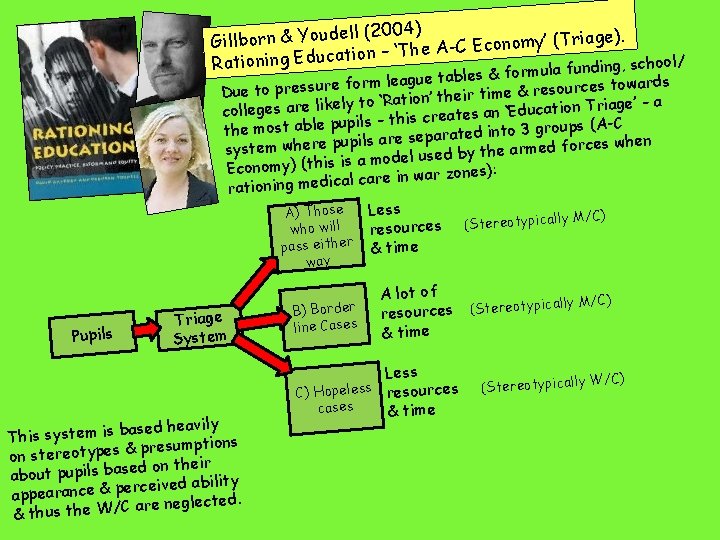
ll (2004) e d u o Y & n r o lb ’ (Triage). il y G m o n o c E C A e tion – ‘Th hool/ Rationing Educa mula funding, sc e tables & for u g a le m r o f e r u s ces towards r u o s e r & e Due to pres im t to ‘Ration’ their ly e k li e r n Triage’ – a a io s t e a g c u e ll d ‘E co n a s e pils – this creat u p le b a t s o m e h o 3 groups (A-C t t in d e t a r a p e s e pils ar forces when d e m r a system where pu e h t y b d a model use Economy) (this is ar zones): w in e r a c l a ic d e rationing m Less A) Those otypically M/C) who will resources (Stere pass either & time way Pupils Triage System ased heavily This system is b esumptions r p & s e p y t o e r e on st ed on their about pupils bas rceived ability e p & e c n a r a e p p a are neglected. & thus the W/C B) Border line Cases A lot of otypically M/C) resources (Stere & time Less C) Hopeless resources cases & time (Stereotypically W/C)
Educational Triage • Gillborn and Youdell call this process of streaming ‘educational triage’ (triage – means sorting). • They argue that the A-C economy produced an educational triage and schools categorise pupils into 3 types. • Teachers do this using a stereotypical view of working-class (and black) pupils lacking ability. This produces a self-fulfilling prophecy and failure.

Educational Triage
Educational triage • The need to gain good league table positions drives the triage and becomes the basis for streaming. • Teachers’ beliefs about working-class pupils are used to segregate them into lower ability streams where they get less support, attention and resources. This results in lower achievement.
Pupil subcultures • What is a pupil subculture? • A group of pupils who share similar values and behaviour patterns. • Why do pupil subcultures occur? • Due to the way they have been labelled and as a reaction to streaming.
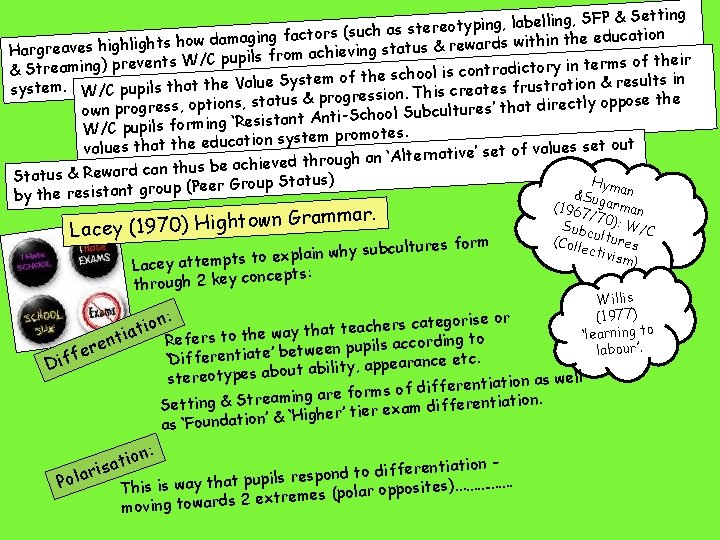
FP & Setting S g, lin el b la , ng pi ty ors (such as stereo ct fa g in ag e education th am d in h ow it h w s ts d h ar lig w h ig re h & Hargreaves om achieving status fr ls pi pu /C W ts en ry in terms of their to ic d ra & Streaming) prev nt co is ol ho System of the sc ustration & results in fr s te system. W/C pupils that the Value ea cr s hi T n. io s, status & progress y oppose the tl on ti ec ir op d , ss at re th ’ og es pr ur n lt ow nt Anti-School Subcu ta is es ‘R g in rm fo ls W/C pupi n system promotes. io at uc ed e th at th values t of values set out se ’ ve ti na er lt ‘A an h us be achieved throug th n ca d ar ew R & s Statu Hym (Peer Group Status) p an ou gr t an st si & re e Su by th n Grammar. w o t h ig H ) 0 7 9 (1 y e c La ures form plain why subcult x e o t s t p m e t t a Lacey oncepts: through 2 key c n: tegorise or a c s o r e h i c a e t t t a h ay t Refers to the w rding to ntia Willis (1977) ‘learning to labour’. upils acco p n e e w t e b ’ e t ia ‘Different arance etc. e p p a , y it il b a t u stereotypes abo iation as well t n e r e f if d f o s ming are form Setting & Strea differentiation. m a x e r ie t ’ r e h ‘Hig as ‘Foundation’ & re e f Dif on: i t a s lari Po (196 garman 7/7 Subc 0): W/C (Coll ultures ectiv ism) ifferentiation – d o t d n o p s e r s il pup es)……………. it s o This is way that p p o r la o (p s 2 extreme moving towards
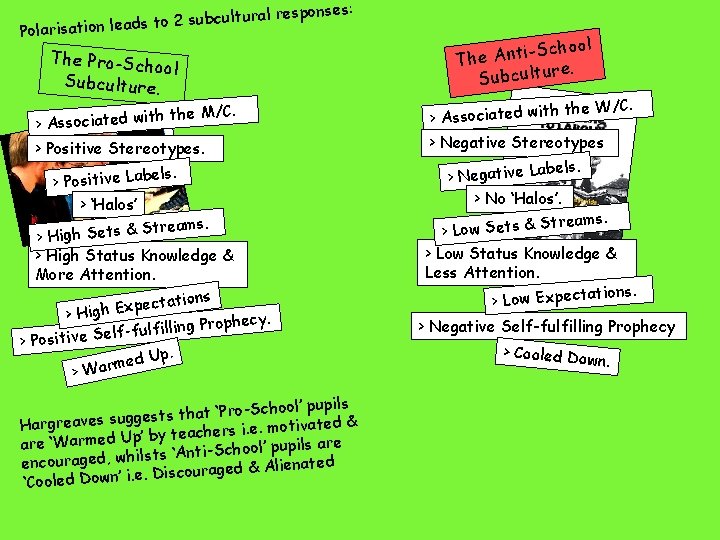
esponses: bcultural r u s 2 o t s d a le n Polarisatio The Pro-Sch ool Subculture. h the M/C. > Associated wit > Positive Stereotypes. els. > Positive Lab > ‘Halos’ treams. High Sets & S > > High Status Knowledge & More Attention. tations c e p x E h > Hig phecy. o r P g n li il lf u lf-f > Positive Se Up. d e m r > Wa ro-School’ pupils ‘P t a h t s e g g u Hargreaves s otivated & m. e i. s r e h c a e t ’ by are ‘Warmed Up pupils are l’ o o h c S it n ‘A s st encouraged, whil Alienated & d e g a r u o c is D. ‘Cooled Down’ i. e chool S i t n A e Th re. Subcultu h > Associated wit the W/C. > Negative Stereotypes bels. > Negative La > No ‘Halos’. treams. S & s t e S w o >L > Low Status Knowledge & Less Attention. ions. > Low Expectat > Negative Self-fulfilling Prophecy > Cooled Dow n.
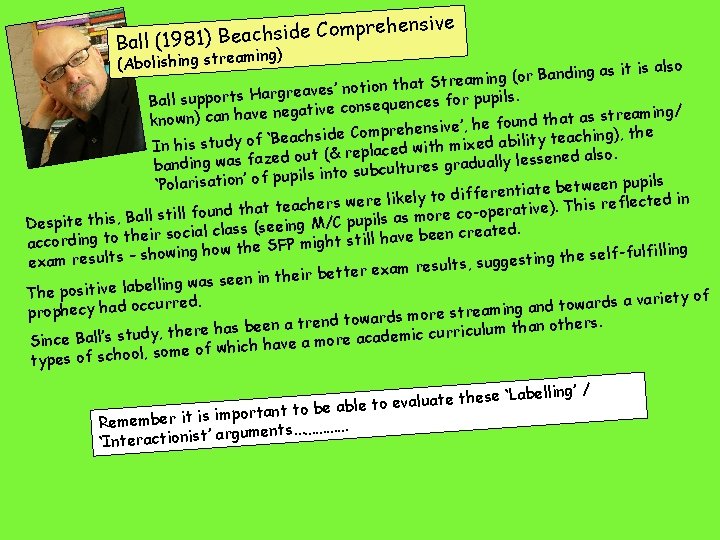
ehensive e Compr id s h c a e B ) 1 8 9 (1 Ball ming) (Abolishing strea as it is also g in d n a B r (o g in ion that Stream t o n ’ s e v a e r g r a Ball supports H nces for pupils. e u q e s n o c e iv t a neg at as streaming/ h t d known) can have n u o f e h ’, e e Comprehensiv id s h c a e teaching), the ‘B y f o it il y b d a u t d s e is ix h m n h I t (& replaced wit u o d e z sened also. a s f le s a y w ll a g u d a r g bandin s e s into subcultur il p u p f o ’ n io t a is ‘Polar tween pupils e b e t ia t n e r e f if d flected in s were likely to e r r e h is c h a T e t ). t e a iv h t t a r d ll still foun as more co-ope s il p u p C / M Despite this, Ba g in e social class (se en created. ir e e b h e t v o a t h l g il in t d s r t o h c ac how the SFP mig g in w o h elf-fulfilling s s – e s h t lt u g s in t s e g g u exam results, s r e t t e b ir e h t in elling was seen The positive lab ds a variety of ed. r r a r u w c o t c o d n d a a h g y in c m e a proph ards more stre w o t d n e r t a n e e an others. b h t s a m h lu e u r e ic h r t r , u y c d u ic Since Ball’s st e a more academ v a h h ic h w f o e som types of school, abelling’ / ‘L e s e h t e t a lu a v t to be able to e n a t r o p im is it r Remembe nts…………… e m u g r a ’ t is n io t ‘Interac
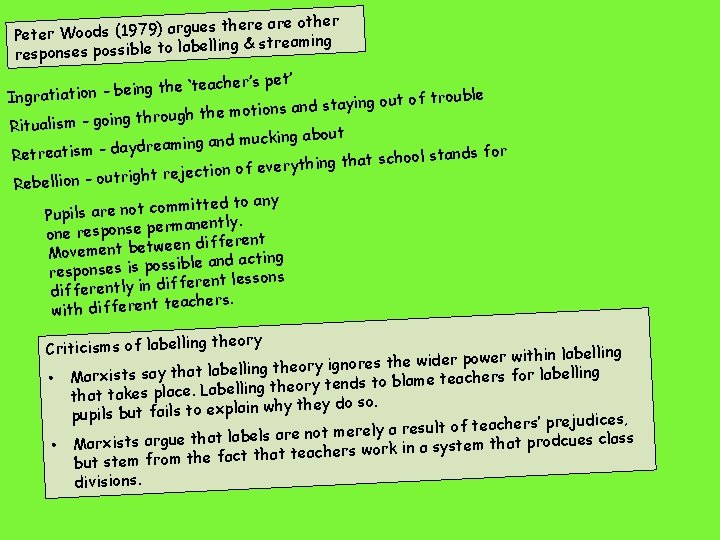
there are other es gu ar 9) 97 (1 ds oo W r Pete belling & streaming la to le ib ss po s se on sp re her’s pet’ c a e ‘t e h t g in e b Ingratiation – g out of trouble in y a t s d n a s n io t through the mo g in o g – m s li a u it R cking about u m d n a g in m a e r yd Retreatism – da chool stands for s t a h t g in h t y r e t rejection of ev h ig r t u o – n io ll e Reb mmitted to any o c t o n e r a s il p u P rmanently. one response pe een different Movement betw le and acting ib s s o p is s e s n o resp ferent lessons if d in ly t n e r e f dif eachers. t t n e r e f if d h it w eory Criticisms of labelling th power within labelling er id w e th s re no ig ry lling theo • Marxists say that labe achers for labelling te e am bl to s nd te ry eo ng th that takes place. Labelli why they do so. n ai pl ex to ils fa t bu ls pupi ’ prejudices, rs he ac te of lt su re a y labels are not merel prodcues class at th em • Marxists argue that st sy a in k or w that teachers but stem from the fact divisions.
Pupil class identities and the school • Sociologists are also interested in how pupil class identities that are formed outside of school interact with the school and its values to produce educational success and failure. • Louise Archer et al (2010) focussed on the interactions between working-class pupils’ identities and school, and how this produces underachievement. To understand this they focus on the concept of habitus by Bourdieu (1984).
Habitus • ‘Dispositions’ or learned, taken for granted ways of thinking, being and acting that are shared by classes. • Includes tastes about lifestyle, preferences, outlook on life, expectations and what is normal for ‘people like us’. • A groups’ habitus is formed as a response to its position in the class structure. • Middle class power is able to define their habitus as better than WC and impose it on the education system. This results in schools putting higher value on MC habitus. • Linked to Bourdieu’s cultural capital – because schools have MC habitus MC pupils have an advantage.
Symbolic capital and symbolic violence • Symbolic capital – because MC pupils have been raised with MC habitus they gain status and recognition from the school. • Symbolic violence – withholding of symbolic capital because the school devalues WC habitus as their tastes and preferences are deemed worthless. • Clash between WC and schools’ MC habitus – therefore WC may experience school as alien and unnatural.
‘Nike’ identities Read the information on P 33 and answer these questions: 1. How did symbolic violence lead to ‘Nike’ identities? 2. What was ‘social suicide’? 3. How did this lead to conflict in schools? 4. How did Nike styles play a part in the rejection of higher education? 5. According to Archer, why do WC pupils invest in ‘Nike’ identities?
Task Complete the sheet on other factors that affect working class achievement and what sociologists said about them by using the text book pages 33 -34. • Working class identity and educational success • Class identity and self-exclusions
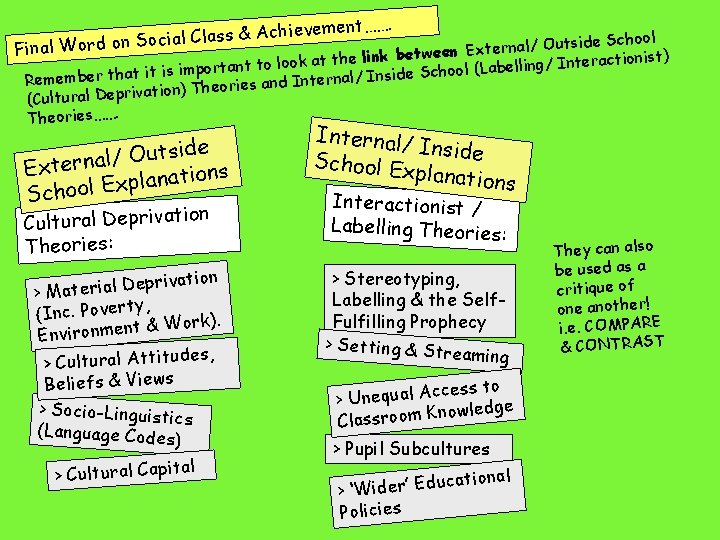
ment……. Achieve & s s la C l ia c o S Final Word on side School t u O l/ a n r e t x E e link between h t t a k o nteractionist) I lo / o g t t in n ll a e t b r a o p (L l im o it is nal/ Inside Scho r e t Remember that n I d n a s ie r o ation) The (Cultural Depriv Theories……. ide s t u O / l a Extern ions t a n a l p x School E n Cultural Deprivatio Theories: ivation r p e D l ia r e t > Ma y, (Inc. Povert Work). & t n e m n o ir Env s, > Cultural Attitude Beliefs & Views > Socio-Linguist ics (Language Codes ) > Cultural Capita l Internal/ Inside School Ex planations Interactionist / Labelling Theories: > Stereotyping, Labelling & the Self. Fulfilling Prophecy > Setting & Str eaming ess to c c A l a u q e n >U nowledge Classroom K > Pupil Subcultures ional ucat > ‘Wider’ Ed Policies They can also be used as a critique of one another! i. e. COMPARE & CONTRAST
Links between internal and external • Select a card from each of the sets in front of you. • Discuss on your table how the 2 factors interrelate in affecting a pupils’ educational achievement.
- Slides: 32