
Internal Direct Product Definition We define an operation
- Slides: 3
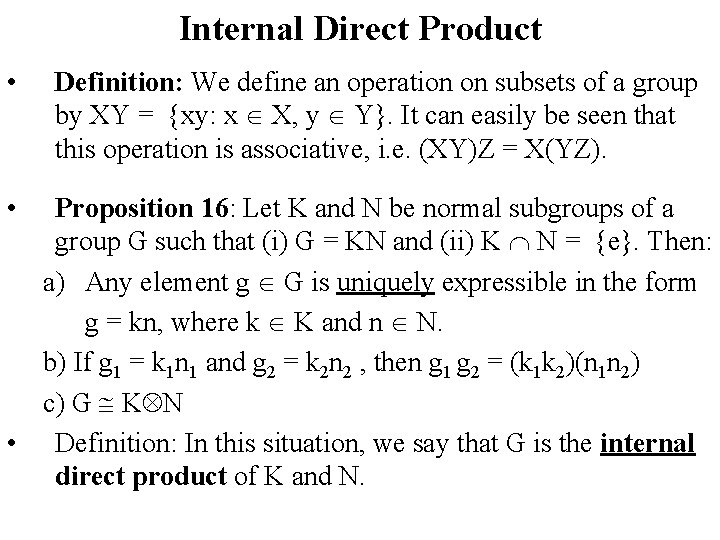
Internal Direct Product • • Definition: We define an operation on subsets of a group by XY = {xy: x X, y Y}. It can easily be seen that this operation is associative, i. e. (XY)Z = X(YZ). Proposition 16: Let K and N be normal subgroups of a group G such that (i) G = KN and (ii) K N = {e}. Then: a) Any element g G is uniquely expressible in the form g = kn, where k K and n N. b) If g 1 = k 1 n 1 and g 2 = k 2 n 2 , then g 1 g 2 = (k 1 k 2)(n 1 n 2) c) G K N • Definition: In this situation, we say that G is the internal direct product of K and N.
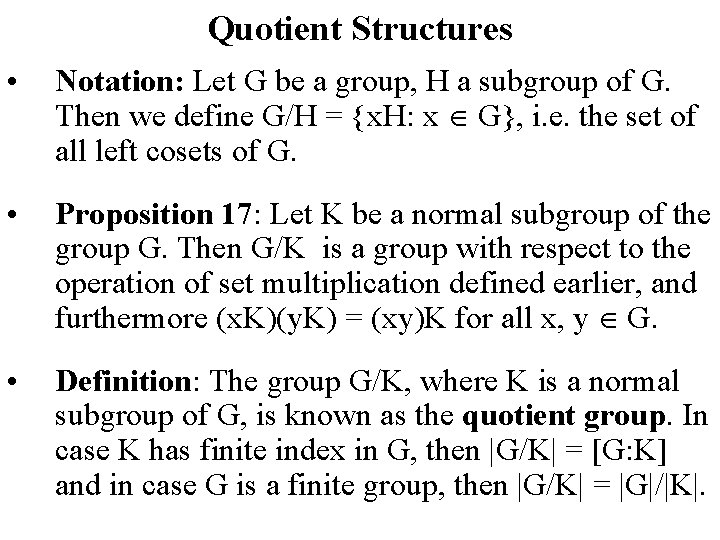
Quotient Structures • Notation: Let G be a group, H a subgroup of G. Then we define G/H = {x. H: x G}, i. e. the set of all left cosets of G. • Proposition 17: Let K be a normal subgroup of the group G. Then G/K is a group with respect to the operation of set multiplication defined earlier, and furthermore (x. K)(y. K) = (xy)K for all x, y G. • Definition: The group G/K, where K is a normal subgroup of G, is known as the quotient group. In case K has finite index in G, then |G/K| = [G: K] and in case G is a finite group, then |G/K| = |G|/|K|.
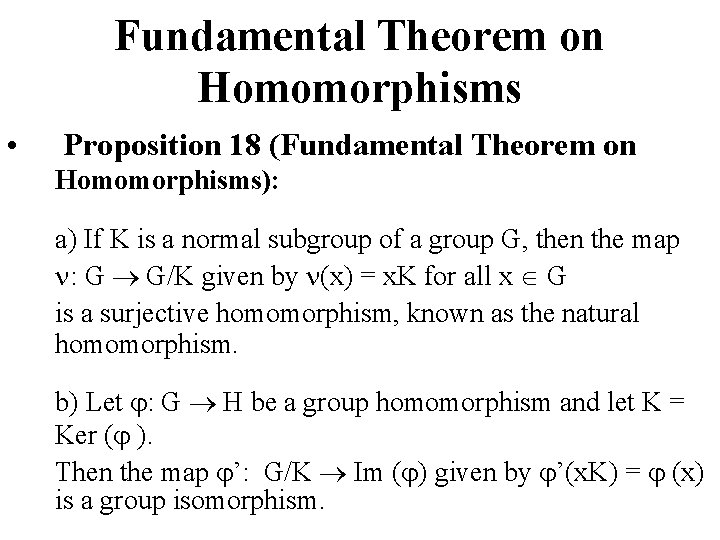
Fundamental Theorem on Homomorphisms • Proposition 18 (Fundamental Theorem on Homomorphisms): a) If K is a normal subgroup of a group G, then the map : G G/K given by (x) = x. K for all x G is a surjective homomorphism, known as the natural homomorphism. b) Let : G H be a group homomorphism and let K = Ker ( ). Then the map ’: G/K Im ( ) given by ’(x. K) = (x) is a group isomorphism.