
Internal coordination Australias approach to the involvement of
- Slides: 6
Internal coordination – Australia’s approach to the involvement of national quality infrastructure in meeting the objectives of the TBT agreement. Jennifer Evans Chief Executive Officer National Association of Testing Authorities, Australia www. jas-anz. org www. nata. com. au
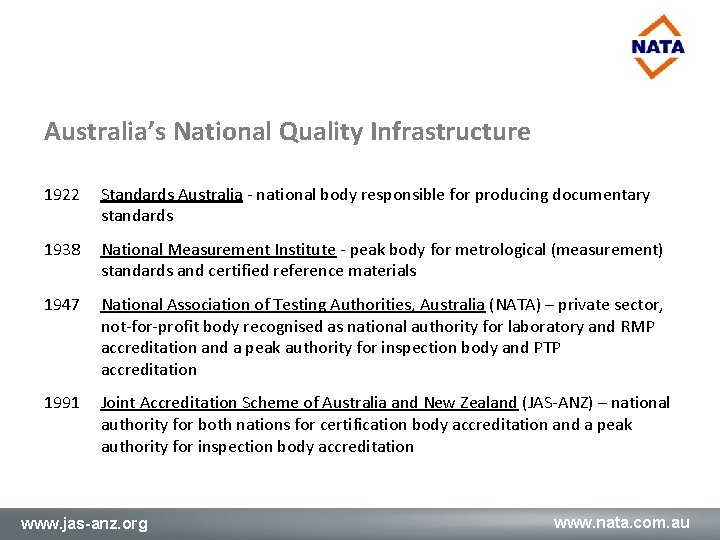
Australia’s National Quality Infrastructure 1922 Standards Australia - national body responsible for producing documentary standards 1938 National Measurement Institute - peak body for metrological (measurement) standards and certified reference materials 1947 National Association of Testing Authorities, Australia (NATA) – private sector, not-for-profit body recognised as national authority for laboratory and RMP accreditation and a peak authority for inspection body and PTP accreditation 1991 Joint Accreditation Scheme of Australia and New Zealand (JAS-ANZ) – national authority for both nations for certification body accreditation and a peak authority for inspection body accreditation www. jas-anz. org www. nata. com. au
Direction Setting by the Federal Government Bodies have differing relationships with government but federal government has a role in the strategic direction and requires: • transparency and impartiality; • engagement with our government and industry stakeholders; and • facilitate mutual recognition internationally www. jas-anz. org www. nata. com. au
Coordination Stakeholder engagement is a key to NQI’s role • Reaching out to the government agencies and industry associations • Information gained is analysed and taken into account in the service offered • Commonwealth Standards and Conformance Advisory Group (CSCAG) facilitates an exchange of information between the NQI and a diverse range of agencies: – on developments within the NQI, – national policy priorities and – a significant focus on trade related issues • NQI ‘working group’ focuses on operationalising key Government initiatives www. jas-anz. org www. nata. com. au
Policy vs Detail Good policy can be undermined by operational detail • Technical and scientific considerations in conformity assessment • Lack of availability of necessary conformity assessment infrastructure – documented standards, laboratory expertise, measurement standards, validated methods, etc. • Examples: – Asbestos – absolute prohibition vs scientific capacity – Microbiological analysis of meat – method validation for pathogens www. jas-anz. org www. nata. com. au
Conclusion Please talk to us … … early www. jas-anz. org www. nata. com. au