
Internal Controls for Small Local Governments PRESENTED BY
Internal Controls for Small Local Governments PRESENTED BY SUMMER SEARS, CPA SDAO 2019 ANNUAL CONFERENCE 2019 FEBRUARY 8,
2 Who are we? !? Summer Sears, CPA www. searscpa. com summer@searscpa. com Kay Johnson, Finance Manager Sisters-Camp Sherman Fire District kayjohnson@sistersfire. com
3 And who the heck are YOU? !?
4 Internal Control - Definition Internal Control is a process designed to achieve objectives in the following categories: Effectiveness and efficiency of operations, including minimizing risk of fraud Reliability of financial reporting Compliance with laws and regulations Internal control components interact with operations, financial reporting and compliance. Examples?
Why are Internal Controls So Important? v Accountability Citizens Approved budget has been followed Spending and letting of contracts has been legal Appropriate safeguards taken against fraud Grantors Funds have been used for the purpose given Compliance requirements have been met Management Data is reliable for decision making 5
Why are Internal Controls So Important? v Clear and accurate reporting Internal Budgeting and planning purposes Cash flow management External Creditors (Bankers, bondholders, etc. ) Grantors Financial statement users 6
Why are Internal Controls So Important? v Efficient use of resources v Eliminating redundancy in our process to allow for a streamlined workforce v Protecting against loss due to fraud and misappropriation v Providing for the ability to recognize excellence within our government v Build and maintain public confidence in the organization 7
8 SDIS Best Practices Survey Receive up to a 10% discount on your general liability, auto liability, and property insurance contributions for your district! (per SDAO website) HANDOUT 1. Financial Management Policy 2. Internal Control Checklist – 13 best practices that limit liability 3. Online Training Videos – 2 You. Tube videos 4. SDAO-SDIS Training
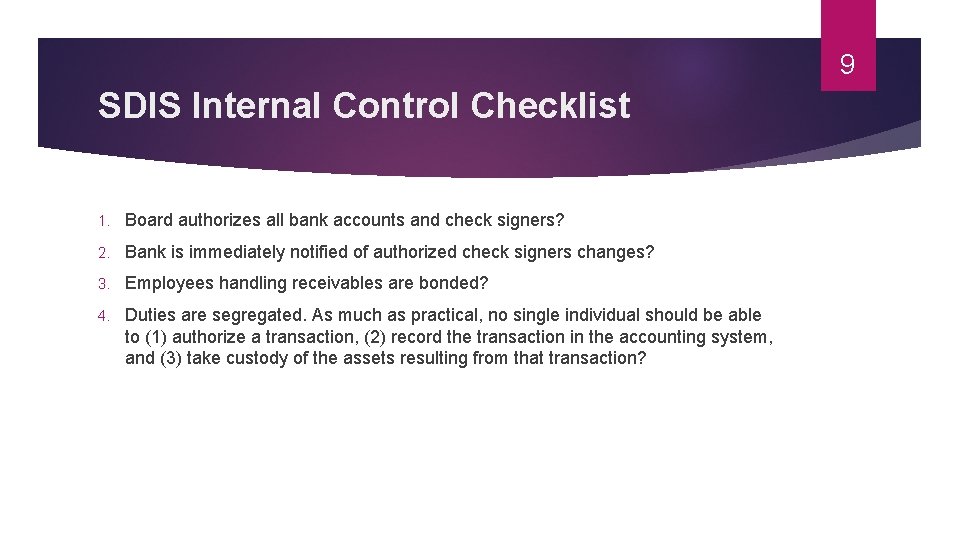
9 SDIS Internal Control Checklist 1. Board authorizes all bank accounts and check signers? 2. Bank is immediately notified of authorized check signers changes? 3. Employees handling receivables are bonded? 4. Duties are segregated. As much as practical, no single individual should be able to (1) authorize a transaction, (2) record the transaction in the accounting system, and (3) take custody of the assets resulting from that transaction?
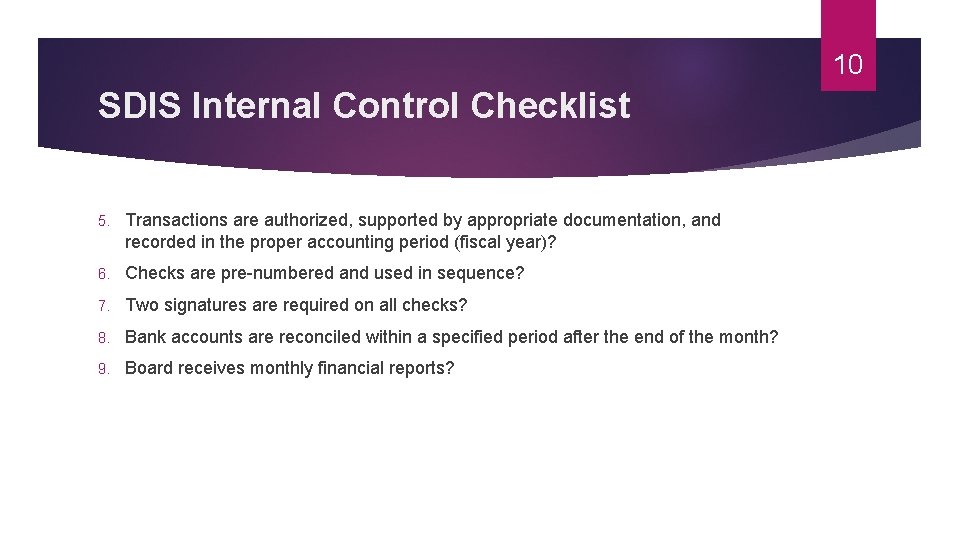
10 SDIS Internal Control Checklist 5. Transactions are authorized, supported by appropriate documentation, and recorded in the proper accounting period (fiscal year)? 6. Checks are pre-numbered and used in sequence? 7. Two signatures are required on all checks? 8. Bank accounts are reconciled within a specified period after the end of the month? 9. Board receives monthly financial reports?
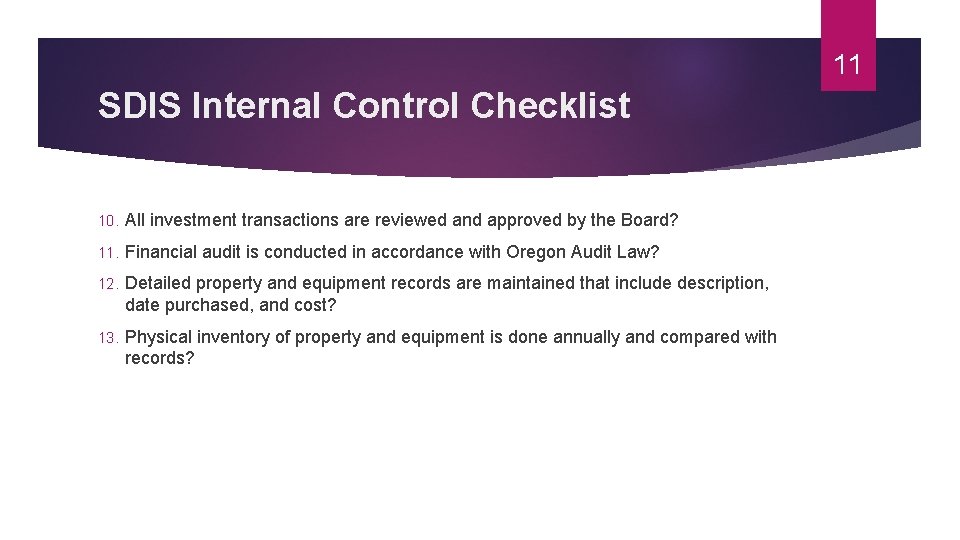
11 SDIS Internal Control Checklist 10. All investment transactions are reviewed and approved by the Board? 11. Financial audit is conducted in accordance with Oregon Audit Law? 12. Detailed property and equipment records are maintained that include description, date purchased, and cost? 13. Physical inventory of property and equipment is done annually and compared with records?
12 SDIS Online Training Videos You. Tube Videos What are Internal Controls? – 4 minutes https: //www. youtube. com/watch? v=750 q-ADn 8 Bg Internal Controls Explained – 3 minutes https: //www. youtube. com/watch? v=Er. B 5 bwj. Vs. Y 0
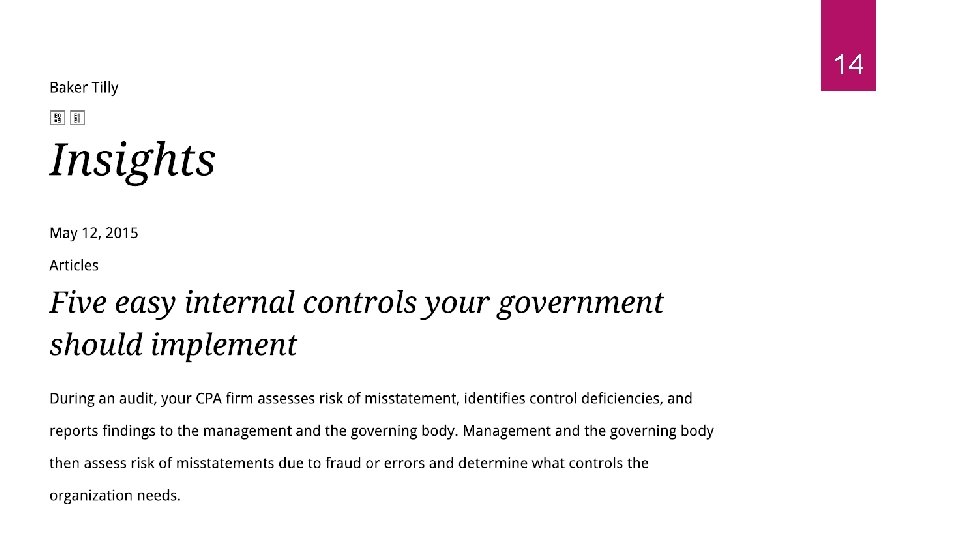
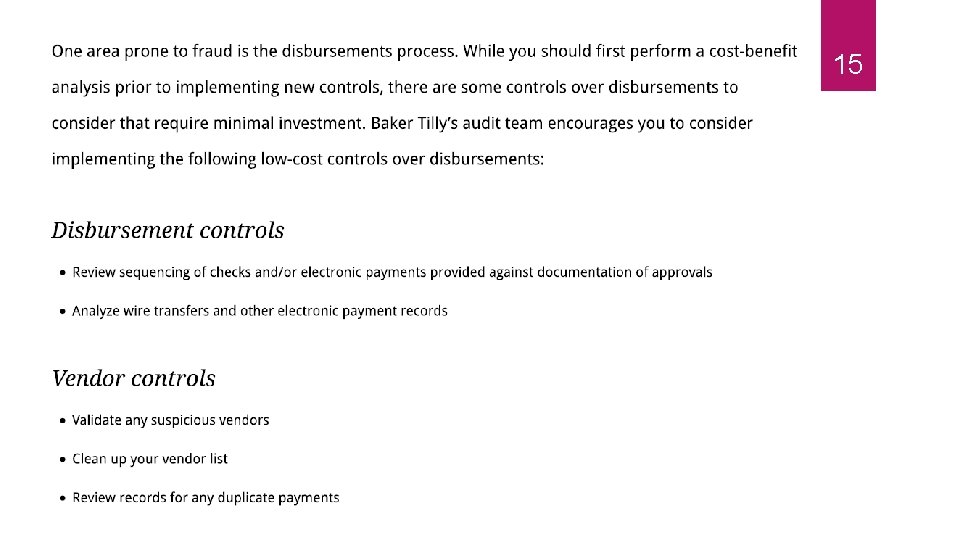
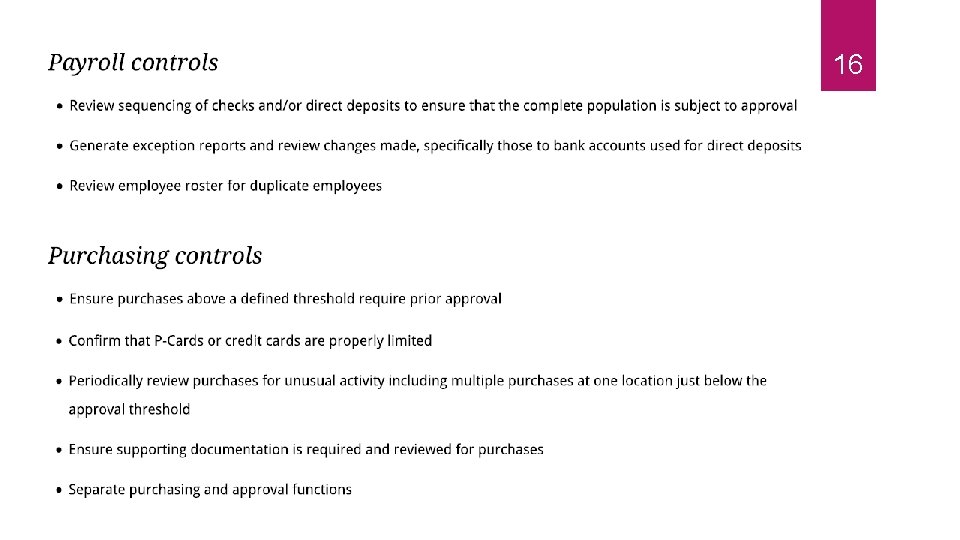
Article: Five easy internal controls your government should implement https: //www. bakertilly. com/insights/five-easy-internal-controls-yourgovernment-should-implement 13
14
15
16
17
Segregation of Duties = Multiple people involved in a process 18 Uh, Summer… That’s why we’re here.
19 People are the KEY Pre-employment screening of job applicants and contractors. Even the most trusted employees can justify their actions: “The District can afford it” “They don’t pay me enough” “I’m not personally harming anyone” “I’ll pay it back” Changes in employee habits - lifestyles, behavior, ALWAYS at their job and never take a vacation. IMPORTANT!! Cross training and mandatory vacations.
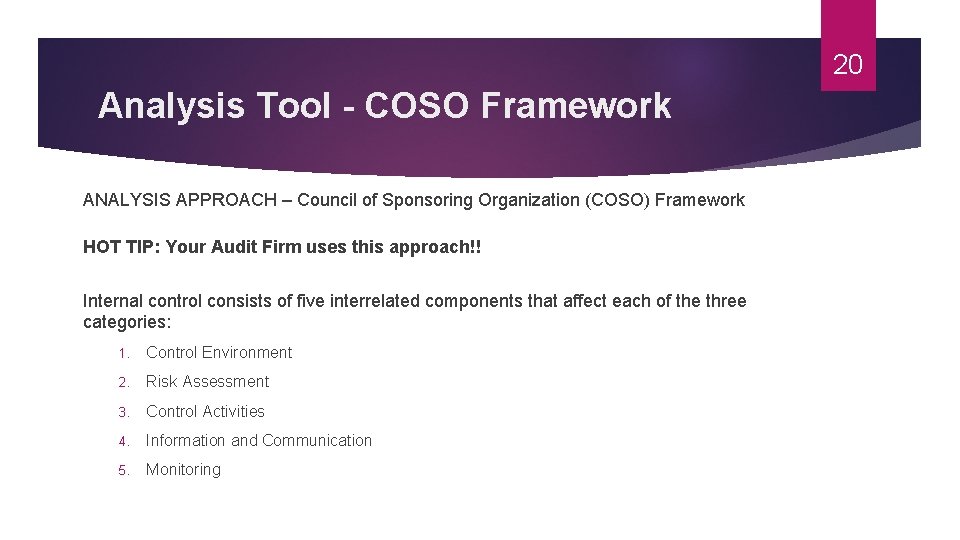
20 Analysis Tool - COSO Framework ANALYSIS APPROACH – Council of Sponsoring Organization (COSO) Framework HOT TIP: Your Audit Firm uses this approach!! Internal control consists of five interrelated components that affect each of the three categories: 1. Control Environment 2. Risk Assessment 3. Control Activities 4. Information and Communication 5. Monitoring
1. Control Environment Sets the tone for the government Influences control consciousness Enforces accountability Includes: integrity, ethical values, competency, management’s philosophy, and the way authority and responsibility is assigned ** FOUNDATION for all other control components ** 21
1. Control Environment – Practical Application Establish current policies with regard to ethical behavior (Code of Conduct), Conflict of Interest, Nepotism Enforce appropriate discipline for failure to comply with these policies Ensure personal adherence to strong moral code Reward competency Place high degree of importance on maintaining strong internal control Provide for a “whistle blower” policy that allows employees and others to report fraud or false statements by the management team 22
23 1. IMPACT of Control Environment DON’T UNDERESTIMATE the importance of this part of the control system. All the great control activities in the world will not be effective if employees know that management is not concerned with strong internal control, lacks integrity or does not value their employees. Examples?
24 2. Risk Assessment Identify “What could go wrong? ” Consider risks result from both external and internal sources They change over time based on economic, regulatory, and operating conditions Risks are created by factors like: The nature of particular accounts or transactions Key employee positions – expertise, turnover Changes in the financial markets Make sure to address IT risk
25 2. Risk Assessment – Pitfalls Trying to identify a control for every risk factor. Ignoring the possibility of existing compensating controls. Not performing a risk assessment annually or at least when key factors have changed (regulatory, employee turnover, etc. ) Ignoring IT controls Examples?
26 3. Control Activities The policies and procedures that ensure management’s directives are followed They occur at all levels throughout the organization Include : approvals, authorizations, verifications, reconciliations, security of assets, segregation of duties and review of operating performance
3. Control Activities – Practical Application Tie control activities to risks previously identified and address “What could go wrong” scenarios IMPORTANT BALANCE COST AND BENEFIT Identify control objectives and the risks of what could happen For each risk factor identified, evaluate the potential impact and probability of occurrence Design control activities to address high impact, high probability concerns GOAL = Evaluate annually Is it effective and still worth the cost? 27
28 3. Control Activities - Pitfalls Remember that for small governments key objectives must be identified. Examples: Reducing the risk of theft or fraud Providing for accountability Ensuring compliance with regulations Focus on true effectiveness – not just cookie cutter approaches Ensure benefit justifies the cost Examples?
29 4. Information & Communication Includes both internal and external interaction Reports must contain relevant and timely operational, financial and compliance information Suggestions: Use system-generated reports whenever possible to avoid human error and avoid changing of information Statements from outside third parties (broker/dealers, bank statements, grantor agency) must be channeled to correct personnel and provided timely
4. Information & Communication – Pitfalls Generating reports that provide inaccurate, untimely or unnecessary information Providing inappropriate information outside the organization (SS #, employee evaluations) Failure to verify accuracy of externally provided reports Examples? 30
31 5. Monitoring Assessing the quality of the internal control system and making modifications as needed Ensure that internal controls activities are operating effectively Determine whether the internal control system is still relevant This process is ongoing through the normal course of operations and via separate specific evaluations (annual? ) of a particular process
5. Monitoring – Practical Application Perform a review of bank reconciliations on a monthly basis and signing off as having reviewed these. Comparison of actual receipts/expenditures to budgeted receipts/expenditures and investigation of significant discrepancies. Management/Staff – Detailed review; investigate significant discrepancies Board – Review summarized information; question management/staff regarding significant discrepancies 32
5. Monitoring – Practical Application Management review of adjusting journal entries Annual board review of internal controls with staff. NOTE: Controls should be evaluated when there are changes in key personnel or software applications 33
34 5. Monitoring – Pitfalls Failure to perform any monitoring control activities. Overkill for the organization’s size. No attempt to actually test key controls in some fashion. Failure to evaluate controls when personnel or software changes. Confusion or inappropriate overlap between Board and Staff/Management responsibilities. Examples?
35 SUMMARY of COSO Components 1. CONTROL ENVIRONMENT establishes the importance of internal control. 2. RISK ASSESSMENT must be realistic and performed when changes to objectives or policies occur, there is turn over in key employees, or significant changes in the financial markets. 3. CONTROL ACTIVITIES should be focused on areas of highest risk. Monitoring-type controls are effective stopgap for smaller entities. 4. INFORMATION AND COMUNICATION must provide relevant information for managing the assets and liabilities of the entity. 5. MONITORING of the internal control system is an ongoing process.
36 What does a COSO analysis look like? HANDOUT
37 Role of the Board in Internal Controls TONE AT THE TOP – the foundation for all other internal controls Can make or break an organization’s internal controls Influences control consciousness Enforces accountability Includes: integrity, ethical values, competency, management’s philosophy, and the way authority and responsibility is assigned Hire management/staff that shares the Board’s value for Tone at the Top
38 Role of the Board in Internal Controls MONITORING Part of your Fiduciary responsibility as a board member Annual review of internal control-related policies Questionnaire with staff/management - SDIS checklist plus additional Consider incorporating in staff/management job description, goals, and review Timely review of budget versus actual resources and expenditures at least quarterly Don’t be afraid to ASK QUESTIONS – Financial oversight is part of your fiduciary responsibility as a board member. If reports don’t make sense, ask for training from staff/management or others
Role of the Board in Internal Controls – Pitfalls Failure to show and communicate a high degree of importance on maintaining strong internal control. Failure to enforce appropriate discipline for fraud and other failures to comply with these policies. Failure to perform any monitoring control activities. Confusion or inappropriate overlap between Board and Staff/Management responsibilities. 39
40 Additional Internal Control Failures Don’t focus on areas where risk is low – Cost vs. Benefit Overkill on Disbursement controls Don’t ignore risk factors you become aware of throughout the year Talk to your auditors about areas of concern they may have and new auditing standards that will affect your audit. Make sure to tailor any “borrowed” policies and procedures to your organization. Remember to address budget, grant and IT controls.
41 Resources Available Professional organization websites: SDAO, OGFOA (list serve), OSCPA, GFOA Best Practices Auditors / CPA Firms Continuing Education opportunities EACH OTHER!!! Build and use your professional network of other local government officials Examples?
42 QUESTIONS? ?
43 OUR SOURCES SDIS Best Practices Program: http: //www. sdao. com/s 4/programs/bestpractices. aspx Donna Collins, Milestone Professional Services: http: //milestoneps. com/ Government Finance Officers Association (GFOA): http: //www. gfoa. org/ COSO Guidance on Internal Controls: https: //www. coso. org/Pages/ic. aspx

- Slides: 44