
Internal Control Systems An organization uses resources to
- Slides: 24
Internal Control Systems • An organization uses resources to create a product or service • Question: How to use accounting systems to make the most important resource --- people --- more efficient? • Managing people – People in interpersonal vs. organizational settings – Accounting systems and numerical data – Your personal relationship to numbers
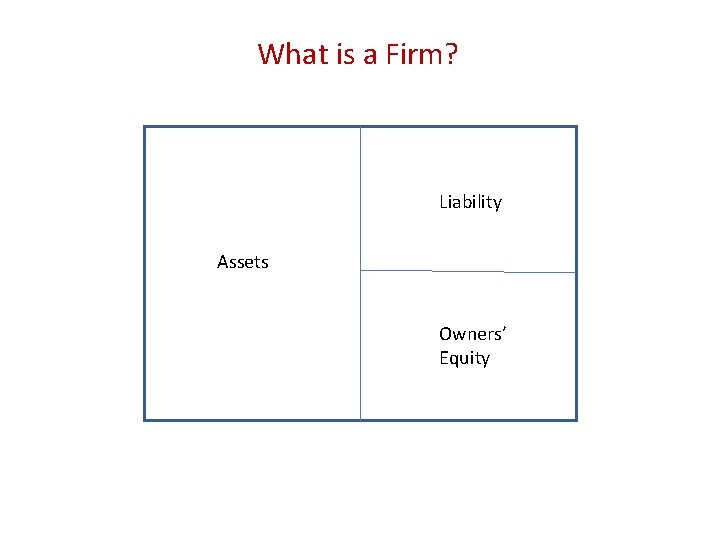
What is a Firm? Liability Assets Owners’ Equity
Nexus of Contracts • Where is the product? The raw material? The financing? • Explicit or Implicit? • Who are the parties? – Financers, suppliers, employees, consumers – Collectively called “stakeholders” • The notion of “impersonal” leadership • How long does it take a student to grasp the nexus? – The role of theater
Strategy as a Nexus of Contracts • Your strategy is as good as its execution • Your competitors, customers, etc. , will not be central to execution • Your organization will be central • Your organization is a Nexus of Contracts – Explicit or Implicit – Financers, suppliers, employees, consumers • Role of Management Accounting Systems in enabling the Nexus
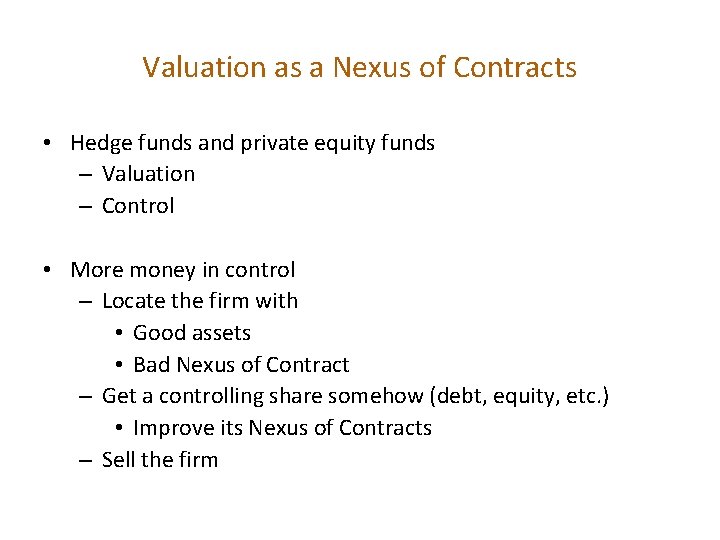
Valuation as a Nexus of Contracts • Hedge funds and private equity funds – Valuation – Control • More money in control – Locate the firm with • Good assets • Bad Nexus of Contract – Get a controlling share somehow (debt, equity, etc. ) • Improve its Nexus of Contracts – Sell the firm
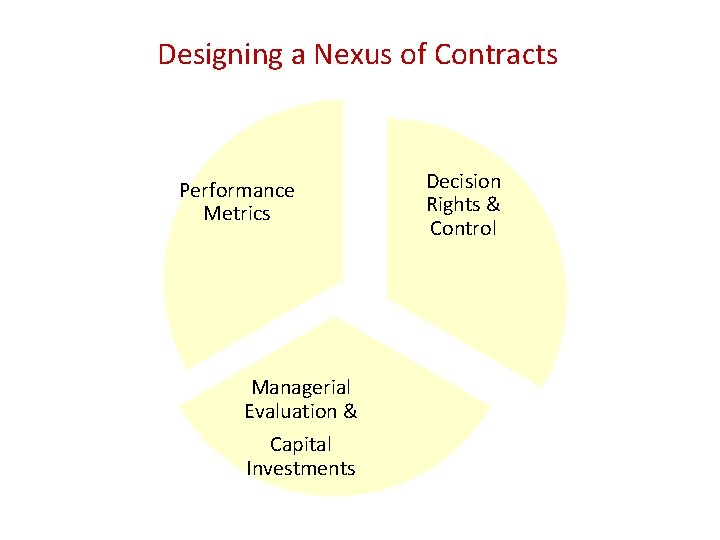
Designing a Nexus of Contracts Performance Metrics Managerial Evaluation & Capital Investments Decision Rights & Control
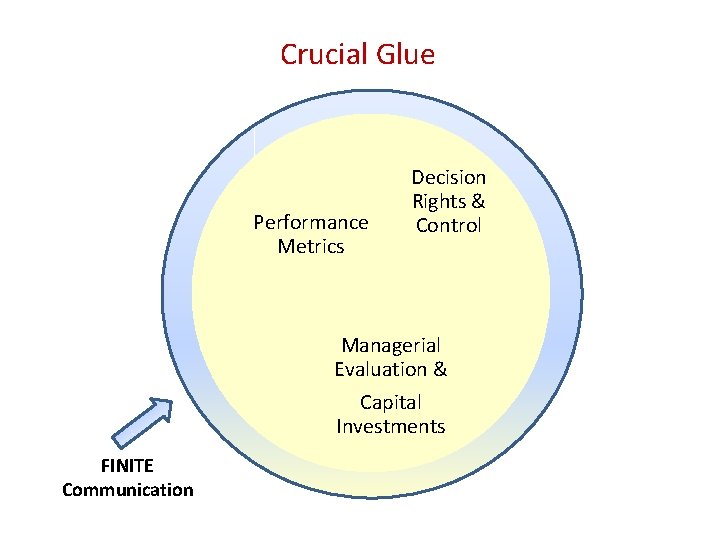
Crucial Glue Performance Metrics Decision Rights & Control Managerial Evaluation & Capital Investments FINITE Communication
The Pedagogy of the Class • Primrose path – I teach how to take a Nexus and figure out the accounting – Linear rule-based teaching – You learn nothing • The steep and thorny way – You learn to uncover the Nexus underlying an accounting statement – I will help you but that will work only if you put in effort
First topic: Budgeting • Costs are driven by Resources • Resources are used by Products • Costing Concepts – Understand how Resource Costs map into Product Costs • Organizations need to compute Product Costs in advance – Planning and pricing cannot wait till actual costs are realized – Resource acquisition decisions must also be made in advance
Budgeting • Budgeting: – Process of developing a forecast of business activities in future periods • Budgets: – Result from the budgeting process – Expressed in financial measures (sales, expenses, income) – Primary uses of budgets: • Planning (e. g. , resource acquisition decisions) • Performance measurement: Actual results are compared to budget
The Budgeting Process • Run the production or the business model in reverse – Forecast sales – Forecast production volume – Forecast various resource commitments and purchases
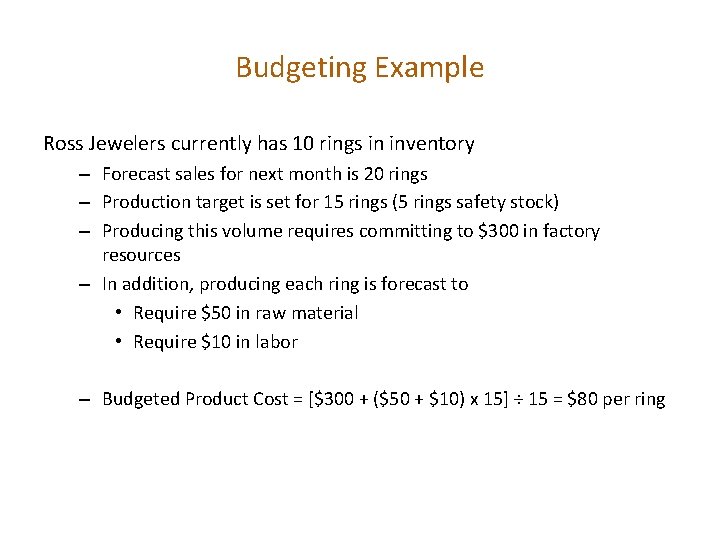
Budgeting Example Ross Jewelers currently has 10 rings in inventory – Forecast sales for next month is 20 rings – Production target is set for 15 rings (5 rings safety stock) – Producing this volume requires committing to $300 in factory resources – In addition, producing each ring is forecast to • Require $50 in raw material • Require $10 in labor – Budgeted Product Cost = [$300 + ($50 + $10) x 15] ÷ 15 = $80 per ring
Budgeting Challenges • Key challenge: – Information that is important for developing budgets is spread throughout the organization. • E. g. , managers of foreign divisions have superior knowledge about local market trends. → Top management can’t prepare budgets by themselves. – What is the best way to collect all the information? • Which employees should make forecasts? • Are employees going to report their “true” forecasts?
Budgeting Summary • The budgeting process runs the business model in reverse: – Forecast: Sales Production Volume Input Resources • Budgets typically have a dual role: – Planning – Performance evaluation • Key challenge: – Information is spread throughout the organization
Performance Measures • Goal of the firm is to maximize value (or profit) – Easier said than done • Giving the manager a profit based bonus contract – Assumes the manager knows how to improve profits • What actions to take? • Will these actions really be effective in improving profits? • We need to decompose the problem – Smaller and more focused goals and actions – These goals and actions combined generate profits
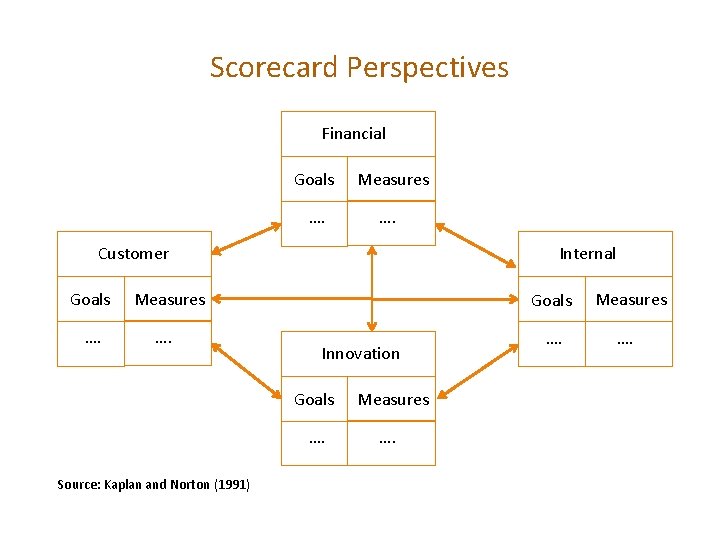
Budgeting with non-financial measures • Idea is to consider a system of multiple measures (both financial and nonfinancial) • Four “perspectives” – Owners (financial) – Customers – Internal processes – Innovation and learning (or growth) • For each perspective, goals are linked to measures
Scorecard Perspectives Financial Goals …. Measures …. Customer Goals …. Internal Measures …. Goals Innovation Goals …. Source: Kaplan and Norton (1991) Measures ….
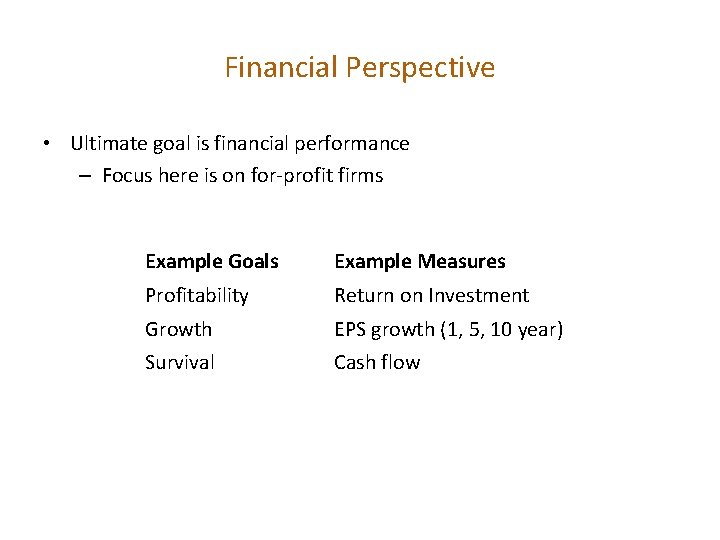
Financial Perspective • Ultimate goal is financial performance – Focus here is on for-profit firms Example Goals Example Measures Profitability Return on Investment Growth EPS growth (1, 5, 10 year) Survival Cash flow
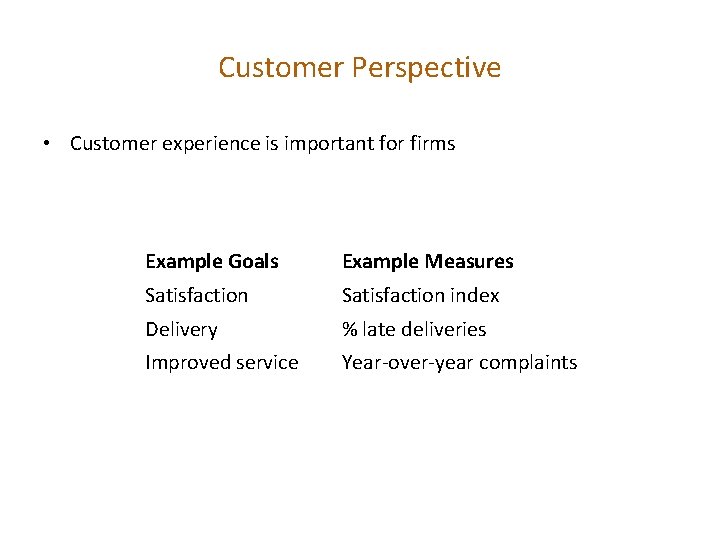
Customer Perspective • Customer experience is important for firms Example Goals Example Measures Satisfaction index Delivery % late deliveries Improved service Year-over-year complaints
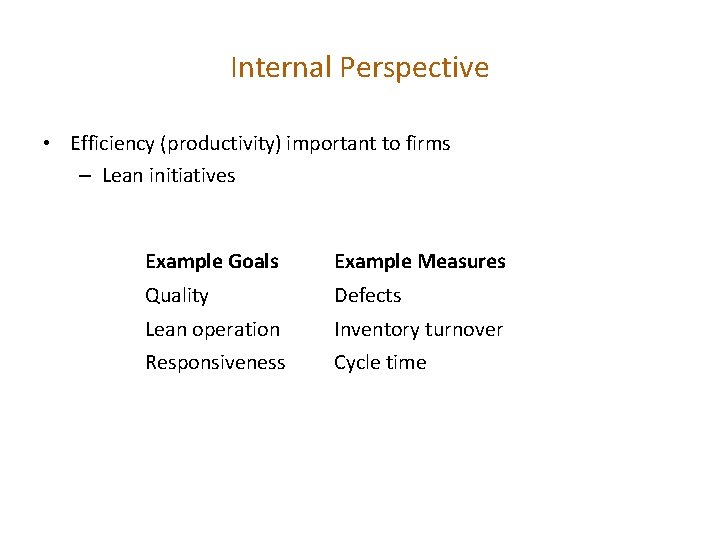
Internal Perspective • Efficiency (productivity) important to firms – Lean initiatives Example Goals Example Measures Quality Defects Lean operation Inventory turnover Responsiveness Cycle time
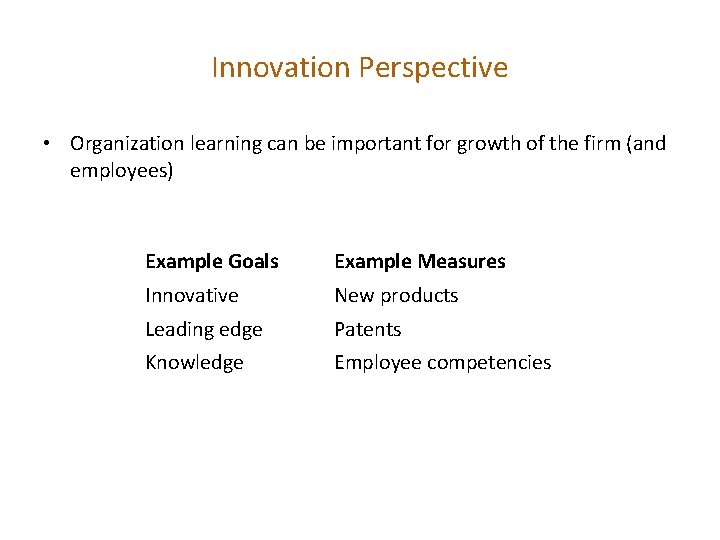
Innovation Perspective • Organization learning can be important for growth of the firm (and employees) Example Goals Example Measures Innovative New products Leading edge Patents Knowledge Employee competencies
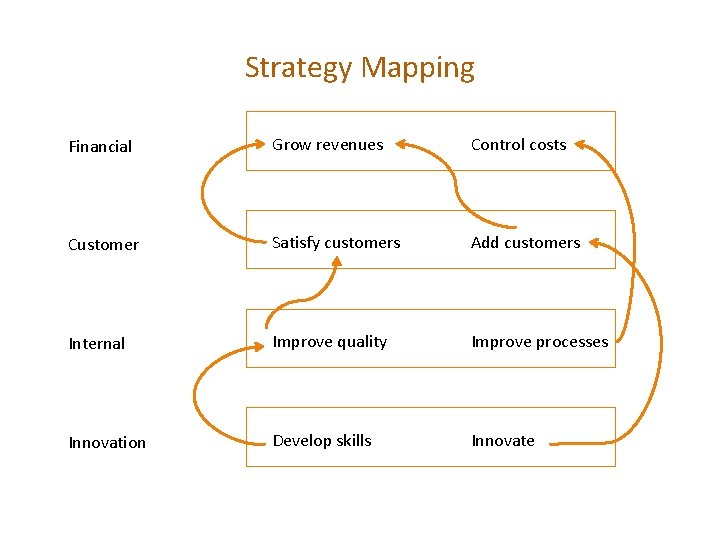
Strategy Mapping Financial Grow revenues Control costs Customer Satisfy customers Add customers Internal Improve quality Improve processes Innovation Develop skills Innovate
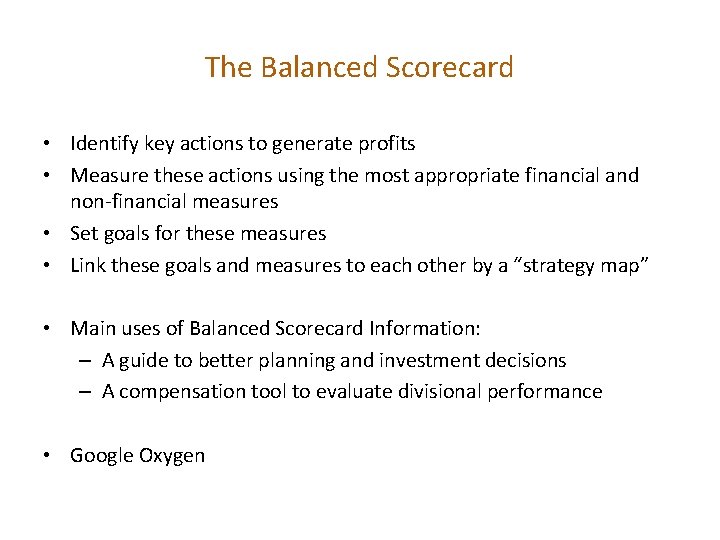
The Balanced Scorecard • Identify key actions to generate profits • Measure these actions using the most appropriate financial and non-financial measures • Set goals for these measures • Link these goals and measures to each other by a “strategy map” • Main uses of Balanced Scorecard Information: – A guide to better planning and investment decisions – A compensation tool to evaluate divisional performance • Google Oxygen
After Budgeting • • • Divisional Manager and CEO Compensation Analysis of Variances from Budgets Analysis of Transfer Pricing Control in the Financial Services Industry The seamless move from Internal External – Corporate Finance – Financial Markets