
Internal Capture Trips Some Developments Are So Large

- Slides: 18
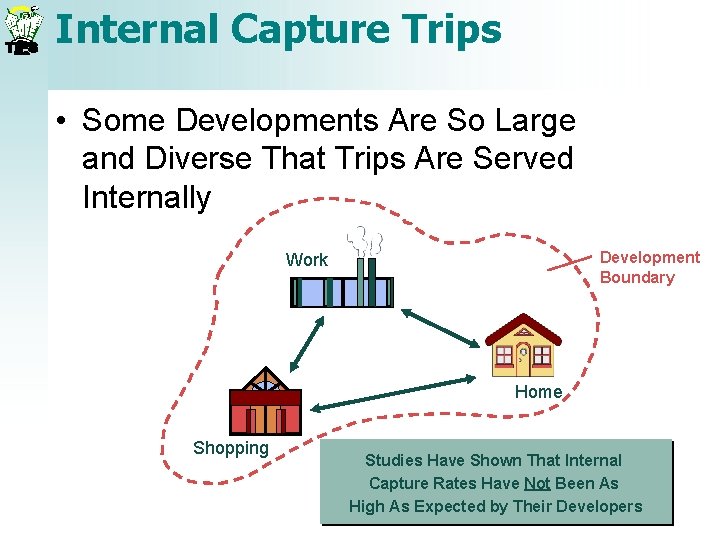
Internal Capture Trips • Some Developments Are So Large and Diverse That Trips Are Served Internally Development Boundary Work Home Shopping Studies Have Shown That Internal Capture Rates Have Not Been As High As Expected by Their Developers
Mixed-Use Developments • Developments that contain two or more land use components • Trip generation is calculated separately for each land use component • Total development trip generation (external + internal) is determined by summing components
Internal Capture Considerations • Residential and employment centers should be compatible (with respect to income levels) to allow internal capture • On-site employment may not attract work trips from on-site homes for several years • Remote projects may have higher internal capture • Trips that cross or use the public road system cannot be subtracted with the internal trip component
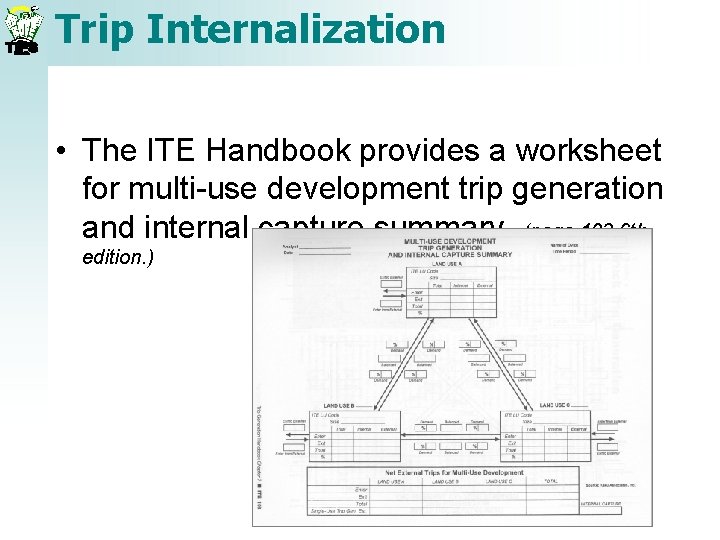
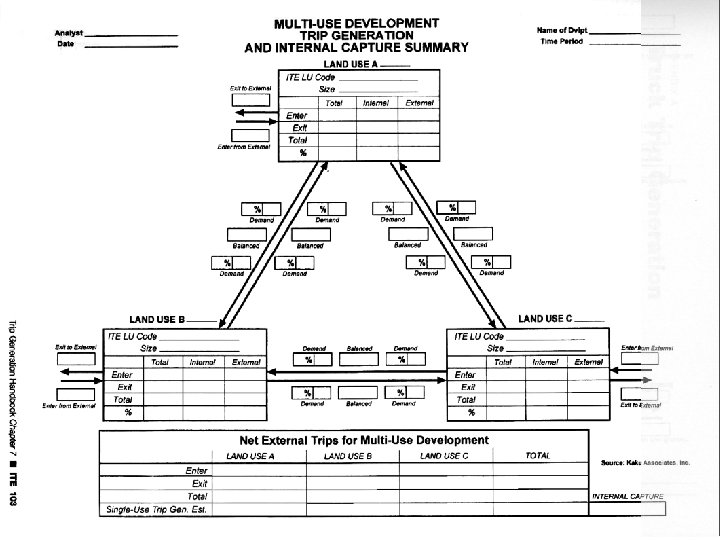
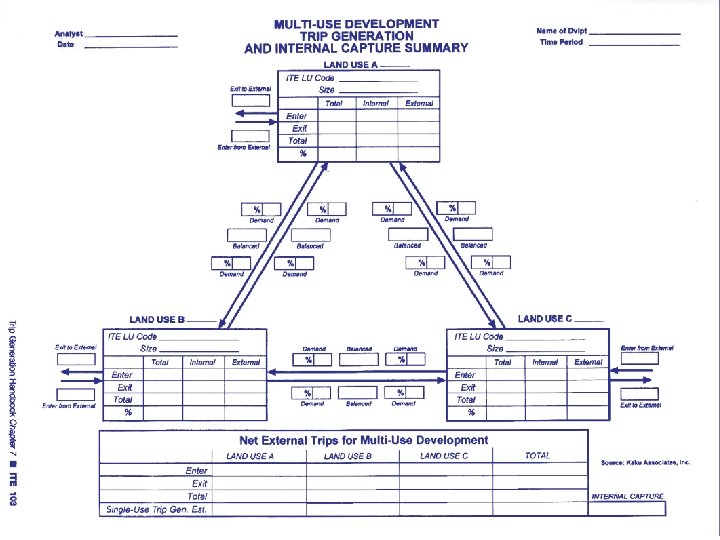
Trip Internalization • The ITE Handbook provides a worksheet for multi-use development trip generation and internal capture summary. (page 103 6 th edition. )
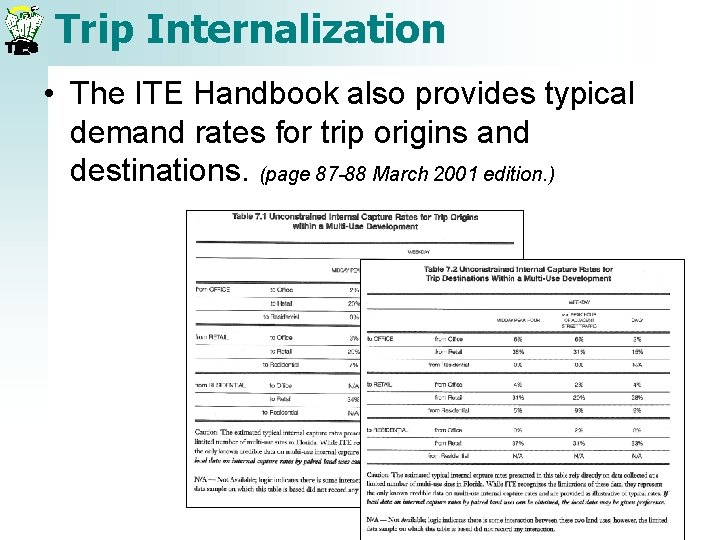
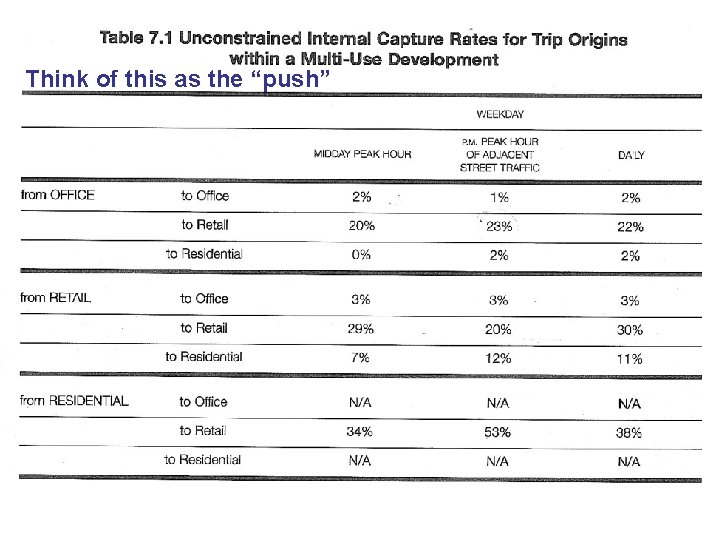
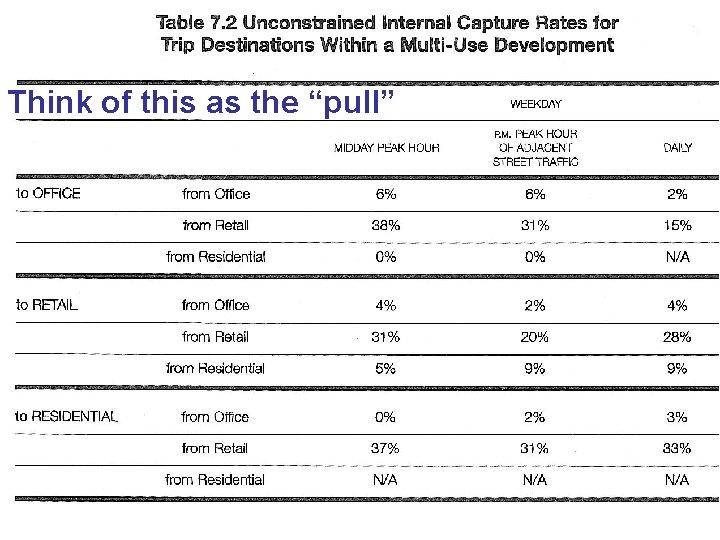
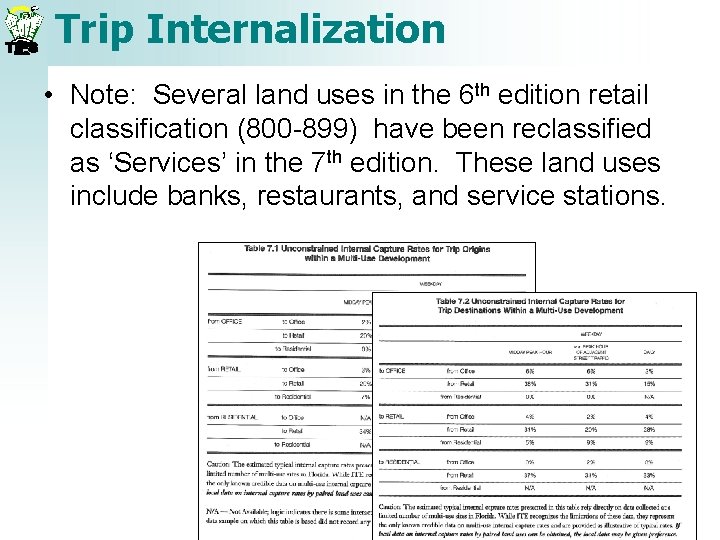
Trip Internalization • The ITE Handbook also provides typical demand rates for trip origins and destinations. (page 87 -88 March 2001 edition. )
Think of this as the “push”
Think of this as the “pull”
Trip Internalization • Note: Several land uses in the 6 th edition retail classification (800 -899) have been reclassified as ‘Services’ in the 7 th edition. These land uses include banks, restaurants, and service stations.
Trip Internalization • Problem #4 – Using the land uses from problems 1 - 3 and the trip origins/ destination rate from the ITE Handbook, what is the internal capture rate of the following development: • a 200, 000 f 2 Shopping Center (ITE #820) • a 120, 000 f 2 Office (ITE #710) • a 200 f 2 Single Family Home (ITE #221)
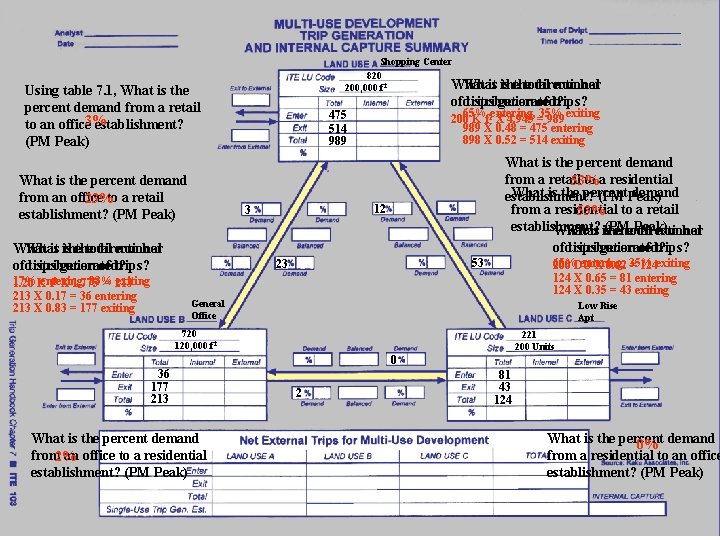
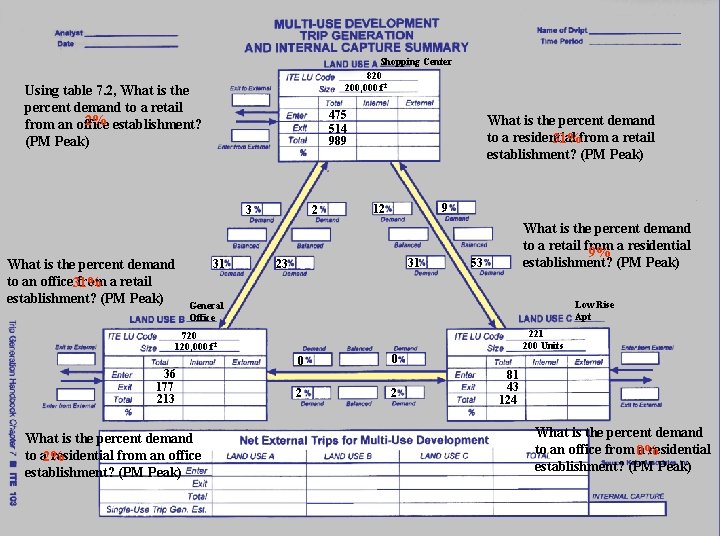
Shopping Center 820 What is is thethe total directional number 200, 000 f 2 Using table 7. 1, What is the percent demand from a retail to an office 3% establishment? (PM Peak) What is the percent demand from an office 23%to a retail establishment? (PM Peak) 20065% K f 2 entering, X 4. 945 =35% 989 exiting 989 X 0. 48 = 475 entering 898 X 0. 52 = 514 exiting What is the percent demand from a retail to a residential 53% What is the percent demand establishment? (PM Peak) from a residential 53% to a retail establishment? (PM Peak) What is is the total directional number 12 3 ofdistribution trips generated? of trips? What is is thethe total directional number ofdistribution trips generated? of trips? 17% entering, 83% exiting 1. 20 K f 2 X 1. 775 = 213 X 0. 17 = 36 entering 213 X 0. 83 = 177 exiting ofdistribution trips generated? of trips? 475 514 989 53 23 65% entering, 200 DU X 0. 62 35% = 124 exiting 124 X 0. 65 = 81 entering 124 X 0. 35 = 43 exiting General Office Low Rise Apt 720 120, 000 f 2 221 200 Units 0 36 177 213 What is the percent demand from 2% an office to a residential establishment? (PM Peak) 2 81 43 124 What is the percent 0% demand from a residential to an office establishment? (PM Peak)
Shopping Center 820 200, 000 f 2 Using table 7. 2, What is the percent demand to a retail 2% establishment? from an office (PM Peak) 475 514 989 3 What is the percent demand to an office 31% from a retail establishment? (PM Peak) 31 2 What is the percent demand to a residential 31%from a retail establishment? (PM Peak) 9 12 31 23 What is the percent demand to a retail from a residential 9% establishment? (PM Peak) 53 Low Rise Apt General Office 221 200 Units 720 120, 000 f 2 0 36 177 213 What is the percent demand to a 2% residential from an office establishment? (PM Peak) 2 0 2 81 43 124 What is the percent demand to an office from 0% a residential establishment? (PM Peak)
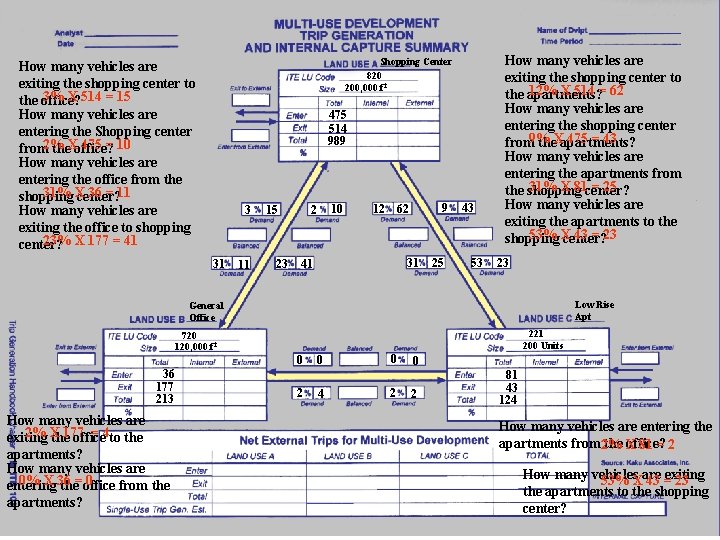
Shopping Center 820 200, 000 f 2 How many vehicles are exiting the shopping center to 3% X 514 = 15 the office? How many vehicles are entering the Shopping center 475 = 10 from 2% the. Xoffice? How many vehicles are entering the office from the 31% X 36 = 11 shopping center? How many vehicles are exiting the office to shopping 23% X 177 = 41 center? 475 514 989 3 31 11 23 10 2 15 12 9 62 31 41 25 43 53 How many vehicles are exiting the shopping center to 12% X 514 = 62 the apartments? How many vehicles are entering the shopping center 475 = 43 from 9% the. Xapartments? How many vehicles are entering the apartments from 31% X 81 center? = 25 the shopping How many vehicles are exiting the apartments to the 53% X 43 = 23 shopping center? 23 Low Rise Apt General Office 221 200 Units 720 120, 000 f 2 0 36 177 213 How many vehicles are 2% X = 4 to the exiting the 177 office apartments? How many vehicles are 0% X 36 0 entering the=office from the apartments? 2 0 4 0 2 81 43 124 How many vehicles are entering the apartments from 2% the X office? 81 = 2 How many vehicles exiting 53% Xare 43 = 23 the apartments to the shopping center?
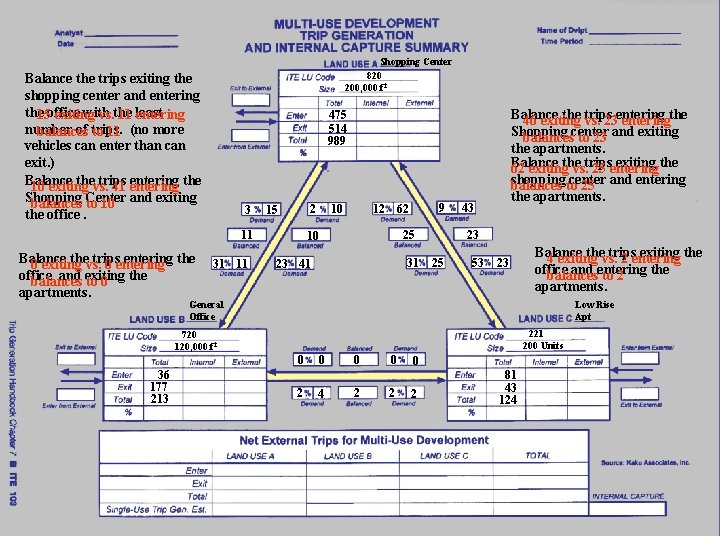
Shopping Center 820 200, 000 f 2 Balance the trips exiting the shopping center and entering the 15 office with exiting vs. the 11 least entering number of trips. balances to 11 (no more vehicles can enter than can exit. ) Balance thevs. trips entering the 10 exiting 41 entering Shopping balances Center to 10 and exiting the office. 3 2 15 11 Balance thevs. trips entering the 0 exiting 0 entering office and exiting balances to 0 the apartments. Balance the trips 46 exiting vs. 23 enteringthe Shopping balancescenter to 23 and exiting the apartments. Balance the exiting the 62 exiting vs. trips 25 entering shopping center balances to 25 and entering the apartments. 475 514 989 31 11 10 9 12 62 25 10 31 23 41 43 23 25 53 23 Balance thevs. trips exiting the 4 exiting 2 entering office and entering the balances to 2 apartments. Low Rise Apt General Office 221 200 Units 720 120, 000 f 2 0 36 177 213 2 0 4 0 2 0 2 81 43 124
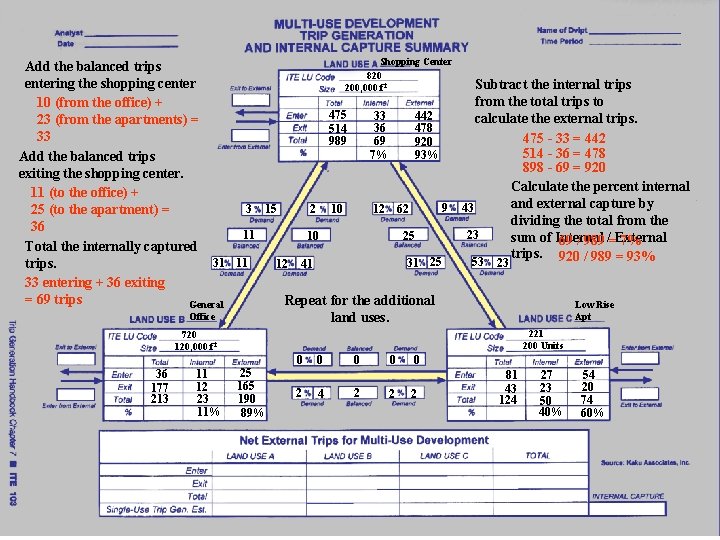
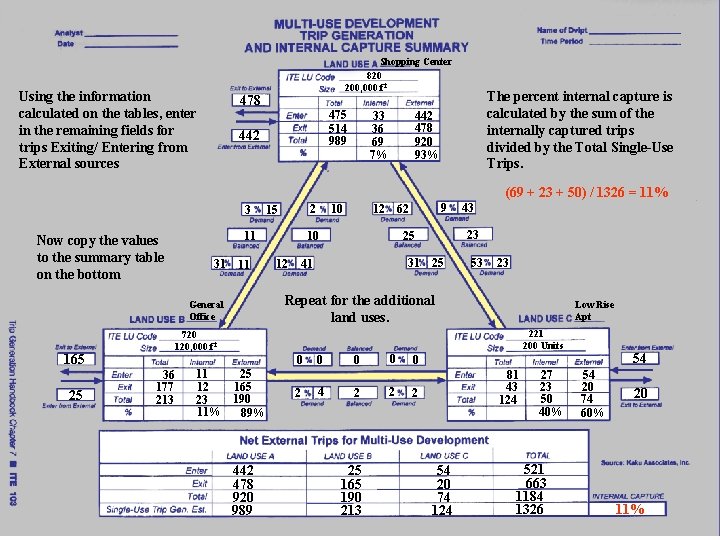
Shopping Center Add the balanced trips 820 entering the shopping center Subtract the internal trips 200, 000 f 2 from the total trips to 10 (from the office) + 475 442 33 calculate the external trips. 23 (from the apartments) = 36 478 514 33 475 - 33 = 442 989 69 920 514 - 36 = 478 7% 93% Add the balanced trips 898 - 69 = 920 exiting the shopping center. Calculate the percent internal 11 (to the office) + and external capture by 9 43 3 15 2 10 12 62 25 (to the apartment) = dividing the total from the 36 23 11 10 25 sum of Internal 69 / 989 /=External 7% Total the internally captured trips. 920 / 989 = 93% 53 23 31 25 31 11 trips. 12 41 33 entering + 36 exiting = 69 trips Repeat for the additional Low Rise General Apt Office land uses. 221 200 Units 720 120, 000 f 2 36 177 213 11 12 23 11% 25 165 190 89% 0 2 0 4 0 2 0 2 81 43 124 27 23 50 40% 54 20 74 60%
Using the information calculated on the tables, enter in the remaining fields for trips Exiting/ Entering from External sources Shopping Center 820 200, 000 f 2 478 475 514 989 442 The percent internal capture is calculated by the sum of the internally captured trips divided by the Total Single-Use Trips. 442 478 920 93% 33 36 69 7% (69 + 23 + 50) / 1326 = 11% 3 Now copy the values to the summary table on the bottom 31 11 10 12 9 12 62 10 11 23 25 31 41 43 25 53 23 Repeat for the additional land uses. General Office Low Rise Apt 221 200 Units 720 120, 000 f 2 165 25 2 15 0 36 177 213 11 12 23 11% 25 165 190 89% 442 478 920 989 2 0 4 0 2 25 165 190 213 0 2 54 0 81 43 124 2 54 20 74 124 27 23 50 40% 521 663 1184 1326 54 20 74 60% 20 11%
Internal Capture Pass By